
Summary
- Full Fibre Ltd is best read as a wholesale access wager in UK market towns: it has real network assets, a recorded wholesale partner model, public interconnection evidence and merger scale, but its value turns on whether enough premises become paying lines before finance, civil works, customer support and brand integration consume the benefit of the build.
- The weakest public hinge is take-up. Company pages and merger announcements describe hundreds of thousands of ready-for-service premises, while Companies House filings show losses, net liabilities and reliance on shareholder support; the commercial question is whether Zzoomm integration, wholesale partners and local authority routes can turn the footprint into durable monthly revenue.
The buyer is paying for a line month, not a footprint
Picture a small retail ISP selling broadband in a Midlands market town where Full Fibre's ducts and poles already pass the street. The ISP can route the customer through Full Fibre's Fibre Heroes wholesale path, or it can point the buyer toward a cheaper substitute if Openreach, CityFibre, Virgin Media O2 or a 5G fixed-wireless provider has made the address serviceable. A household makes the same calculation less formally: does this line arrive soon, install cleanly, stay up, and cost enough less than the next available option to justify the switch? That is the unit that matters.
Not "homes passed", not "ready for service" in an announcement, but one connected premise paying one wholesale or retail line month.
Full Fibre says on its home page that it builds full-fibre infrastructure in carefully selected towns and operates a wholesale-only model with preferred ISP partners (https://fullfibre.co/). Its ISP partner page sharpens the claim: the company calls itself one of the largest wholesale-only alternative networks for ISPs in the UK, focused on mid-sized market towns with legacy infrastructure, community engagement, warm leads, qualified installers, 10-working-day fixed-price on-net connections and layer-2 handoff options (https://fullfibre.co/isp-partners/). That is a useful proposition, but it is not automatically a finished business. A wholesale network sells first to ISPs and then depends on those ISPs, or its own group retail brands, to sell to households and businesses.
The cheaper substitute is visible. Openreach markets full fibre as a direct fibre-to-the-premises product with speeds up to 1,600 Mbps and lower fault exposure than copper (https://www.openreach.com/fibre-broadband/ultrafast-full-fibre-broadband). CityFibre says its independent wholesale network now reaches nearly five million premises and underpins major retail brands including Sky, Vodafone and TalkTalk (https://cityfibre.com/news/cityfibre-hits-one-million-connections-nationwide). Virgin Media O2's shareholders announced a plan to upgrade 14.3 million cable premises to full fibre by 2028, using an already ducted network and a much lower upgrade cost per premise than a fresh civil build (https://www.libertyglobal.com/virgin-media-o2-announces-2028-full-fibre-upgrade-plan/). The House of Commons Library also reminds the market that gigabit-capable broadband can come from full fibre, high-speed cable and potentially wireless technologies, with wireless especially relevant in some hard-to-reach areas (https://commonslibrary.parliament.uk/research-briefings/cbp-8392/).
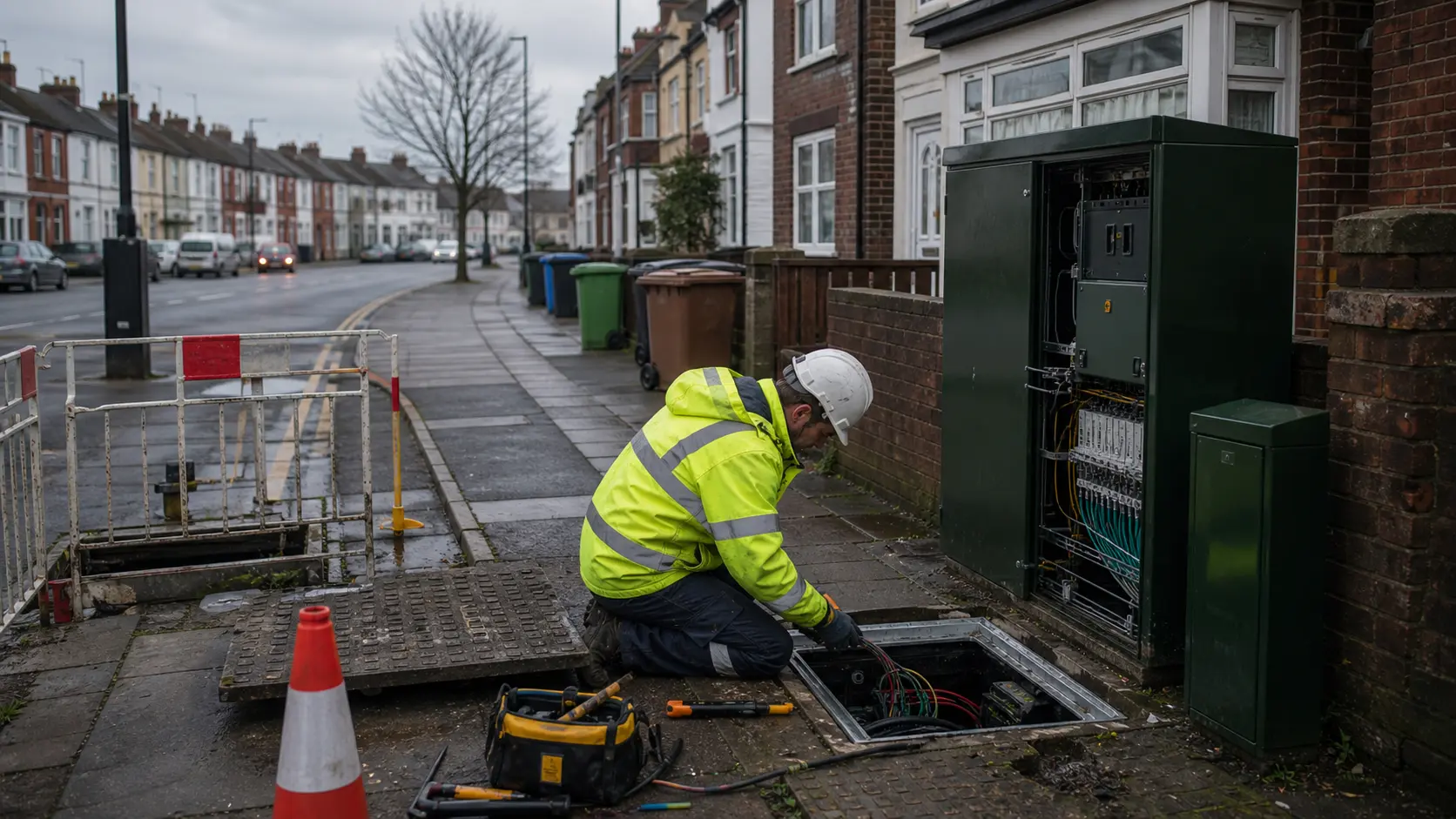
That is why Full Fibre should not be introduced as a simple company story. It is a cost-stack story. The visible product is a fast broadband line. The bought unit is the installed and supported line month. Behind that unit sit financing costs, wayleave negotiations, duct access, pole decisions, streetworks, optical equipment, wholesale partner onboarding, installation labour, support staffing, billing, churn and the cost of persuading a customer that a local or regional altnet line is better than the default choice.
A wholesale-only network has to sell twice before it earns once
Full Fibre's strategic choice is wholesale access. The company's "approach" page says it focuses exclusively on wholesale broadband networks and works with ISP partners, local authorities, property developers and others (https://fullfibre.co/our-approach/). Its products page separates business FTTP and residential FTTP, saying business connections are 1 Gbps or 10 Gbps capable and that residential FTTP is sold through a range of ISPs (https://fullfibre.co/products/). The ISP page lists partners including Zzoomm, BeFibre, Squirrel, IDNet, Uptime Allies, Octaplus, Fresh Fibre, Direct Save Telecom, Home Telecom, POP Telecom, VeloxServ, Beebu, Flexgrid and Gigabit IQ, while also presenting partner quotes about warm leads, onboarding and installation experience (https://fullfibre.co/isp-partners/).
That partner breadth is economically meaningful because a pure infrastructure owner needs someone else to produce retail demand. The wholesale model can lower channel conflict and give smaller ISPs a network they could not afford to build. It can also make Full Fibre vulnerable to partner priorities. A large retail ISP may choose Openreach for coverage uniformity, CityFibre for a broader independent footprint, or its own mobile-fixed bundle if the commercial terms are better. A small ISP may value Full Fibre's local warm leads but lack the marketing budget to convert a town quickly.
The wholesale network wins only if the partner believes the Full Fibre line is easy to sell, install and support.
Full Fibre's partner proposition is not just price. It talks about APIs for postcode lookup, ready-for-service downloads and online purchasing, easy cross-connects from key data centres, layer-2 cross-connects in core data centres, local exchange or local access handoff, 24/7 monitoring and end-to-end link visibility (https://fullfibre.co/isp-partners/). Those details matter more than branding language. Wholesale ISPs care about order flow, install certainty, fault visibility and handoff economics. If these work, Full Fibre can be useful even in a market with bigger networks. If they fail, the partner absorbs customer anger while the network owner still carries the fixed asset base.
The same double sale appears in local authority and carrier pages. Full Fibre tells councils that its network can reduce costs, support social mobility and provide a backbone for CCTV, multi-office networking, emergency communications and smart street furniture (https://fullfibre.co/local-authorities/). It tells carriers and mobile operators that rural-town fibre can support mobile network reach (https://fullfibre.co/carrier-and-mnos/). These are plausible adjacent channels, but again the line has to be sold twice: first as infrastructure capability, then as a live service solving a customer problem. Local authority goodwill and mobile backhaul prospects can help a business case, but neither converts an empty street cabinet into cash on its own.
The hidden fixed cost sits here. Wholesale access looks elegant because it avoids full consumer-marketing burden, but it replaces that burden with partner management, service assurance and integration work. The ISP wants a saleable product, a clean interface and a network that does not damage its brand. The council wants minimal street disruption and credible local benefit. The landlord wants permissions handled and tenants served. Every one of those requirements adds labour before the monthly line produces margin.
The build story grew faster than the connected-customer story
Full Fibre began the public growth narrative as a focused market-town build. Axxeltrova's deal page says it advised Full Fibre on strategic investment from Basalt Infrastructure Partners III to deploy wholesale fibre-only infrastructure to at least 500,000 additional premises by 2025, initially in West Midlands, Central and South West market towns, after a planned first 100,000 premises in 2021 (https://axxeltrova.com/deal/fullfibre-infrastructure-growth-capital-for-fttp-rollout/). Technology Reseller reported the same Basalt financing as a deal giving Basalt a majority interest and capital investment for expansion from 100,000 premises in 2021 to at least 500,000 by 2025 (https://technologyreseller.uk/basalt-invests-in-full-fibre-roll-out/).
That was the easy-money era of UK fibre: low interest rates, investor appetite for infrastructure, and a policy environment encouraging rival networks to build. The footprint could grow before the profit pool was proven. Full Fibre's own coverage page says its network extends across 17 counties and more than 190 towns, connecting 400,000 premises, with coverage data marked as correct at Q4 2023 (https://fullfibre.co/coverage/). The page is granular enough to show the underlying shape: not one dense city network, but a set of Derbyshire, Shropshire, Staffordshire, Worcestershire, Herefordshire and other market-town entries with varied live and coming-soon statuses.
The 2023 Digital Infrastructure combination made the story larger. Full Fibre's announcement said Basalt brought Digital Infrastructure and Full Fibre together to create a single wholesale platform, over 250,000 ready-for-service homes and businesses at that time, more than 300,000 by year end, a build rate of up to 40,000 ready-for-service premises per month, 67 towns actively in build or nearing completion, and an ambition to deliver one million live premises through a wholesale model (https://fullfibre.co/press-coverage/fullfibre-and-digital-infrastructure-consolidate-to-form-a-leading-alternative-network-in-the-uk-fibre-market/). The redirect page for Digital Infrastructure repeats the strategic message that the combined business aims at one million premises (https://fullfibre.co/digital-infrastructure/).
The 2025 Zzoomm transaction made the story larger again. Full Fibre's and Zzoomm's announcement said Full Fibre, BeFibre and Zzoomm agreed to merge, creating a group with about 600,000 properties ready for service and more than 65,000 customers, with Matthew Hare becoming executive chairman and James Warner becoming group CEO (https://fullfibre.co/press-coverage/fullfibre-and-zzoomm-merge-to-form-one-of-uks-largest-altnets/; https://zzoomm.com/fullfibre-and-zzoomm-merge-to-form-one-of-uks-largest-altnets-with-600000-ready-to-serve-properties-and-over-65000-customers). Computer Weekly placed that deal in a wider altnet consolidation context and noted that the merged business expected customer growth, funding access and operational efficiencies from combining complementary networks and operating models (https://www.computerweekly.com/news/366618398/FullFibre-Zzoomm-merge-to-gain-scale-in-UK-altnet-broadband).
The arithmetic is sobering. A group with 600,000 ready-for-service properties and more than 65,000 customers has achieved material scale, but the customer-to-footprint ratio is still the number that decides the cash story. Announcements use "ready for service" because it is a legitimate network milestone. Investors and lenders eventually ask for activated connections, average revenue per user, churn, installation cost, support cost and debt service. Full Fibre's public evidence shows impressive build and consolidation. It does not yet prove that the built network has crossed into mature utility economics.
The accounts turn hidden build cost into visible judgment
Companies House gives the clean identity anchor. Full Fibre Limited is company number 11090610, incorporated on 30 November 2017, active, and registered at C/O DMH Stallard LLP, Fetter Yard, Barnards Inn, 86 Fetter Lane, London EC4A 1EN (https://find-and-update.company-information.service.gov.uk/company/11090610). The persons-with-significant-control page shows Iris Infra Limited as the active controller notified on 26 September 2023, with ownership of shares and voting rights of 75 percent or more and the right to appoint or remove directors (https://find-and-update.company-information.service.gov.uk/company/11090610/persons-with-significant-control). The officers page shows James Stephen Warner as an active director appointed on 29 February 2024 and Julian Smith as an active director appointed on 7 March 2025, while Oliver Helm resigned as director on 29 February 2024 (https://find-and-update.company-information.service.gov.uk/company/11090610/officers).
The financial filing history matters because it turns the hidden build cost into numbers. Companies House lists full accounts made up to 31 December 2024 filed on 8 August 2025, full accounts for 2023 filed on 29 January 2025, and a March 2025 charge created on 7 March 2025 (https://find-and-update.company-information.service.gov.uk/company/11090610/filing-history). In the 2024 accounts PDF, the income statement shows turnover of GBP 4.809 million, cost of sales of GBP 3.208 million, gross profit of GBP 1.601 million, administrative expenses of GBP 23.013 million, an operating loss of GBP 20.158 million, interest payable and similar expenses of GBP 11.014 million, and loss after tax of GBP 31.102 million (https://find-and-update.company-information.service.gov.uk/company/11090610/filing-history/MzQ3NjY0MzIyMmFkaXF6a2N4/document?download=0&format=pdf). The statement of financial position shows intangible assets of GBP 684,375, tangible assets of GBP 72.074 million, cash of GBP 9.665 million, creditors due within one year of GBP 178.763 million and net liabilities of GBP 72.728 million on 31 December 2024.
Those figures do not mean the network is worthless. They mean the asset is still in the expensive conversion phase. A fibre network can carry large losses while it is being built because civil works, equipment, staff, financing and depreciation arrive before customer density. But the going-concern note is the important commercial clue. It says the company reported a GBP 31.1 million loss and GBP 72.7 million net liabilities at year end, that short- to medium-term funding is reliant on continued shareholder support, that shareholders continued funding through 2025 in accordance with the financial plan and committed support through 2026 and 2027, and that downside testing included lower average revenue per user, higher inflation affecting operating and capital costs, and lower long-term penetration and network utilisation (https://find-and-update.company-information.service.gov.uk/company/11090610/filing-history/MzQ3NjY0MzIyMmFkaXF6a2N4/document?download=0&format=pdf).
Those are exactly the valuation hinges. Lower ARPU, higher operating and capital costs, and lower penetration are not remote accounting abstractions; they are the daily risk of a wholesale altnet. A town can be passed but underused. A customer can be activated but low-margin. A partner can sign up but underperform. An interest expense line can keep growing while line growth lags. The accounts show a company with real infrastructure, but also a company whose economics depend on external support until enough paid usage arrives.
The charges page adds another view of finance. Companies House lists two outstanding charges: one created on 7 March 2025 with ING Bank N.V., London Branch in a security role, briefly described as including domain names, and an older 2022 charge with Lloyds Bank PLC (https://find-and-update.company-information.service.gov.uk/company/11090610/charges). Security over assets is normal in infrastructure finance. The point is not alarm; it is timing. Lenders and shareholders can support a build when the route to utilisation is credible. They become less patient when overbuild, churn or weak take-up makes cash conversion slower than the debt clock.
Consolidation bought scale but not automatic demand
The Full Fibre, Digital Infrastructure and Zzoomm sequence is best understood as defensive and opportunistic at once. It bought scale, management capability, retail demand channels and a wider footprint. It also acknowledged that mid-sized altnets were unlikely to thrive as isolated regional builds in a higher-rate market. Houlihan Lokey described Full Fibre as a Basalt Infrastructure Partners portfolio company merging with Zzoomm, backed by Oaktree Capital Management, and said the enlarged group would have one of the largest UK full-fibre footprints with about 600,000 properties ready for service and more than 65,000 customers (https://hl.com/about-us/transactions/full-fibre-basalt-infrastructure-partners-zzoomm-oaktree-efa/). Enders Analysis' public abstract called the Zzoomm-FullFibre merger necessary but not sufficient, saying the parties were mid-sized altnets that had been struggling to raise finance and might still be vulnerably low scale without further consolidation (https://www.endersanalysis.com/reports/uk-altnets-zzoomm-and-fullfibre-merger-necessary-not-sufficient).
That distinction matters. Consolidation can remove duplicate corporate costs, improve procurement, rationalize systems, bring retail brands together and offer lenders a broader collateral base. It cannot by itself cause households to take a service. It can also introduce integration risk. Thinkbroadband reported in February 2026 that the Zzoomm brand became the single retail brand across the 600,000-premise area created by the Zzoomm and Full Fibre merger, with a footprint of about 601,000 premises and a combined total of 90,000 customers across brands (https://www.thinkbroadband.com/news/zzoomm-brand-now-sold-in-both-fullfibreltd-and-zzoomm-areas). That is progress from the 65,000-customer figure announced at merger, but it still puts the spotlight on active penetration.
Brand consolidation is not cosmetic. BeFibre and Zzoomm had separate customer perceptions, pricing pages, support routes and local awareness. Moving customers and prospects under one retail brand can reduce marketing confusion and make national comparisons easier. It can also unsettle existing customers if they experience changed support workflows, new pricing presentation or delayed fault handling. Thinkbroadband's report quoted James Warner saying the integration over nine months was completed on time and budget, and quoted Francesca Lee saying systems, processes and network infrastructure had been aligned to support a better customer experience (https://www.thinkbroadband.com/news/zzoomm-brand-now-sold-in-both-fullfibreltd-and-zzoomm-areas).
The wholesale question is even sharper. Full Fibre's original model depended on partner ISPs selling on its network, and the merged group also has a single retail brand. Those models can coexist, but the incentives must be clear. Independent ISPs want confidence that the network owner will not privilege its own retail arm in price, promotion, install slots or lead access. Full Fibre's ISP page emphasizes level-ground onboarding, dedicated account managers and access across the entire network (https://fullfibre.co/isp-partners/). Sustaining that trust after a retail-brand integration is a management job, not a one-time announcement.
The market context makes further consolidation likely. KPMG's 2025 UK fibre paper says Britain's full-fibre build-out is nearing maturity, financing activity had cooled amid higher rates and uncertain returns, and the era of easy money was over (https://assets.kpmg.com/content/dam/kpmgsites/uk/pdf/2025/06/home-stretch-for-uk-fibre.pdf.coredownload.inline.pdf). Point Topic reported that at the end of Q4 2025, FTTP covered 81.3 percent of UK premises, 12.5 million premises had access to two or more FTTP networks, 2.1 million had three or more fibre networks, and altnet consolidation was underway (https://www.point-topic.com/post/uk-broadband-availability-in-q4-2025). A mid-sized regional footprint must either become very good at converting its towns or find a scale partner that can.
Project Gigabit shows subsidised rural work can change risk quickly
Public subsidy looked like a way to extend Full Fibre's market-town model into deeper rural areas. In April 2024 the UK government announced six Project Gigabit contracts, including West Herefordshire and the Forest of Dean, where Full Fibre was awarded GBP 23 million to connect 7,900 premises, and the Peak District, where Full Fibre was awarded GBP 10 million to connect 4,400 premises (https://www.gov.uk/government/news/broadband-boost-for-380000-rural-premises-as-uk-government-investment-reaches-13-billion). Full Fibre's own announcement framed the awards as more than GBP 30 million in contracts reaching thousands of homes and businesses in West Herefordshire, Forest of Dean and parts of Northern Derbyshire (https://fullfibre.co/press-coverage/fullfibre-ltd-secures-over-30-million-in-project-gigabit-contracts-to-bring-lightning-fast-broadband-to-rural-west-herefordshire-and-northern-derbyshire/).
The later update is more revealing than the award. GOV.UK now says BDUK and FullFibre mutually agreed to terminate the West Herefordshire and Forest of Dean contract, and that in April 2026 BDUK agreed a contract change with Openreach to include the West Herefordshire area within an existing Project Gigabit contract covering other parts of Herefordshire (https://www.gov.uk/guidance/project-gigabit-network-build-contract-west-herefordshire-and-forest-of-dean). GOV.UK also says FullFibre is no longer delivering the Peak District contract, with BDUK and FullFibre mutually agreeing to terminate it and the area being included within an existing Openreach contract covering parts of Staffordshire (https://www.gov.uk/guidance/project-gigabit-network-build-contract-derbyshire-peak-district). Total Telecom reported the same pattern and gave the original contract values as GBP 23.4 million for 7,900 premises and GBP 10.7 million for 4,400 premises (https://totaltele.com/fullfibre-withdraws-from-project-gigabit-contracts/).
This is not proof of operational failure in every commercial town. Subsidised rural work carries different design, eligibility, reporting and delivery burdens. It does show how quickly the risk profile can change when the build moves from relatively attractive towns into harder premises. Public funding lowers some revenue risk but adds contractual risk, build certainty requirements and accountability to BDUK. If the contract no longer fits the merged group's capital plan, labour availability or return threshold, termination can be rational.
It still tells investors something important: not every passed-premise target is equally financeable.
The House of Commons Library's April 2026 briefing says Project Gigabit has GBP 5 billion to subsidise premises not reached by private investment, that as of March 2026 more than one million premises were included in contracts with 227,310 reached, and that some Project Gigabit deployments have faced delays, scale-backs, terminations and reallocations (https://commonslibrary.parliament.uk/research-briefings/cbp-8392/). Full Fibre is therefore part of a wider pattern, not an isolated outlier. The commercial point is that public subsidy can help an altnet fill edge coverage, but it does not repeal the need for capital discipline.
For Full Fibre, the Project Gigabit episode narrows the thesis. The stronger case is not "this company will build every difficult premise." It is "this company can convert its market-town and merged retail footprint faster than its cost of capital grows." That is a cleaner test and a harsher one.
Openreach, CityFibre and cable set the substitute price
Full Fibre's market is now crowded by stronger substitutes than existed when many altnet business cases were written. Ofcom's Connected Nations 2025 report said that as of July 2025, full fibre was available to 78 percent of UK residential premises, or 23.7 million homes, and gigabit-capable broadband was available to 87 percent, or 26.4 million homes (https://www.ofcom.org.uk/siteassets/resources/documents/research-and-data/multi-sector/infrastructure-research/connected-nations-2025/connected-nations-uk-report-2025.pdf?v=407947). Ofcom's Spring 2026 update says the interim report provides a snapshot as of January 2026 and includes availability from fixed-line and fixed-wireless access networks, plus full-fibre take-up (https://www.ofcom.org.uk/phones-and-broadband/coverage-and-speeds/connected-nations-update-spring-2026).
Ofcom's planned deployment report goes further. It says full fibre could be available to 28.1 million UK homes, or 92 percent of residential properties, by the end of 2028 if all planned deployments are realised, with gigabit-capable coverage rising to 29 million homes, or 95 percent (https://www.ofcom.org.uk/phones-and-broadband/coverage-and-speeds/connected-nations-planned-network-deployment/connected-nations-planned-network-deployments-2026). This is good news for consumers but difficult for any regional altnet that expected scarcity to persist. When fibre scarcity fades, price, brand, install quality and support quality become the battleground.
Openreach remains the default reference network for many retail ISPs. Ofcom's Telecoms Access Review 2026 page says the review covers fixed telecoms markets from April 2026 to March 2031 and aims to promote competition and investment in gigabit-capable broadband (https://www.ofcom.org.uk/phones-and-broadband/telecoms-infrastructure/telecoms-access-review-2026). The March 2026 statement says Ofcom's regulation is designed to promote competition and investment in high-quality gigabit-capable networks, and notes full-fibre coverage rose from 6.9 million premises in May 2021 to 23.7 million in July 2025, while gigabit-capable coverage rose from 11.6 million to 26.4 million (https://www.ofcom.org.uk/siteassets/resources/documents/consultations/statement-promoting-competition-and-investment-in-fibre-networks-telecoms-access-review-2026-31/main-documents/volume-1-overview-summary-and-structure.pdf?v=413672). That regulatory stability helped altnets build, but it also helped Openreach make a huge fibre footprint available to retail partners.
CityFibre is the other major wholesale comparison. Its June 2026 announcement says it has connected more than one million premises and built infrastructure reaching nearly five million premises, supporting major household-name ISPs and challenger brands (https://cityfibre.com/news/cityfibre-hits-one-million-connections-nationwide). That creates direct pressure on Full Fibre's wholesale pitch. If an ISP can integrate with CityFibre for a broader footprint and with Openreach for national coverage, Full Fibre must justify why its towns, install process, lead generation or economics are worth a separate operating lane.
Virgin Media O2 adds another pressure point. Its 2028 upgrade plan described a 14.3 million-premise cable upgrade path plus existing FTTP homes, with use of a fully ducted network and an estimated upgrade cost of about GBP 100 per premises passed before customer installation (https://www.libertyglobal.com/virgin-media-o2-announces-2028-full-fibre-upgrade-plan/). That is a powerful substitute because it shows how an incumbent cable footprint can become more fibre-like without repeating every civil-work cost that a smaller builder has carried. A household does not care which capital structure produced the offer. It cares whether the line is available, affordable and reliable.
Take-up is the swing factor because UK fibre is no longer scarce everywhere
Ofcom's 2025 report turns take-up into the central number. It says full-fibre take-up reached 10.6 million premises, or 42 percent of premises with access to full-fibre networks, in July 2025; rural take-up where available was 56 percent, compared with 40 percent in urban areas (https://www.ofcom.org.uk/siteassets/resources/documents/research-and-data/multi-sector/infrastructure-research/connected-nations-2025/connected-nations-uk-report-2025.pdf?v=407947). That national average is useful but not decisive for Full Fibre. A regional altnet lives by cohort: how long the street has been ready, how good the sales channel is, whether a cheaper substitute is available, and how quickly faults are repaired.
Full Fibre's 2024 accounts make the same point through downside testing. The directors' going-concern analysis explicitly considered lower recurring revenue due to lower ARPU, cost-base increases from higher inflation affecting operating and capital expenditure, and lower long-term penetration and utilisation of the network (Companies House accounts PDF: https://find-and-update.company-information.service.gov.uk/company/11090610/filing-history/MzQ3NjY0MzIyMmFkaXF6a2N4/document?download=0&format=pdf). Those are not generic risks; they are the exact drivers of whether an altnet becomes utility cash flow.
The 2026 Zzoomm retail integration gives one public signal. Thinkbroadband's 601,000-premise and 90,000-customer figures imply an active customer ratio around the mid-teens if measured against the whole footprint (https://www.thinkbroadband.com/news/zzoomm-brand-now-sold-in-both-fullfibreltd-and-zzoomm-areas). That is not necessarily poor for a growing footprint because newer towns take time to mature. It is also not enough to make the question disappear. Mature fibre infrastructure investors usually want evidence of rising penetration by cohort, not only total customer growth.
The sales problem is local. Full Fibre's site says its network is aimed at small and medium-sized towns overlooked by larger network builders, and the local-authority page includes testimonials from Shropshire and Worcestershire officials describing investment, collaboration and efforts to resolve issues (https://fullfibre.co/local-authorities/). A town that felt overlooked may welcome an altnet during build. The same town may later compare monthly offers from several providers. The emotional benefit of being first fades once alternatives arrive.
Take-up also shapes operating cost. A street with low utilisation still needs maintenance, power, backhaul, monitoring and customer support capability. A street with high utilisation spreads those costs and makes local field work more efficient. Full Fibre's partner promise of warm leads and community engagement is therefore not a marketing detail; it is a financial necessity. If a wholesale builder cannot convert local awareness into orders, the civil build remains a sunk cost with low revenue density.
Local authorities, landlords and poles are part of the margin
Fibre economics often look too clean in spreadsheets because the physical permission layer is hidden. Full Fibre's local-authority page says its experts work with councils to identify broadband not-spots, use existing assets to reduce build costs, increase deployment speed and minimise civil-works intrusion, and support shared networks for public services (https://fullfibre.co/local-authorities/). Its ISP page says the network uses a mix of third-party duct access, its own duct and pole deployments, and a national backbone for handover (https://fullfibre.co/isp-partners/). Each of those route choices changes capital cost, street disruption, public acceptance and future maintenance.
Streetworks are not a small externality in the UK broadband build. Highways News reported in September 2025, citing Sky News data, that roadworks in Britain had more than doubled in two years and that full-fibre rollout was one reason for the surge (https://highways-news.com/full-fibre-broadband-roll-out-to-blame-for-sharp-increase-in-roadworks/). That national pattern matters to Full Fibre because market-town builds depend on local tolerance. Residents may welcome better broadband but dislike new poles, repeated lane closures or unclear communication.
Customer-review and local-complaint surfaces should be handled as signals, not verdicts. Trustpilot's Full Fibre page shows a small review count and a low rating, with complaints around poles, outages, communication and installation, while also containing some positive installation and speed feedback (https://www.trustpilot.com/review/www.fullfibre.co). Because the sample is small and self-selecting, it cannot prove representative network quality. It does identify the operational pressure points: poles, fault ownership, communication and installation. Those are the same pressure points that determine whether a passed premise becomes a stable line month.
Landlords and multi-dwelling buildings add another layer. Full Fibre's site has a partner category for landlords and its local-authority material talks about social housing and low-rent zones (https://fullfibre.co/). Permissions can make or break local fibre. A builder may pass a street but still face delays entering buildings, routing cables, installing optical terminals or satisfying residents that work is necessary. Every delayed wayleave pushes revenue further from the capital spend.
The commercial judgment is simple: wayleave, streetworks and local communications are not soft factors. They are part of the unit cost of a connected line month. A company that executes them well can make a market-town network sticky. A company that executes them poorly pays twice: first in delay and then in churn.
Interconnection evidence shows an operator but not a national moat
Full Fibre has real public network evidence. PeeringDB lists FullFibre Ltd, also known as Fibre Heroes, with ASN 213094, as-set AS-FULLFIBRE, network type NSP, 20 IPv4 prefixes, five IPv6 prefixes, mostly inbound traffic ratios and undisclosed traffic levels (https://www.peeringdb.com/net/32889). BGP.tools identifies AS213094 as Full Fibre Limited, registered on 12 June 2020, active and allocated under RIPE, with originated prefixes including Full Fibre, BeFibre and Zzoomm descriptions, and peers including Hurricane Electric, Exascale, VeloxServ, euNetworks, Colocation, IX Reach and others (https://bgp.tools/as/213094). RIPEstat also identifies AS213094 as held by Full Fibre Limited (https://stat.ripe.net/resource/AS213094). IPinfo lists IP ranges for AS213094 and says several are RPKI-valid, with peers and upstream data visible on its page (https://ipinfo.io/AS213094).
This evidence matters because it confirms the company is not merely a construction brand. It has internet-number and interconnection surfaces consistent with an access operator. It also shows the post-merger complexity. BGP.tools for AS213094 includes prefixes described as BeFibre and Zzoomm, while a separate BGP.tools page for AS42611 also identifies Full Fibre Limited and shows a larger Full Fibre/Zzoomm-related surface (https://bgp.tools/as/42611). That is not a problem by itself. It is what integration looks like when networks, brands and assets come together.
The caution is that BGP evidence is not a moat on its own. A regional access network needs routing, peers, transit and operations, but those do not guarantee retail demand. Interconnection can help performance and cost when traffic is exchanged efficiently. It can also expose small-scale dependence if traffic flows are limited and transit costs matter. The public routing pages do not disclose enough traffic or cost data to judge margin. They support operating reality, not profitability.
RPKI and registry hygiene are still useful. In broadband, a messy routing surface can become a customer problem through outages, route leaks or poor performance. Full Fibre's visible registration and peering footprint give future analysts points to monitor: prefix growth, origin changes, upstream diversity, peering exchange presence, and whether merged brand traffic consolidates cleanly. Those are evidence signals, not separate companies or products.
The best reading is therefore balanced. Full Fibre has the technical marks of a real operator. The public internet footprint is strong enough to support the company's network identity. It is not strong enough to answer the investment question, which remains take-up, ARPU, churn, partner demand and debt cost.
Partner breadth is useful only if order flow survives brand change
Full Fibre has spent years widening the sales channel. The official site presents partner ISPs and emphasizes easy procurement, fixed-price installs, postcode lookups and partner leads (https://fullfibre.co/isp-partners/). It also announced IPRiver as a wholesale aggregator partner in September 2024, saying the collaboration would expand B2B connectivity options across 170 towns and nine counties (https://fullfibre.co/press-coverage/fullfibre-ipriver/). In February 2025 it announced a VeloxServ partnership to expand business connectivity options across 11 counties and more than 160 towns served by the network (https://fullfibre.co/press-coverage/fullfibre-joins-forces-with-veloxserv-transforming-wholesale-b2b-connectivity/). In September 2025 it announced Uptime Allies as a partner for business and residential broadband (https://fullfibre.co/press-coverage/uptime-allies-partners-with-fullfibre-to-bring-better-broadband-to-businesses-and-homeowners/).
The partner list is strategically sensible. Wholesale-only networks need more than one retail route because no single small ISP can convert an entire footprint quickly. Business aggregators can help monetise towns where residential penetration is slow. A partner focused on support or business users may reach customers a mass-market retail brand misses. Full Fibre's challenge is to make the network easy enough that partners keep selling it after the first announcement.
The 2026 Zzoomm retail-brand integration could help by making consumer demand clearer. A single retail brand can run larger campaigns, present a cleaner offer and remove BeFibre/Zzoomm overlap. It can also create questions for independent partners: which leads go where, how wholesale pricing compares with the in-house retail offer, and whether customer support capacity is shared fairly. That does not assert a conflict. It identifies a commercial tension that any vertically adjacent wholesale-retail altnet must manage.
Equipment choices matter too. Full Fibre announced a September 2025 strategic partnership with Slovenia's Kontron for ONT equipment, saying multi-gigabit ONTs would support data rates up to 10 Gbps and give interoperability across OLT and ONT manufacturers (https://fullfibre.co/press-coverage/fullfibre-announces-strategic-partnership-with-slovenias-kontron-for-ont-equipment/). This is a small but relevant signal: if the network can support multi-gigabit service and avoid vendor lock-in, it has better room to compete on product. If the sales channel cannot convert enough premises, the equipment ceiling does not change the economics.
The partner story therefore has two possible outcomes. In the positive case, Full Fibre and Zzoomm use the merged footprint to give partners and the single retail brand enough density to lower acquisition cost, fill network capacity and improve support metrics. In the negative case, partners remain numerous but shallow, retail brand migration consumes management attention, and the network keeps carrying fixed cost without enough activated lines.
Labour, field work and reviews are the customer-facing balance sheet
Full Fibre's careers page says the company operates field and office-based roles across multiple regions and regional offices in Barnsley, Exeter, Derby, Ledbury and Telford, with benefits including training, PPE, tools, company vehicles, overtime for field roles and career progression (https://fullfibre.co/careers/). Indeed's Full Fibre employer page lists telecommunications as the industry, shows salary estimates for project managers, sales executives, network engineers, field supervisors, quantity surveyors and planners, and shows location signals in Ledbury, Exeter, Telford and Derby (https://uk.indeed.com/cmp/Full-Fibre-Limited). These sources are imperfect, but they point to the same truth: this is a labour-heavy regional infrastructure business.
Labour is not just a cost line. It is what the customer experiences. Full Fibre's own ISP partner page says its dedicated installers are meant to complete installations right first time, improve customer experience and support word-of-mouth advocacy (https://fullfibre.co/isp-partners/). In a market where customers can compare providers online and switch once contracts end, field quality becomes part of the margin. A clean install lowers repeat visits. A bad install creates tickets, reputation damage and potential churn.
The accounts show how heavy the staff and administration burden can become before network utilisation matures. Administrative expenses of more than GBP 23 million in 2024 against turnover of about GBP 4.8 million are not a steady-state utility ratio; they are a build and integration ratio (Companies House accounts PDF: https://find-and-update.company-information.service.gov.uk/company/11090610/filing-history/MzQ3NjY0MzIyMmFkaXF6a2N4/document?download=0&format=pdf). The question is whether the same organisation can grow revenue faster than support and integration costs once the build slows and the retail base matures.
Customer-review signals sit on the same balance. Trustpilot complaints about pole placement, service interruption and communication cannot be treated as a representative survey because the public sample is small and biased toward motivated reviewers (https://www.trustpilot.com/review/www.fullfibre.co). But they name the work areas that management must control: pre-build communication, install coordination, fault ownership and support response. If those improve, customer acquisition can become easier because local word of mouth works for the network. If they deteriorate, every new town becomes more expensive to sell.
The local labour topic is especially important after consolidation. Combining companies often promises efficiency, but the customer sees the merger through service handling. Are tickets routed correctly? Are engineers familiar with legacy Zzoomm, BeFibre and Full Fibre assets? Are wholesale partners given clear fault visibility? Are residents told why poles or ducts are being used? The market will not credit integration until those operational questions are answered in paid line growth and lower churn.
The investment case is utility cash flow versus stranded optionality
Full Fibre's strongest case is that it owns or controls a meaningful market-town fibre footprint, has a wholesale operating model, has become part of a larger Zzoomm-FullFibre group, and now has enough scale to convert more efficiently than a standalone altnet. The public record supports each part of that sentence: official coverage claims across 17 counties and more than 190 towns (https://fullfibre.co/coverage/), a wholesale-only partner model (https://fullfibre.co/isp-partners/), Digital Infrastructure consolidation (https://fullfibre.co/press-coverage/fullfibre-and-digital-infrastructure-consolidate-to-form-a-leading-alternative-network-in-the-uk-fibre-market/), Zzoomm merger scale (https://fullfibre.co/press-coverage/fullfibre-and-zzoomm-merge-to-form-one-of-uks-largest-altnets/), and active internet-routing evidence (https://www.peeringdb.com/net/32889).
The strongest bear case is that the build created option value faster than cash flow. Option value is useful only if exercised. A ready-for-service premise is an option to sell a line; it is not a line. A partner list is an option to reach customers; it is not demand. A government contract award is an option to extend rural footprint; terminated contracts show that not all options should be exercised. A merged retail brand is an option to reduce confusion; it still has to win households.
The 2024 accounts make the debate concrete. Losses, net liabilities, high creditors and shareholder-support language do not prove failure, but they make time expensive. The company can still become more utility-like if customer growth, ARPU, utilisation and operating efficiency improve fast enough. It can also remain stranded optionality if the footprint is expensive to maintain, overbuilt by stronger competitors, or unable to attract wholesale partner demand at acceptable margins.
This is where Ofcom's market data matters. Full fibre is no longer rare enough for a regional builder to rely on scarcity. Ofcom says take-up where full fibre is available was 42 percent in July 2025 and that more premises have access to multiple networks (https://www.ofcom.org.uk/siteassets/resources/documents/research-and-data/multi-sector/infrastructure-research/connected-nations-2025/connected-nations-uk-report-2025.pdf?v=407947). Point Topic says 12.5 million premises had two or more FTTP networks by Q4 2025, with 2.1 million having three or more (https://www.point-topic.com/post/uk-broadband-availability-in-q4-2025). Overbuild does not kill every altnet. It forces proof that the altnet has a local advantage.
Full Fibre's local advantage could be real. Market towns often have awkward ducts, local authority relationships, patchy legacy copper, landlord friction and demand from small businesses that dislike national-provider queues. A wholesale altnet that knows those towns and has a competent retail brand can win. The public evidence does not yet show enough detail to prove that it is winning at the necessary rate.
The next useful facts are lines, churn and debt terms
The facts that would change the view are specific. First, cohort take-up by town: not only total customers, but penetration by launch year and by overlapping competitor availability. Second, wholesale versus retail mix after the Zzoomm brand integration: independent partner lines, Zzoomm lines and business connectivity should be separated because they carry different margins and channel risks. Third, ARPU and gross margin by service: residential FTTP, business FTTP, wholesale B2B aggregation and local authority or carrier uses do not have the same economics.
Fourth, churn and fault metrics. A regional altnet can afford lower national brand awareness if its customers stay and recommend it locally. It cannot afford a reputation for poor communication in small towns. Fifth, debt and shareholder support terms after the 2025 charge and merger integration. Infrastructure investors can support a temporary loss when the forward curve is credible. They will demand sharper action if losses persist without utilisation gains.
Sixth, network integration evidence. AS213094 and AS42611 public routing surfaces, BeFibre/Zzoomm prefix descriptions and PeeringDB data should be monitored for consolidation, upstream diversity and operational hygiene (https://bgp.tools/as/213094; https://bgp.tools/as/42611; https://www.peeringdb.com/net/32889). These are not financial metrics, but they reveal whether the merged network is becoming simpler or more complex. Simpler operations usually help support and cost.
The editorial judgment is therefore conditional but firm. Full Fibre Ltd is a real UK wholesale FTTP altnet with a substantial market-town footprint, credible public operating evidence and a logical role inside the Zzoomm-FullFibre consolidation story. It is not yet visibly a steady utility. The company has to prove that the line-month revenue curve can outrun the financing and operating curve. If it does, the 600,000-premise footprint becomes a useful regional cash-flow platform. If it does not, the same footprint becomes a map of choices that were expensive to create and hard to monetise.
The buyer in the market town will decide before the financial statements do. If the household gets an install date, a fair price and a stable service, the line month renews. If the retail ISP gets easy ordering, clean handoff and low fault burden, it keeps selling Full Fibre's network. If councils and landlords see competent work rather than disruption, the next street is easier. That is the wholesale altnet clock after the easy UK streets were built: every month with an unconnected premise is a cost, every clean activation is evidence, and every cheaper substitute makes the evidence harder to fake.