
Summary
- What it says: Executive Summary
- Main topic: Regional ISP economics
- Context: Telecommunications / Company research / North America
Fox Valley Internet and the Economics of Local Control in Fixed Wireless Broadband
Executive Summary
Fox Valley Internet is best understood as a historical regional Internet Service Provider (ISP) based in Elgin, Illinois, whose durable asset is not nationwide scale, exclusive spectrum, or the fastest consumer broadband tier. Its defensible position stems from local points of control: tower and rooftop siting, accumulated address-level knowledge, fixed wireless installation capability, relationships with municipalities and small businesses, independent Internet numbering resources, and the ability to bundle broadband with voice, managed Wi-Fi, email, cloud, cybersecurity, and local support. This control is real but shrinking.
Cable, fibre, mobile fixed wireless, and LEO satellites are raising baseline speed and coverage expectations for rural and suburban homes. Fox Valley's strategic response appears to be a transition from a standalone WISP to an Opiquad-branded infrastructure platform: fixed wireless remains the local access layer while fibre, cloud, UCaaS, cybersecurity, and private wireless become the higher-margin service layer.
Public registries confirm the target's identity. ARIN lists Organization Handle GIGL-2 with the organization name Fox Valley Internet, a 2023 ARIN registration, and the historical address at 2585 Millennium Drive, Suite G, Elgin, Illinois. ARIN also associates Fox Valley Internet with a historical IPv4 direct allocation, an IPv6 direct allocation, and ASN 10689, all of which are stronger technical identity markers than mere directory entries.
The company website states that Fox Valley Internet has served rural communities 50–100 miles from Chicago since 1996, was acquired by GetGoing Infrastructure Group in 2022, and that GetGoing Infrastructure merged with Opiquad LLC in 2024. The Opiquad site describes the same practical transition in somewhat different terms, indicating that Opiquad acquired Fox Valley Internet in 2024 and continues to market the FoxValley Internet wireless service.
The best interpretation, therefore, is not “a new ISP called Opiquad replaced Fox Valley” but rather “a historical local ISP network and brand were integrated into a broader Opiquad/GetGoing infrastructure and cloud connectivity platform.”
Identity, Legal Perimeter, and Name Transition
The company's naming record is layered. On the technical registry side, the ARIN organization record for GIGL-2 names Fox Valley Internet and gives the historical Elgin, Illinois address, with a registration date of May 10, 2023 and a last update of May 31, 2023. The ARIN point of contact still uses Fox Valley Internet, Inc.,support@foxvalley.net, the 2585 Millennium Drive address, and the long-standing phone number 847-742-4623, the POC having been updated in June 2025.
On the business side, the current Fox Valley website moves the customer address to 600 Tollgate Road, Suite E, Elgin, IL 60123, and the Elgin Chamber of Commerce lists “Opiquad Formerly Fox Valley Internet” at that address as a communications service provider. The Opiquad website footer and wireless page also use the 600 Tollgate Road address, while retainingsupport@foxvalley.netand the same phone number. The mismatch between the historical ARIN address and the current customer address is not unusual after an acquisition; it is nevertheless a watchpoint, as routing, registry, billing, regulatory, and customer service records can remain desynchronized for years after an M&A transaction involving small operators.
The ownership transition evidence is consistent but not perfectly uniform in wording. The Fox Valley company history page states that the business was acquired by GetGoing Infrastructure Group in 2022 and that GetGoing Infrastructure merged with Opiquad LLC in 2024. The Opiquad site states that Opiquad acquired Fox Valley Internet in 2024. PitchBook’s public profile indicates that Fox Valley Internet was acquired by Opiquad on February 12, 2024, while an Italian telecom trade publication described Opiquad’s Fox Valley transaction as a takeover of a U.S. WISP at the beginning of Opiquad’s internationalization process.
FCC license records add another technical clue: an FCC public notice from May 2026 lists a full assignment of microwave call sign WQEC856 from Getgoing Infrastructure Group, LLC to Opiquad, LLC, consistent with license migration after the ownership transition.
The operational conclusion is that Fox Valley Internet remains a service brand and network identity, while Opiquad LLC appears to be the current corporate and strategic platform. This matters economically. A buyer of a local WISP is not just buying subscribers. It is buying address-level serviceability knowledge, customer premises installations, tower paths, microwave links, IP resources, local telephone numbers, support relationships, and a reputation that can be leveraged for business IT services.
Origin and Operational Scope
Fox Valley Internet presents itself as a local ISP founded in 1996, starting with dial-up, web space, web hosting, and business broadband products from 56k to T1. The company states it became the first locally owned and operated ISP in Elgin in 1996. The history then follows the classic WISP evolution: from dial-up and hosting, to wireless broadband, then to VoIP, managed Wi-Fi, CBRS, private wireless, and higher-frequency fixed wireless.
Its expansion history is a map of the Fox River valley and adjacent suburban/rural areas of northern Illinois. The company indicates that wireless broadband began in Elgin, Huntley, St. Charles, and Hampshire in 2002; expanded to West Dundee, Carpentersville, and South Elgin in 2003; and added Union, Wasco, Elgin, Elburn, Pingree Grove, Marengo, and Virgil in subsequent years. It claims to have acquired Freedom Access in 2008, adding Lakewood, Burlington, and Hoffman Estates, and to have acquired North Boone Broadband in 2010, adding Poplar Grove, Capron, Caledonia, Belvidere, Garden Prairie, and Genoa.
Third-party availability sources largely corroborate this geographic interpretation. The Broadband Map page derived from the FCC BDC for “Fox Valley Internet, Opiquad LLC, Getgoing Infrastructure Group” lists fixed wireless coverage around Elgin, Carpentersville, South Elgin, St. Charles, Huntley, and Algonquin, and notes that its information relies largely on the FCC Broadband Data Collection publication from May 2026 representing availability as of December 2025.
Broadband Lens lists the provider group at 44,747 locations and up to 300/60 Mbps, while warning that provider-reported availability in the FCC BDC does not guarantee actual service at a given address, nor pricing, performance tier, or installation time frame.
This operational perimeter is economically important. Fox Valley’s addressable market is not “broadband in Chicago” writ large. It is the irregular edge of the Chicago metro: subdivisions, farms, villages, small commercial sites, municipal service locations, parks, warehouses, and rural/suburban premises where the economics of fibre and cable are patchy. A WISP’s strongest local position is often not in the dense city center, where Comcast, Metronet, AT&T, Frontier, or municipal fibre may dominate.
It lies at the frontier: the business park too far for an affordable fibre build, the private farm stranded by the end of copper, the pump station needing low-cost telemetry connectivity, the home with poor DSL and no cable drop, or the property owner seeking a managed broadband overlay.
Products and Service Scale
Fox Valley’s current public offering is broader than a simple residential WISP menu. On the residential side, the site offers fixed wireless starting at $44.95 per month, along with residential VoIP and cloud email. The residential fixed wireless page lists plan tiers Essential 6/1, Advanced 12/3, and Advanced Plus 25/5, emphasizing streaming, gaming, easy installation, availability, local support, and low latency. FoxFone residential VoIP is offered at $24.95 per line per month plus $1 E-911 fees, with ATA rental or purchase options and DID porting fees.
Residential cloud email is offered at $2.95 per mailbox for a 10 GB base tier and $5.95 per box for a premium tier.
On the business side, Fox Valley’s public offering becomes more infrastructure-oriented. Business Internet is described as using fiber optic infrastructure and FCC frequency spectrum, with speeds up to 10 Gbps in some fibered areas, priority technical support, managed Wi-Fi, cybersecurity, redundancy, low latency, and customizable plans. Business bundles include Internet, cybersecurity, cloud email, UCaaS, and FoxFone.
Business voice pricing starts at $34.95 per month for the first line, with itemized fees for E-911, porting, provisioning, installation, additional lines, users/extensions, call recording, toll-free DIDs, electronic fax, telephone rental, and metered usage beyond included allowances. Professional cloud email is offered at $4.95 per box for the base tier and $9.95 per box for the premium tier, with claims of security, backup, and HIPAA BAA compliance.
The company also offers solutions for property owners and institutions. Its property-owner page targets apartments, stadiums, hotels, commercial properties, outdoor spaces, farms, parks, municipal deployments, campuses, rural broadband, educational institutions, higher education, and healthcare. It describes a mix of fibre, cable, cellular broadband, and fixed wireless, plus managed Wi-Fi, VoIP, cloud email, private 5G/4G-type networks, remote monitoring, irrigation, and subscription management support.
The resulting service scale is significant. The entry-level residential WISP product creates local relevance and network density. Voice, email, managed Wi-Fi, cybersecurity, cloud backup, and UCaaS create switching costs. Business broadband and private wireless deployments create higher average-revenue-per-user opportunities. Property-owner and public-sector projects create semi-custom relationships less directly comparable to a T-Mobile Home Internet box or a Starlink kit.
There are also some inconsistencies in product messaging. The Opiquad and Fox Valley sites claim up to 1 Gbps fixed wireless capacity over proprietary infrastructure, and the Fox Valley history page states that the first 6 GHz and 60 GHz fixed wireless towers were deployed in 2024 with up to 1 Gbps for end users. Yet the residential plans page still lists 6/1, 12/3, and 25/5 offerings, while third-party pages derived from the FCC BDC often show availability of 100/20 or 300/60 Mbps in many towns.
The most defensible interpretation is that Fox Valley has a mix of historical consumer tiers, higher-capacity towers for special zones or businesses, and BDC-reported maximums that vary by location.
Broadband Availability and Competitive Map
The company’s strongest geographic area appears to be the suburban and rural communities of northern Illinois around Elgin, the Fox River valley, and adjacent counties such as Kane, McHenry, Boone, DeKalb, and Winnebago. The statewide Illinois Broadband Lens page lists Fox Valley/Opiquad/Getgoing at 44,747 locations and “2 technologies,” with stated maximum speeds of 300/60 Mbps. The Broadband Map provider page identifies the primary served towns as Elgin, Carpentersville, South Elgin, St. Charles, Huntley, and Algonquin.
Competition is intense in town centers and mixed in edge-address pockets. For business broadband in St. Charles, Broadband Map lists multiple fiber providers including Metronet, Frontier, AT&T, and Xfinity, with Xfinity also having high cable coverage; it lists Starlink as next-generation satellite with high coverage; and it lists fixed wireless competitors Verizon, T-Mobile, Fox Valley/Opiquad/Getgoing, and AT&T. In Algonquin, the same source lists Xfinity cable at 100% coverage, i3 and AT&T fiber in parts of the town, T-Mobile, Verizon, AT&T, MINTernet, Fox Valley, E-vergent, and Starlink.
In Cortland, Broadband Map lists Frontier and Metronet fiber at high coverage, Mediacom cable, T-Mobile, Verizon, Fox Valley/Opiquad/Getgoing, Watch TV, MINTernet, KWISP, AT&T fixed wireless, Starlink, HughesNet, and Viasat.
The competitive conclusion is not that Fox Valley controls an entire town. It controls fragments. A WISP’s real market is created location by location: can the antenna see the tower? Is the customer behind trees? Is there a clean rooftop mount? Is the noise floor acceptable? Is there capacity on that sector? Is the cable drop alternative expensive or absent? Does a business need backup diversity from its wireline provider? Does a municipal service site need sufficient bandwidth at low monthly cost rather than gigabit? These micro-markets are not visible in city-scale coverage tables.
This is how a small WISP can retain local relevance even when a coverage map appears saturated with alternatives. The incumbent cable operator dominates consumer suburban broadband. Fiber providers dominate newly built or overbuilt streets. Mobile fixed wireless creates a low-friction retail substitute. Starlink removes many former “no option” rural monopolies. But none of these automatically solve every operational issue at every small location. A local WISP can still win on installability, response time, business customization, redundancy design, public-sector familiarity, or a lower monthly rate for a low-bandwidth site.
Economic Model and Pricing Power
The economics of Fox Valley likely combine four revenue streams: residential fixed wireless, business broadband/connectivity, voice and communications services, and managed/cloud/security services. Public financial statements are not available. Third-party private-company databases provide ordinary small-business estimates, but they are not sufficiently robust to build a financial model. The best evidence is the product menu, routing assets, public invoices, and acquisition context.
The residential model is a classic WISP model: fixed tower and backhaul costs, customer premises equipment, technician truck rolls, support labor, and recurring monthly subscriptions. The residential price floor is anchored by alternatives: mobile FWA, cable promotions, satellite, and DSL/fiber where available. Fox Valley’s residential pricing power is strongest where wireline competition is absent or unreliable and weakest where Xfinity, Metronet, Frontier, or AT&T fibre are available with higher speeds. The advertised starting price of $44.95 suggests that Fox Valley cannot charge monopoly prices across much of its coverage footprint.
It must position as a local alternative within a national broadband price band.
The business model offers more room to maneuver. Business clients pay for less standardized attributes: availability, static addressing, failover, voice-number continuity, managed Wi-Fi, installation assistance, email migration, security appliances, cloud backup, and local accountability. Fox Valley’s business pages emphasize redundancy, local support, low latency, battery backup, managed Wi-Fi, and bundled deployment. These features convert access into an IT service. The economics of a $75–300 business relationship are different from a $45 residential relationship, especially when voice, email, security, and cloud are bundled.
Switching costs reinforce this model. A Fox Valley fixed wireless customer may have a rooftop radio, antenna alignment, PoE power, a router configuration, and a tested path to a particular tower. A business client may also have ported numbers, FoxFone devices, mailboxes, managed Wi-Fi, a firewall policy, backup circuits, static IPs, or a vendor relationship embedded in procurement. The Fox Valley support page gives a telling operational detail: troubleshooting asks users to first check Wi-Fi, then check the antenna PoE injector, power-cycle the PoE antenna for ten seconds, wait five minutes, then reboot the router.
That is the small physical interface where a local WISP’s switching cost begins.
Pricing power is thus not generalized. It is situational. The company can charge for solving a local connectivity problem that a national operator cannot or will not tailor. It cannot easily charge a premium for low-speed residential service in a town where fibre, cable, mobile FWA, and Starlink are all viable. The strategic migration toward Opiquad’s UCaaS, cloud, cybersecurity, fiber, and private wireless services is a rational response to this squeeze.
Tower, Spectrum, and Backhaul Economics
The public technical history shows the normal fixed wireless progression. Fox Valley states it adopted Cambium 450 in 2012, 3.65 GHz spectrum for multipoint use in 2014, 900 MHz OFDM in 2016 for improved non-line-of-sight coverage, Cambium Pilot managed Wi-Fi in 2018, CBRS service with 100 MHz of additional spectrum in 2020, and 6 GHz/60 GHz fixed wireless towers in 2024 with up to 1 Gbps for end users.
This spectrum stack describes the WISP trade-off. Lower frequencies such as 900 MHz improve range and foliage tolerance but offer less capacity. Mid-band systems like 3.65 GHz/CBRS can balance range and throughput but must manage interference and, in the case of CBRS, shared-spectrum coordination. Higher-frequency links like 6 GHz and 60 GHz can deliver much higher throughput but are more constrained by line-of-sight and distance. A WISP’s local advantage is knowing which combination works at a given address and being willing to send a technician to prove it.
FCC microwave records show that Fox Valley was using licensed point-to-point or point-to-multipoint backhaul infrastructure in its service area. A 2018 FCC public notice for Industrial/Business Pool Microwave band applications lists Fox Valley Internet entries in Marengo, Poplar Grove, Virgil, Hampshire, Union, Elgin, Pingree Grove, Huntley, and West Dundee, with frequencies in the 10–19 GHz range. This public record is consistent with a tower-and-backhaul network rather than a pure reseller ISP.
The economics of this network are lumpy. Each tower or elevated site requires rent, power, battery backup, radios, antennas, sector planning, backhaul, monitoring, and periodic maintenance or truck rolls. Once built, additional customers on a sector are accretive until the sector becomes congested or interference worsens. The operator’s skill is deciding where incremental capacity should go: a new access point, a new backhaul path, a higher-frequency overlay, a fiber-fed tower, or targeted migration of heavy users.
The company’s business page specifically mentions battery backup, redundancy, managed Wi-Fi, and customizable connectivity; these are not just sales pitches but also operational cost drivers.
The key control point is not just owning a tower lease. It is owning an installed path. An overbuilding fiber operator can displace that path if it reaches the same location at scale. A mobile operator can displace it if cellular sector capacity is sufficient and indoor signal is strong. Starlink can displace it if the customer has a clear sky and can accept satellite pricing and support. But for many rural, municipal, and property-owner business applications, the WISP’s installed path remains valuable because it is known, monitored, locally supported, and already bundled with voice or IT services.
ARIN, IP Resources, ASN, and Routing Evidence
The technical identity is exceptionally strong for a small regional ISP. ARIN lists an IPv4 direct allocation 64.135.192.0–64.135.223.255, CIDR 64.135.192.0/19, named FVI-NET, registered on August 13, 2002 and updated on August 22, 2023. ARIN also lists an IPv6 direct allocation 2604:A980::/32, named FVI-NETV6, registered on April 17, 2013 and updated on August 22, 2023. ARIN lists AS10689, name FVI-CHI, registered on October 28, 1997 and updated on August 22, 2023.
BGP.tools shows AS10689 as Fox Valley Internet, a historical access network registered with ARIN, with 31 originated IPv4 prefixes and no originated IPv6 prefixes visible in its current summary. It also shows AS19754, The Fusion Network, LLC, as the visible upstream/peer relationship for AS10689. BGP.tools identifies The Fusion Network’s website as opiquad.com and shows it as a larger network with multiple upstreams, peers, downstreams, IPv4 prefixes, and IPv6 prefixes.
This matters for economics and control. A small ISP with its own ASN and direct IP allocations is not just a commercial storefront. It can originate address space, manage routing policy, support static/business addressing, and migrate upstreams without renumbering every customer. The fact that BGP.tools currently shows no originated IPv6 prefixes by AS10689 despite the ARIN IPv6 allocation is a watchpoint, not necessarily a defect: the allocation may be unused, not visible via this source, routed elsewhere, or reserved for future deployment.
But in an intelligence context, it indicates a distinction between registered resources and currently visible routing behavior.
The relationship with AS19754 also indicates post-acquisition integration. Fox Valley’s local access network can retain its AS10689 identity while depending on, peering with, or being upstreamed by Opiquad/Fusion infrastructure. This integration can improve transit, cloud connectivity, and redundancy, but it creates a new operational dependency: outages, routing misconfiguration, or commercial issues at the parent network level can affect the local ISP. Conversely, Opiquad can use Fox Valley’s access network as a local last-mile and edge platform for cloud, backup, and business services.
Customers and Counterparties
Public customer evidence points to three groups: households in rural/suburban areas, small and medium businesses needing connectivity and managed services, and public-sector or infrastructure customers with small, ongoing connectivity needs.
The residential segment is visible on the fixed wireless and VoIP landing pages. The business segment is visible on the business Internet, UCaaS, VoIP, cloud email, managed Wi-Fi, Fortinet-linked cybersecurity, and bundled-offer pages. The property-owner page broadens the target set to apartments, parks, stadiums, hotels, commercial properties, farms, municipal networks, campuses, educational institutions, higher education, healthcare, and rural broadband.
Public-sector traces are minimal but important. A Poplar Grove village invoice register for January 2026 lists Fox Valley Internet Inc for SWWTP and NWWTP wastewater treatment plant Internet, with line items of $29.95 and $24.95, totaling $54.90. The same register includes other communications providers such as Frontier, Verizon, and Comcast, illustrating that Fox Valley is not the sole municipal telecom provider but can fill specific roles at utility sites.
This type of account is strategically important despite the low dollar amount. A wastewater treatment plant connection is not a home streaming account. It may need low bandwidth, but it values continuity, monitoring, known contacts, and simple billing. Public entities are slow to change when a service is “satisfactory” and already embedded in operations. This is one of the subtle ways a small ISP creates local control: not by dominating consumer market share, but by becoming the default solution for scattered, low-bandwidth, operationally important sites.
Industry and supplier counterparties are also visible. Fox Valley mentions Cambium-linked wireless evolution in its history, Fortinet-linked cybersecurity on business pages, OpiVoice/UCaaS under Opiquad, and email/security/backup services via Opiquad-linked portals. An Opiquad LinkedIn post states it acquired assets of the wholesale business division of Rural Telecommunications of America, including fiber and wave circuits connecting 14 major data centers and customer/supplier relationships.
This is company-published evidence, not independent financial confirmation, but it supports the strategic direction: Fox Valley’s local access network is placed inside a larger U.S. wholesale backbone/cloud narrative.
Ownership Context and Opiquad Strategy
Opiquad appears to use Fox Valley Internet as part of a broader fixed wireless and infrastructure expansion strategy. The Italian trade publication CorCom described the Fox Valley transaction as Opiquad’s takeover of a U.S. WISP and indicated that a subsequent transaction in Volo was Opiquad’s second acquisition in 2024, focused on fixed wireless access and telecom/IT services. The same article described Opiquad as a company that grew through the merger of Briantel and Promo.it, with proprietary networks in northern Italy and a post-acquisition scale of approximately 60 employees, 9,000 global customers, and around €8.5 million in revenue.
These figures are externally reported and may not reflect the current 2026 scale, but they show the approximate strategic posture of the parent: small infrastructure consolidator, not incumbent.
The DataCenterMap Opiquad Srl profile indicates that Opiquad combined the capabilities of Briantel and Promo.it, had around 4,000 recurring customers, 400 km of fibre, proprietary cloud infrastructure based on three data centers, and certifications including ISO 9001 and ISO/IEC 27001. This profile is not an official regulatory filing, but it reinforces the same theme: Opiquad’s acquisition logic is to combine local access, fibre/cloud infrastructure, and managed ICT services.
For Fox Valley, the strategic benefit is access to broader transit, cloud products, and a more complete business bundle. The risk is integration complexity. Customers may still recognize Fox Valley as a local ISP, while ARIN records, FCC licenses, billing files, chamber of commerce listings, and Opiquad web pages variously reference Fox Valley Internet, Fox Valley Internet Inc., GetGoing Infrastructure Group, Opiquad LLC, and The Fusion Network. In small telecom M&A, this creates operational risk in billing, support escalation, number porting, domain ownership, customer notices, and regulatory recordkeeping.
The May 2026 FCC assignment from Getgoing to Opiquad shows that technical assets were still moving through formal registries well after the 2024 business transaction.
Public Sector Exposure, Subsidies, and Regulatory Posture
Direct subsidy evidence is thin. The public sources examined here do not show a major BEAD, RDOF, or state broadband grant award to Fox Valley, GetGoing, or Opiquad. This absence should not be over-interpreted: broadband grants can flow through affiliates, consortiums, counties, or later rounds, and some records are not easily indexed. What is visible is a company positioning itself for public-sector and digital-equity work.
Its property-owner and institutions page explicitly addresses government, education, healthcare, private LTE-type networks, public funds, municipal networks, campus networks, rural broadband, k-12 schools, higher education, and healthcare.
Fox Valley also appears in older and current public-sector payment traces. The Poplar Grove invoice is the clearest current example. Search-engine-indexed public documents also show references from Kane County and the Forest Preserve District to Fox Valley Internet or to Opiquad DBA Fox Valley Internet in vendor summaries and agendas, although these records are fragmentary and not all could be retrieved directly as structured pages.
The regulatory exposure is typical for a telecom/VoIP/broadband provider. FCC Form 499 search results list Getgoing Infrastructure Group, LLC with the DBA Fox Valley Internet, while USAC explains that FCC Form 499-A is used to report prior-year revenue and Form 499-Q is used by non-de minimis filers to project revenue for USF contribution purposes. This does not disclose Fox Valley’s revenue, but confirms the company’s telecom side fits into the ordinary FCC/USAC contribution architecture.
The regulatory watchpoint is broadband label and BDC transparency. Fox Valley’s public website contains service pages and price snippets, but a targeted search did not surface a clearly indexed broadband label page. FCC rules require broadband labels to display cost and performance information in a standardized manner, and the FCC broadband label page states that labels are designed to provide clear, easy-to-understand cost and performance information. Absence of an easily indexed label is not proof of non-compliance; labels may appear inside the ordering flow, address qualification, portals, or on unindexed pages.
But for an intelligence audience, it is a transparency watchpoint, especially since the Nextdoor summary noted that some users had wished for more transparency around service costs on the company website.
Quality of Service, Outages, and Customer Signals
Public customer signals are sparse and mixed. The HighSpeedInternet review page shows only two customer reviews for Fox Valley Internet, both from April 2024, with an overall rating of 5.0; the comments praise support and value for money. The public Nextdoor business page indicates that verified neighbors recommend Fox Valley for broadband service, reliability, affordability compared to AT&T and Comcast, and multi-user simultaneous use, while noting some wish for more cost transparency.
The BBB lists Fox Valley Internet as not BBB accredited but with an A+ rating, 29 years in business, a 1996 business start date, a corporate status, and John Diem as the management contact. The latest visible BBB review snippet is negative and concerns rooftop radio removal fees after a 2020–2022 service period.
Outage evidence is also sparse. Downhunter, a user-reported outage-tracking tool, showed no reports for Fox Valley in the preceding 24 hours and no major outage at the time of consultation, while noting its assessment is based on user reports and may assume normal operation when few or no reports are received. A Facebook group search snippet surfaced a user complaint that Fox Valley Internet was down and they couldn’t reach the provider; the page itself was not accessible via the browser, so this must be treated only as a low-confidence social signal of an isolated outage/support complaint.
The strongest quality signal is operational rather than reputational: the company’s support page offers practical customer-premises-equipment-level troubleshooting, telephone support hours, and separate contacts for technical support, billing, web hosting/domains, and email. This indicates a local support model, not a fully automated national ISP model. Such support can be a competitive advantage for rural customers, but it also creates labor intensity. A WISP with differentiated support cannot indefinitely grow residential subscriber counts without adding support costs.
Security Exposure and Network Management Posture
Fox Valley/Opiquad markets cybersecurity as part of the business bundle, including Fortinet-linked service language on the business solutions page. At the same time, a dedicated cybersecurity page on the Fox Valley site states “Coming Soon,” suggesting either a product-launch inconsistency or a website maintenance delay. This is not a security vulnerability, but a signal that brand/platform integration is still underway.
The public web perimeter includes links to webmail, customer portal, email backup, and email security on Fox Valley/Opiquad pages, as well as explicit support for web hosting/domains and email. These are normal surfaces for an ISP/MSP, not evidence of compromise. They do, however, extend the operational attack surface compared to a pure last-mile broadband provider. Any company that hosts email, manages customer domains, provisions VoIP, and sells cybersecurity must manage credential security, customer portal hardening, DNS/domain administration, abuse handling desks, legal demands, and phishing risk.
The acceptable use policy gives the operator broad rights to suspend or terminate service for illegal use, interference, excessive traffic affecting others, resale, spam, invasion of privacy or security, scanning, data harvesting, intellectual property violations, fraud, and related conduct. The privacy policy states that personal information may be used in customer relationships and marketing, may be shared with Fox Valley entities and business partners providing services, and may be disclosed to government or law enforcement authorities in a legal proceeding.
For an intelligence audience, these policies are ordinary but important: they show the legal basis for network management, abuse response, and cooperation with authorities.
How the Local Control Point Is Created
Fox Valley’s control point is best understood as a stack.
First, there is terrain and address knowledge. The operator knows which routes, farms, subdivisions, and utility sites can be served from which towers. This knowledge is expensive to rebuild because it is built through failed installations, rooftop surveys, foliage experience, sector utilization, and support calls.
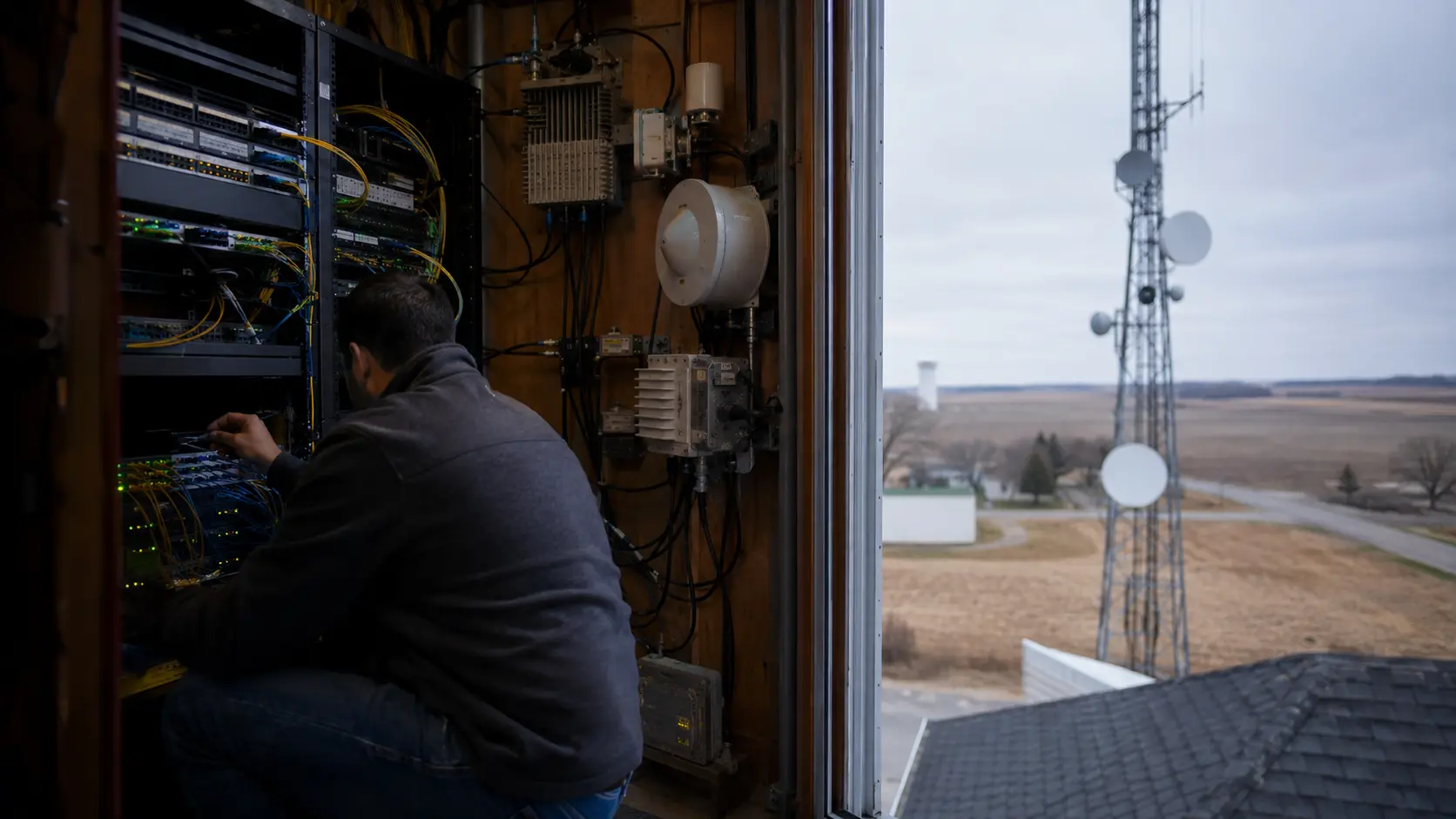
Second, there is site control. The WISP needs locations on towers, rooftops, grain silos, water towers, or commercial buildings. FCC microwave records indicate that Fox Valley had a real licensed microwave network across multiple towns, implying a network of elevated sites and backhaul routes. A competitor cannot instantly replicate these local paths.
Third, there is customer-premises equipment control. The rooftop antenna, PoE injector, router, alignment, and support history become switching friction. A customer can leave, but the replacement must solve the same installation problem. Mobile FWA reduces this friction because the device is often self-installed; Starlink changes the friction by shifting it to sky visibility and equipment cost; fibre eliminates it when available. But many addresses remain operationally specific.
Fourth, there is service bundling. Voice lines, ported numbers, mailboxes, managed Wi-Fi, security services, cloud backup, and support relationships convert a broadband line into a small IT stack. Fox Valley’s business product pages are built around this principle.
Fifth, there is Internet numbering control. AS10689, the IPv4 /19, and the IPv6 /32 are not decisive consumer assets, but they are important for business service, routing autonomy, M&A integration, and the ability to be more than a mere reseller.
Sixth, there is public-sector anchoring. Small municipal accounts, chamber of commerce listings, and local support channels embed the operator in the local infrastructure economy. A $54.90 wastewater plant Internet invoice is not significant revenue, but it is a strong example of the type of site a small ISP can serve better than a national retail channel.
Moat Limits
The moat is real but not wide across all segments. Fibre overbuilding is the most direct threat. When a fiber provider reaches the location at a competitive monthly price, the WISP loses its speed and reliability argument, unless it can sell backup diversity, managed services, or better support. The Broadband Map pages for St. Charles, Cortland, and Algonquin show exactly this pressure: fibre and cable are already present in many parts of the same geographic zone where Fox Valley offers fixed wireless.
Mobile fixed wireless is the second threat. T-Mobile and Verizon can leverage national brands, retail distribution, self-installable hardware, and bundled mobile relationships. Their weakness is capacity management: they can throttle sign-ups, vary speeds with cell load, and provide less personalized support. Fox Valley’s opportunity is to win where mobile FWA is congested, unavailable, signal-blocked, or insufficiently business-tailored.
Starlink is the third threat. It is particularly relevant for rural locations that once had only poor WISP or DSL options. Starlink erodes the former rural-WISP monopoly by making high-bandwidth broadband available almost everywhere with a clear sky. But Starlink does not erase all local WISP use cases. It may be less attractive for customers needing local support, bundled VoIP, managed IT, static routing, public-sector billing, or low-cost connectivity for utility sites.
Cable is the fourth threat. Xfinity’s presence in many Fox Valley markets means fixed wireless must compete against a mature HFC economics. Cable’s weakness lies in build limits, upload constraints versus fiber, local dissatisfaction, and lack of tailored solutions for small sites. Fox Valley’s positioning against Comcast/Xfinity is strongest as a local alternative and backup path rather than as a universal primary replacement.
Market Rumors and Industry Chatter
The public chatter is not a deep rumor market; it is a sparse trail of acquisition, WISP, and local-service signals. Opiquad itself and third-party sources present Fox Valley as a U.S. fixed wireless acquisition. CorCom described the deal as part of Opiquad’s fixed wireless acquisition strategy and international expansion. Opiquad’s LinkedIn activity subsequently positioned the company around WISPA, distributed cloud, wholesale infrastructure, and RTA wholesale network assets.
Customer chatter is equally sparse. The Nextdoor summary is generally positive but notes cost transparency concerns. The BBB shows an A+ rating and a negative review snippet about rooftop equipment/removal fees. Facebook search snippets show at least one local outage/support complaint. These are not enough to infer systemic quality issues, but they are enough to identify the likely complaint categories: transparency, support accessibility during outages, equipment ownership/removal, and post-acquisition billing/support continuity.
Watchpoints
The first watchpoint is brand and legal consolidation. Watch whether the ARIN organization and POC records migrate from the historical Millennium Drive address to the Opiquad 600 Tollgate address, whether AS10689 remains distinct, and whether more FCC microwave licenses are assigned from GetGoing to Opiquad.
The second is routing integration. Watch the origination of routes from AS10689, IPv6 visibility, upstream diversity, and dependency on AS19754/The Fusion Network. A stronger parent network can improve resilience, but a single-parent routing dependency can also concentrate outage risk.
The third is broadband label and BDC transparency. If Fox Valley/Opiquad becomes more enterprise-oriented, residential plan transparency could lag. This matters because broadband labels and FCC BDC records shape subsidy eligibility, customer expectations, and competitive comparisons.
The fourth is fixed wireless capacity versus speed claims. The gap between the 6/1–25/5 residential plans, the 100/20 or 300/60 BDC-derived availability, the 1 Gbps fixed wireless claims, and the selective 10 Gbps fiber claims should be monitored address by address. The investment question is whether the 6 GHz/60 GHz high-capacity deployments are wide enough to change the consumer product, or whether they mainly support special business/property-owner opportunities.
The fifth is public sector and subsidy exposure. Fox Valley markets public-sector and digital-equity use cases, and public invoices show municipal utility site service. A significant grant award, BEAD sub-recipient contract, school/municipal private network, or county broadband partnership would change the narrative scale. So far, the visible evidence is small public-sector service relationships, not major subsidy-supported buildout.
The sixth is post-acquisition customer experience. Small ISP acquisitions often succeed or fail at the billing/support level. The customer does not care whether the upstream is The Fusion Network or Opiquad; the customer cares if the phone is answered, the rooftop radio works, the bill is intelligible, and a technician shows up. The BBB, Nextdoor, local Facebook groups, and outage-tracking tools should be monitored for post-2024 shifts.
Evidence Record
Official ARIN Identity: Organization Handle GIGL-2, Organization Name Fox Valley Internet, address in Elgin, Illinois, registration and update dates.
ARIN Numbering Resources: IPv4 allocation 64.135.192.0/19, IPv6 allocation 2604:A980::/32, and ASN 10689/FVI-CHI.
ARIN POC: Fox Valley Internet, Inc.,support@foxvalley.net, 847-742-4623, historical Millennium Drive address, updated June 2025.
Company History: founded 1996, wireless expansion by town, acquisitions of Freedom Access and North Boone Broadband, Cambium, 3.65 GHz, 900 MHz, CBRS, acquisition by GetGoing, Opiquad transition, 6 GHz/60 GHz towers.
Current Website and Operating Address: Fox Valley Internet/Opiquad service pages, contact info, support hours, address at 600 Tollgate Road.
Local Business Registry: Elgin Chamber listing “Opiquad Formerly Fox Valley Internet,” communications provider, address at 600 Tollgate Road, service description.
Broadband Availability: Broadband Lens Illinois page derived from FCC BDC and Broadband Map fixed wireless provider page.
Local Competition: Broadband Map pages for St. Charles, Cortland, and Algonquin showing fiber, cable, mobile fixed wireless, satellite, and WISP competitors.
FCC Microwave Evidence: 2018 FCC public notice listing Fox Valley Internet microwave entries across multiple northern Illinois towns; 2026 FCC public notice assigning WQEC856 from Getgoing Infrastructure Group, LLC to Opiquad, LLC.
Routing Evidence: BGP.tools routing summaries for AS10689/Fox Valley Internet and AS19754/The Fusion Network/Opiquad.
Products and Pricing: residential fixed wireless, VoIP, cloud email; business Internet, VoIP, UCaaS, cloud email, cybersecurity, and property-owner/private network pages.
Public Sector Trace: Poplar Grove village invoice register showing Fox Valley Internet service for wastewater treatment plant Internet.
Customer Signals and Quality of Service: BBB profile, HighSpeedInternet reviews, Nextdoor summary, Downhunter outage tracker, and low-confidence Facebook snippet about an outage.
Policy and Security Posture: acceptable use policy, privacy policy, support page, cybersecurity/product inconsistency.