
Summary
- Flynas sells a low-fare airline seat, but the evidence shows the real unit is aircraft time: a seat only works when aircraft, crews, fuel, maintenance, airport handling and digital booking convert into high daily use.
- The public record supports the thesis in broad terms. Flynas reports Q1 2026 revenue of SAR 2.01 billion, operating expenses of SAR 1.79 billion, 4.0 million passengers, an 80.7% load factor and 7.5 billion available seat-kilometers, which implies limited profit per passenger even before route-level detail.
- Ancillary revenue is not decorative. Flynas fare rules place baggage, seat choice, meals, lounge access, priority service, price lock, installment payments and credit-shell behavior around the base fare, making the cheap seat a starting price rather than the full commercial product.
- The biggest public gaps are route-level aircraft utilization, ancillary revenue per passenger, fuel cost per available seat-kilometer, on-time performance by route, airport charge exposure and direct customer-support resolution data.
A low fare is a timed promise
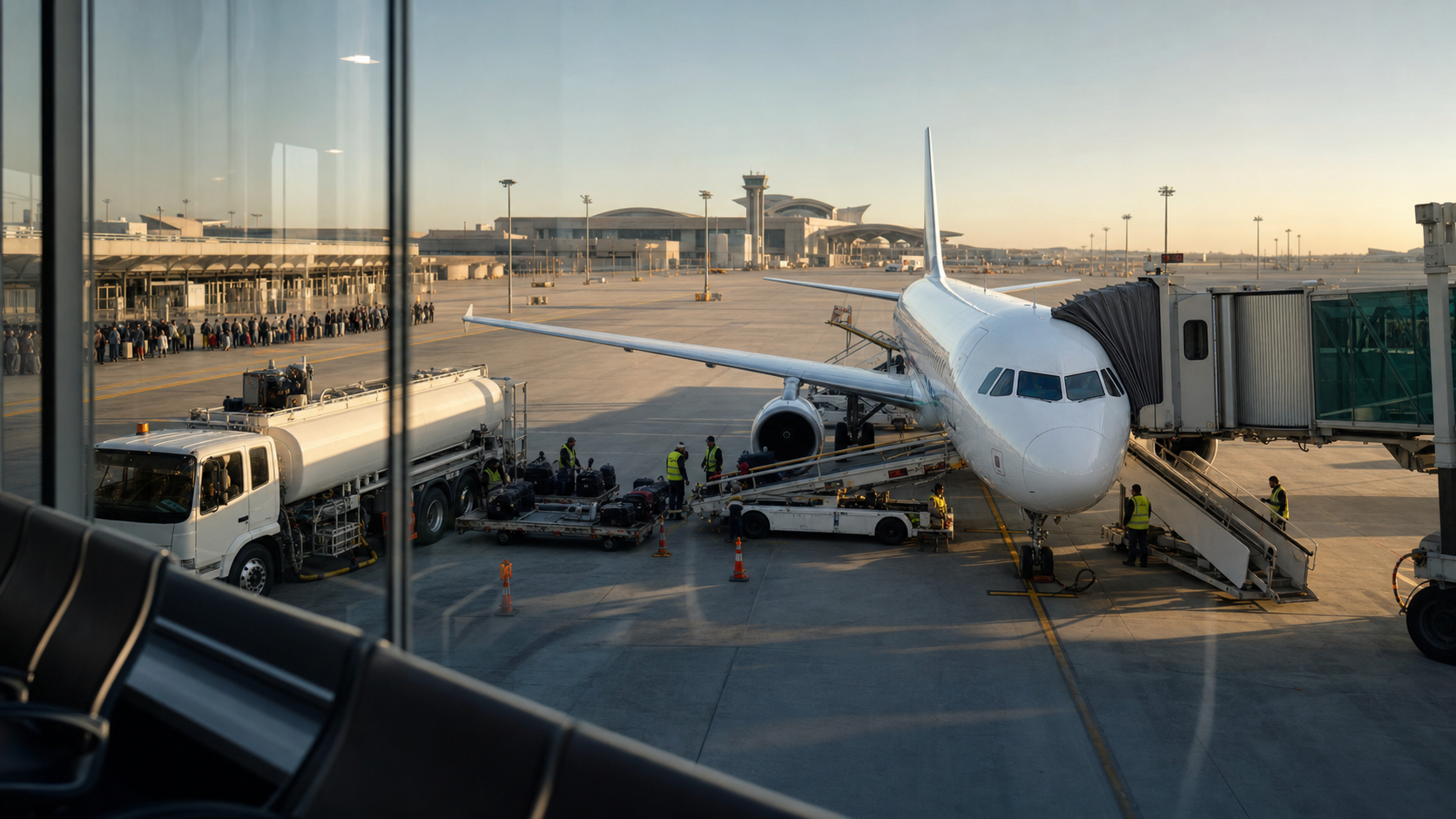
The opening purchase looks small. A passenger sees a Flynas fare, compares it with a full-service airline, notices a route that fits a weekend, a family visit, an Umrah itinerary, a work trip or a connection to a larger international journey, and pays for a seat. The economic promise behind that click is much larger than the displayed fare. The aircraft must be available at the right hour. The crew must still be legal to fly. Fuel must be bought at the right price or at least managed through a hedging policy. The airport must supply slots, gates, ground handling, security flow and baggage systems. The app and booking engine must be online.
The passenger may need a bag, a chosen seat, a meal, priority boarding, a price hold, a refund route, a payment method or a support response.
This is why Flynas is best read not as a seller of cheap seats alone, but as an operator trying to make aircraft time sellable in small pieces. A low-cost carrier wins when it reduces idle aircraft time, uses a dense and modern fleet, fills seats, prices demand dynamically and turns optional services into meaningful revenue without making the passenger feel trapped. It loses when the aircraft sits, when fuel jumps, when maintenance or crew scheduling reduces use, when airport disruption breaks trust, when app issues make buying difficult, or when passengers discover that the cheap fare was too incomplete for the trip they actually needed.
The hard anchor is Flynas's own investor record. On its investor relations site, Flynas says Q1 2026 revenue was SAR 2.0 billion, adjusted net profit was SAR 118 million and adjusted EBITDA was SAR 557 million. It also reports 4.0 million passengers, a 72-aircraft fleet, 80 destinations, 156 routes, 7.5 billion available seat-kilometers and an 80.7% load factor for Q1 2026: https://ir.flynas.com/. The Q1 2026 interim financial statement gives a more detailed version of the same story: total segment revenue was SAR 2,005,545,356, operating expenses were SAR 1,785,510,231 and profit for the period was SAR 117,901,381. The low-fare seat therefore had little room for slack. A simple directional calculation using the 4.0 million passenger count gives roughly SAR 501 of revenue per passenger, SAR 446 of operating expense per passenger and less than SAR 30 of net profit per passenger. That is not a complete unit-cost model, because it mixes scheduled low-cost revenue with smaller Hajj and general aviation segments and does not publish route-level ancillary revenue. It is still enough to show why utilization matters. A small change in fuel, load factor, aircraft availability or fee attachment can consume the apparent margin quickly.
The available seat-kilometer figure sharpens the point. If Flynas supplied 7.5 billion ASKs in Q1 2026 and carried an 80.7% load factor, the public record is consistent with roughly 6.05 billion revenue passenger-kilometers. That puts total revenue near SAR 0.33 per passenger-kilometer and operating expense near SAR 0.30 per passenger-kilometer on a broad segment basis. Those are not audited route economics, but they are useful boundaries. The company must keep aircraft flying enough hours, at enough load, with enough extras per passenger, to turn a thin per-seat spread into an airline-level profit.
The company and the buyer
Flynas Company PJS is a Saudi airline based in Riyadh and trading publicly as Flynas. The company describes itself as a market-leading low-cost carrier in the Middle East and North Africa for short- and medium-haul flying. Its public website operates at https://www.flynas.com/en, while its investor relations site is at https://ir.flynas.com/. The company was formerly known in the market as Nas Air, and it remains associated with the broader National Air Services history and with Kingdom Holding context through the 2025 listing coverage. After the 2025 offering, the investor page calls Flynas the first and only airline to list on the Saudi Exchange, giving investors exposure to a high-growth Saudi aviation and tourism market.
The customer is not one type of traveler. Flynas sells to domestic passengers moving between Riyadh, Jeddah, Dammam, Abha, Madinah, Taif and other Saudi cities; to regional travelers moving between Saudi Arabia and the Gulf; to price-sensitive international passengers; to religious travelers around Hajj and Umrah; and to passengers who are willing to assemble a trip out of a low base fare plus selected services. The payer may be a leisure traveler, a worker, a family, a small business, a travel arranger, a religious-travel organizer or a passenger using installment credit to bring the ticket within monthly cash flow.
That matters because the buyer's willingness to pay is split. The same person who rejects a high base fare may pay for baggage, a front-row seat, a meal, a payment plan, a price hold or priority boarding if those items solve an immediate travel problem.
Flynas's own segmentation confirms that scheduled low-cost flying is the center of the company. In the Q1 2026 financial statement, the Flynas LCC segment produced SAR 1.96 billion of the company's SAR 2.01 billion total segment revenue. Hajj revenue in that quarter was small at SAR 434,873, while general aviation revenue was SAR 45.4 million. That quarter is not a full religious-season picture, but it does show that the everyday scheduled seat is the main economic unit. The Hajj and general aviation segments diversify the company and use aviation capabilities, but the low-fare seat is where the thesis should be tested.
The buyer receives transportation under an airline contract, not ownership of a durable asset. The Flynas terms of carriage make the schedule conditional: flight times may change, and the airline may adjust, cancel, divert, terminate, postpone or delay flights for safety, security, operational or commercial reasons. The same document sets compensation and rebooking rules for denied boarding, delay and cancellation. That is ordinary airline contract language, but it is especially important for a low-fare carrier.
The airline has to sell punctuality and price together, while retaining enough flexibility to recover from aircraft, crew and airport disruption.
The fleet is the utilization machine
The aircraft fleet is the core reason a cheap seat can exist. Flynas says its fleet page now consists of 67 aircraft, including 61 A320neo aircraft, four A320ceo aircraft and two wide-body A330 aircraft: https://www.flynas.com/en/about-us/fleet. The same page says the A320neo aircraft represent more than 90% of the fleet and describes the aircraft as modern and fuel-efficient. The investor page gives a slightly different current fleet number of 72 for Q1 2026. The difference is not unusual for public pages updated on different schedules, but it should prevent over-precise conclusions about aircraft count on a single day.
The narrow-body emphasis matters more than the exact count. A low-cost airline benefits from a common aircraft family because crews, maintenance, spare parts, training, scheduling and cabin layouts can be standardized. Flynas emphasizes an all-Airbus fleet on its investor site and says the modern, young, uniform fleet is part of its operating model. Airbus's own June 2023 release said Flynas firmed an order for 30 additional A320neo-family aircraft, taking its Airbus order then to 120 A320neo-family aircraft, including 10 A321XLRs: https://www.airbus.com/en/newsroom/press-releases/2023-06-saudi-arabias-flynas-firms-up-30-more-a320neo-family-aircraft. Flynas's later fleet page says it signed a landmark purchase order for 160 new Airbus aircraft at the 2024 Farnborough Airshow, including 30 A330neo aircraft and 130 A320-family aircraft, doubling order volume to 280 Airbus aircraft within seven years.
Those orders are not just growth announcements. They are claims about future aircraft time. The A320neo family is suited to dense short- and medium-haul routes, and the A321XLR can stretch that model into longer thin markets if demand is there. Wide-body A330neo aircraft can support religious-travel peaks, longer international routes or high-volume markets where seat cost improves with larger gauge. Each added aircraft also creates risk: delivery schedules, financing, pilot availability, maintenance capability, engine reliability and airport capacity have to keep pace.
A low-cost carrier that orders aircraft faster than it can use them creates lease and depreciation pressure. A carrier that grows too slowly misses route opportunities and loses scale.
The Q1 2026 balance sheet shows the fixed-capital exposure behind the fleet story. Flynas reported right-of-use assets of SAR 7.44 billion at 31 March 2026 and lease liabilities of SAR 5.86 billion. Aircraft-related provisions were SAR 3.26 billion. The financial statement says depreciation charged for aircraft-related and other leases was SAR 213.2 million in the quarter, and depreciation for maintenance assets and redelivery costs was SAR 100.3 million. In plain terms, a large part of the cost base keeps running whether one more seat is sold or not. That is why aircraft time is the commercial test.
The aircraft cannot merely exist on the balance sheet. It has to move passengers at high enough load and high enough total yield.
The public evidence supports the broad utilization claim but not the exact daily schedule. Flynas says on public pages that it operates around 2,000 flights weekly and more than 156 routes to more than 80 destinations across more than 38 countries. Its route map page separately says it flies around 1,500 weekly flights to more than 70 domestic and international destinations: https://www.flynas.com/en/route-map. That mismatch likely reflects page timing or definition differences. Even the lower figure still implies a dense network for a 60-to-70 aircraft carrier. The higher figure would imply roughly 30 weekly flights per aircraft on a 67-aircraft fleet, or about four sectors a day before maintenance, night curfews, stage length and seasonal wet-lease effects. The exact number needs fleet-tail and route-level data, but the public record is consistent with a business built around repeated aircraft turns.
The base fare is deliberately incomplete
The cheapest seat is not the whole product. Flynas's fare-type page splits domestic and international products into Light, Value, Plus and Premium bundles: https://www.flynas.com/en/booking-flynas/fare-types. On domestic flights, Light includes one 7 kg carry-on but checked baggage, seat choice, meals and lounge access are fee items. Value includes one 20 kg checked bag and a standard seat. Plus includes one 30 kg checked bag and more seat options. Premium includes two 23 kg bags, premium seating, a hot meal and lounge access. Domestic changes cost SAR 250 on Light and SAR 100 on Value, while Plus and Premium changes are free apart from fare differences. Light and Value are not cancellable; Plus and Premium have a SAR 150 cancellation fee with credit retained in the passenger's Flynas wallet.
International groups follow the same logic with different weight and fee boundaries. Group 1, which includes routes such as Amman, Bahrain, Baghdad, Doha, Dubai, Kuwait, Najaf, Sharjah, Salalah, Tbilisi, Trabzon and Cairo Sphinx, leaves checked baggage as a fee item in Light but includes 20 kg in Value and 30 kg in Plus. International changes are SAR 350 on Light and SAR 150 on Value in several groups; Plus and Premium carry free changes before fare differences. Cancellations on higher international bundles carry SAR 200 fees.
Other route groups alter the baggage allowance, including 15 kg Light baggage on some Egypt and Algeria routes and larger allowances on South Asia and Africa routes.
That structure is an ancillary-revenue engine. A passenger who only needs a backpack can buy a lower fare and help fill marginal seats. A passenger carrying luggage, wanting a specific seat, traveling with children, needing a meal, needing priority boarding, or trying to avoid change fees produces higher total revenue. Flynas's home page promotes extra baggage, pre-ordered meals, seat selection and premium upgrades as add-ons. The checked-baggage page tells passengers they can save up to 50% from airport prices by adding baggage before the airport: https://www.flynas.com/en/plan-my-trip/baggage. The seat-selection page says prices vary by route and aircraft type: https://www.flynas.com/en/plan-my-trip/seat-selection. Priority service adds dedicated check-in, earlier boarding and priority baggage tags, although the terms warn that priority baggage delivery is not guaranteed at all airports: https://www.flynas.com/en/priority-service.
The public record therefore proves a fee architecture, not the final fee yield. It shows that Flynas has many points to collect revenue after the passenger chooses the base fare. It does not show how many passengers buy each item, how much ancillary revenue is attached to each route, or how much support cost is created when a passenger misunderstands the bundle. Those missing metrics are central. A low-cost carrier can use fees to let price-sensitive passengers self-select, but it can also create complaint risk if the passenger experiences the fare as a trap rather than a menu.
Pricing proxies point to thin but active yield management
There are at least four public pricing proxies for the low-fare seat. The first is the fare calendar visible on Flynas's public site. The July 2026 home page displayed one-way economy examples such as Cairo from SAR 389, Abha from SAR 239, Dubai from roughly SAR 445 to SAR 519, Istanbul from SAR 549 to SAR 699, and longer seasonal European routes such as Budapest from SAR 899.99, Munich from SAR 929.99 and Geneva from SAR 979.99. Those are promotional or availability-dependent starting fares, not average yields.
They still show the airline's market promise: cross-border and domestic mobility priced low enough to make the passenger start shopping.
The second proxy is the Q1 2026 revenue-per-passenger direction. With SAR 2.01 billion of total revenue and 4.0 million passengers on the IR page, the broad revenue-per-passenger figure is about SAR 501. That is higher than the cheapest displayed domestic fares and close to many regional starting fares, which implies that total revenue depends on a mix of international stage length, higher-demand fares, bundle upgrades, ancillaries, general aviation revenue and seasonal effects. A carrier cannot fund Q1 operating expense from SAR 239 domestic tickets alone. It needs the fare ladder.
The third proxy is the fee table. A Light passenger adding a bag, seat and meal can move toward a Value or Plus economics even if the initial display fare remains low. A Value passenger changing a domestic flight pays SAR 100 plus any fare difference, while a Light passenger pays SAR 250. On many international routes, Light changes cost SAR 350. Flynas also offers a Price Lock product that lets passengers hold a fare for SAR 30 for 48 hours, with the fee described as non-refundable and the hold expiring automatically if the booking is not completed: https://www.flynas.com/en/booking-flynas/price-lock. That product monetizes uncertainty itself. The passenger has not bought travel yet; the passenger has bought temporary access to a fare.
The fourth proxy is payments. Flynas supports Mada, credit cards, SADAD, Apple Pay, PayPal, KNET, vouchers, credit shell and installment options through providers such as Tamara, Tabby and Madfu: https://www.flynas.com/en/payment-methods. Buy-now-pay-later options do not change aircraft cost, but they can expand addressable demand and allow higher total baskets. A family that hesitates over a full one-time payment may accept four installments. That can lift conversion, but it also adds dependence on payment partners, redirect flows and fraud controls.
Together these proxies support the thesis that Flynas's low fare is a base unit wrapped in a revenue system. They do not prove that ancillary yield is enough. The public record lacks baggage-attachment rates, seat-selection uptake, premium-upgrade conversion, payment-method cost, refund friction and support cost per passenger. The economics look coherent, but the evidence remains incomplete.
Routes decide whether aircraft time is scarce or wasted
Aircraft time has value only where demand exists at the right hour. Flynas's investment case says Saudi Arabia's market is concentrated, with only three active players and one other Saudi low-cost carrier. It says Flynas operates in key domestic and regional routes, that Flynas reached 15% of Saudi passenger market share in 2024, and that it had an overall domestic market share of 23%. It also claims lead or co-lead positions on six of the top 15 domestic routes, including high shares on routes such as Jeddah-Dammam, Dammam-Abha and Riyadh-Dammam. On regional routes, it says Flynas is a leading or top-two low-cost airline on many busy Saudi-GCC routes, including market-share claims of 28% on Riyadh-Dubai, 17% on Jeddah-Dubai, 14% on Jeddah-Cairo and 27% on Riyadh-Cairo: https://ir.flynas.com/about-us/investment-case/.
This route evidence matters because low-cost airlines cannot rely only on price. They need routes where a dense cabin can be filled repeatedly. Domestic Saudi routes offer population, business, family and tourism demand. GCC routes offer short-to-medium stage lengths, frequent travel and competition with full-service carriers. Egypt, Turkey, South Asia and Africa routes add visiting-family, labor, leisure and religious-traffic flows. Hajj and Umrah add seasonal demand that can support charter, wet-lease or wide-body use, though the Q1 2026 Hajj revenue line was not representative of the full season.
The strongest market signal is Saudi's aviation growth itself. Flynas's investment case ties its prospects to Vision 2030, tourism development, new attractions, large public programs and airport investment. It says Saudi passenger demand growth is outpacing seat-capacity growth and that the seat-capacity gap narrowed from 31% in 2019 to 24% in 2024. Those figures come from the company, not an independent regulator in the reviewed public evidence, so they should be treated as issuer evidence. Even so, they are consistent with the company's fleet orderbook and public network expansion.
The risk is that route leadership can be temporary. Saudia and flyadeal can defend domestic and pilgrimage traffic, and international carriers can compete on cross-border routes. A low-fare airline also competes with long-distance buses, cars and rail on some domestic city pairs, especially when a passenger has baggage or a family group and the all-in airfare rises. For regional and international trips, full-service airlines can use loyalty, baggage inclusion, connections and schedule reliability to counter a cheaper base fare. The low-fare seat wins when the Flynas schedule is convenient and the extras remain acceptable.
It loses when the all-in price approaches the alternative and the passenger values certainty more than the starting fare.
Fuel is the variable cost that can erase the seat margin
Fuel is the obvious moving cost in a low-fare seat. Flynas's public financial statements do not publish a route-level fuel cost per flight in the selected public sources, but the Q1 2026 filing makes fuel volatility central enough to disclose a derivative instrument. Flynas entered a plain-vanilla Asian call option on Brent crude oil with a financial institution. The contract covered a total notional quantity of 1,310,162 barrels at a strike price of SAR 300 per barrel, with an upfront premium of SAR 6.4 million.
The filing says the option was intended to manage exposure to fuel price volatility and became a cash-flow hedge from 11 March 2026 through 30 June 2027.
That disclosure is useful because it shows management treating fuel as a major risk to operating cash flow. The hedge covers the Brent-linked component of jet-fuel purchases, not every part of fuel price. The filing specifically notes that other components, including crack spread, transportation costs and taxes, are not hedged. It also notes that hedge ineffectiveness could arise from timing differences between option settlement and fuel consumption, basis differences between Brent prices and supplier pricing formulas, credit-risk effects and changes in the timing or volume of forecast purchases.
For the passenger, this sounds remote. For the seat, it is not. A low fare is sold before all operational variables are settled. If fuel rises after the fare is sold, the airline cannot always recover the difference from the passenger, especially in a competitive market. If the route is full and demand is strong, revenue management can lift future fares. If the aircraft is half-empty, the carrier may still prefer a low fare to a lost seat. The hedge helps protect a period of forecast fuel purchases, but it does not remove fuel risk from every seat, every route or every passenger cohort.
The fleet strategy partially answers this risk. Flynas's investor page says CFM LEAP-powered engines made up 87% of the fleet in FY 2024 and that these engines reduce carbon dioxide emissions by about 10% and fuel flow by 15% to 20% compared with older narrow-body aircraft. Airbus similarly says the A320neo family uses newer engines, Sharklets and aerodynamic improvements to deliver at least 20% lower fuel burn and carbon dioxide savings compared with previous-generation aircraft. Fuel efficiency is therefore not a brand flourish. It is one of the few ways to protect a low fare from the variable cost most likely to move against it.
Leases, maintenance and crew make idle time expensive
Low-cost airlines often feel variable to passengers because the fare changes constantly, but the operator carries heavy fixed and semi-fixed commitments. Flynas's Q1 2026 lease liabilities of SAR 5.86 billion show that aircraft availability is a financed obligation. Aircraft-related provisions of SAR 3.26 billion show that maintenance, redelivery and aircraft-availability liabilities are material. The same filing says the company settled supplier support credits in relation to aircraft-on-ground disruptions during the quarter.
The public record does not explain the operational cause, aircraft count affected or revenue impact of those disruptions. It does show that aircraft availability is a financial as well as operational issue.
Maintenance also shapes aircraft time. A low-fare seat is profitable only if the aircraft can fly enough sectors between maintenance windows and if parts, engineering labor and supplier support are available. A highly common A320neo fleet can reduce complexity, but it does not eliminate engine, parts or maintenance scheduling constraints. The more Flynas grows into longer routes and wide-body aircraft, the more crew and maintenance planning changes. A short domestic turn and a seven-hour narrow-body route do not consume aircraft and crew time in the same way.
Crew is another utilization gate. Flynas's investor page says the company achieved 100% Saudization of both co-pilots and flight dispatchers as of 30 September 2024, with Saudi nationals representing more than 52% of the workforce and women 28% of employees. That is an important local support-labour signal. It suggests the airline is building local operational capability rather than relying only on imported labor. It also means the growth plan depends on continued training, retention and rostering of Saudi pilots, dispatchers, cabin crew, engineers, airport staff and support personnel.
The benefit is strategic. Local crew and dispatch depth can reduce dependence on cross-border labor markets and improve alignment with Saudi policy. The cost is that rapid fleet growth can outpace training. Aircraft can be delivered faster than pilots become productive, and a low-cost schedule has little tolerance for crew shortages. A high-load factor route with insufficient standby crew can turn one disruption into missed turns, missed connections and support calls.
The public evidence supports Flynas's claim of local workforce progress, but it does not publish attrition rates, training throughput, crew productivity or route-level reserve coverage. Those would be necessary to test whether fleet expansion is matched by people capacity.
Digital booking is part of the aircraft-time system
Flynas does not just sell through airport counters. Its app and website are part of how aircraft time is filled. The investor page says the app had 3.8 million monthly users and serves as a sales and engagement platform for ticket purchase, flight management, online check-in and ancillary services. Google Play lists the Flynas app at 1 million-plus downloads, a 4.1 star rating and about 47,000 reviews as of the page observed for this article: https://play.google.com/store/apps/details?hl=en_US&id=com.flynas.android.app. The app page says passengers can book flights, manage trips, check in, choose seats, pre-order food, buy extra baggage, use priority and lounge services, receive flight updates and access boarding-pass details through Wear OS.
That app surface is commercially important because it allows Flynas to sell after the original ticket. The passenger who remembers baggage the night before departure, the passenger who wants a better seat, the passenger who checks in online and the passenger who receives a disruption message are all interacting with the same revenue-and-service surface. If it works, the app reduces airport pressure and raises ancillary attachment. If it fails, the cheap seat becomes expensive to support.
Unofficial app reviews are a useful stress signal, not verified fact. Recent Google Play reviews visible on the page include complaints about canceled flights, difficulty rebooking through the app, slow support responses, luggage tracking, missing booking visibility and login failures. Those reviews cannot prove system-wide performance, because app-store reviews are self-selected and often come from frustrated users. They do, however, identify the exact failure modes that matter for a low-cost carrier: rebooking, support responsiveness, baggage visibility and login reliability.
A strong average rating coexists with sharply negative edge cases. That combination is normal for high-volume consumer software, but the operational stakes are higher in aviation because a failed app interaction can become a missed flight, a duplicate ticket, a call-center spike or an airport service problem.
Flynas's payment page adds another layer. The company supports local and international payment methods, including Mada, SADAD, Tamara, Tabby, Madfu, Apple Pay, PayPal, KNET, vouchers, credit cards and credit shell. The payment page says SADAD bookings must be paid within four hours or they are canceled, and that credit shells can be used toward future bookings or changes. This tells us that Flynas is not only selling seats; it is operating a real-time reservation, payment, expiry, wallet and refund environment. Aircraft time can be wasted if seats are held but unpaid. Payment rules therefore become inventory controls.
Public technical records show third-party dependence, not full architecture
Public DNS and WHOIS records observed for this article show a multi-provider digital surface. The base domain flynas.com resolved to Cloudflare IP addresses 104.16.149.116 and 104.16.150.116, and WHOIS identified the network as Cloudflare. The booking subdomain booking.flynas.com resolved through booking.flynas.com.edgekey.net and e35414.b.akamaiedge.net to Akamai addresses, and WHOIS identified Akamai Technologies. The support surface help.flynas.com resolved through an Azure Websites chain in West Europe to a Microsoft address, and WHOIS identified Microsoft.
Mail exchange for flynas.com pointed to flynas-com.mail.protection.outlook.com, consistent with Microsoft 365 email filtering. The investor site ir.flynas.com resolved through flynas.eurolandir.com and traffic-manager records to a Saudi-hosted RIPE route associated with AS50837.
Those records prove public routing and vendor exposure on the date observed. They do not prove Flynas's full cloud architecture, contracts, data residency, payment processor locations, private networks, database locations, security controls, incident history or uptime. They also do not prove that passenger booking records are stored in any particular country.
The appropriate conclusion is narrower: the public passenger and investor surfaces depend on global edge, cloud, email and investor-relations providers, while Flynas's privacy pages tell customers that personal data may be processed in the course of booking, travel, website and app use.
The privacy record is relevant to data sovereignty. Flynas's personal data privacy policy says it treats itself as data controller under Saudi Arabia's Personal Data Protection Law and collects booking, service, travel, online-interaction, device, location and in some cases sensitive data: https://www.flynas.com/en/personal-data-privacy-policy. The older website privacy policy says personal information may be used for booking, payment verification, immigration, safety, marketing, loyalty, customer relations, systems testing and related purposes, and may be passed to group companies, airlines, hotels, car-rental providers, payment companies, screening providers, travel agents and authorities: https://www.flynas.com/en/privacy-policy. It also says information may be used in or transferred to countries with different data-protection laws. That language is broad. It does not by itself show a violation or weakness. It does show why a low-fare airline with a cross-border route network and many partners has a data-locality question embedded in the ticket.
Airport and support services are part of the cost surface
Airport fees, ground handling, check-in counters, baggage systems, security flow, gates, buses, lounges and priority services all affect the economics of a cheap seat. Flynas does not publish a route-by-route airport charge schedule in the public sources used for this article. The absence of that schedule is itself a limitation. Airport charges can be flat per passenger, per aircraft movement, by weight, by time of day or by terminal service. Flat passenger charges are especially important for low fares because they consume a larger share of a cheap ticket than of an expensive ticket.
The public Flynas pages still show the airport surface indirectly. Priority service is sold as dedicated check-in, early boarding and priority baggage handling. Cabin baggage rules allow one piece up to 7 kg and set dimensions of 56 cm by 36 cm by 23 cm, while warning that extra pieces are chargeable and non-compliant baggage may have to be checked. Checked baggage rules set weight and dimension limits and say excess baggage acceptance is at the airline's discretion. These rules are not merely passenger instructions.
They are operational controls that protect boarding speed, overhead-bin space, weight planning and baggage-handling capacity.
The more ancillary services Flynas sells, the more it must coordinate with airports. Priority bags need tagging and delivery processes. Lounge access depends on airport and third-party capacity. Gate checks for oversized bags need staff judgment and payment capture. Late boarding and shuttle-bus boarding can dilute the priority proposition. The priority service terms openly say priority access from a bus to the aircraft is not guaranteed. That caveat matters. An ancillary product can increase revenue, but only if airport operations can deliver enough of the promised benefit to keep passengers buying it.
Support costs also belong in the unit economics. A canceled flight that requires rebooking creates app, call-center, airport and refund work. A baggage complaint creates tracking and claims work. A payment problem creates support work before the passenger even flies. Flynas's website links to help, refund, payment problem, feedback, track-your-bag and voucher support pages. These are necessary for scale, but they are also cost centers. The public accounts do not isolate support cost per passenger, so the analysis cannot prove whether ancillary complexity raises or lowers net margin.
It can only identify the mechanism: unbundling sells choice, while complexity has to be serviced.
Customer switching is easy before purchase and harder afterward
A low-fare airline has weak pre-purchase lock-in. A passenger comparing Riyadh-Dubai, Jeddah-Cairo, Riyadh-Jeddah or Dammam-Abha can compare Flynas with Saudia, flyadeal, foreign carriers, road travel, rail where available, or simply not traveling. The app, loyalty program and route frequency can make Flynas more convenient, but the base customer is still price sensitive. That is why the low fare must appear early in the search journey and why payment choice matters.
After purchase, the economics change. Flynas's fare rules make Light and Value fares non-cancellable in many cases, while higher bundles use fees and credit-shell rules. The payment page says credit shell balances are valid for one year and can be used for future bookings or changes. That creates a post-purchase switching cost. A passenger with money in a Flynas credit shell is more likely to rebook with Flynas than with a competitor, even if the next fare is not the cheapest. The same is true for loyalty participation through naSmiles, though this article does not quantify loyalty liability or redemption economics.
The challenge is trust. Switching costs can protect revenue, but they can also make passengers angry if they feel unable to recover value from a disrupted trip. The terms of carriage provide refund and compensation mechanisms, including rebooking, credit shell or refund in defined cases and compensation for denied boarding or major delay. Public app reviews suggest that some passengers experience the practical process as difficult. Again, reviews do not prove the average outcome, but they show why support execution can affect repeat purchase. In low-fare aviation, the next ticket is often won or lost during the last disruption.
Competition is a capacity race, not just a fare race
Flynas competes with different rivals on different parts of the route map. Domestically, the main aviation competition includes Saudia and flyadeal. Flyadeal is a low-cost subsidiary of Saudia's government-owned group, which gives Flynas a competitor that can combine low-cost pricing with group resources. On international regional routes, Flynas faces Air Arabia, flydubai, Jazeera Airways, Nile Air, Turkish carriers, Gulf full-service airlines, Saudia and other national carriers depending on the route.
On pilgrimage and family-travel routes, airlines compete not only on fare but on baggage, schedule, airport, service recovery and group distribution.
The market is not static. Saudi Arabia is building aviation and tourism capacity. More airport capacity and tourism demand can help Flynas by increasing passenger pools. The same expansion can invite more capacity from rivals. If every airline adds aircraft, low fares can become a capacity-clearing tool rather than a profitable strategy. Flynas's orderbook is therefore both offensive and defensive. It needs aircraft to hold route positions, open underserved markets and improve unit cost. It also needs discipline not to add seats faster than demand and ancillary revenue can support.
The route mix gives Flynas some defensible surfaces. The investment case says the company has strong positions on key domestic and regional routes and unique access to religious travel, including Hajj charter capacity allocated to Saudi carriers under bilateral arrangements. It also says Flynas serves Hajj and Umrah markets using wet-lease and dry-lease wide-body aircraft alongside its scheduled network. Those permissions and route positions are valuable. They do not remove execution risk.
Hajj demand is seasonal, politically and operationally sensitive, and dependent on government allocation, bilateral rights, airport readiness and safety performance.
The substitute question is also practical. A passenger carrying multiple bags may find a full-service fare more attractive than a low fare plus extras. A family may choose road travel when airport transfers, baggage and seat selection make the total fare too high. A business traveler may choose a more frequent or more punctual schedule. A religious traveler may choose a package operator with more support. Flynas wins when its all-in proposition remains lower or more convenient, not merely when the first displayed fare is low.
Regulation, geopolitics and airspace can move the unit cost
Flynas operates in a region where regulation and geopolitics matter directly. The Q1 2026 financial statement refers to precautionary airspace closures and route restrictions in connection with regional developments, while management considered the disruption temporary. For an airline, airspace is not an abstract geopolitical issue. A closure can lengthen routes, increase fuel burn, force schedule changes, reduce aircraft availability for the next sector and create customer-support demand. The passenger may only notice a delay or cancellation; the airline sees aircraft time consumed without corresponding seat revenue.
Regulation also shapes passenger rights, compensation, data protection and Saudization. The terms of carriage incorporate refund, delay, denied-boarding and compensation rules. The personal-data policy aligns the company with the Saudi Personal Data Protection Law. Workforce policy aligns with local labor expectations. These are not simply compliance items. They affect cost, trust and the ability to scale. A low-cost carrier can reduce product complexity, but it cannot opt out of aviation safety, consumer protection, data protection or labor requirements.
Airport development is a double-edged policy variable. New airport capacity and tourism initiatives can expand demand, open bases and improve route economics. They can also move traffic patterns, add charges, or create transition risk if new terminals and systems take time to stabilize. The available public evidence does not give a route-level airport-fee table, so the analysis cannot say how much of a SAR 239 domestic fare is consumed by airport and government charges. That missing metric is important. A cheap fare with a high fixed charge component leaves less room for fuel and aircraft time.
Unofficial signals show where the model is stressed
The unofficial signals are clearest in app-store feedback. Google Play's visible aggregate rating of 4.1 over tens of thousands of reviews suggests many users can complete the core flow. At the same time, recent negative reviews visible on the same page mention rebooking failures after cancellation, long support response times, uncomfortable seats on longer trips, luggage tracking issues and login problems. These are not independently verified incidents, and they should not be treated as measured service levels. They are still commercially relevant because they point to the points where a low-cost model can fray.
The complaint themes map directly to the aircraft-time and ancillary-revenue thesis. Rebooking friction can waste passenger trust after an aircraft-time failure. Luggage tracking issues can reduce willingness to buy baggage. Seat discomfort on longer sectors can limit the revenue benefit of stretching a narrow-body low-cost cabin into medium-haul markets. Login and booking-display failures can suppress ancillary purchases or push demand into costlier support channels. Long support waits can make a credit-shell or refund rule feel worse than the printed terms.
The public record also contains positive unofficial and semi-official signals. Flynas highlights Skytrax and World Travel Awards recognition, including best low-cost airline claims in the Middle East. Awards can support brand and trust, but they do not replace operational metrics. The more useful signal is the combination of awards, app usage, route growth and financial performance. It suggests the company has real demand and a recognizable consumer proposition. The unresolved question is whether customer experience at disruption edges is good enough for the next growth phase.
What the public evidence would need to settle
The thesis remains partly unproven because the most important metrics are not public at sufficient granularity. Route-level utilization would show whether aircraft time is actually productive across the network or concentrated in a few strong corridors. Ancillary revenue per passenger would show whether baggage, seats, meals, priority, payment products and premium upgrades materially support the low fare. Fuel cost per ASK would show how much A320neo efficiency and hedging protect the unit economics.
On-time performance by route and cause would show whether utilization is achieved through reliable schedules or at the cost of customer disruption.
Airport charge and ground-handling data would clarify the fee base under domestic and international seats. Crew productivity, training throughput, standby coverage and attrition would test whether local support labour can scale with the fleet. Maintenance dispatch reliability, engine availability and aircraft-on-ground days would test whether a modern fleet is actually available for use. Digital conversion, app failure rates, payment authorization rates and support-resolution times would test whether the cloud and booking surface supports ancillary revenue rather than merely advertising it.
The available evidence supports the core direction. Flynas has a large and modern narrow-body fleet, a major orderbook, reported revenue growth, high reported load factor, visible ancillary product design, active digital channels, regional route positions and market tailwinds. The public record also suggests real pressure: thin passenger-level profit, fuel exposure, lease commitments, maintenance provisions, airport and airspace risk, fee complexity and digital support complaints. That is exactly the shape of a low-cost airline seat. It is profitable when every system around it works at speed.
Public evidence
- Flynas investor relations home page, https://ir.flynas.com/: supports Q1 2026 headline revenue, adjusted profit, adjusted EBITDA, passenger count, fleet size, route count, load factor and available seat-kilometers.
- Flynas Q1 2026 financial statement PDF, https://ir.flynas.com/media/v0rcxjft/flynas-q1-2026-en.pdf: supports segment revenue, operating expense, profit, lease liabilities, right-of-use assets, aircraft provisions and fuel hedging details.
- Flynas investment case, https://ir.flynas.com/about-us/investment-case/: supports FY 2024 revenue, EBITDA, net profit, domestic and regional market-share claims, fleet-age and fuel-efficiency claims, app monthly-user claim, Saudization and workforce composition.
- Flynas fleet page, https://www.flynas.com/en/about-us/fleet: supports public fleet mix, A320neo-heavy strategy, aircraft orders and public claims about weekly flights, routes, destinations and passenger history.
- Airbus June 2023 order release, https://www.airbus.com/en/newsroom/press-releases/2023-06-saudi-arabias-flynas-firms-up-30-more-a320neo-family-aircraft: supports the A320neo-family order, all-Airbus operator claim at that date and Airbus's fuel-burn claims for the A320neo family.
- Flynas fare types, https://www.flynas.com/en/booking-flynas/fare-types: supports Light, Value, Plus and Premium fare bundling, baggage inclusion, seat and meal fee treatment, change fees and cancellation rules.
- Flynas baggage page, https://www.flynas.com/en/plan-my-trip/baggage: supports baggage allowances, extra-baggage pre-purchase positioning and checked-baggage limits.
- Flynas seat-selection page, https://www.flynas.com/en/plan-my-trip/seat-selection: supports route and aircraft variation in seat pricing.
- Flynas priority service page, https://www.flynas.com/en/priority-service: supports the priority check-in, boarding and baggage product and limits to the guarantee.
- Flynas payment page, https://www.flynas.com/en/payment-methods: supports payment methods, installment partners, SADAD expiry behavior, credit shell and 3D Secure positioning.
- Flynas price lock page, https://www.flynas.com/en/booking-flynas/price-lock: supports the SAR 30, 48-hour price-hold product and its non-refundable service-fee treatment.
- Flynas route map, https://www.flynas.com/en/route-map: supports public route and weekly-flight claims and route breadth.
- Flynas personal data privacy policy, https://www.flynas.com/en/personal-data-privacy-policy, and website privacy policy, https://www.flynas.com/en/privacy-policy: support the data-controller position, data categories, third-party service and cross-border data language.
- Google Play Flynas app page, https://play.google.com/store/apps/details?hl=en_US&id=com.flynas.android.app: supports app download, rating, review count, app functions and unofficial complaint themes.
- Public DNS and WHOIS observations made on 2026-07-06 for flynas.com, booking.flynas.com, help.flynas.com, ir.flynas.com and flynas.com MX records: support the bounded technical finding that public web, booking, support, investor and mail surfaces use Cloudflare, Akamai, Microsoft/Azure, Euroland-associated hosting and Microsoft mail filtering.
Conclusion
The evidence supports the thesis that Flynas's cheap seat depends on aircraft time and ancillary revenue rather than on low fare alone. The company's public accounts show a high-volume carrier with SAR 2.01 billion of Q1 2026 revenue, substantial operating expense, thin passenger-level profit, large lease obligations and a fuel hedge. The fleet and route record show a carrier trying to make narrow-body aircraft work repeatedly across domestic, regional and medium-haul markets.
The fare and payment pages show that the base fare is intentionally incomplete: baggage, seat choice, meals, priority, lounge access, price lock, payment terms and credit-shell behavior are part of the economic design.
The public record suggests Flynas has the right ingredients for the model: a modern A320neo-heavy fleet, a large orderbook, strong Saudi and regional demand claims, digital booking scale, local workforce development and a clear unbundled product. The available evidence is also consistent with a business exposed to fuel volatility, aircraft availability, airspace disruption, support friction, airport execution and fee-perception risk. The thesis remains unproven without route-level utilization, ancillary revenue per passenger, fuel cost per ASK, airport charges, support-resolution metrics and on-time performance by route.
Until those are public, the safest judgment is that Flynas can make a low fare work only when the aircraft keeps moving, the passenger keeps adding selected services and the digital and airport systems keep the cheap seat from becoming an underpriced promise.