
Summary
- The partially constructed Florida International University pedestrian bridge collapsed onto live traffic on 15 March 2018 while a crew was retensioning post-tensioning rods in member 11. Six people died and ten were injured. The National Transportation Safety Board attributed probable cause to FIGG Bridge Engineers' load and capacity calculation errors in the main-span member 11/12 nodal region and its connection to the deck, with an inadequate independent peer review and failures concerning cracking, remedial work, work suspension and road closure contributing to the disaster or its severity.
- Accountability cannot be compressed into one defective calculation or one missed crack. The project separated ownership, design, construction, construction engineering and inspection, peer review, local-agency administration and road control among several organizations. Each had a different duty and evidence boundary. The failure was that these boundaries did not produce a conservative, collectively effective response when the structure displayed active distress that the engineer of record could not explain.
- Durable reform requires proof at three levels: technically independent checking of all critical nodal forces and construction configurations; a distress protocol that turns unexplained, growing cracks into immediate shoring, access control and independent validation; and a road-closure system in which every responsible participant knows who can close, who must recommend closure and who must verify that the public is no longer exposed. Post-event guidance and recommendations show corrective activity, not permanent effectiveness.
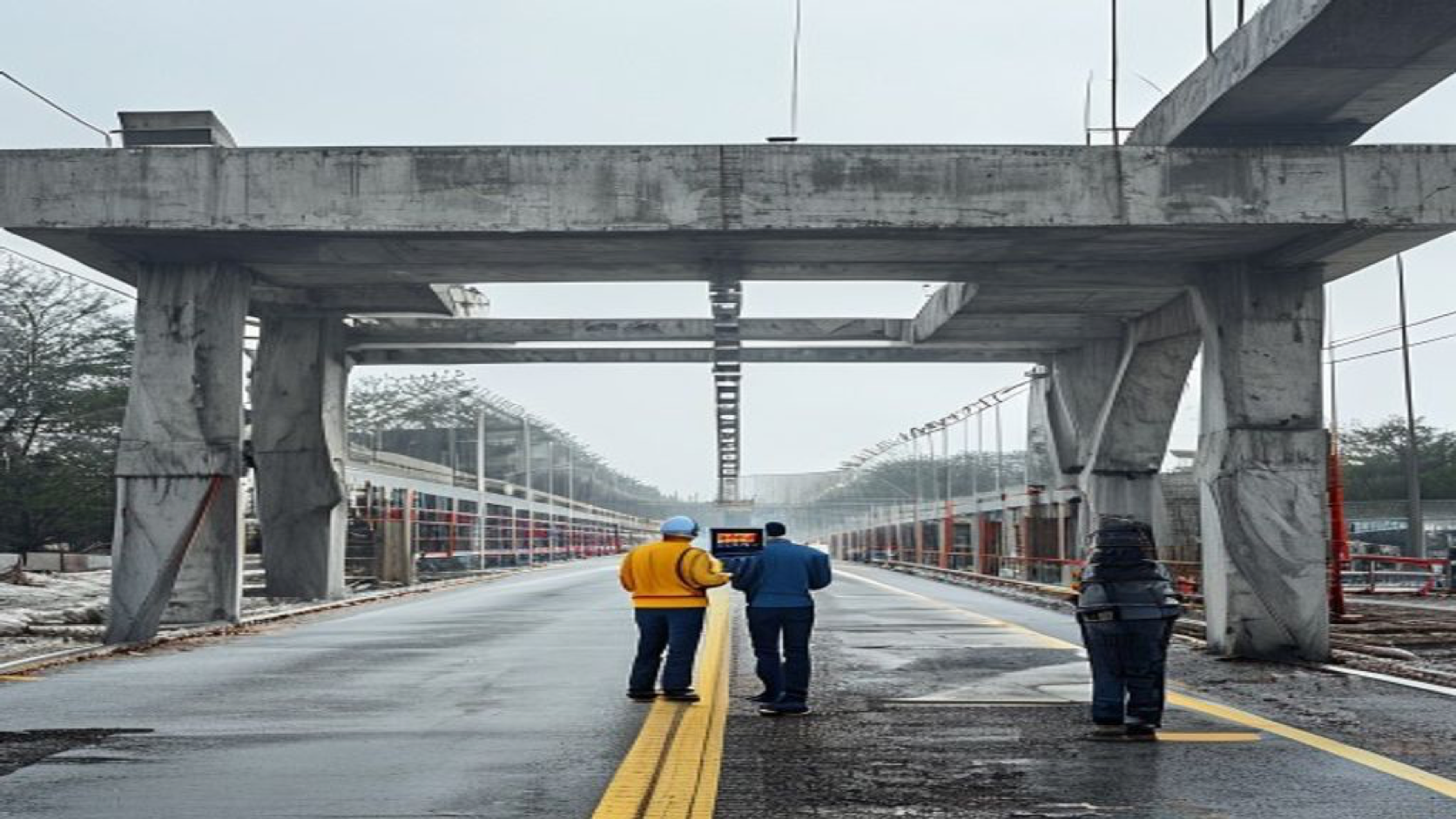
The FIU pedestrian bridge was intended to make a dangerous crossing safer. It instead became a test of whether a modern design-build project could recognize that a structure under construction had ceased to be an engineering problem managed within the project and had become an immediate threat to workers and the travelling public. On 15 March 2018, the 174-foot main span stood over SW 8th Street five days after accelerated bridge construction techniques had moved it from a casting area onto its permanent piers. Severe cracks were visible near the north end. Engineers and project representatives met that morning. Traffic continued underneath.
During retensioning of post-tensioning rods in diagonal member 11, the nodal region failed and the span fell onto vehicles below.
The NTSB completed-investigation page provides the controlling concise account: one bridge worker and five vehicle occupants died, five bridge workers and five other people were injured, and eight vehicles were at least partly crushed. It identifies probable cause as load and capacity calculation errors by FIGG in the main-span member 11/12 nodal region and its connection to the deck. It identifies an inadequate peer review by Louis Berger as contributing, along with the engineer of record's failure to recognize the significance of the cracking and obtain independent review of the remedial plan.
It also identifies failures by MCM, FIGG, Bolton, Perez and Associates, FIU and the Florida Department of Transportation to cease work when cracking became unacceptable and to close the roadway as necessary. Those are transportation-safety findings. They do not determine criminal guilt, contractual damages, professional discipline or the value of any civil claim.
That boundary is not a formality. The collapse generated parallel processes with different standards: a federal transportation investigation, occupational-safety analysis and enforcement, professional and contractual consequences, bankruptcy and civil resolution, and institutional reform. A probable-cause finding answers why the event occurred for prevention purposes. A citation addresses a statutory workplace duty and may be contested or resolved. A contract allocates services but does not by itself prove negligence. A settlement can provide remedy without admitting every allegation.
An accountability analysis must connect those tracks without merging them.
Design-build distributed work but could not distribute the safety outcome
FIU was the project owner and a federal grant recipient. MCM was the design-builder. FIGG was the design consultant and engineer of record. Bolton, Perez and Associates served FIU as the construction engineering and inspection consultant. Louis Berger performed an independent peer review under contract with FIGG. FDOT administered local-agency and road interfaces in a project involving federal funds and a state highway. Specialized firms handled post-tensioning, transport and other construction work.
The NTSB public docket preserves 126 items that make this allocation visible: contracts, criteria, calculations, plans, crack reports, meeting records, photographs, interviews, materials tests and party submissions. The docket is a primary evidence repository, but a document's presence there does not make every statement in it an adopted Board finding.
Design-build can join design knowledge to construction means and sequence. That integration can shorten feedback loops and let constructability shape design early. It can also create a dangerous ambiguity if participants assume that the party closest to a problem necessarily controls every protective decision. A designer may identify a structural concern but not control traffic devices. A contractor may control labor and equipment but defer to the engineer on structural meaning. An inspector may document conditions yet treat design interpretation as outside its remit. An owner may expect its consultants to direct technical work.
A road authority may wait for a formal closure request. The public receives no protection from the elegance of those distinctions if nobody treats a credible collapse hazard as sufficient to stop exposure.
The project agreements matter because they identify the expected channels of authority and information. The FIU–MCM design-build contract records the owner's relationship with the entity responsible for design and construction. The MCM–FIGG agreement records the designer's services and responsibilities to the design-builder. These primary contracts help establish role architecture, not ultimate fault. Contract language must be read with governing law, project specifications, professional duties, later directives and actual conduct.
It is particularly unsafe to infer that a duty allocated to one party eliminates another party's independent responsibility to protect workers or the public when it knows of a grave hazard.
An accountability map must therefore attach decisions to evidence. FIGG controlled design calculations and interpretation; MCM controlled construction; Bolton, Perez held inspection functions; FIU held the owner interface; FDOT held defined roadway and local-agency functions; and Louis Berger controlled its accepted review. Several actors needed authority to stop exposure, while restart needed named, qualified approvals. The project had roles but no reliable veto against catastrophic uncertainty across both work and traffic.
The node was a load path, not a detail to be assumed safe
The bridge's visual concept was a concrete truss with a broad deck and canopy joined by a single central row of diagonal and vertical concrete members. During the stage that existed on 15 March, the main span was simply supported between the south pier and the pylon pier; the back span, continuity system and upper pylon that would form the completed configuration had not yet been added. This meant the as-built structure had to be safe in a temporary construction state with its own load path. A final-model result could not prove every intermediate configuration.
At the north end, diagonal member 11 met the deck near vertical member 12. The connection transferred substantial horizontal force through a nodal region and a concrete interface. The NTSB adopted Highway Accident Report HAR-19/02 found two linked design errors. The design team underestimated demand at the node; post-collapse calculations indicated demand nearly twice the design calculation. It also overestimated the node's capacity to resist interface shear, including through incorrect loads and load factors. The result was an underdesigned region unable to carry the imposed demand.
This is the Board's technical conclusion, not a generic claim that all unusual concrete trusses or accelerated bridge projects are unsafe.
The error illustrates why a calculation package is not an assurance system merely because it is extensive. Software produces results from the model, load cases, boundary conditions, member idealizations and combinations supplied to it. A model that represents a diagonal primarily through axial action may not expose local forces at a node adequately. A capacity calculation can look internally coherent while applying a favorable load factor where a conservative one is required or counting compression that should not contribute in the same way. The control objective is not that a licensed engineer ran analysis.
It is that independent evidence proves the modeled force path corresponds to the structure in each critical state and that demand is compared with capacity using the correct governing provisions.
The released superstructure design calculations are therefore valuable as a decision record. They show what was analyzed, how results were organized and what an independent checker could have interrogated. They should not be read as if every page carries equal causal weight, and raw calculations in the docket are not adopted findings unless the final report says so. A sound audit would trace the demand at node 11/12 from global analysis into local interface-shear and reinforcement checks, confirm load combinations and factors, reproduce the result independently, and reconcile the calculation with drawings and the actual construction sequence.
Post-collapse physical testing helped separate design inadequacy from alternative explanations. The FHWA Turner-Fairbank report on the concrete interface beneath members 11 and 12 documented recovered specimens and interface conditions. The NTSB materials report on member 11/12 surface roughness supplied another bounded physical record. These reports describe examined samples and measurements; they do not independently allocate organizational fault. The Board concluded that even assuming a more favorable roughened interface, the node still lacked sufficient capacity.
That distinction prevents the cold joint from becoming a simplistic substitute for the calculation failures.
The NTSB materials laboratory summary of FHWA steel and concrete testing likewise provides evidence about the recovered materials. Materials testing is essential when investigators must distinguish deficient strength, placement, reinforcement behavior or interface performance from analytical error. But satisfactory values for some samples cannot certify the whole structure, and an anomalous sample cannot by itself prove the failure sequence. Sample location, extraction damage, test method and representativeness remain part of the boundary.
Here the decisive design question remained whether the node had enough capacity for the demand imposed on it.
Independent peer review failed at the point where independence mattered
The project required an independent peer review because the bridge was a complex category 2 structure. Independence meant more than assigning a different company name. It required a qualified reviewer, an adequate scope, enough time and fee to perform the work, access to the design basis, independent analytical models and a closed record of comments and responses. Most importantly, it required checking the forces and connections whose failure could remove the load path.
The FIGG–Louis Berger peer-review agreement is primary evidence of the accepted contractual scope. The NTSB found that Louis Berger analyzed the structure as one unit but did not analyze different construction configurations or individual nodal areas. The reviewer had initially contemplated a more thorough scope, including independent models and connection analysis, but the final work proceeded within reduced time and cost. Contract history explains how scope was formed; it does not excuse a signed certification if the work performed was insufficient for what the certification represented.
The failure has two layers. First, FIGG's original proposal did not include the required independent firm review, and its later procurement did not secure the comprehensive check needed for this unusual structure. Second, the peer reviewer failed to detect the severe underdesign at node 11/12. The NTSB also found that Louis Berger was not qualified by FDOT for the relevant complex concrete bridge work type, even though an FDOT website had listed it as prequalified, and that FIGG and FDOT missed verification opportunities. This is not a reason to treat a qualification letter as a guarantee.
It is a reason to make qualification status a controlled, dated evidence object verified directly before engagement and again before certification acceptance.
Peer review must challenge the architecture of the analysis, not mirror its outputs. For this bridge, a sufficient protocol would identify each construction stage, each support condition, each post-tensioning operation and every critical node. The reviewer would create an independent global model, extract forces at the same interfaces, independently calculate local capacity and reinforcement, and document discrepancies. It would test whether a member treated as a truss element in the global model transfers bending, shear or local force effects at its joint.
It would verify that all drawings and calculations describe the same reinforcement and interface assumptions.
Certification must then describe the scope truthfully. A sealed letter saying that an independent peer review was conducted can create institutional reliance far beyond the reviewer's office. Designers, owners and agencies may treat it as proof that calculations have been checked. If construction stages or nodes were excluded, the certificate should state that exclusion prominently and identify who owns the omitted check. A generic certification attached to a limited review is worse than no certificate because it converts absence of evidence into positive assurance.
The NTSB's recommendations after the collapse targeted that gap: checking and verifying design calculations for all nodal forces in category 2 bridges, confirming reviewer qualifications and strengthening related guidance. Those recommendations are evidence of a repair direction. They do not establish retroactive legal duties beyond the standards then applicable, and implementation on paper does not prove that reviewers now test the right failure modes.
Durable proof would require sampled project files showing independent stage models, node-level calculation reconciliation, resolved comments and agency verification of reviewer qualifications before acceptance.
Accelerated construction changed the evidence that had to be controlled
Accelerated bridge construction was not identified by the NTSB as the probable cause. Moving a large prefabricated span can reduce the time traffic is disrupted and shift work into a controlled casting area. The accountability issue is that movement and support changes create distinct structural states. Temporary post-tensioning may be needed during casting, transport or erection and later released. Loads redistribute when the span is lifted, set on bearings, connected to another span or made continuous. A safe final design does not automatically make those transitions safe.
The NTSB Bridge Factors Group factual report assembles the intended construction sequence, agreements, correspondence and field chronology and is primary evidence of what contractors and reviewers were expected to follow. The main span was transported and installed on 10 March. Temporary post-tensioning bars in members 2 and 11 were destressed after placement. Cracking around the north nodal area became highly visible. This sequence created a vital comparison: what did the design predict would happen when the temporary force was removed, what was observed, and did the observation remain within the predicted service behavior?
The correct response to a discrepancy is not to search first for a benign label. It is to preserve state, limit exposure and resolve the mismatch. Concrete cracks can have many causes and not every crack indicates imminent collapse. Width alone is not a universal failure meter. Location, orientation, depth, progression, associated displacement, load state and structural role determine meaning. Yet wide, growing cracks at a highly loaded node, especially when calculations cannot reproduce them, are not cosmetic evidence. They are a falsification of the current assurance claim.
The construction record shows that cracks were not a single discovery on the morning of collapse. The first Bolton, Perez crack report and second crack report document earlier distress observations while the span remained in the casting area. These reports are contemporaneous evidence, not after-the-fact causal judgments. Their accountability value lies in establishing when conditions were recorded, who received the information, how the cracks changed and what response followed.
After the span was moved, cracks at the north end expanded and new documentation circulated. The 13 March FIGG email to MCM records part of the design-construction communication surrounding proposed remedial work. An email can establish that a message was sent and what it said. It cannot prove that every recipient understood the structural significance, that all attachments were reviewed or that the proposed action was safe.
A controlled distress process would require a formal condition classification, a named structural authority, documented load restrictions, immediate shoring criteria, independent validation and a restart authorization—not merely circulation of messages.
The OSHA engineering investigation offers a separate technical perspective. Its official investigation page identifies a roughly 930-ton span and the worker and motorist consequences; the linked Directorate of Construction engineering report concludes that the cracks were numerous, wide, deep and structural, that FIGG failed to recognize collapse danger, and that the bridge should have been shored and SW 8th Street closed. OSHA's engineering analysis informs workplace hazard and structural understanding.
It does not replace the NTSB's probable-cause findings, and the report itself does not prove the final disposition of every citation issued to every employer.
The morning meeting converted uncertainty into a duty to protect
By the morning of 15 March, project participants had both distress evidence and unresolved analytical uncertainty. They met to discuss the cracks and FIGG's plan to retension the post-tensioning rods in member 11. Two contemporaneous records exist: the Bolton, Perez meeting minutes and the FIGG meeting minutes. Differences in notes should not be smoothed into one reconstructed quotation. Each record has its author, selection and timing. Together with interviews and the final report, they show the subjects discussed and the continued representation that the cracks did not present a safety concern.
The FIGG presentation used for the 15 March review is especially important because it shows how the condition was framed before the failure. A presentation can reveal the analysis and photographs placed before decision-makers, but it does not establish that unshown alternatives were considered or that a remedial hypothesis was validated. The engineer of record could not replicate the observed cracking through its calculations. That should have increased uncertainty and protection. Instead, the inability to explain the cracks coexisted with confidence that they were not a safety issue.
This is a recurring safety pathology: model confidence survives contradictory field evidence. Engineers may assume the structure is safe because the design says it is safe, then interpret distress as a secondary effect that can be corrected within the design. But when the physical structure behaves in a way the analysis does not predict, the model has lost its status as sufficient assurance. The burden reverses. Work should not continue over the public while the project asks the structure itself to test a remedial theory.
Retensioning was not a passive observation. It changed force in the already distressed region and put workers on or near the structure. A remedial operation should have had a sealed method statement based on a demonstrated causal diagnosis, checked calculations for the operation, independent review, instrumentation and abort criteria. It should have stated how workers would be positioned, how the span would be supported, who monitored cracks and displacement, who could stop the jack, and what traffic exclusion was required. If the origin of distress remained unknown, shoring and closure were prerequisites, not optional precautions.
The most consequential institutional fact is that traffic continued under the span. Closing a major arterial imposes disruption and requires coordination, but inconvenience is not a counterweight to credible collapse risk. The FDOT construction-administration guidance on maintenance of traffic and project shutdown helps identify the administrative context for traffic-control action. It is not a judgment assigning sole closure responsibility to FDOT. The NTSB found that multiple participants failed to take appropriate action.
The important control principle is that uncertainty about which entity issues the final traffic order cannot justify leaving traffic exposed while participants resolve the paperwork.
A conservative closure protocol would separate recommendation, authorization and execution. Any licensed project engineer, inspector, contractor safety lead or owner representative should be able to trigger an immediate protective hold when structural distress may threaten a live roadway. The designated road authority should have a continuously available channel to authorize closure. The contractor should have traffic-control resources ready to execute it. One named incident lead should verify lanes are physically clear before structural work begins. Restart should require written structural clearance and independent review.
This architecture provides several paths to safety but one visible proof of closure.
Collapse, rescue and physical evidence
At about 1:46 p.m., workers were retensioning rods in member 11. Video captured concrete failure near member 12, loss of geometric stability and collapse in less than two seconds. The main span fell across westbound lanes and crushed vehicles. The NTSB security-video factual report preserves frame timing and viewpoints used in reconstructing the sequence. Video evidence is powerful for timing and visible motion, but it does not reveal internal force directly, identify every fracture's microscopic initiation or determine legal responsibility.
Emergency responders then faced a massive unstable concrete scene with trapped occupants, damaged vehicles, construction materials and the possibility of further movement. Rescue, recovery, scene preservation and infrastructure control had to occur together. The fatalities and injuries were not an abstract consequence added after a technical failure. They were the foreseeable exposure created by keeping workers on a distressed structure and motorists underneath it. This is why the road-closure failure contributed to severity even though it did not create the node's deficient capacity.
The investigation combined physical recovery, photographs, materials testing, design files, calculations, correspondence, interviews and video. No one evidence class was enough. Fracture position helped reconstruct sequence; calculations compared expected demand and capacity; materials tests evaluated alternative hypotheses; crack photographs established progression; meeting records identified contemporaneous understanding; contracts mapped roles. The reliability of the conclusion came from convergence, with the adopted report explaining which factual material the Board accepted.
Post-collapse presentations continued to test competing interpretations. The FHWA assessment of FIGG's factor-of-safety presentation is an example of technical challenge in the public docket. It should be attributed as an FHWA assessment, not treated as a judicial rebuttal or an independent disciplinary decision. Its larger lesson is procedural: safety-critical disagreements should be resolved through reproducible calculations with declared assumptions, not through the authority of competing slide decks.
This evidentiary structure also sets limits on claims about intent. The record supports findings about calculation errors, inadequate review, misunderstood cracking and failures to protect. It does not support saying that project participants intended the collapse or knowingly chose fatalities. Accountability does not require that claim. Professional systems are designed because sincere confidence can be wrong, schedule pressure can narrow attention and fragmented authority can prevent obvious precautions. The duty is to build controls that remain effective when judgment fails without malicious intent.
Investigation, enforcement and remedy remained separate tracks
The NTSB report allocated causal and contributing findings at an actor-specific level. FIGG's design calculations underdesigned the critical node. Louis Berger's peer review failed to catch those errors. FIGG's engineer of record failed to recognize the significance of cracking and secure independent review of the remedial plan. MCM, FIGG, Bolton, Perez, FIU and FDOT failed in the collective protective response as described by the Board. Those findings should not be diluted into “the bridge industry failed,” nor exaggerated into criminal verdicts.
OSHA's engineering report was not the final enforcement result. The agency's FIGG inspection record shows a closed case, one current serious violation, a current penalty of $9,054 and an administrative-law-judge decision as the latest event; the initial penalty had been $12,934. The MCM inspection record shows a different disposition: the case closed with one current serious violation and a $12,934 current penalty after a second initial citation was deleted, again with an administrative-law-judge decision listed.
These database entries support the final status and current penalty fields, not a claim about what was ultimately collected or a civil finding. Worker enforcement also covered employees, while transportation and owner controls had to protect motorists outside the worksite.
Professional discipline followed its own procedure. The Florida Board of Professional Engineers' case page for W. Denny Pate says the Board accepted his voluntary relinquishment of his Florida Professional Engineer license and his waiver of the right to reapply. That is a concrete qualification consequence. It should not be enlarged into a finding about another engineer or firm, a damages award, or a substitute for the NTSB's technical analysis.
Bankruptcy and remedy require equally specific boundaries. An official Army legal-system bankruptcy action record records Munilla Construction Management's Chapter 11 filing on 1 March 2019 under docket 19-12821. FIU's Board of Trustees 21 November 2019 meeting minutes record the mediated proposal presented to the Board: a separate $9.5 million payment to FIU, funding not drawn from amounts earmarked for the personal-injury plaintiffs' group, releases and a contemplated bankruptcy-court bar order, with Louis Berger identified as outside the global settlement at that point.
The minutes are evidence of the proposal and institutional decision record, not a claimant-by-claimant allocation schedule or proof of liability. Chapter 11 organized claims and settlement channels; it did not determine why the bridge failed.
FIU also had continuity obligations after the collapse. The original safety purpose still existed: pedestrians needed a safe connection across SW 8th Street. The institution had to preserve records, cooperate with investigations, support affected people, manage the failed project and decide how any replacement would be designed and overseen. Public-sector legitimacy required more than completing a new bridge. It required showing that a future owner team could challenge designers, validate peer-review scope and close a roadway without ambiguity.
Civil payments, bankruptcy administration and license action are therefore bounded outcomes, not one accountability score. None proves implementation of bridge-safety reform, and none can be substituted for another track's source or legal standard.
Reform must be tested against the exact failed controls
The NTSB issued recommendations to FHWA, FDOT, AASHTO and FIGG. Their themes included peer review of nodal forces, qualification verification, redundancy guidance, bridge-owner procedures for responding to structural distress and design-company controls. A recommendation is a precisely addressed request for corrective action. Closure by the NTSB can indicate that the recipient supplied an acceptable response, but it does not certify all implementation indefinitely or every project in the jurisdiction.
Documentary implementation can be tested separately from recommendation status. The 2026 FDOT Design Manual, Part 1 preserves a current independent-peer-review workflow whose certification forms identify the independent review firm, reviewer and IPR quality-assurance manager. That is evidence that qualification and review accountability have been put into an operative departmental document. It is not evidence that every project used the workflow correctly, that every critical node was independently recalculated, or that an owner acted properly when distress appeared.
A release audit still needs dated prequalification verification, the accepted review scope, independent models, comments and responses, sealed certifications and field proof that distress and closure procedures worked.
The first durable-control test is calculation traceability. For each category 2 or otherwise complex bridge, the assurance file should identify critical nodes and load paths, list every construction state, map global model outputs into local design checks and record independent reproduction. Automated extraction can help compare forces across models, flag missing nodes and detect differences between drawing revisions and calculation inputs. Automation cannot decide whether a model represents the real load path. A qualified engineer must own that judgment and explain it.
The second test is peer-review independence. Procurement records should show required qualifications verified directly with the agency, scope tied to failure consequences, sufficient resources, independent software or hand checks where appropriate, and unfiltered communication with the owner and road authority. Certificates should enumerate what was reviewed: final configuration, temporary supports, erection, transport, destressing and restressing, every critical connection, reinforcement, bearings and interfaces. Exclusions should be treated as open risks requiring another identified reviewer, not hidden in fee correspondence.
The third test is crack governance. Every crack report should carry a unique identifier, dated photographs with scale and orientation, location on controlled drawings, measured width and length, depth where assessed, load state, trend and classification. The system should link each observation to an engineering disposition and a named reviewer. Repeated reports should plot progression automatically. Thresholds must be conservative around primary load paths, while preserving the rule that not every crack proves imminent failure. If observed behavior is not predicted, the condition should default to unsafe pending independent resolution.
The fourth test is remedial-work control. A remedial calculation must begin with a validated cause. The method should show how each operation changes demand and capacity, specify shoring, define worker exclusion zones and traffic controls, and include instrumentation and stop criteria. Independent review should be completed before work, not sought after an intervention begins. A toolbox talk or engineer's presence is not a substitute for a checked method.
The fifth test is public-exposure control. Project plans should name the people authorized to request and execute road closure at every hour, provide direct contacts and specify automatic closure triggers. Drills should prove that lanes can be cleared within the required time. Contractual arguments can be resolved after closure. Records should show the trigger time, decision time, physical closure time, verification and restart basis. For work over a roadway, traffic status should be a required field in the structural work permit.
The sixth test is owner competence. A public owner using design-build cannot outsource its ability to understand whether assurance is complete. It needs an engineering governance lead independent of commercial delivery, access to calculations and peer-review comments, and authority to question certifications. Its construction inspector must have a direct escalation route to that lead. The owner should commission periodic assurance audits that sample technical content, not just check that documents exist.
Finally, reform needs adverse evidence. A credible program records late calculations, unresolved review comments, scope reductions, unexplained field behavior, near misses, rejected closure requests and work started without complete permits. Boards and agencies should review those exceptions across projects. If only completed certificates reach leadership, the system recreates the false reassurance seen before the collapse.
A reconstruction audit for future design-build projects
The FIU record suggests a practical audit sequence. Begin by freezing the physical configurations. Draw the structure at casting, transport, placement, destressing, back-span construction, continuity and completion. For each state, identify supports, imposed loads, tendon forces, restraints and critical nodes. Do not allow one “final” model to represent all of them without demonstrated equivalence.
Next, reconstruct the calculation chain. Start with source drawings and material assumptions. Reproduce global actions, extract local forces and independently compute connection capacity. Check that load factors are applied according to whether a load stabilizes or destabilizes the interface. Confirm reinforcement crosses the relevant shear plane and that construction tolerances and surface assumptions are bounded. Record every discrepancy and its disposition.
Then reconstruct review scope. Compare the work required by procurement and agency guidance with the reviewer's proposal, contract, model files, comments and certification. Verify qualification on the dates of engagement and certification. Ask whether the reviewer checked each construction configuration and node, and whether fee or schedule changes reduced safety-critical scope. If an exclusion existed, identify who accepted it and who performed the missing work.
Reconstruct field evidence as a time series. Place each crack photograph and report on the configuration timeline. Record who saw it, what structural explanation was proposed, whether width or progression was measured, and what exposure remained. Separate a contemporaneous observation from a later interpretation. Identify the first point at which the structure's behavior contradicted the design model and the first point at which a reasonable protective hold should have begun.
Reconstruct decisions on 15 March minute by minute. Compare the meeting records, presentation, calls, emails, crew instructions, traffic status and work sequence. For each organization, ask what information it possessed, what authority it could exercise and what it did. Avoid saying that everyone had identical knowledge. Also avoid allowing incomplete knowledge to excuse a party that possessed enough evidence to stop its own work or demand closure.
Finally, test remedy against failure. Has the owner adopted a distress protocol? Do contracts empower multiple people to stop exposure? Are reviewer qualifications verified? Do scopes explicitly cover nodal forces and construction stages? Can the road actually be closed quickly? Do audits inspect model files and calculations? Have similar cracks or scope disputes occurred, and how were they resolved? The result should be an evidence matrix, not a declaration that lessons were learned.
The accountability standard
The FIU collapse was preventable not because every participant should have predicted the exact two-second failure sequence, but because the project had several opportunities to reject unsafe uncertainty. Correct node calculations could have changed the design. A comprehensive independent peer review could have detected underdesign. Proper qualification checking could have challenged reviewer selection. Progressive cracking could have triggered shoring and an independent reanalysis. The morning meeting could have suspended retensioning. Any effective road-closure action could have removed motorists from beneath the span.
Those opportunities belong to different actors and must remain distinct. FIGG owned the integrity of its design and its interpretation of distress. Louis Berger owned the adequacy and truthfulness of the review it performed and certified. MCM owned safe execution through the design-build chain. Bolton, Perez owned its inspection and escalation functions. FIU owned institutional assurance and the owner response. FDOT owned its defined road and local-agency oversight functions. None of those statements makes each actor equally responsible for every failure, and none converts NTSB findings into legal verdicts.
The institutional lesson is that design-build integration must be matched by assurance separation. The engineer who creates a model should not be the only authority deciding whether contradictory cracks are safe. The reviewer should not let the designer's budget silently define what “independent” means. The contractor should not begin a force-changing remedial operation without a checked method. The inspector should not treat documentation as completed duty when a condition may be catastrophic. The owner and road authority should not allow uncertainty over jurisdiction to keep live traffic beneath a distressed span.
Public infrastructure earns legitimacy through evidence that survives bad news. For a bridge, that evidence is a verified load path in every relevant configuration, an independent check that reaches the critical details, field monitoring capable of disproving the model, conservative stop-work and closure rules, and records showing that corrective action works. FIU's pedestrian bridge failed all the way from calculation to public exposure. Accountability is complete only when future projects can demonstrate, before crisis, that no single optimistic judgment can defeat the controls meant to protect workers and the public.