
Summary
- FiberCorp is best read as a local San Juan del Rio access provider whose public promise is no-contract, accessible internet service, while the independent network record is limited to AS270131 and one currently visible IPv4 /24 route.
- The economic question is whether local installation, support and cancellation flexibility can offset the risk that public route collectors show a narrow upstream and prefix surface, especially when national fibre, cable, mobile and satellite substitutes are easy for customers to compare.
- The evidence supports the Regional ISP category and the network-resource topic, but it does not support claims of large coverage, resilient multi-homing, IPv6 reach in the default-free zone, enterprise-grade service quality, customer satisfaction, churn performance or profitability.
The paid unit is a local fibre account, not a national network
A FiberCorp customer in San Juan del Rio is not buying a national telecom franchise. The practical unit is simpler: a local broadband account, installed at a home, shop, workshop or small office, with a monthly bill, a support phone number, a cancellation option and an expectation that streaming, remote work, payments, messaging and basic business operations will keep moving. That is the unit the article prices.
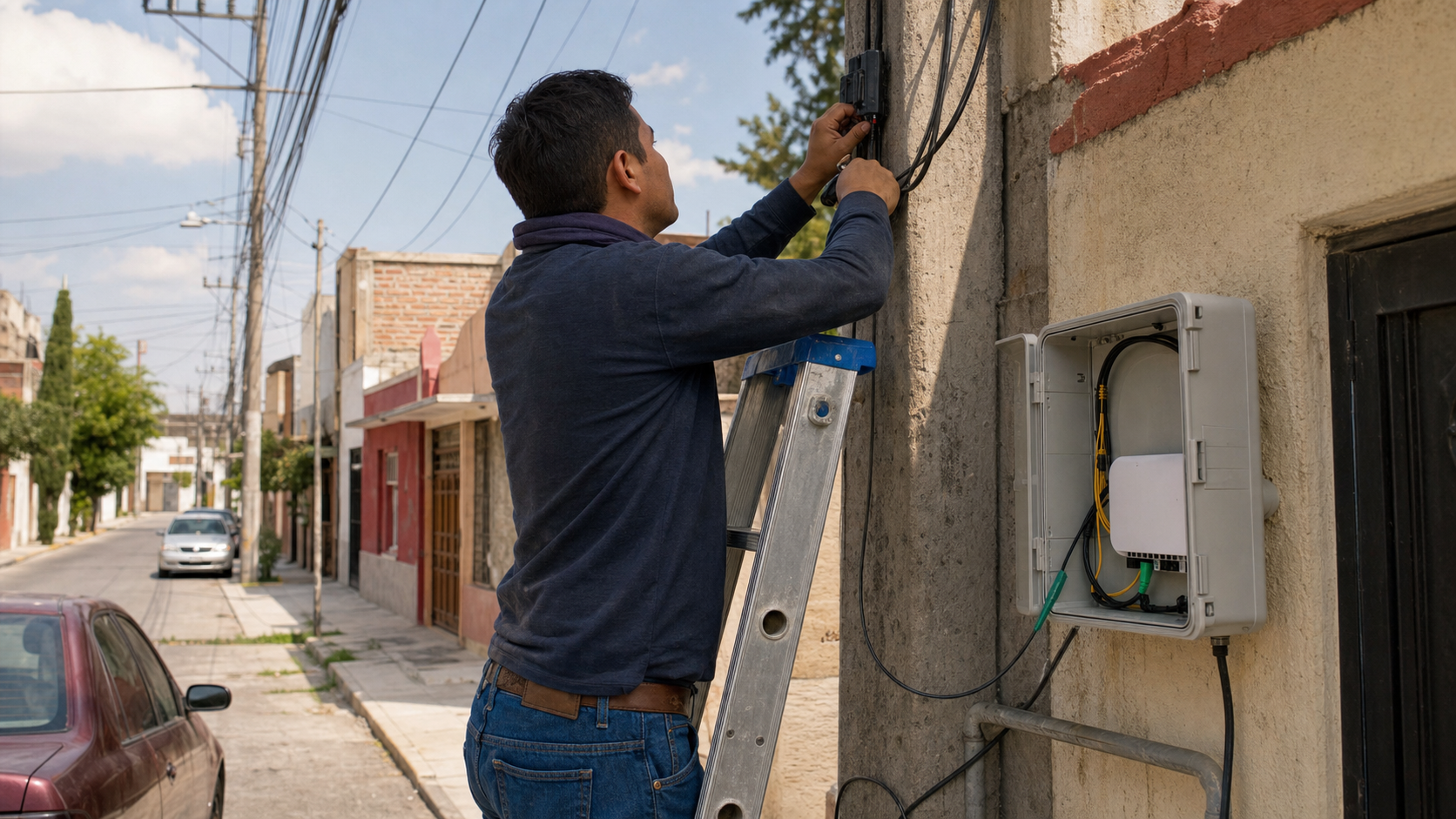
The customer pays for internet access and for the field organisation behind it: the person who checks coverage, the crew that pulls a drop, the router or optical terminal placed in the premises, the upstream bill that carries traffic out of the local network, and the support response when the connection fails.
That paid unit is visible in public material, but only through a thin trail. FiberCorp's public Facebook presence describes the business as a telecommunication company in San Juan del Rio and indexes the offer as accessible, fast and secure internet with no forced terms, giving local contact numbers at the FiberCorp page and in a FiberCorp post. The same social evidence is not a substitute for a tariff sheet, coverage map, uptime record or signed contract. It is enough to show current market-facing service language; it is not enough to prove the size of the customer base, the quality of installation, the installed kilometres of fibre, the number of active neighbourhoods or the service history after storms, construction cuts and payment disputes.
The legal and network identity is clearer than the retail marketing trail. PeeringDB lists the organisation as FIBRA Y SOLUCIONES LATINOAMERICANO SA DE CV, also known as FIBERCORP, with an address on Avenida Francisco Perez Rios in Barrio San Isidro, San Juan del Rio, Queretaro, and an associated network named FIBERCORP on ASN 270131 at the PeeringDB organisation record. LACNIC RDAP records identify AS270131 as an active direct allocation to FIBRA Y SOLUCIONES LATINOAMERICANO SA DE CV, with San Juan del Rio address data, in the LACNIC autonomous-number record. Those records make it reasonable to tie the public-facing FiberCorp name to the responsible organisation behind the routed resources. They do not, by themselves, prove the customer proposition, because a registry holder can own resources without having a large active retail base.
The strongest commercial description is therefore narrow. FiberCorp is a local Mexican internet-access provider associated with FIBRA Y SOLUCIONES LATINOAMERICANO SA DE CV and AS270131. It appears to sell no-contract access in San Juan del Rio. Its observable network footprint is real but small. Its value proposition has to be judged against household and small-business alternatives, not against a large carrier's national engineering budget. If a customer can leave without a long forced term, the provider has to win each month through installation convenience, local trust, billing clarity and sufficient service continuity.
That is the commercial mechanism.
San Juan del Rio gives that mechanism a meaningful market. Data Mexico reports that the municipality had 297,804 inhabitants in 2020 and had grown 23.2 percent compared with 2010 on its San Juan del Rio profile. That is not a village market. It is a large enough municipality for local broadband competition to matter, and it sits inside a state where industrial, logistics and household connectivity needs can overlap. Yet a population figure does not tell us how many streets FiberCorp reaches or how many customers are economically viable per kilometre of drop fibre. The business question remains local density: how many paying premises can be served from each splitter, pole route, backhaul path and support crew hour.
Why no-contract access changes the economics
No-contract selling is attractive to customers because it reduces fear of being trapped. It also changes the provider's risk. A forced term can help recover installation, customer-premises equipment, sales commission and truck-roll cost. Without that lock-in, the operator has to recover more of the build and support burden through either the installation fee, a higher monthly margin, disciplined coverage selection or customer retention earned by actual service quality.
Public FiberCorp material points to "sin plazos forzosos", or no forced terms, but it does not disclose the installation charge, the modem policy, the router ownership rule, the cancellation process, late-fee policy or the actual monthly tariff. The missing commercial details matter because they decide whether flexibility is a real customer benefit or simply a headline attached to other recovery charges.
In a local fibre network, the first month is expensive. The provider must validate coverage, dispatch a crew, pull fibre to the home or business, splice or terminate the service, install equipment, authenticate the customer and handle payment onboarding. If the premises is already passed by the provider's network, the incremental cost can be manageable. If the customer is at the edge of coverage or requires construction, the economics change quickly. The operator either refuses the order, charges installation, asks for a minimum commitment, or carries a payback period that depends on the customer staying long enough.
FiberCorp's no-contract claim is therefore not a decorative marketing phrase; it is a claim about who absorbs early-life churn risk.
The national context makes this harder. Mexico's fixed broadband market has moved toward higher speeds and fibre. The IFT's 2025 comparable tariff report says Telmex-Telnor, Izzi, Megacable and Totalplay place most or all of their analysed fixed internet and telephone plans above 50 Mbps, with double-play monthly ranges including Telmex-Telnor from 389 to 1,399 pesos, Megacable from 450 to 650 pesos, Izzi from 510 to 1,710 pesos and Totalplay from 570 to 1,470 pesos in the IFT fixed plans and tariffs report. The exact local offer seen by a household in San Juan del Rio will depend on address, promotion and bundled services, but the point is clear: customers can benchmark a local provider against large-brand price ladders and bundled benefits.
The official pages of national competitors show the same pressure. Totalplay advertises internet packages with IFT-registered tariffs and free installation promotions. Izzi shows residential internet tiers from 100-to-120 Mbps promotion levels through 1,000 Mbps, with regular prices and a 12-month contract language on several plans. MEGA describes fibre-optic internet and national package pricing from low promotional levels to 1,000 Mbps bundles. Telmex points customers to Infinitum home and business packages, and a March 2026 Telmex notice says it increased upload and download speeds in residential and business Infinitum packages while keeping the same price, moving packages such as 80 to 120 Mbps and 100 to 150 Mbps on the Telmex speed update page. FiberCorp does not need to match every national promotion, but it must give the buyer a reason not to default to one of those brands.
That reason may be local. A household may choose a local fibre provider if national installation is slow, if a block is not well served, if the local operator answers WhatsApp faster, if the monthly bill is lower, if the service has no long forced term, or if the customer trusts the local technician who knows the street. A small shop may value a provider that will come by quickly when a payment terminal or IP camera cannot connect. But none of those benefits can be assumed from a page title. Public evidence supports the possibility of local support and no-contract appeal; it does not verify the support record.
The article therefore treats support as the value FiberCorp must deliver, not as a proven advantage.
The one-prefix record is meaningful, but bounded
The network evidence is the strongest independent evidence in the case, and it is also the main caution. BGP.tools identifies AS270131 as FIBRA Y SOLUCIONES LATINOAMERICANO SA DE CV, registered in November 2020, active under LACNIC, operating in Mexico, and originating one IPv4 prefix and no IPv6 prefixes in its visible view. The visible IPv4 prefix is 45.177.177.0/24. Hurricane Electric's BGP Toolkit similarly lists AS270131 with one originated and announced IPv4 prefix, zero IPv6 prefixes, one observed IPv4 peer and 256 originated IPv4 addresses. RIPEstat's announced-prefixes data also shows 45.177.177.0/24 visible for AS270131 in the late-June to July 2026 query window.
That is real operating evidence. A visible /24 can carry customer traffic, network management systems, NAT pools, business endpoints or other service infrastructure. It is more substantial than a stale domain or an unannounced registry handle. It just does not show scale. Two hundred and fifty-six IPv4 addresses are not a large routed surface for a broadband operator if every customer required public addressing, and most residential ISPs avoid that by using private addressing, carrier-grade NAT or dynamic pools. A small public prefix can support a larger access base, but it still limits what outside observers can prove.
It does not reveal the number of subscribers, the amount of bandwidth sold, the contention ratio, the number of optical line terminals, the local backhaul design or the redundancy of the core.
The LACNIC allocation record is wider than the visible route. LACNIC RDAP shows the IPv4 resource as 45.177.176.0/22 allocated to the company in the LACNIC IPv4 record, with origin-autonomous-number fields including AS270158 and AS270131. A /22 is larger than the one currently visible /24 route seen by route collectors. The difference can have several explanations: the company may announce only one part of the allocation; another related or upstream network may originate other portions; some address space may be reserved, unused, privately routed, or not visible through the collectors checked; or visibility may vary by time and vantage point. The article does not infer unused capacity or hidden customers from the gap. It only notes that allocation and announcement are different forms of evidence.
IPv6 needs the same caution. LACNIC RDAP shows an IPv6 allocation, 2806:33f::/32, to FIBRA Y SOLUCIONES LATINOAMERICANO SA DE CV in the LACNIC IPv6 record. PeeringDB's network entry for FIBERCORP ASN 270131 claims IPv6 support and lists one IPv6 prefix, four IPv4 prefixes, 100-200 Gbps traffic, balanced ratio, open peering policy, one facility and zero exchanges. Current public route evidence does not match the full PeeringDB posture: BGP.tools, HE and RIPEstat show zero visible IPv6 originated prefixes and one visible IPv4 /24. PeeringDB is a useful network self-description and contact database, but it is not a live route collector. For this article, current routing wins over stale or unverifiable self-reported scale claims.
The upstream picture is also narrow. BGP.tools and HE identify Wantelco SAS de CV, AS270158, as the observed upstream or peer. RIPEstat's ASN-neighbours data shows one unique neighbour in the latest available view, also AS270158. CAIDA's AS Rank page for AS270131 lists a one-AS customer cone, one prefix, 256 addresses and one provider relationship. Those observations do not prove the contractual relation, bandwidth commit, failover options or physical path. They do show that the externally visible network is not obviously multi-homed in the checked sources. If AS270158 is the only practical transit path, a FiberCorp customer may be exposed to the reliability of both FiberCorp's access plant and that upstream relationship.
This is why the network evidence grade is medium, not strong. Strong evidence for a small local ISP would include active ASN and prefixes, visible announcements, current service pages, clear support contacts, perhaps an IXP port, multiple upstreams or transparent route objects aligned with service claims. FiberCorp has active ASN and current prefix evidence, and it has public-facing service language, but it lacks observable multi-homing, an IXP presence, visible IPv6 routing, a current tariff page and independently verified coverage. The right conclusion is neither dismissal nor exaggeration.
The network is real; the public route footprint is small.
What the customer is paying for
The customer is paying for a result, not for a BGP table. A household wants video calls, classes, gaming, streaming and messaging to work without negotiating with a call centre for days. A corner shop wants payments, inventory software, security cameras and messaging to stay connected. A small professional office wants invoices, cloud storage, tax platforms and client communication to keep working. The fibre line becomes economically important because ordinary activities now depend on it. But the buyer usually cannot inspect route collectors, upstream diversity or optical split ratios before ordering.
The buyer sees price, speed, installation schedule, word of mouth and cancellation terms.
That asymmetry is where local providers can win and lose. A national provider may have a larger backbone, standardised billing, a better app, more predictable tariff registration and a deeper support organisation. It may also be slow, impersonal or unavailable at a specific address. A local provider may install faster and answer directly. It may also be less resilient if one backhaul path, one upstream or one small technical team has a bad day. In a no-contract model, the customer can switch more easily, but switching still costs time.
The household must return equipment, schedule another installation, change Wi-Fi settings, reconfigure devices, and live through downtime. A shop may lose card payments or camera continuity during the change. Flexibility reduces the legal lock-in; it does not eliminate operational friction.
FiberCorp's economics therefore depend on three spreads. The first is the price spread against national and regional substitutes. If FiberCorp is meaningfully cheaper for comparable speed, the customer may accept a thinner public network footprint. If it is similar in price, the local provider must win on installation speed, cancellation flexibility or service relationship. The second is the reliability spread: if the local line works well in the covered area, the route table may matter less to ordinary customers; if outages are frequent, one-prefix and one-neighbour evidence becomes a warning sign.
The third is the support spread: if FiberCorp solves failures quickly, the provider can defend retention; if support is thin, no-contract customers can churn faster.
The cost base is local and dollar-linked at the same time. Fibre drops, poles, ducts, ladders, optical terminals, routers, splicing tools, fuel, technicians and backhaul capacity are local operating costs. Many electronics, optics and routing devices are imported or priced against dollar-linked supply chains. IPv4 addresses carry scarcity value even when the operator obtained them through a registry allocation rather than a spot purchase. Upstream transit and backhaul economics are affected by the bargaining power of larger networks.
A local provider with one visible upstream may have less leverage than a carrier with several routes, its own metro fibre, and presence at multiple exchanges.
Construction density is decisive. San Juan del Rio's population gives the market enough households and businesses to support local broadband niches, but only if coverage is chosen carefully. A provider that builds along dense streets, apartment clusters, small commercial corridors or neighbourhoods underserved by national fibre can recover plant costs faster. A provider that chases scattered customers across long aerial routes faces more faults, longer repairs, higher fuel cost and more expensive truck rolls.
The public record does not disclose FiberCorp's coverage map, so the analysis cannot say whether its build is dense or stretched. That missing fact would materially change the judgement.
This address-level uncertainty matters more for FiberCorp than it would for a carrier whose national maps and tariff sheets are already familiar to buyers. A customer in San Juan del Rio does not buy an abstract regional network; the customer buys service at one house, storefront or workshop. The commercial question is therefore whether FiberCorp can say yes at that exact address, whether installation can happen soon, whether the drop route is physically practical, and whether the price remains attractive after equipment and activation costs.
National plans can look cheaper in a table while still losing at the street level if the installation date is distant, the building is not passed, or the customer has already had a bad service experience. Local plans can look less documented while still winning when the technician can survey the site and connect the premise quickly.
The same logic limits what this article can infer from market-wide fibre growth. IFT's national data shows that fibre has become a mainstream fixed broadband technology in Mexico, and the national operators' public pages show increasingly aggressive speed tiers. That background raises the competitive bar, but it does not reveal whether one street in San Juan del Rio has three fibre choices, one cable choice, a weak wireless signal, or a single practical local provider. For FiberCorp, the missing coverage map is not a cosmetic gap. It is one of the facts that separates a plausible local ISP from a proven durable access business.
If FiberCorp is concentrated in neighbourhoods where national fibre is weak or slow to install, the no-contract promise can be an efficient acquisition tool. If it overlaps the strongest national fibre zones without a price, support or installation advantage, it has less room to defend churn.
This also explains why the analysis avoids turning small route evidence into a subscriber estimate. A /24 can be enough for a modest access network that uses private addressing or carrier-grade NAT; it can also be too small for a provider promising business-grade public addressing at scale. The public route table cannot tell which customer mix FiberCorp serves. Residential fibre, small shops, camera systems, point-of-sale terminals and small offices have different address, uptime and support needs.
Until the company publishes plan terms or business service options, the safer judgement is that FiberCorp is visible as a local access seller, but the exact revenue mix remains unproven.
Supplier and upstream dependence
The upstream question is not academic. A small access provider can be excellent at local field work but still fragile if its upstream transit, handoff or transport path fails. Public route data shows AS270131 next to AS270158, Wantelco. That does not mean every outage at FiberCorp would be caused by Wantelco, and it does not prove Wantelco's service quality. It means the outside-visible route path is narrow. If there are backup links, private circuits, wireless failover or alternate carriers, they are not visible in the checked route collectors. The public evidence therefore supports a dependence question, not a verdict.
PeeringDB intensifies that question because its self-reported record is richer than the live route evidence. The network lists an open peering policy, a route-set, high traffic band and IPv6 support, but zero exchanges. A network can have useful private interconnection without a public IXP entry, and PeeringDB records may be stale or incomplete. Still, a buyer cannot assume the PeeringDB claim equals real-time resilience. The mismatch is a watchpoint: if FiberCorp wants its network posture to reassure customers, a clearer public record would help.
That could be current website service pages, updated PeeringDB entries, visible IPv6 announcement, an IXP connection, multiple observed upstreams or published service terms.
The domain record also creates a public-trust issue. The network records point to fibercorp.com.mx, but Google public DNS did not return a normal A record for the apex in the checked fibercorp.com.mx A query, and www.fibercorp.com.mx returned an NXDOMAIN-style result. The domain still has nameservers in the NS query, but the public web address is not a usable service page in the checked state. That does not prove the provider is inactive, because the Facebook page and route records remain live evidence. It does mean the official web trail is weaker than a customer or analyst would want.
For a local provider, a dead or unresolving website has an opportunity cost. It makes tariff, coverage and support evidence harder to verify. It pushes customers toward social media, phone and word of mouth. Those channels can work locally, but they make the operator less transparent to customers comparing plans, and less legible to outside partners or business buyers. A business customer deciding between FiberCorp and a national carrier may care less about social engagement and more about written terms, fault escalation, invoice records, static IP availability, service-level language and legal contact details.
Competition is broader than fibre
FiberCorp's substitutes include fixed fibre and cable, but also wireless and satellite. The national fixed-line substitutes are the most obvious. Telmex, Totalplay, Izzi and Megacable/MEGA can compete on brand, bundles, apps, phone service, TV, promotions, installation offers and a bigger operational base. Their weaknesses may be address-level availability, bureaucratic support, forced terms, installation scheduling and inconsistent local service experience. A local provider can exploit those weaknesses only when it is genuinely faster, easier or more responsive.
Wireless substitutes matter because they attack the same flexibility claim. Telcel's WiFi Telcel page advertises home Wi-Fi plans with no forced terms and unlimited data language, while Telcel en tu Casa emphasises no installation appointment, no wiring and a modem the user plugs into power. That is not a perfect substitute for fibre. Wireless performance depends on cell capacity, signal, fair-use policies, latency and indoor placement. But for a renter, a small apartment, a temporary office or a customer tired of waiting for a technician, wireless can be good enough to discipline fixed providers.
Satellite is another substitute at the edge. Starlink service plans make satellite broadband a visible option for customers who cannot get satisfactory wired service or who value independence from local cable routes. It is usually not the cheapest replacement for urban fibre, and it requires equipment, sky view and a different support model. But it changes the ceiling on what a local monopoly can charge in poorly served areas. A local fibre provider in a covered neighbourhood can still beat satellite on latency, indoor convenience and local support; it cannot ignore satellite as an outside option.
Nearby local and regional providers also shape expectations. In Queretaro, Inanet advertises fibre-optic and TV service in Corregidora, Queretaro and Huimilpan, with no forced-contract language and support claims. ENI Networks advertises fibre-optic plans in Queretaro with visible Mbps tiers and monthly prices. These are not proof of FiberCorp's direct neighbourhood competition in San Juan del Rio. They are useful context: Mexican regional providers often sell on the same bundle of local availability, no forced terms, installation speed and support. FiberCorp's economic account belongs to that competitive family.
The practical result is that FiberCorp cannot rely on being the only alternative. It has to defend a local relationship account. The customer can compare against large national names, local/regional offers, mobile broadband and satellite. No-contract fibre can be powerful when a provider believes it can retain customers on service quality. It is dangerous when churn rises, because every early cancellation leaves unrecovered installation and support cost behind.
Regulatory and tariff uncertainty
Mexico's telecom market is regulated, tariffed and increasingly transparent in some areas, but FiberCorp's public record remains incomplete. The IFT fixed plans report provides a useful benchmark for the national offer set, and the IFT annual indicators show the structural direction of the market. The 2025 indicators report says accesses above 100 Mbps rose 225.2 percent between 2021 and 2024, mainly due to fibre deployment, and that fibre-optic fixed internet access rose from 23 accesses per 100 households in late 2021 to 51 per 100 households in the third quarter of 2024 in the IFT 2025 indicators report. This means the customer expectation floor is rising. A local provider selling fibre in 2026 is competing in a market where fibre and high-speed tiers are no longer exotic.
What is not verified is a company-specific IFT concession, authorisation, tariff registration or adhesion contract row for FIBRA Y SOLUCIONES LATINOAMERICANO SA DE CV. The public RPC portal exists and describes itself as the place for information on concessionaires in telecom and broadcasting at the Registro Publico de Concesiones, but searches in this research pass did not produce a clean, company-specific Fibra y Soluciones Latinoamericano record. That absence should not be overread. Search interfaces can be difficult, records can be under variant legal names, and small operators may appear through authorisations or reseller structures that are not easy to locate through ordinary web search. But the absence does matter for confidence. The article does not state that FiberCorp lacks a concession; it states that the concession and tariff proof was not verified from public sources here.
Regulatory proof would change the article's confidence. A public tariff registration for FiberCorp's exact plans would show price, speed, installation, contract term and legal entity. A public concession or authorisation row would show the formal right under which the service is offered. A published adhesion contract would clarify cancellation, equipment, dispute and quality obligations. Without those documents, the article can evaluate the service as a public market offer and network-resource holder, but it cannot audit the full legal operating surface.
The same caution applies to consumer protection. A local broadband provider's reputation is often made in fault handling: whether support answers, whether repairs arrive, whether invoices are clear, whether cancellation is honoured, and whether the customer can escalate a problem. Public search shows scattered social mentions involving FiberCorp and local internet use, but not enough consistent, independently verifiable review evidence to score customer sentiment. The proper treatment is weak market signal, not confirmed fact. There is no basis here to say customers love or dislike the service.
There is only a basis to say that the public review trail is thin.
How to read the one-prefix footprint commercially
A one-prefix footprint is not automatically bad. Many small ISPs begin with a modest routed block and a single upstream while building demand. They can still provide good local service if their last-mile plant is well maintained, upstream capacity is adequate, and support responds quickly. A customer does not feel the number of public prefixes directly. The customer feels congestion, packet loss, latency spikes, DNS issues, power failures, fibre cuts, slow repair and bad billing. A small routing table can be economically rational if the access network is small and disciplined.
The risk is that smallness reduces margin for error. With one visible /24, one visible neighbour and no visible IPv6 announcement, outside observers cannot see a broad resilience design. If the upstream path fails, if capacity is underbought, if a routing error affects the /24, if the NAT pool is mismanaged, or if abuse handling is weak, the provider may have fewer public alternatives than a multi-homed operator. The question is not whether FiberCorp has a worse service than a national carrier. The question is what proof would justify trusting it for a household or business account.
The proof burden differs by customer. A residential customer may accept a local operator if the monthly price is attractive, installation is quick and neighbours report good service. A small office may need more: business support hours, static IP options, written response expectations, backup link recommendations and clear invoices. A multi-site business or industrial user should require even more: service-level language, route diversity, upstream detail, failover design, public IP policy and escalation contacts. FiberCorp's public record is not rich enough to satisfy the higher business proof burden without direct sales documentation.
The one-prefix record also affects how to interpret the headline. "Prices no-contract fibre against a one-prefix network" is not a claim that the network is only one physical fibre route or that it has only 256 customers. It means the public internet can currently see only one originated IPv4 /24 for the ASN in the checked sources. That makes the no-contract offer commercially interesting: the provider is asking customers to trust local access and support rather than a publicly broad routing footprint. The bargain may work, but the evidence does not let us call it resilient at scale.
What would change the judgement
The first fact that would change the judgement is a current FiberCorp tariff and coverage page. It should show speeds, monthly price, installation fee, equipment policy, cancellation terms, address coverage and business options. If it confirmed transparent no-contract terms and competitive pricing in San Juan del Rio, it would strengthen the commercial case. If it showed hidden recovery charges or vague coverage, it would weaken the case.
The second fact is route and upstream diversity. If current public data began to show multiple upstreams, an IXP presence, stable IPv6 announcement for 2806:33f::/32, more of the 45.177.176.0/22 allocation originated by AS270131, and clean RPKI/route-object alignment, the network-evidence grade would move upward. If the visible route disappeared, or if all service depended on a single fragile path, confidence would fall.
The third fact is customer experience. Verified reviews, complaint data, repair-time evidence, outage history, support-hour evidence and churn data would say whether no-contract flexibility is a sign of confidence or a source of revenue leakage. The article cannot infer that from registry data. It is the core missing proof.
The fourth fact is regulatory documentation. A clean public IFT tariff row, concession or authorisation record, and adhesion contract would clarify the legal frame and customer rights. Until then, the article treats FiberCorp as a visible local access provider and network-resource holder with incomplete regulatory trace in public search.
Bottom line
FiberCorp is not a cloud-service case and not a national telecom scale case. It fits the Regional ISP category because the first paid unit is access connectivity, the public offer is local internet service, and the company has live network-resource evidence tied to AS270131. The right topics are Regional ISP economics, Network-resource evidence, and Peering and transit. The evidence does not support SME Service Continuity as a topic, because explicit SME buyers are not at the centre of the public proof. It does not support Local Support Labour as a topic, because support performance and staff depth are not independently shown.
It does not support Cloud Service Dependency, because there is no customer-facing hosting or managed-cloud paid unit in the evidence.
The investment and operating question is whether a local no-contract fibre account can hold customers when national operators, wireless substitutes and satellite alternatives are visible. FiberCorp's advantage, if it has one, must come from local coverage, installation speed, practical support and monthly flexibility. Its public risk is that the visible route record is thin: one IPv4 /24, one observed neighbour, no visible IPv6 route, and a public website that does not currently resolve into a useful service page. That does not make the service unserious. It makes the proof burden higher.
For readers tracking internet infrastructure, FiberCorp is useful because it shows the edge of the broadband market where local trust, field economics and routing evidence meet. A small routed footprint can still support a real access business. A no-contract promise can still be commercially rational. But the public facts available now support only a disciplined, medium-confidence view: FiberCorp is a local San Juan del Rio fibre ISP with real but narrow public network evidence, not a proven large-resilience network, and not a business whose service quality can be judged without more customer, tariff and route-diversity proof.