
Topic
Registry Governance
Within the Topic facet, Registry Governance topic intelligence connects articles that share a specific subject, signal focus, or monitoring theme. The page gives readers a richer path through related reporting, source evidence, market actors, and infrastructure implications, with enough context to understand why the topic matters across company movements, governance decisions, regional exposure, and operational risk. Readers can compare recurring signals, affected organisations, public evidence, market context, service continuity, procurement, competition, compliance, and strategic planning questions behind the subject instead of stopping at a thin list of matching articles. It explains what the topic covers, which infrastructure actors or policies are involved, what evidence supports the coverage, and why the subject may matter for operators, customers, investors, and policy readers.

Story
The Election With Two Seat Numbers: What AFRINIC’s 2005 Central Africa Record Can Actually Prove
AFRINIC’s first regional Board renewal after recognition as an Internet registry delivered a named primary, a named alternate and a five-person Central Africa slate. It did not leave a reproducible public count. More awkwardly, the AFRINIC-2 report calls the contest Seat 5 while…

Story
Three Seats, Three Lines of Authority: AFRINIC's 2005 NRO Number Council Entitlement
On 25 April 2005, AFRINIC acquired an equal three-person place in the NRO Number Council, whose members also served as the ICANN ASO Address Council. That institutional equality was real, but it was never a blank cheque: the AFRINIC Board appointed and could replace only one…

Story
The Indian Ocean seat that the record can name but not reproduce
AFRINIC’s April 2005 renewal of Board Seat 6 returned the same two Mauritius-coded directors chosen at the founding election, satisfying the visible regional design while leaving a harder question unanswered: which member organisations authorised the ballot, and how did their…

Story
The rule that was not there: auditing AFRINIC-2’s first Number Council vote
The surviving record of AFRINIC’s April 2005 Number Council election draws a sharp line that later retellings can easily blur: candidacy was described as open to anybody, while geography appeared on the voter side. That distinction turns a seemingly narrow eligibility question…

Story
Fifth in Line, Equal at the Table: What AFRINIC’s Place in the NRO Chair Rotation Actually Meant
When AFRINIC joined the Number Resource Organization in April 2005, it entered an annual chair rotation behind the four institutions already in the queue. That ordering was real: it delayed AFRINIC’s turn to convene meetings and represent the NRO. But it was also bounded. The…

Story
The Symbolic Price of Joining the NRO
AFRINIC entered the global registry coordination compact in 2005 without the financial capacity to bear an ordinary pro-rata share of its costs. The solution was neither free admission nor reduced institutional standing: it was a negotiated initial contribution, explicitly…

Story
AFRINIC-1: The Meeting Where One Room Held Six Different Kinds of Authority
AFRINIC's first public policy-and-member meeting was an effective act of institutional assembly, but not a moment when everyone in Dakar became one constitutional body. The durable lesson of 23–24 May 2004 is that attendance, policy participation, corporate membership, election…

Story
Two Rooms, One Day: What AFRINIC’s 2005 English–French LIR Training Proves
On 23 April 2005 in Maputo, AFRINIC reported running English- and French-language training for the people expected to use its registry interfaces. The two rooms are meaningful evidence that language access moved beyond an institutional promise. They are not evidence that the…

Story
Twenty-three messages, no mandate: what AFRINIC’s recognition forum can actually prove
ICANN’s 21-day consultation preserved an unusually inspectable signal of support for AFRINIC, but the archive’s duplicates, missing denominator and unrecorded response path make it evidence of participation—not self-validating regional legitimacy.

Story
A /24, a Consensus, and the Decision AFRINIC-3 Did Not Finish
At AFRINIC-3, entities accepted the case for direct IPv4 assignments to qualifying end-user organisations, but the consequential word in the record is not “implemented”—it is “consensus,” the first of four states in a chain whose missing links still matter.

Story
The Contract That Put AFRINIC at the Inter-RIR Table
AFRINIC’s entry into the Number Resource Organization was neither a ceremonial welcome nor a charter to govern African networks. The short joinder signed in April 2005 mattered because it attached an African registry to a detailed bargain about voice, money, procedure and…

Story
The Registry That Was Already Running
On 21 February 2005, AFRINIC became the primary processor of African registry services while its final recognition was still pending and incumbent registries still reviewed allocation decisions. The six-and-a-half weeks that followed reveal precisely what a regional registry can…

Story
The Ledger Moved Before the Networks Did: AFRINIC’s First Post-Recognition Allocation
The Ledger Moved Before the Networks Did: AFRINIC’s First Post-Recognition Allocation intelligence summary explains the development, the public evidence available to readers, the organisations involved, the regional context, market exposure, and the infrastructure consequences…

Story
Cairo After Recognition: What AFRINIC-3 Could Decide—and What It Could Not
AFRINIC-3 brought policy discussion, IPv6 advocacy, registry reporting, training, partnership-making and Internet-governance debate into the same Cairo venue. That concentration made the meeting useful, but it did not create a single electorate or a continental mandate. The…

Story
6Mandela and the boundary between registry service and technology promotion
AFRINIC’s December 2005 launch of 6Mandela promised meetings, training, operational research and transition test beds for IPv6. The initiative was real, and its voluntary services could lower the cost of learning for African operators. Yet the surviving public record is much…

Story
The five-minute appointment that left AFRINIC’s “consensus” unexplained
AFRINIC’s appointment of Haitham El-Nakhal as a PDWG Co-Chair produced a clear officeholder but an unclear public account of the process: one eligible candidate, two advertised seats, a rule prescribing acclamation, and a result announced as consensus.
Story
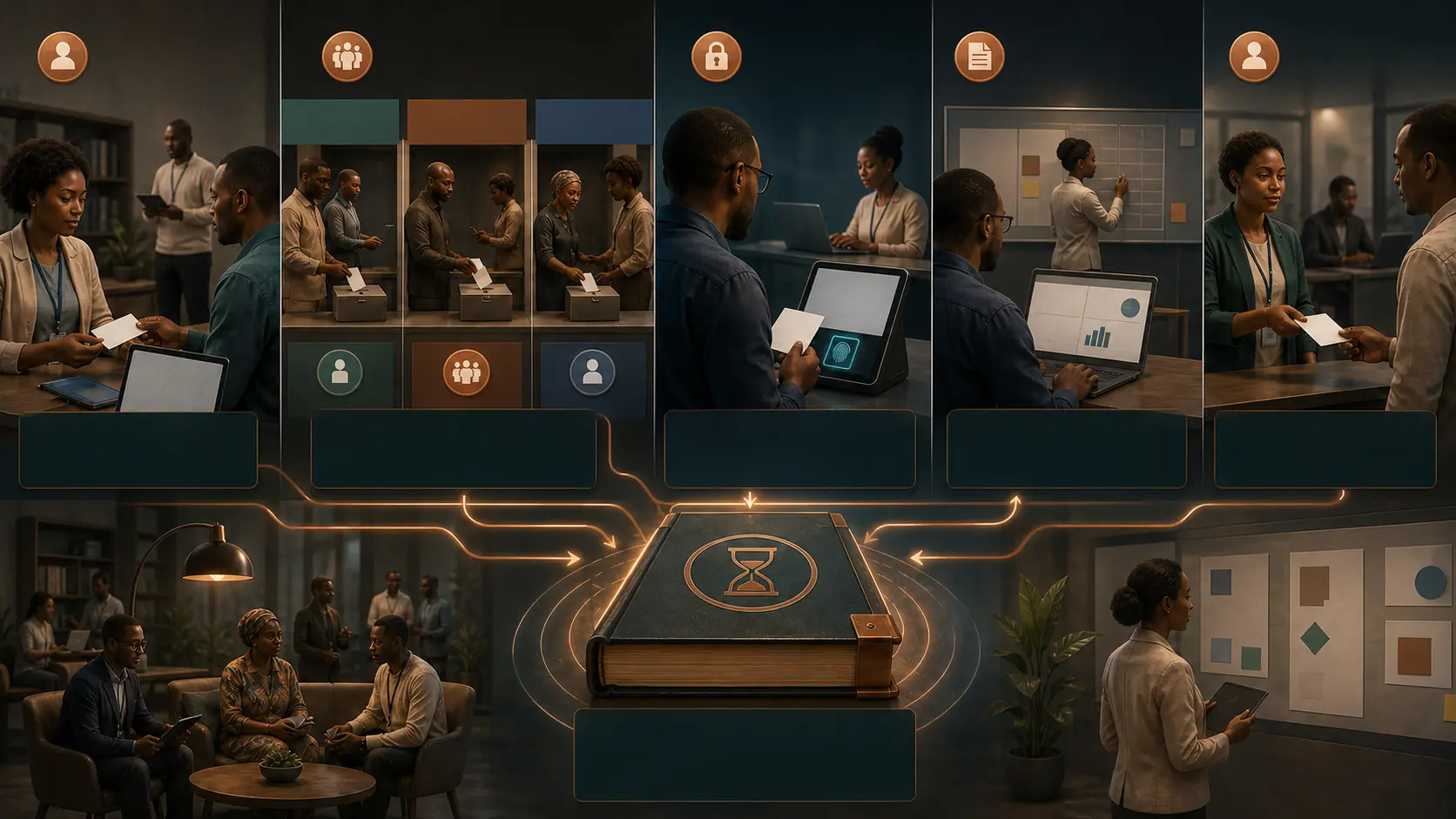
When the ballot decides years, not seats: AFRINIC's 2026 election bridge
AFRINIC's election rules for 2026 did more than tell people how to choose officeholders. They placed three different constituencies beneath one temporary instrument and converted electoral preference into unequal periods of institutional influence. That design offers a credible…

Story
Three Seats, No Mandate: What AFRINIC’s 2026 Governance Committee Election Actually Created
AFRINIC’s members elected Daniel K. Nanghaka, Afaf El Maayati and Maud Adjeley Ashong Elliot to a committee designed to advise, not govern. Their staggered expiries make the order of victory visible, but unpublished aggregate voting statistics and an unfinished public record of…

Story
The Four People Before the Ballot: Auditing AFRINIC’s 2026 NomCom Appointment
On 1 April 2026, AFRINIC’s Board named four people to the committee that would decide which candidates could advance toward seven governance and policy positions. The written rules contain genuine safeguards. The public evidence showing how the screeners themselves were selected…

Story
The Rulebook That Cannot Become AFRINIC’s Constitution
AFRINIC’s proposed overhaul of its Policy Development Working Group contains a serious answer to paralysis and a dangerous shortcut around constitutional authority. The distinction will decide whether continuity rests on lawfully delegated procedure or on a policy manual…