
Topic
IPv4 Scarcity Economics
Within the Topic facet, IPv4 Scarcity Economics topic intelligence connects articles that share a specific subject, signal focus, or monitoring theme. The page gives readers a richer path through related reporting, source evidence, market actors, and infrastructure implications, with enough context to understand why the topic matters across company movements, governance decisions, regional exposure, and operational risk. Readers can compare recurring signals, affected organisations, public evidence, market context, service continuity, procurement, competition, compliance, and strategic planning questions behind the subject instead of stopping at a thin list of matching articles. It explains what the topic covers, which infrastructure actors or policies are involved, what evidence supports the coverage, and why the subject may matter for operators, customers, investors, and policy readers.

Global Cloud Services Trends
Before monetisation, ISPs need to prove which IPv4 blocks are truly idle
The most immediate IPv4 revenue opportunity is not choosing between leasing and selling. It is establishing, with operational evidence, which address blocks can actually leave current production use without disrupting customers, routing, security controls or future capacity…

CASE FILE
IPv4 scarcity is becoming a chain-of-control problem
The immediate operational issue in **How RIR powerlessness impacts IPv4 scarcity and digital asset management** is no longer simple address exhaustion. RIRs can coordinate registration and recognise transfers, but those records are not the same thing as a globally enforceable…

Global Cloud Services Trends
Why IPv4 Scarcity transforms IPs into Investable Assets: liquidity is the missing layer
IPv4 already has scarcity, utility, transactions and lease income. The unresolved question is whether market liquidity and clearer transfer rights can catch up with an asset class that network operators already treat as economically valuable.

Global Cloud Services Trends
A small IPv4 block still needs full-sized due diligence
Calling IPv4 a micro-investment understates the work between paying for addresses and controlling a usable network resource. The smaller the transaction, the easier it is for fixed legal, registry and reputation costs to erase the expected return.

Story
The Eightfold Cut That Still Had No Mandate: Soft Landing BIS Draft 3 at AFRINIC-25
On 22 July 2016, Soft Landing BIS Draft 3 reduced its proposed Phase 1 ceiling from a `/15` to a `/18`, cutting the maximum request from 131,072 IPv4 addresses to 16,384. The proposal kept the rest of its scarcity machinery substantially in place and went to AFRINIC-25 on 29…

Story
Seven Days, a Different Instrument: How Soft Landing BIS Draft 2 Turned a Patch into a Replacement
The most consequential change between the first two Soft Landing BIS drafts was not a newly tightened address threshold. It was a change in form: within seven days, a selective amendment became a self-contained replacement, altering how readers would identify, interpret and audit…

Story
The Final Pool Was a Ledger, Not a Realm
Soft Landing BIS Draft 1 offered a concrete bargain for the dwindling IPv4 pool: cut the largest Phase 1 award, move to the next phase at a declared pool threshold, and preserve separate routes for shared infrastructure, first-time applicants and needs not yet foreseen. The…

Story
The Check Before the Allocation: What AFRINIC Resolution 201411.214 Did—and Did Not—Authorise
On 25 November 2014, AFRINIC's Board recorded a unanimous decision giving its chief executive discretion to use available methods to authenticate resource-allocation applications. Yet the institution left two materially different public traces of that act. Its Board register…
Global Regional ISP Trends
IP revenue needs custody and unit economics
Scarce address space can support new services or leasing income. Revenue is durable only after routing, abuse, reputation and return costs are assigned.
Global Cloud Services Trends
An IPv4 address needs an accountable owner
An IPv4 address locates an interface for routing. Scarcity and reuse make its current operational custodian as important as the number itself.
Global Cloud Services Trends
IP address management needs one source of truth
A spreadsheet can list addresses. It cannot reliably reconcile leases, DNS, routing, cloud inventory and the people accountable for change.

Story
No Reverse Unless Assigned: Draft 1 Put a Database Error in the DNS Decision Path
On 10 April 2012, Tim McGinnis submitted the first “No Reverse Unless Assigned” proposal, asking AFRINIC to condition a new reverse-DNS delegation on a registered assignment or sub-allocation. The draft confronted a genuine weakness in public network records, but it also exposed…

Story
Resolution 201111.138 ratified IPv4 Soft Landing after a 34-month process
One sentence adopted on 21 November 2011 purported to close 1,048 days of argument over AFRINIC's dwindling IPv4 pool. The sentence matters less as a ceremony of authority than as a pointer to the exact draft, allocation limits and scope correction that the Board said it…

Story
When 102/8 crossed the ledger boundary
On 3 February 2011, IANA placed 102/8 in AFRINIC’s regional inventory under a predetermined global rule. That entry created consequential custodial work, but it did not sell a block, convey sovereignty, assign every address, or cause a single route to appear on the Internet.

Story
The objections that reversed AFRINIC's Soft Landing last call
On 14 July 2010, a short procedural conclusion stopped a numerically consequential IPv4 proposal from moving toward ratification. The significance lies neither in the volume of mailing-list traffic nor in a claim that private entities spoke for Africa. It lies in the specific…

Story
The Policy AFRINIC Called Implemented Before the World Could Use It
On 11 November 2010 AFRINIC’s policy archive says that a plan for recovered IPv4 space was “Implemented”. The word sounds conclusive. The instrument was not. Its operative global machinery depended on a common text, ICANN Board ratification and action by IANA; the common proposal…
Story
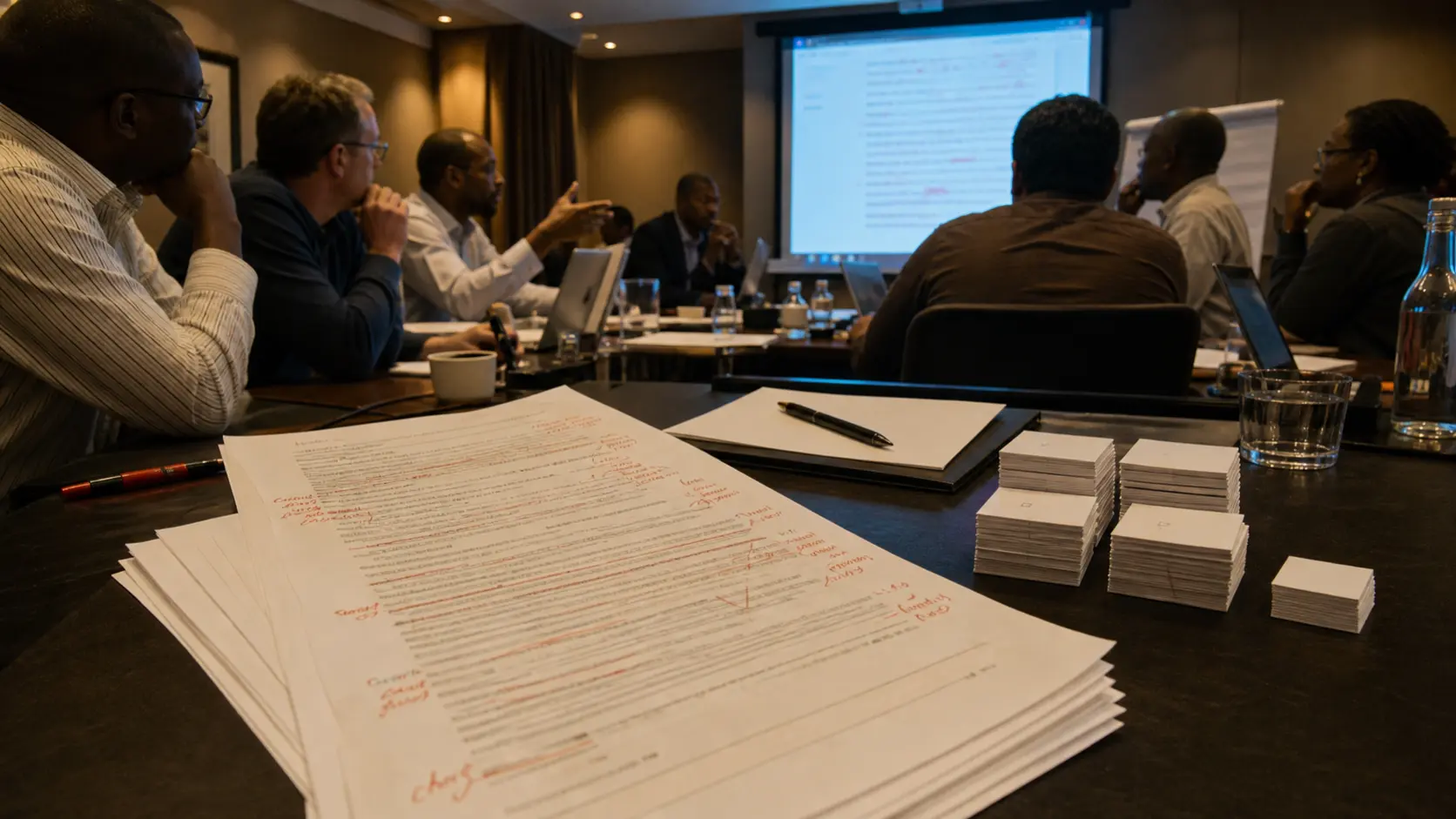
The Mandate in the Margin: What AFRINIC-13 Actually Agreed on Soft Landing
On 25 November 2010, AFRINIC’s public-policy meeting did not approve a finished Soft Landing policy. It agreed to move an identifiable proposal to Last Call while assigning three changes to be incorporated afterward and deliberately leaving a disputed /27 minimum unchanged. That…

Story
The Notice Was Part of the Soft Landing Decision
The decisive entity in June 2010 was not only a proposal about scarce IPv4 space. It was the notice that told people which proposal they were being asked to examine. By carrying a complete draft into a dated review window, then allowing corrections and objections to change the…

Story
AFRINIC changed Soft Landing's reference and left the redline to readers
On 12 May 2010, a materially revised scarcity proposal acquired a new documentary identity in AFRINIC's later history, but the message that carried the text did not carry the identifier. That mismatch shows both the value of version numbers and their limit: metadata can locate a…

Story
The text that consensus had not yet finished: AFRINIC-12 and Soft Landing
In Kigali, the decisive word was not simply “consensus” but the qualification that followed it: the IPv4 Soft Landing proposal had consensus with modifications. That formulation moved the proposal forward while leaving consequential language to be settled after the room had…