
Time Horizon
Current
Within the Time Horizon facet, Current time-horizon intelligence organises articles by the period over which a signal is expected to matter. The page helps readers distinguish immediate operational changes from longer-cycle governance, investment, standards, and infrastructure shifts that may unfold across quarters or years. It connects timing assumptions with public evidence, related actors, market context, customer exposure, policy pressure, and infrastructure planning so readers can judge whether a development is urgent, strategic, or still waiting on confirming evidence. The page also explains how time horizon changes the meaning of a signal, which organisations may be exposed, and which infrastructure decisions require short-term action or long-cycle monitoring.

IETF
Juliusz Chroboczek and the Babel Metric That Was Not a Global Score
A route metric can be indispensable without being universal. RFC 8966 lets Babel nodes compute link costs and route metrics as local policy, then insists on a small common discipline: the resulting metric must be strictly monotonic if the protocol is to avoid persistent loops.…

IETF
Wassim Haddad and the Prefix That Did Not Yet Authorize Forwarding
A mobile router can have a home-agent registration before it knows which mobile-network prefix it may use. RFC 6276, co-authored by Wassim Haddad, makes the next boundary explicit: only a valid DHCPv6 Prefix Delegation lease allows that prefix into the home agent's binding cache…

IETF
Nandita Dukkipati and the TCP Recovery That Stopped Lurching
A sender can finish loss recovery at exactly the intended congestion window and still have taken the wrong journey there. A long pause followed by a burst and a sequence of small, ACK-clocked releases may move the same number of bytes. They do not place the same strain on a…

IETF
Ashesh Mishra and the BFD Check That Had to Be Reversible
The receiver had not accepted the packet. It was merely calculating whether it should. Yet that calculation could erase the only state from which a rejection remained possible.

IETF
Wes Hardaker and the DNS Server That Had to Outlive Two TTLs
The new nameserver was answering perfectly. The old one was quiet. An operator shut it down after the child zone's TTL elapsed—and a minority of users vanished, because their resolvers were still keeping time from the parent.

IETF
Mirja Kühlewind and the QUIC Spin Bit That Measured the Application Period, Not Network RTT
A passive observer saw a clean pulse every 200 milliseconds and labelled the path RTT 200 ms. The packets were real and the arithmetic was correct. The conclusion was not: a sparse application was sending every 200 ms across a much faster path.

IETF
Murray Kucherawy and the DKIM Signature That Left the Tail Unsigned
The verifier returned `dkim=pass`. The message was therefore signed — but not necessarily all of it. One optional number can make both statements true: `l=` tells DKIM to stop hashing after a specified number of canonicalized body octets, while the reader may still see everything…

IETF
John Klensin and the SMTP Reply That Accepted Responsibility, Not Delivery
The sending server sees `250 OK`, removes a message from its queue and calls the transaction complete. That can be correct. Calling the message delivered is not. In SMTP, the final positive reply moves custody to a new operator; the destination still has to be reached, and…

IETF
Tomek Mrugalski and the DHCPv6 Success That Did Not Renew the Lease
A laptop changes networks and asks whether its existing IPv6 addresses still belong on the new link. A server answers `Success`. The tempting conclusion is that the leases are safe. RFC 9915 says something narrower: the addresses fit the link, while every old lifetime keeps…

IETF
Bob Briscoe and the L4S Mark That Did Not Prove Low Latency
An IP packet can carry the L4S identifier all the way across a network even when one operator deliberately sends it through the Classic queue. That is not a contradiction. It is the clue that a packet's declared treatment, its actual queue and its measured delay are three…

IETF
Kent Watsen and the UDP Model That Did Not Record the Running Socket
A management system can hold a perfectly valid UDP endpoint configuration while the machine is listening somewhere else—or nowhere at all. RFC 9984 makes the common vocabulary portable, but it deliberately leaves the runtime testimony to the system that executes it.

IETF
David Schinazi and the UDP Tunnel That Opened Before the Destination Answered
A green CONNECT-UDP response can arrive before the destination has sent a single packet. RFC 9298 makes that apparent paradox precise: the proxy is reporting its own readiness, not certifying a remote application's existence.

IETF
Christopher A. Wood and the Privacy Boundary No One Operator Should Hold
Oblivious HTTP does not ask an operator to forget what it can see. It rearranges the transaction so that one operator can see where a request came from and another can see what the request says—then makes the absence of a single complete view the privacy control.

IETF
Martin Thomson and the Key Log That Could Decrypt a Session but Not Prove It
The incident package looked decisive: a packet capture, a small text file and a screenshot of readable TLS traffic. The decryption had worked. Yet the file did not say who enabled logging, which endpoint produced the secret, when it was collected or whether the alleged session…

IETF
Todd Herr and the DMARC Pass That Did Not Make the Message Safe
The green word `pass` can be perfectly correct and dangerously misunderstood. In DMARC it certifies a narrow relationship between domains. It does not certify the person in the display name, the proposition in the message, the attachment behind the button or the wisdom of putting…

Number Resource Society
The Support Inbox Needs a Case Clock
An email can leave a member's system and still reveal nothing about whether the receiving institution accepted the matter, assigned it or decided when to respond. For a membership organisation that operates in the number-resource governance field, that gap is not solved by…

Number Resource Society
A Public Member Listing Needs a Withdrawal State
A public roster can show who is recognised today. Without a withdrawal state, it cannot explain what yesterday’s recognition means after a name disappears.
Global Institutional Trends
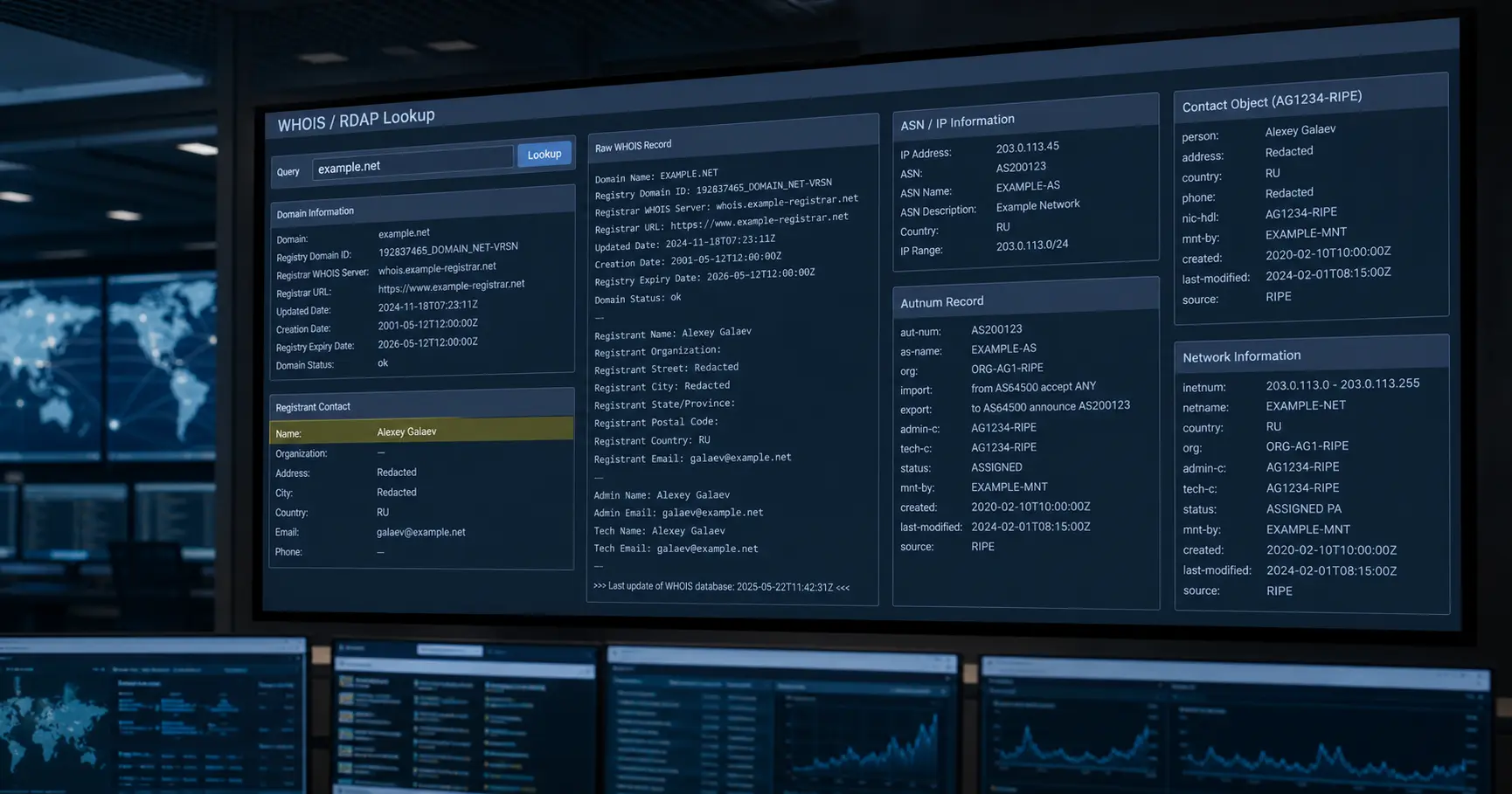
Alexey Galaev
Alexey Galaev intelligence summary explains the development, the public evidence available to readers, the organisations involved, the regional context, market exposure, and the infrastructure consequences that may follow. The Global Institutional Trends intelligence context…