
Impact
HIGH
Within the Impact facet, HIGH impact intelligence highlights articles where the expected effect level, operational exposure, or decision relevance is comparable. Readers can use the page to separate routine market updates from higher-consequence governance, infrastructure, security, and investment signals that may affect planning, procurement, policy, or customer exposure. The page connects the consequence band to public evidence, related organisations, regional context, operating dependencies, service continuity, competition, investment timing, compliance, and customer risk. It helps readers decide which developments deserve deeper monitoring, which actors are most exposed, and how a signal may affect operations or market planning.

Story
Why the title-insurance analogy matters for LACNIC address records
The title-insurance analogy is not a claim that IP addresses are land. It is a way to see why record history, authority and correction matter to scarce-number markets.

Story
Delay, reversibility and the LACNIC discount on usable IPv4
A usable IPv4 block can still trade below its apparent value. Liquidity is priced through delay, uncertainty, reversibility and the cost of proving a clean path to use.

Story
IPv4 leasing contracts beyond the reach of LACNIC's thin ledger
IPv4 leasing turns scarcity into a private contract. That contract must carry routing, abuse, payment and continuity risks that a thin registry ledger cannot safely govern.

Story
Suballocation visibility at LACNIC between privacy and operational proof
Suballocation visibility is the quiet line between privacy and operational accountability. Downstream users need continuity, while markets and abuse desks need enough truth to price risk.

Story
When LACNIC registry cleanliness cannot erase IPv4 reputation memory
A clean registry entry does not always mean a clean address block. Reputation memory can turn scarce IPv4 capacity into a discounted asset with hidden operating debt.

Story
LACNIC fraud checks and the risk of discretionary holder control
Scarce address assets invite false authority claims. The hard institutional task is to reject fraud without converting verification into discretionary control over legitimate holders.

Story
Routing-security evidence as LACNIC infrastructure for accepted IPv4 use
Routing-security evidence increasingly travels with IPv4 value. It does not make addresses land, but it now shapes whether scarce resources can be accepted, financed and used.

Story
What LACNIC route objects decide in transfers, leases and upstream changes
A route object is not a constitution. Yet in scarce IPv4 markets it can decide whether a transfer, lease or upstream change is treated as operationally credible.

Story
Fragmented IRR evidence and the transaction burden on LACNIC IPv4 markets
Routing registries are supposed to reduce uncertainty. When their evidence fragments, scarcity turns old records into new transaction costs.

Story
LACNIC ROA revocation as an immediate continuity shock
A ROA can make reachability legible. Its revocation can turn a registry-layer decision into an immediate continuity shock.

Story
Reverse DNS delegation and LACNIC's leverage over exit and transfer
Reverse DNS looks like a technical service until a holder tries to leave. Then parent-side delegation becomes a price on exit, transfer and customer continuity.

Story
How LACNIC registry decisions travel into customer continuity risk
A registry decision is several contracts away from an end user. The distance does not remove the liability; it merely hides who pays when network identity stops travelling.

Story
Small ISP entry in the LACNIC region before the first invoice
Before a small ISP can send its first invoice, it must finance an identity, an upstream, usable addresses and a stack of proof. Scarcity turns that waiting time into incumbent advantage.

Story
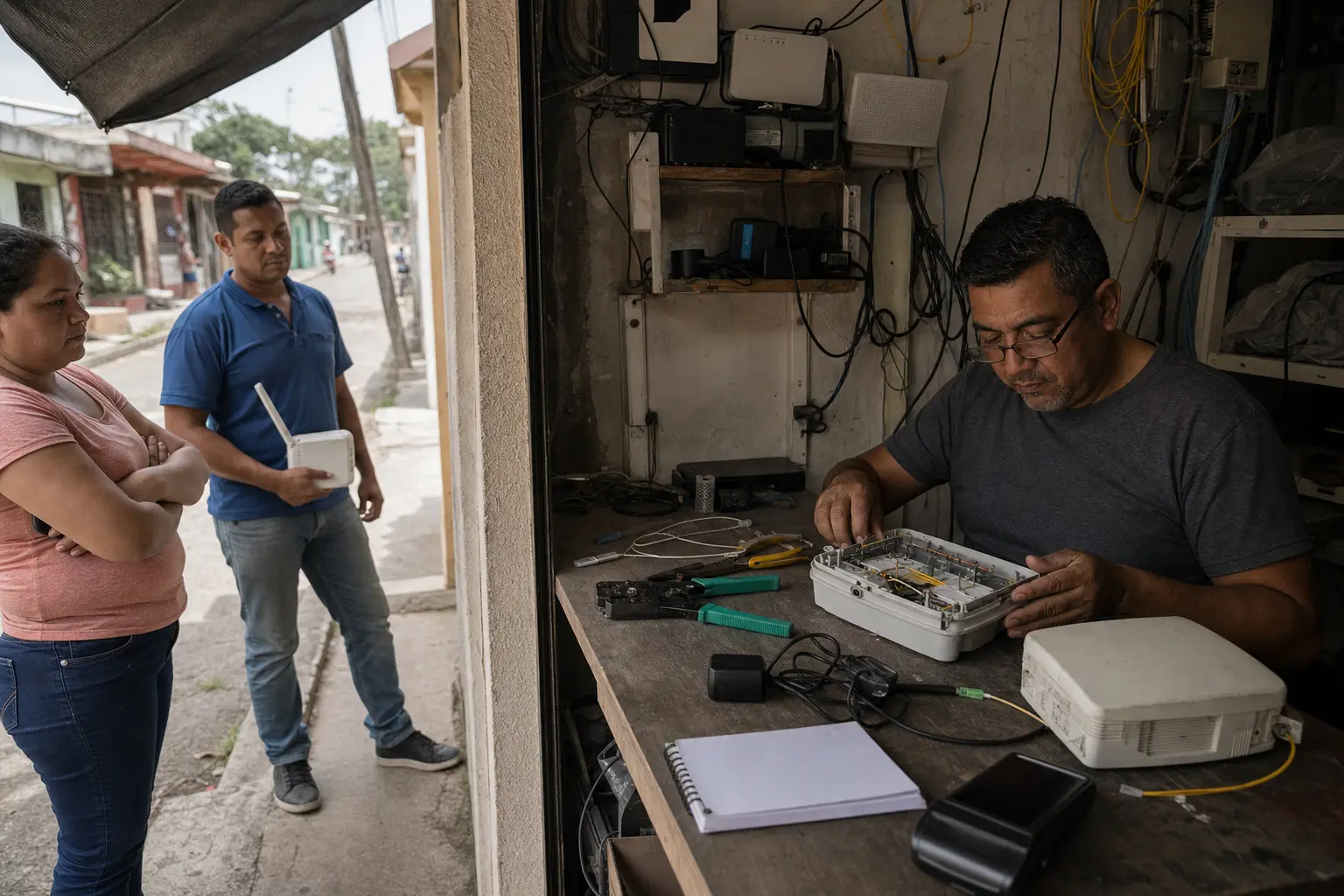
Rural connectivity under LACNIC scarcity when few lines carry fixed obligations
A rural network can travel farther than its revenue. When few active lines must carry every tower, truck roll and address dependency, scarcity becomes a unit-cost problem.

Story
Island network redundancy and the LACNIC record that must survive restoration
An island can buy a second path and still own only one failure. Redundancy has value only when network identity survives the clock between breakage and restoration.
Story
Equal LACNIC charges and unequal burdens in low-income markets
Equal nominal charges are not equal burdens. A hard-currency network obligation divided by a soft-currency customer bill becomes a regressive claim on service quality and expansion.

Story
Emerging-market growth when LACNIC-recognised identity lags demand
Demand can be signed faster than public network identity can be made usable. For a growing operator, the gap is an option cost paid before the next customer produces revenue.

Story
Why IPv6 deployment does not end LACNIC's IPv4 dependency problem
A second protocol can be fully deployed without making the first commercially disposable. The real transition clock stops only when the last revenue-critical IPv4 dependency can be retired.

Story
Who ultimately carries dual-stack costs under LACNIC IPv4 scarcity?
The cost of two stacks rarely appears on one invoice. It is scattered through support, equipment, contracts and recovery until a customer or application finally bears it.

Story
Shared IPv4 identity under LACNIC scarcity when CGNAT failures become evidence disputes
The useful scene begins after the network has apparently behaved. A support representative and a network-operations technician are reconstructing a failed customer session: the access line is up, the router has not gone dark, ordinary web pages load, and yet a payment login…