
Content Type
Research
Within the Content Type facet, Research intelligence gathers BTW.MEDIA articles that share the same editorial format, helping readers compare briefings, profiles, risk notes, market analysis, and event coverage without mixing different kinds of evidence. The page explains how this content type frames internet infrastructure events, company movements, governance decisions, operational signals, and public evidence across the site. Readers can compare which actors or infrastructure systems appear most often, how source quality changes interpretation, and whether the material is a durable profile, a time-sensitive event, a strategic market signal, or a governance development. The result is a useful search page for operators, investors, customers, analysts, and policy stakeholders who need to understand the consequence, timing, and evidence behind similar article formats.

History
The Notices Continued After the Directory Agent. New Services Could Still Be Missed: RFC 3082
RFC 3082 tried to replace wasteful polling with event-driven service discovery. Its recovery rules expose a more precise trade-off: a Directory Agent can lose subscription state while service agents already informed of that subscription keep announcing. A new service may enter…

CASE FILE
The SID Selected the Lane. It Did Not Prove the Capacity Was There
A new Segment Routing identifier can tell every router which resource partition a packet is meant to use. The difficult part begins after that lookup succeeds: proving that the promised bandwidth, buffers and queues were actually committed at every hop, remained bound to the same…

History
One Connection Was Not One Conversation: RFC 3080
A BEEP connection could be healthy while no application conversation had yet been agreed. RFC 3080 began with channel zero, a deliberately thin management plane that advertised profiles and negotiated new channels. Only an accepted profile gave an application channel meaning.…

CASE FILE
Completed According to Whose Plan? Svea Bank's Self-Reported AML Remediation Meets the Regulator's Record
When Sweden's financial supervisor Finansinspektionen (FI) announced a sanction against Svea Bank AB on 17 December 2025, the operational part of the decision contained exactly two points: a formal remark (anmärkning) and an administrative fine of SEK 170 million. There was no…

Asia-Pacific Regional ISP
Two APNIC Lineages, Contradictory Route Data, and a Corporate Record That Names No Telecom License: What XEONFIBER TECHNOLOGY Actually Proves
A same-named Indian company appears in two separate APNIC registration lineages, routing aggregators disagree outright about whether either network currently routes traffic, and the corporate registry entry that matches the name carries an activity code that is not a telecom…

History
The Master Key Never Encrypted a Packet: RFC 3079
RFC 3079 called one value a master key, then forbade it from touching traffic. Its job was to feed two role-aware branches, which in turn produced transient send and receive keys for separate cipher contexts. That hierarchy made a quiet point about interoperability: deriving…

CASE FILE
The Report Was Signed Before the Code Ran
An authenticated status report can be perfectly honest and still stop one step before the fact a governor wants. SUIT revision 22 names that boundary `invoke-pending`: the processor is about to hand control to code, but no one yet knows what the code will do.

CASE FILE
Three Names on One Netblock: How Custody of Svea's Legacy Abuse Contact Split Across a Merger
When a Swedish bank merges, its internet number resources do not disappear — they inherit. The RIPE Database record for 193.105.138.0/24 is a rare case where you can read the aftermath directly in a public registry entity: three distinct legal parties, one dissolved predecessor…
History
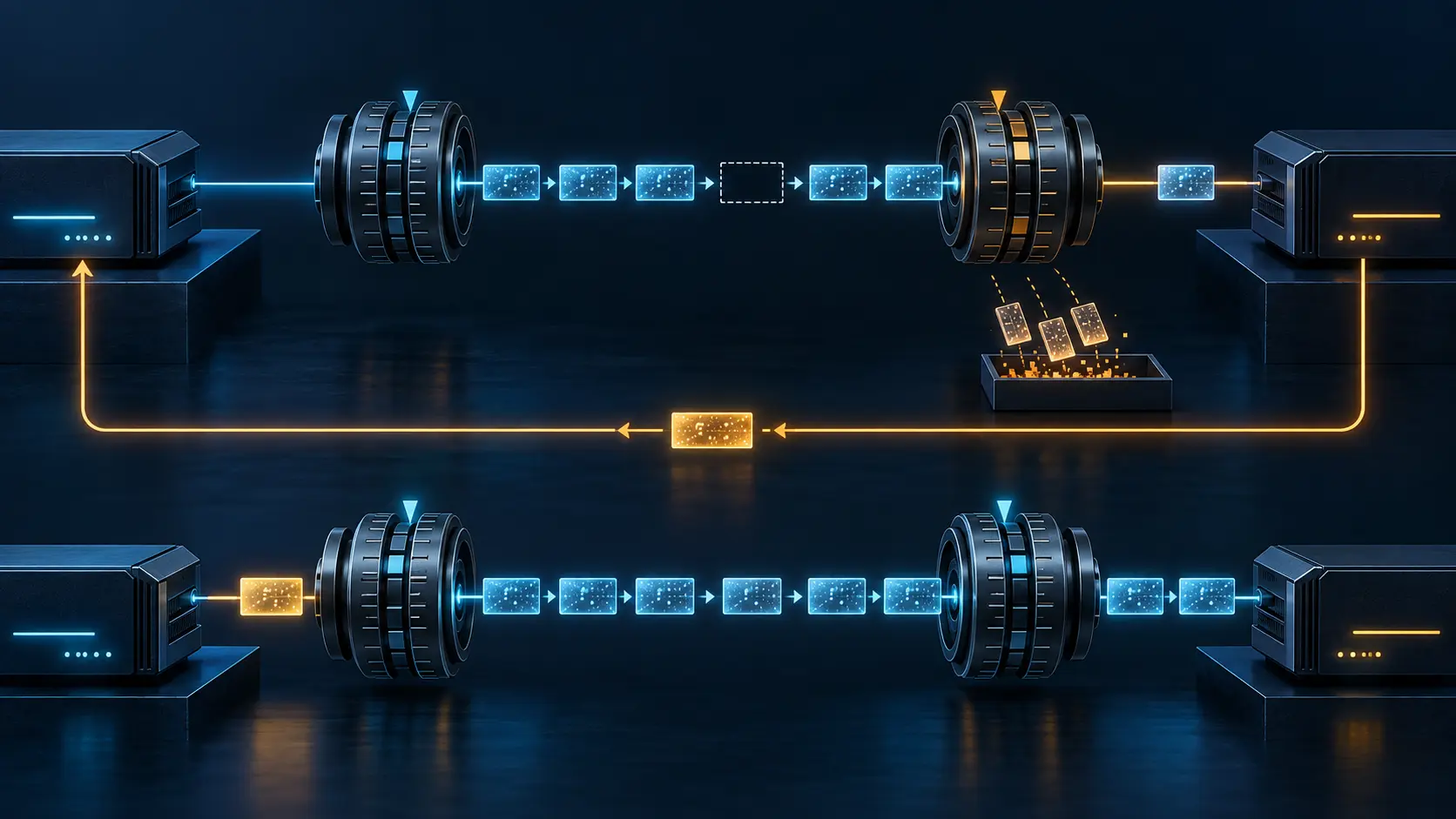
The Counter Detected the Lost Packet. It Could Not Decrypt the Next One: RFC 3078
RFC 3078 placed a twelve-bit counter beside encrypted PPP traffic so a receiver could notice when the stream had jumped. In stateful mode, that knowledge arrived with an uncomfortable consequence: the packet that exposed the gap still had to be thrown away. Recovery needed a…

Story
The 2019 Excess-Contribution Redistribution: How the RIPE NCC's Own Instruments Authorised and Applied a Contested Remedy
When the RIPE NCC returned EUR 8,365,249 to its members in 2020, the money did not move by improvisation. It moved under Standard Service Agreement Article 7, a Clearing House Procedure that predates the decision, and a General Meeting vote that split hard enough to show how…

History
The Satellite Was One-Way. The Link-Layer Model Was Not: RFC 3077
In a satellite network, a receiver could hear a feed without being able to answer it on the same medium. RFC 3077 did not make that asymmetry disappear. It joined the broadcast path to a separate Internet backchannel, then tried to let ordinary link-layer protocols behave as…

History
The Bytes Became Canonical Only After the Parser Had Already Changed the Document: RFC 3076
Canonical XML promised a stable byte stream, not a time machine. Before RFC 3076 could sort a single attribute, an XML processor had already normalized line endings, expanded entities, replaced CDATA and built an XPath node-set. The resulting octets could be repeated exactly.…

CASE FILE
DATAMATIX AS210973: what the live record proves about real operation
DATAMATIX AS210973: what the live record proves about real operation intelligence summary explains the development, the public evidence available to readers, the organisations involved, the regional context, market exposure, and the infrastructure consequences that may follow.…

Asia-Pacific Institutional
The Challenger Who Never Held the Delegation: Cloud Registry Pty Ltd and the Contracted Enclosure of .au Authority
Cloud Registry Pty Ltd has spent more than a decade arguing that Australia's .au registry should be awarded by open tender, and it has never once held the contract. That record makes the small Sydney company a useful instrument for reading how delegated authority over a national…

CASE FILE
Sanctioned but Not Ordered: Svea's Two Accountability Channels
When a Swedish financial regulator fined Svea Bank AB 170 million kronor in December 2025, the fine made headlines. What the decision itself ordered — and, more precisely, what it did not — tells a sharper story about where accountability for the bank and for its internet-facing…

Global Datacenter
Registered, authorised, and still unproven: what DATAMATIX's live posture says about operating a network
Registered, authorised, and still unproven: what DATAMATIX's live posture says about operating a network intelligence summary explains the development, the public evidence available to readers, the organisations involved, the regional context, market exposure, and the…
Story
AS210860 without a first-party witness: what the registry's unreadable endpoint means for DFINFRA
AS210860 without a first-party witness: what the registry's unreadable endpoint means for DFINFRA intelligence summary explains the development, the public evidence available to readers, the organisations involved, the regional context, market exposure, and the infrastructure…

History
The Signature Verified the Transform. It Did Not Verify the Document You Saw: RFC 3075
In XML Signature, a green cryptographic result belonged to a deliberately constructed entity: referenced data after its declared transforms, represented by digests inside canonicalized `SignedInfo`. RFC 3075 made that receipt precise. It also warned that the source document, the…

Number Resource Society
From Draft to Adoption: What the Status Reports Reveal About the ICP-2 Succession
Two years after the Number Resource Organization's Executive Council asked its Number Council to review and update Internet Coordination Policy 2, the successor instrument has been drafted, consulted, revised and handed over — but it has not been adopted. The official process…

History
The Hash Chose Which DHCP Server Could Answer. It Could Not Promise Service
RFC 3074 turned a configured share into 256 buckets and a repeatable answer to one narrow question: which server was eligible to respond? The map did not measure work or prove a lease arrived.