
Summary
The grounding had a multi-factor safety cause, not a single human-error explanation. At about 0009 on March 24, 1989, Exxon Valdez grounded on Bligh Reef after leaving the outbound traffic lane to avoid ice and failing to complete the return turn. The NTSB identified the third mate's fatigue and excessive workload, the master's failure to provide a proper watch because of alcohol impairment, Exxon Shipping Company's failure to provide a fit master and a rested and sufficient crew, an ineffective Coast Guard vessel traffic service, and ineffective pilotage services. Those are adopted transportation-safety findings.
They are not themselves a verdict of civil liability or criminal guilt.
A permitted route deviation became dangerous because the recovery controls were weak. Moving out of the outbound lane to avoid ice was a known operational practice and was communicated to vessel traffic control. The loss occurred when a large, fully laden tanker remained on a course toward shoal water without the turn being made in time. The master left one fatigued officer supervising the navigation, lookout and helm task at the critical stage; company manning and supervision had not produced a rested second licensed officer; shore radar monitoring did not follow the tanker to the reef; and the pilot was no longer aboard.
Accountability therefore follows the design of the whole navigation defense, not the deviation alone.
Fatigue was produced by the work system before departure. Cargo and ballast duties in Valdez disrupted the normal watch cycle. The NTSB estimated that the third mate could have had only five or six hours of sleep in the preceding 24 hours and documented three-mate practices that pushed officers toward six-hours-on, six-hours-off work, overtime and unrelieved lookout gaps. A fatigue control that begins only after a vessel clears the berth is too late. Rested departure staffing, workload records, enforceable limits and a protected stop authority are organizational obligations.
The response plan did not equal operational response capacity. Alyeska's contingency barge was not preloaded with the specified response equipment. The approved plan did not require that it remain loaded, the intended handoff from Alyeska to Exxon was not written into approved procedures, dispersant-delivery equipment and fire-resistant boom were not ready, and the available skimming system could not match the spill. The National Response Team concluded that government and industry plans, individually and collectively, were insufficient for the event.
A credible plan must be demonstrated through timed mobilization, usable equipment, storage capacity, decision rules, trained personnel and realistic exercises.
Cleanup was both an environmental intervention and a workplace. Mechanical recovery, one burn, dispersant trials, manual shoreline work, hot-water pressure washing and later bioremediation each had operating limits and ecological tradeoffs. NIOSH's field evaluation found that volatile exposure from weathered crude was insignificant in the work situations it sampled four months after the spill, but it did not establish the exposure conditions during the earliest phase. It also found inconsistent personal-protective-equipment use and decontamination, diesel and noise concerns, and an unsuccessful effort to construct a systematic injury record.
Response success cannot be measured only in recovered oil or visibly cleaner rocks.
Environmental damage numbers are assessment results, not a literal census. NOAA's case record reports estimated mortality across seabirds, sea otters, harbor seals, bald eagles, killer whales and fish eggs and documents more than 1,300 miles of affected shoreline. Early and later official accounts use other shoreline figures because they record different moments, coast segments and definitions. Mortality estimates may incorporate carcass recovery, detectability, exposure modeling and population inference.
They must stay attached to the issuing assessment instead of being converted into exact counts of every animal or a universal shoreline measure.
Recovery is resource-specific, spatially uneven and definition-dependent. A boulder-scale intertidal study, a regional sea-otter survey, a killer-whale population and a subsistence service can reach different status judgments at different times without contradiction. Natural variability, changing ocean conditions and other pressures make later attribution harder, not unnecessary. The 2015 decision not to invoke the settlement reopener reflected defined legal thresholds and evidence concerning lingering oil, sea otters and harlequin ducks. It did not declare every habitat, species, livelihood or community service fully recovered.
Law and reform created several separate accountability tracks. Corporate criminal pleas, a federal-state civil settlement, private compensatory and punitive litigation, cleanup spending, natural-resource restoration and statutory reform answered different questions. The Oil Pollution Act of 1990 expanded prevention, response, liability, compensation and financial-responsibility controls and required major changes including tanker construction and contingency planning. But enacted rules are inputs.
Durable prevention still requires current evidence that bridge teams are rested, vessel traffic and pilots can intervene, escorts can arrest a casualty, equipment can deploy within the planning window, workers are protected and long-term monitoring can detect both recovery and residual harm.
The casualty began as a navigation-control transfer
Exxon Valdez was a large single-hull U.S. tankship carrying approximately 1,263,000 barrels of North Slope crude from the Alyeska Marine Terminal toward California. It departed Valdez on the evening of March 23 under a state pilot, with the master and bridge team responsible for the vessel and the Coast Guard's Valdez Vessel Traffic Service monitoring traffic from shore. There was glacial ice in the outbound lane. The master advised traffic control that the tanker would cross the separation zone and use clearer water in the inbound lane before returning to the outbound lane.
That maneuver matters because it separates hazard avoidance from loss of control. A lane departure to avoid ice was not, by itself, proof of negligent navigation. Other tankers had taken similar action, and the shore service knew the ship's intention. The safety case depended on the next links: a clearly defined return point, an adequately staffed bridge, reliable position fixing, local knowledge, a vessel traffic service capable of recognizing an unsafe track and enough time and authority for someone to intervene.
Near the planned return, the master left the bridge. The third mate was then the sole licensed officer supervising the navigation watch, accompanied by a helmsman; the lookout had been released to perform other duties. The third mate had to identify the turn point, supervise steering and monitor the tanker's movement while the ship advanced at sea speed toward the reef. The intended turn was begun too late and with insufficient effect. The vessel crossed the charted danger and grounded at about 0009. Eight cargo tanks ruptured. About 258,000 barrels escaped.
No person was physically injured in the grounding itself, but the release converted a bridge-watch failure into a region-wide environmental, economic and institutional emergency.
The time sequence should not be used to manufacture certainty the record does not contain. Sources differ by several minutes in simplified accounts of the grounding, and later litigation summarized some bridge facts for the legal issues then before the court. This analysis uses the NTSB's adopted accident clock for the safety chronology. It does not infer a hidden order, an unrecorded intention or a single instant at which all organizational safeguards failed. The accountability issue is the condition of those safeguards when the tanker reached the last recoverable part of the transit.
The NTSB did not reduce the event to one mistaken turn
The NTSB final marine accident report MAR-90/04 states a compound probable cause. It identified the third mate's failure to maneuver properly because of fatigue and excessive workload; the master's failure to provide a proper navigation watch because of alcohol impairment; Exxon Shipping Company's failure to provide a fit master and a rested and sufficient crew; the lack of an effective Vessel Traffic Service because of inadequate equipment and manning, inadequate training and deficient management oversight; and the lack of effective pilotage services.
Every element changes the prevention question. If the event were described only as the third mate missing a turn, the repair would be more training or discipline for one navigator. The NTSB instead located failure in the fitness and staffing of the bridge, the employer's controls, the shore service and the pilotage boundary. The report's wording also resists a different simplification: focusing only on the master's alcohol impairment.
The master controlled the decision to leave the bridge, and the company controlled important aspects of his assignment and supervision, but the tanker also sailed with a fatigued watch officer, a reduced bridge complement and a shore-monitoring system that did not recognize the unsafe track.
Probable cause in an NTSB report is a safety determination designed to prevent recurrence. It explains why the Board issued recommendations to several recipients rather than naming one actor as the sole cause. It is not a substitute for the elements, defenses and burden of proof in a civil action, nor for proof beyond a reasonable doubt in a criminal case. Later corporate pleas and settlements are legal events and should be reported from their own records. Later private litigation likewise had its own pleadings, stipulations, jury findings and appellate judgment.
The distinction is not semantic. An accident investigation can identify an unsafe supervision system even if no court adjudicates a particular tort claim about that system. A court can accept a corporate plea or approve a consent decree without adopting every NTSB technical finding. A civil defendant can stipulate to negligence for a defined case without converting every disputed historical proposition into an admitted fact. Credible accountability keeps these routes parallel: safety causation informs prevention; legal process determines the liabilities and remedies within its jurisdiction.
The lane departure was a controlled maneuver with an uncontrolled ending
Ice made the outbound transit dynamic. The bridge team could remain in the lane and face ice, reduce speed, or move to clearer water and then return before the track reached Bligh Reef. Leaving the lane was therefore a risk trade, not an inexplicable act. The master communicated the maneuver. What mattered was whether the system could detect and arrest a late return.
The ship's own bridge should have carried the primary control. A passage plan should define the course, wheel-over position, cross-track limits and call criteria. Two licensed officers could divide conning and independent position fixing, while a dedicated lookout protected visual awareness. The master, holding the local pilotage authority for that reach after the pilot left, was the person expected to remain available at the critical stage. When he went below, the third mate inherited a task with very little margin and no rested licensed peer checking the developing track.
The shore system was a separate defense, not a remote duplicate of the bridge. Vessel traffic staff knew the tanker had deviated for ice. An effective service could have retained the plot, recognized that the tanker was maintaining a southerly course toward shoal water and called the bridge while there was still room to turn. The NTSB found that radar range selection, staffing, training and management limited that function. Pilotage was another independent layer. The pilot had disembarked before the reach in which tankers were routinely leaving the lane to avoid ice, leaving the most consequential return maneuver to the shipboard team.
These controls were not interchangeable. A pilot cannot make an unfit master fit. VTS cannot continuously conn every vessel. A second officer cannot compensate for missing response equipment after a grounding. But independence is precisely why several controls are valuable: a single error should have to pass through multiple, separately owned barriers before becoming a spill. The Exxon Valdez system allowed the late turn, the absent master, the fatigued officer, the missing peer, the incomplete shore plot and the pilotage boundary to align.
Fatigue was an operating condition, not a personal excuse
The NTSB recommendations M-90-26 through M-90-31 trace fatigue back to port work. The third mate had participated in a demanding cargo and ballast period. The Board estimated that he could have slept as little as four hours before the workday and taken only a one- to two-hour nap, leaving five or six hours of sleep in the 24 hours before the grounding. He was working beyond his normal watch when he assumed the critical navigation task.
The deeper finding was structural. On a three-mate tanker, the chief mate's cargo duties could consume the port period, with the other two mates covering the chief mate's watch on something close to a six-on, six-off cycle. Maintenance and short voyages reduced the chance to recover. Reduced unlicensed manning also meant that the lookout could be drawn away for routine deck work.
The Board found no company program that reliably ensured hours-of-service compliance, no procedure guaranteeing a rested officer in addition to the master at departure, performance incentives linked in part to willingness to work overtime, and rising workload and standby demands.
Fatigue does not absolve a watch officer of professional duty. It changes what a competent organization must control. Human beings become slower at integrating position, time, rate of turn and competing tasks as sleep debt and circadian pressure increase. Self-assessment is unreliable, and the most dangerous period may arrive after a person has successfully completed many earlier tasks. Telling employees to report when tired is not a sufficient defense if schedules, staffing and appraisal systems reward endurance and make delay costly.
A verifiable departure-rest control would preserve actual work and sleep opportunity, not merely a nominal watch schedule. It would distinguish rest from off-duty time interrupted by calls, meals, transport or cargo work. It would require a second rested licensed officer for constrained waters, protect a lookout from reassignment and authorize delay without retaliation when the minimum team is unavailable. Supervisors ashore would review exceptions and recurring patterns. Regulators would inspect records against operational evidence rather than accepting a signed form at face value.
This is why crew reduction is an accountability decision. Automation may reduce selected tasks, but it does not automatically reduce the need to monitor cargo, maintain equipment, fix position, communicate with shore, supervise a helm and respond to abnormal conditions. A manning model must be tested against peak work: arrival, cargo transfer, departure, ice avoidance, restricted navigation and emergency response. Average workload is the wrong denominator for a system whose consequences concentrate at its hardest moments.
Master fitness belonged to company supervision as well as the bridge
The NTSB found the master impaired by alcohol and linked that impairment to his decision to leave the bridge at a critical time. It also examined the company's knowledge, rehabilitation arrangements, medical follow-up and supervision. The report concluded that Exxon Shipping Company should have prevented a return to sea until there was ample evidence that the dependency problem was under control. That finding turns fitness for duty from a private moral narrative into an institutional control problem.
An operator assigns command. It controls the employment file, medical referral process, return-to-duty conditions, testing policy, supervisory contacts and whether a shoreside assignment is available. A robust program must protect confidentiality and treatment while still resolving a safety-critical question: what evidence establishes that a person can exercise command without impairment? A policy written on paper is not proof that follow-up occurred. Nor is a supervisor's general impression a substitute for documented professional assessment and continuing controls.
The same principle applies beyond substance use. Fitness includes acute illness, medication, sleep disorders, psychological strain, competence recency and workload. The organization needs a lawful, clinically informed process that separates treatment support from operational clearance, specifies who can restrict duty and keeps commercial pressure out of the decision. For masters, the isolation and authority of the role make oversight more important, not less.
It is equally important not to convert the NTSB finding into a criminal adjudication. The Board used toxicology, speech, witness and management evidence within a safety investigation. A criminal court applies charges, admissibility rules, jury instructions and a different burden. This article attributes impairment and supervision conclusions to the NTSB and uses the later corporate resolutions for legal outcomes. It does not claim that the safety report convicted the master or that every allegation heard in later civil litigation became an uncontested historical fact.
The repair is an auditable chain: known concern, qualified assessment, treatment plan, objective return-to-duty decision, monitoring, supervisor training, protected reporting and removal from duty on defined triggers. If any link exists only as an informal expectation, the company still controls an unmeasured risk.
Vessel traffic service and pilotage were prevention controls of their own
The NTSB recommendations M-90-32 through M-90-43 explain the shore-side gap. The Board found that the Valdez VTS was not effective at the time of the grounding. It concluded that the tanker could likely have been tracked farther had the watchstander selected a higher radar range and used the traffic-lane overlay. Exxon Valdez maintained the unsafe course for nearly 18 minutes; a continuing plot could have shown the departure from the separation scheme and movement toward shoal water.
The finding was not that a VTS operator should steer a tanker from shore. A vessel traffic service provides surveillance, traffic organization, information and, within its authority, warnings or directions. Its value is independence. The bridge may normalize a deviation or lose awareness under workload; shore staff can see the track against lane boundaries and other traffic. To perform that role, the service needs radar coverage, reliable communications, sufficient watchstanders, supervision, local procedures, training and a culture willing to query an unsafe movement.
The Board's remedies were concrete: plot participating vessels between the pilot station and berth, increase staffing, install radar closer to Bligh Reef, collect and disseminate ice information, improve communications and preserve pilotage through the hazardous reach. It also sought an additional licensed officer to plot the vessel's position. These recommendations allocate controls to the actors able to operate them. Exxon could not install the Coast Guard radar as a shipboard procedure; the Coast Guard could not schedule Exxon's cargo watches; pilotage rules could not replace company fitness decisions.
Pilotage similarly supplies local knowledge and independent challenge, but only within its boarding boundary. If the recurring ice-avoidance maneuver occurred near Bligh Reef after the pilot left, the boundary excluded the point at which local knowledge was most valuable. Extending or preserving pilotage through that reach addressed the geography of risk rather than assuming the ship's ocean-going credentials were enough.
Present accountability should ask for performance, not institutional names. How often does VTS detect a track-limit excursion before the ship's own call? How quickly does it establish contact? Are radar, satellite and communications feeds independently tested? Do pilot transfer points encompass the actual maneuvering hazard? Do bridge and shore exercises include lost steering, ice displacement, fatigue and ambiguous authority? A service can exist on an organization chart and still fail at the last operational mile.
Spill size and shoreline length answer different measurement questions
The official records converge on the broad scale while using several numerical frames. The NOAA Exxon Valdez incident record describes nearly 11 million gallons of Prudhoe Bay crude released into Prince William Sound. NTSB records use about 258,000 barrels, which is approximately 10.8 million gallons. The tanker retained most of its cargo, yet the released fraction was sufficient to travel far beyond the grounding site.
Shoreline measures require more care. The May 1989 National Response Team snapshot described more than 350 miles of beaches in Prince William Sound and a slick spread over more than 3,000 square miles at that stage. NOAA's later natural-resource case page reports more than 1,300 miles of shoreline affected. The Justice Department's 2015 settlement update refers to about 1,500 miles of Alaska coastline contaminated. Other official retrospectives use still another non-contiguous-coastline figure.
Those numbers should not be averaged into a supposedly more accurate total. An early operational count of observed beaches in the Sound, a later map of affected shoreline across a wider spill path, and a legal retrospective can differ in date, geographic scope, treatment of islands and coves, segmentation and the threshold for recording oil. “Coastline,” “shoreline affected,” “beaches” and “oiled shoreline” are not automatically interchangeable units. Without the underlying spatial dataset and definition, precision to a single mile would be false.
The same discipline applies to volume. “Nearly 11 million gallons” is a public summary; “about 258,000 barrels” is the NTSB estimate; neither should be presented as a laboratory measurement of every gallon that left each ruptured tank. Weathering, evaporation, emulsification, recovery and oil remaining aboard change later inventories. The appropriate use is scale and response planning, not a claim that the release can be reconstructed to the last unit.
Measurement boundaries matter because policy follows the denominator. A plan sized only to an average spill will appear adequate. A cleanup percentage can look better or worse depending on whether the denominator is oil discharged, oil remaining on water after weathering, oil reaching shore or material collected with water and debris. Accountability requires each metric to name its method, date, geographic frame and uncertainty.
The contingency system had documents but not demonstrated capacity
The National Response Team's May 1989 report to the President concluded that government and industry plans, individually and collectively, were wholly insufficient to control a spill of this magnitude. Initial equipment mobilization was unreasonably slow, equipment that arrived could not cope, and the plans did not establish a workable command hierarchy or refer coherently to one another. The report did not blame only the responsible company. It named a system-wide preparedness deficit across Exxon, Alyeska, Alaska and the federal government.
The NTSB recommendations M-90-50 through M-90-52 supply the operational detail. Alyeska's response barge had been unloaded after an earlier pollution response and had undergone repair, but the state-approved contingency plan did not expressly require response equipment to remain aboard. Alyeska believed it could load the barge when needed. The event demonstrated the difference between equipment owned and equipment ready.
The intended transfer of cleanup responsibility had another interface gap. Alyeska said it understood that Exxon would take over a major spill, but that arrangement was not written into approved procedures. Exxon had previously submitted spill plans that Alaska returned on the ground that they were not required. Company leadership activated broader resources and traveled to Valdez after notification, yet the operational handoff was not a pretested, time-defined control. A response organization should never have to negotiate its command architecture while oil is spreading.
Technology options had similar readiness gaps. The local system lacked immediately ready fire-resistant boom for in-situ burning. Air-deliverable dispersant packs were not available in Valdez, and the application system took time to assemble. Mechanical equipment was limited, and recovered oil-water mixture needed storage and transfer. A list of skimmers, boom, aircraft and barges does not show that the right combination can reach the right place, operate in the actual sea state and keep running with maintenance, fuel, trained crews and waste capacity.
A defensible contingency plan therefore has at least five proof layers. The scenario must be credible, including the largest practical release and difficult weather. Resources must be dedicated or contractually available with verified mobilization times. Command, permitting and technical decisions must have pre-agreed thresholds. Exercises must begin without warning and continue through recovery, transfer, waste and demobilization. Finally, independent observers must retain time-stamped results, failures and corrective actions. The Exxon Valdez plan failed where paperwork met the clock.
The first response window exposed the limits of every cleanup method
The EPA spill profile records three principal approaches: mechanical recovery, a trial burn and dispersant application. Each depended on conditions that were changing faster than the response system could mobilize. Calm water initially limited natural mixing and offered an opportunity for containment, but skimmers were not readily available during the first 24 hours. Thick crude and kelp clogged equipment, repairs consumed time and the heavy oil-water mixture was difficult to transfer.
One early burn showed that concentrated oil could be removed, but further burning was prevented by later conditions. Dispersant was available only in limited quantity, and the terminal lacked its own application aircraft or equipment. A helicopter trial took place, but low wave energy meant insufficient mixing; responders concluded the treatment was ineffective in those conditions. This is not proof that burning or dispersants are inherently good or bad. It shows that their useful window depends on oil state, sea energy, proximity to sensitive resources, air quality, equipment, authorization and timing.
Mechanical recovery is often preferred because it removes product from the environment, yet it is not a simple percentage of rated skimmer capacity. Encounter rate governs how much oil reaches a skimmer. Boom performance depends on current, wave height and towing configuration. Storage can become the bottleneck even when collection works. Oil emulsifies, incorporating water and increasing volume. Debris and kelp interrupt pumps. Remote operations require vessels, crews, fuel, communications and repair capability. A nameplate rate measured in a controlled test cannot be multiplied by 24 hours and called field capacity.
The early calm ended, spreading and weathering the slick over a much larger area. Once oil became discontinuous and reached complex shorelines, open-water recovery could not reverse the exposure. Responders then faced triage: protect hatcheries and sensitive habitat, recover mobile oil, prevent remobilization, rescue wildlife where feasible and decide which shores to clean aggressively. Every delay narrowed the available options, but every intervention also carried environmental and worker risks.
Preparedness should therefore be expressed as decision-ready capability. For each technique, a plan needs conditions of use, ecological and health tradeoffs, authority, mobilization time, trained teams, exercise evidence and stop criteria. The correct question is not “Do we own dispersant?” or “How many skimmers are listed?” It is “Within the first operational period, what fraction of the moving oil can this system encounter and control under the expected sea state, and what evidence supports that answer?”
Command continuity is a technical control
Oil-spill command is often described as coordination, which can make it sound administrative. In practice it determines whether vessels are dispatched, permits are obtained, protection priorities are set, contractors are directed and safety limits are enforced. The Exxon Valdez response had a federal On-Scene Coordinator, state authorities, Alyeska's initial role, Exxon's responsibilities and later national support. Their plans did not produce a seamless operating structure at the outset.
The responsible party has resources and a duty to remove oil, but public authorities retain responsibilities for directing or overseeing the response and protecting public interests. That arrangement creates productive tension when roles are clear: the company can mobilize private capability, while government sets objectives, approves sensitive techniques and intervenes if performance fails. When roles are vague, the same tension becomes delay. One party waits for approval; another expects voluntary action; a third assumes a handoff has occurred.
Continuity requires predesignated people as well as agencies. A plan must say who holds authority at 0200, who succeeds that person, which decisions require consultation and when delay itself becomes the larger hazard. Communications need shared terminology and a common operating picture. Field observations, trajectories, resource-at-risk maps, equipment status and worker incidents should enter the same decision cycle. Contractors need one operational assignment and one safety chain even when several organizations fund or oversee the work.
Exercises should test disagreement, not only harmonious deployment. A dispersant request with incomplete data, a burn window closing, a disabled barge, conflicting wildlife priorities, a worker exposure alarm and a failed communications link are realistic injects. The evaluation should measure how long the system takes to decide and whether the record explains the evidence, authority and tradeoff. A drill that ends when equipment reaches the dock does not test command continuity.
The institution accountable for a decision should retain its basis. That does not mean every field choice waits for a legal memorandum. It means a later reviewer can reconstruct who knew what, what alternatives existed, why an option was chosen and when conditions changed. In a long response, the decision log becomes part of environmental protection, worker protection and public legitimacy.
Shoreline cleanup could remove oil and delay biological recovery
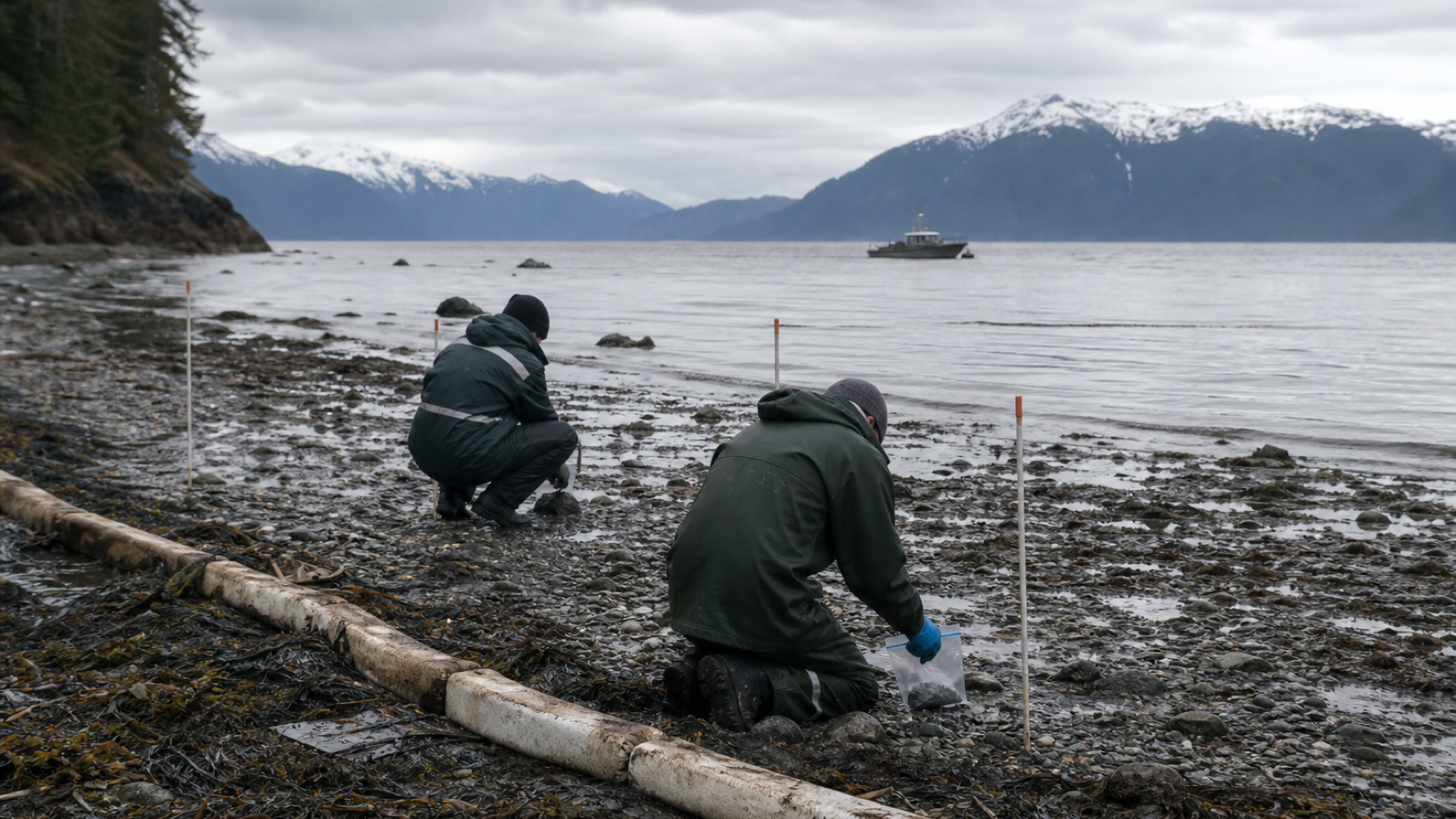
The NOAA account of its response role describes trajectory forecasts, overflights, shoreline sampling, sensitivity maps, weather advice and evaluation of cleanup options. This scientific support mattered because “clean” was not a single physical condition. Mobile oil threatening a hatchery, buried oil in coarse sediment, a lightly oiled marsh and a high-energy rocky shore demanded different objectives.
High-pressure hot-water washing became one of the most visible techniques. It stripped oil from rocks and flushed it toward collection points, but heat and pressure also removed or killed intertidal organisms and altered habitat. NOAA's lessons from long-term shoreline monitoring state that such treatment can produce direct and indirect damage over short and long periods. At one monitored beach, fine sediments were washed away, delaying return of organisms dependent on that substrate.
That finding does not support a universal ban. Leaving bulk mobile oil can create continuing exposure, spread contamination and undermine community use. Aggressive treatment may be justified where the avoided harm is greater. The accountability requirement is a documented net-benefit decision: what resource is being protected, what treatment injury is expected, what endpoints determine completion and what monitoring will detect unintended effects?
Set-aside sites illustrate a difficult evidence tradeoff. NOAA preserved some oiled but untreated locations, allowing comparison between oil effects and cleanup effects. Those controls strengthened later inference but could appear inconsistent with the immediate demand to clean every visible shore. The lesson is to anticipate the question in contingency planning, secure scientific and community input, choose sites carefully and disclose why some treatment is withheld. Without reference sites, later claims about method effectiveness may be impossible to test.
EPA also supported a bounded 1989 bioremediation program, using nutrients to stimulate indigenous oil-degrading microorganisms at selected shoreline sites. The agency's contemporaneous letter described promising preliminary evidence and also said definitive efficacy data were not yet available. That boundary is important. Authorization of a field application establishes a managed experiment and operational choice, not proof that the method removed every toxic component or was suitable for every shore.
Cleanup completion should be defined by risk and recovery objectives, not the absence of visible sheen alone. Residual oil can persist below the surface, while a visually stained high-energy shore may pose less continuing biological risk than an aggressively disturbed sheltered beach. The endpoint should connect chemistry, mobility, exposure pathways, ecological service, worker risk and community use.
Cleanup workers were part of the protected system
Thousands of people worked across a remote and dispersed response, operating boats and aircraft, moving boom, washing beaches, handling oily debris, maintaining engines, caring for wildlife and living in temporary facilities. The event created chemical, physical, ergonomic, noise, transport and fatigue hazards. Environmental urgency did not suspend the obligation to protect them.
The NIOSH Health Hazard Evaluation HETA-89-200 and HETA-89-273-2111 made three field visits and examined training, personal protective equipment, decontamination, inhalation and skin exposure, noise, illness and injury information. Investigators considered the four-hour course they observed adequate for the tasks and found protective gear generally available. They also found inconsistent enforcement of PPE use, inadequate decontamination in one of two task forces examined, preventable skin contamination, high noise near pumps and generators and a potential for diesel-related exposure.
The most quoted exposure conclusion needs its full boundary. About four months after the spill, in the sampled work situations, inhalation exposure to volatile components of weathered crude was insignificant. NIOSH expressly noted that exposure during the earliest cleanup, when crude was fresher and more volatile, could have been substantially different. The report did not retrospectively measure every worker, site, task or day. It also identified confined spaces, trapped fresh oil, diesel exhaust, dermal contact and noise as distinct considerations.
Surveillance was an accountability weakness. NIOSH's attempt to conduct a systematic record-based review of illness and injury data was unsuccessful and was not pursued after the 1989 operation ended. Preliminary compensation information could not replace a complete exposure and incident roster. Without a roster linked to employer, task, location, shift, training, PPE and medical outcome, long-latency questions become difficult or impossible to answer.
A modern response should create that system on the first day. Every worker, including contractors, fishing-vessel crews and volunteers, needs credentialing, task-specific training, fit-tested protection where required, exposure characterization, heat and cold controls, transport safety, fatigue limits, medical access and a durable record. Near misses, symptoms and injuries should be reported across employer boundaries without fear of losing work. The response command should see leading safety indicators alongside barrels recovered and shoreline treated.
Worker protection can also improve environmental performance. Fatigued boat crews make navigation errors; poorly decontaminated gear spreads oil; excessive noise masks warnings; rushed pressure-washing teams damage habitat; fragmented medical reporting conceals a failing control. Safety is not a competing objective added after containment. It is one of the conditions for competent containment and restoration.
Natural-resource assessment translated injury into a public claim
Emergency response and natural-resource damage assessment answer related but different questions. Response asks how to stop, contain and remove a release. Assessment asks which publicly held resources and services were injured, what restoration can compensate for those losses and how the claim can be supported. The separation matters: gallons mechanically recovered do not measure ecological injury, and the end of visible cleanup does not establish the end of lost habitat, harvest or cultural use.
NOAA's Exxon Valdez natural-resource case record reports more than 1,300 miles of affected shoreline and presents estimated mortality including about 250,000 seabirds, 2,800 sea otters, 300 harbor seals, 250 bald eagles, as many as 22 killer whales and billions of salmon and herring eggs. These figures are injury estimates assembled from field observations, sampling, carcass-recovery corrections, population information and models. They are not a claim that assessors found and individually counted every dead animal or egg.
That distinction is not a semantic hedge. Wildlife carcasses can sink, drift, be scavenged, strand on inaccessible shores or remain unseen. A recorded carcass count is therefore a minimum observation, while a mortality estimate depends on assumptions about detection and fate. Egg-loss estimates necessarily use exposure and biological models rather than individual enumeration. Responsible reporting should preserve the estimate, its unit and its method instead of converting it into an exact census.
Assessment also needs a baseline. The relevant comparison is not a pristine imagined ecosystem but the resource condition that probably would have existed without the spill. Natural variability, fishing pressure, climate, predation, disease and other disturbances can affect the same populations. A before-and-after decline may be important evidence, but causal attribution is stronger when it combines exposure pathways, reference sites, toxicology, population trends and a plausible mechanism. The scientific record becomes less trustworthy when uncertainty is removed to make the claim sound decisive.
The public-service dimension broadens the injury frame. A shoreline can provide habitat, food, recreation, commercial opportunity, subsistence access and cultural continuity at the same time. Restoration must consider services as well as the number of organisms. Replacing acres, reopening harvest, restoring prey or protecting equivalent habitat may address different portions of the loss. Dollar recovery is a means to fund restoration and compensate interim loss; it is not itself proof that the resource has recovered.
For institutional accountability, the durable control is an assessment plan with preserved samples, methods, quality assurance, data lineage and peer review. Models should identify inputs and sensitivity. Field records should distinguish observation from inference. Responsible parties, trustees and affected communities should be able to challenge methods without erasing evidence. The purpose is not to manufacture a single uncontested number. It is to create a transparent basis for restoration decisions under uncertainty.
Recovery was plural, uneven and measured on different clocks
The Exxon Valdez Oil Spill Trustee Council's 2014 status-of-restoration update classified injured resources and services in categories such as recovered, recovering and not recovering. That classification is a dated management synthesis, not a permanent biological verdict. Each resource had its own recovery objective and evidence. A population can meet a regional abundance criterion while particular sites remain exposed; a service can remain constrained after some species recover; and a species can change for causes that are only partly attributable to oil.
A 2017 USGS synthesis likewise found highly variable trajectories. Intertidal-feeding species generally experienced greater exposure, and some effects lasted far longer than early expectations. Sea otter evidence indicated continuing exposure into the mid-2000s before later recovery findings. Killer-whale reproduction raised long-duration concern, while changes involving pigeon guillemots and marbled murrelets were difficult to separate from broader ecological pressures. This is not a contradiction of the Trustee Council's categories; it is a reminder that the answer depends on species, place, endpoint and date.
NOAA's Mearns Rock account illustrates the scale problem. Scientists repeatedly photographed and measured one intertidal boulder and observed its biological community return within natural variability after roughly three to four years. The record is valuable because it provides a consistent local time series. It does not prove that every oiled beach, sheltered sediment deposit, food web or population recovered on that schedule. A precisely monitored point should not be silently promoted into a regional conclusion.
The broader NOAA long-term shoreline study followed sites from 1990 through 2000 and compared treatment and recovery patterns over time. Longitudinal design made it possible to see effects that a one-season inspection would miss, including the interaction between cleanup disturbance, sediment structure and recolonization. It also shows why monitoring plans should be designed before response choices erase the comparison.
“Recovered” therefore needs a named endpoint. It could mean no detectable oil exposure, return to a reference range, population growth, restored harvest, acceptable human-health risk, restored cultural use or no further restoration action judged feasible. Those are not interchangeable. A declaration based on one endpoint may be legitimate within its scope and misleading outside it.
Time also changes what can be known. Early response records are strongest on location, weather, equipment and visible oil. Later studies can detect population trends and persistent residues but must contend with changing climate, food webs and human use. No single observation date is privileged for every question. A reliable accountability record keeps the series intact and labels when each conclusion was drawn.
For current operators, monitoring should begin with decision rules. Which finding would trigger more cleanup, habitat protection, harvest support or a change in technique? How long will samples be retained? Who controls the database after contractors demobilize? What happens when a resource appears recovered regionally but not locally? A monitoring program that cannot change a decision risks becoming documentation without governance.
Community continuity cannot be inferred from ecological abundance alone
The spill disrupted food systems and cultural practices as well as commercial activity. The Trustee Council's subsistence-status record discusses 15 principally Alaska Native communities in the affected area, with roughly 2,200 residents at the time, and a wider regional subsistence-permit population. Reported harvest declines varied widely—roughly 9 to 77 percent among studied communities—because access, resource mix, oil exposure and local choices differed.
Harvest volume is only one indicator. People worried about whether foods were safe, whether gathering places were contaminated and whether customary sharing should continue. A lost season can interrupt transfer of ecological knowledge, travel routines, processing skills and reciprocal obligations. Even when laboratory tests or population counts improve, confidence and practice may recover on a different clock. Treating subsistence as a commodity-price loss misses that institutional and cultural dimension.
The official status page itself has a date and a defined classification method. It should not be cited as a universal statement about every community today. Nor should a regional average erase variation. One community's harvest may rebound while another loses access to a preferred species or place. Age, income, vessel access and household networks can distribute effects unevenly inside the same settlement.
Continuity planning should therefore give communities a formal role before an incident. Sensitive-resource maps should include use areas with appropriate confidentiality. Sampling plans should answer the foods and locations people actually depend on. Advisories need a clear basis, translation where needed and a method for revision. Replacement food and income support may be necessary, but neither automatically replaces cultural use.
Trust is also an observable control outcome. Agencies and responsible parties should record questions raised by communities, the evidence supplied in response and unresolved disagreement. Independent sampling, community-based monitoring and access to raw results can be more important than another assurance from an interested institution. Public legitimacy is not created by asking communities to accept a conclusion; it grows when they can examine and influence the process that produces it.
Criminal, civil and private cases answered different accountability questions
The legal aftermath is often compressed into one very large dollar figure. That obscures the distinct purposes and proof rules of criminal prosecution, government civil claims, private compensation and punitive damages. It also risks attributing every payment or finding to the same legal entity. The operational accountability story concerns Exxon Shipping Company, but the litigation record also involved its corporate parent and related Exxon entities. Entity names, capacities and judgments should be preserved.
The Supreme Court's record in Exxon Shipping Co. v. Baker, 554 U.S. 471 recounts corporate guilty pleas under federal environmental statutes, a criminal fine from which a substantial portion was remitted, restitution, a $900 million government civil settlement and hundreds of millions in voluntary private settlements. Those proceedings addressed public offenses, restoration claims and compensation through different mechanisms. They should not be added together and described as one fine.
The Supreme Court case was a private maritime damages action brought by commercial fishers, Native Alaskans and others. Exxon stipulated negligence for that litigation, and the remaining issues included punitive damages. The Court ultimately applied a 1:1 ceiling in the circumstances of the case, limiting punitive damages to an amount equal to the $507.5 million compensatory award. That rule and finding belong to the private maritime case. They are not an NTSB safety conclusion, an NRDA measurement or the amount of the government restoration settlement.
The distinctions matter for institutional learning. A criminal sanction expresses condemnation and deterrence for prohibited conduct. Civil natural-resource recovery funds restoration and compensates public loss under a negotiated legal framework. Private compensatory damages address losses proved by claimants. Punitive damages punish and deter under the governing law. Voluntary settlements can resolve claims without an adjudicated finding on every disputed fact.
An accountability inventory should therefore include columns for defendant, claimant or sovereign, legal authority, conduct or injury alleged, burden of proof, disposition, amount, purpose, payment status and restrictions on funds. It should separately identify facts stipulated for a particular case and facts independently established elsewhere. Without that structure, a safety recommendation can be mistaken for proof of negligence, or a settlement can be described as an admission it did not contain.
The same care applies to the identity of “Exxon.” Corporate groups divide vessel ownership, operation, employment, contracting and financial responsibility among entities. This can be legitimate organization, but incident command and public reporting should show which entity controls each risk and which retains the evidence. A public-facing brand is not a substitute for a legal-entity map, and a legal-entity map is not an excuse for fragmented operational responsibility.
The 2015 reopener decision was a bounded legal decision, not a universal recovery certificate
The 1991 government civil settlement included a reopener mechanism under which additional recovery could be sought, subject to defined conditions, for certain later-discovered injuries. In 2015, the United States and Alaska decided not to pursue additional damages under that provision. The Justice Department announcement explains that the governments had evaluated sea-otter and harlequin-duck work and concluded the specific legal conditions for a reopener claim were not met.
That conclusion has a narrow logical form: the evidence and circumstances did not satisfy the negotiated clause's requirements for another monetary demand. It does not mean no subsurface oil remained, every population recovered, every community considered restoration complete or future scientific concern was impossible. The announcement itself distinguished withdrawal of the demand from the continuing work of understanding and addressing lingering oil.
Settlement clauses have thresholds, deadlines, notice requirements, covered injuries and remedies. Scientific evidence enters that framework, but legal sufficiency is not identical to ecological absence. Conversely, the presence of residual oil does not by itself prove a compensable new injury under a particular clause. Both propositions can be true without contradiction.
Public communication should therefore state the decision, legal test, evidence considered and claims not decided. “The governments declined the reopener demand in 2015” is accurate. “The spill was fully recovered by 2015” is not a conclusion established by that decision. The distinction protects both legal credibility and scientific independence.
Reopener design is itself a governance lesson. Long-tail environmental injury may emerge after a conventional settlement, so agreements need a clear way to preserve samples, data and institutional capacity. But a clause that is so vague it cannot be administered, or so narrow it is publicly misunderstood, can create false expectations. Negotiators should state what new information could trigger review, what causal showing is required and how a decision will be explained.
OPA 90 converted lessons into a broader prevention and response regime
Congress enacted the Oil Pollution Act of 1990 after the spill. The Coast Guard's OPA overview describes a comprehensive federal structure for preventing and responding to oil pollution and for assigning liability and compensation. It strengthened federal authority, planning, financial responsibility and access to the Oil Spill Liability Trust Fund. The regime is broader than one vessel, company or coastline.
The enrolled statutory text of Public Law 101-380 is the controlling primary source for what Congress enacted. Among its many provisions, it addressed vessel response planning, manning and work-hour issues, double-hull requirements and phaseout rules for tank vessels, financial responsibility, federal and state planning and liability. Later amendments, regulations, agency interpretations and implementation choices must be checked before stating a present-day requirement; the 1990 text alone should not be presented as the entire current code.
OPA's architecture acknowledges several control failures exposed in Alaska. Prevention cannot rely solely on individual navigation. A responsible party must be capable of response, public authorities must be able to direct action, money must be available when responsibility is disputed or performance is inadequate, and claims need an orderly route. Financial assurance connects the hazardous activity to the capacity to address harm, though a certificate or limit does not itself prove operational preparedness.
Planning is similarly necessary but not sufficient. A regulator can approve a vessel or facility response plan based on listed resources and contracts, yet actual readiness still depends on location, mobilization time, exercise performance, weather limits and cascading demand. The Exxon Valdez record warns against treating plan approval as a warranty. Oversight must sample the operational claims inside the plan.
Liability rules also affect incentives. When operators expect to internalize removal and damage costs, prevention investment becomes easier to justify. But liability caps, defenses, insurance, corporate structure and causation disputes can weaken or complicate that signal. Public funds provide continuity when immediate response cannot await adjudication, while recovery mechanisms seek to return costs to responsible parties. Accountability requires transparency about both uses and recoveries.
The deepest reform was conceptual: spill risk became a lifecycle duty. Vessel design, crew fitness, navigation, traffic oversight, contingency resources, public command, compensation and restoration belong in one system. An operator cannot claim success because its hull complied while its crew was exhausted, or because its response contractor existed while the barge was not ready.
Alaska's post-spill defenses show what layered prevention looks like
The Trustee Council's spill-prevention and response history describes structural changes around Prince William Sound, including enhanced traffic monitoring, tug escorts, pilotage, contingency planning, equipment and citizen oversight. The page is a historical summary, and any exact inventory of tugs, radar sites or response assets should be verified for the date in question. Its lasting value is the layered model.
A double hull can reduce outflow in some grounding or collision scenarios but cannot navigate the ship. Escort vessels can intervene or tow but have performance envelopes, connection times and crew dependencies. VTS can detect a dangerous track but needs reliable sensors, clear authority and timely communication. Pilots add local expertise but need a boarding boundary aligned with the hazard. Response assets mitigate consequences but cannot undo exposure already delivered. Citizens' councils add independent scrutiny but need access, expertise and institutional protection.
Layering works when controls fail differently. If every layer depends on the same communications link, weather assumption, contractor or management judgment, the apparent redundancy may be illusory. Assurance should map common-cause dependencies and test them. A power failure, earthquake, severe icing event or simultaneous casualty can disable several nominally separate controls.
Performance evidence should also be public enough to sustain legitimacy. Relevant measures include escort availability, time to establish emergency tow, VTS detection and intervention times, pilotage exceptions, crew work-hour exceedances, unannounced deployment times, encounter-rate performance, equipment failures, near misses and corrective-action closure. Sensitive security or personnel information may require protection, but aggregated assurance results should not disappear behind commercial confidentiality.
Independent citizen oversight can expose the gap between regulatory compliance and local confidence. Residents, fishers and Indigenous communities often observe changes, traffic patterns and practical constraints that a periodic audit misses. Their role is not to replace technical regulators or incident command. It is to add an enduring challenge function in a place that bears the consequence of failure.
The appropriate success claim is therefore modest and testable: layered defenses reduce the probability and consequence of another catastrophic spill when each layer is maintained, exercised and independently reviewed. The absence of another event is not, by itself, proof that all controls are healthy. Low-frequency risk demands leading evidence.
Accountability follows controls before it follows blame
The event's enduring institutional lesson is that accountability should be designed before failure. Every critical control needs an owner, a performance standard, evidence that the standard was met, an escalation rule and an independent reviewer. When those fields are absent, post-incident investigations spend years reconstructing who believed someone else was responsible.
For navigation, the control record includes the voyage plan, ice information, pilot exchange, bridge-team roles, position fixes, track alarms, engine readiness and VTS interactions. For fatigue, it includes actual sleep opportunity and hours, not only a compliant schedule on paper. For response, it includes asset status, crew readiness, transit time, authorization and sustained field output. For restoration, it includes sampling design, injury models, decision logs, funded projects and monitored outcomes.
Escalation is central. A bridge officer must know when to call the master; VTS must know when an unusual track requires active challenge; a contractor must know when listed equipment cannot meet the scenario; a safety officer must be able to stop hazardous work; trustees must know when monitoring triggers additional restoration. A control without an escalation pathway merely records deterioration.
Independent challenge also needs protected standing. Auditors should be able to inspect raw records, not just management summaries. Regulators should test deployments. Worker representatives should raise fatigue and exposure concerns. Community bodies should question environmental assumptions. Scientists should publish uncertainty. None of these functions guarantees a correct decision, but together they make convenient certainty harder to sustain.
Metrics must resist gaming. Zero reported fatigue exceedances may mean excellent scheduling or weak reporting. A large number of boom feet says little about deployment time or containment. Shoreline “completed” may measure a contractor's assignment rather than ecological endpoint. Dollars committed may not equal projects implemented. Every metric needs a denominator, a time boundary and an explanation of how it can fail.
Board and executive oversight should connect these measures to resource choices. If vessel schedules repeatedly compress rest, if response drills miss targets or if corrective actions age without closure, leadership should see the pattern before an accident. Compensation and capital decisions should reflect control health. Accountability that appears only after a casualty is punishment without prevention.
What the evidence proves—and what it does not
The assembled record supports a strong but bounded conclusion. The grounding arose from interacting failures in bridge navigation, master oversight, company crewing and fitness controls, VTS and pilotage. Preparedness arrangements did not produce timely, coherent capacity for a release of this magnitude. Cleanup methods had condition-dependent benefits and harms. Worker protection and surveillance were uneven. Ecological and community effects unfolded on multiple timelines. Legal and statutory responses assigned different forms of responsibility and built new defenses.
The record does not support reducing the event to an intoxicated captain, treating the NTSB's safety finding as a civil-liability judgment or assigning every corporate act to one undifferentiated “Exxon.” It does not support averaging incompatible shoreline figures, presenting modeled wildlife mortality as a carcass census or using one monitored rock as proof of regional recovery. It does not support treating the 2015 reopener decision as a finding that all harm ended.
Some questions remain intrinsically uncertain. The earliest worker exposures were not comprehensively measured. Counterfactual ecological baselines cannot be observed directly. Long-term population changes can have multiple causes. Response performance under a scenario that did not happen cannot be proved solely by later inventories. These are reasons to improve records and test controls, not reasons to abandon judgment.
Evidence quality is strongest when institutional roles remain separate but interoperable. Investigators establish safety causes and recommendations. Responders document operational choices. Health agencies evaluate exposures. Trustees assess injury and restoration. Courts resolve cases under defined legal standards. Legislatures and regulators redesign duties. Communities supply knowledge and legitimacy. Collapsing those records loses the method that makes each credible.
For Exxon Shipping Company and every institution operating high-consequence transport, the accountability test is prospective. Can it show that crews are fit, routes are actively monitored, local safeguards cover the hazard, response resources can meet the clock, workers are protected, injury data will survive the emergency and public institutions can intervene? A policy manual is an assertion. A timed exercise, independent audit, preserved decision log and closed corrective action are evidence.
The Exxon Valdez catastrophe became an environmental-accountability test because its consequences crossed every organizational boundary the operating system had treated separately. Navigation determined exposure; staffing shaped navigation; public surveillance was a weak backstop; preparedness constrained response; response choices shaped injury; evidence shaped restoration and law; and public trust depended on whether institutions could explain all of it without overstating what they knew. The durable answer is not a promise that failure is impossible.
It is a transparent system that detects weakening controls early, acts within the available window and remains accountable for harm over the full recovery horizon.
Source notes
This article prioritizes primary and official records: the NTSB accident report and recommendation letters; contemporaneous EPA, NOAA and NIOSH response and health records; trustee and federal scientific syntheses; the Supreme Court opinion, Justice Department settlement record and enacted statute; and official descriptions of OPA and post-spill prevention. The sources were checked on July 17, 2026.
The NTSB report is used for safety causation, not legal fault. Shoreline figures retain their source-specific scope and date. Wildlife mortality numbers remain estimates. Resource-status classifications remain tied to their published assessment dates. The 2015 reopener decision is treated as a decision under a settlement clause, not as a declaration of universal recovery. Scientific case studies are not generalized beyond their stated spatial and temporal scale.