
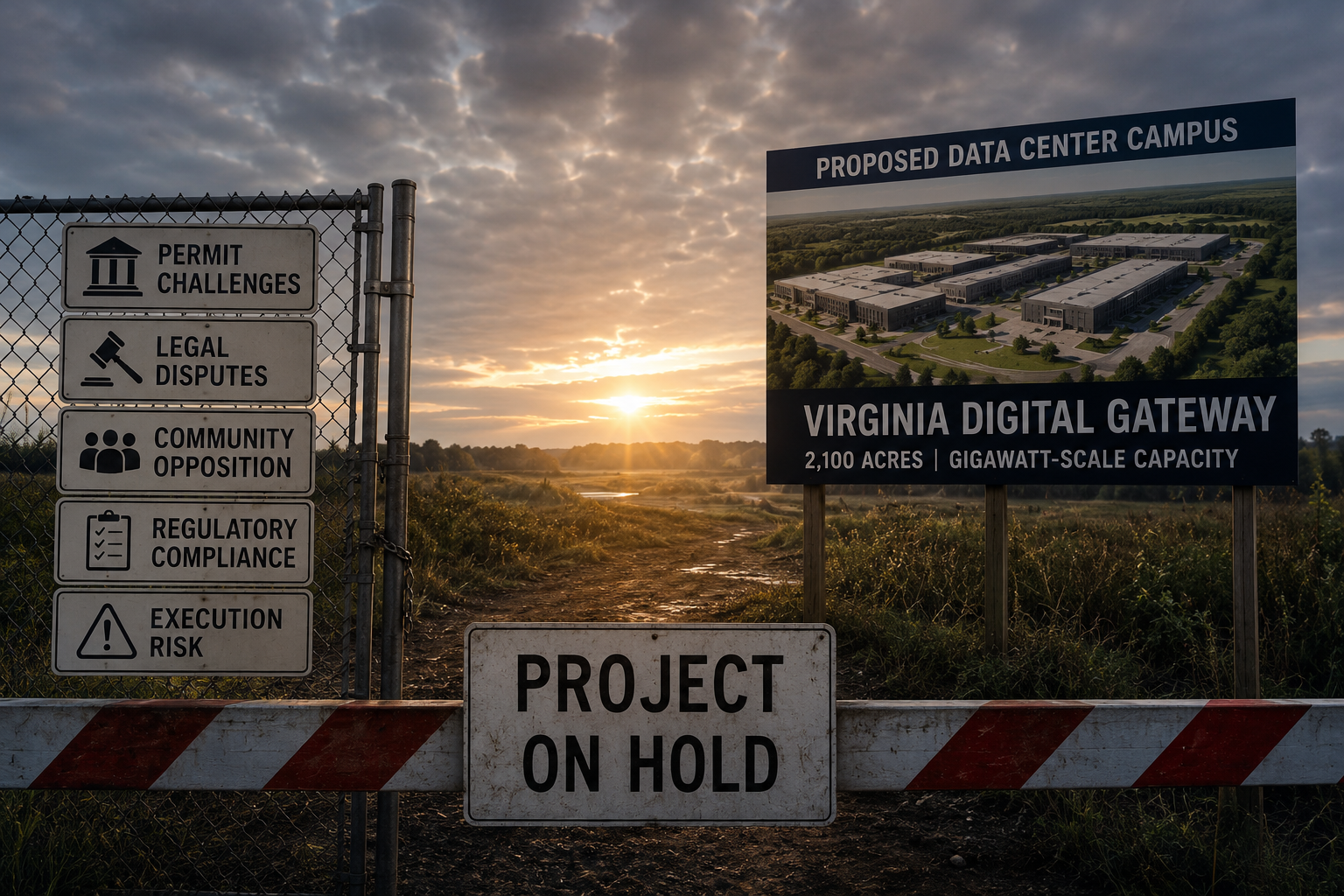
- QTS has abandoned the 2,100-acre Virginia Digital Gateway after years of legal challenges
- The collapse shows execution certainty is becoming as important as demand, power and capital for AI infrastructure
The fact
QTS has abandoned plans for the Virginia Digital Gateway, ending one of the world's largest proposed data centre developments. The Blackstone-owned operator withdrew its final appeal after a Virginia court invalidated the project's rezoning approval, bringing years of planning and legal disputes to a close.
The proposed 2,100-acre campus was designed to deliver 22 million square feet of data centre space with gigawatt-scale capacity. However, the Virginia Court of Appeals ruled that statutory public notice requirements had not been met during the rezoning process, rendering the approval invalid despite previous county approval.
The cancellation comes as developers race to expand AI infrastructure across the United States while facing growing legal, regulatory, and community scrutiny. Industry estimates suggest more than US$130 billion of US data centre projects were delayed or blocked during the first quarter of 2026, highlighting the increasing complexity of delivering large-scale digital infrastructure.
The assessment
Delivering AI infrastructure is becoming as challenging as financing it. Strong demand for AI computing, available capital and access to power no longer guarantee that large-scale projects will reach construction. Planning processes, legal compliance and governance are increasingly determining whether new capacity can be delivered.
Large hyperscale developments now face a broader range of execution risks than previous generations of data centre projects. The Virginia Digital Gateway demonstrates that procedural compliance can determine the outcome of billion-dollar infrastructure investments. Even relatively minor legal errors may invalidate approvals when projects face sustained community opposition and judicial scrutiny.
For BTW readers, competitive advantage increasingly depends on more than securing land, power and customers. Operators that combine disciplined governance, regulatory compliance and early stakeholder engagement are likely to bring new capacity online more reliably than those pursuing increasingly ambitious projects without the same level of execution certainty. As AI infrastructure expands, execution capability is becoming a strategic differentiator in its own right.
What to watch
Watch whether hyperscale developers strengthen governance, regulatory compliance and community engagement during future projects. The frequency of legal challenges, approval delays and procedural disputes will indicate whether execution risk is becoming a defining factor in where large-scale AI infrastructure can be built.