
Summary
- Fideicomiso de Administración Datacenter Capitalinas should be read through several public records at once: the trust/tax name, the CapitalinasDC facility site, Building Networks' data-center pages, the Córdoba contact surface and AS52321 resource records. No single record resolves the whole operating boundary.
- The public service surface is concrete enough to matter. CapitalinasDC describes housing, IP telephony, dedicated servers, virtual private servers, storage and backup, technical service, racks, redundant power, fire suppression, Cisco-based networking, VLAN separation, customer IP assignment and optional filtering/firewall controls.
- The strongest live operating cue is Building Networks' statement that it operates Data Center Capitalinas in Córdoba, paired with its data-center business-unit pages and local contact surface. That supports local support and facility accountability, but it does not independently prove SLA performance, staffing depth or support resolution.
- AS52321 gives the name a network-resource footprint: public views show four IPv4 /24s, RPKI-valid origin evidence, LACNIC attribution and observed upstream/peer relationships. Those clues are valuable for due diligence, but they are not uptime, capacity or data-residency guarantees.
The first task is separating the name from the service boundary
The first thing to know about Fideicomiso de Administración Datacenter Capitalinas is that the public record does not present one tidy company profile. It presents a set of overlapping names and operating surfaces. The legal/tax directory record names Fideicomiso de Administración Datacenter Capitalinas and a CUIT. The datacenter website presents Datacenter Capitalinas as a facility and service brand in Córdoba, Argentina. Building Networks presents Data Center Capitalinas as a business unit and says it operates the facility. Public internet-resource records attach AS52321 and a set of IPv4 ranges to the Fideicomiso name.
The contact addresses repeatedly point to Humberto Primo 670 in Córdoba.
That is not a weakness by itself. Many regional data-center and hosting businesses have layered structures: a property vehicle, a facility brand, a technology integrator, an ASN holder, a support organization and separate customer contracts. The problem begins when a buyer treats the shared name as if it automatically answers every question. A trust name in a registry does not prove who answers an incident call. A facility page does not prove current capacity. An ASN does not prove that a specific customer workload is routed through those prefixes. A local address does not prove that support is staffed at the moment an application fails.
A Building Networks page does not by itself define the legal counterparty in a customer agreement.
The right starting point is therefore not enthusiasm or dismissal. It is attribution. Which entity owns the contract? Which organization operates the racks? Which team controls support? Which network resources are assigned to the service being bought? Which systems are managed by the customer and which by the provider? Which documents are current, and which are older public pages that still matter as identity evidence but need confirmation before procurement?
For Datacenter Capitalinas, the public record offers enough to build that attribution file. The facility's own static website describes a Córdoba data center for hosting and using servers and equipment in a controlled and secure environment. It says companies inside the Capitalinas complex can connect through fiber links at 1 Gbps. The services page lists housing, IP telephony, dedicated servers, virtual private servers, storage and backup, and technical service.
The infrastructure page describes restricted access, biometric controls, video supervision, environmental controls, fire detection/extinction, redundant UPS and generators, Cisco-based networking, customer VLANs, multiple connectivity alternatives and optional filtering or dedicated firewalls. Building Networks adds a more current public voice, presenting Data Center Capitalinas as a data-center business unit and describing local support, high availability, multi-carrier links, contingency sites, edge computing and bare-metal or dedicated-server leasing.
Those claims are specific enough to be useful. They are also still claims. The buyer's job is to connect them to a signed service boundary, a dated service schedule, a current support route, a verified network assignment and a recovery procedure. Without that connection, the name can become a comforting shorthand that hides operational ambiguity.
The trust record is an anchor, not a complete assurance model
The Fideicomiso name matters because it gives the profile a legal and resource-registration anchor. Public tax-directory pages identify FIDEICOMISO DE ADMINISTRACION DATACENTER CAPITALINAS, CUIT 30-71126328-0, in Córdoba, with an activity classification tied to telecommunications services. ASN records identify AS52321 as Fideicomiso de Administración Datacenter Capitalinas, with LACNIC-style owner fields and contacts at Humberto Primo 670. IPinfo and Hurricane Electric show the same AS number associated with Argentina, hosting/resource categories and a set of originated IPv4 prefixes.
That is much better than a datacenter name that exists only as a marketing page. A buyer has identifiers to query: CUIT, address, AS number, resource ranges, contact names, facility site, Building Networks domain and the BTW directory entry. If an invoice, route object, support email or contract refers to a different name, the buyer has enough public data to ask why.
But the trust structure should not be overread. The phrase "Fideicomiso de Administración" is a legal-administrative name, not a technical design document. It does not say which entity manages customer operations, which assets belong to the trust, which obligations sit with Building Networks, which responsibilities sit with a carrier, or which commitments are enforceable under a customer's agreement. The public record can identify the name. It cannot infer the whole governance chain.
That distinction matters in failure scenarios. If power fails, who owns the customer communication? If a route is withdrawn, who updates the carrier? If a customer needs an additional IP address, which party approves it? If a rack move is required, who signs off? If a customer wants a backup restored, which team handles storage and which team handles the application? If an abuse complaint arrives against an IP in AS52321, which contact responds? If a managed server needs operating-system work, is that included, separately scoped or customer-owned?
The article's practical judgment starts here: the Fideicomiso name is an anchor for diligence. It is not a substitute for a contract, support matrix or operational runbook. That is especially important because Datacenter Capitalinas appears in public records both as a facility and as a resource holder, while Building Networks appears as the operator and technology integrator. A serious buyer should insist on a written map of those roles before relying on the facility for critical systems.
The official facility pages describe a real operating surface
The CapitalinasDC pages are old-fashioned, static and undated, but they are not empty. They describe services that map to practical data-center buying decisions. Housing is presented as rack space from 1U to full racks, with shared or dedicated internet connectivity. Dedicated server service is framed for companies that want to externalize systems, including operating-system operation and maintenance. Virtual private servers are described for corporate web applications with dedicated management over a Gigabit Ethernet link.
Storage and backup services include information protection and database installation, configuration, maintenance and backup. Technical service covers preventive and corrective on-site maintenance of equipment, connectivity, networking and antivirus support.
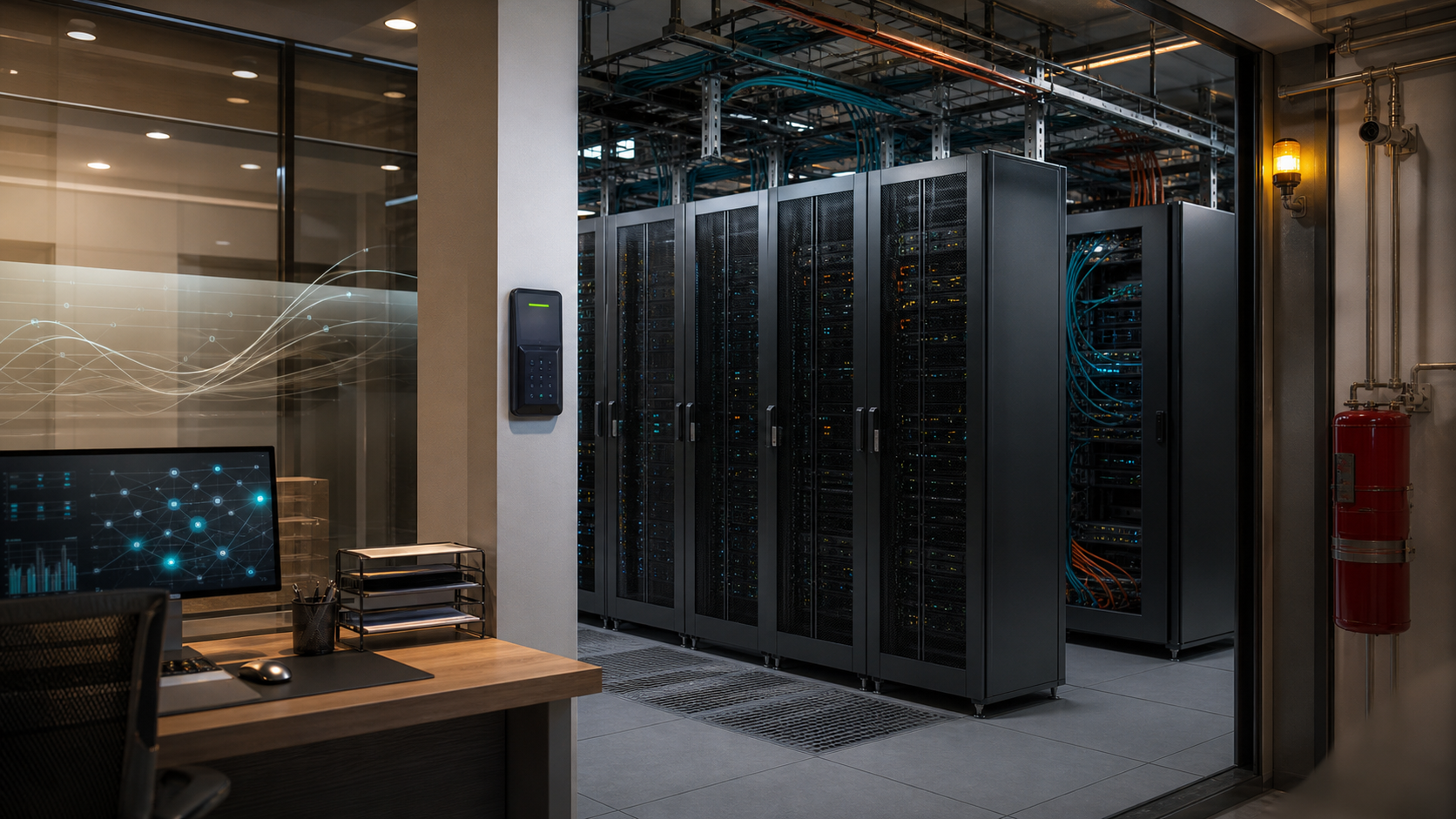
The infrastructure page gives the strongest technical detail. It describes a restricted rack and operations room with biometric access controls, video-camera supervision, environmental controls, fire detection and extinction, motion sensors and security alarms. It says racks are standardized 19-inch units, with optional independent cages, duplicated 220VAC supply, redundant cabling, double independent circuits per rack and no visible equipment/rack labeling for confidentiality.
It describes redundant UPS, generator-backed supply, FM-200 gas fire suppression, multi-zone detection, smoke detectors, humidity and temperature controls, flood and condensation sensors, and redundant air conditioning.
On the communications side, the page says the data center uses a modular converged network architecture, Cisco equipment, Gigabit Ethernet routing and switching, traffic-shaping and routing-protocol functions for connections to providers' backbones. It says the network architecture is duplicated, that servers connect through different network interfaces, that office connectivity is distributed by Cisco Catalyst switches at Gigabit Ethernet, and that bandwidth can be sustained at 1 Gbps across the structure to servers.
It also references optional load balancing, persistence, NAT for web servers, customer-specific VLANs, multiple connectivity alternatives, one IP address per hosted server, optional additional IPs, filtering policies by IP address, application port or URL, protection against denial-of-service attacks, and dedicated firewalls.
These are not generic "cloud transformation" words. They are the vocabulary of colocation, managed servers, in-building fiber, customer VLANs, rack power, fire suppression, provider backbones and security controls. That makes the public record useful for a buyer who needs a checklist.
A customer can ask whether the current rack/power design still matches the public page, whether FM-200 and environmental controls are current, whether Cisco remains the switching/routing standard, whether optional firewalls are shared or dedicated, whether customer VLANs are truly exclusive, whether IP assignment is provider-dependent, and whether denial-of-service filtering is a standard feature or a separately scoped policy.
The static nature of the pages is also a diligence signal. A page can be old and still truthful, but undated infrastructure copy should be refreshed or confirmed before procurement. Data centers age through power density, cooling load, carrier mix, hardware lifecycle, security practice, customer concentration and staffing changes. A buyer should not assume that every detail on an undated page remains current. The page should be treated as a public claim to verify, not as a contemporary inspection report.
Building Networks is the clearest operator-facing record
The newer and more active public record comes from Building Networks. Its data-center page presents data-center design, development and management as part of its technology-integration work. It links directly to Data Center Capitalinas and describes the business unit as offering storage, connectivity and digital-security services, with housing, controlled environment, security and uninterrupted energy.
Its explanatory page goes further: it says Data Center Capitalinas is operated by Building Networks in Córdoba and describes the facility as a local option for companies that want infrastructure without relying only on Buenos Aires or international cloud providers.
That operator statement is central. It helps resolve a question the Fideicomiso name alone cannot answer: who is visibly standing in front of the service? Building Networks also offers adjacent context. Its homepage describes an integration business for converged networks, video surveillance, access control and CamScope, its own software for managing cameras, speakers and access systems. That matters because a datacenter is not only racks and power. It depends on structured cabling, physical access, camera coverage, alarm workflows, network segmentation and the staff discipline to keep those systems alive.
The Building Networks pages describe Data Center Capitalinas as using uninterrupted energy with redundant UPS and generators, controlled climate, fire detection/extinction, physical and logical security, 24/7 video surveillance, scalable dedicated multi-carrier links and specialized local support. They identify housing/co-location as the main service, with contingency/business-continuity sites, edge computing and dedicated/bare-metal leasing as additional services. They also invite technical teams and decision-makers to guided visits and provide a named commercial contact route.
For a buyer, this shifts the diligence from "Is there a public datacenter site?" to "Can Building Networks evidence the current operating model?" Useful questions include who staffs support, what hours are covered, what is done remotely versus on site, how access is approved, how remote hands are logged, how carriers are escalated, how power/cooling incidents are communicated, what happens when a customer needs emergency access, and whether the Fideicomiso or Building Networks appears on the contract and invoice.
The public Building Networks evidence is encouraging because it shows a living commercial and support surface around the facility. It is not enough to prove support quality. There are no public severity metrics, audited incident reports, support-resolution distributions, contractual response matrices or customer references with current technical detail. The fair conclusion is that Building Networks gives Datacenter Capitalinas a credible public operator face, while the buyer still has to turn that face into a written support obligation.
Locality is the value proposition and the risk
Datacenter Capitalinas is a locality story. The pages repeatedly place the facility in Córdoba, Argentina, and specifically in the Capitalinas district or complex. The facility site says companies in the complex can connect through fiber links at 1 Gbps. Building Networks frames the value of a nearby data center as local support, lower latency, physical connection efficiency, more control over contracted infrastructure and less dependence on remote support from Buenos Aires or international cloud providers.
For many Argentine organizations, that is a real argument. A local facility can simplify site visits, rack access, provider meetings, continuity planning, cabling, support language, billing expectations and the politics of where critical equipment sits. A company in Córdoba may prefer a local colocation and support provider for a contingency environment, a controlled rack, a migration from an office server room, a backup target, or a low-latency connection to nearby offices.
Local support labor can matter more than a marginal cloud price difference when the issue is a physical server, a rack cable, a firewall replacement, a carrier handoff or a Friday-night recovery.
But locality can also be overclaimed. A facility in Córdoba does not automatically solve data sovereignty. It does not prove where every backup sits, whether a virtual server depends on another provider, whether support access is locally constrained, whether a third-party carrier touches traffic outside the region, whether logging is retained in Argentina, whether cloud services are blended into the offering, or whether a disaster-recovery site is outside the same risk zone. Locality is not a badge. It is a set of architectural facts.
The buyer should split locality into at least five layers. The first is legal locality: which entity contracts with the customer and under which jurisdiction. The second is facility locality: where the rack, server, storage or network equipment physically sits. The third is operational locality: who can access, maintain and support the service, from where and under what approval process. The fourth is data locality: where files, databases, backups, logs and replicas reside.
The fifth is network locality: where traffic leaves the facility, which carriers carry it, and whether upstream routes match the customer's latency and resilience needs.
The public record answers facility and contact locality better than it answers data or operational locality. The Córdoba address, facility descriptions and Building Networks pages are strong enough to anchor an on-site diligence conversation. They are not enough to prove the location of every dataset or the staffing depth behind every service. A buyer with ordinary colocation needs may be satisfied after a visit and contract review.
A buyer with regulated data, public-sector obligations, healthcare records, financial systems or strict business-continuity requirements needs written answers on data paths, backups, administrative access, subprocessors, carrier diversity and recovery timing.
The commercial value of Datacenter Capitalinas therefore depends on whether local control lowers the total cost of reliability. If the alternative is a poorly managed office server room with weak power, weak cooling, no access logs and improvised backups, a local professional facility can be a major step up. If the alternative is a mature cloud or carrier-grade colocation arrangement with formal certifications, measured SLAs and multiple regions, the local facility has to justify itself through specific proximity, support and migration advantages rather than the mere fact of being nearby.
Network-resource evidence makes the profile more queryable
AS52321 is one of the most useful parts of the public record because it gives the Datacenter Capitalinas name a queryable internet-resource footprint. Public views identify AS52321 as Fideicomiso de Administración Datacenter Capitalinas in Argentina. IPIP shows the ASN with four IPv4 prefixes and no IPv6 prefixes, 1,024 IPv4 addresses, and ranges 190.123.120.0/24 through 190.123.123.0/24. It also shows LACNIC-style owner fields, ownerid AR-FADC-LACNIC, responsible contact Hector Ruben Abdala, Humberto Primo 670 in Córdoba, and routing/abuse contacts.
IPinfo adds a second view. It identifies the ASN website as capitalinasdc.com, counts 1,024 IPv4 addresses, zero IPv6 addresses, classifies the ASN as hosting, and shows the same four /24 ranges as RPKI-valid. It lists two peers and upstreams, Level 3 Parent and NSS S.A., no downstreams, a small number of hosted domains and pingable IP observations from Buenos Aires. Hurricane Electric's BGP Toolkit likewise shows four originated and announced IPv4 prefixes, no IPv6 prefixes, all four originated prefixes RPKI-valid, two observed IPv4 peers and 1,024 originated IPv4 addresses.
This is meaningful evidence. It means the name is not only a building page and a tax listing. It has public numbering resources that can be checked by risk teams, network engineers, abuse desks and customers with IP dependencies. If a customer receives an assigned IP from the provider, it can ask whether the assignment falls inside one of those ranges. If a firewall allowlist depends on an address, the customer can document which prefix and origin ASN are involved. If email deliverability or reverse DNS matters, the customer can ask how those controls work.
If a support issue involves route reachability, the customer has public collectors to check.
The caveat is equally important. Network resources are evidence, not assurance. An ASN does not tell the buyer which product uses it. A customer service could use AS52321, a carrier-provided address, another upstream assignment, a cloud provider or a private interconnect. Four originated IPv4 prefixes do not prove bandwidth, redundancy, latency, route stability or support responsiveness. RPKI-valid status is valuable because it reduces one kind of route-origin ambiguity, but it does not prove application uptime.
Pingable IP observations are useful signs of reachability from specific measurement points, not synthetic monitoring of a customer's workload.
The public route views also show a compact footprint: 1,024 IPv4 addresses, four /24s, no IPv6 in the observed public pages, and two observed upstream/peer relationships in the captured views. That footprint may be perfectly adequate for a regional facility, but it changes the questions. Does the service support IPv6 where needed? Are the two observed upstreams both active for the customer's service? Are there diverse paths into the facility? Are customer prefixes portable? Can the provider support BGP sessions for enterprise customers, or is the customer using provider-assigned addresses only?
Are DDoS controls native, carrier-provided or optional firewall features? How are abuse reports handled? How are reverse DNS records requested?
In other words, AS52321 makes Datacenter Capitalinas easier to inspect. It does not make the facility self-certifying. A network engineer can do useful due diligence because the identifiers exist. The procurement error would be to treat the identifiers as proof that the service boundary is already fit for every workload.
Automation is mostly record discipline, not a shiny interface
For a regional datacenter trust and facility, automation should not be understood narrowly as a customer portal or an API. The core automation problem is whether identity, account, support, network, access, change and recovery records stay fresh enough to be used repeatedly. A datacenter fails operationally when the right information is trapped in email, a single employee's notebook, an old rack diagram, a stale contact list or an untested backup process.
The public Datacenter Capitalinas record suggests several operational records that must be kept synchronized: customer rack/cage assignment, power feed, circuit inventory, VLAN assignment, IP allocation, firewall/filtering policy, carrier handoff, access authorization, remote-hands request, backup/storage scope, server management responsibility, contact list, escalation route and service termination procedure. The network-resource record adds origin ASN, prefix, RPKI, abuse contact, reverse DNS and route-policy evidence.
The Building Networks operator surface adds guided visits, local support, commercial contact, technology integration, video surveillance and access-control context.
Those records are valuable only if they remain current. A buyer should ask how Datacenter Capitalinas or Building Networks records customer contacts, authorized access, IP assignments, firewall changes, support tickets, maintenance windows and physical interventions. Is there a ticketing system? Are changes approved in writing? Are rack visits logged? Are remote-hands actions recorded? Are access permissions reviewed when a customer employee leaves? Are carrier outages tied to affected customers? Are maintenance notices separated from incidents? Are backup restores tracked? Are incident reports available after high-severity events?
Are contact details tested periodically?
This is the operational meaning of automation for the assignment. The public record does not need to show a flashy management console to be useful. It needs to support repeatable decisions. If a customer cannot quickly answer which IP belongs to which server, which rack has which power circuit, which firewall rule was changed, which person approved access, which backup covers which database and which carrier carries which service, then a local datacenter can still become a manual-risk environment.
The facility's public service list implies several boundaries that should be automated or at least tightly recorded. Housing customers may manage their own servers but depend on the facility for power, cooling, access and connectivity. Dedicated-server customers may expect more operating-system involvement. Virtual private server customers may expect a managed link and host environment. Storage and backup customers may expect protection of data, but still need restore evidence. Technical-service customers may depend on on-site labor. Each service has a different responsibility line.
That is why the trust/operator distinction matters again. If the Fideicomiso holds the resource or facility identity while Building Networks handles operations, customer records must bridge that boundary cleanly. The buyer should not discover during an incident that billing, rack access, IP assignment and support escalation live in separate undocumented systems.
Reliability requires current evidence, not inherited confidence
The public pages for Datacenter Capitalinas make reliability claims in the language one would expect from a data-center facility: high availability, controlled environment, redundant power, generator-backed supply, fire suppression, redundant air conditioning, duplicated networking, fiber links and local support. Building Networks repeats several of those themes and frames the facility as a way to avoid less controlled office infrastructure and distant support.
Those claims are plausible and relevant, but reliability cannot be inherited from nouns. A rack, a UPS, a generator, a biometric sensor, a Cisco switch and a multi-carrier claim all need current operating evidence. When was the generator last tested under load? What is the UPS autonomy? What power density is supported per rack? How is cooling redundancy measured? Which fire-suppression system is active and maintained? What inspections or certificates apply? Which carriers are physically diverse? Which network devices are redundant? Are configurations backed up? What is the maintenance window process? How are customers notified?
The public record does not answer those questions at the level a critical workload needs. That does not mean the answers are bad. It means they are not public. A buyer should request dated service descriptions, inspection evidence, maintenance records, access-control procedures, a sample incident notice, support escalation terms and any current certification or audit documentation the provider can share. If none is available, the buyer has to price the risk accordingly.
Recovery is the other half of reliability. CapitalinasDC lists storage and backup services, including tape-backed information protection and database services. Building Networks mentions contingency sites and business continuity. Those are valuable surfaces, but they do not prove recovery objectives. A backup service is not a recovery plan until a representative restore has been tested. A contingency site is not business continuity until failover scope, data currency, access permissions, network rerouting and customer responsibilities are written down.
Customers should distinguish at least four recovery cases. The first is facility trouble: power, cooling, access, fire, carrier or network-device failure. The second is customer-equipment trouble: a server, disk, operating system, application, firewall or cabling problem. The third is data trouble: deletion, corruption, ransomware, failed update or database loss. The fourth is administrative trouble: lost credentials, unauthorized access, lapsed payment, stale contact or contract ambiguity. A facility can be strong in one case and weak in another.
Datacenter Capitalinas' public record is strongest on facility features and network-resource identifiers. It is thinner on recovery outcomes, support metrics and dated assurance. The fair reliability conclusion is therefore bounded: the record supports a serious data-center evaluation, but it does not let a buyer skip the evidence request.
Support accountability is where the commercial case is won or lost
A local datacenter earns its margin when support turns proximity into lower risk. Building Networks' pages emphasize specialized local support, guided visits and a local Córdoba operating context. CapitalinasDC's contact page gives a phone number and address. The services page includes technical service and on-site maintenance. For organizations that do not want to maintain a server room or send staff to Buenos Aires, that support layer may be the difference between a workable infrastructure decision and a risky one.
The support question is not whether someone is friendly or nearby. It is whether support is accountable under pressure. A buyer should ask what channels are official, what response hours apply, what emergency process exists, how physical access is approved, how remote-hands tasks are scoped, how carrier issues are escalated, how status updates are sent, how change windows are documented, how after-hours work is billed, and how problems are closed. For each service category, the customer should know whether the provider will diagnose, repair, escalate, observe or only grant access.
This is particularly important for the mixed service set in the public record. Housing and colocation put more responsibility on the customer. Dedicated servers and operating-system maintenance may shift more responsibility to the provider. Virtual private servers imply a host layer that the provider controls. Storage and backup involve data-protection obligations that must be precise. IP telephony adds service-continuity expectations beyond ordinary web hosting. Technical service can range from simple field support to substantial managed operations. The phrase "support" covers too much unless the buyer splits it by task.
The public evidence does not show response-time metrics or support-resolution outcomes. There are no public dashboards in the captured evidence, no incident-history page, no severity table, no customer support statistics and no support portal proof. The Building Networks record still matters because it creates a visible operator face and local contact route. But visible contact is only the first layer. If the workload is critical, the buyer needs severity-specific commitments.
There is a practical way to test support without creating a crisis. Before moving production systems, a buyer can ask for a pre-sales technical walkthrough, request a sample change ticket, schedule a facility visit, document the after-hours procedure, confirm who can authorize access, ask how carrier trouble is isolated, and perform a small noncritical support request. The goal is not to catch the provider out. It is to see whether the record is repeatable. Does the same answer come from commercial, technical and support contacts? Are commitments written down?
Does the provider know where the trust, Building Networks and customer responsibilities meet?
If support accountability is strong, Datacenter Capitalinas may justify itself through locality, proximity and reduced operational burden. If support accountability is vague, the local facility can still become expensive because every incident turns into negotiation.
The commercial comparison is against unmanaged burden, not only cloud price
It is easy to compare a regional data-center service against a hyperscale cloud invoice and declare one cheaper or more modern. That is usually the wrong comparison. The real commercial question is what work the service removes from the customer and what risk it leaves behind.
Datacenter Capitalinas is most compelling where the customer has physical infrastructure that it should no longer operate alone: office servers, local storage, backup systems, telephony equipment, legacy applications, specialized appliances, or a need for local continuity infrastructure. The public service mix fits that case. Housing/co-location, dedicated servers, virtual private servers, storage/backup, technical support, IP telephony and local connectivity are practical for organizations moving from improvised IT rooms into a more controlled environment.
The economic value comes from avoiding many hidden costs: cooling, power conditioning, generator support, fire suppression, rack security, access control, cabling, carrier coordination, network monitoring, hardware visits, spare parts, backup discipline, staff travel and the distraction of keeping non-core infrastructure alive. Building Networks' argument that teams can focus on strategic work instead of hardware upkeep is commercially plausible when the customer lacks a mature infrastructure team.
The case is weaker if the customer expects a regional facility to behave like an elastic global cloud. A hyperscale cloud may offer richer automation, global regions, managed databases, object storage, identity controls, infrastructure-as-code, mature security attestations and integrated monitoring. A large carrier-grade colocation provider may offer more formal certifications, carrier density, documented power tiers and multi-site options. Datacenter Capitalinas can still be the right choice, but only when locality, access, support, proximity, existing equipment, data-control preferences or migration constraints outweigh those alternatives.
The buyer should price migration carefully. Moving into a local facility is not a one-time rack move. It can involve IP renumbering, DNS changes, firewall rules, VPN updates, backup redesign, application dependency mapping, hardware maintenance contracts, remote-access controls, support training, monitoring, documentation and a future exit plan. The cost of leaving later should be estimated before the move. If the provider's IP space is used, the buyer should know how portable the setup is. If provider-managed backup is used, the buyer should know how data can be exported.
If dedicated servers are rented, the buyer should know how images, licenses and data return at termination.
For some customers, those costs will be worth paying. A local datacenter can reduce the fragility of office-hosted systems and create a more accountable operational environment. For others, a cloud or larger colocation alternative will be better. The public record does not answer the commercial question alone. It gives the buyer enough evidence to build a comparison around real operating work rather than brand impression.
Failure modes are visible if the buyer looks directly at them
The main failure modes for Fideicomiso de Administración Datacenter Capitalinas are not exotic. They are the predictable gaps between identity, service description and operational proof.
The first is trust/facility/operator ambiguity. A buyer may see the Fideicomiso name in network records, the Datacenter Capitalinas name on the facility site and the Building Networks name on operator pages, then assume the same party owns every obligation. The safer approach is to ask for a role map: legal counterparty, facility owner, service operator, network-resource holder, support desk, billing party and escalation contacts.
The second is capacity overreach. Public pages mention racks, cages, redundant power, Cisco networking, carrier links and hosted services. They do not disclose current occupancy, power-density limits, cooling headroom, cross-connect availability, spare hardware, carrier diversity by route or maintenance history. A customer should ask for current capacity facts before moving equipment or renting dedicated infrastructure.
The third is data-sovereignty overreach. Córdoba locality is valuable. It does not prove that every backup, log, management tool, virtual host, support access path or third-party service remains in Argentina. The buyer should request data-path and backup-location documentation for the exact service.
The fourth is network-resource overreach. AS52321 and its prefixes are useful. They do not prove that a specific service uses those routes, that IPv6 is available, that route performance meets the workload, or that addresses are portable. The customer should verify the assigned IP, origin ASN, reverse DNS, RPKI, carrier path and DDoS controls before relying on IP-level assumptions.
The fifth is support-opacity risk. Public local contact and operator pages are helpful, but they do not show severity metrics, response times, after-hours practice or resolution evidence. The customer should turn support into a testable matrix: routine request, urgent physical task, carrier issue, backup restore, firewall change, access request, security incident and termination/exit.
The sixth is recovery optimism. Storage and backup services are listed, and contingency services are mentioned, but no public restore evidence is provided. Customers should run a restore test for any important dataset and document recovery time, recovery point, responsibilities and dependencies.
These failure modes do not argue against the provider. They argue against lazy buying. The public record is strong enough that buyers can ask specific questions. That is a positive sign. A provider with no address, no service pages and no network-resource evidence would leave far less to inspect.
What a serious acceptance test should include
A buyer considering Datacenter Capitalinas should create an acceptance file before moving a production workload. The first section should be identity. Record the legal counterparty, CUIT, contract name, invoice name, facility name, Building Networks role, AS52321 role, contact addresses, support channels and authorized customer contacts. If any name differs, document why.
The second section should be service classification. For each workload, state whether it is housing, colocation, dedicated server, virtual private server, storage/backup, IP telephony, technical service, connectivity, firewall/filtering, edge/contingency service or a custom managed arrangement. Then write which party owns the operating system, application, backup, firewall, data restore, monitoring, patching, physical access and carrier escalation.
The third section should be facility evidence. Confirm rack assignment, power feed, UPS/generator posture, cooling assumptions, fire-suppression status, access controls, camera coverage, maintenance windows, remote-hands procedure and on-site visit process. Ask for dated evidence where the workload justifies it. A walk-through is useful, but a current service schedule is better.
The fourth section should be network evidence. Record IP ranges, origin ASN, upstreams, reverse DNS process, RPKI status, VLAN assignment, firewall controls, DDoS options, carrier diversity, cross-connect path, monitoring responsibility and what happens if an address changes. If IPv6 matters, require an explicit answer because the public ASN pages captured in this pass showed no IPv6 prefixes in those views.
The fifth section should be support evidence. Define severity levels and map them to response routes. Ask how support is staffed, how after-hours incidents are handled, how status updates are delivered, how third-party carrier delays are communicated, how tasks are closed and how customers can escalate unresolved incidents. If the provider cannot share public metrics, request contractual response language or sample reports.
The sixth section should be recovery. Run at least one restore or failover drill for a noncritical workload before relying on the service. Confirm backup frequency, retention, storage location, encryption, access control, restore request process, restore timing and customer responsibility. If the service includes contingency or business continuity, test the switch rather than accepting the label.
The seventh section should be exit. Document how equipment leaves, how data is exported, how IP addresses are replaced, how DNS changes, how backups are returned or destroyed, how credentials are removed, how access cards or permissions are revoked and how final invoices are handled. A provider is easier to trust when the customer knows how to leave without improvising.
This acceptance test is not heavy bureaucracy. It is the minimum structure needed to convert a local datacenter promise into an operating decision.
The fair operating judgment
Fideicomiso de Administración Datacenter Capitalinas has a stronger public record than a thin name in a directory. The profile has a legal/tax identity, a facility website, a local Córdoba contact surface, Building Networks operator-facing pages, public service descriptions and a queryable ASN with RPKI-valid IPv4 prefixes. For a regional data-center subject, that is meaningful evidence.
The record also has clear limits. The CapitalinasDC site is static and undated. The Building Networks pages are vendor-authored. Tax-directory records are identity clues, not operational proof. ASN evidence is valuable but narrow. Public pages do not show audited uptime, current capacity, formal certifications, contract terms, support metrics, backup restore results, customer satisfaction, staffing levels or exact data paths. Those are not small details for critical infrastructure.
For customers in Córdoba or nearby Argentine markets, Datacenter Capitalinas may be most attractive where proximity, physical access, local support, existing equipment, office connectivity, continuity planning and migration from improvised infrastructure matter. The public service vocabulary fits that market: racks, housing, dedicated servers, VPS, backup, technical support, local connectivity and facility controls. The Building Networks connection adds a visible integration and support layer that could be commercially important.
For customers with strict compliance, high availability, multi-site resilience, formal audit requirements, deep automation needs, global scale or detailed data-residency obligations, the public record is not sufficient by itself. Those customers need written answers, dated evidence and tested procedures before relying on the service. They should not infer current assurance from the trust name, the facility label or AS52321.
The balanced conclusion is that Datacenter Capitalinas deserves a serious diligence conversation, not automatic approval. Its public record is specific enough to support an informed evaluation and thin enough to require verification. Treat the Fideicomiso name as an anchor, Building Networks as the visible operator surface, the facility pages as a service checklist and AS52321 as a network-resource clue. Then make the provider prove the current operating boundary in writing.
That is the difference between a local datacenter story and a service decision. The story is attractive: a Córdoba facility, local support, controlled environment, fiber connectivity, rack services and network resources. The decision is harder: who is responsible, what is current, what is measured, what is recoverable and what happens when something fails. Buyers who keep those questions separate can use the public record well. Buyers who collapse them into a single reassuring name will carry the risk themselves.