
Summary
- Cosmonova matters if its Kyiv and Kyiv-region broadband accounts make households and small businesses value stable fixed access, TV bundling, account support, backup power claims and local repair labour enough to stay instead of moving to a national fixed operator, a mobile hotspot, Starlink or another satellite backup, a rival local ISP or no paid redundancy.
- The public case is credible but bounded. Company pages and Kolo.TV tariff pages show a real access, TV, small-business and support proposition; Ukrainian resilience sources explain why power autonomy matters; PeeringDB and routing records support the network-presence claim. Public evidence still does not disclose measured churn, fault restoration distribution, node-level battery autonomy, household renewal rates or margin after batteries, generators and support labour.
The paid unit is household continuity, not only megabits
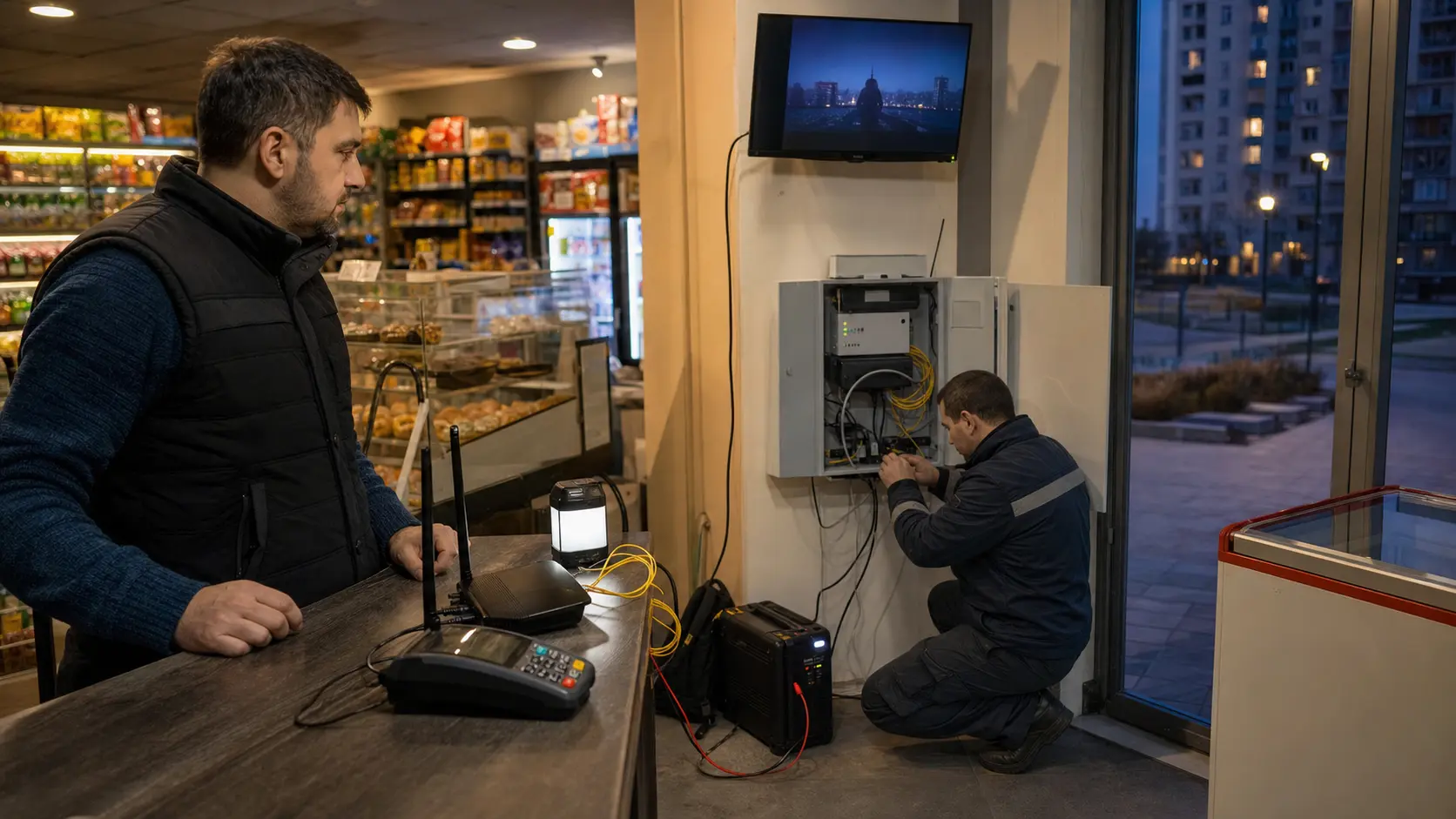
The buyer who makes Cosmonova economically interesting is easy to picture. A small grocery in a Kyiv residential complex wants its card terminal, stock app, camera feed and messaging channels to work during a rolling blackout. A household wants children to stay connected to classes, parents to keep remote work sessions open, and a TV package to keep evening media simple when mobile data is congested. A small salon or medical office wants one accountable contact for broadband, Wi-Fi, video surveillance, cloud backup and an engineer visit when the access line fails.
That buyer is comparing Cosmonova against a national fixed operator, a mobile hotspot, Starlink or another satellite backup, a rival local ISP and the cheapest option of no paid redundancy.
That is the economic unit: a Ukrainian broadband, TV and continuity account. It includes installation, the monthly broadband plan, the router or optical terminal, the TV bundle if the household wants one, support access, power-backup expectations, churn friction and the cost of replacing the service with a substitute stack. In normal consumer broadband writing, the account might be reduced to headline speed and monthly price. In Ukraine, after repeated power stress and infrastructure damage, the account has a second price tag.
The user is paying for the chance that the fixed line will keep working when the building has power backup, the provider's node has battery power, the router is connected to a local UPS, and a support worker can explain what has failed.
Cosmonova's own public pages make that continuity frame visible. The company describes itself as a Ukrainian telecommunications company founded in 2004, active in B2B, SMB and B2C markets through the Kolo.TV brand, with service platforms in Ukraine, Germany and the Netherlands (https://cosmonova.net/en/). Its English home page says one key direction is business internet in Kyiv and the region, using its own 700 km fibre network, Ethernet and GPON technologies, peering at domestic and international exchanges, parity channels with fifteen Ukrainian operators, five international operators in its partner pool and 220 Gbit/s of total channel capacity (https://cosmonova.net/en/). Those are company claims rather than audited operating metrics, but they show that Cosmonova sells more than a consumer access line.
The household and small-business side appears most directly through Kolo.TV. The Kolo.TV tariff page lists residential packages around 100 Mbit/s, 500 Mbit/s and 1 Gbit/s with monthly prices shown as 299, 349 and 399 UAH before promotional reductions, and it pairs some packages with "power reserved" language (https://kolo.tv/). The same page shows internet plus Kolo.TV packages at 369, 399 and 469 UAH, adding more than 150 channels, including 60 in HD, to the broadband plan (https://kolo.tv/). For small commercial premises, it lists "Vlasna sprava" plans for work with terminals, computers, video surveillance, CRM, cloud services, online payments and guest Wi-Fi, at higher monthly prices such as 500, 600, 700, 750 or 850 UAH depending on speed and TV bundle (https://kolo.tv/). The price difference is the first clue: small-business continuity is priced as a different product from household browsing.
Installation also prices the account. Kolo.TV states that connection costs are 499 UAH for Ethernet and 999 UAH for PON, with urgent same-day connection, where possible, at 1,200 UAH for Ethernet and 1,900 UAH for PON, and higher in one listed settlement (https://kolo.tv/). The page also notes advance payment for the remainder of the current month and the following month. Those small frictions matter. A household that has already paid installation, configured router settings, added TV, set up payments and learned support channels may not switch after one annoyance. A shop with a point-of-sale line and cameras has even more friction, because moving provider means scheduling access, reconfiguring equipment and risking downtime during the handover.
The account is not automatically defensible. Broadband users can move quickly if the line fails during outages. A national fixed operator may offer brand scale, larger field operations or mobile bundling. A mobile hotspot may keep messaging and payments alive at low setup cost. Starlink or another satellite backup may be attractive for emergency use. A rival local ISP may know the same building better. No paid redundancy may be rational for a household that can tolerate occasional outages.
Cosmonova's thesis works only if the local account feels reliable enough, responsive enough and bundled enough to beat those substitutes for the exact job the customer needs done.
That is why the opening question should not be "how fast is Cosmonova?" The better question is whether Cosmonova turns fixed broadband into an everyday continuity account. Speed helps, but it is only one input. The account earns renewal when the customer believes the access line, TV bundle, support desk, engineer visit, power-backup design and payment channel reduce the total cost of being offline.
Cosmonova's product surface is broader than a household ISP page
Cosmonova is a useful case because its public footprint straddles household broadband, small-business access, corporate telecom, data centre, cloud and TV distribution. That breadth can strengthen retention when the customer wants one local provider. It can also blur the economics if the public reader assumes that every claimed capability applies to every residential access line. The distinction matters. A household Kolo.TV tariff, a small-shop business line, a corporate data-transfer circuit, a data-centre rack and a TV-channel distribution service are related by network assets and staff, but they are not the same paid unit.
The official Cosmonova site emphasizes business internet, data transfer, data-centre services, cloud, IP telephony, TV and video services, and fibre construction (https://cosmonova.net/en/). The business internet page uses unusually direct power-resilience language. It says the service uses fibre, works in the absence of electricity, reserves the network, monitors all network segments around the clock, offers 24/7 backup service, connects to six major internet traffic exchange centres and uses LiFePo4 batteries and CWDM reservation at sites and backbone nodes (https://cosmonova.net/internet). For a buyer under outage pressure, those claims are more commercially relevant than a general statement that the company has experience.
The small-business page is even more explicit. It advertises stable internet for small businesses in residential complexes and lists "16+ hours Ethernet" and "72 hours PON" under uninterrupted operation, service under an SLA, mesh systems, modern routers, professional access points, wired connection to critical points such as workstations, server rooms, POS terminals and video surveillance, separate guest networks and business documentation support (https://cosmonova.net/smb-internet). It also names the customer types: shops and retail, service businesses, cafes, clinics, pharmacies, offices, small production sites, mini hotels and hostels. That page closely matches the assignment's economic unit because it says the relevant customer is not only a gamer or streaming household. It is a micro-business whose loss from outage is immediate.
The Kolo.TV retail page connects this business layer back to the household account. It shows ordinary residential tariffs, TV bundles, small-business tariffs, connection fees, PON terminal costs and payment terms on one surface (https://kolo.tv/). It also states that Ethernet subscribers are protected by modern power-reservation solutions, including LiFePo4 lithium batteries designed for repeated discharge and recharge, while PON subscribers rely on nodes equipped with powerful batteries and, in some places, generators (https://kolo.tv/). The exact level of autonomy at any given building is not public. Still, the selling logic is clear: the account is meant to compete on continuity, not only on speed.
Legal and permission evidence supports the idea that Cosmonova is a long-standing operator, though it does not prove current service quality. The company's licence page lists an NKRZI licence from 2016 for technical maintenance and operation of telecom networks in Kyiv, previous construction and hazardous-work permits, a fixed local telephone licence and numbering-resource permits, plus an information-security compliance certificate dated 24 July 2018 (https://cosmonova.net/page/licencies). The contacts page gives Cosmonova LLC's Kyiv contact channels, including multichannel phone, technical support email and official request email (https://cosmonova.net/contacts). These pages are not revenue disclosures, but they show that the company presents itself as a licensed operator with support and business contact infrastructure.
There is also a useful outside company-history source. EU4Business published a 2022 profile of Cosmonova that describes the company starting from a shared residential-building connection in 2004, then growing into B2C and B2B services, with presence in more than 80% of new buildings in Kyiv and Kyiv Oblast according to the profile, a fibre network of more than 700 km, a 2010 data-centre launch, cloud platforms in Ukraine and Europe, IP telephony, internet and IPTV services for home users, and B2C subscriber-base growth of 85% from 2019 to 2021 (https://eu4business.org.ua/en/success-stories/ahead-of-its-time/). Because it is a success story, it should be read as promotional context. It is still valuable because it gives a narrative of how a local access provider became a multi-service operator.
The operational breadth has a cost side. A provider that sells household broadband, small-business continuity, TV distribution, data-centre services and cloud has to maintain more than access switches. It needs field crews, splicers, optical stock, router and Wi-Fi stock, batteries, generators at some nodes, billing support, sales, finance documentation, data-centre technicians, TV-platform staff, monitoring, customer communication and partner interconnects. The more the customer expects one provider to solve all of that, the more labour and spare equipment are embedded in the account price.
This is where Cosmonova's account can defend itself. The household that buys a cheap fixed line may churn when a national operator offers a promotion. The shop that uses the same provider for broadband, Wi-Fi, cameras, cloud backup, Ajax installation and business documents may be less willing to churn, provided support works. The business internet page's "single source" framing for internet access, fixed telephony and digital TV is commercially important (https://cosmonova.net/internet). A local ISP's moat is often not scale alone. It is the operational memory of buildings, cabinets, access rules, customer equipment and local support habits.
The weakness is that breadth can become a promise burden. If Cosmonova markets continuity too strongly and the customer's line fails when the lights go out, disappointment is harsher than for a commodity plan. A customer can forgive a cheap line for being cheap. It is less forgiving when the service was bought to keep a terminal, class, stream or shop online. That makes proof and expectation management central to the economics.
Installation and monthly pricing show where continuity becomes a bill
The Kolo.TV tariff ladder is useful because it converts the abstract word "continuity" into household and small-business numbers. A residential account can begin around the 299 UAH monthly tier for up to 100 Mbit/s, move to 349 UAH for 500 Mbit/s, or reach 399 UAH for up to 1 Gbit/s before promotional discounts. With TV, the same page lists 369 UAH for 100 Mbit/s plus a full Kolo.TV package, 399 UAH for 500 Mbit/s plus TV, and 469 UAH for 1 Gbit/s plus TV (https://kolo.tv/). These are not large sums in global telecom terms, but in a household budget under war and inflation pressure they are still recurring commitments.
The small-business prices show a different willingness-to-pay test. "Vlasna sprava" plans are framed around terminals, computers, video surveillance, CRM, cloud services, online payments, guest Wi-Fi and larger data needs (https://kolo.tv/). These accounts sit above household tariffs because downtime has a direct economic cost. A shop that cannot accept card payments may lose sales immediately. A clinic that loses appointment access may lose trust. A cafe with guest Wi-Fi and online delivery orders may see revenue leak while staff troubleshoot mobile data. For these customers, the provider is not merely selling access to the internet; it is selling reduced operational disruption.
Installation adds a second layer. A 499 UAH Ethernet connection and 999 UAH PON connection, plus the obligation to prepay the current remainder and next month, create a small but real switching cost (https://kolo.tv/). The PON terminal cost listed on the Kolo.TV page is also part of the account calculation, with ordinary PON terminal options at 499 or 798 UAH and a higher terminal cost for a 2.4 Gbit/s plan (https://kolo.tv/). The customer also has to buy or own a router, choose whether to pay for a better router or mesh system, and decide how to power the router during outages. The monthly plan is only the visible part of the bill.
The cost of continuity rises further when the customer wants power backup at the premises. Kolo.TV's service-work page is not opened here as a full tariff proof, but the public page and payment-site summaries point to a wider accessory logic: routers, optical terminals, Wi-Fi devices, UPS or DC adapters and service visits all affect whether a household line works through a blackout. Even when the provider's node is backed up, the customer's home router and optical terminal need power. A household that refuses to buy local backup may blame the provider for a line that could have worked if the terminal had been powered.
That is a support and education cost.
Third-party tariff aggregators are useful as market signals, not as primary Cosmonova price proof. Connect.net.ua lists Cosmonova business-style "works without power" plans around 1,100 UAH for 20/100, 1,800 UAH for 50/100 and 2,300 UAH for 100/100 (https://www.connect.net.ua/ru/provayder/cosmonova/). OnlineYouNet lists a Cosmonova "Unlimited 100/100" business plan at 2,300 UAH per month, describing 100 Mbit/s business internet, static IP, network operation without power for more than 24 hours and connection based on an individual quote (https://onlineyounet.com/eng/tariff/12240). These sources may lag or simplify current commercial terms, so they should not replace Cosmonova's own site. But they confirm that the market sees a premium business continuity product, not only low-price household broadband.
The economics are therefore two-tiered. At the household level, Cosmonova competes on a monthly price close enough to local broadband norms that a user can compare it with other Kyiv providers. At the small-business level, Cosmonova competes on the cost of avoiding interruption: SLA language, priority support, 16+ hours Ethernet, 72 hours PON, critical-point wiring and a single provider for multiple IT needs (https://cosmonova.net/smb-internet). That difference matters because household price sensitivity and business continuity sensitivity are not the same.
The strongest retention case is the customer that uses the bundle. A household that buys internet plus TV, configures several devices, pays online and trusts Kolo.TV support has more attachment than a household buying naked internet. A small office that adds Wi-Fi design, cameras, cloud backup or telephony has a stronger tie. A customer that only buys one low-speed line and keeps a mobile hotspot ready can leave more easily.
The weakest retention case is the customer whose outage experience contradicts the continuity promise. A negative review on 2IP.ua complains that "energy-independent internet" did not work at the user's location and that support attributed the issue to unpowered equipment during outages; other reviews praise stable work without electricity and good support (https://2ip.ua/ru/services/providers-rating?act=1&asid=34867). Anonymous review pages are noisy and cannot settle service quality. They are useful because they show exactly what the market will test: when power fails, does the user still have service, and does support explain the failure quickly?
Cosmonova's cost paragraph is therefore concrete. It must fund fibre maintenance, access equipment, PON splitters or Ethernet switches, batteries, power supplies, replacement cycles, routers, optical terminals, field labour, customer support, call and messaging systems, billing, business documentation, TV-platform costs, peering, upstreams and data-centre or cloud overhead. If blackout preparedness raises battery and generator costs faster than monthly tariffs can rise, margin compresses. If users value the continuity enough to choose higher tiers, business plans, TV bundles and add-on services, the same expense becomes pricing power.
TV bundling is a household retention device
The TV part of the account is not decorative. It is a retention mechanism for households and a channel-list mechanism for small venues. Kolo.TV's public tariff page places internet-only packages beside internet plus TV packages. The TV bundles promise more than 150 channels, including 60 in HD, and are priced only tens of hryvnia above the corresponding broadband-only tiers (https://kolo.tv/). That small increment tells us how the bundle is likely meant to work: TV may not be the highest-margin product by itself, but it raises the household's perceived loss from switching.
The economics of TV bundling are different from broadband speed. A user may compare 500 Mbit/s with 1 Gbit/s and decide that the lower speed is enough. But a family that uses a familiar TV app, several household devices and a channel list may treat a provider change as more disruptive. The switching cost is not only technical. It is the time spent teaching family members a new interface, confirming which channels are included, reinstalling apps, changing passwords, moving payments and handling complaints when the living-room routine changes.
Cosmonova's corporate TV evidence is unusually strong for a regional ISP. The Cosmonova TV page says the company was the first operator in Ukraine to launch a licensed IPTV project in commercial operation, describes infrastructure for receiving satellite and studio feeds, video format conversion, redundancy at all nodes, a content-delivery network and constant engineering monitoring (https://cosmonova.net/en/tv). It also says Cosmonova works with more than 40 carriers and 120 channels, has antenna facilities, data-centre containment areas, a fibre network of more than 500 km for the TV platform, broadcast-centre and exchange-point service platforms, and global content delivery (https://cosmonova.net/en/tv). Those claims are broader than the household TV bundle, but they explain why TV is not an afterthought in Cosmonova's identity.
The testimonial section on the TV page should be used carefully because it is company-selected. Still, it shows the service situations Cosmonova wants to be known for: online broadcasts for public institutions and foundations, stable internet for events, TV signal delivery to cable operators, dark fibre with IP reserve for broadcast signal delivery, colocation for bandwidth-heavy HD video, IP stream formation, rapid emergency response and backup redundancy for media customers (https://cosmonova.net/en/tv). For this article, the point is not to turn those customers into separate subjects. The point is that Cosmonova has a public history of pricing video delivery as operational continuity.
That history matters for household bundling. In a stable economy, TV can be a content upsell. Under outage pressure, it becomes a test of whether the provider can keep a family connected to information and routine. A household may not need full broadcast-grade redundancy, but it values a simple bundle that keeps news, children's content and entertainment reachable when mobile networks are stressed. A small cafe or waiting room may value TV and Wi-Fi as part of customer experience. A building manager may prefer one provider that can sell internet, TV and telephony into a new development.
The developer channel is visible on Cosmonova's business internet page. It says that internet, interactive television and telephony in a single triple-play package can make a project under construction more attractive for future tenants (https://cosmonova.net/internet). That is a classic local ISP acquisition route: enter new residential complexes early, wire the building, sell a package to residents and small commercial spaces, then defend the account through familiarity and support. The EU4Business profile says Cosmonova focused B2C on apartment buildings and residential complexes put into operation no more than three years earlier, and had presence in more than 80% of new buildings in Kyiv and Kyiv Oblast according to that profile (https://eu4business.org.ua/en/success-stories/ahead-of-its-time/). If true at meaningful scale, that building-entry strategy is central to retention.
There is a downside. TV can also discipline price because customers have alternatives. Households can use over-the-top services, free online video, satellite TV, mobile video, or the TV bundle from a national operator. A customer that cares only about Netflix-style apps may not value the ISP's TV package. A household that wants only outage resilience may spend the extra money on a UPS or mobile data rather than TV. A small shop may not need television at all. The bundle works where convenience and routine matter; it does not work when customers are trying to strip the account to the lowest necessary broadband service.
This is why Cosmonova's TV logic should be judged as retention, not as proof of monopoly power. The Kolo.TV bundle gives households a reason to keep one bill. The broadcast and TV infrastructure pages show that Cosmonova has deeper video capability than a minimal reseller. But the bundle's value still depends on local access uptime, easy support and whether the price gap over internet-only service feels small enough to keep paying.
Power risk changes the meaning of fixed broadband
Ukrainian broadband cannot be valued without power risk. The line may be fibre, but the service still depends on powered equipment in the building, cabinet, provider node, data centre, exchange, customer premises and sometimes mobile backup layer. The UN Human Rights Monitoring Mission reported in September 2024 that repeated large-scale attacks on Ukraine's electricity infrastructure had affected essential services including water, heating, education, the economy and daily life, with strikes across 20 of 24 regions under Ukrainian control including Kyiv (https://ukraine.ohchr.org/en/Attacks-On-Ukraines-Electricity-Infrastructure). Cloudflare's Q1 2026 disruption review recorded roughly 50% regional internet traffic drops in Dnipropetrovsk and Kharkiv after energy-infrastructure attacks and related power outages (https://blog.cloudflare.com/q1-2026-internet-disruption-summary/). Those sources do not audit Cosmonova. They define the environment in which Cosmonova sells.
The continuity claim has become a national market feature. A 2025 Centre for Economic Strategy summary of a discussion with NCEC head Liliia Malion says the regulator's wartime role expanded to coordination with energy providers and local authorities, and that operators invested heavily in generators, battery systems and energy-efficient base stations after the winter of 2022-2023 (https://ces.org.ua/en/connectivity-during-blackouts-liliia-malion/). It also says many operators are switching to PON technology, which can keep networks running for up to 72 hours without electricity, while regulators inspect generator, fuel, battery and mobile-response readiness (https://ces.org.ua/en/connectivity-during-blackouts-liliia-malion/). That makes Cosmonova's own 72-hour PON claim part of a broader Ukrainian industry trend, not an isolated slogan.
Cosmonova and Kolo.TV both use power language prominently. The Cosmonova home page says LiFePo4 batteries are installed on provider equipment to support continuity during long-term outages, and that backbone nodes are reserved using CWDM and directly connected to the core so that intermediate power or equipment issues can be bypassed (https://cosmonova.net/en/). The business internet page says the network works in the absence of electricity and uses robust LiFePo4 batteries across sites (https://cosmonova.net/internet). The small-business page states 16+ hours for Ethernet and 72 hours for PON (https://cosmonova.net/smb-internet). The Kolo.TV page says Ethernet customers use backed-up power systems with LiFePo4 batteries and that PON nodes have powerful batteries, with some nodes also equipped with generators (https://kolo.tv/).
Those statements are commercially valuable, but they need boundary conditions. A PON network can be more energy-efficient than active Ethernet in the access layer, but the customer's optical terminal and Wi-Fi router still need local power. A node battery can be full or depleted depending on the duration and repetition of outages. A generator helps only where it exists, has fuel and can be maintained safely. A reserved backbone can bypass some intermediate issues, but it cannot fix a powerless apartment router, a cut drop cable or a damaged building access room. The continuity account is therefore shared between provider and user.
This shared responsibility creates support labour. Customers need to know which device to power, whether their tariff uses Ethernet or PON, whether their building has backed-up access equipment, whether an outage is local, building-wide or upstream, and when a technician can visit. Kolo.TV's small-business page offers priority business support through a Telegram bot or calls, advance information, and a master visit within 12 hours (https://cosmonova.net/smb-internet). That is part of the paid product. During rolling outages, a support representative who explains that the provider node is alive but the customer terminal is unpowered may save the account. Support staff who cannot answer may lose it.
Power also changes substitution. Mobile hotspots are flexible, but mobile base stations also need power and can congest when many users move traffic from fixed lines. Starlink or another satellite backup can bypass a terrestrial access fault, but it still needs terminal power, clear placement, subscription management and traffic discipline. A national fixed operator may have larger backup operations, but also larger failure domains. A rival local ISP may have better power backup in one building and worse in another. No paid redundancy may be rational when a household can tolerate downtime or cannot afford extra equipment.
Cosmonova's economic role is strongest when fixed fibre plus provider backup plus customer device power is cheaper and easier than assembling a substitute stack.
The cost of that role is not trivial. LiFePo4 batteries are not one-time magic. They have purchase cost, installation labour, charging equipment, replacement cycles, monitoring and theft or damage risk. Generators add fuel, servicing, noise, placement and safety constraints. PON migration requires optical terminal stock, splitter design, technician training and customer education. Support channels need staffing. If a provider raises prices too sharply to recover these costs, customers may defect to the substitutes. If it absorbs the cost, resilience can become margin pressure.
The article's judgement therefore cannot say simply that Cosmonova "has power backup" and stop there. The better view is that Cosmonova has made power backup central to its customer proposition, and that public Ukrainian market evidence makes that proposition economically relevant. What is missing is measured proof by location: which nodes have how many hours of autonomy, how often the promised hours were reached during real outages, how many customers lost service because premises equipment was unpowered, and how quickly support resolved those cases.
Support labour is the local operator's scarce asset
For a regional ISP, local support labour is often the hidden differentiator. The network matters, but customers experience the service through ordering, installation, repair visits, billing, chats, phone calls and the person who knows how to enter a building. Cosmonova's public pages repeatedly place labour inside the product. The business internet page advertises round-the-clock monitoring, quick application review, 19 years of experience, 24/7 backup service and support that continually works for clients (https://cosmonova.net/internet). The small-business page names a dedicated business support line through Telegram bot or call, instant response, advance notices and fast master visits within 12 hours (https://cosmonova.net/smb-internet). The contact page lists multichannel phone and technical support email (https://cosmonova.net/contacts).
This labour is not a soft add-on. It is where the account becomes local. A national operator can have more staff overall, but a local provider may know specific Kyiv residential complexes, business centres, access rooms, building managers, parking-level ducts, legacy cabling and the awkward hours when a technician can enter. A small ISP can be faster in one building and slower in another. The value is hyperlocal and uneven. A customer that gets a fast technician visit remembers; a customer that waits through repeated outages churns.
The customer evidence on Cosmonova's site is selected by the company, but it helps map the support proposition. The TV page includes customer statements about stable internet, technical support for online broadcasts, event connectivity, data links, high-load hosting, rapid emergency response and engineers solving poorly specified technical tasks (https://cosmonova.net/en/tv). Kolo.TV and 2IP.ua review pages show the consumer side: some users praise speed, power-outage performance and technical support; at least one complains about speeds, dropouts and support explanations during power cuts (https://2ip.ua/ru/services/providers-rating?act=1&asid=34867). The contrast is exactly what a local operator has to manage. A few strong relationships do not prove universal quality, and a few anonymous complaints do not prove systemic weakness.
Support labour also has direct cost. A provider selling small-business continuity has to keep enough technicians, support agents and escalation capacity for simultaneous incidents. It needs people who can splice fibre, replace an optical terminal, configure a router, troubleshoot a POS path, explain PON power requirements, coordinate with a building manager, update customers during an outage and close the billing question afterward. During wartime conditions, field work also faces safety, transport, curfew, fuel and spare-parts constraints. The labour pool is not infinitely elastic.
The small-business page's "all included" language is economically revealing. It says connection, configuration, components and consultations are included in the installation price, and that the company offers simplified documentation, electronic document flow and direct contact with the finance department (https://cosmonova.net/smb-internet). That is not just telecom engineering. It is administrative labour. A sole proprietor or small limited-liability company may value VAT documentation, primary accounting documents and a finance contact almost as much as the access line, because the account has to fit the business's bookkeeping.
This is why Cosmonova's small-business account may be more defensible than a pure residential account. Household users often judge by speed, price and outage annoyance. A small business judges by whether the provider reduces the owner's coordination load. If one provider can arrange broadband, Wi-Fi, guest network, cameras, cloud backup, security installation and billing documents, the owner saves time. If the same provider fails to respond during an outage, the owner pays twice: lost connectivity and lost time chasing support.
Local support also shapes churn friction. A rival local ISP may offer a lower monthly price, but switching means a new install date, new equipment, possible downtime, a new support habit and sometimes a new public IP or router setup. A mobile hotspot avoids field labour, but may not support cameras, multiple devices or stable point-of-sale use. Starlink reduces dependence on local cable but moves support to a different model and requires power and placement. No paid redundancy saves money but leaves the owner improvising under stress.
Cosmonova's support value is highest when it makes the owner feel that one accountable local team is cheaper than personal troubleshooting.
The private metric that would most change this part of the judgement is not advertised speed. It is support performance under stress: ticket volume during blackouts, first-response time, time to restore, percentage of faults solved remotely, percentage requiring field visits, percentage of missed 12-hour visit windows, number of field technicians by district and customer satisfaction after outage cases. Public pages describe the promise. The economic quality depends on whether the labour bench can keep that promise when many customers call at once.
Network-resource evidence supports the account but does not become the account
Cosmonova's network records are useful, but they must stay in their lane. ASNs, prefixes, exchange ports and routing records are evidence that the company operates a visible network. They are not customers, products or directory subjects. The paid unit in this article remains the broadband, TV and continuity account. Network-resource evidence helps explain whether Cosmonova has enough internet-facing presence to support that account.
PeeringDB lists Cosmonova LLC under AS34867, also known as Cosmonova, as a Cable/DSL/ISP network with AS-COSMONOVA, a looking glass, 150 IPv4 prefixes, 20 IPv6 prefixes, balanced traffic ratio and a 200-300 Gbit/s traffic level (https://www.peeringdb.com/net/5222). The same public exchange data shows Cosmonova at UA-IX with 20G entries (https://www.peeringdb.com/ix/184). BGP.tools describes AS34867 as a 21-year-old Ukrainian network peering with 134 other networks and using five upstream carriers, with RIPE organisation data for Cosmonova LLC (https://bgp.tools/as/34867). Hurricane Electric's BGP page shows country of origin Ukraine, six internet exchanges and originated prefix counts (https://bgp.he.net/AS34867). IPinfo lists major Cosmonova IP ranges, including 95.67.0.0/17 and related subnets with RPKI-valid route-origin coverage (https://ipinfo.io/AS34867).
These records support several reasonable inferences. Cosmonova is not merely a sales brand reselling a tiny hidden access service. It has a visible autonomous-system footprint, exchange participation and routing resources consistent with an operator that carries real fixed-access, business and hosting traffic. The PeeringDB traffic level aligns with a provider whose services include household broadband, business internet, data transfer, data-centre and TV distribution. The looking-glass and as-set records suggest that routing operations are part of the company's public technical identity.
But network records do not prove the customer experience. They do not show whether a specific building's access switch has power at 03:00. They do not show how long a shop's PON terminal stayed online during a blackout. They do not show whether support staff answered a Telegram message in two minutes or two hours. They do not show monthly revenue, churn, contract terms, retail subscriber count or margin. They also do not make AS34867 itself a subject of the article. The record is evidence, not the thing being valued.
This distinction matters because technical evidence can seduce analysts into the wrong economic unit. A provider can have solid peering and still lose retail customers if support is weak. A provider can have limited public routing resources and still dominate one building because it has the best local access. A provider can show many prefixes while a customer's outage is caused by unpowered premises equipment. For Cosmonova, the network evidence says the backbone side is plausible. It does not decide the continuity account.
Network evidence also tells us about substitutes. A national fixed operator may have broader route diversity, more upstream capacity and better nationwide maintenance. A rival local ISP may have less routing presence but a better cable path into a given building. Mobile data may avoid the fixed line but depend on radio capacity and tower power. Satellite avoids terrestrial routing for the last mile but introduces latency, terminal placement and subscription cost. The account wins when Cosmonova's network presence plus building access plus support labour creates a simpler and more dependable package than those substitutes.
The data-centre and cloud layer also supports the account, especially for business customers. Cosmonova says its DC|COSMONOVA data processing centre entered commercial operation in 2013, has four server rooms for client servers and telecommunications, and offers guaranteed 99.98% uptime under SLA (https://cosmonova.net/en/). It also describes cloud platforms in Ukraine, Germany and the Netherlands, backup, hosted accounting applications, cloud PBX and mail hosting (https://cosmonova.net/en/). For a small business, these products can make the broadband account stickier: the provider is not only an access path but also a host for business applications and backups.
The downside is concentration. If a customer buys access, cloud backup, hosted applications and TV from one provider, the account is convenient but also more dependent on that provider's service quality. A second provider, mobile backup or satellite link may become necessary precisely because Cosmonova is important. Continuity economics often turn a provider into both anchor and risk. Cosmonova's strongest customer relationship may still be part of a multi-provider plan.
The private network facts that would improve the judgement are practical: exchange capacity over time, upstream diversity, traffic during outage periods, packet-loss and latency during power events, access-node autonomy by district, number of buildings converted to PON, percentage of customers with powered optical terminals, and incidents where route or power backup preserved service. Public routing records are enough to justify attention. They are not enough to guarantee resilience.
Ukraine's market keeps the customer disciplined
Cosmonova sells into a Ukrainian market where demand for connectivity is high but tolerance for weak service is low. UNDP's 2025 survey on mobile communications and fixed internet in Ukraine says the study was designed to assess availability, quality, use, problems and expectations for mobile and fixed internet services, based on 2,004 interviews conducted in April 2025 in government-controlled territory (https://www.undp.org/sites/g/files/zskgke326/files/2025-07/undp_ukraine-report-mobile_connection_in_ukraine_2025-eng.pdf). The same report's fixed-internet section identifies a fragmented provider market with national brands and many small providers, and its provider list includes national operators, regional ISPs and Starlink Ukraine among named services (https://www.undp.org/sites/g/files/zskgke326/files/2025-07/undp_ukraine-report-mobile_connection_in_ukraine_2025-eng.pdf). That fragmentation is Cosmonova's opportunity and its discipline.
The opportunity is that customers do not have to think only in national-carrier terms. Ukraine's fixed-access market has long contained many local and regional providers. A household in a specific building may choose the provider that already has fibre in the basement, responds quickly and offers a reasonable TV bundle. A small business may choose the provider that can visit quickly, issue proper documents and wire the router, POS and cameras. Cosmonova's local-building strategy fits that market structure.
The discipline is that customers have substitutes. Kyivstar, Ukrtelecom, Volia and other national or large regional fixed operators provide brand-scale alternatives. Triolan and other urban providers discipline price where coverage overlaps. Mobile operators give every household a fallback when fixed service fails, even if mobile performance drops under congestion. Starlink and other satellite options offer a last-resort path for customers with enough budget and power. Rival local ISPs may beat Cosmonova on one building, one district or one install date.
No paid redundancy remains an option for households that choose to wait, save money or rely on neighbours and mobile data during outages.
This competitive structure means Cosmonova's power-resilience language has to convert into felt reliability. The customer does not pay for a claim; the customer pays for fewer failed work calls, fewer blocked card transactions, fewer support dead ends and fewer evenings without TV or internet. If those outcomes are not felt, the account becomes a commodity and the customer compares only monthly price.
National resilience context raises the stakes. RIPE Labs' 2026 essay on Ukraine as a laboratory of internet resilience notes heavy stress on Ukraine's digital infrastructure since February 2022, including damaged cables, destroyed power stations and separated communities, while also emphasizing that the Ukrainian internet adapted and rerouted rather than collapsing (https://labs.ripe.net/author/eliza-rohotska/ukraine-as-a-laboratory-of-internet-resilience/). The ITU's 2025 Ukraine digital development profile describes a telecom market modernizing amid crisis, with shifting consumer behaviours, declining fixed voice and a focus on fibre-optic connectivity and next-generation technologies (https://www.itu.int/en/ITU-D/Regional-Presence/Europe/Documents/Publications/2025/Final_Ukraine%20Digital%20Development%20Country%20Profile%20version%203.0.pdf). These country-level sources do not prove Cosmonova's performance, but they explain why fixed broadband has become part of resilience spending.
The market also disciplines how much customers will pay for backup. A household may accept a 299 to 469 UAH monthly internet or internet-plus-TV account, but not a much larger bill unless the benefit is visible. A small shop may accept 500 to 850 UAH for a business-oriented plan if card payments and cameras stay online, but may balk if it still has to buy mobile backup and a UPS. A business may pay 2,300 UAH for a 100/100 continuity-oriented plan if a static IP, support and power-autonomy claim reduce outage losses; it will not pay if the plan feels like ordinary internet with a high label.
The affordability question is not only household income. It is the order in which a customer buys resilience. First may come a small UPS or power bank for the router. Then a mobile data plan. Then a better fixed line or PON conversion. Then a TV bundle or business support plan. Then Starlink or another satellite option for customers with higher stakes. Cosmonova wins share of wallet when it sits early in that sequence as the dependable fixed anchor. It loses when customers buy only minimum fixed access and spend the resilience budget elsewhere.
The most important market signal to watch is not a single tariff. It is whether Cosmonova keeps being chosen in new Kyiv residential complexes and by small businesses that need card terminals, guest Wi-Fi, cameras and cloud services. Building entry creates a customer pool. Support quality and outage performance keep it. Pricing can attract the first month; continuity earns the next year.
What the public evidence proves and what it only implies
The public record proves several things directly. Cosmonova presents itself as a Ukrainian telecommunications operator founded in 2004 with B2B, SMB and B2C operations through Kolo.TV, a 700 km fibre network, Ethernet and GPON access, domestic and international exchange presence, partner operators, LiFePo4 backup batteries, CWDM-reserved backbone nodes, data-centre and cloud services, and technical support contacts (https://cosmonova.net/en/). It publicly sells business internet, small-business internet, data transfer, fibre construction, data-centre services, cloud, TV and video services (https://cosmonova.net/internet; https://cosmonova.net/smb-internet; https://cosmonova.net/data; https://cosmonova.net/vols; https://cosmonova.net/en/tv). Kolo.TV publicly lists residential, TV-bundled and small-business tariffs, connection fees and power-reservation language (https://kolo.tv/). PeeringDB, BGP.tools and related network databases show that AS34867 has meaningful public network presence (https://www.peeringdb.com/net/5222; https://bgp.tools/as/34867).
The public record also proves that Cosmonova's value proposition is aligned with real Ukrainian needs. Ukraine's power infrastructure has been repeatedly attacked, and internet connectivity has dropped during power events in other regions (https://ukraine.ohchr.org/en/Attacks-On-Ukraines-Electricity-Infrastructure; https://blog.cloudflare.com/q1-2026-internet-disruption-summary/). The regulator-facing public discussion says operators have invested in batteries, generators and PON to keep connectivity during blackouts (https://ces.org.ua/en/connectivity-during-blackouts-liliia-malion/). UNDP's 2025 survey confirms that fixed internet and mobile services are public-policy concerns with household-level availability, quality and satisfaction issues (https://www.undp.org/sites/g/files/zskgke326/files/2025-07/undp_ukraine-report-mobile_connection_in_ukraine_2025-eng.pdf).
What the public record only implies is current economic strength. It implies that Cosmonova has a plausible retention thesis in Kyiv and Kyiv-region residential complexes. It implies that small businesses may pay more for business support and power-aware access. It implies that TV bundling can reduce churn. It implies that a visible AS and exchange presence supports the access proposition. But it does not prove that these accounts are profitable after power equipment, field labour, support and replacement costs. It does not prove that customers stay through repeated blackouts.
It does not prove that every building receives the advertised autonomy.
The biggest missing proof category is churn. A local ISP can have a strong-looking product and still lose customers if outages cluster by building or if national operators run aggressive promotions. The second missing category is restoration distribution. Mean time to repair is less useful than the spread: how many incidents are fixed in minutes, hours, one day or several days. The third missing category is node-level power autonomy. A headline of 72 hours PON matters only if the relevant node, terminal and customer power chain hold. The fourth is support capacity during simultaneous events.
A 12-hour master-visit promise is valuable only if staffing remains adequate when many customers need help.
The fifth missing category is account mix. Cosmonova's public pages show residential, small-business, corporate, data-centre, cloud and TV services. Without revenue split, it is hard to know which products carry margin. A large low-margin residential base may support brand presence but strain field labour. A smaller set of business and data-centre customers may contribute more margin. TV bundling may be an upsell, a retention tool or both. Private management accounts would change the valuation more than another public speed claim.
The sixth missing category is customer-side power adoption. Provider backup works best when customers power their router and optical terminal. If many households do not buy the right adapter or UPS, the provider's node autonomy may not translate into usable service. That gap can create unfair complaints, but it still affects churn. A provider that educates customers and sells the right equipment may turn a technical feature into experienced reliability.
This boundary paragraph is not a reason to dismiss Cosmonova. Sparse private data is normal for a regional ISP. The public evidence is enough to say Cosmonova is a serious Kyiv broadband and continuity provider with a credible product surface. It is not enough to say that the continuity account is always superior to substitutes in every building or outage condition.
Final judgement
Cosmonova matters if the customer values continuity enough to keep a local broadband account in place under pressure. The company's public case is strongest in Kyiv and Kyiv-region residential complexes, apartment-block commercial premises and small offices where a household or business wants fibre access, TV, support, business documentation, local installation, power-aware design and one provider that understands the building. Its Kolo.TV tariffs show the household account. Its small-business page shows the continuity account. Its TV and data-centre pages show broader operational capability.
Its network records show that the access brand sits on a visible routing footprint rather than on a purely notional service.
The account is most defensible when the customer uses multiple parts of the package: broadband plus TV, PON plus local power backup, small-business support plus wired critical points, cloud backup plus local access, or TV delivery plus business internet. In those cases, switching away is not only a matter of finding a cheaper monthly plan. It is a matter of replacing support habits, wiring, equipment, content, payment routines and repair knowledge.
The account is least defensible when the user sees no difference during outages. If the router is unpowered, the building node is down, the support line is overloaded or the technician visit misses the promised window, Cosmonova's local continuity thesis becomes vulnerable. The customer then returns to the substitute list: a national fixed operator with scale, a mobile hotspot for immediate fallback, Starlink or another satellite backup for a separate path, a rival local ISP with better building performance, or no paid redundancy if the household can tolerate downtime.
The final economic judgement is therefore conditional but positive. Cosmonova has enough public evidence to be treated as a meaningful Ukrainian regional ISP and small-business continuity provider rather than a generic broadband reseller. It has a clear paid unit, direct tariff proof, power-resilience claims, TV-bundle logic, local support language, customer and company-history evidence, and supporting network-resource records.
What would most improve the judgement is measured proof: churn by tariff, outage restoration times, node autonomy by technology, field technician capacity, support response during blackout periods and profitability after batteries, generators, routers, terminals and labour.
Until those facts are public, Cosmonova should be valued as a local continuity account whose worth depends on execution at building level. The household or small shop does not renew because AS34867 exists. It renews because the connection, TV, payments, support and repair response keep daily life and business open when the alternatives are either more expensive, less local, more manual or no redundancy at all.