
Summary
- COSMIC NET PRIVATE LIMITED should not be valued as a publicly proven large ISP. The visible record is much thinner than the marketing surfaces of Nepal's largest access providers, and that absence is itself part of the commercial test.
- The strongest public company-specific evidence is APNIC transfer data. APNIC's public transfer log at https://ftp.apnic.net/stats/apnic/transfers/transfers_latest.json lists COSMIC NET PRIVATE LIMITED in Nepal as the source organization for a 2024 transfer of 103.129.132.0 through 103.129.135.255 to VIA NET COMMUNICATION PUBLIC LIMITED, while APNIC RDAP now shows the range under a Vianet registration at https://rdap.apnic.net/ip/103.129.132.0.
- The paid unit, if Cosmic Net has durable customer value, is the local access and field-support account: installation, last-mile adaptation, outage visits, customer explanation, supplier coordination and renewal confidence. The cheaper substitutes are a national operator, a large Nepal ISP, mobile broadband, satellite access, an in-house private link or simply delaying installation.
- That unit is costly because Nepal access is not only a wholesale bandwidth resale problem. A provider must absorb installation time, drop-fiber trouble, router placement, customer education, cash collection, upstream dependence, local peering choices, service visits and the risk that the customer churns before those costs are recovered.
- Public evidence cannot prove Cosmic Net's active customer count, utilisation, revenue, gross margin, outage history, support response times, supplier contracts or retention. Those missing facts are not footnotes; they are the facts that would change the business judgement.
- The most realistic positive case is narrow: Cosmic Net matters if it retains accounts after installation because its response is faster, more personal or more locally credible than cheaper access. The negative case is equally clear: if the public resource trail only marks a past address transfer and there is no current service base with retention, the economic value is limited.
The Renewal Decision Starts Before The Speed Test
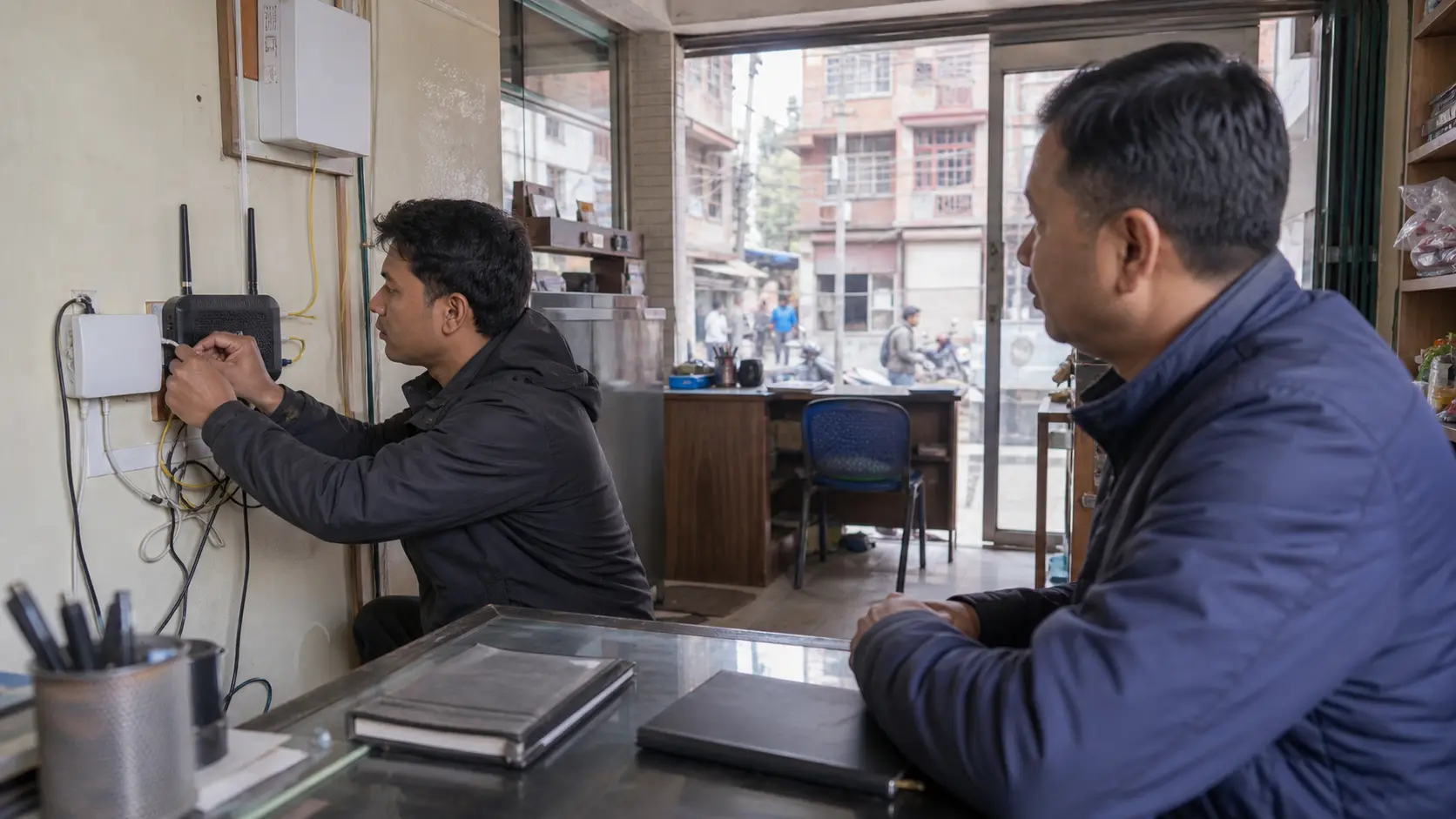
Imagine the buyer as a small office outside the easiest part of Kathmandu's broadband market. The shop has a point-of-sale terminal, a few phones, a router placed wherever the first installer found power, a customer chat channel that has become more important than the signboard outside, and a manager who remembers how long the last outage took to fix. The renewal question is not only whether a faster plan exists somewhere else. Faster plans do exist.
The question is whether switching will bring a cheaper bill or a new set of installation delays, support queues, router problems, billing confusion and missed revenue during the first week after the change.
That is the right place to begin with COSMIC NET PRIVATE LIMITED because the company's public trail is unusually scarce. The BTW directory page at https://btw.media/en/directory/cosmic-net-private-limited identifies the existing directory company entity in Nepal, but it does not, by itself, prove a live retail footprint, an active service map, a support centre, current tariffs or customer scale. The independent company-specific record found in APNIC data is real but narrow. It points to number-resource history, not to a complete operating account. A serious assessment therefore has to start with the buyer's job to be done rather than with a claim that the public record cannot support.
By the third paragraph, the business unit can be stated plainly. If Cosmic Net is economically meaningful, the paid unit is the local access and field-support account: a connection that includes installation labour, local fault response, supplier coordination, customer communication and retention after the first technical visit. The cheaper substitute is not hypothetical. A customer can price against Nepal Telecom's national fixed and mobile access surfaces at https://ntc.net.np/, against larger private ISPs such as WorldLink at https://worldlink.com.np/, Vianet at https://www.vianet.com.np/ or CGNET at https://www.cgnet.com.np/, against mobile broadband, against satellite access indicated by the broad availability proposition on https://www.starlink.com/map, against a private link for a business site, or against delaying the installation until cash flow improves. The cost driver is the labour and coordination after the sale. Public evidence cannot prove that Cosmic Net recovers those costs through retention, margin, high utilisation or superior response.
That boundary is not a weakness in the article's logic. It is the logic. In a sparse public record, uncertainty is not a generic risk paragraph placed at the end. It is the commercial mechanism. A small provider can look weak in public and still keep accounts if its installer knows the lane, if the customer's router placement is awkward, if the office has no spare technical staff, if the last outage was solved by a person rather than a ticket queue, and if the monthly bill is close enough to the substitute price that the buyer chooses familiarity.
The same provider can also lose quickly if the customer sees a national operator's bundle, a larger ISP's app, a mobile backup plan or a satellite option as good enough.
The first diligence question is therefore not "how fast is Cosmic Net?" It is "what is the customer afraid will happen if it leaves?" If the answer is nothing, the account is a commodity and the provider has little pricing room. If the answer is a week of missed appointments, uncertain fault escalation, reconfigured devices, unreliable Wi-Fi inside the shop and nobody taking ownership of the outage, then the provider may sell continuity even with a modest public profile. That is why installation margin, field response, upstream dependence and customer retention are the right frame.
Nepal's access market makes that frame sharper. DataReportal's Digital 2025 Nepal report at https://datareportal.com/reports/digital-2025-nepal described 16.5 million internet users at the start of 2025, 55.8 percent penetration and 39.0 million cellular mobile connections. Those numbers are broad market context, not a company-specific revenue base for Cosmic Net. They show that the buyer's alternatives include mobile connectivity and that a large share of the population still sits outside the easiest internet-adoption story. A local access provider is tested in the gap between headline adoption and the practical work of getting a stable line to a particular home, shop, school, clinic or office.
Ookla's public Nepal page at https://www.speedtest.net/global-index/nepal adds another useful caution. Its May 2026 fixed-broadband data showed Nepal ranked 92nd on median fixed broadband speed, with median fixed download of 86.31 Mbps and upload of 70.21 Mbps. Those figures are not an audit of any one ISP, and they certainly do not measure Cosmic Net. They do show that Nepal's fixed-broadband market can produce usable headline speeds. For a small provider, the economic question is therefore not whether basic speed exists in the country. It is whether a customer gets enough local service reliability, fault response and supplier discipline to keep paying after the first installation is done.
The Hard Company Evidence Is A Transfer Record
The most important public company-specific evidence is APNIC's transfer log. The public file at https://ftp.apnic.net/stats/apnic/transfers/transfers_latest.json, produced by APNIC and carrying its own accuracy caveats, lists a resource transfer dated 2024-02-13T09:06:27Z in which COSMIC NET PRIVATE LIMITED, country code NP, is the source organization. The recipient organization is VIA NET COMMUNICATION PUBLIC LIMITED, also country code NP. The IPv4 range in that transfer is 103.129.132.0 through 103.129.135.255.
That is a bounded fact. It supports the view that Cosmic Net has appeared in APNIC number-resource administration in Nepal and that at least one IPv4 block associated with its name moved to Vianet. It does not prove that Cosmic Net currently sells consumer broadband, that it operates an autonomous network, that it retains any customer accounts, that it made money from the transfer, or that it still controls other public resources. The APNIC file itself warns that the report records information accurate at the time of transfer and is not intended to provide all information related to the transfer.
That warning matters because the article's business question is current operating value, not merely historical appearance.
The current RDAP view for the transferred range at https://rdap.apnic.net/ip/103.129.132.0 shows why the distinction matters. APNIC RDAP returns the range 103.129.132.0 through 103.129.135.255 as an active IPv4 network in Nepal with the name VIANET-NP and a registrant entity for VIA NET COMMUNICATION PUBLIC LIMITED. The registration event shown for the network is 2024-02-13T09:06:44Z, close to the transfer timestamp, and the last changed date shown in the network record is 2024-12-10T03:47:03Z. That current RDAP record supports Vianet's public registration context for the range, not a continuing Cosmic Net control claim.
This is the point at which weak public evidence becomes commercially interesting. A past transfer can mean several things. It can mark a small operator selling or transferring address space because it no longer needs it, because it has consolidated, because it was absorbed into another network arrangement, because it needed cash, because the address block was more useful in another operator's hands, or because the original service plan changed. The public record alone cannot tell which explanation is correct.
It only tells the buyer and analyst that number-resource history exists and that the current visible holder of the block is not Cosmic Net.
For a local access account, that matters in two opposite ways. On the negative side, a provider whose public resource evidence is mostly a transferred IPv4 block may have less independent network leverage than a larger operator with visible address, routing, support and product infrastructure. If Cosmic Net no longer controls the relevant addresses and has no visible autonomous-system footprint in the directory preflight, then a customer should not infer that it can provide independent routing resilience from the APNIC transfer.
On the positive side, the record may still indicate past participation in the resource economy, which is more substantive than a purely informal reseller label. It is evidence of presence, not evidence of scale.
The absence of a confirmed company website in the available directory record is also meaningful. A provider can operate with limited public marketing, especially in local and referral-driven access markets, but a missing storefront raises the buyer's diligence burden. Without public tariff sheets, service-level claims, outage notices, coverage maps, support promises or terms, the customer cannot compare Cosmic Net on the usual retail variables. The customer has to compare it on lived service: who installed the line, who answers, who visits, who coordinates the upstream, and who keeps the account working after the first month.
That is why the article should not try to turn APNIC evidence into a bigger claim. ASNs, prefixes, RDAP entries, transfer dates, handles and public database records are evidence. They are not customers. They are not cash receipts. They are not retention. The APNIC transfer proves that a Nepal company named COSMIC NET PRIVATE LIMITED appears in a real number-resource event. It does not prove the paid unit's margin. The margin depends on service accounts, labour cost, supplier terms and customer behaviour that are not visible in the public record.
What The Customer Actually Buys
The phrase "internet connection" hides several transactions. In a stable urban apartment with many providers in the building, the customer may buy little more than a tariff, a router, an installation slot and a support number. In a harder access case, the customer buys route planning, a field visit, cable placement, device placement, password setup, cash or digital payment handling, explanation to non-technical staff, and a promise that someone will take responsibility when service fails. For Cosmic Net, the business case is only persuasive if the second version is true often enough to retain accounts.
The local access and field-support account has at least five parts. First is acquisition: finding the customer, estimating whether the connection is practical, setting expectations and avoiding a bad installation that will become an expensive support burden. Second is installation: labour, travel time, drop-fiber or wireless access work, router configuration and indoor Wi-Fi placement. Third is upstream supply: buying or arranging enough capacity and routing discipline so the customer does not experience every wholesale problem as a local failure.
Fourth is fault response: answering complaints, diagnosing whether the problem is customer Wi-Fi, last-mile plant, upstream congestion, power, cable damage or device failure. Fifth is renewal: convincing the customer that the next payment buys lower risk than switching.
That bundle is costly because much of it is variable labour, not simply bandwidth. Wholesale capacity and address resources matter, but the small-account economics can be destroyed by truck rolls, repeated visits, unpaid bills, underpriced installation, cheap routers that fail, long support calls and churn before payback. A provider can sell a plan that looks profitable on monthly access revenue and still lose money if it spends too much human time keeping the account alive.
Conversely, a provider with good local installation practices and disciplined support can retain a customer even when the bandwidth component is not the cheapest in the market.
Public evidence cannot tell which side Cosmic Net sits on. There is no visible audited customer base in the reviewed public materials. There is no verified support-response dataset, no ticket backlog, no field-force map, no installation payback cohort, no churn curve and no outage history. Those are the central facts. If Cosmic Net has many retained accounts with low repeat-visit rates, the business can make sense even in a competitive market. If it installs accounts cheaply but loses them quickly to larger providers, the business is fragile.
If it relies on a few business customers with high support expectations, the margin depends on contract discipline. If it mostly resold access without controlling response quality, it may have had little defensible value.
The APNIC transfer sharpens this account-level test. IPv4 address space can be valuable, but transferring a block away removes one possible source of continuing differentiation. If a provider previously had address resources and later moved them to a larger operator, the remaining value, if any, must come from customers, local reputation, field response, reseller relationships, area knowledge or contractual positions. That does not make the provider irrelevant. It changes the evidence burden. A buyer should not pay for an address-control story if the visible transferred range is now registered to Vianet.
The buyer should pay only for the service result it can observe or contract.
The larger Nepal providers show how much of the customer promise has become packaged. Vianet's own home page at https://www.vianet.com.np/ describes fiber broadband, home and enterprise solutions, a 24/7 call centre, a customer portal and a mobile app. WorldLink's home page at https://worldlink.com.np/ presents residential plans, SME plans, enterprise solutions, customer portals, support booking and branch-location surfaces. CGNET's site at https://www.cgnet.com.np/ advertises residential internet, internet plus IPTV, enterprise solutions, SME packages and support. Nepal Telecom's site at https://ntc.net.np/ shows the national operator's service breadth, including FTTH and mobile services. Those public surfaces do not prove service quality, but they show the buyer's substitute set.
Against that, Cosmic Net's possible advantage cannot be ordinary packaging. A smaller or quieter provider has to win on something that does not show up in a headline Mbps comparison. It may be closer field support. It may be willingness to install where a large provider is slow. It may be relationship-based billing. It may be practical response during power, router or cable problems. It may be a narrow local cluster where the installer knows the physical environment. But those are hypotheses until supported by customer retention, fault-response and margin data.
The retention-after-installation metric is the cleanest way to test the business. Installation creates a cost before the provider knows whether the customer will behave well. If the customer stays for a long period, pays regularly and does not require repeated high-cost visits, the installation cost can be amortised. If the customer churns after a short promotional period, refuses to pay after outages, or moves to a larger provider once service demand is proven in the area, the provider has effectively subsidised the market for someone else. For Cosmic Net, the question is not whether access was once installed.
It is whether enough accounts stayed after installation to make field labour a profitable asset rather than a sunk cost.
Why The Unit Is Costly In Nepal
Nepal's geography and market structure make the access account more than a billing relationship. A provider has to deal with road conditions, power reliability, building access, cable exposure, neighbourhood density, customer ability to pay, local competition and upstream routes that may depend on cross-border capacity. A large provider can spread those costs across scale. A small provider has to be more careful about where it installs, how much equipment it leaves with the customer, how fast it responds and how much support it promises.
The regulator's public presence at https://www.nta.gov.np/ matters because a communications provider is not simply a retailer. The Nepal Telecommunications Authority publishes licensee, reporting, quality, interconnection and cyber-security surfaces. The public licensee-list entry point at https://www.nta.gov.np/page/licensee-list, the ISP licence navigation surface at https://www.nta.gov.np/page/license-for-the-isp, the licence-transfer application surface at https://www.nta.gov.np/page/application-for-sale-or-transfer-of-license, and the MIS PDF listing at https://www.nta.gov.np/page/mis-pdf all signal a regulated sector in which permission, reporting and compliance context matter. None of those pages proves Cosmic Net's current licence standing from the evidence reviewed here. They do show that a local access provider operates in a regulated account environment rather than in a completely informal market.
Regulation becomes a cost when a provider must maintain paperwork, respond to authority requirements, keep contactability, manage customer complaints, respect quality expectations and handle changes in ownership or licence status properly. For a larger operator, compliance is part of a corporate department. For a small operator, the same obligations can sit on a few managers whose time also has to be spent on sales, supplier negotiation and field problems. If Cosmic Net had a narrow local access base, the compliance burden would need to be supported by recurring revenue.
If the recurring base was thin, compliance and administration would be another reason to transfer resources or consolidate.
Quality of service is also an economic issue. The NTA quality-of-service page at https://www.nta.gov.np/page/quality-of-service is a public sector-support surface, and the interconnection page at https://www.nta.gov.np/page/interconnection points to the way telecommunications services are embedded in wider coordination rules. A customer may not read these pages before buying broadband, but the provider lives inside the consequences. A field complaint becomes expensive if the provider cannot determine whether the issue is inside the home, on the last mile, at the aggregation point, in the upstream path or in interconnection with another network. The smaller the provider, the more important it is to prevent problems before they create visits.
Peering and local traffic also shape cost. Nepal Internet Exchange presents itself at https://www.npix.net.np/ as helping ISPs keep local traffic local, and an April 2026 NPIX post at https://www.npix.net.np/npix-local-traffic-crosses-100gbps said local NPIX traffic had crossed 100 Gbps and linked local traffic to better latency. That is market context, not proof of Cosmic Net membership or peering. It does show the kind of network discipline that matters to a customer's experience. If popular local or regional traffic can be exchanged locally, the provider can reduce dependence on more expensive or congested paths. If the provider is not directly present and depends on an upstream, the quality of the upstream arrangement becomes part of the customer's service.
The landlocked nature of Nepal adds another layer. NPIX's older conference coverage at https://www.npix.net.np/sanog-36-virtual-started included a local keynote topic on connectivity challenges of a landlocked country. The article should not convert that into a specific Cosmic Net outage claim. It should use it as a reminder that Nepal access economics depend on more than the last line to the customer. International capacity, upstream payment terms, cross-border routing, domestic aggregation and exchange discipline all sit behind the customer's complaint when a video call fails. A small provider that cannot manage those dependencies will be blamed even when the root cause sits outside its direct plant.
This is where upstream bargaining becomes central. A small access provider usually buys more of the network than it controls. It may buy wholesale internet, lease transport, depend on another operator for aggregation, use third-party towers or poles, and rely on someone else's facility or routing. Supplier dependence is not automatically bad. It can allow a small provider to serve a local area without owning the whole stack. But it means the provider's margin is exposed to wholesale price changes, congestion, payment discipline, outage escalation and the supplier's own priorities.
A customer may pay Cosmic Net, but Cosmic Net may have to coordinate problems through a chain it does not fully control.
The customer sees only the final service. That creates a dangerous asymmetry. The customer compares the monthly fee with WorldLink, Vianet, CGNET, Nepal Telecom, mobile data or satellite. The provider compares the same fee with installation labour, upstream cost, support time, device replacement, bad debt, compliance work and churn risk. The account is profitable only if the provider can keep the service stable enough that the customer does not force repeated interventions or switch before the provider recovers cost.
Competition Makes Price A Trap
A sparse public provider has to be careful when competing on price. Larger Nepal providers publicly present scale, packages and self-service features. WorldLink's page at https://worldlink.com.np/ described itself in page metadata as Nepal's largest ISP, with more than 10 lakh active consumer accounts and 3,000 business accounts; the page also exposes residential broadband, SME plans, dedicated internet connectivity, data connectivity, international private leased circuit, dark fiber, server co-location, virtual private server, email hosting, private cloud, managed Wi-Fi and managed infrastructure surfaces. Those claims should be treated as company marketing, not audited financial proof. Still, they shape the outside option.
Vianet's public page at https://www.vianet.com.np/ is equally important because it is both a competitor and the current RDAP registrant for the transferred IPv4 range. The page describes Vianet as a leading Internet and TV service provider in Nepal, says it pioneered FTTH service in Nepal in 2011, describes home, small-office and large-enterprise solutions, and presents a 24/7 call-centre claim. That does not prove Vianet's performance for any individual customer, but it does show why Cosmic Net cannot rely on obscurity. The buyer can see a larger operator with a visible support promise, product pages and a customer portal.
CGNET adds another form of price pressure. Its public site at https://www.cgnet.com.np/ advertises high-speed residential internet, internet plus IPTV, enterprise solutions, SME packages and support. It also places the access product inside the brand context of CG Communications and the wider Chaudhary Group. Again, this is public positioning rather than a company-by-company service audit. But the buyer's perception matters. A small provider has to explain why the customer should pay it rather than a more visible brand that appears to bundle speed, service and account management.
Nepal Telecom is the national-operator substitute. Its site at https://ntc.net.np/ presents a broad telecom operator with mobile, fixed, FTTH and customer account functions. In the renewal decision, the national operator can be attractive because it appears permanent, broad and tied to established telecommunications infrastructure. It can also be less attractive if the customer values a more personal local visit, faster neighbourhood support or flexible account handling. Cosmic Net's opportunity, if it exists, is in the gap where national scale does not guarantee the particular response the customer needs.
Mobile broadband is another substitute. DataReportal's 2025 Nepal page reported 39.0 million cellular mobile connections, equivalent to 132 percent of population, and said 80.5 percent of mobile connections could be considered broadband under its cited GSMA Intelligence data. Those figures do not mean mobile broadband can replace every fixed account. Capacity, indoor coverage, data limits, device management and business reliability all matter. But mobile access is good enough for many fallback or low-usage scenarios, which reduces the customer's willingness to tolerate a poor fixed-line provider.
Satellite access is not necessarily a mass-market replacement for every Nepal customer, and the article should not overstate its current regulatory or affordability position. The Starlink map page at https://www.starlink.com/map carries the broad proposition of high-speed internet available almost anywhere on Earth, while also noting that service may be limited or unavailable depending on area. That is enough to frame satellite as a potential substitute class, not as proof that every Cosmic Net customer can switch tomorrow. The strategic point is that hard-to-reach access markets are no longer protected only by geography. If satellite becomes easier or cheaper, the local provider has to justify itself through response, installation, local adaptation and support rather than simply through availability.
Another substitute is delay. Many small accounts do not choose among perfect alternatives. They decide whether to install now, wait another month, use mobile data, share a neighbour's Wi-Fi, buy a cheaper plan, or ask an employee to tether a phone. For a provider with upfront installation cost, delayed installation is a real competitor because it prevents cost recovery from ever starting. If the buyer is price-sensitive and the provider asks for installation fees, router deposits or annual prepayment, the buyer may wait unless the provider can explain the operational benefit clearly.
This is why price is a trap. A small provider can cut monthly fees to win the account and still lose money if the customer requires repeated visits. A large provider can offer a promotion and recover through scale, cross-selling or lower support cost per customer. A mobile operator can sell data without sending a technician to every premise. A satellite provider can shift much of the installation burden to hardware and self-service.
Cosmic Net's only sensible competitive story is not "cheaper than everyone." It is "worth paying because the account will keep working and someone local will solve problems." Public evidence does not prove that story. The customer record would have to.
Upstream Dependence Becomes A Customer Problem
For an access customer, upstream dependence is invisible until something breaks. A shop owner does not care whether a route failed because of a wholesale supplier, a local distribution point, a peering issue, a device problem or an international path. The customer sees missed messages, failed payments, frozen video, unreachable services and staff using mobile phones to work around the fixed line. The provider has to translate technical dependency into a customer promise: either it owns the fix, or it does not.
Cosmic Net's public evidence does not show an active autonomous network or current routing footprint. The assignment's directory preflight records no ASN count, and the strongest APNIC evidence concerns an IPv4 transfer away from the company. That does not prove the company has no current access accounts. It means any current account should be understood as supplier-dependent unless private contracts show otherwise. If Cosmic Net serves customers through another operator's aggregation, the customer's experience depends on that upstream operator's capacity, routing and response as well as Cosmic Net's own local labour.
Supplier dependence has margin consequences. The provider may not be able to control wholesale price. It may have to prepay or settle on strict terms. It may have little leverage during congestion if its traffic volume is small. It may have to wait for a bigger operator to fix an upstream fault while the end customer blames the local installer. It may also lack visibility into parts of the route, which increases diagnosis time. Every minute spent determining whether the problem is upstream or local is support cost.
At the same time, supplier dependence can be a rational model. A small provider may not need to own every layer if it can bundle local knowledge with a reliable upstream. In some areas, customers may prefer a local contact who can visit and coordinate over a large provider's call queue. The question is not whether upstream dependence exists. It is whether Cosmic Net can turn that dependence into a managed account rather than a customer frustration. That requires clear supplier terms, escalation contacts, monitoring, honest communication and enough gross margin to spend time on incidents.
NPIX's local-traffic argument helps define what good upstream discipline looks like. If local traffic can remain local, latency and reliability can improve. If a provider can choose or influence upstreams that peer well, it may give customers a better experience without owning every path. If it cannot, customers may experience international transit problems as ordinary broadband failure. The public NPIX record does not put Cosmic Net inside that exchange. It simply shows that Nepal's access economics reward providers that understand domestic peering and latency, and punish those that treat all bandwidth as interchangeable.
The transferred 103.129.132.0/22 range also raises a resource-control question. Address continuity can matter to business customers with static IP needs, remote access, firewall rules, mail reputation or hosted services. If Cosmic Net once had address resources but transferred a block to Vianet, the current value proposition cannot rest on that block. A buyer needing stable addresses should ask directly which provider controls the relevant address, who can update reverse DNS, who handles abuse mail, and whether the account can survive a provider change. If the answer points to a larger upstream, the buyer should contract with eyes open.
Upstream dependence is therefore a commercial risk, not just a technical note. It affects customer retention because outages become moments of truth. A customer may forgive a local provider if the provider explains the fault, offers a workaround, sends a technician when needed and restores service quickly. The same customer may churn if the provider blames an upstream without giving a timeline. The retained account is built in those moments, after installation, when the customer decides whether the provider is accountable.
This makes outage history one of the missing facts that would most change the judgement. A three-year record of few repeated faults, fast restoration, clear messages and low churn would support the positive case. A pattern of repeated upstream congestion, unresolved complaints or long restoration times would destroy it. Public evidence does not provide that history. The article should not invent one. It should state that the business value depends on it.
Regulation, Settlement And Account Discipline
The regulatory surface matters because access providers handle a public service even when they are small. NTA's public pages expose the institutional context: reports, licence lists, licence applications, licence transfers, quality of service, interconnection and cyber-security. For an investor, supplier or customer, the key question is whether the provider treats the account as a regulated service obligation or as an informal resale relationship. The former can support retention. The latter becomes risky when disputes appear.
In a regulated account, settlement discipline is commercial infrastructure. The provider has to pay upstream suppliers, collect from customers, reconcile accounts, manage renewals, respond to complaints and maintain permission to operate. A weak settlement process can turn a technically workable service into a business failure. If customers pay late or churn early, the provider may delay upstream payments. If upstream payments become strained, service can degrade. If service degrades, more customers leave. The cycle is not visible in APNIC records, but it is central to small-ISP economics.
Licence transfer and resource transfer are distinct topics, but both remind the market that infrastructure rights and operating accounts can move. APNIC shows an address transfer from Cosmic Net to Vianet. NTA's licence-transfer application page shows that the regulator has a public surface for licence sale or transfer requests. The article should not claim that Cosmic Net filed any particular licence-transfer request, because that has not been verified. The point is that a provider's assets are not only physical cables.
They include permissions, customer contracts, resource records, supplier agreements and the administrative ability to keep them aligned.
For a customer, administrative weakness appears as service uncertainty. Bills arrive with unclear terms. Support cannot confirm whether a fault is accepted. The provider changes bank details or contact numbers. A promised installation date moves. A router deposit is disputed. A renewal offer is not documented. None of these issues is glamorous, but each can decide whether the customer stays. A provider that sells field response must also sell account discipline, because a good technician cannot compensate forever for weak billing and supplier settlement.
Compliance costs are especially important where the public record is thin. A visible large provider can reassure customers through brand, branches, apps and published terms. A smaller provider has to build trust through direct behaviour. If it does not publish much, every invoice, visit and support call carries more reputational weight. That can be an advantage in a neighbourhood where the provider is known personally. It can also be a weakness if a new customer wants evidence before paying.
The positive case for Cosmic Net would therefore require private proof of administrative steadiness. Does it have signed customer agreements? Does it issue clear bills? Are tax and licence obligations current? Are supplier settlements regular? Does it keep records of installations and equipment? Are complaints recorded and closed? Can it show that customers renew because the account is dependable? Without those facts, the APNIC transfer is only a signpost, not a valuation basis.
The negative case is that a thin public record reflects a thin operating base. If no current licence visibility, website, tariff, support contact, customer references or network footprint can be found, a prudent buyer has to assume high uncertainty. That does not mean the company did nothing. It means the burden of proof shifts to private diligence. The stronger the private evidence of accounts and retention, the more the sparse public trail can be understood as under-marketing. The weaker the private evidence, the more it looks like residual record presence after an address-resource event.
Customer Dependence And Churn
Customer dependence is the mirror image of supplier dependence. A small access provider may depend on a narrow set of customers, a locality, a few business accounts or a referral network. That concentration can be profitable if the accounts are sticky and low-maintenance. It can be dangerous if one apartment cluster, one institution or one reseller relationship produces too much revenue. Public evidence does not reveal Cosmic Net's customer mix, so the article has to treat concentration as a diligence question.
The economic unit demands a cohort view. How many new accounts are installed in a month? What is the cash cost per installation? How many pay setup fees? How many require a second visit in the first 30 days? How many renew after three months, six months and twelve months? How many churn to a large ISP after the provider proves demand in the area? How many are retained because the provider solved an outage better than the substitute would have? These are the numbers that convert field response from a story into a business.
Churn matters more than headline revenue. A provider can grow gross connections while destroying value if customers leave too fast. Installation cost is paid up front in labour, device handling and time. Revenue arrives over months. If the provider discounts the first period heavily, payback takes longer. If support is costly, payback takes longer again. If the customer leaves before payback, the provider loses money even if the plan looked profitable. This is why "retention after installation" is the right metric for Cosmic Net.
Retention also reveals whether support is actually valued. Customers often complain about support but still choose the cheapest provider. A provider's support advantage is real only if customers renew because of it or pay a premium for it. If customers leave whenever a cheaper offer appears, field support is not a defensible moat. If customers stay after outages because the provider responds quickly, field support becomes an asset. Cosmic Net's public evidence cannot prove either outcome.
The competitor pages show how hard retention can be. WorldLink exposes customer portals, support booking and branch-locator features. Vianet describes a call centre, self-service portal and mobile app. CGNET presents support and high-speed packages. Nepal Telecom offers the comfort of national-operator breadth. These surfaces reduce the friction of switching because they give the buyer something visible to trust.
A smaller provider must counter with relationship-specific evidence: faster local visits, better problem ownership, more flexible installation, better understanding of the site or a willingness to serve locations that larger operators treat as low priority.
Customer retention also depends on unofficial market signals, but those signals must be handled carefully. Reviews, social posts, forum discussions and local word of mouth can reveal patterns of support dissatisfaction or praise. They can also be distorted by a few angry customers, promotional activity, fake reviews, competitor noise or one-off incidents. In this article, informal signals can only color the diligence questions. They cannot prove Cosmic Net's service quality, customer count or margin without corroboration.
The absence of visible chatter is also ambiguous. It may mean the company is small, inactive, referral-based, locally known under another trading style, or simply not indexed in the places a researcher checked. It may also mean customers did not have enough public interaction to leave a visible trace. A prudent assessment should not turn silence into proof of failure. It should turn silence into a demand for direct evidence: customer references, invoices, support logs and renewal data.
For a buyer of the service, the churn question is personal. "Will I regret switching?" is more important than "Which provider has the biggest brand?" If a Cosmic Net account has worked for years and the provider answers quickly, a customer may rationally stay even when a larger ISP advertises higher speeds. If the account has repeated faults and unclear support, the customer should test substitutes. The company's economic value is the aggregate of those customer decisions.
Network-Resource Evidence Is Useful But Limited
Network-resource records are valuable because they are harder to fake than marketing prose. APNIC transfer data and RDAP records identify resource events, current registrations, dates, country codes and contact structures. They help distinguish a real public-internet footprint from a purely invented brand. In Cosmic Net's case, they establish a concrete Nepal resource event. That is useful.
But the limits are just as important. A transferred IPv4 block does not show why the transfer happened. It does not show consideration paid. It does not show whether the transfer was part of a customer migration, a commercial sale, a consolidation, a settlement, a compliance event or a strategic exit from resource holding. It does not show the rest of Cosmic Net's balance sheet. It does not show whether the company still has customers. It does not show whether the transferred addresses were fully utilised before the transfer. It does not show the margin of any access account.
The current RDAP record for 103.129.132.0/22 under Vianet is useful in a different way. It prevents overclaiming. An article that described Cosmic Net as currently controlling that block would be wrong. An article that treated the range as evidence of past Cosmic Net resource participation and current Vianet registration would be more accurate. That distinction matters to readers because address-control claims can imply technical capability. If the address has moved, the capability has to be proven elsewhere.
The directory preflight's lack of confirmed operator detail should also be respected. The existing directory page makes Cosmic Net a tracked company entity in Nepal, but the article must not create a new relationship, event or object from the thin evidence. It must not transform the APNIC transfer into a claim of acquisition, partnership or continuing dependency between Cosmic Net and Vianet. The correct phrasing is that APNIC lists a transfer from Cosmic Net to Vianet and APNIC RDAP now shows the transferred range registered to Vianet. The business meaning remains uncertain.
This disciplined use of network data is especially important in small ISP research. It is tempting to treat every IP range, ASN or route object as a business line. That is often wrong. Address resources can be held without large customer operations. Routes can be inactive. Records can lag reality. Contact handles can remain after operational changes. Conversely, a provider can serve customers through someone else's resources and leave little direct routing trace. The analyst's job is to connect resource evidence to business mechanism only where the bridge is supported.
For Cosmic Net, the bridge is this: a company that appears in a past APNIC transfer had enough public-number-resource presence to be worth tracking, but the current business value depends on whether it retains access accounts after installation and manages supplier dependence. The resource record gives a starting point. It does not answer the valuation question.
The missing utilisation data is one of the most important gaps. If the transferred /22 was heavily used by customers who moved smoothly to Vianet, the transfer could indicate consolidation of an active base. If it was lightly used or unused, it could indicate resource monetisation with little operating effect. If it was tied to business customers with static addressing, the customer-retention implications would be different again. None of those scenarios can be proven from the public transfer log alone.
The missing economics are equally important. IPv4 resources have market value, but the article should not infer a sale price or profit. APNIC transfer records do not disclose consideration. Even if a transfer involved value, that would be a resource event, not proof of recurring access margin. A one-time resource transaction can help a company survive, shrink, exit, consolidate or fund operations; it cannot substitute for evidence of customer retention.
The Facts That Would Change The Judgement
The first fact that would change the judgement is a verified current customer count. Not a marketing claim, but a count separated by residential, small business, enterprise, reseller and inactive accounts. A provider with 100 sticky local business accounts has a different economics from one with 2,000 low-margin residential accounts or a handful of legacy connections. The public record does not provide this.
The second fact is installation payback. How much does it cost Cosmic Net to connect an account, including staff time, transport, router or optical device, cable, splicing or mounting, customer education and failed installation attempts? How much, if anything, does the customer pay up front? How many months of gross margin are needed to recover the cost? This number decides whether growth is attractive or dangerous.
The third fact is support response. The assignment's thesis makes field response central, so the evidence should be concrete: median first response, median restoration, percentage of faults solved without a visit, percentage requiring more than one visit, common failure causes, and the share of tickets caused by customer Wi-Fi rather than upstream service. A provider selling response should be able to show response.
The fourth fact is outage history. A clean outage history would support retention. Repeated upstream congestion, cable damage, power-related downtime or unresolved complaints would weaken it. The best version of Cosmic Net would have monitoring records and customer messages that show it can diagnose, communicate and restore. The public record does not show this.
The fifth fact is upstream supply. Who provides capacity? Are there multiple upstreams? Are service terms written? Is there a peering arrangement, direct or through another provider? Are payments current? Is there any local caching or domestic exchange advantage? Can the provider show traceroutes and monitoring that match the sales promise? Without those answers, upstream dependence remains a risk borne by the customer.
The sixth fact is churn after installation. How many customers remain after three, six, twelve and twenty-four months? Why do they leave? What share leave for price, what share for service, and what share because they move? A provider that retains after faults has an account asset. A provider that loses after promotions has a customer-acquisition problem.
The seventh fact is collection discipline. If customers pay monthly in cash or through local digital channels, late payment and bad debt can consume management time. If the provider requires annual payment, churn risk moves differently. If business customers pay after service, the provider may finance customers without intending to. Settlement terms with upstream suppliers then decide whether late collection becomes service risk.
The eighth fact is the reason for the APNIC transfer. If the 2024 transfer to Vianet was part of a customer-base migration, that would imply one kind of story. If it was a sale of unused or underused address space, another. If it reflected consolidation after an operating change, another. If it was a settlement or administrative cleanup, another. Public APNIC data does not reveal motive, so motive should not be inferred.
The ninth fact is current licence and compliance standing. NTA's public pages show the regulated environment, but a company-specific assessment would require current licence documentation, renewal status, complaint status and any relevant filings. Without that, the article can discuss the regulated account burden only as market context.
The tenth fact is customer willingness to pay for support. This can be measured through renewal price, complaint behaviour, referrals and discounting. If Cosmic Net has to discount heavily to keep accounts, the support story is weak. If customers stay at fair prices because the provider solves problems, the support story is real. This is the decisive commercial evidence.
Final Judgement
COSMIC NET PRIVATE LIMITED matters as a business question because it sits at the edge of what public evidence can prove. The APNIC transfer record establishes that the company appeared in a real Nepal number-resource event. APNIC RDAP shows the transferred range now registered to Vianet. The BTW directory identifies the existing Nepal company entity. Nepal's regulator and market pages show a sector where access, licensing, quality, interconnection, peering, support and large competitors all matter. That is enough to write a serious economic assessment, but not enough to declare scale, quality or margin.
The positive case is practical. Cosmic Net may have value if it sells a local access account in which the customer buys more than bandwidth: a field visit that works, a support person who owns the fault, a supplier relationship that is managed rather than dumped on the customer, and renewal confidence after installation. In that case, the company would be judged by retention, support cost and churn rather than by public visibility alone. A small provider can survive against cheaper access when customers fear the cost of disruption.
The negative case is also practical. If the public transfer record is the main surviving evidence, if the company has no visible current resource control, no verified customer base, no published support promise, no tariff surface, no current licence evidence and no retention data, then the safer conclusion is that its economic value is unproven. A buyer should not pay for a network story that is not visible in current records. A customer should not assume field response without evidence. An analyst should not infer revenue from an address transfer.
The judgement therefore rests on private facts. Customer count, installation payback, support response, outage history, upstream terms, licence standing, collection discipline, margin and retention would change the assessment. Until those facts are available, Cosmic Net is best treated as a sparse-evidence Nepal access company whose commercial relevance depends on whether field support turns cheaper substitutes into a risky switch. That is a narrower claim than saying the company is a proven regional ISP. It is also the claim the public evidence can carry.