
Summary
- Coca-Cola Icecek is best understood through the delivered beverage case, not through brand fame alone. The customer buys a case that is made, packaged, warehoused, routed, chilled, displayed, replenished and promoted often enough to deserve scarce shelf and cooler space.
- The proof metric is delivery cost and gross profit per case. Public filings do not disclose the ideal private route metric, but 2025 figures imply about TL 41 of gross profit per unit case, about TL 19 of distribution, selling and marketing expense per unit case, and about TL 5 of transportation expense per unit case as a narrow lower-bound transport signal.
- The evidence supports CCI as a scaled route-density operator with strong official proof of volume, sales points, distributor dependence, route optimization, direct key-account service, packaging exposure and per-case revenue gains. The thesis remains unproven without route-level cost, cooler productivity, outlet retention and competitor displacement data.
The case has to earn the stop
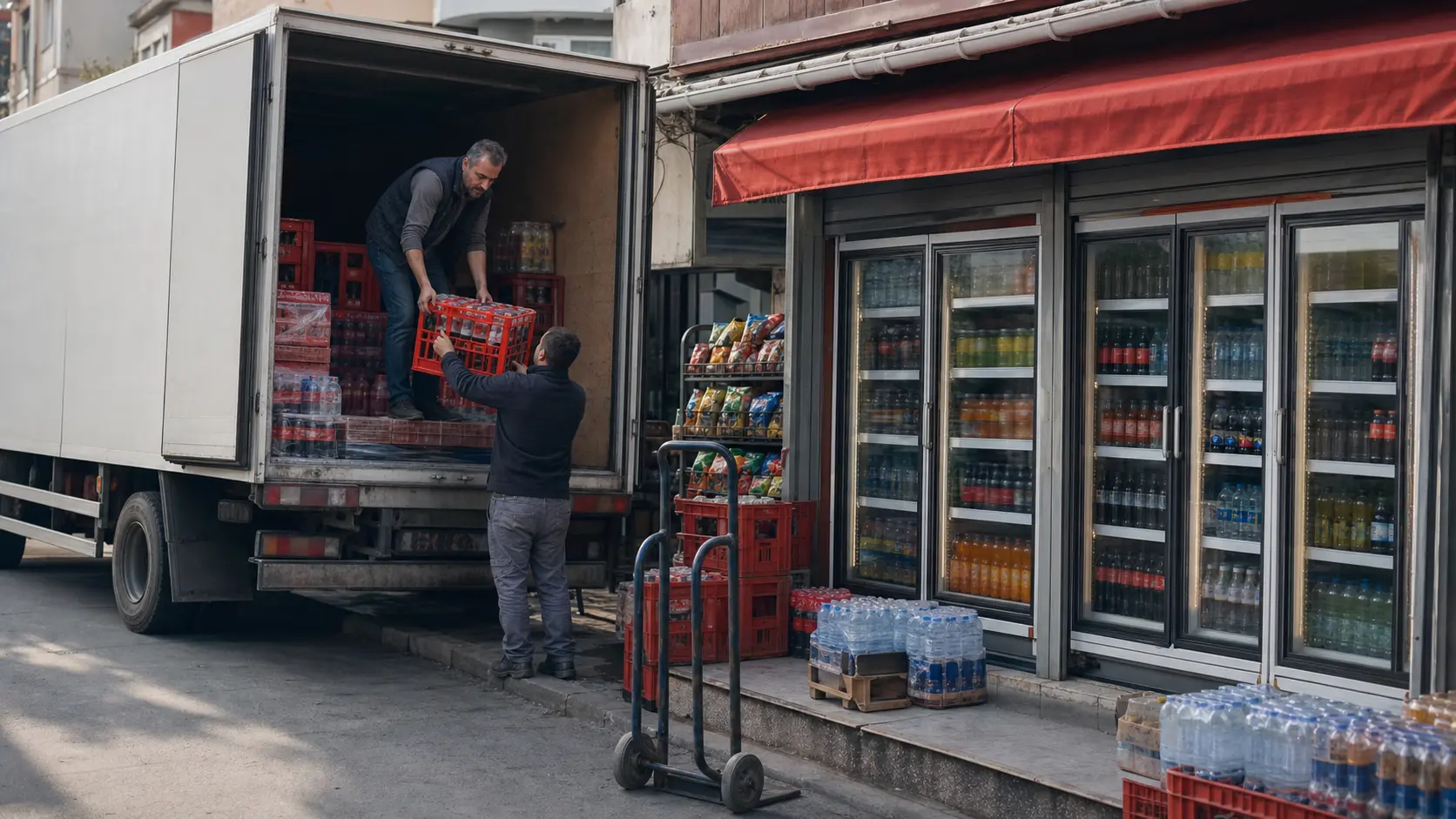
Imagine a small market in Istanbul or Ankara deciding whether to accept one more beverage delivery before the weekend. The shop owner has a cooler with finite space, a cash register that turns slowly during weak consumer weeks, a nearby discount store that can undercut on water or private-label cola, and a supplier relationship that is useful only if cases arrive before the busiest hours. A delivered beverage case is not just liquid in bottles.
It is shelf space, working capital, refrigeration, glass or plastic packaging, driver time, route planning, sales-force attention, merchandising and the promise that the next delivery will be reliable enough to keep the cooler full without overloading the back room.
That is the useful economic unit for Coca-Cola Icecek, usually shortened by the company to CCI. CCI reports sales volume in unit cases. A unit case is a standard beverage-volume measure rather than a literal crate in a store, but it is the best public proxy for the paid case because it links volume, price, cost of sales, gross profit and distribution expense.
The direct substitutes are not theoretical: a Pepsi bottler, a private-label soft drink, bottled water, tea, energy drinks, direct retailer procurement, a local bottler with lower prices, or a shop owner's decision to allocate less cooler space to branded carbonated drinks and more to faster-moving or cheaper products.
The burden transferred to CCI is the hard part of beverage economics. The company has to turn concentrate, sugar, water, packaging, labor, trucks, warehouses, distributors, coolers, sales visits and retailer incentives into a profitable delivered case. The retailer does not want a lecture on procurement or currency exposure. The retailer wants cases that sell, arrive reliably, fit the channel and generate enough gross profit in the shop to justify their space. CCI, in turn, needs each additional case to ride on a dense enough route that delivery and commercial cost do not consume the margin created by brand, mix and scale.
The falsifiable proof metric is delivery cost and gross profit per case. The best private version would show delivery cost per physical case by route, stop, outlet type, pack and country, then compare that with gross profit per case after concentrate, sugar, packaging, direct production cost, discounts, returns, cooler cost and distributor incentives. Public accounts are less precise, but they are still revealing. In 2025 CCI reported 1.622 billion unit cases, TL 187.185 billion of revenue, TL 66.568 billion of gross profit from operations, and TL 31.184 billion of distribution, selling and marketing expense.
That equals roughly TL 115.4 of revenue per unit case, TL 41.0 of gross profit per unit case, and TL 19.2 of distribution, selling and marketing expense per unit case. Transportation expense alone was TL 8.382 billion, or roughly TL 5.2 per unit case. The company notes that unit-case data is outside the independent audit scope, so these figures should be treated as public proxies rather than audited route accounts. Still, the economic question is clear: if delivered-case gross profit rises faster than delivery and selling cost, route density is working; if delivery cost catches gross profit, the brand becomes less valuable at the outlet.
Scale is real, but scale must arrive cold and on time
The official record supports CCI's scale. The 2025 integrated annual report shows 1.622 billion unit cases, TL 187.185 billion of net sales revenue, TL 25.156 billion of EBIT, TL 33.197 billion of EBITDA and TL 14.072 billion of net profit. The same report describes 36 bottling plants and three fruit processing plants in 12 countries, more than 25 brands, 600 million consumers and about 1.4 million sales points.
The geography is wider than a Turkish domestic bottler: Türkiye, Pakistan, Kazakhstan, Uzbekistan, Azerbaijan, Kyrgyzstan, Tajikistan, Turkmenistan, Iraq, Jordan, Syria and Bangladesh sit in the operating map through subsidiaries and joint ventures.
That footprint matters because the delivered case has low value density. Beverages are heavy, bulky and time-sensitive. A truck full of drinks cannot be judged like a software subscription or a financial asset. The route has to be planned, loaded, driven, unloaded and reconciled. The cooler has to be present and working. The outlet has to trust the delivery cadence. The store must believe that allocating space to the Coca-Cola system creates a better outcome than giving the same space to another brand, water, a private-label alternative or faster-rotating local products.
Scale is useful only if it turns those many small decisions into repeated stops with low incremental cost.
CCI's value-chain disclosures make that operational nature visible. The company says it uses digital technologies to plan warehouse operations according to customer and distributor demand. It describes logistics, distribution and sales as connected parts of the chain, not as a detached back-office function. It also says it works through customers and distributors, invests in distributor talent and uses returnable glass bottle systems and recycling efforts as part of the packaging cycle. These are not decorative sustainability statements for this article's purpose.
They show why the case is expensive: every unit has a physical path through bottling, warehousing, distribution, retail placement, consumption and packaging recovery or disposal.
The route-to-market model is especially important. CCI's 2026 investor presentation describes a hybrid model in which distributors handle about 80% of volume, while CCI distributes directly to key accounts such as supermarkets and discounters for about 20%. The same material says distributors are independent and loyal, and that CCI builds capability and trains them. In Türkiye, the 2025 annual report says CCI carries out 65% of Türkiye sales and distribution through distributors. This is a route-density compromise. Direct distribution gives control over key accounts and large-format buyers.
Distributor distribution gives local reach and labor flexibility in smaller or more fragmented channels. The economics depend on whether CCI can keep the route standard high while using distributors to reach more outlets than a purely direct model could economically serve.
That is where the corner shop becomes the test again. A national brand gives CCI permission to ask for space. Route density determines whether it can keep that space profitably. A weak route leaves the shop waiting, the cooler underfilled, or the distributor short of service quality. A strong route turns the same stop into a recurring sale with a lower cost per case, better pack mix and better relationship with the retailer. Public filings do not show stop-level productivity, but they do show that CCI's business is designed around the repeated delivery of small economic units through a large outlet network.
The margin is made before the truck arrives
Delivery cost matters, but the delivered case is not won only on the road. CCI's margin is made before the truck reaches the shop, through package mix, price discipline, procurement and production efficiency. The 2025 release says consolidated sales volume grew 8.0% to 1.6 billion unit cases, while net sales revenue per unit case declined 3.9% under inflation accounting. Excluding inflation accounting, net sales revenue grew 38.2% and net sales revenue per unit case grew 28.0%. The same release says pre-inflation-accounting net sales revenue per unit case reached $2.8 in 2025, the highest level in ten years.
The mix signal is more useful than the headline. CCI reports that immediate-consumption packages remain a strategic priority. In the May 2026 investor presentation, immediate-consumption packages in sparkling beverages are shown as generating roughly twice the net sales revenue per case and about 1.5 times the gross margin of future-consumption packages. That is the route-density story in pack form. A multi-serve bottle sold through a price-sensitive channel may deliver volume but lower unit value.
A single-serve cold bottle or can sold for immediate consumption can carry higher revenue and gross margin, but only if the cooler, outlet, route and sales execution are strong enough to secure the occasion.
CCI's 2025 operating comments show the trade-off. The company says it deliberately reduced exposure to the lower-value water category in Türkiye, and that excluding water Türkiye volume grew 3.8% in 2025 despite total Türkiye volume declining 1.0%. The stills category grew 19.2% at consolidated level, supported by Fusetea. Sparkling grew 9.2%. Water declined 10.7%. That is not a random category shift. It is a margin choice. A company that chases every low-value case can make the truck look full while weakening gross profit per case.
A company that prunes lower-value water volume may lose some cases but improve the quality of the route if the remaining mix earns more.
The cost side is equally clear. CCI's investor presentation breaks cost of sales into a rough composition of 30% packaging, 30% concentrate, 20% sugar and 20% overhead. The 2025 financial-statement note shows raw material cost of TL 103.964 billion inside total cost of sales of TL 120.616 billion. Packaging is therefore not a side issue. It is one of the main determinants of whether a case is worth delivering. Glass, PET, aluminum, closures, secondary packaging, returnable systems and regulatory obligations all sit inside the case economics.
A packaging procurement error can turn a good route into a marginal route because the delivery cost is paid after the gross profit has already been squeezed.
This is why CCI repeatedly emphasizes proactive procurement, hedging and pre-buys. In 1Q26, it said gross margin expanded by 592 basis points to 36.3%, supported by the full-quarter impact of late-2025 price increases in Türkiye, stronger net sales revenue, and cost measures including timely hedging and pre-buys to mitigate raw material inflation. The same release said consolidated net sales revenue per unit case rose 3.6% under inflation accounting and 35.6% excluding inflation accounting, while cost of sales per unit case growth was 25.0% excluding inflation accounting.
That gap is the kind of proof a buyer of the equity, or a buyer of the service in the form of retail space, should want to see: price and mix moving ahead of input cost.
Distribution expense is not overhead; it is the product
It is tempting to treat distribution, selling and marketing expense as the cost that comes after the product is made. For a delivered beverage case, that is wrong. Distribution is part of the product because the retailer pays in space, attention and trust. CCI's 2025 financial statements show TL 31.184 billion of selling, distribution and marketing expenses. The largest disclosed items were marketing and advertising at TL 9.888 billion, transportation at TL 8.382 billion, personnel at TL 6.652 billion, depreciation at TL 2.665 billion, outsourced services at TL 1.018 billion and maintenance at TL 903 million.
These are the costs that turn factory output into available, cold, visible drinks.
The transportation line is the narrowest delivery cost signal, not the full economic burden. It excludes parts of selling, distributor incentives, cooler depreciation, warehousing labor, sales-force routines, trade marketing and inventory handling. Yet even that narrow line shows the materiality of the route: more than TL 8 billion of 2025 cost went directly to transportation. At the unit-case level, transportation was about TL 5.2 per case. Distribution, selling and marketing expense was about TL 19.2 per case. Gross profit was about TL 41.0 per case.
The public record therefore suggests a delivered-case spread before general administration, other operating items and finance costs, but not a comfortable one if route execution weakens.
The domestic and international split adds nuance. In 2025 Türkiye generated TL 81.582 billion of revenue on 562 million unit cases, for TL 145.1 of net sales revenue per unit case. International operations generated TL 106.263 billion on 1.060 billion unit cases, for TL 100.3 per unit case. Türkiye also had higher distribution, selling and marketing expense per unit case by public proxy: TL 18.063 billion over 562 million cases, or about TL 32.1 per case. International operations had TL 13.121 billion over 1.060 billion cases, or about TL 12.4 per case. That does not mean Türkiye is worse.
It means the Turkish case appears to carry higher revenue and higher commercial cost, which is exactly what one would expect in a more mature, more intensely served and more inflationary market.
The delivered-case metric also explains why CCI cares about channel mix. On-premise channels, traditional shops, supermarkets and discounters do not impose the same cost or create the same margin. The FY25 release says Türkiye's on-premise share was 31.7%, while the traditional channel decreased to 36.1%. In 1Q26, Türkiye's on-premise share rose to 28.8% and the traditional channel declined to 35.3%. International operations also reported on-premise share expansion in 1Q26. On-premise and immediate-consumption packages can lift value, but they also demand cold availability, field discipline and more careful outlet service.
A discount chain may give volume and predictability but less pricing freedom. The route has to balance both.
The company is trying to engineer that balance. The annual report describes Sales Force Automation used across CCI countries to plan routes in shorter and more efficient ways, optimizing visit durations to reduce carbon footprint and improve time and resource use. It describes a One Number Execution Score based on availability at customers, in-store execution, cold availability and efficiency. It describes an Artificial Sales Assistant that uses customer historical sales data and market conditions to recommend orders.
It describes CCINEXT, a mobile and web platform for traditional and on-premise customers in Türkiye, Pakistan and Kazakhstan to place orders, use campaigns, provide feedback and support sales-team effectiveness. These tools are valuable only if they reduce delivery cost per case or increase gross profit per case. Otherwise they are simply software around a truck.
The distributor is part of the margin, not a contractor outside it
CCI's distributor model makes route-density economics harder to judge from the outside. A distributor can lower the bottler's direct labor and asset burden, but it can also create service-quality risk. The annual report says distributor sales and distribution teams are key partners in delivering products to consumers, and that CCI provides classroom and online training across topics including route-to-market, competition law, commercial mathematics, merchandising, equipment processes, CCI Next, negotiation and distribution team basics. In 2025, CCI delivered 16,287 hours of training to 28,985 distributor employees.
That is not a trivial adjunct. It is an admission that the case depends on third-party local labor being trained to execute the brand's retail promise.
The annual report also discloses distributor satisfaction and customer satisfaction signals. CCI's average customer satisfaction score increased from 71.9 in 2024 to 74.4 in 2025, while the distributor satisfaction score decreased from 87.7 to 82.6. CCI cautions that these are simple averages across markets and not cross-country benchmarks. They still matter because they point to the social side of route density. A dense route is not just a map with many stops.
It is a relationship in which retailers accept recommended orders, distributors invest in service quality, and CCI can push mix, pricing and cooler discipline without breaking the relationship.
The distributor's economics are especially important in fragmented traditional trade. A supermarket or discounter can receive direct CCI distribution, planned promotions and negotiated account terms. A small shop may rely on distributor cadence and local sales knowledge. If the distributor is underpaid, undertrained or overburdened, the branded case loses execution advantage. If the distributor is efficient and loyal, CCI can reach outlets that would be too expensive for a centralized direct route.
This is the basic reason the investor presentation's 80% distributor volume signal is so important: CCI's route density is partly owned by a network of independent local operators.
Sustainability disclosures provide another operating clue. CCI says it increased the number of Türkiye distributors investing in solar power plants from 33 to 44, and the number sourcing electricity through a Green Energy Certificate system from one to seven. It says distributor-related CO2 emissions reduction in Türkiye rose from 16% to 22%, that 93 distributors used elastic polyester straps instead of stretch film in mixed pallet preparation, and that water-efficiency measures expanded in distributor warehouses. These facts are not themselves proof of route profitability.
They show that distributor warehouses and vehicles are material enough to be managed as a measurable operating estate. In a beverage business, the warehouse and route are part of the product's cost base.
The risk is that the distributor model can hide weak economics until demand softens. If volume grows, a route looks dense. If affordability pressure reduces orders, the same route can carry fewer cases over similar fixed visits, vehicles, warehouse routines and cooler demands. Pakistan illustrates the pressure. CCI's FY25 release says Pakistan returned to volume growth of 1.3% to 314 million unit cases after a 14.2% decline in the prior year, but it also mentions elevated energy prices, tax burdens, affordability pressure and increasing competitiveness of local brands in affordability segments.
In 1Q26, CCI said Pakistan volume grew only 0.2% on a high base, with local-brand share showing signs of stabilization and fuel price hikes weighing on sentiment. That is the kind of market where delivery cost per case can move against the bottler quickly.
Cold availability is a capital allocation decision
The delivered case is not fully delivered until it can be bought at the right temperature and in the right package. CCI's route language includes cold availability as one of the criteria in its execution score. The investor presentation lists coolers as part of the invest-ahead-of-demand strategy. The annual report includes installation and management of coolers, vending machines and equipment in the operating boundary. That matters because a cold bottle or can is the immediate-consumption unit with the higher revenue and margin potential. The cooler is therefore not just retail furniture.
It is an asset that helps convert a case into a higher-value occasion.
Cooler allocation has a hard economic logic. A cooler in a high-traffic shop can defend brand share, drive immediate consumption and support the higher gross margin of single-serve packs. A cooler in a weak shop can become trapped capital: electricity, maintenance, depreciation, placement dispute and field-service cost without enough case velocity. CCI does not disclose cooler productivity by outlet, but its own materials make clear that cold availability is part of execution measurement. The proof metric should therefore be gross profit per case after cold-channel cost, not volume alone.
The same idea applies to returnable glass bottles. Returnable packaging can reduce packaging-material pressure and support affordability in some markets, but it adds reverse-logistics complexity. Bottles have to come back, be sorted, cleaned, refilled and kept in circulation. A dense route can make that work. A thin route can make returnable packaging expensive. CCI's value-chain description says it collects packaging placed on the market through returnable glass bottle systems and recycling efforts. The annual report also notes coolers and returnable bottles under tangible assets.
Those disclosures again point to the same conclusion: the case is a physical operating loop, not a one-way sale.
Immediate-consumption growth is attractive because it improves revenue and gross margin per case, but it can also raise execution demands. A can portfolio expansion in Kazakhstan, a Monster Energy push in Türkiye, a Fusetea growth cycle, or no-sugar sparkling share gains all carry different outlet, temperature, pack and price dynamics. In 1Q26, Türkiye's Monster Energy volume rose strongly from a small base, Fusetea grew, and no-sugar sparkling share increased. These are higher-value signs, but they do not eliminate the route question.
They increase the importance of outlet segmentation: which products deserve the cooler, which deserve shelf placement, and which can travel through lower-cost channels.
This is why the proof metric should not be just net sales revenue per unit case. A higher revenue case can still be poor business if it requires too many small deliveries, too much cooler cost, too many promotions or too much working capital. The useful metric is gross profit per case after the direct cost of the beverage and packaging, compared with the cost of making that case available, cold, visible and replenished. Public filings give enough evidence to see the outline, but not enough to rank outlets or packs by economic quality.
Currency mismatch is a case-level problem
CCI operates in markets where inflation, currency and local purchasing power can move faster than price lists. The 2025 and 1Q26 releases spend substantial space on TAS 29 inflation accounting and on pre-inflation-accounting figures because the Turkish lira presentation can obscure operating momentum. That accounting issue is not merely technical. A delivered case in Türkiye is bought by a consumer in local currency, sold to a retailer in local currency, but exposed to packaging, concentrate, sugar, energy, fuel, spare parts, financing and capital-equipment costs that may reflect foreign currency, commodity prices or imported inputs.
The investor presentation lists currency and inflation among key risks, including fluctuations in the Turkish lira and other currencies in CCI markets, and the ability to obtain raw materials and packaging materials at reasonable prices. The 2025 annual report's financial notes show foreign-exchange losses from foreign-currency-denominated borrowings and a net foreign-currency liability position. This does not mean every case has the same currency exposure. It means the company must protect per-case economics in markets where the consumer's ability to absorb price increases may lag cost movement.
The 2025 result shows both sides. Reported net sales revenue per unit case declined 3.9%, partly because of inflation-accounting effects and currency translation. Excluding inflation accounting, CCI said net sales revenue per unit case rose 28.0%. In Türkiye, pre-inflation-accounting net sales revenue per unit case rose 36.9% in TL and 13.8% in USD. In international operations, price adjustments were implemented selectively and cautiously to preserve affordability and volume growth.
The message is not "pricing power solves everything." The message is that route density and mix have to work alongside price because consumer affordability can cap price action.
The outside macro record sharpens the same point. Turkey's official consumer-price table still showed annual inflation above 32% in June 2026, while the food and non-alcoholic beverages category and transportation costs were also rising at high double-digit rates. Those are directly relevant to a beverage route: the consumer faces higher grocery prices, the retailer faces pressure on working capital, and the bottler faces fuel, labor, packaging and financing costs. Global input data point in different directions rather than one simple inflation story.
World Bank commodity data showed crude oil higher in early 2026 than the 2025 average, sugar lower than its 2024 average, and continuing movement in food, metals and raw-material indices. FAO's June 2026 sugar index was down sharply from a year earlier, while the London Metal Exchange describes aluminium as a global benchmark for packaging-linked contracts and hedging. CCI therefore cannot assume one uniform cost trend. The route has to be profitable through a mix of cheaper and dearer inputs, local inflation, imported packaging exposure and currency translation.
The first quarter of 2026 gives a cleaner example of the desired spread. Excluding inflation accounting, net sales revenue per unit case rose 35.6% to $2.9, while cost of sales per unit case rose 25.0% and EBIT per unit case rose 95.4%. Management attributed the result to stronger gross margin, Türkiye price increases, procurement timing, hedging, pre-buys and operating-expense discipline. The public record supports that as evidence of a favorable quarter. It does not prove a permanent margin regime. First quarters are seasonal, the base was low in some lines, and pricing taken at the end of 2025 had a full-quarter effect.
Still, the spread is exactly what the delivered-case thesis requires: per-case revenue and gross profit growing faster than per-case cost.
Currency mismatch also changes the competitive set. A multinational brand may have stronger procurement and hedging capability than a small local bottler, but local competitors may have lower overhead, local sourcing, simpler packages or greater willingness to trade margin for volume. Private-label products and local brands become more dangerous when consumer income is strained. CCI's comments on Pakistan's affordability segments are a direct reminder that brand power does not eliminate value competition. The delivered case has to win at the shelf every time the consumer's wallet tightens.
The substitute is the route that does not need CCI
The closest substitute for CCI is not simply Pepsi. Pepsi is an obvious branded rival, but the deeper substitute is any path by which the retailer fills the cooler and shelf without paying CCI's required economics. A discount retailer can emphasize private label. A small shop can allocate more space to bottled water if consumers trade down. A cafe can buy local tea, juice or energy drinks from another distributor. A supermarket can use procurement scale to press branded suppliers on promotions and discounts. A consumer can choose a cheaper local cola.
A distributor can shift effort to a product with better local incentive if the route is not tightly managed.
The regulatory record makes this outlet-level competition concrete. Turkey's competition authority opened and then concluded a case involving Coca-Cola Satış ve Dağıtım over concerns about exclusivity and discount practices, accepting commitments in June 2026 rather than imposing a fine in that proceeding. The accepted commitments expanded cooler-access rules: in traditional and on-premise outlets, 35% of CCSD coolers must be opened to rival products, with extra information to outlets and QR-code access to the relevant explanations.
That does not prove wrongdoing in CCI's ordinary route economics, and it should not be confused with route profitability. It does show that cooler space is economically important enough to become a competition-law remedy. If a cooler is partly shared, the delivered case has to earn its position through velocity and margin rather than through equipment control alone.
Retail evidence points in the same direction from the buyer side. USDA market reports on Turkey describe hard discounters as major forces in the grocery channel, with BİM selling a very high share of private-label products and A101 competing in similar locations. The same reporting notes a shift from branded products toward economy-priced or private-label options during high inflation. PepsiCo Turkey's own materials show a direct branded beverage substitute set across Pepsi, Pepsi Max, 7UP, Mirinda, Mountain Dew, Aquafina and Tropicana.
These sources do not measure CCI's outlet losses or wins, but they prove that the corner shop and the chain buyer have credible alternatives. The case must pay for itself against both a rival branded route and a lower-price retail route.
CCI's own 2025 choices show that it understands this. Reducing lower-value water exposure is not a retreat from volume for its own sake. It is a refusal to fill the route with cases that may not pay for their space. Growing no-sugar products, energy drinks, iced tea and immediate-consumption packs is not just a brand portfolio exercise. It is an effort to increase the gross profit available to pay for the route. The relevant question is not whether CCI can sell more liters. It is whether it can sell more profitable cases without damaging affordability.
Retailer bargaining power is the hardest channel risk. Key accounts such as supermarkets and discounters are served directly by CCI in the hybrid model, and they can deliver volume. They can also demand price concessions, promotion funding, service levels and category support. Traditional and on-premise channels may offer higher value in immediate-consumption occasions, but they require more fragmented local execution. A delivered case sold to a large discounter and a delivered case sold cold through a small shop do not have the same economics even if both count as unit cases.
The proof should therefore distinguish volume quality. Public disclosures are moving in that direction through immediate-consumption mix, on-premise share, traditional-channel share, net sales revenue per unit case, gross margin and EBIT per unit case. They do not yet provide enough detail to settle the outlet question. A strong investor would want case-level margin by package, channel and route. A strong retailer would want delivery reliability, cooler service and promotional support. A strong distributor would want route economics that allow service quality without squeezing local labor.
CCI has enough public evidence to show it manages these issues. It has not made enough public evidence available to prove the best routes from the outside.
Unofficial market color should be kept small here. Consumer complaints, store anecdotes and social chatter can reveal frustration with prices, product availability or promotions, but they cannot measure CCI's route economics. The stronger evidence is in filings, segment accounts, official channel commentary and operating disclosures. Those show a company whose competitive position depends on turning scale into service and mix, not merely on owning famous marks.
Bangladesh and Central Asia show why new volume is not enough
CCI's acquisition of Coca-Cola Bangladesh Beverages in 2024 and the growth of Central Asia are important because they test the scalability of the route model. The FY25 release says Bangladesh was consolidated from March 2024, and the annual report lists Coca-Cola Bangladesh Beverages as a wholly owned subsidiary engaged in production, distribution and sales of Coca-Cola products. Bangladesh gives CCI a large emerging consumer market, but it also adds a new distribution, affordability and execution challenge.
A volume acquisition is economically attractive only if CCI can lift route productivity, package mix and gross profit per case without letting integration cost consume the margin.
Central Asia looks stronger in the public record. Uzbekistan grew 33.7% in FY25 to 220 million unit cases and 40.7% in 1Q26 to 49 million unit cases. Kazakhstan grew 15.5% in FY25 to 215 million unit cases and 11.0% in 1Q26 to 63 million unit cases. CCI describes innovation, favorable macro conditions and strong competitive execution in those markets. The company also opened or expanded operations, including references to plant openings in Azerbaijan, Uzbekistan and Baghdad, and a second production line in Tajikistan in the 2025 highlights.
These are invest-ahead-of-demand moves: add capacity and route capability before the market is fully saturated.
The opportunity is clear. In younger, growing markets, route density can improve quickly if volume rises, outlets are added and consumer occasions expand. A new plant or line can shorten supply distance, improve availability and reduce pressure on import or cross-border logistics. A stronger local network can turn brand demand into repeatable delivered cases. In that setting, CCI's distributor model, sales-force tools and pack innovation can create a compounding effect.
The risk is equally clear. New volume can flatter the consolidated case count before it proves per-case profit quality. If growth comes from lower-value packs, heavy discounts, costly new routes or capital-heavy expansion, the gross profit per case may not cover the new delivery burden. CCI's international gross margin expanded in 2025, and international operations delivered strong volume growth. That supports the thesis. But public evidence does not show route-level payback on the new capacity, outlet profitability, cooler productivity or distributor return in these markets.
The evidence supports growth; the economics still need case-level follow-through.
Iraq shows the volatility. FY25 volume grew 12.0% to 140 million unit cases, the third consecutive year of volume growth. In 1Q26, Iraq declined 1.8% after eleven consecutive quarters of expansion, with management citing severe political, security and economic stress and colder weather. A dense route can absorb ordinary seasonality. It cannot fully neutralize regional security stress, fuel-price shocks or consumer caution. That is why CCI's geographic diversification helps but does not erase route risk.
The case buyer should ask what changed after the delivery
A good delivered case leaves evidence after the truck leaves. The outlet has the right pack in the right place. The cooler is full and working. The retailer's inventory is not excessive. The consumer buys at a price that protects value without breaking affordability. The distributor can make the next stop economically. The bottler can show that gross profit per case still exceeds delivery and selling cost after promotions, returns, maintenance and route labor.
For CCI, the strongest public operating evidence is aligned with that logic. Right Execution Daily standardizes outlet execution through ideal store execution, placement and display, reporting and coaching through analysis. Sales Force Automation plans routes. Order management and direct distribution route optimization digitize order and logistics activities. Mobile delivery tools support shipment and distribution. CCINEXT lets traditional and on-premise customers in core markets place orders online and give feedback. Distributor training extends the operating standard beyond CCI's own employees.
These are the right building blocks for a route-density business.
The missing evidence is also clear. Public filings do not disclose route cost per stop, average cases per stop, delivery frequency by channel, cooler return on invested capital, out-of-stock rates, on-time delivery, distributor margin, outlet churn, promotion payback, credit losses from small retailers, or gross profit per case by package. Without those, outside analysis can judge direction and plausibility, not final route quality. A buyer of the article's thesis should be disciplined: CCI has the right scale and operating vocabulary, but the decisive proof would be operational data that is not public.
There is a second missing dimension: retailer economics. A beverage case can be profitable for CCI while being unattractive to the retailer if it ties up too much space, cash or electricity. Conversely, a case can be valuable to the retailer while squeezing CCI through discounts and service obligations. The durable relationship exists only when both sides make money. CCI's customer satisfaction improvement is a positive sign, but it is not a retention or margin disclosure. The distributor satisfaction decline deserves attention because distributors carry much of the route burden.
If distributor economics weaken, service quality can follow.
The right way to monitor CCI is therefore not to celebrate volume mechanically. Watch gross profit per case, distribution and transportation expense per case, net sales revenue per case, immediate-consumption mix, on-premise share, water exposure, local-brand pressure, distributor satisfaction, cooler availability, capex as a share of sales, and whether international growth markets keep expanding margin rather than only cases. Those metrics connect directly to the corner-shop decision.
The evidence supports a scaled operator, not an untouchable franchise
The evidence supports Coca-Cola Icecek as a scaled delivered-case operator with meaningful route-density advantages. The company has large volume, a multi-country network, a hybrid route-to-market model, strong distributor reach, direct key-account service, a broad outlet base, recognized brands, higher-value immediate-consumption opportunities, active procurement management and official disclosure of per-case revenue and margin trends.
Its 2025 and 1Q26 filings show that management is focused on exactly the right questions: net sales revenue per unit case, gross margin, cost of sales per unit case, EBIT per unit case, channel mix, affordability, procurement and operating-expense control.
The public record suggests that CCI's margin protection depends less on abstract brand strength than on the physical economics of getting another case through the route. In 2025, consolidated gross profit per unit case was about TL 41 while distribution, selling and marketing expense per unit case was about TL 19. In 1Q26, gross profit per unit case rose to roughly TL 46 and distribution, selling and marketing expense to roughly TL 22. These figures do not settle outlet-level profitability, but they show the public shape of the bargain.
CCI can afford the route when gross profit per case expands faster than the cost of making the case available.
The available evidence is consistent with a company using mix, pack strategy and route tools to defend that spread. Immediate-consumption packs carry better economics. Water was deliberately deprioritized where it was lower value. Türkiye pricing and procurement improved 1Q26 margin. Central Asia delivered growth. Distributor and route systems are being digitized. Coolers and cold availability are treated as execution measures. Packaging, concentrate and sugar are recognized as core cost exposures rather than secondary details.
The thesis remains unproven without delivery cost and gross profit per case at the route level. The decisive private evidence would show, by country and outlet type, whether each route is carrying more profitable cases per stop, whether cooler placements raise gross profit enough to cover capital and service cost, whether distributors earn enough to maintain service quality, whether key accounts are taking too much of the value through discounts, and whether local competitors are forcing CCI into lower-margin packs. Public evidence supports confidence in the model. It does not support complacency.
The final judgement is practical. CCI's delivered beverage case is worth paying for when brand demand, pack mix, route density and cold execution combine to leave enough gross profit after the truck, warehouse, cooler and sales visit have been paid. It is not worth paying for if the case becomes merely heavy volume in an inflationary market. The company is strongest where it can make a shop owner say yes to another cold case because the last one sold quickly, arrived reliably and left money for everyone in the chain. That is the economics of Coca-Cola Icecek: the case wins only when the route does.