
Summary
- CityLanCom LTD appears to be a compact Moscow-linked network operator whose public footprint combines RIPE NCC membership, autonomous system operation, local access offers, enterprise connectivity language and a small but visible set of public-contract and customer-signal evidence.
- The investment question is not whether the company can sell bandwidth; it is whether paid reliability, repair access and local network control generate enough gross profit to fund transit, backhaul, building work, compliance, abuse handling and churn.
- Public evidence points to a real network with scarce address assets and Moscow interconnection, but also to a business that must avoid being trapped between low consumer tariffs, high-touch field work and larger substitutes with lower per-subscriber overhead.
The economic incentive starts with who pays for downtime
The clean way to read CityLanCom LTD is to begin with the customer pain rather than the network map. A local access network is paid when a household, a cottage settlement, a small office, a building owner, a property manager or a local enterprise believes that an outage has a cost above the monthly bill. If the connection is simply a commodity, the lowest visible tariff wins and the operator inherits a thin spread between retail price and the cost of moving packets.
If the connection is part of a working day, a payment terminal, a video system, a remote workstation, a shared office or a building-service bundle, the operator can sell a different thing: fast repair, reachable staff, a known local plant and enough route control to keep common traffic usable.
That distinction matters because the public footprint around CityLanCom is not the footprint of a national carrier. It is the footprint of a local or regional operator with RIPE NCC membership, autonomous system resources, a Moscow legal and service identity, public tariffs, a support channel, business service terms and evidence of physical line or channel work. The question is not whether such a company can exist. The question is whether it can earn a return after paying the less visible costs that sit behind reliability. Transit must be bought or exchanged. Backhaul has to reach usable interconnection points.
Field teams must travel to buildings where the revenue per month may be modest. Abuse mail has to be answered. Regulated subscriber data and contract duties have to be handled. Churn has to be contained. A local network that underprices those tasks may look active while slowly consuming owner time, technical debt and capital spares.
CityLanCom's public residential ladder gives a useful clue to the economics. The headline consumer plans visible on the company's site place speeds up to several hundred megabits per second in a monthly-price band that is not premium by Moscow standards. That makes the offer easy to understand for households but difficult to use as a pure margin engine. At those levels, the upside is not just the nominal subscription. It is density.
A building, residential cluster or small locality can justify the access port, cable work and support habit if enough customers join, remain current on payment and use a reasonable amount of capacity at peak time. Low density turns the same plan into a service burden.
The company therefore has to make local knowledge pay. If it already has plant near a building, if it can reuse a route, if it can sell business access beside household plans, or if it can add video, local area network work, access-control installation, telephony, virtual private connectivity, leased channels or physical-line rental, the revenue mix is healthier. If it sells only low-price broadband in scattered locations, the same network evidence is weaker.
The public materials point to both sides: consumer tariffs and support channels on one side; service rules naming internet access, data channels, virtual private networks, leased lines, physical-line rental, equipment placement, telephone service, messaging and digital television signal delivery on the other. That mix is exactly where the cash-flow test sits.
The customer gets a local provider that may be easier to reach than a national call center and may already understand local building constraints. The company gets recurring revenue and the option to layer business or technical services over its access footprint. The downside sits with the operator if it sells a reliability promise without enough route diversity, technician capacity, spares, monitoring, billing discipline and bargaining power with upstream networks. Reliability is not a slogan. It is an allocation of labor, capex and working capital.
That is why the right buyer is not simply the user who wants a faster speed label. It is the user who sees connection failure as a cost event and values a provider with a local duty to answer. For such a buyer, reliability is not measured only by peak throughput. It is measured by whether bills are clear, site access is understood, outage updates are timely, and the same firm that sold the line can also repair or adapt it. CityLanCom's opportunity is to make that practical value visible enough that customers accept a price above the cheapest substitute.
Identity and operating boundary
CityLanCom LTD's public identity is stable enough to treat it as an operating telecom company rather than a paper-only resource holder. The company is associated with the Russian legal name OOO CityLanCom, a Moscow address, tax and registration identifiers, contact channels, visible support hours and telecommunications activity codes. Third-party Russian business registries list the company as active, with a 2002 registration date, a modest charter capital figure, a small reported employee count, a president and sole owner named in those registries, current communications licenses and recent financial data.
Those figures should be treated as registry-derived facts, not as audited investor disclosure. They still matter because they place the company in a small-business frame rather than in a large-infrastructure frame.
The operating boundary is narrower than the word "internet provider" can imply. The existing directory evidence used by BTW tracks CityLanCom as RIPE NCC membership and number-resource context. That proves a resource-holder and network-governance footprint. It does not by itself prove the sale of every service a casual reader might associate with an ISP, such as large cloud hosting, wholesale transit, managed security, registry services or nationwide access. Public company materials, however, add meaningful detail. The official site advertises home access plans and contact channels.
The service rules describe a network called CityLAN and name several service families: high-speed internet access, broadband data channels, virtual private connectivity, leased channels, physical-line rental, equipment placement within the network, telephone service, messaging functions and digital television signal delivery. That does not tell us current revenue by line, but it tells us what the company says its contractual offer can include.
The practical boundary looks Moscow-centric and locality-based. The official address and contact pages point to Moscow. RIPE and BGP datasets attach the company to Russian operations. PeeringDB lists Moscow facilities rather than a broad international footprint. Prefix descriptions visible in routing datasets point to named localities and access segments such as Mesherskiy, Noginsk, Odintsovo, Solntsevo and Moscow user-line labels. Public tender and contractor pages refer to optical-fiber delivery and channel work linked to Moscow-area routes and an M9 facility address. None of that should be inflated into a nationwide network claim.
It supports a narrower view: CityLanCom is best read as a Moscow-region operator with address resources, local plant, business-service capability and access products.
That boundary is strategically important. A local operator cannot beat a national carrier by claiming total scale. It can win when its geography is an asset: when a building owner needs a second provider, when a business wants a local contact, when a customer values quick site attendance, when existing cable plant lowers the incremental connection cost, or when local traffic and Russian routes can be kept efficient through nearby interconnection.
The moment the buyer asks for national mobile bundling, mass-market discounts, nationwide enterprise account management or a balance sheet able to absorb large projects without customer prepayment, CityLanCom is likely competing against a substitute with scale.
The identity also creates a responsibility. If the public service promise includes business access, data channels and physical lines, customers will judge the company by operational response, not by marketing vocabulary. A small operator can be trusted precisely because it is local and accountable. It can also lose trust quickly if phones are unanswered, repairs slip or contract transitions confuse customers. Locality concentrates both advantage and reputational risk.
Network evidence and the scarcity value of resources
The network evidence gives CityLanCom a real operating surface. AS25308, named CITYLAN-AS in RIPE-derived records, was allocated in September 2002 and is visible across multiple BGP data platforms. BGP tools list it as active, allocated under RIPE, an eyeball-type network, with originated IPv4 prefixes and no visible IPv6 origination in the current summaries examined. IPinfo and Ipregistry also classify the autonomous system as an ISP and show thousands of IPv4 addresses.
PeeringDB lists the network under CityLanCom LTD, records an as-set of AS-CITYLAN, describes a balanced traffic ratio and an open peering posture, and shows facility presence in Moscow locations including M9, M10, Linxdatacenter and other Moscow sites.
Those details matter because a local ISP's economics depend on control points. An operator with an autonomous system and address space can manage routing policy, upstream selection, peering and customer assignments in a way that a pure reseller cannot. It can decide which routes to buy, which peers to prefer and which customers receive address or channel products. Address holdings also create scarcity value. IPv4 remains constrained. A network with several thousand usable IPv4 addresses has a commercial asset, even if it is not large by global carrier standards.
That asset can support access customers, business services and hosted services. It can also impose governance duties: registration accuracy, abuse contact handling, routing hygiene and potential RPKI management.
The evidence is not unambiguously high-scale. Different sources report different current IPv4 counts and originated prefix totals. That is common across BGP views, because route visibility, aggregation, low-visibility prefixes and data refresh timing vary. The consistent point is not a precise count; it is that CityLanCom has a multi-prefix IPv4 footprint, no visible large IPv6 footprint in several data views, several upstreams and a small downstream or customer-cone signal. BGP tools list upstreams including INETCOM CARRIER, Fiord Networks and BiMajLink.
IPinfo lists peers that include those upstreams plus Westlan, i3D.net, G-Core Labs, Fiber Telecom and other networks. AS204076, another CityLanCom-linked autonomous system named citylan-east in RIPE-derived views, appears smaller, with two IPv4 /24s and a single upstream relationship in the IPinfo view.
The strategic interpretation is that CityLanCom has enough network autonomy to be operationally meaningful but not enough scale to avoid supplier dependence. It can buy transit, peer, and serve local customers, but it still depends on upstreams, facilities, ducts, building access, equipment supply and regulatory permission. If one upstream raises price, degrades quality or becomes difficult because of geopolitical constraints, the company needs alternatives. If a key Moscow facility changes cost or access terms, the company feels it. If equipment supply is delayed or spare units become costly, local repair promises become cash-intensive.
The absence of visible IPv6 scale is also a strategic signal. IPv4 scarcity helps pricing in certain enterprise contexts, but the long-run network has to handle IPv6 expectations, device growth and cloud connectivity. A local operator that lacks IPv6 readiness may still serve many customers today, especially where customer equipment and applications remain IPv4-led. Yet it may face higher future support complexity, greater carrier-grade address sharing pressure, or weaker appeal to technical buyers. The issue is not ideological. It is unit economics: if scarce IPv4 lets the operator charge for value while controlling abuse, it helps.
If scarcity forces expensive workarounds and customer friction, it hurts.
Business model and unit economics
CityLanCom's business model appears to have three layers. The first is household broadband, priced in simple speed tiers. The second is business and technical connectivity, including channels, private connectivity, physical-line rental and customer-specific service orders. The third is adjacent on-site work, including local network installation, video-surveillance setup, mesh Wi-Fi, access-control or intercom work, and other practical services visible in the company's consumer-facing materials. The value of the model depends on whether those layers reinforce each other.
Household broadband provides recurring revenue, but it is easy to overestimate. A tariff of hundreds or roughly a thousand roubles per month has to cover international and domestic capacity, local transport, power, support, billing, payment fees, customer premises visits, network monitoring, equipment depreciation, taxes, regulatory burden and bad debt. A single household is not highly profitable unless connection cost is low and churn is low. The right unit is a building or locality, not a subscriber. When a cluster has enough penetration, the fixed cost of the local segment is spread across many bills.
When a cluster is thin, each repair trip consumes too much of the monthly revenue.
Business services can change that arithmetic. A leased channel or physical-fiber service can carry a higher monthly charge and often has a clearer buyer: a firm, institution, property owner or another operator. The customer may care about service parameters, route, handoff and repair path rather than only headline speed. Public procurement and contractor data around CityLanCom show small but relevant examples of optical-fiber or channel work, including links involving research-institute or telecom counterparties and Moscow-area facility endpoints.
These entries are not evidence of large recurring wholesale revenue, but they show the company has participated in line and channel transactions beyond ordinary home broadband.
Adjacent installation services can be useful if they are attached to connectivity. A video system, access-control installation or building local-area network project can pull a customer into a broader relationship. It can also produce immediate cash to offset field-labor cost. The risk is that such work is episodic. It may distract staff from recurring network reliability unless scheduled carefully. The best version is a practical bundle: install the building or site network, sell access, keep support reachable and earn recurring revenue after the initial job.
The worst version is a collection of low-margin one-off tasks that leave support obligations behind.
Registry financial data gives a partial lens. Russian business listings report 2025 revenue a little below sixty million roubles and profit of a little above twelve million roubles for the legal entity, with small headcount. If directionally accurate, that suggests a compact company with positive net income, not a venture-scale growth asset. Revenue growth alone would not prove value creation. A local ISP can grow by adding distant low-yield customers, accepting underpriced contracts or building capex-heavy routes with weak payback.
Value creation would look different: stable cash profit, low churn, dense clusters, useful address resources, paid business services, manageable supplier exposure and a support reputation that allows pricing discipline.
The pricing question is central. In a competitive Moscow market, large substitutes can sell bundles, promotional discounts and mobile-linked offers. A small operator should not try to win every price comparison. It should win where the buyer pays for locality, a second path, a specific handoff, repair access or a known route. If CityLanCom discounts below cost to preserve subscriber count, the business becomes a treadmill. If it can maintain a price that reflects actual support burden, the network becomes a cash-flow machine, small but resilient.
Cost base, capital needs and supplier dependence
The major costs of a company like CityLanCom are partly visible and partly inferred from the service set. Transit and upstream connectivity sit at the top of the cost stack. Even with peering and local exchange access, a local ISP must buy reachability for the traffic it cannot exchange directly. Upstream diversity improves resilience but raises fixed or committed cost. A single cheap upstream may lower the bill and increase outage or quality risk. The right answer depends on customer mix. A household-heavy network may tolerate commodity routing at the edge.
Business channels and reliability-led offers require enough diversity to make the promise credible.
Backhaul and facility access are the next layer. PeeringDB's Moscow facility entries imply points where the network can connect with other networks or house equipment. Those points are valuable because they reduce distance to transit, peers and customer routes. They are not free. Cross-connects, racks, power, access fees and remote-hands arrangements consume cash. Local fiber routes, ducts and building risers also require upkeep. The service rules state that the company may organize access ports, install equipment and use third-party lines or services.
That is practical, but it means the operator's cost base includes both owned resources and bought inputs.
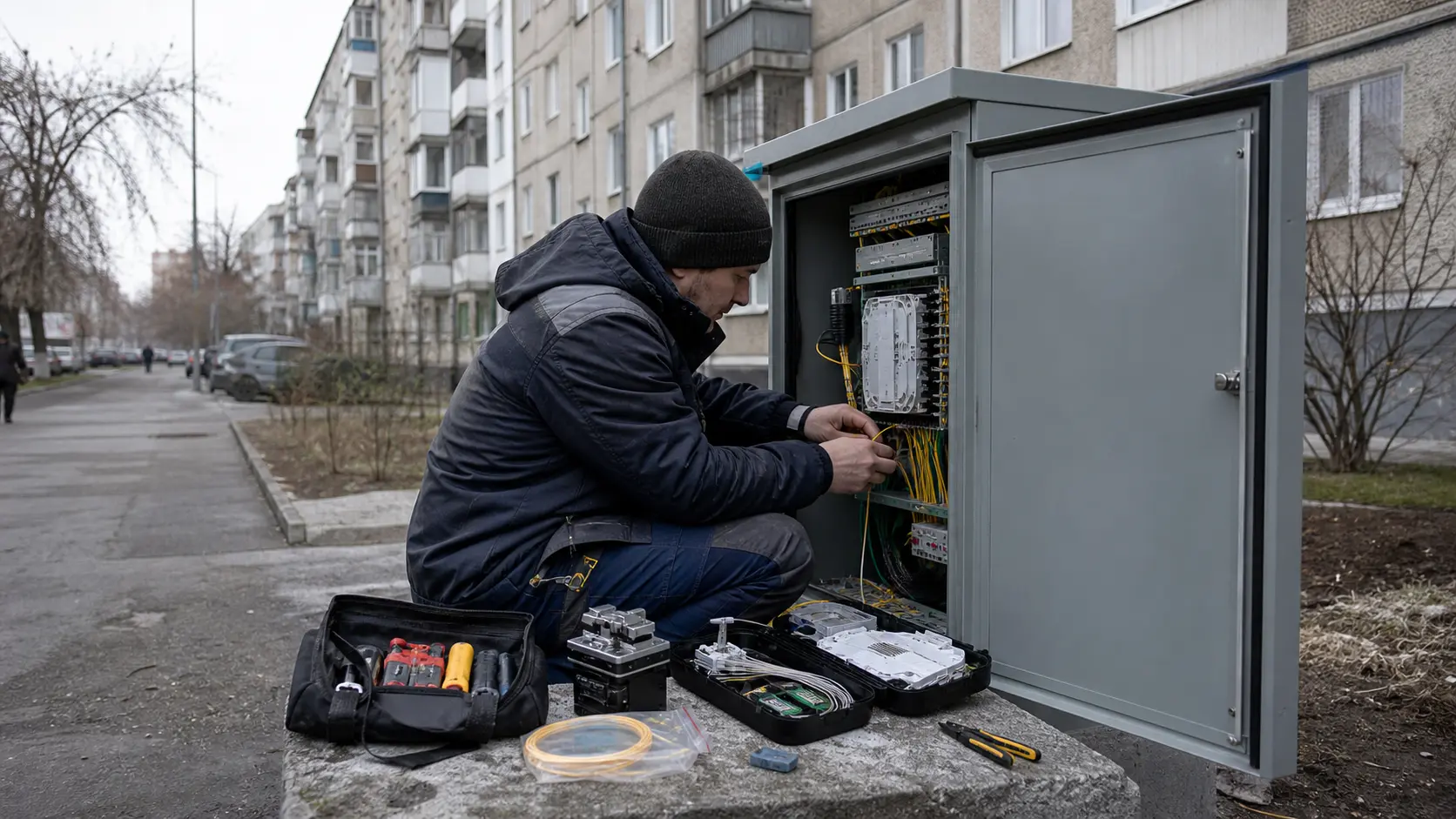
Field work is the cost customers notice only when it fails. A local operator's advantage often sits in the technician who can reach a building, diagnose a cut, replace a device, trace a power issue or negotiate access with a property manager. That labor is expensive relative to a low monthly plan. It is also uneven. Storms, construction cuts, power events and building access conflicts arrive in bursts. A small team can look efficient in normal weeks and overloaded in bad weeks.
If public registry headcount indications are close to reality, CityLanCom must be extremely disciplined about where it connects customers and how it schedules repair work.
Compliance is another cost that cannot be ignored in Russia. Operators must operate under communications licenses, provide subscriber and service information, meet service rules, handle data and identification duties, and interact with state requirements around lawful access and network measures. Public regulatory guidance and legislation describe obligations around licensed operation, network commissioning, subscriber data, service terms, traffic-passage rules and technical measures. Those duties are not just legal fine print. They consume management attention, systems, documents, storage, equipment and sometimes capex.
A small operator does not get a small version of every rule.
Supplier dependence is heightened by geopolitics and equipment constraints. Russian telecom operators have faced a changed vendor environment since 2022, with sanctions, payment constraints, logistics disruption and substitution pressure affecting network hardware, spares, software updates and support arrangements. CityLanCom's public footprint does not identify its equipment vendors, so the conclusion cannot be company-specific. The risk still applies to the category. If the network relies on imported optical, switching, routing or customer-premises gear, spare availability and replacement cost affect repair speed and capex timing.
If it shifts to alternative vendors, the cost may be lower but integration and staff-learning costs rise.
Capital allocation is the test. A company can announce coverage, speed and reliability, but only cash allocation makes those claims durable. The right capital choices may be unglamorous: spare optics, power backup, route documentation, monitoring, better ticket tracking, redundant upstream commitments, technician vehicles, inventory and billing systems. Strategy without those choices is marketing. For CityLanCom, the cash-flow question is whether recurring revenue and business services fund that base without forcing the owner to choose between short-term profit and network maintenance.
Customers, concentration and competition
Customer concentration is difficult to prove from public evidence, but the risk profile can be framed. CityLanCom appears to serve a mix of households, legal entities and possibly other operators or institutions. Public procurement and contractor databases show a limited number of contracts and line-related work, while official site materials are directed at both individuals and legal entities. IPinfo's activity and classification indicators describe AS25308 as a consumer ISP or eyeball network, while the service terms and BGP relationships leave room for business connectivity.
This mix is commercially useful if no single customer or cluster dominates cash flow. It is risky if a few buildings, institutions or reseller relationships account for a large share of margin.
The household customer is price-sensitive and interruption-sensitive in a contradictory way. Many households shop on price, speed and installation convenience. They may not pay much extra for route diversity until a failure occurs. After a failure, the question becomes whether support is reachable and repair is believable. Review signals in public maps and provider-rating sites are mixed and thin. Some users praise stable service and price; others complain about outages, unreachable support or confusing transitions involving related local operators. Those signals cannot be treated as statistically robust.
They should be read as market texture: local reliability is emotionally valuable when it works and reputationally damaging when it does not.
The business customer is different. A small office, shop, building operator or institution may value a named support path and a predictable handoff. It may also compare CityLanCom against national carriers, metro fiber providers, mobile backup, cable operators, wireless options, building incumbents and cloud-based managed services. A business buyer can ask for a second connection from another carrier, use a cellular router for backup, rely on a landlord's building provider, or buy a national enterprise package.
CityLanCom's advantage has to be concrete: local route, faster install, lower coordination friction, willingness to handle small projects, a known support contact or a better price for a narrow need.
Competition in Moscow is not forgiving. Large operators can amortize marketing, billing systems, compliance and backbone cost across millions of users. They can bundle fixed broadband with television, mobile, cloud, security or corporate account services. Smaller neighborhood and regional operators can also compete on local presence. Price-comparison sites show many Moscow providers with low entry tariffs, promotional claims and higher maximum speeds. In that environment, CityLanCom should not be judged by subscriber count alone.
A smaller profitable operator can be strategically sound if it avoids unprofitable expansion and owns enough local relevance. A larger unprofitable subscriber base would be weaker.
The company must also manage churn. Churn is not just a lost monthly fee. It is stranded install cost, wasted customer-premises equipment, administrative handling and sometimes a public complaint. If churn comes from price shopping, the operator needs loyalty through service. If churn comes from outages, the operator needs engineering investment. If churn comes from contract confusion or support availability, the fix is operational rather than technical. Each churn cause has a different cost answer. That is why reliability must be measured as a cash-flow discipline, not as a generic quality word.
Regulation, geopolitics and operating risk
Russia adds a distinctive risk layer for any network operator. Communications service provision is licensed and rule-heavy. Operators must present information on tariffs, service terms, license details and support channels; identify customers under relevant contract rules; protect subscriber data; interact with oversight bodies; and comply with technical requirements around network operation. Data-retention and lawful-access duties have been a major cost concern in the Russian telecom sector for years.
Rules around traffic routing and threat-countermeasure equipment also affect operators, exchange points and networks with autonomous-system resources. The burden is partly capex, partly paperwork and partly management exposure.
For CityLanCom, that burden has two economic consequences. First, scale is valuable. A national operator can spread compliance systems across many customers. A small operator must absorb a fixed rule load across a smaller revenue base. Second, locality is also valuable. A smaller operator with known customers, narrow geography and a practical service set may keep documentation and operations tighter than a sprawling network. Whether the burden is a moat or a drag depends on execution. If regulation raises the cost of entry for new rivals while CityLanCom already has licenses, resources and routines, it helps.
If compliance consumes scarce technical time and capex, it hurts.
Geopolitics affects supplier choice, cross-border connectivity, payment flows and route quality. Transit from international networks, European interconnection, content delivery placement and equipment support can all be affected by sanctions, de-risking and the fragmentation of internet infrastructure. CityLanCom is not a cross-border backbone, but it depends on the broader system. A Moscow user still needs routes to domestic content, Russian cloud services, international platforms where available, enterprise applications and security updates.
If international routes degrade or become costly, a local operator can either absorb the hit, pass it on, rely on alternative upstreams or push local caching and domestic-route quality. Each option has a margin effect.
Operational risk is also physical. Local fiber can be cut by construction. Building access can be blocked by property disputes. Power issues can take down access equipment. Customer-premises devices fail. Shared ducts and third-party segments introduce coordination risk. A small network's resilience is not only about BGP. It is about whether the field team can find the fault, enter the building, access spares, communicate with the customer and restore service quickly enough that the monthly fee still feels fair.
Abuse handling is a quiet but real cost. An ISP with address space may receive complaints about spam, malicious traffic, open proxies, compromised customer devices or hosting abuse. IPinfo tags at least one CityLanCom-linked ASN with signals such as BitTorrent and VPN use. Such indicators are not proof of wrongdoing by the operator or its customers. They are a reminder that address space attracts operational duties. If abuse is handled well, the operator protects upstream relationships and customer trust. If it is neglected, routes, reputation and support workload can suffer.
The geopolitical and regulatory setting makes the business less purely competitive and highly execution-sensitive. CityLanCom does not need to win every market. It needs enough paid relationships where local reliability is valued, and it needs enough operational discipline to keep compliance and repairs from overwhelming the cash generated by those relationships.
Unofficial signals and what they can and cannot prove
Unofficial market signals should be used carefully. Public map reviews, provider-rating sites, comparison pages and local business directories contain comments about CityLanCom, but they are thin, inconsistent and sometimes tied to old addresses, related brands or user-specific events. They are useful for identifying what customers care about. They are not reliable enough to establish service quality by themselves.
The signals cluster around three themes. First, some users or listings associate the company with local internet access in Moscow-area neighborhoods and nearby business facilities. That supports the view that CityLanCom is not only a registry name. Second, positive comments tend to praise stable service, adequate speed or practical pricing. That fits the local-reliability thesis. Third, negative comments complain about disconnection, unreachable phones, support frustration or confusion around related operator transitions.
That points to the main risk: local operators win on accessibility, so every support failure damages the very reason to choose them.
Provider-listing sites add a competition signal. Some list CityLanCom but show no current tariff data in certain address-search contexts, while the official site does show plans and regional tariff documents. The interpretation should be cautious. Third-party comparison sites may have stale data, limited address coverage or commercial filters. Still, for a buyer, availability uncertainty is part of the purchasing friction. If a customer cannot quickly confirm serviceability, price and installation terms, a larger provider with a better digital sales path gains an advantage.
Business registries and contractor databases add another unofficial but relevant signal. They show active legal status, microbusiness classification, reported financials, licenses, public-contract entries and line-related goods or services. None of these sources replace official filings. But together they suggest a small company that has generated revenue, held licenses and participated in telecom-adjacent contracts. That is materially different from a dormant resource holder.
The key is not to let signals outrun evidence. A few bad reviews do not prove network failure. A few good reviews do not prove reliability. A contract entry does not prove a broad wholesale business. A traffic rank does not prove profitability. The right use is triangulation. If official tariffs, RIPE membership, BGP evidence, business-service terms, facility presence, contracts and customer comments all point toward local access and connectivity, the strategic hypothesis is reasonable. The valuation of that hypothesis still depends on margins, churn, repair data and customer density, none of which is fully public.
What would change the judgment
The judgment would become stronger with evidence that CityLanCom earns recurring gross profit from dense local clusters and higher-value business services. The most important facts would be churn by customer group, average revenue per user by locality, business-service monthly recurring revenue, gross margin after upstream and backhaul cost, trouble-ticket volume, mean repair time, renewal rates, and capex payback by building or route. Those numbers would tell whether the company sells reliability or simply absorbs support cost.
Evidence of route resilience would also matter. A clear view of upstream commitments, traffic split, facility redundancy, spare capacity, IPv6 plan, RPKI status, monitoring practices and outage history would show how credible the reliability promise is. Public BGP evidence gives a start, but operational reliability lives below the public routing table. A local ISP can look fine in global route data while failing at the building switch, the power socket, the riser or the customer call.
Customer concentration data would change the risk view. If a handful of business customers or buildings produce a large share of margin, the company may be stable until one buyer leaves. If revenue is spread across many dense clusters and contract types, the business is healthier. Public procurement signals are too small to settle this. A private customer ledger, renewal pattern and service-area map would be decisive.
The cost of compliance and equipment replacement is another swing factor. If CityLanCom has already funded lawful-access, retention, network-security and license-related obligations without stretching cash, regulation may act as a barrier against weaker rivals. If those obligations require new capex, imported hardware substitution or technical staffing the business cannot afford, the same rule set becomes a margin threat. The public license data confirms a regulated operating environment. It does not reveal the cost curve.
Finally, the company's strategic discipline matters. A tempting path for a local ISP is to add locations, speed tiers and side services until the brand looks larger. That can destroy value if each new area lacks density or each side service adds support load without recurring margin. The better path is narrower: serve locations where existing plant, customer density and business demand make the unit economics attractive; price support honestly; use autonomous-system control and Moscow interconnection to improve quality; and treat field repair as a priced product, not a free afterthought.
On the available evidence, CityLanCom LTD is a real local-network business with meaningful number-resource and access-service signals, but it is not a scale carrier. Its strategic worth depends on a small set of practical questions. Are customers paying enough for local reliability? Are business services lifting blended margin? Are upstream and facility dependencies diversified enough? Is support reachable when the network breaks? Are compliance and abuse duties funded inside the monthly price? If the answer is yes, CityLanCom can be a durable cash-flow operator in a narrow geography.
If the answer is no, the same assets become a low-margin maintenance obligation dressed as broadband growth.