
Summary
- CETIN Ltd. Belgrade is best read as a wholesale access and tower-lease business: it sells the use of shared mobile access infrastructure, passive sites, active radio access capacity, fibre and microwave backhaul, power systems, maintenance and related fixed connectivity rather than a retail mobile subscription.
- The strongest public anchor is the e& PPF Telecom Group disclosure that CETIN Serbia was created in July 2020 from the active and passive mobile infrastructure assets and wholesale business of Yettel Serbia, provides mobile network services to Yettel Serbia as anchor customer, and reported EUR 158 million revenue, EUR 123 million EBITDA and EUR 72 million CAPEX for 2025.
- The build-versus-lease pressure rose after Serbia's 2025 5G spectrum award: RATEL assigned Yettel blocks in 700 MHz, 900 MHz, 1800 MHz, 2100 MHz, 2600 MHz and 3540-3670 MHz, with a one-off fee of EUR 100,028,170 and additional coverage obligations in municipalities with weaker coverage.
- The public record is strong on network shape and demand pressure but weak on site-level pricing, tenant density, outage history and churn. The missing proof should be grouped as economics, reliability and retention, not as a reason to treat towers, routes, radio blocks or datasets as stand-alone companies.
A coverage buyer in Serbia starts with a simple choice that becomes expensive fast. It can find land or roof space, negotiate with a landlord, secure permits, pour concrete or reinforce a roof, install a tower or pole, bring in grid power, add batteries and emergency equipment, protect the site against lightning, build cable trays and shelters, connect the radios to fibre or microwave backhaul, monitor the cabinet, dispatch technicians when the power fails, and repeat the process wherever the next weak cell or enterprise site appears.
Or it can ask whether a shared infrastructure provider has already absorbed enough of that work to make leasing cheaper than building alone.
That second path is the economic reason to study CETIN Ltd. Belgrade. CETIN is not a retail brand competing for a household SIM card. Its unit is the paid layer under a retail network: tower space, radio access, transport, backhaul, data-center interconnection, power, operations and maintenance. On CETIN Serbia's own site, the company says Yettel's 2G, 3G, 4G and 5G mobile network services are "fully powered" by CETIN's network and expertise, and it presents itself as the planner, builder, operator and maintainer of reliable networks in Serbia. The public claim is broad, but the economic unit is precise.
CETIN sells the avoided build.
That avoided build is not a soft benefit. It is the conversion of hard capital work into a recurring infrastructure charge. If a mobile operator or enterprise customer builds alone, it owns the site-acquisition risk, the civil-work delay, the power bill, the battery replacement cycle, the security incident, the landlord dispute, the fault truck roll and the backhaul constraint. If it leases, it pays for an existing surface that another party must keep useful. The lease is not automatically cheaper.
It is cheaper only when shared use, anchor demand, operating discipline and regulatory timing make the site more valuable to many users than to one.
CETIN's public service pages describe exactly what the buyer is trying to avoid. Its network services page says it has 30 years of expertise in owning and operating nation-wide networks and offers planning, infrastructure engineering and deployment, operation, monitoring and maintenance, optimization, passive infrastructure, active radio access infrastructure, optics and wireless backhaul, and five transport hubs. The same page says CETIN deploys and optimizes access and backhaul networks with redundant transport hubs and offers tailor-made coverage in hyper-dense areas, unserved locations and places such as stadiums, hotels, congress halls, shopping malls, industrial areas, office buildings, outdoor crowds, bus and railway stations and airports.
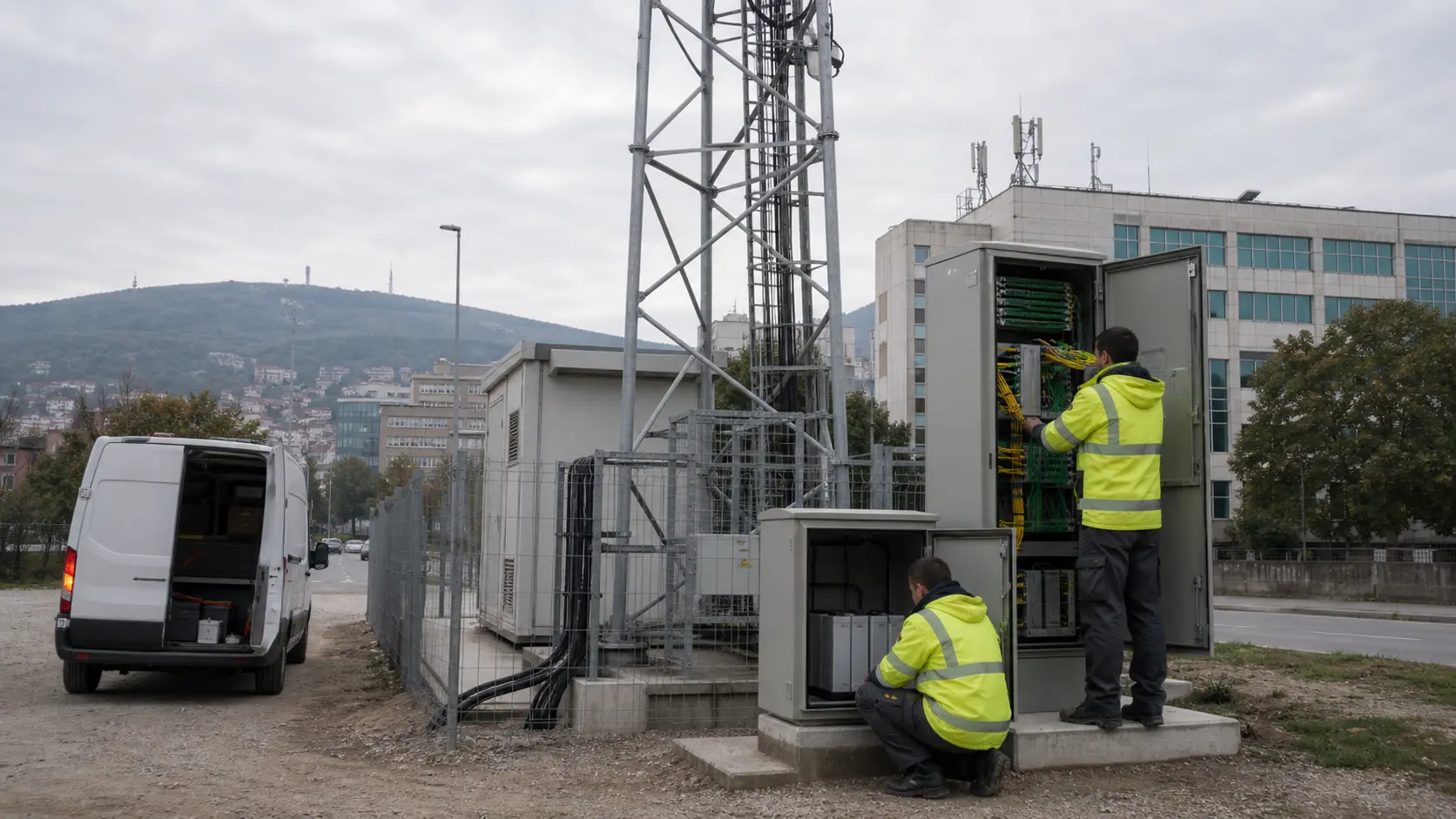
The collocation page brings the tower lease into view. CETIN says collocation gives operators access to more than 1,750 CETIN locations across Serbia, including sharing passive network infrastructure, leasing space on towers and rooftop poles, and use of distributed antenna systems. The list of what CETIN offers is economically revealing: site evaluation, access management, landlord contract management, passive infrastructure operation and management, power supply equipment including batteries, emergency equipment, tower or pole, grounding and lightning protection, cable ladders and trays, mounting equipment, cooling, surveillance systems and equipment shelter. That is the bill a solo builder would have to assemble one line at a time.
The connectivity page adds the backhaul and wholesale transport side. CETIN says it supports cost-effective connectivity across Serbia and European cities from Frankfurt to Sofia, offers fixed network solutions up to nx100 Gbps, and combines fibre optic and microwave networks to cover 98 percent of national territory. It lists E-line EPL, EVPL, ENNI and EoDWDM, dark fibre and collocation, IP transit, SD-WAN and cloud connectivity. It also says CETIN has more than 9,500 km of fibre optic network in Serbia, Hungary and Bulgaria with ring topology, cross-border links with Hungary, Croatia, Romania, Bulgaria, North Macedonia and Montenegro, and points of presence in Belgrade, Budapest and Sofia.
For a buyer, those claims define the lease's hidden denominator. A tower without backhaul is a tall structure, not a sellable network. A radio on a roof without power resilience is a liability during storms, load disruption or maintenance. A rural site without enough tenants may carry too much cost for one user. A 5G site without fibre or high-capacity microwave may not deliver the latency and throughput promised to enterprise customers. CETIN's value is therefore not only that it owns or manages a location. It is that the location can be connected, powered, monitored, maintained and sold into a larger wholesale fabric.
The group structure explains why this fabric exists. e& PPF Telecom Group's CETIN Serbia page says CETIN Serbia was established in July 2020 by separating telecommunications infrastructure from Telenor Serbia, later rebranded as Yettel, and that it provides mobile network services for Yettel Serbia. The same page names Vladimir Radojicic as CEO and discloses 2025 financial results: total assets of EUR 483 million, revenue of EUR 158 million, EBITDA of EUR 123 million and CAPEX of EUR 72 million. Revenue rose from EUR 99 million in 2021 to EUR 158 million in 2025, while CAPEX rose from EUR 21 million to EUR 72 million.
Those numbers make CETIN Serbia more than a passive tower catalog. A 2025 EBITDA of EUR 123 million on EUR 158 million of revenue implies a high-margin infrastructure business, but the EUR 72 million CAPEX figure also shows that the unit is not merely clipping rent from old sites. It is investing while Serbia moves into 5G and while Yettel expands fixed broadband, Pay TV and enterprise services. The margin is the reward for a durable access layer. The CAPEX is the price of keeping that layer current.
The e& PPF group's 2024 annual accounts provide the legal and segment frame. In the annual accounts PDF, the group says the CETIN Serbia segment was created on 1 July 2020 from the spin-off of active and passive mobile infrastructure assets and the wholesale business of Yettel Serbia into CETIN d.o.o., Belgrade. It says CETIN Serbia provides mobile network services on a wholesale basis to Yettel Serbia as anchor customer. It also says the group held 70 percent of CETIN Serbia as of 31 December 2024, while the remaining 30 percent was owned by Roanoke Investment, a GIC-linked investment vehicle.
That anchor-customer phrase is central. A tower company with no anchor demand has to search for enough tenants to justify each site. A wholesale network company with a retail sister customer begins with traffic to serve. Yettel gives CETIN a base load of mobile access demand. That base load lets CETIN invest in towers, rooftop poles, radio access, transport and backhaul with better revenue visibility than a new entrant would have.
It can then sell incremental access, colocation, dark fibre, transport, data-center interconnection, IP transit or private connectivity to other carriers, internet service providers, enterprises and public-sector customers.
The anchor also creates concentration risk. If most of the economics depend on Yettel, CETIN's lease is partly an internal group transfer priced around one retail operator's network needs. That does not make it weak. It means the external tenant story needs proof. A buyer considering CETIN's sites or transport should ask how much of a location's economics is anchor traffic, how much comes from third-party tenants, whether other mobile or fixed providers lease space, whether public bodies or large enterprises take custom coverage, and whether tenant additions can be made without impairing Yettel's service quality.
The wider CETIN platform helps answer part of that question. e& PPF describes CETIN infrastructure as wholesale fixed and mobile telecommunications infrastructure offered to operators on an equal and transparent footing. It says CETIN companies operate in Slovakia, Hungary, Bulgaria and Serbia, with anchor customers from the same group under O2 and Yettel brands. It lists key strengths that fit the tower-lease thesis: open access infrastructure, structural data-demand growth, committed and growing cash flows underpinned by mobile service agreements, upselling beyond the mobile service agreements, high margins and high revenue visibility. CETIN International's own profile similarly presents a wholesale provider of active and passive infrastructure in four Central and Eastern European countries, with mobile access assets, fibre backbone, aggregation network and high-capillarity fixed access.
Serbia's 5G timeline makes the lease more valuable because it compresses build decisions. RATEL's public tender result, published on 14 November 2025, says the spectrum auction covered 694-790 MHz, 880-915/925-960 MHz, 1710-1785/1805-1880 MHz, 1920-1980/2110-2170 MHz, 2500-2690 MHz and 3400-3800 MHz for GSM and IMT systems on a technology-neutral basis. RATEL listed three qualified bidders: Telekom Srbija, Yettel and A1 Srbija.
For Yettel, RATEL assigned blocks including 703-713/758-768 MHz, 905-915/950-960 MHz, 1710-1735/1805-1830 MHz, 1965-1980/2155-2170 MHz, 2540-2560/2660-2680 MHz and 3540-3670 MHz, with a one-off fee of EUR 100,028,170 and coverage obligations in specified municipalities.
Yettel's own 5G spectrum announcement confirms that it acquired spectrum in 700 MHz, 2600 MHz and 3.6 GHz and renewed rights in 900 MHz, 1800 MHz and 2100 MHz for more than EUR 100 million. Its later 5G launch announcement says the 5G network became available in major cities and popular tourist areas on 2 December 2025, with 700 MHz low band and 3.5 GHz mid band as the two main 5G frequencies. The announcement also frames the network goal as reliable, stable and sufficiently capacious for both consumers and the business sector.
That sequence changes CETIN's economics. Spectrum fees hit the retail operator. Coverage obligations and user expectations hit the network layer. Low-band 700 MHz reaches farther and helps coverage; mid-band 3.5 GHz carries capacity but demands a denser and better-backhauled site grid. The towers and rooftop poles do not become less important because software is more advanced. They become more contested.
The value migrates toward locations with power, resilient transport, cooling, landlord stability, line of sight where microwave matters, fibre where capacity matters, and enough mounting and shelter space to host more equipment without a new civil build.
RATEL's Q4 2025 mobile coverage publication gives a rare public cross-section of that physical layer. The coverage PDF records three mobile operators in Serbia: Telekom Srbija, Yettel and A1 Srbija. As of 31 December 2025, it reported 2,747 Yettel locations with active mobile base stations, compared with 3,415 for Telekom Srbija and 2,800 for A1. For Yettel, it listed 1,517 raw-land locations, 1,133 rooftop locations, 65 indoor locations and 32 combined rooftop/indoor locations. It also listed 2,723 2G locations, 2,727 3G locations, 2,743 4G locations and 1,265 5G locations.
The same RATEL document helps connect tower lease to backhaul. For Yettel, it reported 1,114 active mobile base-station locations connected by optical transmission systems, 908 connected by one radio-relay link to a point with optical transmission, and 725 connected by two or more radio-relay links to a point with optical transmission. It also reported 2 Yettel base stations powered from renewable energy sources, compared with 18 for Telekom Srbija and 371 for A1.
Coverage percentages in the same document put Yettel at 97.20 percent population coverage for 4G and 75.20 percent population coverage for 5G, with footnotes explaining dynamic spectrum sharing in the 700 MHz band.
These figures do not say "CETIN owns each site" and should not be read that way. They are RATEL's operator-side coverage and base-station data for Yettel. But because CETIN says Yettel's mobile network is fully powered by CETIN network and expertise, they are useful public evidence for the scale of the infrastructure workload CETIN supports. They turn the tower lease from abstraction into thousands of raw-land, rooftop, indoor, fibre and radio-relay sites that require power, access, monitoring, landlord handling and maintenance.
The market demand side is also visible. RATEL's Q1 2026 electronic communications market overview says Serbia had about 7.892 million active mobile telephony subscribers in the first quarter of 2026, generating about 5.23 billion minutes of national and international traffic and sending about 0.94 billion SMS messages. Yettel's share of active mobile subscribers was 32.27 percent, between Telekom Srbija at 41.53 percent and A1 at 26.20 percent. RATEL also reported mobile data traffic of 473.5 million GB in Q1 2026, up from 429.6 million GB in Q4 2025, and said a mobile broadband subscriber used about 21.81 GB per month on average.
Those numbers matter because towers are not purchased by theory. They are paid for by traffic, market share, coverage pressure and enterprise demand. A 32 percent retail mobile share gives Yettel a large user base to defend, and CETIN's anchor role means its infrastructure decisions are tied to that base. Rising data traffic creates a constant pressure to add capacity, improve backhaul and reduce bottlenecks. M2M subscriptions, which RATEL reported at 934 thousand in Q1 2026, add another pressure: more devices, lower tolerance for gaps, and more demand for predictable radio and transport performance outside simple smartphone use.
Yettel's group page adds the customer-side scale. e& PPF says Yettel Serbia offers mobile, fixed broadband, Pay TV and voice services to consumer and business segments, that it acquired Serbia Broadband in 2025, and that its 2025 operating results included 2.904 million mobile subscribers, mobile ARPU of EUR 13.4 per month, 726 thousand fixed broadband subscribers and 854 thousand Pay TV subscribers. Its 2025 revenue was EUR 604 million and EBITDA EUR 188 million, excluding SBB where noted. That makes the retail customer of CETIN's wholesale layer a convergent operator, not just a handset brand.
Convergence changes the tower lease. A mobile-only operator might value a tower mostly for radio coverage and capacity. A convergent operator also cares about fixed broadband bundles, television distribution, enterprise access, customer premises links, content and data-center paths. CETIN's connectivity, data-center and IP transit pages are therefore part of the same economics. A mobile tower site needs transport. A fixed wholesale customer needs circuits. A business customer may need cloud connectivity, SD-WAN or secure interconnection.
The same access company can price a broader layer when tower, fibre, data center and IP are sold as one infrastructure system.
CETIN's data-center page claims a carrier-neutral data center in Belgrade with 99.9999 percent service availability, scalable telehousing from racks to separated rooms, and the role of a large interconnection hub in Serbia for national and international operators, financial institutions, content providers and digital service providers. It lists standard colocation, web portal, customized solutions and remote hands services. The page is not a tower document, but it completes the wholesale-access surface. A tower lease may solve the last radio hop; a data center and interconnection hub solve where traffic aggregates, where carriers meet, and where customers host or cross-connect equipment.
Bounded network records support that same, limited conclusion. PeeringDB's network page for AS15958 lists CETIN Ltd. Belgrade with ASN 15958, network type NSP, regional scope, mostly inbound traffic ratio, 1,500 IPv4 prefixes and 75 IPv6 prefixes, without disclosing traffic levels. PeeringDB's facility page lists Cetin Data Center in Belgrade with CETIN Ltd. Belgrade as the organization and the address at 90 Omladinskih brigada. RIPEstat's AS overview identifies AS15958 as CETIN Ltd. Belgrade, while RIPEstat's announced-prefixes view shows visible IPv4 and IPv6 route announcements for the same AS. These records are not companies and should not be treated as counterparties. They are useful only as boundary evidence that CETIN operates a routed wholesale network and public interconnection surface consistent with its fixed-connectivity and data-center claims.
Power is the least glamorous part of the unit and one of the most important. The collocation page's list of power supply equipment, batteries, emergency equipment, grounding and lightning protection is not marketing filler. Every shared site is a power problem. Grid supply, battery autonomy, generator access, cabinet cooling, equipment density and technician access decide how much of a tower lease is usable during heat, storms, outages or maintenance. A buyer that builds alone has to design that power chain and keep it maintained.
A buyer that leases is paying for someone else to keep the chain available, but it should still ask for measurable evidence: battery replacement cycles, fault rates, maintenance windows, power-failure response, generator policies, and how energy costs flow through the contract.
Backhaul is the second quiet constraint. RATEL's data showing Yettel sites connected by optical systems or radio relay does not price the links, but it explains why CETIN's fibre and microwave story matters. A 5G radio site with weak transport can advertise coverage while failing under load. A rural site with only a long microwave chain may solve coverage but not enterprise-grade latency. A city rooftop with fibre may be more valuable for dense capacity and private network use. CETIN's claim of 98 percent territory coverage through combined fibre optic and microwave network is therefore not a generic national claim.
It is the condition that lets tower leases become access products rather than isolated mast rentals.
Maintenance is the third constraint. Serbia's geography, winter conditions, urban rooftops, rural roads, landlord access and high-traffic tourist areas all create different operating costs. CETIN's own language around operation, monitoring and maintenance, access management, landlord contract management and remote hands should be read as cost categories. A tower lease is a promise that someone can reach the site, diagnose the fault, replace equipment, restore power, maintain cooling, respect safety rules and coordinate with landlords without making the tenant rebuild a field organization.
Tenant density is the fourth constraint and the most opaque one. Public documents say CETIN offers equal and transparent wholesale infrastructure and collocation. They do not disclose how many tenants are on the average site, how many third-party tenants use the 1,750 locations, how often a rooftop or raw-land location carries non-Yettel equipment, or how colocation is priced by space, height, power draw, backhaul, cooling, access hours and equipment type. Tenant density determines whether tower economics are truly shared or mostly carried by one anchor. A site with one tenant is a necessary network cost.
A site with several paying users becomes infrastructure capital with operating leverage.
Regulatory terms shape that density. RATEL's spectrum process assigned coverage obligations to each mobile operator in municipalities with weaker coverage. Those obligations can make marginal locations non-discretionary. A carrier may have to cover a place that would not clear a private investment hurdle on traffic alone. Shared infrastructure can lower the hurdle, but only if the regulatory and commercial terms allow efficient access and if the site has enough power and backhaul.
The public record does not disclose CETIN's site-level lease terms, so the economic test must be framed around incentives: do rules and contracts make it easier for a tenant to use existing infrastructure, or do they leave each operator duplicating steel, power and transport?
Security and continuity add another layer. CETIN's management systems page lists ISO 9001 quality management, ISO 22301 business continuity, ISO 27001 information security, ISO 27701 privacy information management, ISO 14001 environmental management and ISO 45001 occupational health and safety certifications. The page says the network protects confidentiality, integrity, availability and data privacy by managing safety, security and business risks. Certification does not prove perfect operations. It shows that CETIN sells infrastructure into a market where buyers, especially carriers, financial institutions, public-sector bodies and enterprise customers, will ask whether outages, physical access and information security are managed under recognized systems.
The buyer's build-versus-lease model should therefore start with avoided CAPEX but not stop there. A solo build includes land or rooftop rights, permits, civil work, tower or pole construction, site design, power equipment, batteries, shelters, cooling, fire and lightning protection, surveillance, field force, spares, backhaul, monitoring tools, insurance, taxes, landlord management and decommissioning obligations.
A lease includes recurring fees, term commitments, service levels, upgrade costs, equipment limits, access terms, power pass-throughs, maintenance coordination and possible dependence on the infrastructure owner's priorities. The lease wins when it removes more risk and delay than it adds in recurring cost and dependence.
For a mobile operator, the hardest comparison is time. If a 3.5 GHz 5G capacity layer needs new points fast, leasing a usable rooftop, pole or tower can be worth more than saving a few euros per month on rent. Time to coverage can protect market share. Time to capacity can prevent congestion in commercial districts, stadiums, tourist areas and transport nodes. Time to backhaul can make enterprise offers credible. CETIN's existing footprint and Yettel anchor demand are therefore part of the value, not incidental facts.
For an enterprise buyer, the calculation is different. A factory, mine, logistics park, hospital, airport or public building does not necessarily want to become a telecom site owner. It wants coverage, capacity, security, uptime and one responsible counterparty. CETIN's network-services page explicitly mentions tailor-made coverage in industrial areas, office buildings, shopping malls, hotels, railway stations and airports. Distributed antenna systems and private 5G are not just technologies. They are ways to convert difficult indoor or campus coverage into a managed access charge.
The buyer avoids owning a permanent telecom engineering function.
The data-center and interconnection layer gives enterprises another reason to lease rather than build. If a customer needs private connectivity to cloud partners, IP transit, cross-border circuits or protected Ethernet, the tower or DAS site is only one part of the service. CETIN's connectivity page links that edge to national and international routes, dark fibre, IP transit, SD-WAN and cloud connectivity. The economic value is not simply "we have a tower near you." It is "we can connect that tower, office, factory or data-center rack into a managed regional network."
The pressure on CETIN is that all of this must be priced without losing the buyer to alternatives. Telekom Srbija and A1 operate their own mobile networks. Other fibre, data-center, enterprise and internet providers sell connectivity. Large enterprise customers can source from multiple carriers or build private infrastructure with equipment vendors and integrators. Hyperscale cloud providers and content networks can shift interconnection demand toward global hubs. Public authorities can set obligations that raise cost without matching revenue. CETIN's advantage is local physical depth and group-linked anchor demand.
Its risk is that buyers will not pay a premium unless uptime, access speed and tenant economics are visible.
Three proof gaps should decide how much weight to put on the thesis. The first is economics. Public filings disclose company-level revenue, EBITDA, CAPEX and assets, but not site-level lease prices, power pass-throughs, third-party tenant count, average tenancy ratio, customer concentration beyond the Yettel anchor, contract length or colocation churn. A serious buyer needs these numbers because the same tower portfolio can be either high-quality shared infrastructure or a high-cost obligation depending on tenancy and price.
The second gap is reliability. CETIN's certifications, 99.9999 percent data-center availability claim, 24x7 support language and service pages support a continuity story, but they do not show outages, mean time to restore, planned maintenance history, fibre cut incidence, battery autonomy, grid-failure experience, customer-credit history or site-access performance. Reliability is where the lease either pays for itself or fails. If a tenant must keep its own field team ready because the shared site cannot be restored quickly, the avoided-build case weakens.
The third gap is retention. Anchor demand from Yettel is strong, but long-term value also depends on whether external customers stay, whether carriers add equipment over time, whether enterprise coverage projects expand beyond one site, and whether data-center and connectivity customers renew. The public record shows services that could support retention, including collocation, remote hands, web portal, cloud connectivity, cross-border circuits and security offerings. It does not show renewal rates or customer losses.
Without retention data, the best public conclusion is that CETIN has a plausible shared-infrastructure platform, not that every site has proven multi-tenant economics.
The buyer should also price the lease as a bundle of separable charges, even when the commercial offer arrives as one managed service. The passive space charge pays for tower or rooftop rights, structural capacity, trays, mounting, shelter and access. The power charge pays for grid supply, backup equipment, batteries, cooling and the technician time needed to keep power reliable. The backhaul charge pays for fibre, microwave, routing, transport equipment and route diversity. The service charge pays for monitoring, maintenance, landlord coordination, security, repair and reporting.
The upgrade charge pays for additional antennas, heavier radios, more cabinets, higher power draw or a shift from coverage to capacity. If those components are not visible, the buyer cannot know whether the lease is cheap because CETIN is efficient, cheap because the service is thin, or expensive because it includes real resilience.
This component view is also the fairer way to compare CETIN with self-build. A solo build can look cheaper if the model includes only tower construction and ignores permitting delay, landlord negotiation, battery replacement, site access, cooling, security, fibre route build, microwave alignment, spares, insurance and decommissioning. A lease can look too expensive if the model treats every recurring charge as rent and ignores the avoided capital and operating tasks. The right comparison is net present cost for the required service level.
In a dense city district, the value of a ready rooftop with fibre and power headroom may dominate the rent. In a rural municipality with weak coverage, the value may be meeting an obligation without building a one-tenant site from scratch. In an enterprise campus, the value may be one accountable provider for radio, transport and interconnection.
Density is the lever that can make or break the tower price. If Yettel is the only user at a location, the site may still be necessary for national coverage, but the economics are mostly anchor-driven. If a second mobile operator, an enterprise customer, a public-sector network, a fixed wireless service or an indoor coverage customer uses the same location, the fixed cost of access, power, shelter and maintenance is spread across more revenue. CETIN's own claim of more than 1,750 locations and 1,800 own sites ready for other operators' equipment creates the possibility of that spread.
It does not prove that the spread is already happening. The difference between "ready to host" and "hosting paying tenants" is one of the most important missing facts.
Power deserves an even more explicit treatment because it can quietly move the lease from attractive to expensive. A tenant with high radio load draws more current, creates more heat and may require stronger backup. Batteries age. Cooling units fail. Grid conditions vary by location. A rooftop with constrained electrical supply may need upgrades before it can host new equipment. A rural site may be cheaper in rent but more expensive in maintenance access and backup resilience. CETIN's collocation offer includes power supply equipment, batteries and emergency equipment, while the network page says the company secures reliable uninterruptible power supply at its sites (https://www.cetin.rs/services/collocation; https://www.cetin.rs/about-us/network). The public documents do not say whether energy is billed at actual cost, indexed, bundled into the lease or charged by equipment draw. That billing method changes the buyer's risk.
Maintenance has the same hidden leverage. A carrier can accept a higher monthly lease if it genuinely replaces an internal field operation. It cannot accept that price if the tenant still has to keep people, spares and escalation capacity ready for routine failures. CETIN's service language around operation, monitoring and maintenance is therefore central, as is the careers evidence that transport planning covers microwave, optical links, DWDM and MPLS networks for mobile, residential and business use (https://www.cetin.rs/careers). The more CETIN can demonstrate fast restoration, planned maintenance discipline and clean access coordination, the more the lease looks like operational insurance rather than rent.
The Serbian fixed-broadband context also matters because mobile towers and fibre markets are no longer separate planning islands. RATEL's Q1 2026 report says fixed broadband had about 2.19 million subscribers and that cable access and FTTx were dominant access types (https://www.ratel.rs/storage/upload/2026/07/Q1-2026.pdf). e& PPF's annual accounts say the group acquired SBB Serbia in 2025, adding a large fixed provider to the same wider telecom perimeter that includes Yettel and CETIN (https://www.datocms-assets.com/56100/1771365178-fr39_20260217_eand_ppf_telecom_group_fy2025_annual_accounts_public.pdf). That can increase internal demand for transport, interconnection and data-center capacity. It can also sharpen competition with Telekom Srbija and A1, because converged operators can use fixed assets, mobile assets and wholesale infrastructure together.
For public-sector continuity, the key question is not whether CETIN is officially critical in every document. The practical question is whether public, financial, transport and emergency-adjacent users can rely on the infrastructure during stress. CETIN's management-system certificates include business continuity and information security, and its data-center offer points to financial institutions, content providers and digital service providers as customers or target users (https://www.cetin.rs/management-systems; https://www.cetin.rs/services/data-center). That puts the company near services that matter during outages, cyber incidents, floods, heat waves or sudden traffic bursts. A lease price for such users should therefore include evidence of continuity controls, not only a map pin and bandwidth.
Geopolitics enters through equipment, ownership and cross-border routing. e& PPF is ultimately controlled by e& Group and PPF Group, with a minority partner in the CETIN International infrastructure perimeter. The cross-border connectivity page places CETIN in a regional route between Western, Eastern and Southern Europe, with links toward Hungary, Croatia, Romania, Bulgaria, North Macedonia and Montenegro (https://www.cetin.rs/services/connectivity). CMS's Serbia 5G guide notes the absence of focused network-sharing regulation while also discussing commitments around avoiding untrusted 5G equipment suppliers (https://cms.law/en/int/expert-guides/cms-expert-guide-to-5g-regulation-and-law/serbia). A buyer of wholesale access may not choose equipment vendors directly, but it will care whether vendor policy, sanctions risk, lawful access duties and cross-border routing are stable enough for long-term contracts.
Procurement signals are modest but still useful. CETIN's supplier code page says clean, transparent and fair business conduct is part of its operations and that it expects suppliers to meet ethical principles (https://www.cetin.rs/supplier-code-of-conduct). e& PPF's annual accounts say group subsidiaries operate within national and international supply chains for telecom equipment, software and network construction materials, and that the group pays attention to supplier selection, quality certificates and compliance with standards and import regulations (https://www.datocms-assets.com/56100/1771365178-fr39_20260217_eand_ppf_telecom_group_fy2025_annual_accounts_public.pdf). These statements do not reveal vendor pricing or spare-parts risk, but they show that upstream supply is a real cost and control surface behind the tower lease.
The compact evidence register is therefore best read as a map of what is proven and what remains open:
| Evidence point | URL | What it proves | What it does not prove |
|---|---|---|---|
| CETIN Serbia identity and financials | https://www.eandppftelecom.eu/our-companies/cetin-serbia | Belgrade entity, Yettel service relationship, 2025 revenue, EBITDA, assets and CAPEX | Site-level economics or contract length |
| Segment origin and ownership | https://www.datocms-assets.com/56100/1771365178-fr39_20260217_eand_ppf_telecom_group_fy2025_annual_accounts_public.pdf | 2020 spin-off, wholesale service to Yettel, 70/30 ownership and 5G investment context | Tenant mix outside group customers |
| Collocation product | https://www.cetin.rs/services/collocation | Tower and rooftop lease, more than 1,750 locations, power and passive-site components | Prices, occupancy and SLA performance |
| Network footprint | https://www.cetin.rs/about-us/network | Own sites, points of presence, microwave links, fibre, coverage and renewable-power claims | Independent audited site inventory |
| Connectivity product | https://www.cetin.rs/services/connectivity | Fibre, microwave, 100 Gbps services, cross-border links and wholesale transport scope | Per-route utilization or margins |
| Serbian mobile demand | https://www.ratel.rs/storage/upload/2026/07/Q1-2026.pdf | Subscriber shares, mobile data traffic, fixed broadband and M2M context | CETIN-specific revenue attribution |
| 5G coverage workload | https://www.ratel.rs/storage/upload/2026/04/Prikaz-mobilnih-mre%C5%BEa-operatora---%C4%8Cetvrti-kvartal-2025.-godine.pdf | Yettel base-station counts, site types, 5G locations and backhaul categories | Which physical sites are leased to third parties |
| Network-resource boundary | https://www.peeringdb.com/net/5066 and https://stat.ripe.net/data/as-overview/data.json?resource=AS15958 | AS15958 visibility, interconnection posture and regional network role | Customer count or commercial neutrality |
This evidence supports a disciplined middle view. CETIN Serbia is not merely a tower owner and not merely a back-office cost centre for Yettel. It is a wholesale infrastructure company with a large anchor customer, disclosed financial scale, a product catalogue that spans passive sites and active network support, and market demand driven by 5G and data growth. But the public evidence stops short of proving a fully diversified neutral-host model.
The better conclusion is that CETIN's lease is valuable where it beats the buyer's full build cost, and that value must be tested site by site through density, power, maintenance, backhaul and contract terms.
There is also a pricing discipline on CETIN's side. If it prices too low, it may win tenancy but underfund the power, backhaul and maintenance that make the lease worth buying. If it prices too high, buyers will reserve CETIN for hard locations and build or source alternatives elsewhere. If it bundles too much into one opaque charge, sophisticated carriers will discount the offer because they cannot compare risk. If it separates charges clearly and proves reliability, the lease becomes easier to defend internally for the buyer. Transparency is not only good governance; it is a sales tool in shared infrastructure.
The facts that would most change the view are specific. A table of third-party tenancy by site class would show whether CETIN's 1,750-plus location offer has external traction. A split of revenue between Yettel, other group customers and non-group customers would show concentration risk. Power billing methods and outage credits would show who carries energy and reliability risk. A capex split between new locations, 5G modernization, backhaul, energy resilience and replacement would show whether growth investment is expanding the platform or merely keeping pace with requirements.
A renewal-rate or churn table for colocation, data-center and connectivity customers would show whether buyers stay after the first contract period.
The 2025 and 2026 data make the platform more important. Serbia now has 5G spectrum in use, mobile data traffic continues to rise, Yettel has a large mobile share, and the retail group has expanded into fixed broadband and Pay TV. CETIN's own revenue and CAPEX have risen. RATEL's coverage records show Yettel with a substantial 5G site count and population coverage, alongside thousands of 2G, 3G and 4G locations that still require maintenance while new capacity is layered on top. The infrastructure company is being asked to support both legacy continuity and new build-out at once.
That is why the tower lease is not merely rent. It is a financing, operations and coordination instrument. It lets a buyer use an already maintained structure, power chain, access process, landlord relationship and transport path. It lets the infrastructure owner spread cost across anchor and external demand. It lets the retail operator focus capital on spectrum, services and customers while the wholesale unit prices the physical layer. The model works when each layer is honest about what it owns.
The clearest way to model the paid unit is to split a site into five cash drivers. The first is the physical position: ground or roof, height, loading, access hours, landlord rights, safety conditions and upgrade space. A high rooftop in Belgrade can be valuable even if it is hard to access, because it may avoid a separate urban build. A rural raw-land location can be cheap on rent but expensive on civil works, power and field travel. The second driver is power: contracted capacity, battery autonomy, cooling, energy metering and emergency supply. Power is often where a low headline lease becomes a larger recurring bill.
The third driver is transport: direct fibre, protected fibre, one radio-relay hop, several radio-relay hops, or a combination. The fourth driver is operational support: monitoring, dispatch, landlord contact, security, spares and maintenance. The fifth is commercial density: whether one tenant carries the site or several tenants help cover fixed costs.
Each driver changes the build-versus-lease answer. If the tenant needs a simple rural coverage point with low traffic and no nearby enterprise demand, a shared lease may be attractive because the tenant avoids a complete civil build, but the site may still be weak economically if no other user joins. If the tenant needs dense urban 5G capacity, the lease may be more expensive per square meter but cheaper in time, permits and backhaul.
If the tenant is an enterprise customer that needs indoor coverage, the tower analogy becomes less useful; the economics move toward distributed antenna systems, private radio, fibre handoff, SLA language and support. CETIN's public service pages cover all of these surfaces, which is why the company should be valued as an access-infrastructure operator rather than as a narrow steel landlord.
Pricing should also distinguish capacity from responsibility. A tenant can buy a place to mount equipment and still keep responsibility for much of the service. Or it can buy a deeper managed layer in which CETIN handles more of the site design, backhaul, operations and customer support. The deeper the layer, the more the buyer is paying for process and risk transfer, not just square meters or rack units. That is visible in the service language around site evaluation, access management, landlord contract management, operation, monitoring and maintenance. It is also visible in the data-center page's web-portal and remote-hands language.
In wholesale access, the commercial question is not only "How much space do I get?" It is "Which failure modes stop being mine?"
This is where customer concentration cuts both ways. Yettel as anchor customer gives CETIN a reason to keep the network modern, because the retail operator's service quality and market share depend on it. It also gives external customers comfort that the infrastructure is not speculative. The downside is priority ambiguity. If a third-party tenant needs a bespoke upgrade on a site that is primarily important to Yettel's mobile plan, the tenant needs to know whether capacity, power and maintenance windows can be aligned.
Equal and transparent footing is the right principle, but the buyer should still ask how conflicts are handled, how scarce tower loading is allocated, how power upgrades are charged and how much notice is required for planned work.
The group structure can improve funding discipline. Infrastructure units with visible anchor cash flow and high EBITDA margins can finance upgrades more predictably than fragmented site owners. The e& PPF financial table shows CETIN Serbia growing revenue and CAPEX together, which is consistent with a network still absorbing modernization demand. But funding discipline is not the same as proof of site-level profitability. A high-margin company can still have weak individual locations that are justified by coverage obligations, strategic corridors, resilience, enterprise options or future tenancy.
For that reason, the buyer's diligence should not stop at company financials. It should ask for the commercial rationale of the exact site or service being leased.
The most valuable sites may not be the highest towers. A site with fibre, stable power, easy access, clean landlord rights and several nearby enterprise prospects can be more profitable than a difficult high structure with weak transport. A data-center connection in Belgrade can be more valuable than a remote site if the buyer needs national interconnection or cloud connectivity. A tourist-area 5G site may carry seasonal peaks that justify capacity upgrades even if average traffic looks modest.
A municipality named in coverage obligations may be valuable because it satisfies regulatory requirements, not because it generates immediate high traffic. CETIN's economics are therefore portfolio economics. The company needs profitable dense sites, necessary coverage sites and strategic interconnection points to support each other.
This portfolio view explains why missing metrics should be grouped carefully. Missing economics data means we cannot see lease rates, power margins, tenant count or site profitability. Missing reliability data means we cannot see how often the physical layer fails or how quickly it is restored. Missing retention data means we cannot see whether customers expand or leave after the first contract. Those are serious gaps, but they are the right gaps for this business. Asking for unrelated retail metrics would miss the point. The unit is paid for by site access, transport, power, operations and renewal trust.
For CETIN Belgrade, the strongest public facts are straightforward. It came out of the separation of Telenor/Yettel Serbia's active and passive network assets and wholesale business. It provides wholesale mobile network services to Yettel Serbia as anchor customer. It reports high revenue and EBITDA relative to its Serbian scale. It markets more than 1,750 collocation locations, power and shelter services, active and passive radio infrastructure, optics and wireless backhaul, five transport hubs, national and international fixed connectivity, a carrier-neutral data center and certified management systems.
RATEL data show the demand and physical network burden around Yettel's mobile network. PeeringDB and RIPEstat records support the existence of a routed interconnection surface, without making network records into companies.
The strongest unresolved questions are equally clear. How many paying tenants sit on each category of location? How are power, emergency equipment, cooling and backhaul billed? How often do third parties lease space outside the Yettel anchor relationship? What service levels apply to tower access and repair? How quickly can CETIN add capacity in the municipalities and enterprise zones that matter after the 5G auction? How much of the EUR 72 million 2025 CAPEX is expansion, modernization, energy resilience or routine replacement? These are not abstract disclosures. They decide whether leasing is cheaper than building.
A buyer choosing between a solo build and CETIN's shared infrastructure should therefore ask for a quote that separates the tower or pole, cabinet or shelter, power, batteries, emergency equipment, cooling, security, access rights, backhaul, IP or transport, installation work, maintenance and service levels. It should ask which costs are fixed, which scale with power or traffic, which are one-time, which recur, and what happens if equipment density grows. It should ask for site-specific backhaul options and restoration data.
It should ask whether other tenants are already present and whether adding a tenant changes power, cooling or loading limits. Only then can the buyer compare the lease with its own build cost.
CETIN's public case is that the shared option will often win. Serbia's network traffic, 5G transition, Yettel anchor demand, cross-border connectivity position and enterprise coverage needs all point toward more value in reused infrastructure than in duplicated steel. But the price of that value is scrutiny. The lease is cheaper than building alone only if the shared site is reliable, upgradeable, well powered, well connected and populated by enough demand to spread its fixed costs.
CETIN Belgrade's economics are therefore hidden in plain sight: tower sites, fibre backhaul, power, maintenance and tenant density are not support functions around the product. They are the product.