
Summary
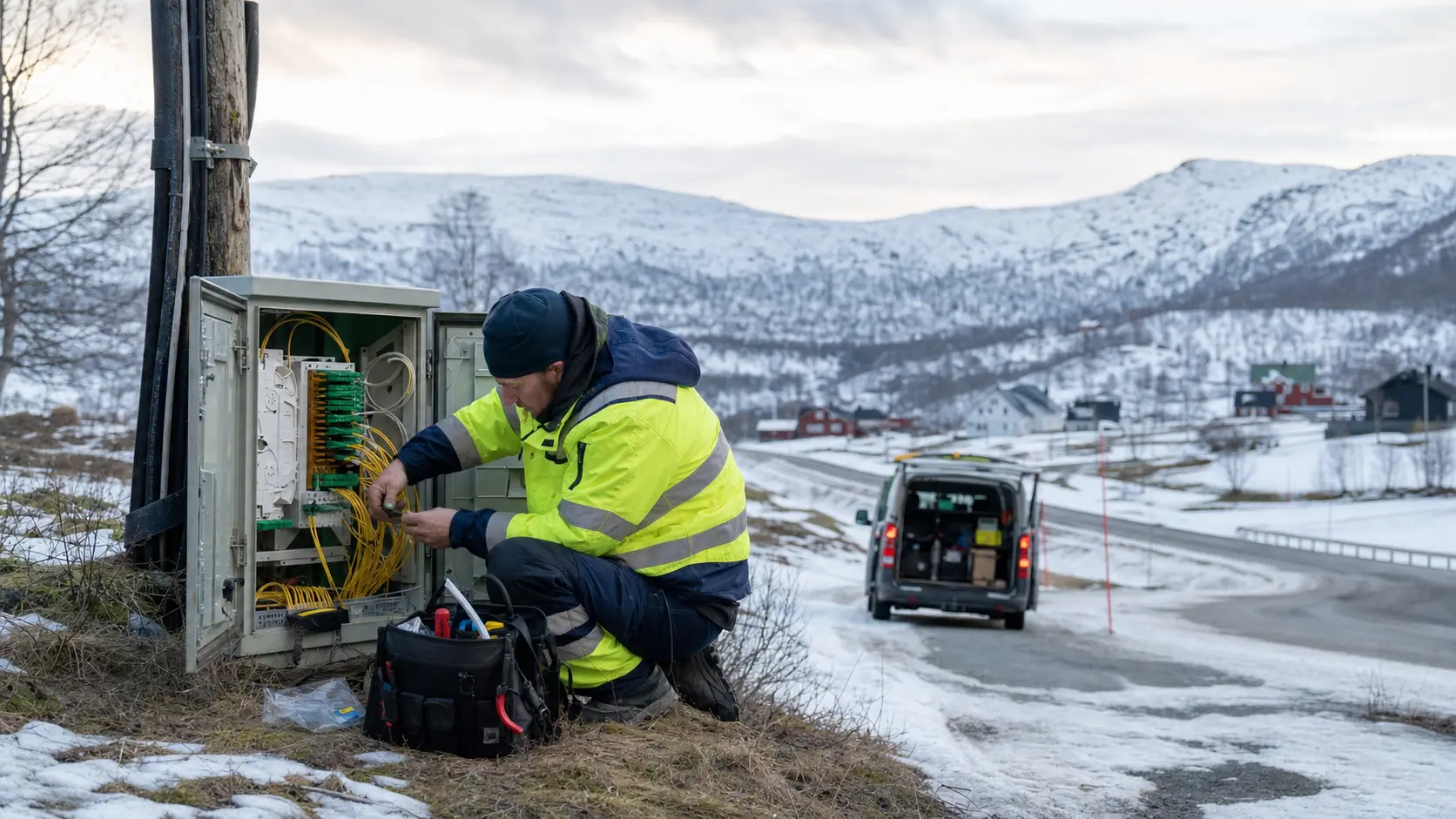
- Bykle Breiband's paid unit is a rural fibre line. The customer sees an 80/80 Mbit/s cabin package at NOK 398 per month plus NOK 5,900 installation, while the operator absorbs a harder burden: maintaining local access fibre, customer drops, field visits and service expectations across a high-mountain municipality with about 1,054 residents, 2,861 leisure buildings and one resident per square kilometre. The operating burden being transferred into the monthly line is not bandwidth alone; it is repair distance, winter access, local call handling, customer-premises work and backhaul dependency.
- The direct substitute is not abstract "no internet." A cabin owner can buy mobile broadband with Telenor coverage from PlussMobil at ordinary prices of NOK 399 per month for 50 GB, NOK 499 for 100 GB, NOK 699 for 200 GB, or NOK 49 per month in dormant mode with usage paid per GB; Telenor also markets fixed wireless broadband as no-digging access using a small antenna. Those offers reduce installation friction, but they price data volume, radio conditions and congestion differently from a symmetrical fibre line.
- The strongest public evidence is Nkom's fixed-broadband coverage data: the 2025 municipality row for Bykle shows 100% fibre coverage for households and 100% fixed broadband coverage when mobile and satellite are excluded. That does not disclose Bykle Breiband's customer count, margin, fault rate, trench length or pole/duct mix. It does show that the local access problem has largely been solved as coverage, so the economic question moves from build-out to renewal, repair, take-up and public expectations.
- The private metrics that would change the judgement are grouped in three buckets. Economics: route kilometres per active paying line, field call-outs per 100 lines, and backhaul cost per gigabit. Reliability: annual outage minutes by cause, mean time to repair in winter and share of faults on customer-side cabling. Retention: cabin renewal rate after the first contract year, take-up by hytte field, and the ratio of always-on users to seasonal users.
A household, cabin owner, school or small business in Bykle is not choosing between the internet and no internet. The real choice is whether a fixed fibre line is worth renewing when mobile broadband, fixed wireless broadband and satellite are easier to imagine than they were a decade ago. Bykle Breiband's public cabin offer says the fibre "Fritidspakke" includes symmetrical 80/80 Mbit/s internet for NOK 398 per month, with NOK 5,900 installation and a 12-month commitment from establishment: https://www.byklebreiband.no/. PlussMobil, using Telenor coverage, advertises flexible mobile broadband for cabin use, with ordinary monthly prices of NOK 399 for 50 GB, NOK 499 for 100 GB, NOK 699 for 200 GB, and a NOK 49 dormant mode where connected cabin systems can stay lightly online: https://www.plussmobil.no/mobilt-bredband. Telenor markets fixed wireless broadband as an address-bound mobile-network service with a small wall or window antenna and no digging: https://www.telenor.no/privat/internett/tradlost-bredband/. Third-party price comparison by Bytt.no lists Telenor fixed wireless tiers from NOK 849 per month for 50 Mbit/s to NOK 1,149 for 500 Mbit/s, a useful market signal but not a local Bykle quote: https://www.bytt.no/bredband/tradlost-bredband/telenor-bredband.
That comparison puts the Bykle fibre price in its proper frame. For a light-use cabin with only alarm, heat control and a few work sessions, a mobile data plan can look cheaper in winter because the owner can freeze or reduce it. For a cabin used many weekends, for remote work, TV, gaming, cloud backup or rental turnover, data caps and radio variability become part of the bill. Fibre asks the customer to pay a steadier monthly line even when the cabin is empty. In return, the customer is buying low-latency capacity, symmetrical upload and a local access path that is not competing with every mobile user on a busy ski weekend.
The avoided cost is not only a larger mobile data plan. It can also be the time spent managing a router SIM, moving a hotspot, waiting for video calls to recover, asking guests to reduce streaming, or paying for a national fixed-wireless tier that still depends on local radio capacity.
Bykle is a severe place to run that bargain. Statistics Norway's municipality page lists Bykle at 1,054 residents in the first quarter of 2026, 2,861 cabins and leisure buildings in 2026, and population density of one resident per square kilometre: https://www.ssb.no/kommunefakta/bykle. Store norske leksikon describes Bykle as Agder's largest municipality by area, with land area of 1,254 square kilometres, the county's highest mountain at 1,507 metres, settlement along the valley and Hovden about 27 kilometres north of the municipal centre, much of the municipality above 900 metres, and tourism around Hovden as a major economic activity: https://snl.no/Bykle. The municipality itself says it has 58 registered cabin associations and holds annual meetings with them at Hovden: https://www.bykle.kommune.no/tenester/turisme-og-hyttebyklar/hyttebyklar/. These are not soft background facts. They define the repair-distance economy. A fault van, a splicer, a home gateway swap or a buried drop repair travels through this geography.
Public evidence register
| Claim | Public evidence | What it proves | What it does not prove |
|---|---|---|---|
| Bykle Breiband is the local company and the fibre offer is priced for cabins. | https://www.byklebreiband.no/ | The cabin package, monthly price, installation fee, local positioning and service hours are public. | It does not show margin, cost per route kilometre or renewal rates. |
| Permanent residents are handled through an Altifiber customer layer while Bykle Breiband supplies the fibre. | https://www.byklebreiband.no/fastboende/ | The customer-facing split between local fibre and Altifiber billing/contact is visible. | It cannot prove wholesale transfer price, revenue share or fault allocation. |
| Bykle has unusually low density and a large cabin base. | https://www.ssb.no/kommunefakta/bykle | Resident count, leisure-building count and density are official municipal statistics. | It does not say which cabins buy fibre. |
| Terrain and settlement make repair distance material. | https://snl.no/Bykle | Area, altitude, settlement pattern and tourism context are documented. | It does not give actual fibre-route length. |
| Nkom records Bykle as fully covered by fixed broadband and fibre for households in 2025. | https://nkom.no/statistikk/nedlasting-av-datasett/_/attachment/download/ff1ff97b-cf15-443e-bd7a-988899fe41a6%3A604d8b6c73a8dda9db1cce9c41de8e6e6f923829/dekning2025.xlsx | Coverage outcome, excluding mobile and satellite, is extremely strong. | It is not a customer count or reliability report. |
| The 2024 data show mobile coverage is strong but high-speed radio coverage is not identical to fibre. | https://nkom.no/statistikk/nedlasting-av-datasett/_/attachment/download/f16f7394-3a40-44b9-9123-aa206cea75ab%3Adea4984d71550029975d292317f157357cae9e89/OS-Dekning.xlsx | Mobile can be a real substitute for many addresses, while speed classes vary. | It does not predict indoor cabin performance or holiday congestion. |
| Public broadband support is reserved for areas where commercial build economics fail. | https://nkom.no/fysiske-nett-og-infrastruktur/offentlig-stotte-til-bredbandsutbygging | The policy logic ties subsidy to non-commercial build economics. | It does not show a current Bykle Breiband subsidy award. |
| Agder's 2026 broadband support frame is NOK 9,902,257 and targets high-speed broadband in underserved areas. | https://agderfk.no/vare-tjenester/samferdsel/bredbandsutbygging/ | Regional funding context and 2024/2025 project lists are visible. | The visible lists do not show a current Bykle project. |
| Bykle Breiband has RIPE records and an access-network address resource context. | https://stat.ripe.net/data/whois/data.json?resource=AS211383 and https://stat.ripe.net/data/whois/data.json?resource=185.149.16.0%2F22 | Internet resource records support that the company has network identity and allocated IPv4 resources. | They do not show retail customers, traffic volume or local uptime. |
The company in the local bill
Bykle Breiband AS is registered in Norway as an aksjeselskap with organisation number 986 150 188, business address Hovdetun, 4755 Hovden i Setesdal, and industry code 61.100 for cable-based, satellite-based and wireless telecommunications: https://virksomhet.brreg.no/nb/oppslag/enheter/986150188. That registration matters because this is not merely a reseller page. The local company sits in the place where the network is consumed. Its public website calls it "din lokale bredbandsleverandor" and says it supplies fibre in Bykle for NOK 398 per month: https://www.byklebreiband.no/.
The practical split is clearest on the page for permanent residents. Bykle Breiband says Altifiber takes care of the customer, while Bykle Breiband delivers the fibre. The same page says customers register through Bykle Breiband, but those with internet or TV/internet deal with Altifiber as contact point and receive invoices from Altifiber, even when ordering through Bykle Breiband: https://www.byklebreiband.no/fastboende/. That evidence can prove the local access role and customer-facing arrangement. It cannot prove local access rent, operating margin, churn, or who pays which share of a field repair. In an economic reading, the important point is that the fibre path and the customer relationship are not perfectly the same thing. The household may see a national service brand, while the local economic burden still lands on the access network.
For cabins, the Bykle Breiband page is more direct. The company sells the 80/80 Mbit/s cabin package itself, names the NOK 398 monthly price, and states the NOK 5,900 establishment charge and 12-month contract period: https://www.byklebreiband.no/. The offer is interesting because it is not a premium speed tier. It is a utility-like line: enough symmetrical capacity for streaming, remote work, heat control, cameras, software updates and ordinary family use. Its economic content is the standing cost of keeping a dispersed access network alive.
The company's general terms make the maintenance transfer more explicit. They say service delivery may depend on permission to pass over third-party land, that the supplier can connect other customers to cable networks crossing a customer's property if it does not cause material inconvenience, and that moving or changing fixed installed equipment can only be done by the supplier. The terms also place internal household cabling responsibility on the customer, set fault-notification rules, and allow the supplier access to premises when needed for technical, operating or maintenance reasons: https://www.byklebreiband.no/generelle-vilkar/. These are ordinary telecom terms, but in a place like Bykle they explain why the monthly line is not just a port on a switch. It is an agreement about land, premises access, equipment, customer-side cabling, waiting time, weather and the right to maintain a shared network.
The 24/7 claim also belongs in the bill. Bykle Breiband says it offers business customers operation and maintenance of networks and data equipment, network electronics, PCs, Wi-Fi solutions and cabling, with much equipment monitored remotely and an established 24/7 watch arrangement that can support customers: https://www.byklebreiband.no/. That does not prove a service-level agreement for every household. It does show a local operations posture. For a small business, a school-adjacent service, a rental cabin manager or a municipal office, the value of fibre is partly whether a person can answer, diagnose and dispatch in the same geography.
Coverage changed the problem from building to keeping
The historic policy record helps explain why Bykle Breiband exists. The Norwegian public report NOU 2020:12 referred to Bykle Breiband AS as created with the aim of offering fibre to all permanent residents in Bykle: https://www.regjeringen.no/no/dokumenter/nou-2020-12/id2776843/?ch=5. That is a build-out statement, not a profitability statement. It says local public expectations attached fibre to settlement and municipal development. Once a community has reached broad fibre availability, the question stops being "will anyone build here?" and becomes "can the network be maintained, renewed and priced so people keep paying?"
Nkom's 2025 fixed-broadband dataset shows the build-out outcome. In the municipality sheet for households, Bykle appears with fibre coverage at 1.0 and total fixed broadband coverage at 1.0; the same row shows fixed wireless broadband coverage near 0.996 and fixed wireless at 100 Mbit/s near 0.901, while mobile and satellite are explicitly excluded from those fixed-broadband tables: https://nkom.no/statistikk/nedlasting-av-datasett/_/attachment/download/ff1ff97b-cf15-443e-bd7a-988899fe41a6%3A604d8b6c73a8dda9db1cce9c41de8e6e6f923829/dekning2025.xlsx. This is a powerful public fact. It says that households in Bykle, as measured by Nkom, have effectively complete fixed broadband and fibre coverage. It also means a new article should not write about Bykle as if the central problem were first-time access for most residents. The current problem is durability.
The 2024 dataset adds the mobile comparison. It showed Bykle with 4G basis coverage at 1.0 for households, 4G at 30 Mbit/s near 0.998, 4G at 100 Mbit/s near 0.721, 5G basis at 1.0, 5G at 30 Mbit/s near 0.980, and 5G at 100 Mbit/s near 0.501; combined 4G plus 5G at 100 Mbit/s was near 0.725: https://nkom.no/statistikk/nedlasting-av-datasett/_/attachment/download/f16f7394-3a40-44b9-9123-aa206cea75ab%3Adea4984d71550029975d292317f157357cae9e89/OS-Dekning.xlsx. Mobile is therefore not a weak substitute in the abstract. It is a real option. But the speed distribution shows why it is not the same paid unit as fibre. Fibre sells an address connection. Mobile sells radio access whose performance depends on signal, capacity, indoor placement, seasonal load and data plan.
The method caveat matters. Nkom's 2025 method document is public and indicates that some operator coverage inputs may be calculated by Nkom rather than supplied directly by the operator; search snippets for the method identify Bykle Breiband AS with organisation number 986150188 and an "ikke levert" note in that context: https://nkom.no/statistikk/offisiell-statistikk/_/attachment/inline/9507455e-51bd-45f4-badd-28bbf309e7ff%3A63a9fb2be6a149ccf667cf33b22021060126fe68/Metode%20dekningsunders%C3%B8kelsen%202025.pdf. That does not invalidate the coverage figure, but it does warn against treating the dataset as a direct operational submission by the company. The article can use the coverage result to describe market conditions. It cannot use it to infer subscriber numbers or network quality.
Why repair distance matters in Bykle
Rural fibre economics often look odd because the revenue unit is small and regular while the cost unit is lumpy. A customer pays NOK 398 each month. The operator may go months without touching that drop. Then one winter cut, one damaged cabinet, one power problem, one customer-side equipment fault or one access-road delay can consume several years of margin from a single line. In an urban block, a van can repair many customers in a short radius.
In Bykle, the route may run from the municipal centre up the valley toward Hovden, into cabin fields, across roads, around snowbanks and through land where permission, ground conditions and season matter.
The public geography supports that logic. Bykle's settlement is concentrated in the main valley, with Hovden around 800 metres above sea level and tourism-driven cabin development; 85% of the municipality's area is higher than 900 metres, according to Store norske leksikon: https://snl.no/Bykle. The same source says National Road 9 runs through the municipality from north to south and connects to E134 at Haukeligrend. A fibre access network follows human settlement and road corridors, but it still serves customers scattered across a wide mountain municipality.
Cabins change the ratio between lines and people. Statistics Norway lists 2,861 cabins and leisure buildings in Bykle in 2026 against 1,054 residents: https://www.ssb.no/kommunefakta/bykle. The municipality's cabin-owner page lists 58 registered cabin associations and treats the annual Easter meeting at Hovden as an important information venue: https://www.bykle.kommune.no/tenester/turisme-og-hyttebyklar/hyttebyklar/. This creates a customer base with two opposing traits. It can be large enough to support fibre beyond the resident population, but its use is seasonal and clustered. Traffic may spike on weekends, holidays and winter sport periods. Fault reporting may arrive when owners are present, not when a fault first occurs. A cabin that is empty for weeks still expects heat control, alarms and cameras to work.
The strongest version of the Bykle Breiband case is therefore not "local fibre is cheaper than everything else." It is "local fibre converts a volatile mountain access problem into a predictable monthly line." For a permanent resident, that monthly line supports home working, school work, health communication, municipal forms and normal entertainment. For a cabin owner, it keeps the property usable without managing a mobile plan and without rationing usage. For a small business, it removes a class of uncertainty around guest Wi-Fi, bookings, point-of-sale systems and cloud software.
The value is highest when the customer needs the line to work when everyone else has arrived in the valley too.
Substitutes keep the price honest
Mobile broadband is the sharpest substitute because it is flexible. PlussMobil's page is plainly designed for cabins: it says the service can be used at a cabin, in a camper or boat; it advertises Telenor coverage, no binding, rollover data, freeze or dormant mode, and packages from 10 GB to 200 GB: https://www.plussmobil.no/mobilt-bredband. The ordinary 50 GB package at NOK 399 per month is almost the same monthly price as Bykle Breiband's fibre cabin offer, but it has a data cap. The ordinary 100 GB plan at NOK 499 and the 200 GB plan at NOK 699 move above the fibre monthly line, but can be paused or reduced when the cabin is unused. For a cabin that only needs thermostat data and occasional email, mobile can win. For regular streaming, remote work and multi-device use, the fibre line's unlimited character and symmetrical upload become the difference.
Fixed wireless is a second substitute. Telenor's official page says it uses the mobile network, is installed at a fixed address, uses a small antenna on a wall or window, and avoids digging: https://www.telenor.no/privat/internett/tradlost-bredband/. That is a direct attack on fibre's installation friction. A customer does not need trenching, duct access or a field crew to pull a fibre drop. But the same Telenor page says speed can vary with capacity and other conditions, and the service works only at the installation address. The Bytt.no price table, while not an official Telenor price list, places Telenor fixed wireless at NOK 849 per month for 50 Mbit/s, NOK 899 for 100 Mbit/s, NOK 999 for 250 Mbit/s and NOK 1,149 for 500 Mbit/s as of July 2026: https://www.bytt.no/bredband/tradlost-bredband/telenor-bredband. If those listed prices are representative, Bykle's cabin fibre is not expensive for a user who actually needs an always-on line. If the customer can tolerate lower data and can pause use, mobile broadband remains cheaper.
Satellite is the third substitute, but the public evidence is less clean. Starlink's Norwegian residential page is accessible but requires JavaScript for details in a standard browser capture: https://www.starlink.com/no/residential. Recent Norwegian comparison coverage describes Residential Lite at NOK 399 per month, but that is not the same level of proof as a captured official tariff page: https://www.bytt.no/bredband/tradlost-bredband/a-xllj/starlink-vs-telenor-den-sanne-prisen-for-tradlost-bredband. Satellite matters because it changes the threat model for very remote cabins. It makes "no fixed access" less fatal. But it does not erase the value of a local fibre network for low latency, indoor Wi-Fi simplicity, property aesthetics, snow exposure, support and public-service continuity.
The substitute pressure matters because it disciplines Bykle Breiband's local price. In an earlier rural broadband market, customers might have accepted almost any fixed line because the alternative was poor DSL or weak mobile. In 2026, the alternative is a real menu: mobile data that can sleep, fixed wireless that avoids digging, and satellite that can bypass the valley. Bykle Breiband's NOK 398 cabin line has to justify itself as a reliable utility, not as the only possible way to get online.
Local customer signals are thin, but useful
The public customer record around Bykle Breiband is not rich enough to score satisfaction. That absence should not be filled with invented sentiment. There are no public line-by-line repair logs, no audited uptime table, no recent large sample of customer reviews tied specifically to the Bykle fibre line, and no visible dashboard that separates Bykle Breiband access faults from Altifiber service issues, home Wi-Fi problems or upstream transport. The best available signals are weaker but still useful: the official terms, the official customer split, the cabin-owner organisation base, regional resilience pages, and older social outage notices.
One older Bykle Breiband Facebook post surfaced in search says some Haugaland and Altifiber customers were without internet service during an afternoon in 2016: https://www.facebook.com/byklebreiband/posts/enkelte-kunder-hos-haugaland-og-altifiber-er-uten-internett-tjeneste-n%C3%A5-i-etterm/10154834905877835/. Another search result from the same period referred to a fault affecting customers in Agder and Dalane, with fault correction under way and Altifiber contact details. Those posts are too old to prove current service quality. They are useful for one narrower point: the local Bykle Breiband channel has historically been used to relay service information that may involve wider Altifiber or regional systems. That fits the resident-page split, where the customer may order through Bykle Breiband but deal with Altifiber for contact and invoices: https://www.byklebreiband.no/fastboende/.
The cabin-owner page is a stronger current signal, even though it is not a broadband page. Bykle municipality's list of 58 registered cabin associations shows that the leisure-home base is organised enough to communicate with the municipality through recurring forums: https://www.bykle.kommune.no/tenester/turisme-og-hyttebyklar/hyttebyklar/. For a rural fibre company, organised cabin fields are commercially important. They reduce the cost of reaching owners, concentrate demand, and create a visible place where service reputation can spread. If a fibre cabinet repeatedly fails in a dense hytte field, the problem is not a one-customer private issue; it can become a community issue. If the service works during peak weekends, the same social structure can support renewal.
The limits are equally important. A cabin association count does not equal broadband take-up. A social outage post does not equal annual reliability. A municipal digital-systems incident does not equal a fibre fault. These signals should only be used to locate the decision environment. Bykle has organised cabin owners, seasonal public meetings, public-service digital dependence and regional weather resilience concerns. Those conditions make broadband reliability visible. They do not establish whether Bykle Breiband currently performs well or poorly.
For an investor, regulator or buyer, the missing customer-signal metrics would be simple: net promoter score or complaint rate by product, number of active cabin fibre lines by hytte field, outage notices per year, repeat-fault addresses, average time to answer support, and share of customer complaints that are actually home Wi-Fi or customer cabling. For a small rural operator, these metrics are not public trivia. They are the difference between a monthly line that customers regard as a fair utility bill and a monthly line that gets compared every spring against a dormant mobile SIM.
A fair price test
The simplest price test begins with annual cash. Bykle's cabin fibre costs NOK 398 per month, or NOK 4,776 per year, before the one-time NOK 5,900 establishment charge: https://www.byklebreiband.no/. A PlussMobil 50 GB mobile plan at its ordinary NOK 399 monthly price is roughly the same annual subscription cost, but it provides a finite data pool and can be frozen or put into dormant mode: https://www.plussmobil.no/mobilt-bredband. A 100 GB plan at NOK 499 is NOK 5,988 per year if left active all year. A 200 GB plan at NOK 699 is NOK 8,388 per year. The mobile offer can be far cheaper if the cabin is used lightly and placed in dormant mode for much of the year. It can also become more expensive or less convenient if the owner keeps buying enough data for work, streaming and guests.
The installation charge changes the first-year comparison. A new Bykle fibre cabin customer paying NOK 5,900 to establish service plus 12 months at NOK 398 faces a first-year cash outlay of NOK 10,676, before any equipment or other extras implied by the final order. That makes mobile broadband attractive for a new, uncertain user. But installation is a capital-like charge from the customer's viewpoint. If the owner keeps the line for five years, the establishment fee averages NOK 1,180 per year, making the effective five-year annual cost about NOK 5,956 plus any future price changes.
At ten years, the establishment fee averages NOK 590 per year and the effective annual cost moves close to NOK 5,366. Those simple calculations explain why retention matters more than first-year conversion. The longer the customer keeps the line, the more the price resembles a utility payment rather than a project cost.
Fixed wireless tests differently. Telenor's official page sells convenience: no digging, antenna installation and an address-bound service over the mobile network: https://www.telenor.no/privat/internett/tradlost-bredband/. The Bytt.no comparison table lists Telenor fixed-wireless monthly prices well above Bykle's cabin fibre price for lower headline speeds, but the table is a national market signal and actual availability can vary by address: https://www.bytt.no/bredband/tradlost-bredband/telenor-bredband. If a Bykle cabin can already get fibre, fixed wireless has to win on installation speed, brand preference or avoidance of the fibre establishment charge. If the cabin cannot get a practical fibre drop, fixed wireless becomes a primary option rather than a price competitor.
Satellite tests differently again. It can serve remote properties without local trenching, but it transfers practical burdens to the customer: equipment placement, sky view, exposure, power, self-installation and vendor support. Because the captured official Starlink page did not expose tariff details without JavaScript, any price comparison should remain tentative: https://www.starlink.com/no/residential. Satellite's strategic effect is still real. It prevents rural fibre from relying only on scarcity. A local fibre line must now compete on dependability, support, latency, simplicity and the fact that it is integrated into the property rather than mounted as a separate sky-facing system.
The fair conclusion is conditional. Bykle's NOK 398 cabin fibre line is strong value for a property used often, rented out, equipped with smart systems, used for remote work or expected to support several people without data management. It is less compelling for a property used only a few weekends a year, especially if the owner has good Telenor mobile coverage and can keep a SIM in dormant mode. That is exactly why rural fibre is repair-distance economics. The operator needs enough high-value, always-on users to cover a network that also passes low-use properties tempted by cheaper seasonal substitutes.
Public-service expectations raise the floor
Local fibre economics are not just private consumer economics. Bykle's own public-services profile raises the minimum expectation for communications. Statistics Norway records high municipal spending per resident and a small, dispersed population; it also records 35.1% of pupils receiving school transport in 2025, which is one indicator of distance in daily public services: https://www.ssb.no/kommunefakta/bykle. Store norske leksikon notes municipal administration, library, swimming hall, sports facilities and a Setesdal upper-secondary school department with a ski programme: https://snl.no/Bykle. These facts do not say those buildings use Bykle Breiband lines. They do show why reliable digital access is a public expectation in the municipality.
The regional resilience context is stronger for mobile than for fibre, but it still matters. Nkom's 2020 note on reinforced electronic communications in inner Agder named Bykle among 11 municipalities receiving stronger mobile preparedness, tied to long power outages, extreme precipitation, wind and flooding. It said the programme aimed for continued mobile coverage for at least three days in selected municipal centres during fibre breaks, power failures and incidents: https://nkom.no/aktuelt/11-kommuner-i-indre-agder-far-okt-mobilberedskap. This is not evidence that Bykle Breiband has poor reliability. It is evidence that the region's communications problem is treated as public infrastructure, not just retail convenience.
Bykle municipality also published a 2024 account of evaluating a transition from Setesdal IKT to IKT Agder after most municipal data systems failed during a June incident: https://www.bykle.kommune.no/aktuelt/evaluerer-overgang-fra-setesdal-ikt-til-ikt-agder.4517.aspx. That incident was not presented as a fibre fault and should not be read that way. Its relevance is narrower: public services in a small municipality now depend on digital systems so deeply that a communications or systems failure becomes an operational issue for crisis leadership, records, professional systems and daily work. A local access network sits in the same public-expectation environment.
This public-service layer changes the customer's mental model. A cabin owner may compare NOK 398 fibre with a cheap dormant mobile plan. A school, municipal office, health-adjacent service, rental operator or local shop compares it with the cost of being down at the wrong moment. Rural broadband pricing has to carry both kinds of demand. The resident who just wants streaming and the public service that needs continuity share some of the same access plant.
Subsidy policy shows where pure market pricing fails
Norway's broadband support policy is a useful outside check on the economics. Nkom says public support is used to stimulate broadband build-out in areas where it is not commercially profitable to build digital infrastructure, and that county municipalities administer funds with Nkom guidance on state-aid rules and third-party access: https://nkom.no/fysiske-nett-og-infrastruktur/offentlig-stotte-til-bredbandsutbygging. Agder county says it has responsibility for public support for broadband build-out in Agder; for 2026, the frame is NOK 9,902,257, with support directed to scattered areas lacking a broadband offer, and supported projects must deliver at least 1 Gbit/s stable download: https://agderfk.no/vare-tjenester/samferdsel/bredbandsutbygging/.
The visible Agder page lists 2025 and 2024 project allocations, and Bykle is not visible in those project tables: https://agderfk.no/vare-tjenester/samferdsel/bredbandsutbygging/. That absence matters as much as an award would. It suggests that the present Bykle question is not a live public grant for uncovered homes in the visible list; it is the economics of maintaining a built network in a place that still resembles the subsidy problem: sparse, high-cost, seasonal and public-service sensitive.
Public support policy also explains why wholesale access and local fibre ownership matter. Nkom's support page frames third-party access as part of legal state-aid design: https://nkom.no/fysiske-nett-og-infrastruktur/offentlig-stotte-til-bredbandsutbygging. Bykle Breiband's resident page frames Altifiber as the customer contact and invoice point while Bykle Breiband delivers the fibre: https://www.byklebreiband.no/fastboende/. These two facts do not prove a regulated wholesale product for Bykle's network. They do show that access-layer economics can be separated from retail contact. In rural fibre, that separation can be efficient if it lets a local company focus on plant and field operations while a larger brand handles services, TV packages, support systems and billing. It can also make accountability harder for customers if they do not know whether a fault is local fibre, retail service, Wi-Fi equipment or upstream capacity.
Routing and backhaul evidence
Internet number records give a narrow but useful view of the network layer. RIPEstat whois for AS211383 lists ASN-BYKLE, organisation ORG-BBA76-RIPE, imports from AS31726 and AS59767, and creation in May 2021: https://stat.ripe.net/data/whois/data.json?resource=AS211383. RIPEstat's announced-prefixes view for AS211383 showed no visible prefixes in the queried recent window: https://stat.ripe.net/data/announced-prefixes/data.json?resource=AS211383. Separately, RIPEstat whois for 185.149.16.0/22 lists netname NO-BYKLE-20160425, country NO, organisation ORG-BBA76-RIPE and allocated PA status: https://stat.ripe.net/data/whois/data.json?resource=185.149.16.0%2F22. The routing-status view for that prefix shows origin AS31726, Telefiber AS, first seen in 2016 and visible to RIS peers in July 2026: https://stat.ripe.net/data/routing-status/data.json?resource=185.149.16.0%2F22.
The correct inference is modest. These records support that Bykle Breiband has RIPE network resources and that at least one associated IPv4 block is routed through Telefiber. They do not reveal access-line count, customer concentration, traffic volume, redundancy, commercial contract terms or repair performance. For the economics, though, the records fit the structure one would expect from a small local access operator: local fibre at the edge, upstream or partner networks for broader reach, and public internet resources that are evidence of network operation rather than proof of retail strength.
Backhaul is one of the decisive private metrics. A mountain access network can have beautiful local fibre and still be constrained by upstream price, capacity or resilience. Conversely, a modest customer count can be profitable if backhaul is bought well, route diversity is sufficient and local field costs are low. The public RIPE evidence does not settle that. It simply marks the part of the value chain where a local fibre bill leaves the municipality and becomes national internet economics.
The monthly line as a repair-distance instrument
The title claim that Bykle Breiband prices rural fibre by repair distance should not be read as a formal tariff formula. The public tariff does not say "kilometres from Hovden cabinet" or "snow-zone surcharge." It says NOK 398 per month for a cabin fibre package, NOK 5,900 to establish, and general terms for equipment, premises access, land crossing, maintenance, price changes and fault correction: https://www.byklebreiband.no/ and https://www.byklebreiband.no/generelle-vilkar/. The repair distance is hidden in the economics, not printed on the invoice.
That is normal for access networks. A dense urban customer and a difficult rural customer often pay simple retail prices, even when their service costs are very different. The provider spreads risk across a base. In Bykle, that base includes permanent residents, cabin owners and businesses. The public data imply the base is unusual: about 2.7 leisure buildings for every resident, one resident per square kilometre, high mountain terrain and almost universal fixed coverage: https://www.ssb.no/kommunefakta/bykle and https://snl.no/Bykle. If the network has enough cabin take-up, the seasonal property base can help pay for long routes. If cabin take-up is weak, the same geography becomes a burden.
This is why take-up is the missing number. Coverage tells us where fibre can be bought. Take-up tells us whether the cost of passing those properties is being converted into recurring revenue. A 100% coverage figure can hide very different businesses. In one version, a large share of cabins buy the NOK 398 line and keep it active because they rent out, stream, work remotely or use smart systems. In another version, many cabins rely on mobile data for occasional use, leaving the local network with the cost of passing properties but fewer active monthly lines. Public coverage data cannot distinguish those versions.
Repair frequency is the second missing number. A fibre network in rough terrain can be cheap to operate if buried routes are stable, active equipment is reliable and customer premises faults are rare. It can be expensive if winter cuts, power issues, road works, animal damage, snow clearing, customer-side Wi-Fi complaints and cabinet visits create recurring dispatches. Bykle Breiband's terms place customer-side cabling responsibility on the customer and allow the supplier to charge for faults that prove to be on customer equipment or cabling: https://www.byklebreiband.no/generelle-vilkar/. That allocation matters because it protects the shared monthly line from becoming free on-site IT support for every private Wi-Fi problem.
Labour availability is the third missing number. A small local provider can be more responsive than a national call centre because its staff know the area. It can also be fragile if too few technicians carry too many roles. Bykle Breiband's website lists weekday opening hours, a Saturday telephone watch and business service claims including 24/7 watch support: https://www.byklebreiband.no/. That is a positive public signal. It is not the same as audited mean-time-to-repair data.
How the buyer should think about renewal
The rational Bykle household or cabin buyer should separate four questions. First, how much data and upload does the household actually need? A camera, heat pump and occasional email can run on a small mobile plan. Several adults working remotely, children streaming, cloud backup, rental guests and smart-home devices point toward fibre. Bykle Breiband's 80/80 Mbit/s symmetrical cabin package is not the fastest product in Norway, but symmetry matters for video calls, cloud storage, remote monitoring and sending large files: https://www.byklebreiband.no/.
Second, how much does the owner value not managing the connection? PlussMobil's freeze and dormant options are attractive, especially for cabins used only in short seasons: https://www.plussmobil.no/mobilt-bredband. But flexibility has management cost. Someone has to watch data use, unfreeze the plan, keep SIM and router working, place equipment where signal is good, and accept that heavy use may require a larger package. Fibre is less flexible and more boring. That can be a feature.
Third, where is the property relative to the repair map? The public record does not publish Bykle Breiband's repair zones. But the buyer knows whether the cabin is in a dense hytte field, near other year-round users, on a road that is ploughed, or in a harder corner. Fibre in a dense cabin field can be economically strong because one dispatch can cover several customers and the route is justified by many paying lines. Fibre to isolated edges is harder. The customer's monthly price may be uniform, but the operator's cost is not.
Fourth, what happens when it fails? Mobile broadband can be an excellent backup to fibre, but a mobile-only property is exposed to radio congestion, indoor signal and regional power/resilience issues. Nkom's inner Agder preparedness note is a reminder that mobile networks themselves require reinforced power and redundant links in exactly the weather conditions that affect rural communications: https://nkom.no/aktuelt/11-kommuner-i-indre-agder-far-okt-mobilberedskap. Satellite can bypass local fibre and mobile plant, but it introduces its own equipment, sky-view and support questions. The best high-usage cabin may eventually use fibre as primary and mobile as backup, not one or the other.
What would change the conclusion
The public evidence is enough to support the planned thesis, with limits. It supports the claim that Bykle Breiband operates in a high-cost rural fibre setting, that the cabin tariff is low relative to some unlimited or fixed-wireless alternatives, that mobile substitutes are real for light or seasonal use, and that the local coverage outcome is strong. It does not prove that Bykle Breiband is highly profitable, underpriced, overbuilt or operationally fragile.
The economics bucket would be settled by route kilometres per active line, active cabin-line count, average revenue per line, upstream cost, technician hours per fault, vehicle time per dispatch and capital renewal requirement. Two decisive metrics would be active fibre subscriptions per kilometre of access route and annual field labour cost per active line. A third would be cabin take-up by field, because dense cabin clusters can carry network cost while sparse take-up leaves the same plant stranded.
The reliability bucket would be settled by annual outage minutes, fault causes, mean time to repair by season, repeat faults by location and backup-power coverage at active sites. Two decisive metrics would be winter mean time to repair and fault minutes per 100 active lines. A third would be the percentage of faults resolved remotely versus field-dispatched, because remote resolution is the cheapest way to serve a dispersed customer base.
The retention bucket would be settled by first-year conversion after installation, cabin renewal rate, churn to mobile or satellite, and share of customers that suspend, downgrade or return after winter. Two decisive metrics would be annual cabin churn after the first 12 months and net additions in established hytte fields. A third would be usage concentration during holiday peaks, because a network can appear lightly used annually but need peak capacity for a few high-value weeks.
Final judgement
Bykle Breiband's public record looks less like a growth story and more like a maintenance story. The company is not trying to convince a dense suburb to buy gigabit fibre. It is selling a stable line in a municipality where the population is tiny, the cabin base is large, terrain is severe and public expectations for digital continuity are high. The NOK 398 cabin fibre line is therefore a price for standing readiness. It charges a cabin owner each month for a route that must be there in bad weather, not only for bits moved during a holiday week.
That line is vulnerable to substitution at the low-usage edge. A cabin owner who visits rarely and only needs light monitoring can rationally choose mobile broadband with a dormant mode. A property outside convenient fibre reach can rationally consider fixed wireless or satellite. A household that needs unlimited use, low latency, upload, guest reliability or fewer moving parts has a stronger reason to keep the fibre line. The more Bykle's cabins become remote-work, rental and smart-property assets, the stronger Bykle Breiband's monthly-line logic becomes.
The strongest public fact is not the price. It is coverage. Nkom's 2025 data show Bykle as effectively fully covered by fixed broadband and fibre for households, excluding mobile and satellite: https://nkom.no/statistikk/nedlasting-av-datasett/_/attachment/download/ff1ff97b-cf15-443e-bd7a-988899fe41a6%3A604d8b6c73a8dda9db1cce9c41de8e6e6f923829/dekning2025.xlsx. That achievement moves the analysis to the harder phase. A rural fibre operator wins not by passing every address once, but by keeping enough customers paying, keeping repair distance under control, and making the local line feel more dependable than the flexible substitutes around it. In Bykle, the monthly fibre bill is the place where snow, distance, labour, backhaul and public-service expectations meet the customer's simple question: is this line still worth renewing?