
Summary
- The paid unit for Burger Rus is the quick-service restaurant account: a franchise and operating bundle that converts beef, buns, fry oil, rent, labour, payments, app ordering, delivery demand and brand recognition into a repeatable lunch-rush transaction. The question is not whether a Burger King sign exists in Russia; the question is whether each outlet can keep throughput moving when suppliers, payments, foreign-brand governance and local substitutes all changed at once.
- The strongest evidence says the Russian network kept operating after the 2022 brand shock. Restaurant Brands International said in March 2022 that it owned a 15% minority stake, that Alexander Kolobov handled day-to-day oversight of about 800 Russian restaurants, that Burger King Russia refused RBI's demand to suspend operations, and that RBI suspended corporate support in operations, marketing and supply chain support (https://www.rbi.com/English/news/news-details/2022/Actions-on-Burger-King-Russia/default.aspx). The Guardian and Axios carried the same refusal-to-close issue as a franchise-control problem, not as ordinary brand management (https://www.theguardian.com/business/2022/mar/18/burger-king-owner-says-operator-in-russia-refuses-to-shut-shops-ukraine and https://www.axios.com/2022/03/18/burger-king-business-partner-russian-restaurants).
- The current public surface is active and consumer-facing. Burger King Russia's site shows live promotions, ruble menu tiles, app-store links and 2026 copyright by ООО "Burger Rus" (https://burgerkingrus.ru/). Its app page tells customers to choose, pay, collect at pickup, use coupons, order delivery and receive cashback through the app (https://burgerkingrus.ru/orderapp). Those pages prove a live digital retail surface; they do not prove uptime, unit margins or private delivery-platform economics.
- The public financial and ownership trail suggests a large but cost-sensitive Russian operator. Interfax reported in September 2025 that Burger King Russia redomiciled to Russia as MKOOO BKR, that BKR owned 99.84% of Burger Rus, and that Burger Rus 2024 revenue reached 90.26 billion rubles while net profit fell to 1.63 billion rubles (https://www.interfax.ru/business/1046092). That scale matters, but the thin net margin signal keeps the judgement tied to input discipline, labour, rent and transaction reliability.
- The practical substitute is not one rival alone. A customer can choose Vkusno - i tochka, Rostic's, a domestic burger chain, an independent cafe, a delivery-only kitchen, home cooking or cheaper street food. Burger Rus therefore has to sell more than nostalgia for a global name. It must sell a reliable meal account: predictable menu availability, fast payment, enough staff, working kiosks and phones, delivery reach and a price point that still feels worth leaving home for.
The lunch rush prices the whole company
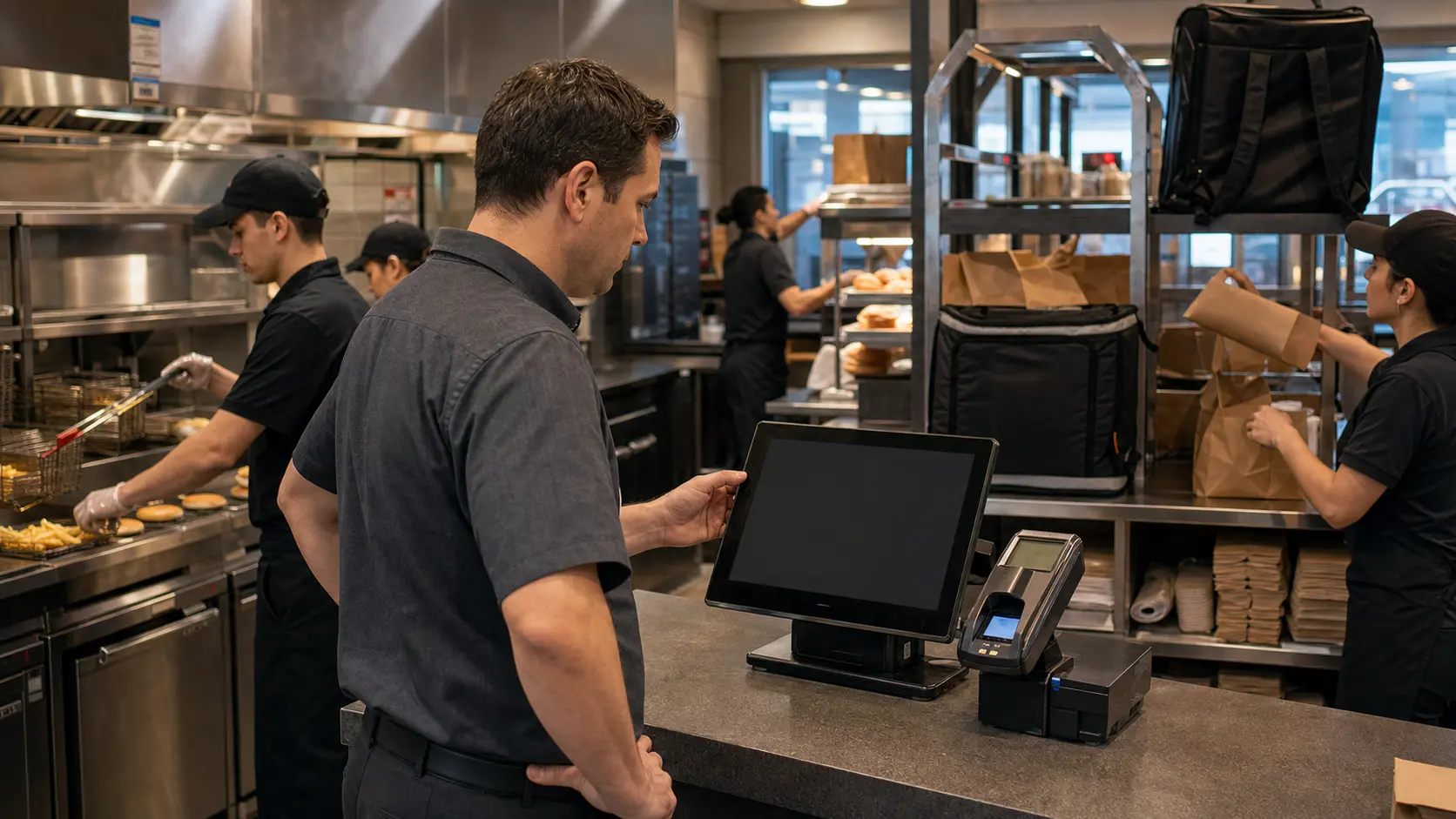
The revealing moment is a lunch rush after something breaks. A store manager does not have to think in geopolitical language when a queue forms at 12:40. The manager thinks in orders, seconds, trays, fryer baskets, card payments, app tickets, couriers, stock on the line and the one ingredient that is running low. If the POS stalls, the app orders keep arriving but cannot be reconciled, a delivery courier waits while dine-in guests complain, or a familiar sauce is unavailable because the supply path changed, the brand shock becomes an operating problem.
The sign can remain outside the store, but the account customers are buying is inside: quick food, known taste, reliable payment and a queue that moves.
That is the right unit for Burger Rus. The company does not sell only burgers. It sells repeatable throughput under a brand that was global in origin but locally operated in practice. The paid unit is a quick-service account in which every site must turn food inputs, kitchen timing, labour scheduling, payment acceptance, order screens, app coupons and delivery logistics into small transactions again and again. A restaurant that fails once at lunch may lose only a few orders. A network that repeatedly fails at lunch loses habit, and habit is the main asset of quick-service restaurants.
The current site proves the visible side of that account. Burger King Russia still presents new offers and ruble-priced menu tiles on https://burgerkingrus.ru/, including low-ticket promotional language and a visible product price for cheese medallions in the captured public page. The app page at https://burgerkingrus.ru/orderapp is more economically important than the menu tile because it describes the consumer behaviour Burger Rus wants: order without a queue, choose, pay, collect at pickup, use coupons, order delivery and receive cashback. That is not decoration. It is the mechanism by which a fast-food operator tries to raise frequency, smooth front-counter pressure, collect demand data and keep customers from switching to another food option inside the same shopping centre or delivery app.
The lunch-rush problem also explains why Burger Rus matters to a media-intelligence view even though it is not a telecom or cloud company. A quick-service restaurant has become a small digital operations business. The store is a food factory, but the account depends on payment rails, app sessions, order screens, loyalty offers, delivery dispatch, customer support and staff who can recover when a device or supplier fails. The public evidence cannot show Burger Rus internal architecture or store-level uptime.
It can show that the company openly asks customers to use digital ordering and delivery, and it can show that the chain remained open after foreign-brand exits made those systems harder to treat as ordinary imported support.
Operating capacity is the first of the seven price mechanisms because it is what the customer actually feels. A store can have a famous name, a broad menu and a cheap app offer, but if it cannot turn orders into completed trays fast enough, the account is weak. Capacity in a fast-food restaurant is not only kitchen square metres. It is how many patties can be cooked without waste, how many baskets of fries can be timed without cold product, how many orders can be packed without missing items, how many staff members can switch between counter and delivery handoff, and how quickly a manager can reopen a stalled lane.
Burger Rus is valuable only if those small capacities survive at scale.
The second mechanism is scarce specialist labour. Quick-service work is often treated as low-skilled, but the store depends on people who know rush timing, cleaning rules, equipment quirks, promotion handling, customer de-escalation and courier traffic. A new cashier can accept orders; an experienced shift manager protects margin by deciding when to prep, when to hold, when to call for more staff and when a delivery queue is about to damage dine-in service. That labour is local. It cannot be imported from a global brand manual after the fact. If Burger Rus kept operating after 2022, its store-management bench became more important, not less.
The 2022 brand shock changed the contract
The central discontinuity is March 2022. RBI's official letter said the Russian business sat in a joint venture with Alexander Kolobov, Investment Capital Ukraine and VTB Capital, with RBI holding a 15% minority stake and no partner holding a majority. It said Kolobov was responsible for the day-to-day operations and oversight of about 800 restaurants in Russia. It also said RBI demanded a suspension of Russian Burger King restaurant operations, was refused, began disposing of its stake, suspended corporate support for the Russian market, refused approvals for new investment and expansion, and would redirect any profits it received from the business to UNHCR (https://www.rbi.com/English/news/news-details/2022/Actions-on-Burger-King-Russia/default.aspx).
That letter is not just corporate history. It changed what a Burger Rus restaurant had to prove. Before the shock, a customer could read the restaurant as part of a global brand system, even if the outlet was locally operated. After the shock, the operational question became more local: can the Russian operator keep the menu, supply base, training rhythm, promotional calendar, payment acceptance and delivery presence alive without normal corporate support from the brand owner? The Guardian described the same issue as a contract problem in which RBI could not directly close the Russian stores and identified Kolobov as the main franchise partner (https://www.theguardian.com/business/2022/mar/18/burger-king-owner-says-operator-in-russia-refuses-to-shut-shops-ukraine). Axios put the point more sharply: the Russian partner controlling about 800 restaurants refused to suspend operations (https://www.axios.com/2022/03/18/burger-king-business-partner-russian-restaurants).
This is why global Burger King evidence must be handled carefully. RBI's brand standards, global scale and franchise experience are context. They do not prove Burger Rus current margin, supplier quality, local support quality, payment uptime or retention. Brand-linked evidence explains the original contract and the dispute around it.
It does not tell us how much beef Burger Rus buys, what share of stores are franchised onward, how many restaurants are profitable, how much rent pressure sits in Moscow malls, or how many customers still prefer the brand after the Russian market absorbed former McDonald's sites under a domestic successor.
The shock also changed the competitive story. McDonald's chose a different route. The Guardian reported in May 2022 that McDonald's would sell its Russian business, remove the name, logo, branding and menu before sale, and keep paying local employees until a buyer was agreed (https://www.theguardian.com/business/2022/may/16/mcdonalds-to-sell-russia-business--invasion-ukraine). Yum Brands also moved toward exit for KFC and Pizza Hut Russia, with Food & Wine reporting that Yum was selling KFC franchise operations and had already sold Pizza Hut operations (https://www.foodandwine.com/news/yum-brands-kfc-pizza-hut-exit-russia). Burger Rus did not receive the same clean de-branding event. Its public-account challenge became different: keep operating under a known foreign name while the foreign owner publicly distanced itself.
That can be an advantage and a burden. The advantage is recognition. In a food court where the former McDonald's has become Vkusno - i tochka and KFC has become a local successor, the Burger King name still signals a pre-2022 global standard to some customers. The burden is that the name also invites scrutiny. Customers and counterparties can ask whether the Russian menu still has the same quality, whether supply substitutions changed taste, whether promotions are funded locally, and whether the brand-owner dispute could still matter. The store manager at lunch cannot solve those questions. The manager can only keep the queue moving.
This is where upstream supplier dependence becomes visible. In the old mental model of a foreign franchise, the brand owner carries some of the burden of validated suppliers, training updates, marketing and menu development. In the post-shock model, Burger Rus has to make more of those choices locally or through domestic partners. That does not make the chain weaker by default. Local sourcing can be cheaper, faster and better adapted to Russian logistics. But it removes part of the comfort investors and customers might have drawn from global support.
A supplier failure, packaging shortage or replacement-equipment delay is now more clearly a local operating test.
Capital and infrastructure intensity are also higher than the public storefront suggests. A quick-service restaurant has kitchen equipment, refrigeration, POS devices, menu screens, routers, fire-safety equipment, ventilation, furniture, pickup shelving and delivery handoff space. Those assets do not have the drama of a data centre, but they decide whether a restaurant can operate at rush speed. A small independent restaurant can sometimes improvise around a broken station. A standardized chain has less room because every station is part of a timed system.
The more the Russian business must localize repair and replacement, the more those assets become a margin variable.
Scale helped, but the margin signal is thin
The public financial evidence is unusually useful because it shows both scale and pressure. Interfax reported that the Cypriot Burger King Russia redomiciled to Russia and would operate as MKOOO BKR, registered in the Kaliningrad special administrative region on September 1, 2025. It also reported that Sergey Kozlov, who heads Burger Rus, was listed as general director, that BKR owned 99.84% of Burger Rus, and that Burger Rus 2024 revenue under Russian accounting standards rose 21.2% to 90.26 billion rubles while gross profit rose 14.3% to 17.29 billion rubles and net profit fell 8.1% to 1.63 billion rubles (https://www.interfax.ru/business/1046092). Local outlet Klops repeated the same redomiciliation story and linked it to the 2022 support suspension and 2024 financial figures (https://klops.ru/kaliningrad/2025-09-09/366173-burger-king-pereedet-iz-kipra-v-kaliningradskiy-ofshor).
Those numbers are not enough to calculate unit economics, but they discipline the argument. A 90.26 billion-ruble revenue base means Burger Rus is not a marginal kiosk brand. It is a large restaurant operator in Russian quick service. Yet a 1.63 billion-ruble net profit on that revenue is thin enough that small cost changes matter. Food inputs, payroll, rent, logistics, app discounts, payment fees, equipment, local marketing and tax treatment can all move the result. The gross profit increase lagging revenue growth, while net profit fell, fits the broad thesis that throughput alone is not the same as economic comfort.
The revenue figure also shows why a purely brand-centred reading is incomplete. If Burger Rus can grow revenue in 2024 after the shock, customers are still buying the account. But the falling net profit tells us that keeping the account alive may have required heavier cost absorption, promotion, wage increases, supplier substitution or fixed-cost pressure. Public filings do not split those causes. The cautious conclusion is that Burger Rus had revenue resilience but not enough public evidence of margin resilience to treat the model as settled.
Restaurant scale helps in three ways. First, it increases purchasing power. A large network can bargain harder for buns, beef, chicken, cheese, potato products, packaging, cleaning supplies, kitchen equipment and delivery terms than an independent cafe. Second, it supports a repeatable operating method: staff training, menu cards, prep rhythm, food-safety routines, cash handling and promotional cadence. Third, it gives the app a reason to exist. A loyalty and delivery app is more useful when a customer expects the same brand across cities and repeated trips.
Scale also creates liabilities. Large quick-service chains are exposed to food inflation, rent escalators, wage competition and public criticism in a way a small independent can partially hide from. They cannot easily change recipes or packaging if customers expect a known taste. They need enough managers who can run standardized restaurants. They need store equipment repaired quickly. They need delivery orders to be profitable enough after discounts and courier costs. They need payment acceptance to be boring, which is another way of saying reliable.
In a sanctions-constrained market, every imported spare part or brand standard that once felt routine can become a procurement question.
The financial record therefore supports a balanced judgement. Burger Rus is large enough to matter and visible enough to remain in customers' food-choice set. It is not publicly proven to be a high-margin beneficiary of foreign exits. The public evidence points to a company that kept the account alive, grew revenue, and still faced a cost stack heavy enough to reduce net profit.
The same financial record also warns against treating revenue as proof of customer love. In inflationary or promotion-heavy conditions, revenue can rise because prices rise, because app offers pull forward demand, because delivery adds tickets, or because former foreign competitors left space in the market. None of those drivers automatically protects profit. What would matter most is same-store traffic, average ticket after discount, food waste, labour hours per transaction, delivery mix and store contribution after rent. Those are private metrics. Without them, the public figure should be read as resilience with a question mark attached.
The revenue-to-profit shape also makes customer switching cost a live issue. If a consumer's switching cost is low, Burger Rus may need promotions to keep frequency. Promotions can defend habit but lower effective price. A high-margin business can afford that temporarily; a thin-margin business must make sure discount traffic becomes repeat traffic. The official app page's emphasis on coupons and cashback is therefore strategically logical. It is also a warning that the customer relationship may require constant nudging. The best version of the model uses offers to reinforce habit.
The weaker version uses offers to buy transactions that leave too little margin.
Supply discipline is the first operating wall
Fast food looks simple because the menu is simple. The supply burden is not simple. A Burger Rus outlet must receive ingredients in the right temperature, pack sizes and timing. A burger chain is exposed to beef supply, chicken supply, potatoes, cheese, sauces, buns, packaging, fry oil, cleaning materials and maintenance spares. If any one of those lines becomes unreliable, the store loses either menu availability or speed. Customers may forgive a missing special item once. They will not build a lunch habit around uncertainty.
The 2022 shock matters here because RBI said it suspended supply-chain support for the Russian market (https://www.rbi.com/English/news/news-details/2022/Actions-on-Burger-King-Russia/default.aspx). That sentence does not mean Burger Rus could not source food locally. It means the public evidence points to a loss of normal brand-owner support, which raises the burden on local sourcing, local QA and local substitutions. The customer does not see the supplier contract. The customer sees whether the burger tastes right, the fries are hot, the drink is available, the packaging holds and the app offer is honoured.
The economic wall is that supply discipline must fit the price point. Burger King Russia's public site still shows low-ticket promotional language such as "9 for 99" and current ruble-priced product tiles on https://burgerkingrus.ru/. Promotions like that are commercially useful because they drive footfall and app frequency. They also limit room for error. A discounted item can be profitable if it fills spare capacity, uses predictable inputs and attaches higher-margin products. It becomes costly if it adds kitchen load, waste or coupon traffic that does not convert into habit.
Rent compounds the issue. Many quick-service outlets sit in malls, transport hubs, high-street units or food courts where occupancy cost is a fixed claim on every lunch rush. A store that keeps staff and rent but loses menu availability has no easy way to recover the day. A domestic independent restaurant may cut a dish, change the menu, or close early. A quick-service franchise has less flexibility because consistency is the product. The account depends on the belief that the same order can be bought again tomorrow.
Labour is the second wall. The service model needs line cooks, cashiers, cleaners, delivery handoff staff, shift managers and local maintenance coordination. A thinly staffed outlet can look profitable until a rush arrives. Too many staff can protect speed but destroy margin. The manager is constantly buying a small option on reliability: one extra person may keep the queue moving; one missing person may turn a good sales hour into a review problem. Public sources do not disclose Burger Rus wage rates or turnover.
But any quick-service model with 90 billion rubles of revenue and thousands of daily operating hours is exposed to local support labour, not just head-office economics.
Food inputs and labour also interact. If a supplier delivers late, staff wait or improvise. If staff are new, waste rises and throughput falls. If the app pushes a promotion that the store is not ready to fulfill, the line slows for both app and counter customers. The supply chain is not a background cost. It is a timing system.
Compliance and data locality form another cost layer. Burger Rus is not simply selling food from a counter; it is collecting orders, payments, offer redemptions and delivery details through a public digital surface. The site footer points to personal-data and cookie-policy material, and the app page asks the customer to transact through the phone. That does not prove weak or strong compliance. It proves the company has reader-visible obligations around data, recommendation technology and consumer transactions.
In the Russian setting, local handling of those obligations can matter to regulators, payment partners and customers who expect digital service without foreign-platform uncertainty.
Supplier dependence also affects menu psychology. A quick-service customer may not know the source of beef, buns or sauce, but the customer notices if the same order tastes different or is unavailable. The stricter the brand memory, the less room there is for local substitution to feel visible. Burger Rus therefore has to perform a quiet balancing act: localize enough to keep supply resilient, but not so much that the customer thinks the product has become a cheap imitation. That balance is a commercial asset if done well and a churn trigger if done badly.
Payments and app ordering became part of the meal
The payment shock is easy to understate because Russian domestic card systems kept many local transactions functioning. But for a restaurant chain, the loss of international payment-system normality still matters. Axios reported in March 2022 that Visa, Mastercard and American Express suspended operations in Russia, cutting off cross-border card functionality and adding to the isolation of firms operating there (https://www.axios.com/2022/03/06/visa-mastercard-russia-suspend). A Russian Burger King outlet serving local customers may still accept domestic cards and local payment methods, but the operating account became more local, less internationally portable and more dependent on domestic rails.
That matters in three ways. First, the store must keep acceptance reliable at the counter, kiosk and app. A slow payment terminal is a kitchen problem because it holds the queue. Second, the app must handle customer trust. If customers order, pay and collect through the app, any failure becomes a food-service failure even when the root cause is technical. Third, delivery depends on digital coordination. A delivery order is not only food; it is address handling, courier timing, menu availability, refund handling, platform terms and customer messaging.
Burger King Russia's app page makes this visible. It says the smartphone becomes a free register, tells customers to choose, pay and collect at pickup, promises coupons and special offers, and describes delivery and cashback in the app (https://burgerkingrus.ru/orderapp). The page does not reveal whether the app runs on domestic cloud hosting, what payment providers are used, which delivery partners carry the load, or how often orders fail. It does prove that the public customer promise includes digital ordering, payment and delivery. For a restaurant chain after a sanctions shock, that promise is part of the product.
App coupons are also a pricing system. A restaurant can keep headline menu prices visible while using coupons to segment demand. Students, commuters, office workers and delivery customers may all see different reasons to buy. The danger is that coupons can train customers not to pay full price. They can also create store-level friction if the POS, app and cashier do not read the same offer. A promotion that looks cheap on a screen can cost real margin if it increases complaints, slows ordering or pushes a low-margin product at the wrong time.
Delivery-platform dependence sits beside the in-house app. The public app page says delivery can be ordered directly through Burger King's app, but Russian consumers also compare offers across food-delivery environments, domestic chains and independent restaurants. Delivery adds reach, but it also inserts fees, courier constraints and quality risk. Fries travel badly. Burgers cool. A missing item becomes a refund and a review. The more the restaurant uses delivery to defend volume, the more the account depends on digital reliability outside the dining room.
The correct economic question is therefore not whether Burger Rus has an app. It is whether app, POS, kitchen and courier timing reduce labour waste or add another layer of failures. Public pages prove the offer; they do not prove the answer. That is why the watchpoint is store-level digital failure, not app marketing.
Digital dependence also changes the substitute set. A customer standing in a food court may compare signs. A customer on a phone compares delivery time, coupon value, minimum order, rating and fee. The delivery screen can flatten brand differences. A domestic kitchen with lower rent can appear next to Burger King if the offer is cheap and fast enough. Burger Rus must therefore win two markets at once: the physical lunch rush and the mobile ordering moment. The public app page shows it is trying. The private question is whether delivery and cashback deepen loyalty or simply move margin to discounts and couriers.
Payment reliability is part of customer trust because it is invisible until it fails. In a cash-light quick-service setting, a card or app-payment problem can make the kitchen look disorganized even when the food line is ready. A store can recover from one slow terminal by moving a customer to another register, but repeated friction changes behaviour. Customers begin choosing the restaurant where payment feels easiest. That is why the 2022 payment context matters even without Burger Rus-specific failure evidence.
The broader Russian card environment became more domestic, and restaurant chains had to make that domestic reality feel ordinary to customers.
Brand control without brand comfort
Burger Rus holds a difficult middle position. It kept the Burger King name visible in a market where other Western restaurant brands exited, sold or rebranded. That gives Burger Rus customer recognition. It also leaves the chain operating under a brand whose owner publicly said it wanted Russian operations suspended and had stopped support. The result is brand control without brand comfort: local management can use recognition, but cannot rely on the old relationship to reassure every supplier, customer or investor.
This ambiguity can be commercially useful. For some customers, Burger King may still feel more familiar than a new domestic brand. For others, the very fact that the chain stayed open while McDonald's left may make it feel adapted to local reality. A restaurant account is not judged only by corporate statements. It is judged by whether the meal tastes familiar, the price is acceptable, the payment works and the branch is open. If those four things hold, many customers will not care who supported the marketing budget in 2022.
But ambiguity can also leak into operations. A global brand normally provides standards, training updates, supplier approvals, menu development, equipment advice and marketing discipline. RBI said it suspended operations, marketing and supply-chain support and refused approvals for new investment and expansion in Russia (https://www.rbi.com/English/news/news-details/2022/Actions-on-Burger-King-Russia/default.aspx). Public evidence does not show what local replacements Burger Rus built. The safe judgement is only that the local operator had to carry more of the load.
The ownership trail adds another layer. Interfax said BKR owned 99.84% of Burger Rus after redomiciliation and that ownership details for the new international company were not disclosed in the story (https://www.interfax.ru/business/1046092). RBI's 2022 letter had already named VTB Capital and ICU among the joint-venture partners. That does not let us infer current beneficial ownership beyond the public reports. It does mean a buyer, landlord, supplier or regulator looking at Burger Rus sees a more complicated control history than at an ordinary domestic chain.
Complicated control matters because quick-service restaurants depend on routine decisions. Who approves a new store? Who funds a kitchen refit? Who absorbs a bad supplier month? Who negotiates with delivery platforms? Who owns the risk if brand standards and local supply realities diverge? The public record does not answer these questions. It tells us why the questions matter.
The optimistic view is that Burger Rus built local muscle. A company that kept operating, grew revenue and maintained a live app after the shock may have localized enough support to survive without normal brand-owner help. The pessimistic view is that the company kept the sign but lost some invisible advantages: brand-owner knowledge, procurement support, global benchmarking, and easier access to equipment or vendor contracts. The right view is conditional. Burger Rus is valuable if local management converted the shock into durable independence. It is vulnerable if the public-facing continuity masks higher costs and deferred maintenance.
There is also a reputational arbitrage. Burger Rus can benefit from a global name while behaving economically like a local chain. That arbitrage is valuable if customers keep trusting the name and if local managers can meet the promise at Russian cost. It becomes fragile if the global name raises expectations that the local system cannot satisfy. The brand is therefore not a moat by itself. It is a promise that must be renewed at every counter, kiosk, delivery handoff and app order.
The domestic substitute set is stronger than it looks
Substitutes are not abstract. They are what a hungry customer chooses at 1 p.m. when the queue is long or the app offer fails. The obvious substitute is Vkusno - i tochka, the successor to McDonald's Russia. Its official development page at https://vkusnoitochka.ru/company/development shows a company that presents itself as a growing domestic quick-service network. Business Insider reported in June 2025 that Vkusno - i tochka had about 930 outlets, served 2 million customers daily and generated 187 billion rubles in 2024 revenue (https://www.businessinsider.com/putin-business-allies-oppose-return-western-companies-russia-mcdonalds-2025-6). Those figures, if taken as company statements carried by media, make it a much larger public comparator than a niche burger chain.
Rostic's and other KFC successors add a second substitute. Yum's exit path, reported by Food & Wine, left a local fast-food operator set rather than an empty market (https://www.foodandwine.com/news/yum-brands-kfc-pizza-hut-exit-russia). Chicken competes with burgers at lunch because the customer is not buying a category name. The customer is buying speed, price, location and habit. A shawarma stall, bakery, cafeteria, convenience-store hot counter or local burger chain can compete with Burger Rus if it is closer, cheaper or faster.
Independent restaurants are a different substitute. They cannot match a national app or standardized menu, but they can adapt quickly. If beef costs rise, they change specials. If a location has a local lunch crowd, they can price around it. If delivery fees are too high, they can push phone orders, messengers or pickup. Their weakness is consistency. Their strength is flexibility. Burger Rus has the opposite profile: consistency is the pitch, flexibility is constrained.
Delivery-only kitchens are another substitute because they attack the app-ordering account directly. A customer ordering through a platform may not care whether the meal comes from a visible storefront. The platform sorts by price, delivery time, cuisine and promotion. If Burger Rus uses delivery to defend volume, it competes against kitchens with lower front-of-house rent, fewer brand constraints and menus tuned for travel. The chain can respond with name recognition and operational scale, but the delivery screen reduces the advantage of a physical sign.
Home cooking and cheaper local fast food are the final substitutes, and they matter most when household budgets tighten. A burger meal has to be cheap enough to remain an impulse, not expensive enough to require planning. The official Burger King Russia site showing low-price promotional language is evidence that Burger Rus understands this (https://burgerkingrus.ru/). The substitute judgement is therefore strict: Burger Rus can keep customers only if it offers a better mix of speed, familiarity, app value and location than domestic chains, independents, delivery-only kitchens, home cooking and cheaper local food. The brand name helps, but it does not end the comparison.
The practical substitute paragraph is therefore not a footnote. A domestic quick-service chain gives the customer standardized speed without the foreign-brand overhang. An independent restaurant gives local flexibility and sometimes better perceived freshness. A delivery-only kitchen gives app convenience without dining-room rent. Home cooking gives the household control over cost. Cheaper street food gives speed and price without loyalty mechanics. Burger Rus has to beat enough of those options often enough to preserve habit. That is a demanding standard because the customer can switch one meal at a time.
The substitute set also varies by location. In a mall, Burger Rus competes with neighbouring food-court brands and the customer's walking patience. Near offices, it competes with cafeterias, bakeries and lunch delivery. In transport locations, it competes with time itself. In residential delivery, it competes with kitchens that may never need a visible storefront. A national revenue figure blends those micro-markets together. The store manager cannot. The manager has to know which substitute is winning today.
Cost stack: why revenue growth is not enough
The cost paragraph is straightforward. Burger Rus has to cover food inputs, packaging, rent, staff, utilities, maintenance, kitchen equipment, local marketing, app discounts, payment fees, delivery economics, support staff, corporate overhead and whatever local investment is needed to replace brand-owner support. A 90.26 billion-ruble revenue number is large, but Interfax's reported 1.63 billion-ruble net profit shows that the net claim left after those costs was small relative to sales (https://www.interfax.ru/business/1046092). The exact store-level mix is private. The public arithmetic says margin discipline matters more than brand visibility.
Food inputs are the most visible cost, but not always the most dangerous. A chain can sometimes adjust portioning, menu mix, supplier contracts or promotions. Rent and labour are harder in the short term. A store must open with enough people and pay occupancy cost even when traffic is weak. Digital promotions can increase volume while reducing average ticket quality. Delivery can add sales while reducing margin. Payment and app failures can turn a high-volume hour into refunds and complaints.
Capital and equipment intensity sit behind the counter. Fryers, broilers, refrigerators, POS terminals, screens, network devices, kiosks, power systems and kitchen spares must be kept working. In a sanctions-constrained environment, imported or brand-specific parts may be slower, more expensive or more awkward to replace. Public evidence does not identify Burger Rus equipment vendors or spare-part routes. The burden is still economically real because quick-service standardization depends on equipment uniformity. A store that cannot repair a key kitchen station loses more than a machine; it loses the rhythm of the line.
Compliance and locality are also part of the cost stack. Burger Rus operates in Russia, under Russian corporate, tax, labour, data and food-service rules. The app page shows the company asking customers to order and pay digitally, which implies customer-data handling and transaction records (https://burgerkingrus.ru/orderapp). The official site also presents data and cookie policy links in the footer on https://burgerkingrus.ru/. These pages do not prove compliance quality. They show that the public surface includes data, recommendation technology and digital transactions, which must be managed locally.
The upstream supplier burden extends beyond food. Packaging, cleaning chemicals, uniforms, spare screens, network equipment, receipt paper, delivery bags and kitchen maintenance all have to arrive before they are noticed. A chain can hide many substitutions from customers if the final meal is familiar. It cannot hide a broken cold-storage unit, a missing cup size, a failed order screen or a restaurant that closes a lane during peak hours. Supplier dependence is therefore not a single procurement line. It is a collection of small dependencies that either keep the account boring or make it visibly brittle.
There is also an information-cost component. Every promotion, app offer and menu change has to be understood by store staff. If head office pushes an offer that staff cannot explain or equipment cannot honour, the cost appears as slow service and customer frustration. If the offer is clear, the same app can reduce counter friction and raise frequency. That distinction is not visible in public reports, but it is central to quick-service economics. Good information lowers labour cost. Confusing information spends labour at the counter.
Customer switching cost is moderate, not high. A consumer does not have to migrate a server or close a bank account to leave Burger King. The customer simply buys lunch somewhere else. That makes habit the lock-in. Burger Rus wins when app offers, taste, location, speed and price become routine. It loses when a single bad experience reminds the customer how many substitutes exist.
What unofficial signals can and cannot tell us
Unofficial market signals around fast food are noisy. Reviews, social posts, complaint sites and delivery-app comments can reveal friction in taste, missing items, late delivery, app failures or staff behaviour. They cannot measure national service quality without a denominator. A chain with hundreds of restaurants will always have angry customers online. The signal is useful only when it matches the economic mechanism.
For Burger Rus, the useful unofficial signal would be repeated comments about unavailable menu items, app coupon failures, payment refusal, delivery delays, cold food, missing items, long queues or inconsistent taste after 2022. Those would point directly at the operating account. They would not prove the whole company is weak, but they would show where the account is being contested. Conversely, social chatter about a popular promotion or familiar taste would indicate habit resilience, not audited margin.
The public pages already show the areas most likely to generate chatter. The app page promises queue avoidance, payment, pickup, delivery, coupons and cashback (https://burgerkingrus.ru/orderapp). Each promise has a failure mode. Queue avoidance fails if pickup is not ready. Payment fails if domestic rails or app reconciliation break. Coupons fail if the store cannot honour the offer. Delivery fails if the courier handoff or packaging quality is weak. Cashback fails if customers cannot see or trust the reward. None of that requires a dramatic outage. Small frictions repeated at lunch can erode habit.
Market-signal analysis also needs competitor context. Business Insider's 2025 report about Vkusno - i tochka pushing against Western return, and claiming large outlet, customer and revenue figures, suggests the domestic successor market is not passive (https://www.businessinsider.com/putin-business-allies-oppose-return-western-companies-russia-mcdonalds-2025-6). It is building its own protection and identity. If domestic chains become better at app ordering, kitchen equipment localization and patriotic positioning, Burger Rus cannot rely only on being the familiar foreign brand that stayed.
The safest conclusion from unofficial signals is therefore conditional. They should be read as pressure gauges. If they cluster around app failures, delivery quality and menu shortages, the digital and supply account is weaker than revenue suggests. If they cluster around price complaints, margin pressure may rise. If they cluster around nostalgia and familiar taste, the brand account remains valuable. None of those signals alone should override financial reports or official pages.
Proof boundaries: economics, reliability and retention
The public evidence proves several direct facts. Burger King Russia's public site is active in 2026, carries Burger Rus copyright language, shows ruble-priced menu and promotional surfaces, and links to app stores (https://burgerkingrus.ru/). The app page publicly sells queue avoidance, payment, pickup, coupons, delivery and cashback (https://burgerkingrus.ru/orderapp). RBI publicly said in 2022 that Russian operations continued despite its demand to suspend them, that the Russian business had about 800 restaurants under day-to-day oversight by Alexander Kolobov, and that RBI suspended support and began trying to dispose of its stake (https://www.rbi.com/English/news/news-details/2022/Actions-on-Burger-King-Russia/default.aspx). Interfax publicly reported a 2025 redomiciliation and 2024 Burger Rus financial figures (https://www.interfax.ru/business/1046092).
The evidence implies, but does not prove, a stronger claim: Burger Rus likely had to localize much of the supply, marketing, support and digital operating burden after the shock. That implication is reasonable because RBI said corporate support stopped and because the Russian public surface is active. It is not the same as proof of how the company replaced that support. We do not have supplier contracts, delivery-platform terms, app architecture, store-level uptime, ticket times, staff turnover, franchisee economics, or internal margin by city.
The missing proof falls into three classes. Economics: store-level revenue, food cost, rent, delivery fees, coupon cost, labour cost, equipment capex and franchise payments would show whether revenue resilience becomes durable profit. Reliability: POS uptime, app failure rate, payment-acceptance failures, delivery cancellation rates, kitchen equipment downtime and supplier fill rates would show whether the account works when customers need it. Retention: active loyalty users, repeat-order frequency, customer churn by city, delivery reorder rates and substitute switching would show whether habit survived the brand shock.
Those boundaries matter because a live website and a large revenue figure are not enough. They show activity and scale. They do not show whether Burger Rus is compounding a stronger local system or exhausting its margin to keep volume. The difference is the investment judgement.
Watchpoints that would change the judgement
The first watchpoint is margin mix. If future Russian accounts show revenue still growing while net profit expands faster than sales, the judgement improves because Burger Rus would be proving that localization and scale are converting into operating leverage. If revenue grows but net profit keeps narrowing, the company may be buying continuity with promotions, labour, rent and supplier cost.
The second watchpoint is digital reliability. Any public evidence of repeated app, POS, payment or delivery failures would matter more than ordinary food complaints because Burger Rus has made digital ordering part of the meal. Conversely, signs of strong app adoption, reliable delivery execution and fewer coupon disputes would support the bull case that the company turned digital dependency into frequency rather than fragility.
The third watchpoint is control clarity. If the post-redomiciliation ownership, investment and brand-rights position becomes clearer, counterparties can price the account with less uncertainty. If control remains opaque while foreign-brand pressure, sanction risk or local support obligations rise, suppliers and landlords may demand more protection.
The conclusion is practical. Burger Rus matters because it kept a quick-service account alive after the brand shock, not because a sign remained on the storefront. The company must turn repeatable food supply, store labour, payment uptime, app ordering, delivery access and local management into thousands of small decisions that feel boring to customers. Its substitute set is real: domestic quick-service chains, independent restaurants, delivery-only kitchens, home cooking and cheaper local fast food. Burger Rus wins only if the familiar brand plus local execution remains faster, more reliable and better priced than those alternatives.
The next year of public evidence should therefore be read less like a brand-reputation story and more like an operations scorecard. A new promotion is meaningful only if it does not slow the kitchen. A new app feature is meaningful only if stores can honour it. A new restaurant is meaningful only if the supply base and manager bench can support it. Better public proof would show stable stores, cleaner digital handoffs and less dependence on discounts. Burger Rus has already shown public continuity. The higher bar is proving that continuity can be profitable without asking customers to overlook more friction than the familiar name can absorb.