
Summary
- BCI's public record supports a cautious thesis: the company is visible as a Palestinian ICT, security and infrastructure integrator with a related BNET connectivity footprint, but the record does not prove a simple retail-ISP story. The commercial product is constrained distribution, local implementation, support labour and dependency management.
- The case turns on whether BCI can make procurement and continuity cheaper than the alternatives: a mobile carrier bundle, a direct equipment-vendor purchase, a regional distributor, informal procurement, a cloud-only service, or simply delaying upgrades until budget and access improve.
The buyer is paying for continuity, not just equipment
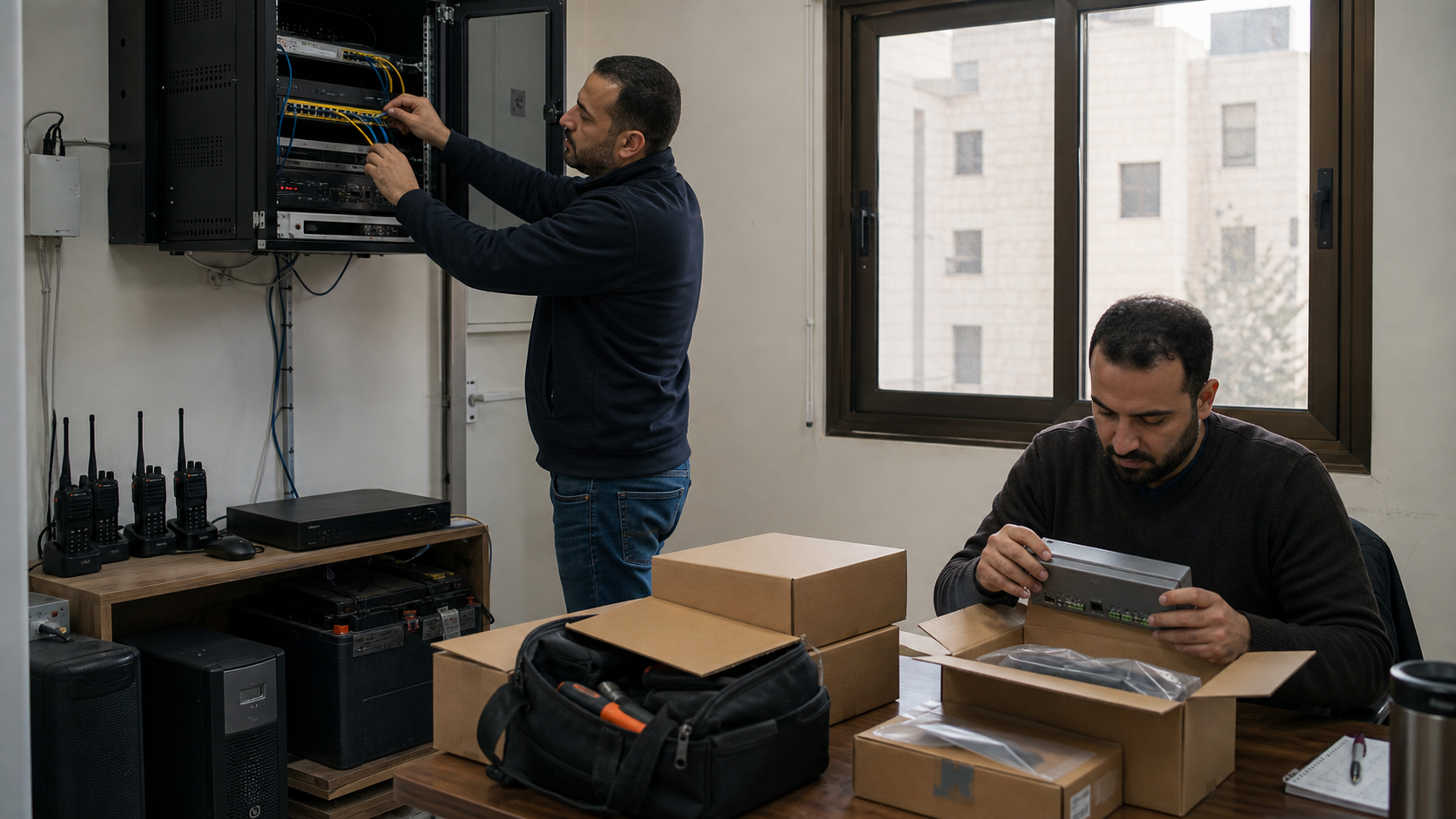
Start with a school, municipality, hospital supplier, bank branch, logistics office or public-safety unit in Ramallah, Jenin or another West Bank city. It needs a working mix of connectivity, radios, cameras, access control, routing, wireless LAN, backup power, software, maintenance and help from people who can actually reach the site. In a richer and less constrained market, the procurement officer might buy a mobile carrier data bundle, order directly from a global equipment vendor, use a regional distributor in Jordan or the Gulf, move more workloads to cloud services, buy informally from whoever has stock, or postpone the upgrade.
In Palestine, each of those choices carries a local penalty. A mobile bundle may not replace fixed or private-network reliability. Direct vendor supply may leave customs, spares and warranty coordination unresolved. Regional distribution may be slow when movement and clearance are uncertain. Informal procurement may be cheap but weak on configuration, documentation and after-sales support. A cloud-only choice still needs last-mile reliability, backup power and a support path. Delaying upgrades saves cash but increases operational risk.
That is the economic frame for BCI Telecommunication & Advanced Technology Company. BCI's own public site presents "BCI Solutions" as a Palestinian provider of ICT, security and infrastructure solutions since 1995, serving government entities, public safety agencies, telecom providers, banks and enterprises (https://www.bci-solutions.com/). Its about page says the company designs, implements and supports mission-critical technology solutions, and it describes West Bank and Gaza based support teams as part of its process (https://www.bci-solutions.com/about/). Its solutions page lists communication systems, security and surveillance, infrastructure, data centres and networking, software and digital transformation, and C5I-style command, control, communications, computers, cyber and intelligence offerings (https://www.bci-solutions.com/solutions_and_services/). The public contact page places the headquarters at Umar Al-Mukhtar Street 2 in Ramallah and gives a Palestine phone number (https://www.bci-solutions.com/contact/).
Those claims are broad marketing, not audited revenue segmentation. They are still useful because they define the product shape. BCI is not selling a pure web-hosting plan or a pure mobile subscription in the way a mass-market carrier does. It is selling local accountability around systems that are difficult to specify, import, install, secure and maintain. That can be valuable in a constrained market if the company has real procurement relationships, engineers, stock discipline and service response.
It can also become thin if the same work is reduced to reselling hardware at a margin while customers absorb the underlying delays and outages themselves.
The related BNET evidence sharpens the point. The BNET site says, in Arabic, that BNET was established in 2010 within the BCI group as the group's arm in telecommunications and internet services, and describes internet, broadband and services for individuals, institutions and companies (https://bnet.ps/site/aboutus/). BNET's services page includes domain and hosting services, VPS hosting and data-link services for connecting company and institutional branches (https://bnet.ps/site/home-2/). Its branches page lists a Jenin branch and a general administration location (https://bnet.ps/site/branches/). This does not mean every BCI contract is a network-access contract. It means BCI sits close to a group connectivity arm and can plausibly bundle equipment, site work, managed support and access-related services. The public evidence supports a distribution-and-support thesis more strongly than a narrow catalogue thesis.
The registry record proves a network footprint, but not the whole business
The public registry record is unusually important here because it disciplines the article. RIPE lists ORG-BTAT1-RIPE as "BCI Telecommunication & Advanced Technology Company", country PS, registration number 562429191, organisation type LIR, and a Ramallah address. The RIPE organisation object was created in 2008 and last modified in May 2026 (https://rest.db.ripe.net/ripe/organisation/ORG-BTAT1-RIPE). The associated maintainer is MNT-BNET, described as "BNET MAINTAINER" (https://rest.db.ripe.net/ripe/mntner/MNT-BNET). RIPE also lists AS47253, named AS-BNETSET, under the same organisation, with import and export policy entries that include Palestinian, Israeli and global networks (https://rest.db.ripe.net/ripe/aut-num/AS47253).
BGP tools show the operating texture. bgp.tools identifies AS47253 as BCI Telecommunication & Advanced Technology Company, links the website to bnet.ps, labels the network type as eyeball, and reports 66 originated IPv4 prefixes, no IPv6 originated prefixes, four peers, two upstreams and one Palestine Internet Exchange Point entry at PSIX (https://bgp.tools/as/47253). Hurricane Electric's BGP toolkit similarly lists AS47253 with country of origin Palestine, one internet exchange, 69 IPv4 prefixes originated, no IPv6 prefixes originated, 67 RPKI-valid originated prefixes, and observed IPv4 peers including Palestine Telecommunications Company and Cellcom Fixed Line Communication (https://bgp.he.net/AS47253). RIPE route objects tied to AS47253 include routes described as BNET network, ADSL static, ADSL users and BNET DSL, with examples such as 46.18.16.0/21, 62.16.64.0/20, 93.184.0.0/20, 185.6.56.0/22, 193.124.248.0/22, and 2a02:26d0::/32 as a route6 object in the RIPE registry (https://rest.db.ripe.net/search?query-string=AS47253&inverse-attribute=origin&flags=no-filtering).
This network evidence matters, but it should not be made to carry more than it can support. Registry and BGP records establish that the BCI/BNET footprint has public number resources, an autonomous system and address space that appears in routing data. They do not prove customer counts, margins, service-level performance, outage history, field-force capacity, stock depth, government contract values or the mix between consumer broadband, enterprise connectivity, hardware distribution and public-sector integration. They also do not make ASNs or prefixes into business actors. They are evidence of technical footprint and dependencies.
The dependence itself is visible. bgp.tools reports upstreams from Palestine Telecommunications Company and Cellcom Fixed Line Communication for AS47253 (https://bgp.tools/as/47253). The RIPE aut-num object lists multiple imports from external ASNs and exports announcing AS-BNETWORK (https://rest.db.ripe.net/ripe/aut-num/AS47253). For a Palestinian customer, that means the continuity promise cannot be understood as pure self-sufficiency. It is an arrangement among BCI/BNET's own resources, local access infrastructure, upstream providers, exchange fabric, regulatory permissions and the physical realities of West Bank and Gaza communications. BCI can reduce coordination cost for customers. It cannot abolish the political and carrier constraints around the network.
Palestine makes integration a reliability product
The Palestinian telecom market is a case study in why integration sometimes has more value than equipment. A World Bank press release on its 2016 telecom-sector report estimated Palestinian mobile-sector revenue losses at more than US$1 billion over three years and fiscal losses as high as US$184 million, citing years of mobile broadband delay, unauthorized Israeli operators in the Palestinian market, restrictions on importing equipment, and the absence of an independent regulator (https://www.worldbank.org/en/news/press-release/2016/03/31/lifting-restrictions-and-promoting-better-regulation-to-unleash-the-potential-of-the-digital-economy-in-palestine). The same release says Palestinian operators were unable to operate in more than 60% of the West Bank under Israeli control, faced Israeli restrictions on telecom and ICT equipment imports, and had to access international links through an Israeli-registered company. That is not a normal cost environment.
The Ministry of Telecommunications and Digital Economy presents the sector as both a development priority and a regulated field. Its English homepage describes the ministry as the official website of the State of Palestine's Ministry of Telecommunication and Digital Economy, lists departments for frequencies, communications, licensing and complaints, and says licensing policy covers telecom professions, market study, regulation and monitoring (https://mtde.gov.ps/?culture=en-US). The ministry's 2022 indicators PDF gives a more concrete view of market scale: 4,062,067 Palestinian mobile lines, 421,065 fixed broadband subscriptions, 51,746 fixed fibre broadband subscriptions, 1,148,698 mobile broadband subscribers, 389,300 Mbps of utilized international internet capacity, total telecom-sector revenue of US$592.3 million, US$67.3 million of telecom-sector investment, and licensed categories that include wireless internet services, broadband services, BSA, value-added services, import of wired and wireless communications devices, and trade in wired and wireless communications devices (https://mtde.gov.ps/uploads/files/20241211111603_%D8%AA%D8%AD%D9%88%D9%8A%D9%84_%D8%A7%D9%84%D9%88%D8%B2%D8%A7%D8%B1%D8%A9_%D9%85%D8%A4%D8%B4%D8%B1%D8%A7%D8%AA_2022.pdf).
The household demand side is also not small. PCBS' public indicators show Internet access at home at 93.5% in 2023, up from 79.6% in 2019, 64.5% in 2018 and 51.7% in 2017, based on the Household Survey on Information and Communications Technology (https://pcbs.gov.ps/). In other words, the market is not one where internet access is exotic. The constraint is not basic awareness of connectivity. It is the quality, resilience, speed, affordability and support around connectivity and institutional technology. That distinction favours companies that can do practical local work: survey a site, source compatible equipment, configure it, install it, document it, answer calls, arrange spares and adapt the design when power, access or upstream service fails.
The World Bank's 2020 TechStart announcement makes the labour angle clearer. The bank approved a US$15 million grant to help the Palestinian IT sector upgrade firm capabilities and create high-quality jobs, noting more than 3,000 IT graduates per year, high youth unemployment and the potential of remote or crisis-resilient technology work (https://www.worldbank.org/en/news/press-release/2020/06/15/us15-million-investment-in-information-technology-to-boost-high-skilled-jobs-for-palestinian-youth). BCI's public promise of local support sits inside that wider labour market. Its margin depends less on one device and more on whether local engineers and support teams can turn imported and configured technology into continuity for institutions.
Distribution is the product when imports and spares are uncertain
The easiest mistake is to treat distribution as low-value resale. In a frictionless market, a customer can compare prices on switches, routers, CCTV systems, two-way radios, antennas, UPS systems, access-control devices, virtualization platforms and software licences, then choose the cheapest channel. The Palestinian market is different. If equipment is delayed, held, mismatched, undocumented or unsupported, the real cost is not only the invoice.
It is a broken branch link, a disabled camera wall, a hospital supplier that cannot reconcile orders, a bank office that has to fail over manually, a school that cannot keep a lab connected, or a public-safety unit whose radio system is not interoperable.
BCI's official services page is broad enough to cover several parts of that problem. It lists portable and mobile two-way radios, base stations and repeaters, radio dispatch and operations centers, GPS and AVL tracking systems, P25 and DMR radio solutions, antenna site and tower construction, access control, CCTV and intelligent surveillance, intrusion and alarm systems, x-ray and metal detection, perimeter security and fire safety, data-center and disaster-recovery solutions, enterprise networking, cloud and virtualization, cybersecurity, structured cabling and UPS systems (https://www.bci-solutions.com/solutions_and_services/). The list reads like a public-sector and enterprise integrator catalogue. The commercial question is whether BCI can deliver the messy parts behind the list: approvals, specifications, compatibility, training, service calls and spares.
That is why substitutes in the opening third matter. A customer can buy a mobile carrier bundle from Jawwal or Ooredoo, use Paltel fixed access, order a global-vendor kit through another distributor, lean on a regional reseller, buy informally, move some workflows to SaaS, or delay the purchase. Paltel Group is a large Palestinian telecom incumbent with a public web presence (https://paltelgroup.ps/). Jawwal markets consumer mobile services (https://www.jawwal.ps/). Ooredoo Palestine markets itself as a modern and economical Palestinian mobile network (https://www.ooredoo.ps/). Those choices can be cheaper or simpler for routine connectivity. They are less complete when the buyer needs integrated systems, site work, installation, security, maintenance and accountability across several suppliers.
Direct equipment vendors can also be attractive. Global vendors bring product roadmaps, warranty documentation and technical certification. But direct vendor procurement may be difficult for a mid-sized Palestinian institution if the vendor does not provide fast local installation, does not hold the right spares locally, or expects the customer to manage clearance, subcontractors and first-line support. A regional distributor may have better availability but less local context. Informal procurement may solve urgency at the cost of traceability.
Cloud services reduce local hardware needs but leave the access link, identity, devices, backup power and support desk unresolved. Delaying upgrades may be rational when budgets are stressed, but it compounds technical debt. BCI's opportunity is to be the least bad coordination layer among these options.
The margin structure follows the same logic. Hardware resale alone is vulnerable to price comparison. Installation has better margin if skills are scarce. Managed support and maintenance can build recurring revenue if customers trust response times. Software and lifecycle-management services can be stickier if they become part of the customer's daily process. Connectivity can add recurring revenue but also creates exposure to upstream and last-mile dependencies. The best version of BCI is a bundle that converts constrained distribution into lower operating risk for customers.
The weakest version is a broad catalogue without proof of service-level delivery.
Revenue quality depends on the mix behind the invoice
The public record does not disclose BCI's revenue mix, so the economics have to be inferred from the work being sold. A project that combines network equipment, access control, cameras, radios, cabling, UPS, software, installation and support contains several different margin pools. The equipment line may have the largest invoice value but not the best economics. It is exposed to vendor pricing, exchange rates, freight, customs timing, warranty rules and customer comparison shopping. Installation and commissioning are more labour intensive and can earn better returns if BCI's engineers are genuinely scarce.
Support and maintenance should be the highest-quality revenue if contracts renew and customers pay for response time, documentation and preventive care. Connectivity and hosting can be recurring, but they inherit upstream, last-mile and power dependence.
The distinction matters because a broad systems integrator can look bigger than it is. A US$100,000 institutional upgrade may contain imported equipment with thin pass-through margin, a local installation fee with better gross margin, a first-year support package, and optional recurring software or connectivity revenue. If most of the invoice is hardware, the business is more like constrained distribution. If a meaningful share is support, managed service, lifecycle software, branch connectivity or security maintenance, the business has more durable economics. BCI's official services page supports the possibility of all these lines, but not their weights (https://www.bci-solutions.com/solutions_and_services/). That is why revenue quality, not headline project value, would be the private metric that changes the view.
The pricing model should also vary by customer. A small enterprise may buy on equipment price and basic installation. A bank, public agency or emergency-services buyer should pay for documentation, spares, acceptance testing, escalation and periodic review. A telecom or ISP customer may care more about interoperability and software support. A school or municipality may need staged payment and simple maintenance. If BCI prices all of these customers as a single catalogue market, it will either overcharge low-complexity buyers or underprice difficult ones.
If it prices by risk, it can preserve margin while giving customers a clearer choice between basic delivery and continuity assurance.
The most important revenue question is renewal. A one-off installation proves sales access; a renewal proves that the customer believes BCI lowered operating risk after the first invoice. For a continuity thesis, a 12-month support renewal rate above 80% among institutional customers would materially strengthen the case. A renewal rate below 50% would weaken it, because it would suggest customers see the initial purchase as enough and do not value ongoing support. Similarly, recurring support, hosting, connectivity and managed-service revenue above one third of gross revenue would make BCI look less like a distributor.
A support share below 15% would make the company much more dependent on project timing and procurement cycles.
The payment side can reverse the picture. Public-sector and institutional buyers may be sticky but slow. A business can report strong project wins while cash is tied up in receivables. Days sales outstanding below 75 days would be a healthy sign in a constrained procurement market. DSO above 150 days would turn attractive contracts into financing exposure. The same goes for gross margin by line. Hardware gross margin below 10% can be tolerable if installation and support attach strongly. Hardware margin below 10% with weak support attach would leave little room for delays, warranty disputes or currency movement.
Installation gross margin above 30% and support gross margin above 45%, if paired with customer retention, would support the thesis that local labour and coordination are valuable products.
Carrier dependence is both a weakness and a route to relevance
AS47253's routing picture suggests BCI/BNET is not a disconnected reseller. It has public number resources, a BNET-maintained network, a PSIX entry and observed upstream dependence. That gives the company operational relevance. It also exposes the business to carrier concentration and external control. Hurricane Electric reports 17,664 originated IPv4 addresses and observed peers for AS47253, but no originated IPv6 prefixes in its summary (https://bgp.he.net/AS47253). bgp.tools reports one PSIX connection with a 1,000 Mbps link and upstreams including Paltel and Cellcom Fixed Line Communication (https://bgp.tools/as/47253). RIPE records include IPv4 allocations and a route6 object, but public BGP summaries still show the routed service footprint as primarily IPv4 in observed origin data.
For a customer, this means BCI's connectivity-related value is contingent. If the customer needs local enterprise access, static addressing, branch connectivity or integrated network support, BCI/BNET's own footprint may be useful. If the customer needs mass-market mobile data, nationwide cellular coverage or large-scale international transit guarantees, the larger carriers and their regulatory position matter more.
BCI can package access and support; it cannot remove the fact that Palestinian connectivity often depends on a small number of large networks, international links and regulatory approvals outside the control of a single integrator.
That dependency is not merely technical. The World Bank's 2016 telecom note described delays in mobile broadband, import restrictions and the requirement to access international links through an Israeli-registered company (https://www.worldbank.org/en/news/press-release/2016/03/31/lifting-restrictions-and-promoting-better-regulation-to-unleash-the-potential-of-the-digital-economy-in-palestine). Those constraints become commercial questions in every customer conversation. Can the supplier provide a realistic implementation schedule? Which components have a long lead time? Which elements can be replaced with locally available alternatives? What happens if a link fails? Who coordinates with the carrier? What parts of the system can be maintained by the customer, and which require specialist labour? Are spares held locally? Does the contract distinguish between supplier failure, carrier failure, regulatory delay and force majeure?
The best integrators make those boundaries explicit. They do not promise a frictionless environment. They translate the friction into design choices, escalation paths, stock buffers and support contracts. That is why BCI's official emphasis on design, implementation, integration and support is more important than its list of products (https://www.bci-solutions.com/about/). A catalogue can be copied. A credible method for keeping systems running under constraint is harder to copy.
The upstream evidence also gives buyers a practical diligence script. They should ask which customer services are on BCI/BNET-originated address space, which sit behind another carrier, which depend on Paltel, which depend on Cellcom Fixed Line Communication, and which are merely installed by BCI but operated by the customer's own provider. They should ask whether static addressing is included, whether failover uses a second fixed provider, a mobile backup, local caching, or manual recovery, and whether the service-level agreement measures end-to-end availability or only BCI-controlled equipment.
AS47253 can be a useful part of the continuity story, but it should not blur the boundary between owned, leased, resold and customer-controlled links.
For BCI, upstream dependence can become a sales advantage if it is disclosed and managed. A customer that buys separately from a carrier and an equipment installer may have to coordinate failures itself. A customer that buys from BCI should expect BCI to translate routing, access and device dependencies into plain service commitments. The company does not need to own every link to be valuable. It needs to know which link matters, who can fix it, how fast they normally respond, what temporary bypass exists, and whether the customer has paid for that bypass.
Without that discipline, carrier dependence becomes a reputational trap: BCI receives the complaint even when the fault sits outside BCI-controlled infrastructure.
There is also an IPv6 and modernization question. RIPE route data includes an IPv6 route object, but public BGP summaries used for this article show no originated IPv6 prefixes for AS47253 (https://bgp.he.net/AS47253) (https://bgp.tools/as/47253). That is not a fatal weakness for a local integrator, because many enterprise access and managed-service contracts still run on IPv4. It is a watchpoint. A provider that wants to support modern public-sector, cloud, security and telecom workloads should eventually show cleaner IPv6 operational evidence, not only registry history. The same applies to RPKI, prefix hygiene, route filtering and incident communication. These are technical hygiene metrics; they become commercial metrics when customers depend on the provider during outages.
Private carrier metrics would change the thesis faster than more marketing. If BCI/BNET can show 12-month network availability above 99.5% for contracted enterprise links, median repair time under six hours for BCI-controlled equipment, documented carrier escalation within one hour for upstream faults, and tested failover for high-consequence customers at least twice a year, the continuity case strengthens. If most outages are unresolved for days, if carrier escalation is informal, or if customer contracts do not distinguish BCI-controlled and carrier-controlled failures, then the network footprint is less valuable than it appears.
The customer base points to public-sector and institutional risk
BCI's own language points toward high-consequence customers. It names government entities, public safety agencies, telecom providers, banks and enterprises on its homepage (https://www.bci-solutions.com/). Its communications section mentions government agencies, military, emergency services and security forces, while its security and surveillance section refers to people, assets and critical infrastructure (https://www.bci-solutions.com/solutions_and_services/). That does not prove specific contracts. It does tell readers where the company's public positioning is aimed: buyers whose technology failures are visible and costly.
Institutional buyers in Palestine have a particular risk profile. They often need systems that are neither fully consumer nor fully global-enterprise. A municipal department may need cameras, access control and connectivity but lack a large internal IT team. A bank branch may need standardized infrastructure, branch uptime and vendor accountability. A school or university may need Wi-Fi, labs, security and periodic maintenance under budget pressure. A public-safety buyer may need radio systems, dispatch tools and secure communications that must work when ordinary mobile service is congested or impaired.
A logistics or trading company may need branch links and support but cannot wait for perfect import conditions. These are the places where local support labour can be worth more than nominally cheaper procurement.
The BNET service list gives a smaller but useful example. Domain hosting, VPS and branch data-link services are not glamorous, but they are everyday continuity tools (https://bnet.ps/site/home-2/). A branch data link is valuable because it makes distributed operations legible to the institution. Hosting and VPS matter because small organizations often need basic digital presence or application hosting without running their own server room. These services can be commoditized, but in a constrained market the support layer matters. A customer is not only asking, "How many megabits?" It is asking, "Who answers when this fails, and do they understand our site?"
Public-sector continuity also affects payment risk. Government and quasi-public customers can be large and sticky, but they may have slow procurement cycles, budget stress, political exposure and documentation requirements. Banks and enterprises may pay better but demand stronger service levels. Telecom-provider and public-safety work may require specialized certification, compliance and maintenance. If BCI can handle documentation, site acceptance, support logs and renewals, it can turn constrained distribution into recurring work. If it relies on one-off procurement wins without retention, the business becomes more cyclical.
The customer base also determines product discipline. A consumer broadband customer may tolerate a simple service menu, a call center and a technician visit. A public-safety or bank customer will demand configuration records, access control, change approvals, maintenance windows and named escalation paths. A telecom-provider customer may care about integration with its own operational support systems, not merely field installation. A government customer may care about procurement documents, compliance, acceptance certificates and continuity under budget pressure. These are not the same markets.
If BCI sells them with one operating model, complexity will leak into support costs. If it separates them into clear service tiers, the company can protect both customer trust and margin.
Customer concentration is the private risk that public pages cannot show. If the top five customers produce more than 45% of annual gross profit, BCI's continuity thesis may be real but fragile. A single delayed public-sector payment, vendor dispute or political procurement shift could move the year. If no customer is above 10% and institutional renewals are high, the thesis is much stronger: it would mean the company has distributed trust rather than one or two anchor relationships. The same is true by sector. Too much security/public-safety dependence raises political and procurement exposure.
Too much small-business dependence raises price sensitivity. A healthier mix would combine public-sector, bank, telecom-provider, enterprise and education customers with different budget cycles.
The unofficial market signal is modest but worth stating. Publicly searchable consumer chatter around BCI/BNET is not strong enough to prove service quality, and this article does not use isolated complaints as facts. The more credible signal is the shape of BNET's own public service surface: BNET links mobile and TV app downloads, branch locations, support navigation and consumer-facing internet services from its site (https://bnet.ps/site/app-store/) (https://bnet.ps/site/branches/) (https://bnet.ps/site/). That suggests the group has some retail-service exposure where user frustration would normally surface if service were poor, but the absence of a robust, easily auditable review corpus limits what can be concluded. In this case, thin chatter is a weak signal of limited public transparency, not proof of satisfaction.
Bounded market chatter should therefore be handled as watchpoints. If app-store reviews, local business listings or social-media complaint threads show repeated unresolved themes around installation delay, billing confusion, throttling, poor outage communication or unavailable technicians, that would weaken the support thesis. If the same channels show repeated praise for fast repair, clear branch support, stable enterprise links or competent technicians, that would strengthen it. The article cannot assert either outcome from the available record.
It can identify the exact categories of chatter that matter because they map to the commercial product: continuity, response, documentation, fairness of billing and repair credibility.
Gaza shows the extreme version of continuity risk
BCI's headquarters and much of the public evidence are West Bank centred, but the company's and BNET's public language refers to Palestine, West Bank and Gaza support or group context. The Gaza experience is an extreme reminder of why communications continuity cannot be assessed only by normal-market metrics. AP reported in June 2025 that a significant internet and phone outage across central and southern Gaza disrupted humanitarian work, emergency services, education and banking, and that Paltel said some services had been restored while attacks and material shortages made repair work difficult (https://apnews.com/article/6a80a74fd02a21e2ed064b9b661c3f7f). The same AP report said Gaza had experienced at least ten partial or full communications outages since the war began in October 2023, according to Paltel, and cited the Palestinian Ministry of Telecommunication's statement that more than 70% of Gaza's telecom networks had been destroyed since the war's onset.
That evidence should not be turned into a claim about BCI's own wartime operations. It is a context source, not a company performance record. Its relevance is to the buying logic. Institutions in a market exposed to outage, damaged infrastructure, fuel shortages, restricted materials and dangerous repair conditions will value suppliers differently from institutions in a stable market. They will ask whether the provider has alternate links, backup power, spare devices, local technicians, realistic incident procedures, and the honesty to say when a dependency is outside its control.
For BCI, this cuts both ways. The demand for resilient local support should rise when customers have seen communications fragility up close. But the cost of delivering resilience also rises. Spare inventory ties up cash. Field visits take longer. Staff safety and movement can be uncertain. Carrier outages can damage customer trust even when the integrator is not at fault. Payment delays can stretch working capital. Customers may ask for higher continuity than they can afford.
The business therefore depends on contract design: what is included, what is excluded, what response time is paid for, what contingency stock is held, and what service-level language recognizes the underlying environment.
The most dangerous commercial promise would be total resilience. No local integrator can guarantee that under the conditions described by the World Bank and AP. The more credible promise is narrower: better procurement planning, better installation, better local support, clearer escalation, better device and network documentation, and faster recovery when the recoverable parts fail.
Competition is fragmented above the mass carriers
Competition for BCI should be separated into layers. At the access layer, large carriers and ISPs shape customer expectations. Paltel, Jawwal and Ooredoo are visible substitutes for connectivity and mobile services (https://paltelgroup.ps/) (https://www.jawwal.ps/) (https://www.ooredoo.ps/). The ministry's 2022 indicators show a large telecom market with millions of mobile lines and hundreds of thousands of fixed broadband subscriptions (https://mtde.gov.ps/uploads/files/20241211111603_%D8%AA%D8%AD%D9%88%D9%8A%D9%84_%D8%A7%D9%84%D9%88%D8%B2%D8%A7%D8%B1%D8%A9_%D9%85%D8%A4%D8%B4%D8%B1%D8%A7%D8%AA_2022.pdf). At the ISP and broadband-services layer, the World Bank noted a liberal licensing regime with more than 20 ISPs that had rights to invest directly in broadband infrastructure (https://www.worldbank.org/en/news/press-release/2016/03/31/lifting-restrictions-and-promoting-better-regulation-to-unleash-the-potential-of-the-digital-economy-in-palestine). At the device and systems layer, the ministry's licence categories include import and trade in wired and wireless communications devices, which implies a broad set of licensed competitors and channels.
That fragmentation can help BCI if buyers want one accountable local integrator. It can hurt BCI if buyers split the work: carrier for access, global vendor for equipment, freelance technician for installation, cloud provider for software, and in-house staff for support. Splitting can be cheaper in cash terms, especially for small businesses. It can also create hidden coordination costs when no one owns the whole failure.
BCI's strongest defensible position would be in jobs where the customer needs multiple disciplines at once. A security system that requires cameras, storage, cabling, access control, network segmentation, backup power and maintenance is not just a camera sale. A dispatch or radio system that requires field devices, repeaters, site work, dispatch software, training and maintenance is not just a radio sale. A branch network that requires access links, routing, failover and support is not just an internet plan. In those jobs, the customer may pay a premium for one local party that can integrate and maintain the full stack.
The weakest competitive position is commodity resale. If BCI is one of many companies quoting the same hardware, its margin will be squeezed by price, payment terms and stock availability. If a carrier bundles enough equipment and support into access plans, BCI may lose small business demand. If global cloud tools become easier to buy and support remotely, some server and software work may shrink. If informal procurement becomes the default under budget stress, formal integrators may lose projects to lower-quality channels. BCI's answer has to be proof of avoided failure, not simply proof of product availability.
What public evidence cannot prove
The public record leaves major gaps. It does not show BCI's revenue, profit, customer concentration, contract backlog, inventory, vendor authorizations, staff count, certification status, service-level performance, repair times, debt, payment collection, or ownership structure beyond the RIPE and website-level evidence. It does not show how much revenue comes from BCI Solutions as an integrator versus BNET connectivity, how many customers use AS47253, how many are consumer versus institutional, or how much of the listed solutions catalogue is actively sold.
It does not show whether the company has exclusive distribution rights, deep vendor partnerships or only general reseller capability.
This uncertainty matters because the same public facts support two different readings. The positive reading is that BCI has decades of local market presence, a Ramallah headquarters, a related connectivity arm, public number resources, a routed BNET network, a broad ICT/security catalogue and a market where customers need local continuity under constraint. The sceptical reading is that the visible evidence is mostly marketing plus registry records, while the economics of distribution remain unproven.
A strong buyer would test the gap through references, site visits, support logs, stock records, vendor letters, service-level history and proof of similar deployments.
The network evidence also needs careful interpretation. AS47253's prefixes and upstreams are real public routing evidence, but they do not prove network quality by themselves. Prefix counts do not equal revenue. RPKI validity is a hygiene signal, not a customer satisfaction score. A PSIX connection can improve local exchange economics, but it does not replace resilient international capacity. Upstream diversity matters, but public routing snapshots can change. The route descriptions such as ADSL, BNET network and static access are useful clues, not a complete service map.
A customer should ask for measured latency, loss, repair history and failover arrangements for its own sites.
The support claim also needs proof. BCI's about page says it provides West Bank and Gaza based support teams and ongoing support (https://www.bci-solutions.com/about/). That is encouraging but not enough. Support quality is measured after installation: how quickly calls are answered, whether the same engineers understand the customer design, whether spares are available, whether documentation is accurate, whether the supplier can coordinate carriers and whether invoices align with the contract. For mission-critical institutions, these details are the product.
Pricing power comes from accepting risk others avoid
The obvious way for a Palestinian technology buyer to reduce the invoice is to break a project into cheaper pieces. Buy commodity access from a carrier. Buy cameras, radios or switches through a cheaper reseller. Ask a freelance technician to install them. Put software in a cloud account. Let internal staff handle first-line support. This approach can work for a small shop or a low-consequence office. It becomes more expensive when the system matters, because each supplier can blame the others when something breaks. The carrier says the local router is misconfigured. The router vendor says the access link is unstable.
The installer says the equipment arrived late. The cloud provider says the site has no reliable last mile. The customer loses time turning a technical failure into a procurement dispute.
BCI's pricing power, if it exists, should come from accepting some of that coordination risk. A proper integrator quote is not only the sum of devices. It includes site survey, design, compatibility choices, procurement timing, installation, user training, documentation, preventive maintenance, escalation and recovery. In Palestine that bundle is not administrative decoration. It is the mechanism by which the customer buys less uncertainty. The ministry's 2022 indicator list shows licensed categories for importing wired and wireless communications devices and for trading in those devices, alongside broadband, BSA, wireless internet and value-added services (https://mtde.gov.ps/uploads/files/20241211111603_%D8%AA%D8%AD%D9%88%D9%8A%D9%84_%D8%A7%D9%84%D9%88%D8%B2%D8%A7%D8%B1%D8%A9_%D9%85%D8%A4%D8%B4%D8%B1%D8%A7%D8%AA_2022.pdf). That is a competitive field. The extra margin is justified only when the supplier takes responsibility for turning the licensed activities into a working system.
Working capital is the other hidden issue. Distribution under constraint requires cash before it produces cash. Stock must be ordered before the customer pays. Spares must be held even when they sit idle. Engineers must be retained between projects. Support desks must be staffed even on quiet days. If import timing is uncertain, the integrator may need to carry more inventory than a supplier in a normal market. If public-sector customers pay slowly, receivables can become a financing cost. If the shekel, dollar and supplier-credit terms move against the company, the gross margin on hardware can disappear before installation is finished.
These are not dramatic risks, but they determine whether a broad services catalogue is profitable.
Inventory quality is different from inventory volume. A room full of obsolete stock does not create resilience. Useful inventory is matched to installed base, failure history and contractual promises. For BCI, the important private metrics would be spare-part fill rate, inventory age, write-offs, warranty recovery and emergency-purchase frequency. A spare fill rate above 85% for contracted institutional systems would support the continuity thesis. Inventory write-offs below 5% of inventory value would suggest disciplined procurement.
Emergency spot purchases above 20% of project materials would suggest weak planning or severe market disruption. Warranty recovery above 75% of eligible claims would show that BCI can turn vendor relationships into customer value rather than absorbing every failure itself.
Procurement lead time is equally important. A distributor-integrator in Palestine needs to know which components are easy to source locally, which require long lead times, which need approvals, which have acceptable substitutes, and which should not be promised without confirmed stock. The customer may not care where a switch, radio, camera or UPS came from when the system works. It will care when a failed component has no replacement for weeks. BCI's public catalogue includes many categories that can become maintenance liabilities if stock and documentation are weak (https://www.bci-solutions.com/solutions_and_services/). A private dashboard showing median lead time by product family, delayed-order rate, substitute-use rate, and installation slippage would be more revealing than another partner logo.
The procurement problem is also geopolitical. The World Bank's telecom-sector release explicitly identifies restrictions on importing equipment as part of the Palestinian telecom constraint (https://www.worldbank.org/en/news/press-release/2016/03/31/lifting-restrictions-and-promoting-better-regulation-to-unleash-the-potential-of-the-digital-economy-in-palestine). AP's Gaza reporting shows the operational extreme, where material shortages and dangerous repair conditions can block restoration even when a telecom operator is trying to repair service (https://apnews.com/article/6a80a74fd02a21e2ed064b9b661c3f7f). BCI is not responsible for those structural facts, but its business model is exposed to them. The right response is conservative project scoping, substitute planning, local spares and explicit force-majeure language. The wrong response is a heroic implementation promise that turns external constraints into customer anger.
The customer should therefore read a BCI contract as a risk allocation document. Which items are delivered from local stock, and which depend on external procurement? What spares are held in Palestine? Which tasks are included in the fixed fee, and which are billed by effort? Who owns the configuration files and diagrams? Which outages are covered by support, and which are carrier events? How quickly must an engineer respond? Does the supplier provide temporary replacement equipment while a warranty case is handled? Does the support contract include preventive visits or only incident calls?
How are software renewals, security updates and licence expiries handled? These questions are more important than whether a single device is a few percentage points cheaper elsewhere.
For BCI, clearer contracts could protect margin as much as they protect customers. If the company promises open-ended continuity at a fixed price, the most difficult customers and most difficult sites will consume the margin. If it excludes too much, customers will treat the quote as ordinary resale and shop it against cheaper channels. The commercially durable middle ground is explicit: a base support scope, defined escalation, paid standby or priority options for high-consequence sites, documented carrier dependencies, priced spares, and a renewal path that rewards customers for keeping systems documented and maintained.
This is where a local integrator can become more valuable over time. The longer it supports the same customer, the more it knows about the sites, devices, access links, failure patterns and budget cycle.
The same logic applies to cybersecurity and surveillance work. BCI's official services include cybersecurity, threat protection, access control, CCTV and intelligent surveillance (https://www.bci-solutions.com/solutions_and_services/). These are not products that should be sold once and forgotten. A camera system without patching, storage management and access discipline becomes liability. A network without segmentation and credential control becomes a breach path. A dispatch or radio system without training and periodic testing becomes fragile exactly when it is needed. Local support labour can be defensible here because the work is recurring and site-specific. But it also raises the standard of proof: customers should ask for maintenance schedules, change records, user training, backup checks and incident escalation evidence.
The wider Palestinian IT labour context helps but does not solve the problem. The World Bank's TechStart release says the sector has a supply of graduates and potential for high-skilled jobs, while also noting unemployment and the need for firm capability upgrades (https://www.worldbank.org/en/news/press-release/2020/06/15/us15-million-investment-in-information-technology-to-boost-high-skilled-jobs-for-palestinian-youth). That suggests local talent exists, but capability still has to be organized. A company with good technicians but weak project management may disappoint institutional customers. A company with strong sales but weak documentation may win initial projects and lose renewals. A company with both engineering discipline and support discipline can convert local labour into a defensible product.
This is why the article's thesis is not that BCI wins because Palestine is constrained. Constraint creates demand and cost at the same time. BCI wins only if it prices and manages the constraint better than customers can manage it themselves and better than substitutes can bundle it away. If it can do that, its value is not the box, the line or the licence. Its value is a lower probability that a Palestinian institution has to stop work because each supplier in a fragmented chain says the fault belongs somewhere else.
The investment case is local execution under stress
BCI's economic unit is not a line item. It is a contract that wraps procurement, equipment, installation, connectivity, software and support around a Palestinian customer's need to keep operating. That contract can be attractive if it replaces a chain of fragile choices with one accountable provider. It can be unattractive if it merely inserts another reseller into a market already constrained by carriers, imports and budgets.
The strongest argument for BCI is that Palestinian technology buyers face unusually high coordination costs. The World Bank identifies constraints on spectrum, import, Area C operations and international links (https://www.worldbank.org/en/news/press-release/2016/03/31/lifting-restrictions-and-promoting-better-regulation-to-unleash-the-potential-of-the-digital-economy-in-palestine). The ministry's own indicators show a real telecom and ICT market with millions of mobile lines, fixed broadband demand, fibre growth, device import and trade licensing, and hundreds of millions of dollars in telecom revenue (https://mtde.gov.ps/uploads/files/20241211111603_%D8%AA%D8%AD%D9%88%D9%8A%D9%84_%D8%A7%D9%84%D9%88%D8%B2%D8%A7%D8%B1%D8%A9_%D9%85%D8%A4%D8%B4%D8%B1%D8%A7%D8%AA_2022.pdf). PCBS shows household internet access has become widespread (https://pcbs.gov.ps/). BCI's official pages show a company that positions itself exactly where coordination is needed: mission-critical communications, security, infrastructure, networking, software and support (https://www.bci-solutions.com/solutions_and_services/).
The strongest argument against overconfidence is that public evidence is thin where economics matter most. A broad list of services does not show attach rates, retention or service-level success. RIPE membership does not show market share. BGP visibility does not show customer economics. A support promise does not show repair discipline. The Palestinian market creates demand for dependable integrators, but it also raises their costs. Working capital, inventory, field labour, access delays and carrier dependence can eat the margin that a simple catalogue appears to promise.
The judgement, therefore, is conditional. BCI is interesting if it can turn constrained distribution into a repeatable continuity contract: enough local staff, enough supplier access, enough network coordination, enough documentation, enough spares, and enough trust that customers pay for support rather than chase the cheapest device. It is less interesting if customers see it as one more intermediary between them and the carrier or the global vendor.
The facts that would change the view are practical rather than rhetorical: audited contract mix, recurring support revenue, customer retention, outage and repair records, vendor authorization evidence, inventory policy, carrier agreements, and proof that public-sector and enterprise customers renew because BCI lowers their operating risk.
The public record does not allow a heroic story. It allows a useful one. In Palestine, distribution under constraint can be a commercial product. BCI's public footprint gives it a plausible claim to that product. The burden is proof that the claim survives the day after installation, when a link degrades, a power unit fails, a spare is needed, a support engineer must reach the site, and the customer discovers whether the contract bought a catalogue or continuity.