
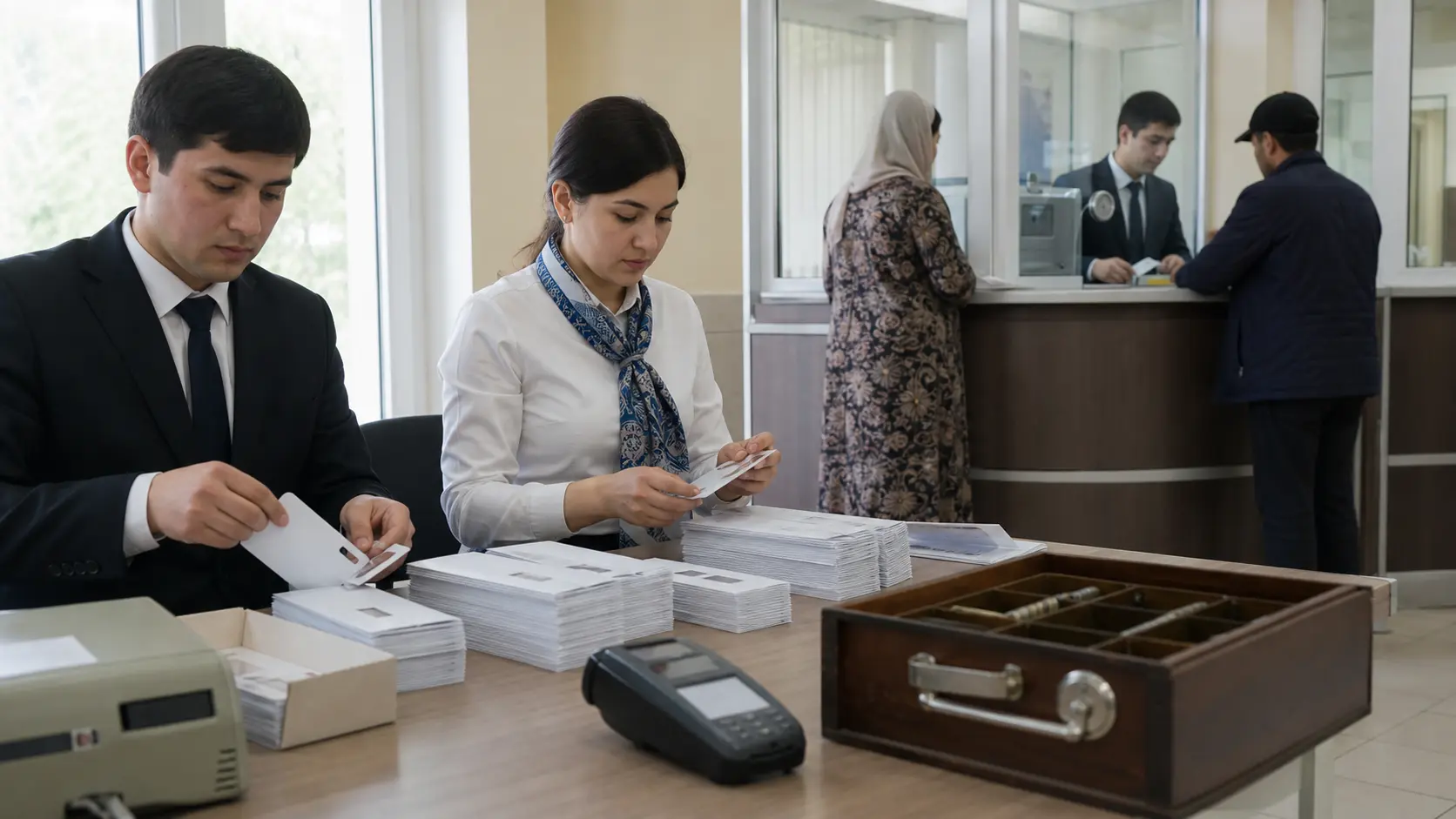
Summary
- Bank Eskhata's salary-account proposition is a liquidity conversion mechanism. The employer sends wages; the bank turns that deposit into cash access, domestic and Visa card spend, QR payments, mobile transfers, account history, overdraft capacity and a relationship that can later absorb savings, credit, currency conversion and small-business services. The bank's salary-project page says the unit includes a free card, Eskhata Online, a card overdraft of up to 40 percent of salary, and 3 percent annual remuneration on Visa card balances.
- The public evidence supports a large and growing balance-sheet role. Bank Eskhata's 31 December 2025 financial statement shows 9.36 billion somoni of assets, 5.21 billion somoni of customer accounts split between 3.00 billion somoni demand and 2.21 billion somoni term balances, and 475.4 million somoni of net profit. Its 31 May 2026 prudential filing reports capital adequacy K1.1 at 20.27 percent against a 12 percent requirement and current liquidity K2.1 at 67.88 percent against a 50 percent requirement.
- The unresolved question is not whether the bank can describe itself as trusted. It is whether a salary customer can reliably use money at the moment it is needed. The strongest proof is around licensing, scale, financial statements, product tariffs, card infrastructure, deposit insurance and development-finance relationships. The missing proof groups into economics, reliability and retention: account-level profitability, absolute app uptime, failed payment rates, complaint resolution times, salary-card churn and the share of payroll customers who keep Bank Eskhata as their main account after substitutes such as Alif, Amonatbank, Dushanbe City Bank, Humo, Visa, Korti Milli and electronic wallets remain available.
Salary money is not liquid until it can move
The economic unit is a salary and current account, not a bank brand. A payroll file is only the start of the transaction. The money becomes usable local liquidity when an employee can see the balance, withdraw cash, pay a merchant, send money to family, repay a loan, receive a transfer, keep a small emergency balance, and survive a weekend or holiday without visiting an office. For Bank Eskhata, the account therefore has to connect three worlds that do not always move together in Tajikistan: the employer's payroll process, the customer's daily payment habits, and the bank's regulated funding base.
Bank Eskhata's own salary-project page is explicit about the conversion design. It markets the product to companies and says the package includes a free card and the Eskhata Online mobile bank, a possible payment-card overdraft of up to 40 percent of salary with a grace period, and 3 percent per year on the Visa card balance. The same page emphasizes 24/7 support for companies, lower tariffs in Eskhata Business, and the bank's status as a systemically and socially significant bank in Tajikistan. The page is public at https://eskhata.com/corporate/salary-project/.
Those terms reveal the real bargain. The employer gets a standardized wage-distribution process. The worker gets faster access to pay, a card, mobile banking and, in some cases, a small credit line against the expected wage stream. The bank gets demand deposits, card activity, digital usage, merchant settlement volume, cross-sell opportunities and a reason to keep the customer inside its own rails. The salary account is not a passive liability. It is an operating relationship that either turns wages into local liquidity or pushes the customer toward cash, another bank, a wallet or an informal substitute.
That distinction matters because Tajikistan's banking system still carries a high-cash legacy. The National Bank of Tajikistan's 2024 banking-system review says non-cash transactions through bank cards and electronic wallets reached 92.4 million transactions worth 30.4 billion somoni in 2024, up 61.7 percent by number and 95.3 percent by value from 2023. Yet the same review says the ratio of non-cash operations to cash withdrawals was still 26.2 percent to 73.8 percent. The system is moving, but cash remains heavy. The relevant NBT review is at https://nbt.tj/ru/news/568091/.
For a salary account, that means liquidity has two faces. The bank must make digital money useful enough that the customer does not cash out immediately, while keeping enough branch and ATM access that the customer does not fear being trapped in digital form. Bank Eskhata's account economics therefore sit between a modernization target and a cash-safety requirement. A bank that pushes too hard toward digital can lose salary customers who need notes in local markets. A bank that relies too heavily on cash can lose fee income, data, retention and scale benefits from app-based payment behavior.
The balance sheet shows why payroll deposits matter
Bank Eskhata's latest public financial statement makes the salary-account unit economically visible. At 31 December 2025, the bank reported total assets of 9.36 billion somoni. Customer accounts were 5.21 billion somoni, with demand deposits at 3.00 billion somoni and term deposits at 2.21 billion somoni. Loans to customers, net of loan-loss allowances, were 4.86 billion somoni. Net profit for 2025 was 475.4 million somoni. The statement is published on the bank's document page and directly at https://eskhata.com/upload/iblock/3df/66c63h9hjvnukbs81oua8dqbbga0fx4o/%D0%A4%D0%B8%D0%BD%D0%B0%D0%BD%D1%81%D0%BE%D0%B2%D0%B0%D1%8F%20%D0%BE%D1%82%D1%87%D0%B5%D1%82%D0%BD%D0%BE%D1%81%D1%82%D1%8C%20%D0%BD%D0%B0%2031.12.2025.pdf.
The demand-deposit figure is central. Salary money that remains on a card or current account is often cheaper and more operationally valuable than term funding. It can fund parts of the bank's loan book, support liquidity ratios, create transaction data and make the customer reachable for deposits, currency exchange, credit or insurance-style offers. But demand balances are also less stable than term deposits. Workers can withdraw wages on payday. Employers can move payroll mandates. A mobile outage can teach customers to empty the account faster next month.
A competitor's cashback or easier wallet transfer can move the operating balance away without a formal bank run.
The 31 March 2026 interim statement shows the same tension in a different quarter. It reported 8.49 billion somoni of assets, 2.42 billion somoni of demand customer accounts, 2.41 billion somoni of term customer accounts and 88.4 million somoni of first-quarter net profit. The line items are not salary-specific, but they show that demand deposits were still a major part of funding at the start of 2026. The interim filing is at https://eskhata.com/upload/iblock/a8d/qo1ltyrfub20qjtl1j9m0ffoqqg7uibs/%D0%A4%D0%B8%D0%BD%D0%B0%D0%BD%D1%81%D0%BE%D0%B2%D0%B0%D1%8F%20%D0%BE%D1%82%D1%87%D0%B5%D1%82%D0%BD%D0%BE%D1%81%D1%82%D1%8C%20%D0%BD%D0%B0%2031.03.2026.pdf.
Profitability also matters for liquidity access. A bank cannot run a mass salary platform on goodwill alone. It must pay for ATMs, cash logistics, card processing, mobile support, cybersecurity, branch staffing, compliance, failed-payment handling and customer service. Bank Eskhata reported 1.10 billion somoni of operating income and 508.0 million somoni of operating expenses in 2025.
That spread helps explain why salary projects are attractive: even when card issuance and account opening are cheap for the customer, the bank can recover value from balances, interchange-like economics, transfers, merchant acquiring, lending, foreign exchange and retained relationships.
The bank's corporate tariff PDF makes the pricing logic more concrete. For corporate and private-enterprise accounts, opening and maintaining an account are listed with no commission, while SMS information costs 10 somoni per connected account. Incoming national-currency payments are free; outgoing payment orders are more expensive on paper than through Eskhata Business, where the standard electronic payment order up to 17:00 is listed at 1 somoni. Cash withdrawal from business-client accounts in national currency is listed at 0.8 percent, and the tariff notes that cash withdrawals require an application one day before receiving funds. The tariff PDF is at https://eskhata.com/upload/tarif/tarif1.pdf.
Those lines are not a payroll customer bill, but they describe the operating environment around payroll. A company that uses Eskhata Business can move routine payments more cheaply than by paper. A company that needs physical cash faces a cost and notice requirement. The bank is therefore nudging business flows toward electronic channels while preserving cash service. Salary money becomes cheaper liquidity for the bank when it remains electronic; it becomes costlier liquidity when it immediately becomes notes.
The salary card is a retention instrument
The card is the part of the account that customers touch most often. Bank Eskhata's salary-card tariff says card-account opening under salary projects is commission-free. It lists a zero security deposit for local, Korti Milli, Visa Classic TJS, Visa Gold TJS, accountable Visa Gold TJS, Visa Classic and Visa Gold card accounts. It also says the bank charges no commission for providing the card and PIN envelope for local, Korti Milli, Visa Classic TJS, Visa Gold TJS and accountable Visa Gold TJS cards, while Visa Classic and Visa Gold are listed at 100 and 200 somoni respectively in that tariff section.
The same tariff lists no commission for cash withdrawals in somoni from Bank Eskhata's internal network for local, Korti Milli, Visa and Visa TJS cards, and no commission for cashless payment in trade and service points.
The pricing is revealing. For a salary worker, the cost of getting the account open is not the primary friction. The harder question is whether the card lets the worker keep money in the account without losing access. Free internal cash withdrawal protects the worker who still needs notes. No commission for purchases protects the worker who is willing to spend electronically. The bank's salary-transfer fee to card accounts, however, is not zero to the employer: the corporate tariff lists 0.5 percent of the total amount for local, Korti Milli and Visa TJS cards and 0.6 percent for Visa payment cards.
That is the enterprise-side cost of converting payroll into card balances.
The domestic rail matters because the paid unit is local liquidity. Bank Eskhata's Korti Milli page says the card is in somoni, costs nothing, is valid up to five years and allows free withdrawal up to 10,000 somoni. It says cash can be withdrawn from any ATM in Tajikistan, cash is available 24/7, and the bank has a large network of ATMs and offices across the country. It also says identified Eskhata Online users can open the card in the app. The product page is at https://www.eskhata.com/card/korti-milli/.
This is not the same as a global card value proposition. Korti Milli is a domestic payment system, which makes it important for salary localization. A worker paid in somoni may care less about international acceptance than about local ATM access, merchant acceptance, fees and continuity when international rails become expensive or constrained. Visa matters for travel, online commerce, Google Pay and foreign-currency uses. Korti Milli matters for ordinary domestic spend and card-based salary distribution. The salary account works best when both sets of rails are treated as complements rather than substitutes.
Google Wallet's country support page for Tajikistan lists Bank Eskhata Visa debit and credit cards and also lists OJSC Bank Eskhata Visa cards as supported payment methods. That is narrow evidence: it does not prove every customer can provision every card successfully, and it says nothing about failed tokenization attempts. But it shows that Eskhata's Visa card proposition reaches into a global wallet layer, not only a local plastic-card layer. The support page is at https://support.google.com/wallet/answer/12059326?co=GENIE.CountryCode%3DTJ&hl=en.
Bank Eskhata's own January 2025 Google Pay announcement makes the same point from the bank side. It says Visa cardholders from the bank can make contactless payments with a smartphone and frames the service as a secure and convenient way to pay without carrying a card. The announcement is at https://www.eskhata.com/events/news/bank-eskhata-zapuskaet-dlya-svoikh-klientov-google-pay-/. For salary customers, the value is not novelty. It is the chance to leave the payroll balance in the account and spend it where a phone or card is accepted.
Branch liquidity remains part of the digital product
Bank Eskhata's website describes the institution as a systemically important bank in Tajikistan and says it is among the country's top three in the banking sector. The same page says it has more than one million permanent customers, more than 2,000 employees, 137 branches and banking-service centers, and 400 ATMs in significant population centers. The bank's "About" page is at https://eskhata.com/about/.
Those numbers should not be treated as independent service-quality proof. They are company-authored and can change. But they are directly relevant to salary-account economics. A payroll bank with only an app would be exposed to cash-out fear. A payroll bank with only branches would struggle to capture digital payment growth. Bank Eskhata's proposition depends on the combination: app, card, branch, ATM, call center and business-banking workflow.
The National Bank of Tajikistan's bank registry gives the institutional anchor. It lists OJSC "Eskhata bank" as a bank in Khujand, at Gagarin Street 135, with board chairman Saifidinov Akmaljon Tolibjonovich, chief accountant Osimov Jamshed Jafarovich, telephone numbers and the website www.eskhata.com. The registry is at https://nbt.tj/en/banking_system/banks.php. Bank Eskhata's own requisites page gives the full Russian name, the start date of activity as 16 November 1993, the Khujand address, tax number, bank identification code and SWIFT EJSATJ22. That page is at https://eskhata.com/about/info/requisites/.
The address and registry details matter because payroll money is a regulated claim, not only an app balance. If the app fails, the customer needs a bank that exists in the supervisory register, has offices, has a complaint route and has legally identifiable management. If a salary file posts late, a card is blocked, a transfer is disputed or a cash withdrawal cannot be completed, the failure cost is not abstract. It is rent, food, transport, school fees or family support delayed.
Cash therefore stays inside the digital strategy. Bank Eskhata's corporate tariff charges 0.8 percent for certain business cash withdrawals and requires advance application for cash from client accounts. For individuals, its Korti Milli page advertises free withdrawal up to 10,000 somoni and round-the-clock access. The two facts can coexist. Corporate cash management is costly and planned; salary customer cash access is a product promise. The bank must manage both without letting one undermine the other.
Mobile uptime is the front door, but not the whole house
Eskhata Online is the daily interface where the salary account either becomes convenient or becomes fragile. The bank's mobile-app page says users can register with a phone number, make fast transfers by details, card number or phone number to Bank Eskhata or other-bank customers, receive bank news and personal notifications, follow exchange rates, open foreign-currency accounts, apply for cards, loans, deposits and savings accounts, manage cards and security settings, pay and repay with QR code, find offices, ATMs and terminals, and ask for round-the-clock chat support. The page is at https://eskhata.com/mobileapp/.
The app-store record shows scale and also reminds readers that app evidence is not an audit. Google Play listed Eskhata Online at 4.7 stars, about 38,400 reviews, more than one million downloads and a 30 June 2026 update when retrieved for this article. The listing says the app supports balance and history for e-wallets, savings accounts and bank cards, service payments, money transfers inside and outside the country, currency conversion, card orders, loan applications, QR payment, push notifications, chat support, exchange-rate viewing and quick widgets. The Google Play page is https://play.google.com/store/apps/details?hl=ru&id=com.eskhata.online.
Apple's U.S. App Store listing shows a much smaller visible rating base, with 3.8 from 41 ratings at retrieval, and its visible comments include requests for English-language support alongside positive comments. The app description also says the team continuously improves functions, fixes minor defects and improves design. The App Store page is https://apps.apple.com/us/app/%D1%8D%D1%81%D1%85%D0%B0%D1%82%D0%B0-%D0%BE%D0%BD%D0%BB%D0%B0%D0%B9%D0%BD/id1438481790.
These public app records should be used carefully. Ratings are self-selected. The Google and Apple markets have different review bases. Update notes are not incident reports. A high Google Play rating does not prove salary-payment continuity; a low-count Apple rating does not prove poor reliability. What the records prove is narrower but still important: Eskhata Online is a mass-market channel, it is actively updated, it carries account and card functions, and language/support friction can affect customer retention.
For salary customers, mobile uptime is liquidity access. If the app is unavailable, the customer may still have an ATM or branch. But the failure cost rises. They may not see whether wages arrived. They may not be able to transfer money to a relative, change a card setting, repay a loan, convert currency, find the nearest ATM or use QR payment. An app outage is not merely a software issue; it is a delay in turning salary into usable local money.
The public record does not disclose absolute Eskhata Online uptime, failed login rates, failed QR payment rates, transfer reversal rates, support response time, fraud false positives or card-token provisioning failures. That absence is not proof of weakness, but it is a boundary around the evidence. The bank's public product pages show capability. They do not show reliability distribution under peak payday loads, holiday periods, telecom interruptions or cyber incidents.
Prudential discipline is a liquidity claim, not a slogan
Bank Eskhata's prudential filing for 31 May 2026 gives a more concrete view of resilience than promotional language. It reports K1.1 capital adequacy at 20.27 percent against a 12 percent requirement, K1.2 at 16.94 percent against a 10 percent requirement, K1.3 core-capital adequacy at 17.72 percent against a 10 percent requirement, and K2.1 current liquidity at 67.88 percent against a 50 percent requirement. It also reports related-party borrower risk K4.1 at 1.97 percent against a 2 percent ceiling, leaving very little headroom on that specific measure. The filing is at https://eskhata.com/upload/iblock/4b5/18aszk972oesmizl4lo017szrnucj5kh/%D0%9F%D1%80%D1%83%D0%B4%D0%B5%D0%BD%D1%86%D0%B8%D0%B0%D0%BB%D1%8C%D0%BD%D1%8B%D0%B5%20%D0%BD%D0%BE%D1%80%D0%BC%D0%B0%D1%82%D0%B8%D0%B2%D1%8B%20%D0%BD%D0%B0%2031.05.2026.pdf.
That is useful but should not be overstated. Capital adequacy protects against loss absorption. Current liquidity protects against short-term cash and funding pressure. Open currency-position limits reduce balance-sheet exposure. None of those ratios tells a worker that a salary card will authorize at a merchant, that a cash machine will have notes, or that a complaint will be resolved quickly. Prudential discipline lowers one set of risks while leaving operational risk to be proven elsewhere.
The National Bank of Tajikistan's broader 2024 review gives the system backdrop. It says financial institutions' assets reached 47.5 billion somoni at year-end 2024, liabilities reached 38.5 billion somoni, deposits reached 25.5 billion somoni, and capital adequacy for the banking system was 21.8 percent against a 12 percent norm. These sector figures are not Bank Eskhata metrics. They show that Eskhata's salary-account growth occurs inside a system where deposits are expanding, cards and wallets are increasing, and regulators are actively publishing prudential standards.
Deposit protection is another boundary condition. The Deposit and Savings Insurance Fund of Tajikistan says the coverage limit for insured deposits and savings per depositor at a single credit institution is 35,000 somoni. It says multiple accounts at the same institution are treated as one account for compensation purposes, foreign-currency balances are reimbursed in national currency at the National Bank's official exchange rate on the insured-event date, and interest is not reimbursed unless capitalized in the account balance. The coverage-limit page is https://dif.tj/en/main/for-depositors/deposit-coverage-limit/.
For salary accounts, the guarantee is meaningful but limited. Many ordinary wage balances may fall within the 35,000 somoni limit, especially if wages are spent soon after receipt. Higher earners, business owners and families that store larger balances face uncovered exposure above the limit. Deposit insurance also does not make funds accessible during app downtime, prevent card disputes or reduce the cost of switching employers' payroll arrangements. It is a failure-loss backstop, not an everyday service-level promise.
Payment rails define the account's substitution risk
Salary liquidity does not depend on Bank Eskhata alone. It depends on national payment infrastructure, domestic and international card schemes, merchant acceptance, wallets, telecom availability and rival banks. The National Bank of Tajikistan says that during January to March 2026, operations were carried out for participants of the automated interbank money-transfer system, the National Processing Center Remittance, the national payment system Korti Milli and Visa domestic transactions under the TJNNSS project. The NBT payment-infrastructure page is https://nbt.tj/en/payment_system/rushdi-infrasokhtori-nizomi-pardokhtii-bmt.php.
The same NBT page says the automated interbank money-transfer system processed 379.9 billion somoni of payments during January to March 2026, 141.5 billion more than the same period in the previous year, and 1.3 million transactions, 0.06 million more than the same period in 2025. These are system-level figures. They are important because salary accounts do not sit in isolation. Employer settlement, interbank transfers and merchant acquiring all rely on common infrastructure and settlement rules.
The NBT payment-card market page shows why the account cannot depend only on a bank's own branch desk. It says credit financial institutions had installed 3,665 ATMs and 5,413 electronic terminals at cash supply points, and that 9,141 POS terminals and 31,090 QR codes were installed at trade and service enterprises. It also says cashless payments for goods and services using electronic payment instruments reached 42.4 percent overall for the stated period, and that cashless transactions increased by 158.4 percent by number and 74.3 percent by value. The page is https://nbt.tj/en/payment_system/rushdi-bozori-kort-oi-pardokhtii-bonk.php.
That infrastructure growth is a double-edged signal for Bank Eskhata. More acceptance points make salary cards more useful, which can help keep wages in accounts. But the same acceptance points also make substitute banks and wallets more credible. If Alif, Amonatbank, Dushanbe City Bank, Humo or another institution gives a better app experience, a worker may move the active balance even if the employer uses Eskhata for payroll. If a wallet offers a smoother bill-payment path, a salary customer may cash in or transfer out on payday.
Electronic wallets intensify that substitution risk. The NBT electronic-money page says that as of 31 December 2025, 27 credit financial institutions had 17.7 million electronic wallets, up 5.6 million or 46.4 percent from 2024. It says wallet transactions during January to December 2025 reached 22.303 million non-cash transactions worth 3.728 billion somoni, up 20.5 percent by number and 25.6 percent by value. That page is https://nbt.tj/en/payment_system/mablaghoi-elektroni.php.
The salary account therefore has to compete after the employer chooses the payroll bank. Bank Eskhata may win the company mandate, but the employee still chooses where money rests after payday. Retention depends on the app, card acceptance, ATM convenience, fees, language support, customer service, fraud handling and the perceived cost of failure. A salary project is not complete when wages arrive; it is complete when the customer has no reason to drain the account immediately.
International funding signals discipline, not deposit certainty
Development-finance relationships provide useful context for Bank Eskhata, but they should not be confused with guarantees for salary depositors. FMO's project disclosure says OJSC Bank Eskhata was founded in 1993, is headquartered in Khujand, offers lending, deposit taking, foreign-exchange and money-transfer services, specializes in micro, small and medium enterprises, and was described by FMO as Tajikistan's market leader in money remittance operations for that project. FMO and DEG extended a five-year USD 18 million senior loan facility, with FMO providing USD 8 million, intended for on-lending to SMEs. The disclosure is at https://www.fmo.nl/project-detail/31709.
The EBRD's December 2023 announcement says it shared risk on two loans collectively worth up to USD 5 million through Bank Eskhata to support Tajik retailers and described Eskhata as Tajikistan's largest private lender. It says risk sharing improves local banks' capacity to lend to SMEs and can improve risk management. The announcement is at https://www.ebrd.com/home/news-and-events/news/2023/ebrd-and-bank-eskhata-support-tajik-retailers.html.
IFC's February 2024 release says it invested up to USD 10 million in Tajikistan's first green bond issued by Eskhata Bank, with proceeds for climate-smart projects by micro, small and medium businesses. The IFC release is at https://www.ifc.org/en/pressroom/2024/ifc-invests-in-tajikistans-first-green-bond-to-support-climate-s. Bank Eskhata's own green-bond framework says the bank would allocate proceeds to eligible green projects and report allocation and impact, and it describes the bank's transformation from historical strength in remittances and currency exchange toward a full-featured micro and SME bank. The framework is at https://eskhata.com/upload/iblock/59b/2lftw8243guopp2duydnj30w47b4wos9/Green%20bond%20framework.pdf.
These relationships matter because they impose reporting expectations, environmental and social screening, risk-sharing discipline and external attention. They can help the bank diversify funding, improve governance and build longer-term lending products. They do not prove that a salary customer can access money at 8 p.m., that a card will work in a provincial shop, or that the app will recover quickly after an update. International capital can strengthen a bank's funding story while leaving local liquidity access to be tested in daily operations.
Ownership should be read with similar caution. Bank Eskhata's about page says its main shareholders include resident individuals and the European Bank for Reconstruction and Development, with EBRD at 4.61 percent and several Nosirov family shareholders near 10 percent each. The NBT shareholder list for qualifying holdings as of 31 December 2025 lists Bank Eskhata's authorized capital at 125.3 million somoni and qualifying holders Nosirov D.M., Nosirov A.D., Nosirov Kh.D. and Nosirov P.Kh. at 10 percent each. The NBT list is at https://www.nbt.tj/en/banking_system/spisok_aktsionerov_bankov.php.
For salary customers, the ownership lesson is limited but useful. The bank is not an anonymous wallet. It is a supervised bank with visible shareholders, a long operating history and international development-finance relationships. But no shareholder list should be converted into a blanket claim that the account is safe in every operational sense. The relevant tests remain liquidity access, settlement reliability, failure cost, compliance burden and retention.
Compliance is part of the cost of keeping payroll useful
Salary accounts are simple for customers only when compliance is handled well in the background. The bank must identify customers, screen suspicious activity, monitor card and wallet flows, respond to dispute rules, maintain data records, manage foreign-exchange controls and comply with domestic and international payment requirements. Those costs are not visible when a worker taps a card, but they shape fees, limits and support friction.
Bank Eskhata's mobile pages emphasize remote identification. The Google Play description says remote identification opens more possibilities and limits after four steps. The mobile-app page says users can manage card and security settings and use support chat. The online-loan page says a customer must be an identified Eskhata Online user, with passport and tax identification number needed for identification, before receiving certain online credit. That page is https://eskhata.com/loans/online/.
Identification creates an economic tradeoff. The more functionality the bank moves into the app, the more it must know about the user. Better identification can reduce fraud, raise limits and support lending. But it can also increase onboarding friction, create privacy concerns, exclude customers with documentation problems and generate support costs when records mismatch. A salary-account bank has to make that compliance load feel ordinary, not punitive.
Cross-border payment pressure adds another layer. Bank Eskhata's requisites page lists correspondent details for ruble, euro, dollar and yuan transactions, including banks in Russia, Germany, the United States, Uzbekistan, Kazakhstan, Georgia and China. These details are not salary-product features for most domestic workers, but they show the bank's exposure to correspondent relationships, foreign-currency settlement, sanctions screening and changing cross-border payment routes. A bank active in remittances and foreign-exchange operations cannot treat payroll as isolated from compliance pressure.
That is why "trust" is too blunt a word. A customer does not simply trust or distrust a bank. The customer asks whether wages can be accessed, whether settlement will fail, whether a failed transfer will cost time or money, whether compliance review will block legitimate use, whether the branch can solve a problem, whether the app works in the right language, and whether alternatives are easier. Trust decomposes into those costs.
What is proven, and what is still missing
The proven case is strong enough to take Bank Eskhata seriously as a salary-account liquidity platform. It is listed by the National Bank of Tajikistan as a bank. Its own pages show a long operating history, a Khujand headquarters, more than one million customers, broad branch and ATM numbers, a mobile app, salary-project terms, domestic and Visa card products, Google Pay support, published financial statements and prudential ratios. The bank's 2025 balance sheet shows a large customer-account base and profitable operations. NBT payment data show the country is expanding card, QR and wallet infrastructure.
Deposit insurance provides a statutory backstop up to 35,000 somoni per depositor per institution.
The missing proof should be grouped into economics, reliability and retention.
The economic gap is account-level profitability. Public statements do not disclose salary-project revenue, average payroll balance, active card spend, overdraft utilization, employer fee realization, interchange-equivalent income, cash-service cost, fraud losses, support cost, acquisition cost or profitability by customer cohort. Without those figures, readers can see why salary deposits are valuable but cannot know whether the paid unit is a high-margin relationship or a costly distribution channel supported by lending and foreign exchange.
The reliability gap is operational. Public sources do not disclose app uptime, failed-login rates, failed-transfer rates, failed QR payment rates, card authorization declines, ATM cash-out rates, cash replenishment timing, contact-center answer time, branch queue time, dispute-resolution time or recovery time after technical incidents. A worker cares about these facts because reliability determines whether salary money can be used at the moment of need.
The retention gap is behavioral. Public sources do not disclose the share of salary customers who keep Bank Eskhata as their main account, the share that withdraws most wages on payday, the share that transfers money to another bank or wallet, the share using Eskhata Online monthly, the churn rate after employer payroll mandates change, or the effect of language and support friction on active use. A salary project can look successful by employer count while failing to retain worker balances.
These gaps do not negate the thesis. They define its limits. Bank Eskhata appears to have the balance-sheet scale, product architecture, branch liquidity, card rails, app distribution, prudential headroom and development-finance context needed to turn salary deposits into local liquidity. The claim becomes stronger when the worker's money remains spendable across branch, ATM, card, QR and mobile channels. It becomes weaker when the worker treats Eskhata as a payday pass-through and moves value to cash, a rival bank or a wallet.
Competitors price the same promise differently
Bank Eskhata's salary account should be judged against specific substitutes, not against an abstract idea of banking. Amonatbank is the most obvious continuity benchmark because it is state-linked and has a public-service identity. Its English salary-project page says it offers salary projects for enterprises and organizations of any ownership form, with salary service using international bank cards. That page is at https://www.amonatbonk.tj/en/business/services/salary-projects/. For an employer that values state connection, provincial reach and perceived public-sector continuity, Amonatbank can feel safer even if another bank has a more modern interface. Bank Eskhata has to offset that with service speed, card usability, app functions, employer support and evidence that its private-bank incentives improve rather than weaken reliability.
Alif Bank prices the same problem through a more app-led and fintech-style promise. Its salary-project page says companies can pay salaries, advances and other staff payments online through Alif Business, upload payroll sheets and payment orders, download statements online, reduce paperwork and let employees withdraw money from Alif ATMs without commission. That product page is at https://alif.tj/en/business/salary-project. Alif's main page also emphasizes transfers, deposits, cards, installments, auto finance, Visa cards and Google Pay at https://alif.tj/en/. For younger urban workers, the substitute is not only another salary bank; it is a daily financial app that may become the preferred place for spending and borrowing after the salary arrives. Eskhata's response has to be more than branch count. It needs app reliability, card-token support, transfer simplicity and enough rewards or pricing clarity to stop the active balance from moving out.
Spitamen Bank is a card-rail substitute. Its salary-card page says employees can withdraw cash without paying commission from Spitamen ATMs and POS terminals, make payments in Tajikistan and in more than 160 foreign countries without commission, and use a card combining UnionPay and the national Korti Milli payment service. The page is at https://www.spitamenbank.tj/en/products/business/plastic-cards/. That offer matters because a salary worker does not care whether a rail is elegant. The worker cares whether the card works at the merchant, whether cash is nearby, whether travel or foreign online payments are possible and whether the fee is predictable. Bank Eskhata's Visa, Korti Milli and Google Pay evidence helps, but a worker comparing banks will ask which card works in the actual shops, ATMs and family payment routes they use.
Dushanbe City Bank, Humo and other wallet or payment-service brands are substitutes even when they are not the employer's salary bank. A household can receive wages at Bank Eskhata and still move the useful balance into another app, card, wallet or cash position. The NBT electronic-money figures make that risk visible: wallet counts and wallet transaction values are large enough that the salary account is no longer the sole digital doorway. If Eskhata cannot make bill payment, transfer, QR use and card control easy, the account will become a wage inbox rather than a main account.
The most durable substitute is still cash. Cash has no app password, no card authorization, no mobile-data dependency, no maintenance window and no transfer review. Its weaknesses are theft risk, handling time, lack of remote payment, no savings return and limited proof of transaction. Bank Eskhata's salary product wins only if it makes the bank balance feel almost as immediate as cash while adding functions cash cannot provide: overdraft, card payment, deposit interest, remote transfers, foreign-exchange access, Google Pay, formal statements and safer employer payroll.
If any of those functions breaks often enough, households will keep using the bank only for the moment wages arrive.
That competitive landscape also explains why the bank advertises both convenience and institutional status. A state-linked bank competes on continuity. A fintech-style bank competes on interface and speed. A card-focused bank competes on rail acceptance. Cash competes on certainty. Bank Eskhata's differentiated promise is the combination: a long-standing Khujand-rooted private bank with systemic recognition, branch and ATM reach, salary-card pricing, domestic and Visa rails, mobile app, deposit products, external funding relationships and visible prudential ratios.
The combination is plausible, but it must be defended continuously because each rival can attack one part of the bundle.
Pricing shows the funding discipline behind the account
A salary account looks cheap at the front end because the bank wants the operating balance. Bank Eskhata's salary-card terms show free card-account opening and no security deposit for several salary-card categories. Its individual and corporate tariff pages show many routine digital actions priced below physical or paper-based actions. That is not charity. It is a calculated exchange: the bank lowers visible account friction so that payroll inflows, card transactions, app activity, merchant acquiring, foreign exchange, deposits and credit products can produce revenue elsewhere.
The deposit side shows the cost of retaining funds. Bank Eskhata's term deposit page lists 12 percent annual interest in somoni for 180 to 365 days and 15 percent for 366 to 731 days, while its Ozod savings account advertises 6 percent annual interest with flexible withdrawal and replenishment. Those pages are https://eskhata.com/depo/profit/ and https://eskhata.com/depo/ozod/. These rates make sense in a market where somoni funding is valuable and where households have strong reasons to cash out or hold money elsewhere. But they also create a discipline test. A bank that pays high rates must either lend profitably, earn enough fee and foreign-exchange income, or accept thinner margins.
Bank Eskhata's 2025 profit statement suggests it was earning enough to support that model during the period reviewed. Interest income was 1.135 billion somoni, interest expense was 441.9 million somoni, loan-loss provisioning was 76.8 million somoni and net profit was 475.4 million somoni. Fee income and foreign-exchange income were also material. The salary account contributes to that mix because a wage relationship can become a deposit relationship, a card relationship, a transfer relationship and a credit relationship.
The risk is that the bank overestimates how much of the salary flow will stay, or underestimates how quickly customers will move if service degrades.
Cash logistics are another hidden cost. A salary bank has to fund cash desks, ATMs, replenishment, security, reconciliation and exception handling. The card and branch network can be an advantage only if the bank can afford it. A card campaign that removes customer withdrawal fees may improve retention, but the bank still carries cash-handling costs and must recover them elsewhere. Merchant acquiring, external transfers, business-account fees, loan spreads and foreign-exchange spreads are all possible recovery points. This is why a household should compare total use cost rather than a single headline fee.
Overdraft pricing deserves separate attention because the salary account can turn wage visibility into credit. Eskhata's salary page advertises overdraft access up to 40 percent of salary, but the public salary page does not settle the full credit-cost question for every customer. For a worker, an overdraft can be useful emergency liquidity if it is short, transparent and affordable. It can also become expensive if repeated each month. For the bank, overdraft is a high-information credit product because salary inflow is predictable.
The quality of that product depends on limits, grace period, disclosure, collections behavior and whether workers treat it as a bridge or as hidden wage reduction.
Foreign-exchange and transfer pricing matters for remittance families. The bank's official exchange-rate displays and NBT rate tables show that currency conversion is part of everyday banking. The World Bank's remittance data make clear why: household demand in Tajikistan is heavily shaped by money from workers abroad. A salary account that also receives remittances can become the household's main liquidity account. But if spreads widen, transfer routes slow or documentation burdens increase, customers may split behavior: salary at one bank, remittance at another route, cash stored outside both.
The cleanest test of pricing discipline would be account-level data: average salary balance, monthly card spend, monthly cash withdrawal, transfer frequency, deposit conversion, overdraft arrears, fee revenue and support cost by payroll cohort. Those numbers are not public. In their absence, the article reads the public tariff and statement evidence as directional. Bank Eskhata has built the correct economic machine for salary liquidity. The machine still depends on a behavioral question: do workers leave enough money and activity inside the bank to fund the service quality that keeps them there?
The practical test
The practical test for Bank Eskhata is not whether it can call itself systemically important. It is whether an employee paid into an Eskhata salary account can keep money there without raising personal risk.
That test has a clear chain. The employer must be able to send payroll cheaply and on time. The employee must see the salary promptly. The card must work for cash and merchant payment. The app must show balances, transfers and settings reliably. The branch and ATM network must be available when cash is still necessary. The bank must manage liquidity, capital and currency exposure under regulator scrutiny. Compliance checks must stop abuse without trapping ordinary wages. If any link breaks, the account becomes a conduit rather than a store of local liquidity.
Bank Eskhata's public evidence suggests a bank moving in the right direction: profitable, regulated, digitally active, card-oriented, salary-project aware and connected to development-finance funding. The harder judgement is about durability. Salary deposits are sticky only when the employee experiences the account as cheaper, safer and easier than the alternatives. In Tajikistan, where cash remains large but electronic payments are growing quickly, that is an operating discipline rather than a marketing line.
For now, the article's conclusion is deliberately bounded. Bank Eskhata can plausibly turn salary deposits into local liquidity because it combines demand deposits, payroll cards, domestic card rails, Visa functionality, Google Pay, Eskhata Online, branch cash, ATMs, prudential buffers and external funding relationships. What remains unproven is the worker-level persistence of that liquidity: how often salary money stays, how often it fails to move, how costly failures are, and how quickly customers shift to substitute banks or payment apps when the account disappoints them.