
Summary
- Awasr's public retail case is strongest where a customer can actually get a fibre installation, values high download speed, accepts asymmetric upload on home plans and wants a fixed line rather than a mobile-home router. Its residential page lists unlimited-data plans from OMR 27 per month before VAT for 300 Mbps down / 40 Mbps up to OMR 500 before VAT for a 10 Gbps headline plan.
- The monthly wager is not only price. Awasr's own terms make installation, equipment, downgrade limits, early termination and complaint handling central to the economics. A buyer who cannot get fast installation or timely repair can be locked into a line that looks cheap per megabit but expensive in time and switching friction.
- Business pricing shows the real cost curve. SME fibre starts near residential levels for small packages, but enterprise broadband, Ethernet and leased-line products climb sharply when buyers need static IPs, target availability, managed equipment, symmetric speeds or site-to-site service.
- The public record supports a cautious version of the thesis. Awasr has visible tariffs, local support channels, a fibre and enterprise product set, references to Oman Broadband coverage dependency, and PeeringDB and Oman-IX evidence of peering ambition. It does not publicly prove subscriber count, churn, repair times, wholesale costs, traffic quality or the actual customer experience behind every advertised line.
The Monthly Commitment Starts At The Door
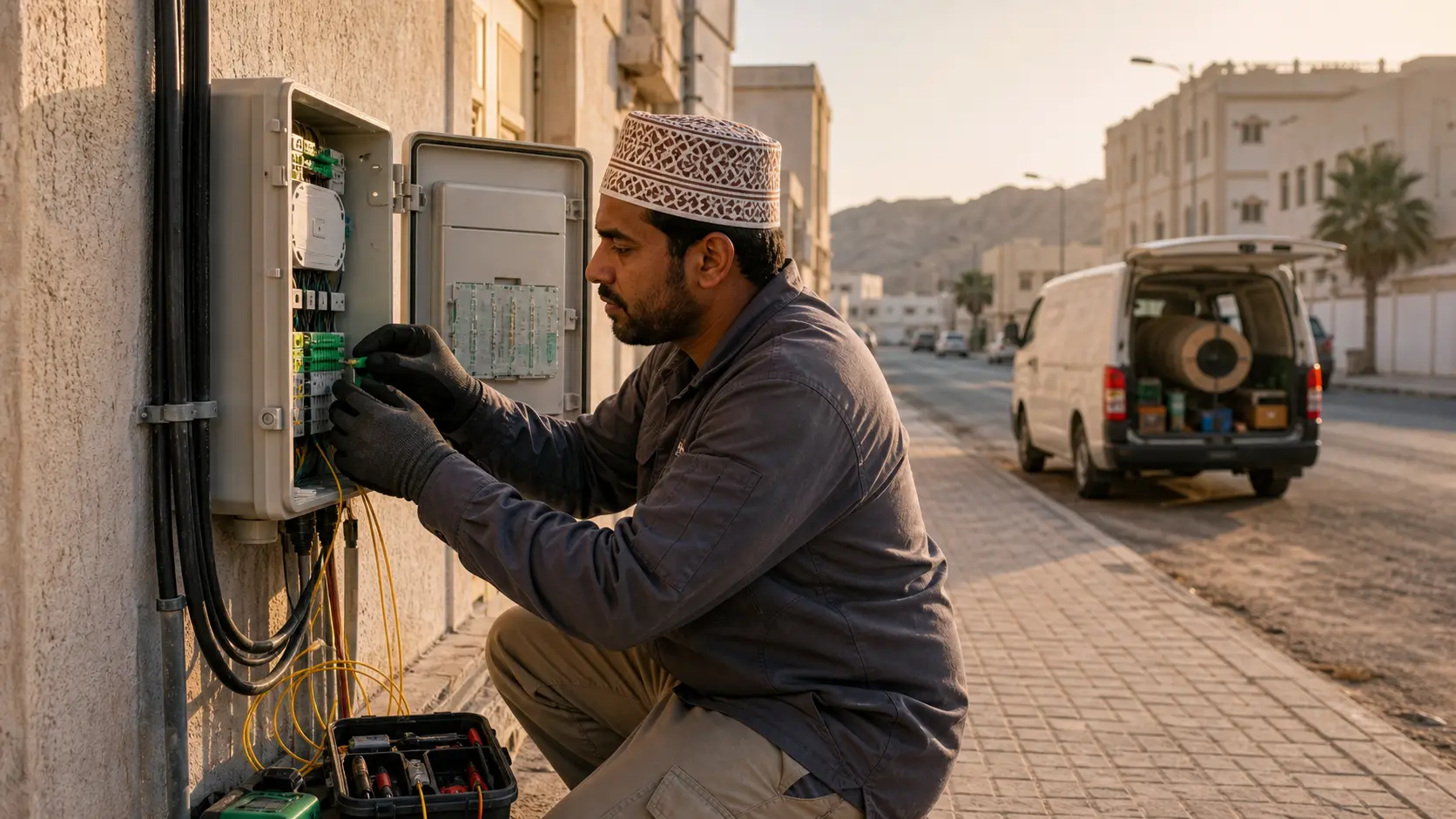
The practical buyer of an Awasr fibre line is not thinking first about network diagrams. A household in Muscat or Seeb is deciding whether the monthly bill will make video calls, streaming, schoolwork, gaming and family phone use smoother than a larger operator's fixed line or a 5G home router. A small office is deciding whether staff can run cloud accounting, point-of-sale systems, uploads and customer messaging without spending its day on support calls. The paid unit is simple: a fibre broadband line to a premises, backed by an installation visit, a customer-premises device and a monthly tariff.
That simplicity hides the economics. The customer pays for more than a speed label. They pay for being in a serviceable building, having the drop installed, accepting the contract period, keeping Awasr's equipment in good condition, and using support when the line, router, billing account or application fails. If the line works, the tariff can look attractive because Awasr's headline home prices convert into low monthly cost per advertised download megabit. If the line does not work, the same tariff becomes a commitment to waiting time, contract penalties and replacement friction.
Awasr's own retail page makes the value proposition direct. Its home fibre page, accessed on July 6, 2026, presented "Fibernet Home" packages on 12-month and 24-month terms. The visible 24-month promotion page listed OMR 27 before VAT for 300 Mbps download and 40 Mbps upload, OMR 28 for 350/45 Mbps, OMR 30 for 500/65 Mbps, OMR 35 for 800/100 Mbps, OMR 40 for 1.2 Gbps/150 Mbps, OMR 45 for 1.5 Gbps/200 Mbps, OMR 90 for 2 Gbps/250 Mbps and OMR 500 for a 10 Gbps down / 2.5 Gbps up plan. VAT was shown separately, making the OMR 27 plan OMR 28.350 with VAT and the OMR 40 plan OMR 42.000 with VAT.
The page also tied packages to unlimited data, free calls to Awasr fixed lines and bundles such as SafeNet, Ashal Education and entertainment services on higher plans.
This is why the line has to prove itself every month. A household does not experience "OMR 27" as an abstract tariff. It experiences it as the router in the hallway, the Wi-Fi reach through concrete walls, the upload cap during video calls, the service desk when billing fails and the installer's ability to finish the job without several follow-ups. Awasr can win against bigger telecom names only when the whole chain from order to repair behaves like a local broadband specialist rather than a smaller biller sitting on someone else's infrastructure.
Identity And Public Footprint
The public identity is not perfectly neat. The consumer brand is Awasr. The existing directory entry is Awaser Oman LLC. Apple's public App Store lookup for the Awasr app lists the seller as "Awaser Oman LLC", while Awasr's own customer terms define "Company or AWASR" as "AWASR Oman and Partners (SAOC)". RIPE registry search also showed an organisation named "awasr oman and partners saoc" at Knowledge Oasis Muscat. These are not competing operating stories so much as public naming fragments around the same retail brand.
The company presents itself as a specialist broadband provider. Its website offers personal "Fibernet Home", business "Fibernet Business", leased-line, Ethernet, managed Wi-Fi and MPLS-style intralink products. Its "Who We Are" page names a board and management team, including Dr. Hamed Salim Al Rawahi as chairman and Eng. Adnan Mohamed Al Alawi as chief executive officer. Its support and terms pages list practical contact channels: the residential support page includes awasrcare@awasr.com and 80001000; the business pages list 80009999 and corp.sales@awasr.com for corporate sales and faults.
The most important identity point for a buyer is that Awasr is not just a website reseller. It publishes fixed-broadband tariffs, takes customer applications, supplies equipment, offers business fixed broadband with static IP and voice, sells leased lines, and appears in public peering records. At the same time, its own FAQ says that where an area is not covered, customers can ask when service will be released "with our partner Oman Broadband." That sentence matters. It tells the buyer that local fibre availability is partly a wholesale and rollout question, not only an Awasr sales question.
No public source reviewed here gave a reliable shareholder table or audited Awasr revenue figure. That creates a real limit. The article can examine tariffs, product architecture, registry evidence and market signals. It cannot prove whether Awasr is gaining or losing share, whether its capital backing is deep enough for every expansion plan, or whether its service economics are profitable at the current headline prices. The evidence supports a company with visible local broadband operations and a serious public product set. It does not support a precise valuation or subscriber estimate.
What The Buyer Actually Buys
Residential customers buy a fibre internet line, an installed customer device and a monthly package. The public FAQ says all necessary equipment is provided at installation. The retail plan page says a one-time installation charge applies: OMR 15 for 12-month contracts and OMR 10 for 24-month contracts on the promotion page reviewed. The standard charges table in the customer terms also lists an installation charge of OMR 15 for residential or business connections and says customer-premises equipment remains Awasr's property during the customer's tenure.
The home packages are asymmetric. That is normal for many residential fibre offers, but it matters for the monthly value test. A customer buying 500 Mbps download receives a 65 Mbps upload line in the visible Awasr home plan table. A customer buying 800 Mbps receives 100 Mbps upload. A customer buying 1.2 Gbps receives 150 Mbps upload. A user whose pain point is remote backup, content upload, cloud cameras, large design files or multiplayer streaming needs to read those upload figures, not only the larger download headline.
Unlimited data is important, but it is not the same as guaranteed experience. Awasr's terms state that measured speeds to servers outside Awasr's own controlled network can fall for reasons beyond its control. Its FAQ tells users to test speed with an Ethernet cable directly to a laptop and notes that Wi-Fi speed varies with home size and construction. The terms reserve the right to restrict misuse and forbid redistribution outside the contracted residential or commercial unit.
Those clauses are ordinary in telecom contracts, but they place the retail promise in a practical frame: the fibre line can provide high access speed, but in-home Wi-Fi, distant content sources and user equipment still shape the result.
The SME offer shows a different version of the unit. Awasr's Riyada business page listed a 12-month small-business offer at OMR 30 before VAT for 100 Mbps down / 50 Mbps up and OMR 35 before VAT for 200 Mbps down / 100 Mbps up, both with unlimited data, static IP and voice included. The page's FAQ listed an OMR 15 installation fee, no downgrades during the 12-month term and an early termination charge of OMR 85. For a small office, that is a much more meaningful comparison than a pure home package because the static IP, business support promise and upload ratio may matter more than the absolute headline download speed.
Larger business buyers pay very different prices. The three-year "Fibernet Business" page listed packages from OMR 29 before VAT for 5 Mbps down / 2.5 Mbps up to OMR 798 before VAT for 1 Gbps down / 512 Mbps up, with static IP and voice included. That table is a reminder that business broadband is not priced like a mass-market household line. Even when it is still asymmetric and uses fibre-to-the-premises infrastructure, the economics reflect service class, support, account management, IP addressing and lower tolerance for failure.
The Tariff Ladder Says Where Awasr Wants To Fight
Awasr's residential ladder is aggressive at the high-speed mass-market end. The OMR 27 to OMR 45 range covers 300 Mbps through 1.5 Gbps download on the page reviewed. In simple pre-VAT arithmetic, the 300 Mbps plan costs OMR 0.09 per advertised download Mbps per month, the 500 Mbps plan costs OMR 0.06 per advertised download Mbps and the 1.2 Gbps plan costs about OMR 0.033 per advertised download Mbps. That calculation is not a service guarantee. It does show the commercial tactic: use high headline speed to make the fixed line feel like a better value than lower-speed alternatives.
The OMR 90 and OMR 500 tiers perform a different job. A 2 Gbps home package at OMR 90 before VAT and a 10 Gbps package at OMR 500 before VAT are not likely to be the mass-market core. They serve as premium anchors, gaming and enthusiast options, and a way to associate the Awasr brand with top-end fibre rather than with a single low-price plan. Their practical take-up cannot be inferred from the web page. What can be inferred is that Awasr wants to be seen as the provider with a speed ceiling above ordinary home broadband.
The tariff ladder also exposes the cross-subsidy question. If many households buy high-download plans at low monthly rates, Awasr needs enough wholesale access, international capacity, caching, peering, customer support and installation discipline to avoid turning those packages into congestion complaints. The lower price per advertised megabit is attractive only if the operator can keep average use below the capacity cost it incurs. Telecom networks survive by statistical sharing: not every customer uses peak speed at once.
The risk for any fixed-broadband challenger is that the customers most attracted by high-speed plans are often the same customers who notice slowdowns first.
The business ladder shows that Awasr knows how to price higher service expectations. The leased-line page listed Lite service starting from OMR 1,440 per month per site for 5 Mbps to 90 Mbps, Premium from OMR 12,826 per month per site for 100 Mbps to 900 Mbps, and Giga from OMR 39,077 per month per site for 1 Gbps and beyond. Those numbers are startling beside the home page, but the product is different. It promises symmetric access, a managed enterprise router, public IP addressing, 99.9 percent annual target availability and a dedicated line with a 1:1 bandwidth contention ratio.
A bank branch, government office, military site or enterprise campus is buying risk reduction, not just speed.
Ethernet pricing sits between these worlds. Awasr's Ethernet page listed Ethernet over GPON from OMR 472 per month per site with 10 Mbps to 1 Gbps options, shared GPON access and 99.5 percent annual target availability. It also listed Metro Ethernet from OMR 2,378 per month per site with dedicated point-to-point access, 100 Mbps to 10 Gbps options and 99.9 percent target availability. That product line is important because it turns the local fibre footprint into private connectivity between business locations, not merely internet access. It also shows why fibre economics depend on business density.
Residential packages build scale; enterprise services help pay for capabilities that mass-market tariffs cannot easily fund alone.
Installation, Penalties And Support Are Part Of The Price
The retail tariff is only the first price. The customer also pays in installation fees, downgrade restrictions, early termination exposure, equipment obligations and the time needed to resolve disputes. On the home promotion page, Awasr said downgrades are not allowed within the contract period and that customers can downgrade only after the contract ends. It listed early termination fees of OMR 55 for a 12-month contract and OMR 110 for a 24-month contract if the service is terminated after activation, including termination for non-payment, within the minimum period.
Those charges change the buyer's risk. A household comparing Awasr with a mobile home router may see the fixed line as cheaper per megabit, but the mobile alternative may be easier to stop, move or test. A small office comparing Awasr with an incumbent line may care less about the installation fee than about relocation and support response. Awasr's business FAQ says an account manager can advise on moving service to a new location. That is useful, but the cost of relocation failure can be high for a shop or clinic that needs connectivity to collect payments or message customers.
Awasr's standard customer agreement creates a regulated complaint path. It tells customers to first complain through Awasr channels such as 80001000, awasrcare@awasr.com or stores and kiosks, and to obtain written acknowledgment. It says Awasr will issue its final decision according to Telecommunications Regulatory Authority procedures. If the employees do not resolve the complaint or the customer does not receive a response within five working days, the customer has the right to file the complaint with the Authority. This does not prove that complaint handling is fast. It proves that Awasr's own public agreement recognises regulator-visible escalation.
Support channels differ by customer type. Residential support is routed through 80001000, WhatsApp numbers listed in the FAQ and the app. Business support pages refer to 80009999 and account managers. The enterprise Ethernet page says a support desk is available 24/7, that networks are monitored from a national network operations center and that a trained service-delivery team provisions service. The leased-line page says the product includes 24x7 support and priority business support. These are meaningful claims because support labour is not a side cost in fixed broadband.
It is one of the main ways a provider defends churn, reputation and monthly recurring revenue.
The customer signals create a warning. Public app-store evidence is not representative of all customers, and app reviews often over-sample frustrated users. Still, the signals are relevant because Awasr directs customers to the app for payments, service requests and account handling. Apple's public lookup for the Awasr app showed a 2.54545 average rating from 110 ratings in Oman, version 1.18 current as of May 25, 2026. Google Play page data reviewed locally showed a low aggregate around 2.4 and recent reviews describing payment failures, login problems, relocation delays, speed disappointment, support friction and termination disputes.
These complaints do not prove network-wide failure. They do show that the operational part of the monthly commitment is a real reputational risk.
There are also positive signals. Some visible Google Play reviews praised installation speed or service quality before raising app issues. Awasr's published tariff and support pages are unusually detailed for a smaller provider. Its business products are not vague "contact us" brochures only; several pages publish concrete start prices, target availability and support models. The result is mixed but actionable: Awasr has enough public operating surface to be evaluated, and the customer pain points are specific enough to identify what would improve the buyer's confidence.
Local Substitutes Change The Buyer Calculation
Awasr does not sell in a vacuum. Oman has larger telecom brands with mobile and fixed portfolios, and a third mobile operator makes fixed-wireless substitution more credible than it was a decade ago. A customer who wants a dependable home connection can compare Awasr fibre with incumbent fibre, mobile home broadband, 5G routers and business wireless plans. The exact best option depends on address, indoor signal, building wiring, contract flexibility, upload needs and support experience.
Omantel's home-services page, reviewed on July 6, 2026, did not expose a clean price table in the captured text, but it did show substitute terms that matter. It promoted Baiti Fiber up to 1 Gbps, said new customers must sign a 24-month commitment contract for Baiti Home Internet plans, listed OMR 15 installation charges, said 5 percent VAT would be added, and listed OMR 50 for premature termination or cancellation before the commitment period ends. It also listed mobile-style data add-ons for home services: OMR 5 monthly for 100 GB, OMR 10 for 250 GB and OMR 15 for 500 GB.
That gives buyers a benchmark for contract structure and add-on economics even where the captured page did not reveal the full base tariff.
Vodafone Oman's Makani Internet page provides a different substitute: movable 5G home-style internet. The page described Makani as a service that lets a user move the device anywhere in Oman while staying connected with unlimited data and 5G speeds. It listed 12-month plans: Makani 24 with 500 GB open data, Makani 29 with 900 GB open data and Makani 34 with unlimited data. This is a direct challenge to fixed fibre's installation logic. If a household values mobility, quick start and a lower initial commitment to wiring, a 5G router can be more attractive than waiting for a fibre release in a specific building.
If the household values lower latency, predictable indoor performance, higher sustained use and fixed-line stability, fibre can still win.
The substitution pressure is especially sharp for renters, small shops and expatriate households. They may move before a 24-month fibre contract ends. They may not be able to authorise building work. They may be more sensitive to termination penalties than to small monthly price differences. Awasr's answer has to be service quality and speed-per-riyal. The company cannot assume that a high headline fibre speed automatically beats a mobile product if the customer has to wait for coverage, chase a relocation, or fight an app-payment problem.
At the same time, Awasr has advantages that mobile substitutes do not fully replace. A fibre line can anchor heavier household use, business uploads, static IP requirements and enterprise private connectivity. Awasr's business products include static IPs, voice, managed routers, 99.5 to 99.9 percent target availability and site-to-site Ethernet services. Those are not the same as a consumer 5G router.
The monthly wager is therefore segmented: mobile substitutes pressure the entry and flexible use cases; Awasr's fibre and enterprise catalogue matter more where location stability, bandwidth predictability and business service classes justify a fixed line.
Ooredoo's Manzili fibre page adds a third fixed-line benchmark. The page reviewed in July 2026 exposed OMR 28, OMR 35, OMR 45 and OMR 95 monthly price anchors before VAT, showed 100 Mbps through 1 Gbps home-fibre speed tiers, and promoted higher "new speed" bundles such as 400 Mbps and 800 Mbps on longer commitments. Those offers narrow the simple price gap. Awasr's OMR 27, OMR 30, OMR 35 and OMR 40 home packages still look sharp against the observed competitor anchors, but the buyer is comparing much more than a tariff.
Ooredoo and Omantel bring larger brand reach, mobile bundles, retail footprint and existing customer relationships. Awasr's response has to be a visibly better local fibre experience, not only a slightly lower plan line.
Oman Market Data Puts The Line In Context
The national market is large enough for a specialist fibre provider, but it is not empty space. The Telecommunications Regulatory Authority's 2024 annual report said mobile subscriptions reached 6.35 million, mobile broadband subscriptions reached 5.34 million, fixed telephone subscriptions reached 435,000 and fixed broadband subscriptions reached 582,000. It also reported OMR 918 million of telecom-sector revenue, OMR 250 million of infrastructure investment and an investment-to-revenue ratio of 28 percent.
Consumer protection was visible in the same report: the Authority handled 3,876 complaints, compensation to beneficiaries exceeded OMR 139,000, and complaints against service providers fell by 28 percent. Those numbers matter because Awasr is competing in a regulated, capital-heavy market where quality and complaint handling are part of the public record.
The more recent national indicator release cited by Oman's Foreign Ministry, based on National Centre for Statistics and Information data to the end of October 2025, shows why fixed fibre is still strategically important. Total active fixed broadband subscriptions reached 595,692, up 3.6 percent from the same period in 2024. Fibre-to-the-home or building subscriptions reached 351,432 after 12.4 percent growth. Fixed 5G subscriptions reached 219,751, while fixed 4G and ADSL declined sharply.
That mix explains the competitive pressure in Awasr's monthly line: fibre is growing, but fixed wireless is already a large substitute pool, and older copper-style access is shrinking.
Oman Broadband's public 2024 interview gives the wholesale backdrop behind that growth. The company said its fibre network covered 886,537 units by the end of October 2024, including 422,106 in Muscat Governorate and 464,431 outside Muscat, with 302,191 active subscribers. It also said it expected coverage above 97 percent in Muscat and about 50 percent outside Muscat over the following three years, and that its investments and movable assets had reached more than OMR 287 million since 2014. This is not Awasr's own subscriber base. It is evidence of the national fibre platform around which retail providers compete.
Awasr's ability to sell a local monthly line depends partly on converting that passed-premises infrastructure into timely orders, clean installs and customers who stay after the first contract period.
Wholesale Access And The Oman Broadband Dependency
Awasr's FAQ contains one of the most revealing sentences on the site: if an area is not covered, customers can contact Awasr for information on when service will be released "with our partner Oman Broadband." That does not prove the full commercial contract between the parties, but it does show that Awasr's retail availability depends in part on a broader national fibre rollout and wholesale access arrangement.
This is central to the company's economics. A fixed-broadband retailer can own every layer of infrastructure, rely heavily on wholesale access, or combine its own network with shared and partner infrastructure. The public pages reviewed here point to a mixed picture: Awasr sells the customer-facing service, supplies equipment, operates support, publishes business and enterprise products and appears in public peering records; it also acknowledges a coverage release partner. That means the monthly retail charge has to cover more than the customer's router and bill.
It has to absorb wholesale access, support labour, sales commissions, payment handling, customer premises equipment, marketing, international capacity and network operations.
Wholesale access is not weakness by itself. In small and medium-sized markets, open-access fibre can be a powerful way to avoid duplicative civil works and increase retail competition. It lets a specialist provider focus on product design, support, pricing and traffic engineering rather than digging every street itself. The risk is that the customer does not care whose dependency caused the delay. If installation stalls because a building is not ready, a duct is blocked, a wholesale address database is wrong or a release schedule slips, the customer experiences it as Awasr's problem.
The business pages reinforce this dependency. The Fibernet Business FAQ says that if a customer's area is not covered, they can contact Awasr for release information with partner Oman Broadband. The FAQ also says Awasr will check that it can provide service at the requested location before agreeing a contract and starting the order process. That sequence is operationally sensible. It also means pre-sale address validation is a key customer experience moment. Over-promising coverage would turn a tariff-led sale into an installation dispute.
For investors or market analysts, the missing facts are wholesale rates, covered premises, take-up by area and order-to-install completion times. Awasr's public prices look strong, but without wholesale cost per active line and serviceable address density, it is impossible to know how much margin remains after access fees and support costs. The evidence supports a retail model that leans on local fibre availability and partner rollout. It does not prove whether that model has scale economics or only a niche in high-demand urban zones.
International Reach, Peering And What Public Records Prove
Public DNS, registry, autonomous-system and peering records can support a connectivity story, but they cannot prove the quality of a customer's home line. They show registration, hosting dependencies, exchange presence and stated peering policy. They do not show actual throughput to a household, congestion during peak hours, repair speed, subscriber count, wholesale access cost or whether a particular customer gets the advertised service.
With that boundary, the records are useful. DNS lookup on July 6, 2026 showed awasr.om and www.awasr.om resolving to 185.64.27.2, with MX pointing to mail.awasr.om and nameservers dns01.awasr.com and dns02.awasr.com. WHOIS for 185.64.27.2 showed an Oman Data Park allocation and route origin AS201684. That is evidence that the public website is hosted on an Oman Data Park-addressed network. It is not evidence that residential broadband traffic rides on Oman Data Park or that Awasr's retail network is outsourced to that provider.
RIPE registry search for Awasr returned records naming "awasr oman and partners saoc" and an address at Knowledge Oasis Muscat. PeeringDB showed three relevant public network entries under the Awasr organisation: "Awasr" with ASN 204170, "OM-IX Route Servers" with ASN 211521 and "Awasr IGW" with ASN 214982. The Awasr IGW entry listed a Cable/DSL/ISP type, open general peering policy, IPv4 and IPv6 unicast enabled, one facility and two exchange presences. PeeringDB netixlan records showed Awasr IGW at NL-ix: Main and Oman-IX, and netfac records showed Equinix MC1 in Muscat.
These records are evidence of declared peering presence and international gateway positioning, not proof of customer traffic volume.
The Oman-IX evidence is stronger because it has a public launch article from AMS-IX. On April 14, 2024, AMS-IX published that AWASR, Alliance Networks and AMS-IX had officially launched Oman-IX, deployed at Equinix's MC1 neutral carrier data center in Muscat. The article framed Oman-IX as a neutral internet exchange for local and global networks and quoted Awasr's chief commercial officer on internet traffic exchange and customer experience. That helps the local-internet thesis: a domestic exchange can keep more traffic local when content networks, operators and service providers actually participate.
But peering ambition should not be confused with proof of retail value. An exchange point helps when enough networks connect, when traffic routes are engineered well, and when popular content, cloud and telecom networks use the facility. Awasr's monthly customer still needs their own access line, Wi-Fi, support and billing to work. Peering can lower latency and transit cost for some destinations; it cannot rescue poor in-building Wi-Fi or a delayed field visit.
Cost Base: Fixed Assets, Variable Work And Customer Density
The economics of a regional fibre provider revolve around density. A fibre line has high fixed and semi-fixed costs: access network build or wholesale access, customer-premises equipment, installation labour, call-center and field support, billing systems, network operations, marketing and upstream connectivity. Once a premise is serviceable, the incremental cost of more data is partly shared, but not zero. Peak-hour capacity, international transit, peering ports, caching relationships and support tickets all create real cost.
Awasr's residential price ladder suggests it wants to fill serviceable areas with high-speed lines and use product simplicity to lower acquisition friction. The very low price per advertised download Mbps on the midrange home plans makes sense only if the average customer does not consume peak capacity in proportion to the advertised headline speed. A 1.2 Gbps home user is not expected to use 1.2 Gbps all evening. The operator sells a burstable access pipe into a shared network. That is standard broadband economics, but it puts pressure on capacity planning and customer expectations.
Installation is a variable cost with reputation effects. The website says Awasr supplies the connection and hardware when signing up. The terms and plan pages list modest installation charges relative to the labour and equipment involved. That means the operator is likely recovering much of the installation economics over the contract term rather than at the door. Early termination fees and downgrade restrictions are one way to protect that payback. For the customer, those same terms create switching friction. The monthly bill is therefore part of a bundle that includes upfront subsidy and a minimum stay.
Support is another large variable cost. A low-touch customer who pays online and never calls is highly valuable. A customer who has billing failures, relocation issues, Wi-Fi complaints or repeated speed disputes can erase much of the margin from a low-price package. App-store complaints therefore matter even when they are not statistically representative. They point to payment and account operations, not just network engineering. In a recurring service business, a broken payment journey can be as damaging as a slow router.
Enterprise services help diversify the cost base. A leased line at OMR 1,440 per month per site, or Ethernet over GPON at OMR 472 per month per site, supports a different margin and service model than a OMR 30 home line. Those customers demand more, but they also pay for managed equipment, target availability, account management, static addressing and business support. The strategic question is whether Awasr can use enterprise and peering capabilities to improve the whole network while still offering sharp residential tariffs. The public evidence is consistent with that strategy, but it does not prove the mix of revenue.
Regulatory Context And Consumer Protection
Oman's telecom market is regulated, and Awasr's own terms place the company inside that framework. The customer agreement refers to the Telecommunications Regulatory Authority, says Awasr must provide services according to licences, laws, regulations and decisions issued by the Authority, and states that new tariffs or changes to tariff terms require the Authority's prior approval. It also cites Royal Decree 30/2002 in relation to redistribution of internet service outside the contracted unit.
For customers, the most practical regulatory point is complaint escalation. The terms say a customer should first attempt to resolve a complaint through Awasr channels, receive written acknowledgment and provide information such as service type, complaint nature, account number and prior resolution attempts. If the customer is not satisfied or does not receive a response within five working days, the customer has the right to file a complaint with the Authority. This creates a public accountability route that is especially important for a smaller challenger asking customers to commit to a fixed line.
Regulation also shapes pricing. When tariffs and amended conditions require prior approval, a provider cannot treat public price changes like an unregulated software subscription. That can protect customers from abrupt changes, but it can also slow product iteration. If wholesale costs, international capacity or inflation move quickly, a provider may need to manage margin within approved tariff structures. Conversely, visible tariff approval gives customers more confidence that headline plan terms are not just temporary landing-page copy.
The regulatory frame does not remove commercial risk. A regulator can handle complaints and approve tariffs, but it cannot make every building serviceable, every app transaction reliable or every international destination fast. Awasr still has to manage the last mile, partner dependencies and customer support. The public contract language is valuable because it defines rights and duties. The unresolved question is how often customers need to use those rights and how quickly cases are resolved in practice.
Customer Signals: Useful, But Not Conclusive
The clearest unofficial signal is the mobile app. Awasr tells customers they can apply for service, pay bills and access support through digital channels, and the Linktree account promoted by the company links to Huawei AppGallery, Google Play and Apple App Store app pages. Apple's lookup described the Awasr app as a utility for viewing and paying bills, applying for services and packages, upgrading packages, locating branches and stores, and raising and following up with complaints. That makes the app part of the service experience, not a side marketing asset.
The ratings are weak. Apple's public lookup showed an average user rating of about 2.55 from 110 ratings. Google Play page data showed an aggregate around 2.4 and exposed recent negative reviews. The themes were repeated enough to matter: payment failures, debits without clear account posting, inability to log in, trouble obtaining receipts, slow or disappointing speeds relative to purchased packages, relocation delays, poor WhatsApp or call-center follow-up, and frustration with termination or ownership-change rules. These are not audited evidence, and they may overstate dissatisfaction.
They nevertheless identify the areas where a monthly fibre commitment can fail in the customer's mind.
The unofficial signals also show why Awasr's contract and support design matter. A customer who cannot pay through the app or verify a receipt is not thinking about PeeringDB. A renter who cannot move service without delay is not comparing per-megabit tariffs. A user who buys 800 Mbps and tests under 100 Mbps on their own device may be measuring Wi-Fi, LAN, server capacity, provisioning or actual line performance; the cause matters technically, but the dissatisfaction lands on Awasr. The company needs diagnostics that customers can understand and trust.
The app evidence is not all negative. Apple release notes thank customers for choosing Awasr and describe the company as Oman's fastest fixed broadband provider for eight consecutive years. Because this is Awasr's own statement inside an app listing, it should be treated as a brand claim unless matched to the underlying independent award source. Some Google Play reviews mention fast installation or good service before complaining about the app. This mixed picture is believable: network and installation quality can be good for some customers while payment, support or relocation workflows frustrate others.
For this article's thesis, the customer signals make the bar higher. Awasr can have attractive tariffs and still lose the local-line argument if account operations are weak. A regional ISP's advantage is supposed to be reachability: local support, local knowledge, fast field response and a product tuned to the national market. When app reviews question support responsiveness and billing reliability, they strike directly at that advantage.
The Case For Awasr
The positive case is clear. Awasr gives Omani broadband buyers a specialist fixed-line option with visible high-speed residential tariffs, business products, enterprise connectivity and public peering ambition. It publishes enough detail for a buyer to compare packages rather than forcing every customer into a sales call. Its home tariffs are simple to understand. Its SME and enterprise pages show static IP, voice, managed service, target availability and account support. Its terms acknowledge regulator approval and complaint escalation. Its FAQ recognises coverage dependency instead of pretending every area is immediately serviceable.
The local-internet argument is also credible. Oman-IX, Equinix MC1 presence and PeeringDB records suggest Awasr is not merely reselling access with no technical footprint. A domestic internet exchange can reduce the need to send local traffic out of the country and back, depending on participation. Peering and local data-center presence can improve latency and cost economics for some traffic. For a country seeking stronger digital infrastructure, a specialist ISP participating in local exchange development can add market depth.
The product ladder gives Awasr multiple ways to earn. Residential broadband builds brand and line count. SME fibre moves some customers into static IP and business support. Enterprise broadband, Ethernet and leased lines serve higher-paying customers with stricter requirements. If managed well, those segments can reinforce each other: business revenue supports network capability; network capability improves residential quality; residential scale creates brand and support density. That is the best version of the model.
The price story is also compelling for a household that is already covered and unlikely to move. OMR 30 before VAT for 500 Mbps down, unlimited data and included value-added services is easy to understand. OMR 35 for 800 Mbps and OMR 40 for 1.2 Gbps create a strong upgrade path. If installation is quick and the line performs, Awasr gives customers a reason to believe a local fixed-broadband specialist can beat larger brands on speed and focus.
The Case Against Overconfidence
The public evidence does not prove that Awasr has won the market. It does not disclose residential subscriber numbers, churn, average revenue per user, gross margin, wholesale access charges, network utilisation, repair intervals or order completion times. It does not prove that the premium 2 Gbps and 10 Gbps packages are widely available or widely purchased. It does not show whether customer complaints have improved or worsened over time. Without those metrics, the thesis remains a judgement about public surfaces, not a complete operating audit.
Customer friction is the biggest public warning. The negative app reviews are not just generic complaints. They touch payment, account access, support response, relocation, speed expectations and termination. Those are the exact areas that define whether a fixed line is worth a monthly commitment. Awasr's support pages and contract escalation rights are useful, but the unofficial signals suggest the company has work to do in making those rights feel easy to use.
Wholesale dependency is another risk. If Awasr's coverage expansion depends partly on Oman Broadband releases and shared infrastructure, retail demand can outpace serviceability. Customers may see a good tariff but not be able to get connected. A provider can manage this with accurate address checks and transparent timelines. It can damage trust if sales and installation are not aligned.
Mobile substitutes are a third risk. Vodafone's Makani page shows a simple 5G alternative with 500 GB, 900 GB and unlimited-data plans at OMR 24, OMR 29 and OMR 34 on 12-month terms. That does not beat fibre for every use case, and the page's "fastest 5G speeds" claim needs local signal and congestion context. But it does change the comparison. Awasr has to make installation and support feel worth the loss of mobility.
Public Evidence Reviewed
The main public evidence is visible at these URLs:
- Awasr residential Fibernet Home packages - residential package ladder, upload speeds, VAT totals, installation charges, downgrade limits and early termination fees.
- Awasr customer terms and conditions - legal company name, customer obligations, tariff approval language, complaint process, charges and equipment responsibilities.
- Awasr FAQ - fibre-service explanation, equipment, application channels, partner Oman Broadband coverage reference and speed-test guidance.
- Awasr support page - consumer support categories, email, call-center number and physical-channel categories.
- Awasr business fibre page - enterprise fixed-broadband tariff ladder, static IP, voice, support claims, coverage checking and business support contacts.
- Awasr Riyada SME page - small-business fibre prices, installation fee and early termination charge.
- Awasr leased line page - symmetric enterprise internet, target availability, managed router, high monthly start prices and contract range.
- Awasr Ethernet page - Ethernet over GPON and Metro Ethernet pricing, access type, speed ranges and target availability.
- TRA 2024 annual report - fixed broadband scale, telecom-sector revenue, infrastructure investment and consumer-protection complaint figures.
- Oman Foreign Ministry telecom indicator release - October 2025 fixed broadband, FTTH/B, fixed 5G, ADSL and satellite subscription indicators citing National Centre for Statistics and Information data.
- Oman Broadband 2024 interview - national fibre units covered, active subscribers, Muscat/outside-Muscat coverage targets, investment scale and local labour context.
- AMS-IX Oman-IX launch article - public launch of Oman-IX by AWASR, AMS-IX and Alliance Networks at Equinix MC1 in Muscat.
- PeeringDB Awasr search - public network records for Awasr, OM-IX Route Servers and Awasr IGW.
- Apple App Store lookup for Awasr - app seller name, app purpose, release notes, rating and rating count.
- Google Play Awasr app page - app listing and visible customer-review signals.
- Omantel home services - substitute fixed-home terms, Baiti Fiber positioning, installation charge, termination charge and add-on data prices.
- Ooredoo Fibre Home Internet - Manzili fibre plan-price anchors, speed tiers, VAT framing and fixed-fibre substitute context.
- Vodafone Oman Makani Internet - movable 5G internet substitute with 500 GB, 900 GB and unlimited-data tiers.
These sources support the article's core judgement but leave important facts unresolved. The most decisive missing evidence would be Awasr's active fixed-line subscriber count, on-time installation rate, repair-time distribution, retail churn, wholesale access cost, peak-hour capacity utilisation and independent speed-test performance by plan and governorate.
Conclusion: The Thesis Holds, But Only At Evidence-Strength Level
The evidence supports the view that Awasr can win Omani broadband customers only when the whole fixed-line bundle works: a serviceable address, a quick installation, a reliable router, clear billing, responsive support, enough wholesale and international capacity, and local peering that improves real traffic rather than just marketing language. The tariff page alone is not enough. Awasr's prices are attractive, especially in the residential midrange, but fixed broadband is a trust product. Customers commit before they know how the line will behave in their home or office.
The public record suggests Awasr is more than a lightweight reseller. It has a visible legal and operational identity, a detailed retail and business catalogue, support channels, regulated complaint language, Oman Broadband coverage dependency, enterprise services and public peering records. The Oman-IX launch gives the local-internet argument substance. Awasr's business lines show that the company understands differentiated service classes, not just cheap household speed.
The same public record also keeps the conclusion cautious. App-store signals point to billing, support, relocation and speed-expectation friction. Contract terms protect Awasr's installation economics but increase customer switching costs. Mobile-home internet substitutes give renters and flexible households an alternative. The available evidence is consistent with a local ISP that can make Oman's internet feel more local for covered, well-supported customers.
The thesis remains unproven without hard operating metrics showing that installation, repair, peak-hour performance and complaint resolution match the promise across the customer base.