
Summary
- Artkom's public offer fits the Regional ISP category because the first paid unit is fixed access: fibre internet for households and small organisations, with IPTV, cable TV, SIP telephony, static IP and corporate connectivity as adjacent services.
- The official evidence supports a strong but bounded network grade. AS208410 is active, RIPEstat sees two IPv4 /24 prefixes and RPKI-valid routes, and the ministry registry lists ARTKOM.NET LLC as an operator and internet provider for GPON and ETTH. That does not prove uptime, contention, repair speed or customer satisfaction.
- Free installation is the commercial hinge. It reduces the customer's switching friction at the moment of sign-up, but it moves the technician visit, fibre drop, router handling and failed-install risk onto the operator's payback period.
- Artkom competes in a market where Aztelekom, CityNet, Aile NET, Fibernet and other Azerbaijani access providers advertise similar 25 AZN entry prices and device or connection concessions. Retention, service locality and route resilience therefore matter more than the first-month price.
The order starts with a household, not an abstract network
The useful way to read Artkom is to start at the door of a Baku, Sumgayit or Khirdalan apartment. A family has a mobile data plan, perhaps an old fixed line, perhaps a neighbour who recommends a local provider, and several alternatives that all promise fibre-like speeds. The household does not begin by asking how many prefixes a network announces.
It asks whether someone can connect the flat without a painful up-front fee, whether the monthly price is close to the national benchmark, whether the Wi-Fi will reach the rooms that matter, whether the television package replaces a separate bill, and whether a fault will be answered by a human who can actually send a technician.
That is why Artkom's own language matters. The company presents itself under the Artkom brand and the ARTKOM.NET LLC legal surface as a provider of fast internet, telephone and digital television services to individuals, private organisations and government bodies. It says its activity area includes Baku, Sumgayit and Khirdalan, and it explicitly markets favourable connection, customer satisfaction and free installation. Its services section names FTTx fibre-optic internet, IPTV over IP, and SIP telephony.
Its tariff section lists individual internet packages from 100 Mbit/s to 1000 Mbit/s, TV add-ons, a static IP option and two tiers of corporate connectivity.
The business case is therefore not a generic "Azerbaijani technology company" story. It is an access-account story. A subscriber pays a recurring fee for a connection that reaches a home or small site. The provider has to win the account, install it, keep the connection alive, handle billing, buy upstream or transit, maintain enough address and routing resources, support television and voice options, and then keep the customer from switching to a larger provider with the same displayed price. The edge of the business sits in a technician visit and a monthly invoice.
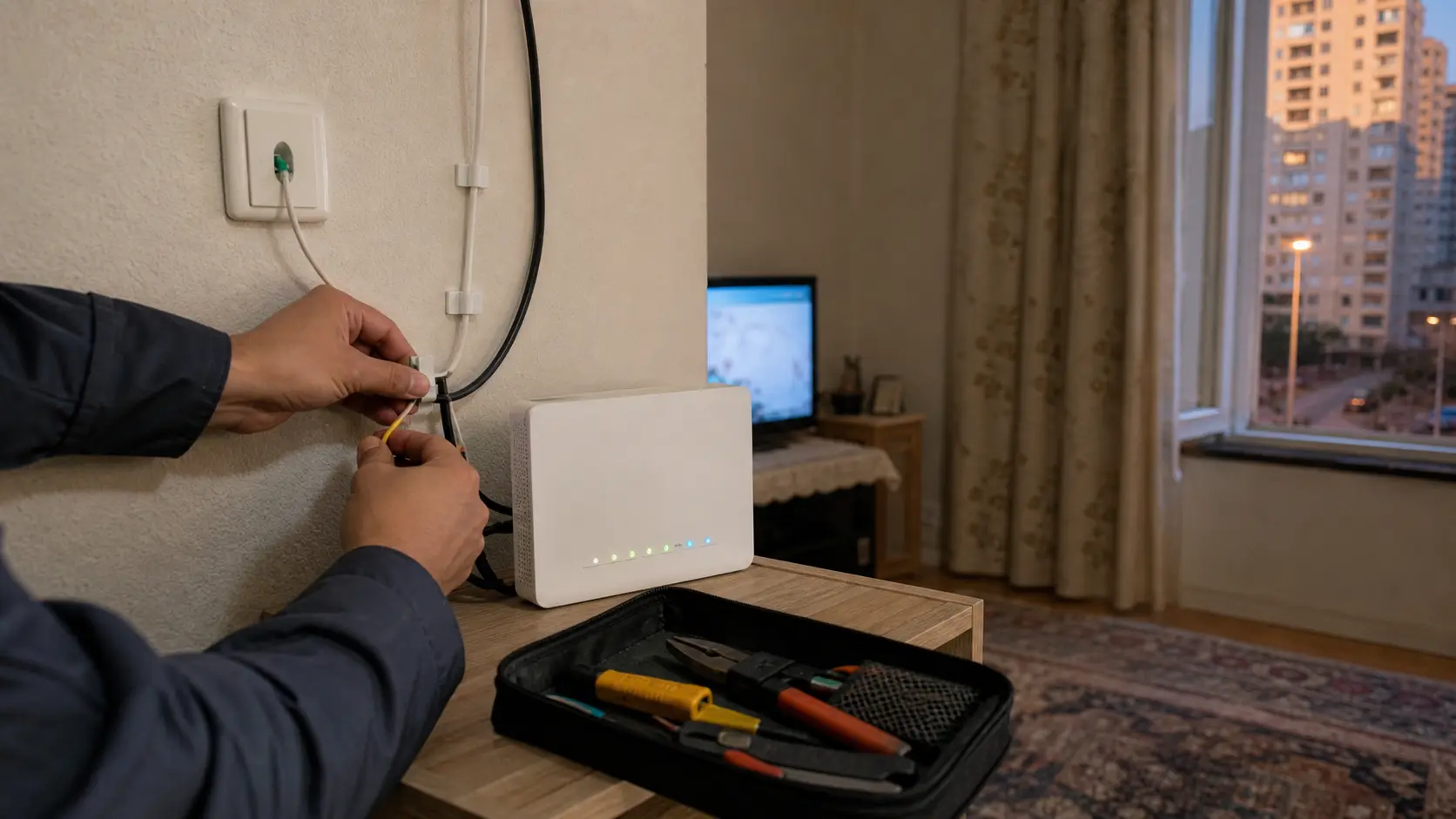
Free installation changes that edge. For the customer, it makes the decision feel safer: no large fee before the first speed test, no separate line item for the cable run, and less anxiety about paying before the service is usable. For the operator, it is a cost transfer. The labour, materials, router or terminal handling, scheduling, failed appointments and post-install support do not disappear. They become an acquisition cost that must be recovered through months of service revenue. If the customer leaves quickly, the operator has subsidised a connection for a rival or a mobile substitute.
If the customer stays, the free install becomes a retention investment.
That is the lens for Artkom. Its 25 AZN entry price is important, but it is not the whole price. The real product is the installed household account: fibre access plus optional video and voice, with the provider absorbing enough of the activation burden to make the household say yes.
The official paid unit is fixed broadband access
The regulatory evidence is clear enough to support the Regional ISP classification. Azerbaijan's Ministry of Digital Development and Transport lists ARTKOM.NET LLC on the registered operators and providers page as an operator and internet provider, with GPON and ETTH technologies, registered on 13 April 2023. That registry entry is a better anchor than directory listings or marketing snippets because it directly names the service category and the technologies that match a fixed access provider.
It does not show coverage by street, subscriber count or network quality, but it confirms that the public operating surface is internet access, not merely a website, reseller name or dormant resource holder.
Artkom's own site then turns that regulatory category into retail and small-business prices. The individual internet menu lists 100 Mbit/s for 25 AZN, 150 Mbit/s for 30 AZN, 250 Mbit/s for 36 AZN, 500 Mbit/s for 40 AZN and 1000 Mbit/s for 49 AZN. Static IP is listed at 5 AZN. Cable TV is listed at 10 AZN, IPTV at 10 AZN, and TV plus 100 Mbit/s internet at 31 AZN. The small corporate menu lists 10, 20, 30 and 50 Mbit/s tiers from 29 to 59 AZN. The large corporate menu lists 5, 10, 15, 20 and 30 Mbit/s tiers from 29 to 79 AZN.
Those prices reveal two commercial curves. The residential curve follows Azerbaijan's widely visible fibre benchmark: 100 Mbit/s at 25 AZN, 150 Mbit/s at 30 AZN and 250 Mbit/s at 36 AZN. Artkom also stretches upward to 500 and 1000 Mbit/s, which gives the sales pitch a path beyond the entry package. The corporate curve looks different. It sells much lower headline speeds at higher prices per megabit, which suggests a different service expectation: business support, more stable service, static addressing, service location, or a different contention profile.
The public page does not spell out service-level terms, so the article should not invent them. Still, the tariff split is enough to show that Artkom is not only a household entertainment provider. It is positioning around small organisations as well.
The tariff table also shows the strategic role of bundles. A 100 Mbit/s household paying 25 AZN can add TV through a 31 AZN combined package, or separately add cable TV or IPTV at 10 AZN. The exact uptake is not public. The economics are obvious: if the provider can add six to ten AZN of monthly revenue to the same access relationship, the free installation payback becomes easier. The same customer who might churn from a pure internet account has more friction if the household has also rearranged its television habits or voice service around the provider.
The evidence gate is therefore satisfied, but bounded. The public sources establish the paid access unit and the official operator status. They do not establish actual speeds at peak hour, fault clearance time, home-pass count, connection backlog, truck-roll cost, or gross margin.
Free installation is a retention bet disguised as a welcome gift
The phrase "free installation" is easy to treat as a small promotion. In fixed broadband it is more important than that. Installation is the moment when a local ISP turns coverage into revenue. Someone has to decide whether the address is reachable, arrange a visit, bring cable and equipment, terminate or test the line, place the router, explain payment, and leave the customer with a working service. If the building has existing in-building fibre, the job may be simple. If the drop is awkward, access permissions are poor, or the customer changes their mind, the job can become expensive relative to a 25 AZN monthly account.
For a small regional ISP, the risk is sharper than for a national provider. A larger operator can spread failed installs and promotional costs across a broader base, cross-sell mobile or enterprise accounts, and negotiate equipment at scale. A smaller provider has to care about neighbourhood density, technician scheduling and customer retention more visibly. A cluster of subscribers in one building or district can make free installation rational because the next connection is cheap. Scattered demand across Baku suburbs can make the same offer costly because each customer consumes field time.
Artkom's stated geography matters here. Baku, Sumgayit and Khirdalan are not remote villages, but they are not one uniform access market either. Baku contains dense apartment blocks, new developments, old copper-era buildings, commercial floors and mixed-use streets. Sumgayit and Khirdalan add commuter-city dynamics. In these places, broadband acquisition is often won at the level of building access, neighbour recommendation and installation speed. A provider that can connect quickly and avoid up-front fees can win a customer even if it is not the largest brand in the country.
Free installation also changes how customers compare substitutes. If every provider advertises similar monthly speeds and prices, the customer looks for the lowest hassle. "Pay nothing to install and start with 25 AZN per month" competes well against a provider that asks the household to buy a router, wait for a technician, or navigate a government-linked service queue. But the promise can hurt the operator if support quality disappoints. A customer who paid no installation fee may feel less locked in and more willing to churn if the connection is unstable.
The strongest reading is that Artkom uses free installation to borrow from future tenure. The company accepts lower first-month cash recovery in exchange for a higher chance of account capture. The trade works if customers stay for many billing cycles, add IPTV or voice, pay on time, and do not require repeated repairs. It fails if the provider attracts price-sensitive customers who churn whenever a larger competitor offers free devices, a referral bonus or a faster headline tier.
The public evidence does not show Artkom's churn. It does show why churn is the key variable. A 25 AZN account has limited room to absorb many truck rolls. The more installation cost Artkom absorbs up front, the more valuable the tenth, twelfth and eighteenth monthly payment become.
IPTV and voice turn the broadband line into a household account
Artkom's offer is broader than a raw internet pipe. Its public page describes digital cable TV, IPTV and SIP telephony. The IPTV offer is priced at 10 AZN per month and claims more than 300 channels, including more than 80 HD channels. The cable TV offer is also 10 AZN and claims more than 100 channels. The site notes that IPTV use requires acquiring a TVIP box, while its service description says IPTV can be watched on Smart TV without extra equipment. That apparent tension should be read carefully: it may reflect different device paths or an outdated line on the site, not a definitive technical contradiction.
The commercial point is clearer than the device wording. Television gives a local ISP a way to defend the access account from pure price comparison. A household that only wants internet can switch to another 25 AZN plan with less emotional friction. A household that has moved its television routine, remote controls, channel list and family habits onto the provider's bundle may be slower to move. That gives the provider more time to recover installation cost.
Voice has a similar role, though probably with a smaller emotional footprint for many households. Artkom's SIP telephony description frames packet-based IP telephony as a new era in telephone service. In a residential market where mobile phones dominate daily communication, fixed voice may not drive the household decision. But for small offices, shops, clinics, building managers and service firms, a stable local number can still matter. If the same provider supplies internet and voice, a fault becomes more consequential and the customer relationship becomes more integrated.
The bundle also changes the support burden. Internet, IPTV and SIP are not three unrelated products. IPTV quality depends on the home network, access link, device compatibility and multicast or streaming path. Voice depends on packet stability and power at the premises. If Artkom sells the bundle, customers will judge the provider by the whole experience, not by a speed number. A broadband connection that works for browsing but freezes television during peak evening hours can still feel like failure.
That is why the free installation promise is not only a sales cost. It is the first act of service configuration. The installer may influence router placement, Wi-Fi quality, television setup and customer confidence. A rushed or low-quality installation can create support cost later. A careful installation can reduce repeat calls and make the bundle stickier. Local support labour is therefore part of the paid unit, even if the customer sees only a monthly tariff.
This is where Artkom's public page leaves open questions. It provides a phone number, email address and an e-complaint link, but it does not publish a detailed repair SLA, technician coverage map or support hours. CityNet, one of the substitutes, explicitly advertises 24/7 support and describes technicians coming to the address after a connection time is agreed. Aile NET says subscribers can call 920 or use an online application, and that the cable to the house is free for new connections. Artkom's support surface is real, but less richly documented than some competitors.
That should temper any claim that free installation automatically means strong field service.
The routing footprint is real, small and concentrated
Artkom's network evidence is stronger than a stale registry trace. RIPEstat's AS overview identifies AS208410 as Artkom / ARTKOM.NET LLC and marks it as announced. RIPEstat's routing status, queried on 10 July 2026, shows two IPv4 prefixes and 512 IPv4 addresses, no IPv6 announcement, and visibility from all 326 IPv4 RIS peers in that dataset. The announced prefixes are 37.32.78.0/24 and 212.102.123.0/24. RIPE whois data shows AS208410 created on 28 February 2022, while 212.102.123.0/24 appears as an allocated PA block for ARTKOM.NET LLC and 37.32.78.0/24 appears as a sub-allocated PA block with ARTKOM netname context.
RIPEstat RPKI validation reports both prefixes valid for AS208410.
BGP.tools adds a useful market label. It describes AS208410 as an active RIPE network, network type "Eyeball," with two IPv4 prefixes and one listed upstream, AS200154 IZONE LLC. IPinfo similarly classifies the ASN as an ISP, shows 512 IPv4 addresses, lists the same two /24 ranges, reports Azerbaijan as the IPv4 geography, and labels the observed activity pattern as a consumer ISP signal. IPinfo also shows recent Baku probe measurements to reachable IPs and identifies one downstream or peer relationship in its dataset. These third-party routing views should not be overread, but they align with the retail access evidence.
The grade is therefore strong for existence and relevance: active ASN, visible announcements, current prefixes, RPKI-valid routes, government operator registration and a matching fibre access offer. The grade is not strong for scale or resilience. Two /24s are a small IPv4 footprint. No visible IPv6 announcement means the public network evidence does not show an IPv6 customer edge, even though RIPE membership lists can show IPv6 allocation context for many LIRs. A single observed upstream in BGP.tools points to route concentration, not route diversity.
The public searches did not identify a current PeeringDB profile or public internet exchange port for AS208410, so the article should not imply open peering or IX optionality.
This distinction matters for the customer. A small ISP can provide a good local service with a small routing footprint if its upstream is reliable, its access network is well maintained and its customer density is high. But a small footprint gives less public evidence of redundancy. If IZONE has an outage, congestion event or commercial dispute affecting Artkom paths, customers may feel it quickly. If the provider has private arrangements that are not visible in public routing databases, those arrangements could improve resilience, but they are not evidenced enough to state as fact.
For readers, the right conclusion is neither dismissal nor hype. Artkom is not just a name in a directory. It has an active network and a service page matching that network. It is also not a national-scale access carrier in public routing terms. Its public footprint looks like a local access ISP whose economics depend on dense retail accounts and upstream discipline.
Azerbaijan's broadband benchmark leaves little room for pricing fantasy
Artkom's 100 Mbit/s for 25 AZN does not sit in isolation. Aztelekom's public tariff page lists 100 Mbit/s at 25 AZN, 150 Mbit/s at 30 AZN and 250 Mbit/s at 36 AZN. Its home page also markets free connection and modem for 100 Mbit/s internet, with bundles at 27 AZN for internet plus telephone and 33 AZN for internet plus telephone plus TV. CityNet lists 100 Mbit/s at 25 AZN, 250 Mbit/s at 36 AZN, 500 Mbit/s at 40 AZN and 1000 Mbit/s at 50 AZN, and says the router and TV device are free for the duration of use.
Aile NET lists 100 Mbit/s at 25 AZN, TV plus internet from 31 AZN, free cable and connection, and a Wi-Fi router option. Fibernet lists similar fibre packages, including 100 Mbit/s at 25 AZN and higher-speed bundles with free router, TV box, TV channels and landline references.
That competitor pattern is the central constraint on Artkom's pricing power. The entry broadband price has become a market convention. A local provider can match it, but cannot easily make it the whole differentiation story. A household looking only at speed and monthly price will see several familiar options. Some are larger, some have broader brand recognition, some have government-linked scale, and some publish more elaborate device or support claims.
These substitutes are therefore not theoretical. Azeronline and Baktelecom/Aztelekom bring state-linked or large-brand weight. CityNet brings a polished residential acquisition flow, explicit technician scheduling and 24/7 support language. Aile NET brings a long-running cable and TV relationship, a call-centre number, free cable and connection language, and a 31 AZN TV plus internet package. Fibernet brings aggressive device-inclusive bundles and a broad speed ladder. Mobile broadband remains a substitute for renters, students, low-usage households and customers who do not want a technician visit at all.
In that market, free installation is necessary but not sufficient. If several providers waive connection fees or devices, the customer will compare coverage, responsiveness and neighbour experience. If a large provider offers 1000 Mbit/s for nearly the same price, the small provider has to explain why a customer should care about locality, installation speed or service familiarity. If mobile networks improve enough for ordinary streaming and messaging, some households may treat fixed broadband as optional, especially where installation friction remains high.
Artkom's best niche is likely not "the cheapest internet in Azerbaijan." Its own pricing does not support that claim. The better niche is "a local access provider that can connect selected Baku-area households and organisations with a familiar price, free installation and add-on TV or voice." That niche can be profitable if the company chooses buildings and neighbourhoods carefully. It can be fragile if acquisition becomes a subsidy race against bigger operators.
Upstream dependence is the hidden supplier risk
The average household does not know or care who carries a provider's routes upstream. It notices only whether video stalls, calls drop, games lag, online classes freeze or payments fail. For the operator, upstream dependence is a cost and resilience issue. Artkom's public routing view points to IZONE LLC as the observed upstream for AS208410. That is enough to identify a supplier dependency surface, but not enough to know contract terms, capacity, pricing or failover arrangements.
One upstream in public BGP views is not automatically a defect. Many small ISPs buy from a single upstream because it is simpler, cheaper and adequate for the size of their customer base. A concentrated upstream can also be a rational choice when domestic transit, building access and field support are the larger constraints. Adding a second upstream, joining an exchange, or paying for more diverse transport can improve resilience, but it adds cost and operational complexity. A 25 AZN access account does not leave infinite room for network optionality.
The risk is that upstream concentration turns a supplier problem into a retail support problem. If the upstream path is congested, Artkom's customers do not call IZONE; they call Artkom. If international reachability degrades, the household sees the local ISP brand. If a competitor has better peering or more direct content-network access, the customer may not understand the topology, but will understand that one provider's streaming works better in the evening.
Public routing evidence can only go so far. BGP collectors see paths from their vantage points. They can miss private interconnection, backup sessions that are quiet until failure, or commercial arrangements not reflected in a public profile. The absence of a PeeringDB profile is not proof that a provider has no interconnection beyond transit. It is only an absence of public industry-database evidence. The right editorial posture is to treat route diversity as an open watchpoint.
IPv6 is another watchpoint. RIPEstat and IPinfo show no IPv6 addresses announced for AS208410 in the current public view. For many residential customers in Azerbaijan, lack of visible IPv6 may not be a buying criterion today. Over time it matters. IPv4 scarcity, carrier-grade NAT, gaming, remote access, content delivery, security monitoring and future device ecosystems all make IPv6 readiness part of access-network maturity. A small ISP can continue operating on IPv4, but an announced IPv6 customer edge would improve the network-resource story.
Artkom's current routing evidence is enough to support the article's thesis: this is an operating local ISP with live resources. It is not enough to support a claim of robust multi-homed resilience. That difference should stay visible.
Regulatory visibility raises accountability, not certainty
The ministry registry gives Artkom formal visibility. The same ministry's E-Complaint information system shows how Azerbaijan is trying to structure telecom customer complaints. The system accepts complaints related to internet services such as GPON, ADSL and LTE, telephone services, mobile communication, mobile internet and postal services. Each operator and provider has a dedicated account where incoming complaints are displayed, while the agency can monitor and analyse the process. Artkom's own site links to an e-complaint path.
This matters because fixed broadband quality is hard for outsiders to measure. Tariffs are public. ASN records are public. Customer frustration is often scattered across phone calls, social media, private chats and building groups. A complaint system does not prove good service. It creates a channel where poor service can become visible to the regulator and where providers have an obligation to respond. That changes the operating environment for small ISPs: support quality is not only a retention issue, it can become a regulatory and reputational issue.
The Baku Research Institute's 2024 study on internet access and network quality gives useful market context. It says the 2024 tariff changes by Aztelekom triggered public discussion about quality, and that many users said speed had not increased despite price changes. In its survey, most respondents were from Baku; many reported fibre access, but only a small share said they were completely satisfied with internet quality. Dissatisfied users named high price, low speed and unsatisfactory service; only about a third said technical problems were solved within a few hours, while others reported longer delays.
The study is not Artkom-specific, and it should not be used to accuse Artkom of those problems. It does show that Azerbaijani broadband customers judge providers by service outcomes, not tariff tables.
That context sharpens the free installation angle. A provider can win a customer with a frictionless install, but it keeps the customer by avoiding the complaint path. If a family experiences daily drops, slow evening speeds or poor repair communication, the waived installation fee will not save the account. If the provider responds quickly, solves Wi-Fi placement problems, explains outages and keeps television stable, the initial free installation becomes part of a longer trust relationship.
For a small ISP, regulatory visibility also creates a documentation burden. The provider must keep registration current, handle customer complaints, maintain contact channels and avoid promising more than it can deliver. Artkom's public material is relatively simple. That may be appropriate for a local operator, but simplicity makes third-party verification harder. More detailed public terms on installation, router ownership, fault reporting and cancellation would improve the customer's ability to compare offers.
Payment rails and social signals point to ordinary retail presence
Artkom appears in more than one payment surface. Rabita Mobile's App Store listing includes Artkom among internet providers that can be paid through the app. MilliOn has an Artkom internet payment page asking for a contract number. Search-indexed Instagram posts from the Artkom account refer to internet, TV, cable and IPTV services and to payment availability through bank channels. These signals are lower-grade than the ministry registry or RIPEstat, but they matter for the customer account story. They show Artkom is treated as a billable retail provider, not only as a network record.
Payment integration is practical retention infrastructure. A household that can pay through familiar mobile banking or terminal channels has less monthly friction. For low-ticket access accounts, payment convenience matters. Missed payments, difficult top-ups and unclear contract numbers can create churn even when the network is technically fine. Larger Azerbaijani providers can lean on broad payment ecosystems. A smaller provider has to be present in enough of those channels that the customer does not feel they have chosen a marginal service.
The market chatter is thinner on service quality. Search results show scattered Instagram references and payment announcements, but not a reliable body of public, Artkom-specific reviews that can be used to measure uptime or support. That absence should not be turned into a negative claim. Many local ISPs operate through phone calls, building groups, neighbour recommendations and private messaging rather than review platforms. The lack of visible reviews means only that the public evidence cannot confirm customer satisfaction.
There are also unrelated Artkom names in other countries and sectors, including non-Azerbaijani trading or industrial businesses. The article therefore relies on the Azerbaijan-specific sources: artkom.az, ARTKOM.NET LLC in the ministry registry, AS208410, and payment surfaces naming Artkom as an internet provider. That prevents brand confusion from polluting the analysis.
The useful semi-public signal is not "people love or hate Artkom." The useful signal is that Artkom has enough ordinary retail presence to appear in payment app and terminal ecosystems, while still lacking the broad public review and performance footprint of a national operator. That fits the local ISP profile: visible to its subscribers, less visible to national media unless complaints or promotions surface.
Corporate access changes the cost base
Artkom's corporate tariffs deserve attention because they are economically different from household fibre. The small corporate list starts at 10 Mbit/s for 29 AZN and rises to 50 Mbit/s for 59 AZN. The large corporate list starts at 5 Mbit/s for 29 AZN and rises to 30 Mbit/s for 79 AZN. Those speeds are much lower than the residential headline speeds, yet the prices are higher per megabit. The public page does not say why. It may reflect dedicated service expectations, different contention, business support, static addressing, installation complexity, or simply legacy packaging.
For Artkom, business accounts can improve the economics if they produce higher monthly revenue, lower churn and predictable locations. A small office, shop or building customer may be less likely to switch for a one-month consumer promotion if the connection supports POS terminals, cameras, IP phones, booking software or staff Wi-Fi. A corporate customer may also value quick local support more than a household does, because downtime turns directly into lost sales or staff disruption.
The risk is support intensity. Business customers can be more demanding. A 30 Mbit/s corporate account paying 79 AZN may expect answers, fault escalation and installation professionalism that a residential page does not document. If Artkom uses the same field team and upstream capacity for consumer and corporate customers, the company has to manage contention and repair priority carefully. Public tariffs do not reveal whether it does.
Corporate connectivity also interacts with static IP. Artkom lists static IP at 5 AZN. For households, static addressing is usually optional. For small businesses, it can matter for cameras, remote access, VPNs, mail systems, point-of-sale services or whitelisted applications. The static IP option adds revenue and reinforces the network-resource evidence, but it also consumes scarce IPv4 resources. With only 512 IPv4 addresses visible in public routing datasets, Artkom has limited public address inventory if many customers want dedicated addresses. Carrier-grade NAT can serve residential users, but static IP customers need careful allocation.
This is another place where IPv4 economics and installation economics meet. A provider can advertise cheap household access while reserving scarce public addressing and more careful service for business accounts. That segmentation is rational. It becomes risky if the public address pool is too small, if customer demand shifts toward remote-work or security-camera use, or if competitors bundle static IP or business support more aggressively.
The article should not infer revenue mix. It can say the tariff menu gives Artkom more than one path to recover access-network costs. Residential volume, IPTV/TV add-ons, static IP fees and corporate accounts all help convert a free installation into a longer-lived account.
Substitution pressure is not only another fibre provider
The obvious substitutes are other fixed broadband providers. Aztelekom and Baktelecom bring state-linked scale and wide recognition. Azeronline appears as a large fibre-optic provider with online registration and a dedicated short number. CityNet competes with clear residential pricing, device concessions, 24/7 support language and a polished activation process. Aile NET competes through a long-standing cable and TV relationship, free cable and connection, and a TV plus internet bundle. Fibernet competes with a broad speed ladder and free device-heavy bundles.
But substitution also comes from outside fixed fibre. Mobile broadband can be enough for a renter, a student household, a single-person apartment or a family that does not want a drilled cable or technician visit. Fixed wireless and LTE providers appear in the ministry registry. A household can also use a mobile hotspot temporarily while waiting for a fixed install. The more reliable mobile networks become, the more free installation must do to justify the inconvenience of an appointment.
Another substitute is inertia. Many customers stay with a mediocre provider because switching is annoying. Free installation fights that inertia by making the first switch easier. But after Artkom wins the account, the same inertia should work in Artkom's favour if the service is adequate. That is the paradox of free installation: it lowers the barrier to leave someone else and then relies on the customer not wanting to leave again.
Neighbour recommendation is also a substitute for formal marketing. In apartment buildings, the best broadband sales force is often a working connection next door. If Artkom has a cluster of satisfied households in one building, free installation can spread quickly. If it has a cluster of faults, the same social channel can damage the brand. Public sources cannot measure that building-level sentiment, but the economics of local ISPs make it important.
The tariff market makes price leadership difficult. A provider can temporarily discount, waive a fee or offer a router, but competitors can copy those moves. The harder-to-copy assets are route stability, building access, field technicians who know the local plant, payment convenience, and support relationships. Those are also harder for outsiders to verify. That is why the article's judgment must stay conditional: Artkom's public offer makes sense if those operating capabilities are present behind the page.
What would change the judgement
Several facts would materially improve the Artkom assessment. A public PeeringDB profile, an exchange membership record, or disclosed secondary upstream would reduce the route-concentration concern. A visible IPv6 customer announcement would improve the network maturity story. Published installation terms would clarify whether router, fibre drop, TV box and cancellation costs are truly absorbed or recovered through later obligations. Public fault-response targets, support hours and repair channels would strengthen the Local support labour topic beyond installation and contact evidence.
More coverage detail would also help. Artkom says Baku, Sumgayit and Khirdalan, but not which neighbourhoods, buildings or service zones are live. A coverage checker, building list or installation feasibility map would let customers compare the offer more honestly. It would also make the free installation promise more credible, because the customer could see whether the provider is likely to connect the address quickly.
Customer evidence would change the risk reading in either direction. A body of recent independent reviews, complaint-resolution data or speed-test evidence tied to AS208410 could show whether the service performs as a local access product. Positive evidence would support the retention thesis. Negative evidence would turn free installation into a costly churn trap. The current public record is too sparse for either conclusion.
Financial data would be the hardest but most valuable evidence. The thesis depends on acquisition payback. If Artkom's average installation cost is low because buildings are already wired and technicians are nearby, free installation can be a modest promotion. If each install requires significant labour, equipment and follow-up, payback requires longer customer tenure or higher bundle revenue. No public source gives that cost stack.
Regulatory updates are also worth watching. The ministry registry includes many GPON and ETTH providers, with some entries showing suspended activity or reorganisation for other companies. Artkom's entry currently shows no suspension in the reviewed registry lines. Any future suspension, complaint-index inclusion, licence change, or technology update would change the operating-risk picture. Conversely, a broader service registration, host-provider status, or additional listed technology would expand the possible paid units.
The key point is that none of these unknowns invalidate the current thesis. They set its boundary. Artkom is visible enough to analyse as a Baku-area regional ISP. It is not transparent enough to judge as a proven high-quality access network.
The final read
Artkom's free installation offer is best understood as a small-provider acquisition instrument in a benchmark-priced broadband market. The company cannot rely on a unique 25 AZN entry tariff because several competitors show the same price. It cannot rely on a large public routing footprint because its visible network is small and upstream-concentrated. It can rely, if execution is good, on locality: connecting the right buildings, absorbing the first visit, bundling TV or voice, making payment easy, and keeping customers satisfied long enough for the installation subsidy to earn back its cost.
That is a real business, but it is a narrow one. The public sources support the paid access unit, the Regional ISP category, the network-resource evidence and the peering/transit watchpoint. They support Local support labour mainly through the free installation and support/contact surface, not through a published repair SLA. They do not support claims about uptime, customer happiness, revenue, coverage density or service superiority.
For readers tracking Azerbaijan's fixed access market, Artkom matters because it shows how smaller providers compete after national broadband prices have converged around visible speed tiers. The fight moves from headline megabits to acquisition cost, field execution, payment convenience and churn. A free install is not generosity. It is a bet that a household in Baku, Sumgayit or Khirdalan will stay long enough for the provider to turn a technician visit into a durable monthly account.