
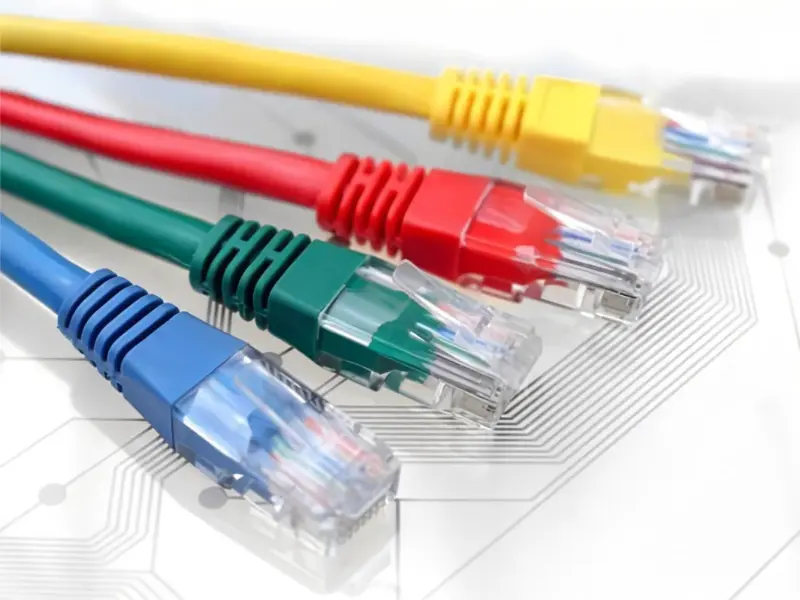
- Ethernet cables and other types of cables used for network connections are collectively referred to as network cables.
- Network cables make data transfer easier, enabling resource sharing and communication.
In this article, we will look closely at the main differences between these two kinds of cables, their types, features, and uses in today’s tech world. After reading, you will know how to choose the right option for different needs.
The essence of ethernet cables
Ethernet cables, often called RJ45 cables, are a kind of network cable built for local area networks (LANs). They take their name from the ethernet standard, a set of technologies used in LANs, including the Internet. The word “ethernet” points to the tech the cable supports, while “cable” means the physical line that carries the data.
The structure of ethernet cables
Ethernet cables usually contain four twisted pairs of copper wires inside a plastic cover. The twisting lowers crosstalk, which is signal noise between the wires. At each end are RJ45 connectors, made to fit into ethernet ports on computers, routers, and other devices.
Types of ethernet cables
There are several types of ethernet cables, each one built for different speeds:
Cat5: Old type, good for up to 100 Mbps.
Cat5e: A better Cat5 that goes up to 1 Gbps and deals with interference better.
Cat6: Faster, can hit 10 Gbps on short runs, more stable than Cat5e.
Cat6a: Stronger version of Cat6, keeps 10 Gbps working even at 100 metres.
Cat7: Has extra shielding, also does 10 Gbps, used when you need steady speed on longer links
Ethernet cables vs. network cables
Are they the same? Nope. Ethernet cables are one kind, made for ethernet setups. “Network cable” is the bigger group that also covers fibre and coax.
Real-world scenarios
Home use: Ethernet often links up home devices for fast, steady internet.
Business networks: Offices mix ethernet and fibre to keep connections quick and reliable.
Telecom: Providers use coax and fibre for moving data over long distances.
Ethernet cables are part of the bigger “network cable” family. They’re made for ethernet, but the larger group covers many cable types.