
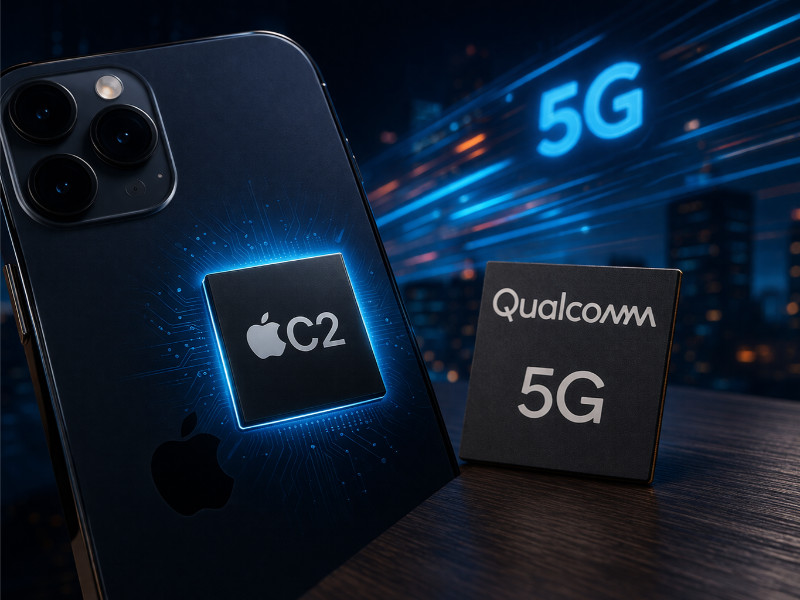
Apple’s second-generation C2 modem has achieved performance levels comparable to Qualcomm’s latest 5G chips, indicating a significant shift in the mobile chip industry. This advancement could reduce Apple's dependency on Qualcomm and enhance its control over smartphone supply chains.
- The tested Apple modem was C1X in the iPhone Air, not an unreleased C2; the comparison device was the Qualcomm X80-equipped iPhone 17 Pro Max.
- Ookla observed finished phones on commercial networks through crowdsourced Speedtest Intelligence data, not isolated modem chips in a controlled laboratory.
- C1X narrowed the download and latency gap, but X80 still led upload by as much as 32% and the iPhone Air remained sub-6 GHz only.
What Ookla actually compared
Ookla's Q4 2025 analysis compared Speedtest Intelligence results from the iPhone Air, which uses Apple's C1X modem, with the iPhone 17 Pro Max, which uses Qualcomm's X80, and with the C1-equipped iPhone 16e. The earlier article called the Apple part “C2” and described direct tests of chips. That is wrong: C1X was the shipping product in this dataset, while C2 was not the subject of the report.
Download and latency were close, not universally equal
In the United States, the iPhone Air recorded a 352.21 Mbps median 5G download, 2.65% below the iPhone 17 Pro Max and 69.41% above the iPhone 16e. At the 10th percentile in the US, the Air was about 7% ahead of the Pro Max. Across the study, the Air had lower latency than the Pro Max in 19 of 22 markets. Results varied: C1X led median download in China, Singapore and Sweden, while X80 had larger leads in Taiwan, Poland, the UAE, Mexico and Japan.
Upload remained a material Qualcomm advantage
The report did not find parity across every metric. The X80-equipped Pro Max retained upload leads of up to 32%, which Ookla associated with Qualcomm's more mature uplink carrier aggregation. In most markets the median upload gap was within 5 Mbps, but the direction and size changed with the market. A fair conclusion is that C1X became competitive on observed download and latency, not that it beat or matched X80 in every radio task.
These are device-and-network outcomes, not a modem-only benchmark
Speedtest Intelligence is based on user-initiated tests on live networks. The samples were not paired tests of identical hardware under identical radio conditions. The two iPhones differ in antenna layout, RF front end, thermal envelope and product design, while carrier, spectrum, signal, congestion, location and subscriber mix also vary. The data are valuable evidence of real-world outcomes, but they cannot assign every difference to the baseband modem alone.
Feature coverage still matters
Apple's iPhone Air specifications list C1X and sub-6 GHz 5G; they do not list mmWave. Ookla's comparison therefore says little about markets or locations where mmWave availability matters. Apple's launch claim that C1X is up to twice as fast as C1 and uses 30% less energy than the iPhone 16 Pro modem is a vendor statement; the crowdsourced throughput report does not independently validate modem energy consumption.
Apple's supplier transition is real but incomplete
Apple shipped C1X first in iPhone Air and later in iPhone 17e, expanding its control over baseband design and integration with its own processors and software. Yet Qualcomm's supply agreement covers Snapdragon 5G Modem-RF systems for Apple's 2024, 2025 and 2026 smartphone launches. C1X performance is evidence that Apple can move more products in-house; it is not evidence that Qualcomm has already been removed from the iPhone supply chain or from cellular licensing.
What to watch
Track which future iPhones adopt Apple modems, whether Apple closes the uplink carrier-aggregation gap, whether a shipping model adds mmWave, and whether controlled independent tests reproduce the crowdsourced pattern. Also watch carrier certification, band support, RF-front-end choices and any new Apple-Qualcomm supply disclosures. Those signals will show whether one strong generation becomes a broad platform transition.
Member Briefing
Deeper Trend Context
Sign in with the right membership level to unlock the full briefing and source notes.
Only for Strategic Circle
Strategic Circle
Open to all readers. Unlock trend briefings after joining and signing in.
Join Strategic CircleOnly for Leadership Alliance
Leadership Alliance
For operators, investors, and policy teams that need relationship evidence, failure paths, and source notes. Sign in to unlock.
Join Leadership Alliance