
Summary
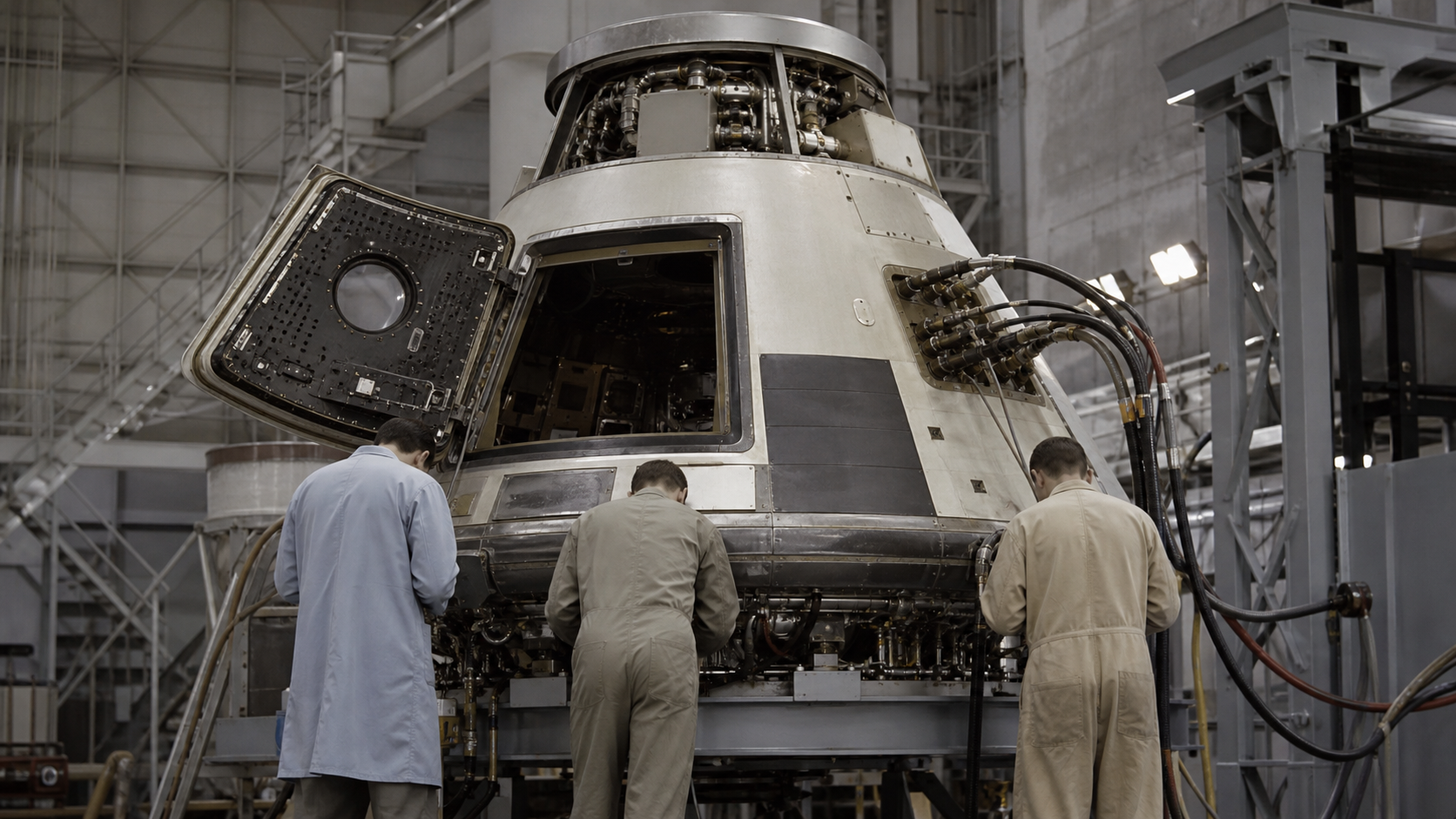
The Review Board found a coupled hazard system, not one conclusively identified spark. On January 27, 1967, Virgil I. “Gus” Grissom, Edward H. White II and Roger B. Chaffee died in Command Module 012 during the Apollo 204 plugs-out ground test at Launch Complex 34. The NASA-hosted Report of the Apollo 204 Review Board did not conclusively identify the specific initiator. It did identify six conditions that led to the disaster: a sealed oxygen-pressurized cabin, extensive combustibles, vulnerable powered wiring, vulnerable plumbing carrying combustible and corrosive coolant, inadequate escape and inadequate rescue or medical provision.
Those are adopted safety findings, not criminal charges, civil judgments or proof that one person controlled the entire chain.
Pure oxygen on the ground was materially different from low-pressure oxygen in flight. The cabin had been purged and pressurized with 100 percent oxygen at about 16.7 pounds per square inch absolute, roughly two psi above local ambient pressure. That produced far more oxygen partial pressure than Apollo's planned roughly five-psi orbital atmosphere. Oxygen did not ignite by itself, and “pure oxygen” is not a complete causal explanation: an ignition source and combustible material were also required.
But high oxygen concentration and pressure made ordinarily manageable materials ignite more easily and propagate fire much faster, converting a small initiating event into a cabin-wide emergency.
The specific ignition source remained unresolved even though electrical arcing remained credible. The Board examined powered equipment, wiring, components, telemetry, damage patterns and many competing mechanisms. It found numerous examples of poor wiring installation, design and workmanship and located the most probable origin region near the environmental-control area, where fire damage was severe. Arcing could not be eliminated, but no particular conductor was proved to be the initiating source. Claims that a named wire, a crew movement, static electricity or a plumbing leak “caused” the first ignition exceed the adopted record.
Combustible material was a configuration-control failure, not merely a material-specification failure. Hook-and-pile fasteners, nylon netting, foam, fabric, checklists and other nonmetallic items existed throughout the cabin. Individual material acceptance under one test condition did not prove that the installed arrangement was safe in a 16.7-psia oxygen atmosphere. Quantity, location, orientation, proximity to wiring, flame paths and the absence of effective fire breaks mattered together.
Accountability therefore belonged to design, materials approval, manufacturing, configuration control, test preparation and final crewed release—not only to whoever installed the last item.
The hatch was one barrier within a larger failed egress system. The inner pressure hatch opened inward and formed part of a multi-piece assembly beneath an outer hatch and boost protective cover hatch. Even under ideal conditions, opening took about 90 seconds. Rising cabin pressure made inward opening impossible during the fire. The crew appears to have begun the prescribed procedure, while pad workers attacked the outer layers amid heat and dense smoke.
A faster outward-opening unified hatch became a central redesign, but emergency classification, rescue equipment, access routes, training and medical attendance were also necessary parts of egress.
The test's administrative label suppressed precautions that its physical state demanded. Because the launch vehicle was unfueled, the plugs-out exercise was treated as nonhazardous and did not receive the safety review or emergency posture appropriate to a sealed, occupied, oxygen-rich pressure vessel. The official NASA accident chronology shows how rapidly the interval from the first fire report to pressure-vessel rupture and loss of data unfolded. A safe test system must classify the actual configuration, energy sources, atmosphere, crew exposure and escape time—not inherit a broad label from the absence of propellant.
NASA, its centers and North American Aviation held different but interacting control rights. NASA owned programme requirements, acceptance, test governance, safety organization and flight approval. The contractor designed and built the command and service module under NASA direction and carried manufacturing, quality and test responsibilities within that relationship. Center organizations and pad teams controlled parts of the test procedure and emergency response. The Board found deficiencies in design and engineering, manufacture and quality control across the Apollo team.
It did not make a judicial allocation of negligence or reduce responsibility to a single manager, engineer or technician.
Congressional oversight added a separate institutional record. House and Senate proceedings examined the Board's work, NASA's self-investigation, contractor performance, earlier management warnings, astronaut confidence, schedule and corrective action. The House Subcommittee on NASA Oversight hearing, Volume I is a primary oversight record, not an engineering substitute for the final Board report. Questions, allegations and witness opinions in a hearing remain attributed to their speakers unless a committee or agency later adopted them.
The return to crewed flight depended on linked redesign and programme controls. NASA reduced and controlled combustibles, protected wiring and plumbing, introduced a rapid outward-opening unified hatch, revised ground atmosphere practice, strengthened test classification and emergency readiness, changed quality and management structures, conducted full-scale flammability testing and held crewed flight until the modified Block II system was accepted. Apollo 7's successful October 1968 mission was powerful operational evidence.
It was not proof that one redesign alone eliminated every human-spaceflight risk or that every later safety system would remain effective without continued verification.
Durable accountability is evidence that survives success. The repair must remain visible in approved material lists, oxygen-pressure limits, configuration baselines, hazard analyses, test readiness records, emergency drills, independent stop authority, discrepancy closure, qualification results and lessons transferred to later programmes. A sequence of successful missions matters, but success can also recreate the familiarity and overconfidence that congressional reviewers saw before the fire. The test is whether NASA and its contractors can continually prove the safety case, not whether history has become ceremonial.
The plugs-out test combined flight realism with ground-only hazards
Apollo 204 was intended to become the first crewed Apollo mission. On the afternoon of January 27, the crew entered spacecraft 012 atop a Saturn IB for a plugs-out integrated test. The exercise was meant to show that the spacecraft and launch vehicle could operate on internal power with external umbilical connections removed while the team rehearsed countdown functions. It was a ground qualification step, not a launch attempt, but the crew wore pressure suits, the hatches were installed, power was applied and the cabin was configured to resemble a consequential part of launch-day operations.
The distinction between simulation and exposure is fundamental. A simulated countdown can contain real electrical energy, a real pressure boundary, real oxygen, real combustible materials and real people. Calling an exercise a “test” does not reduce the energy already present. Conversely, the absence of fueled launch-vehicle stages did remove major propellant and explosion hazards. The error was to let that absence dominate the classification while the occupied cabin's own fire and egress hazards escaped an equivalent review.
The NASA history volume Chariots for Apollo records the sequence and the institutional context. The crew entered after midday, the cabin and suit circuit were purged, and pure oxygen at 16.7 psi replaced the sea-level mixture. Communications trouble delayed the operation. An unattended live microphone complicated the loops, and the planned plugs-out portion had not been completed when the emergency began around 6:31 p.m. These facts should not be converted into a claim that the communication fault ignited the fire; the Board examined that possibility and did not identify the keying circuit as an initiator.
The communications failures instead matter because they were part of test control, anomaly management and emergency coordination.
At the first verbal report of fire, movement inside the cabin was consistent with the crew attempting the standard escape procedure. Within seconds, temperature and pressure rose sharply. The pressure vessel ruptured, flame and gases entered surrounding spaces, and data and voice ended. Pad workers repeatedly entered the smoke-filled white room to remove the outer portions of the hatch assembly and reach the pressure hatch. Their effort was courageous, but personal courage could not compensate for an emergency system that had not been designed, staffed and rehearsed for this event.
The crew's deaths are the human consequence of the system, not a device for sensational description. The official historical account attributes death to asphyxiation from toxic combustion products, while also recording burns. The accountability question is upstream: why did an occupied ground test permit an atmosphere and installed configuration in which a small, unidentified initiating failure could produce unsurvivable conditions before escape or rescue became physically possible?
Oxygen concentration, total pressure and material arrangement must be kept distinct
The phrase “pure-oxygen fire” is accurate only if used carefully. Oxygen supports combustion; it is not normally the fuel and did not spontaneously ignite the cabin. Combustion required combustible material and an energy source. The Review Board's causal structure kept these elements together. A sealed cabin pressurized with oxygen created the oxidizing environment; distributed materials created fuel and propagation paths; vulnerable wiring or another failure could provide ignition; and slow escape plus inadequate rescue converted a rapidly developing fire into a fatal event.
Pressure changes the severity. Planned Apollo flight used a low total cabin pressure of about five psia after reaching space, with oxygen replenishment. The January ground test used pure oxygen above normal atmospheric pressure. Even though both environments could be described as “100 percent oxygen,” they did not present equivalent oxygen partial pressure or flame behavior. The ground condition put materials in an oxidizing environment more than three times the total pressure of the orbital cabin.
The practical result was easier ignition for some materials, faster flame spread and greater heat release than intuition based on ordinary air would suggest.
The original one-gas choice had engineering reasons. A pure-oxygen, low-pressure space atmosphere could reduce system mass and complexity and avoid some problems associated with managing two gases. The historical record also shows that Apollo engineers had considered fire in flight and intended to control it through material selection and ignition prevention. Those rationales are relevant; they prevent the crude conclusion that choosing oxygen was irrational in every context.
But a rationale for low-pressure flight does not automatically validate a high-pressure ground checkout, and controlling likely ignition sources is not equivalent to ensuring a fire cannot propagate.
NASA's later operational record documents a changed boundary. The Apollo 7-to-11 medical results report says Apollo was launched after the fire with a mixed oxygen-nitrogen cabin atmosphere—approximately 64 percent oxygen and 36 percent nitrogen in actual missions—then transitioned toward the low-pressure oxygen-rich flight environment. This is evidence of a different launch and ascent practice, not proof that nitrogen alone solved wiring, materials, hatch or emergency-response problems.
The right control model therefore records at least four variables: oxygen percentage, total pressure, oxygen partial pressure and exposure duration. It also records whether personnel are suited, whether hatches are installed, whether power is live, what nonmetallic configuration is present and how quickly pressure can be relieved. A test limit expressed only as “100 percent oxygen allowed” or “pressure within component capability” misses the combined hazard that mattered in spacecraft 012.
The Board could bound the ignition problem without pretending to solve it
Investigators secured the pad, photographed the spacecraft, removed components under controlled procedures and used a similar command module to develop disassembly techniques. They inspected wiring, plumbing, connectors, powered equipment and damaged material; studied telemetry and voice; ran tests; and reconstructed fire propagation. The complete NTRS copy of the Apollo 204 Review Board report preserves the scale of this work and the Board's formal findings, determinations and recommendations.
The most important uncertainty is explicit: the Board could not conclusively determine the specific initiator. The most probable fire-origin region was in the lower left portion of the command module near environmental-control equipment, but damage there was extreme. Several observed electrical arc sites could be evaluated or given low probability, yet none could be established as the initiating arc. Powered components were examined, and mechanisms such as spontaneous combustion, static discharge and oxygen-flow heating were considered. The public conclusion did not promote one candidate into a fact.
That uncertainty is sometimes misused in two opposite ways. One narrative claims a particular wire definitely started the fire, often adding a precise crew movement or component failure. The other says that because the first spark was not identified, institutional causation was unknowable. Both are wrong. The Board had enough evidence to identify the configuration that allowed any small initiating event to escalate: vulnerable wiring, plumbing, combustibles and oxygen existed together; escape and rescue were inadequate; and safety attention had not matched the test.
Wiring evidence must remain similarly bounded. Teflon insulation resisted fire but could cold-flow or be damaged by abrasion and poor routing. The Board found numerous examples of inadequate installation, design and workmanship, including conditions that could allow a powered conductor to contact structure. Electrical arcs in high-pressure oxygen could throw ignition energy into nearby combustibles before a circuit breaker interrupted the fault. This made electrical ignition credible and demanded correction. It did not establish which conductor initiated the January 27 fire.
Plumbing belonged to the same prevention system. The cabin included oxygen lines and environmental-control plumbing carrying a water-glycol coolant that the Board described as combustible and corrosive. Soldered joints and lines needed protection from mechanical damage and fire. Evidence that plumbing could contribute to fire propagation or secondary leakage should not be rewritten as proof that a coolant leak was the first fuel or that one joint caused the accident. The Board listed vulnerable plumbing as a condition, not a conclusively identified initiating mechanism.
Installed combustibles defeated a component-by-component view of acceptance
Spacecraft cabins need nonmetallic materials: insulation, restraints, seals, garments, cushioning, checklists, fasteners and stowage cannot all be bare metal. The safety problem is therefore not solved by a slogan that forbids “flammables.” It requires a controlled installed configuration whose materials, quantities, location and proximity have been tested under the real oxygen and pressure environment.
Before the fire, material screening and ignition prevention existed, but the total cabin arrangement had accumulated combustible items. Hook-and-pile fasteners provided convenient attachment points in weightlessness. Nylon netting and other materials served operational purposes. Items individually accepted or familiar in ordinary air could ignite and spread differently when distributed through a pressurized oxygen environment. After ignition, flame could travel through connected material paths across the cabin rather than remain at one component.
The later Apollo command-module mockup flammability tests are particularly important because they addressed configuration, not just coupons. NASA used a full-scale boilerplate command module with prototype and flight hardware to evaluate whether revised arrangements were acceptable. Materials were removed, substituted, shielded or relocated; ignition locations and propagation were tested under relevant atmospheric conditions. The programme thereby recognized that a list of material properties was insufficient without an integrated test of how the cabin burned as installed.
That evidence also sets a limit on hindsight. Full-scale testing after the accident showed what the revised programme considered necessary with the newly understood hazard. It does not mean every engineer before January 1967 violated a later test rule, and it does not by itself establish a civil design standard. It is repair evidence: the institution changed from relying heavily on individual material acceptance and ignition control toward demonstrating resistance to fire propagation in a representative system.
Configuration control is the administrative counterpart. Every fastener patch, checklist, cable wrap, cushion, stowage bag and temporary test item should have an approved identity, quantity, location, fire classification and removal status. A safety analysis based on one drawing is invalid if the occupied vehicle contains unrecorded or relocated fuel. Digital tools can help by maintaining an as-tested material map and blocking test release when installed items differ, but software cannot compensate for weak physical inspection or a hazard model that ignores the combined arrangement.
The hatch, pressure boundary and rescue plan formed one egress system
Spacecraft 012's crew access was not one simple door. The command module had an inner pressure hatch that opened inward, an outer hatch and a hatch in the boost protective cover. Opening required a sequence of latch and removal actions. The inward-opening design used cabin pressure to help seat the seal in normal operation. Under emergency overpressure, that same geometry meant the inner hatch could not move inward until pressure was equalized.
Even without abnormal pressure, the opening sequence took roughly 90 seconds under ideal conditions. During the fire, the cabin pressure rose beyond the range of sensors and the vessel ruptured. The crew did not have 90 orderly seconds. Evidence of movement and hatch procedure initiation does not prove how far any astronaut progressed, and it should not be used to accuse the crew of delay. The physical system did not provide a feasible escape within the event's time scale.
The multi-part geometry also separated inside and outside actions. White, in the center couch, had the assigned role in opening the inner hatch. Pad workers outside had to reach the white room, contend with smoke and heat, and remove outer hatch elements. The system lacked a single rapid action available from either side. Nor did it have an explosive hatch: such a device would introduce its own hazards and had not been installed. Popular demands that the crew should simply have “blown the hatch” therefore describe a capability that did not exist.
NASA's retrospective account of the fire and aftermath records the later unified hatch as a rapid outward-opening design operable from inside or outside. The redesign changed the pressure relationship, reduced the number of operations and shortened opening time. It was central because it aligned mechanical egress time with a rapidly developing emergency. But it did not make cabin fire acceptable; it had to sit alongside prevention, detection, material control, pressure management and ground rescue.
Emergency preparation was a separate failed layer. The test had not been classified to bring dedicated fire, rescue and medical teams into attendance. Breathing equipment and protective gear at the working level were not suited to the smoke. Access routes contained obstacles and sharp turns. Pad personnel had not rehearsed this specific cabin-fire emergency under a configuration that realistically represented the closed hatches and atmosphere. The problem was therefore larger than response time: the programme had not defined this event as one the response system must be able to handle.
A current accountability record would time the complete egress and rescue chain under worst credible conditions. It would include alarm recognition, command authority, communication, crew action, pressure equalization, hatch operation from both sides, responder travel, protective-equipment donning, removal of an incapacitated crewmember and medical intervention. Testing only the hatch on a bench proves mechanism operation; it does not prove crew survival through the end-to-end ground system.
Test classification and communication were programme controls, not paperwork
The plugs-out test was treated as nonhazardous principally because the Saturn vehicle was not fueled. That label shaped who reviewed the procedure, which teams attended, what equipment was stationed nearby and how emergency plans were prepared. The Board determined that the actual test conditions were extremely hazardous and that adequate safety precautions were neither established nor observed.
This is a classic configuration-governance failure. Hazard classification should be calculated from the state of the system at execution: occupied pressure vessel, oxygen concentration, pressure above ambient, live electrical circuits, combustible inventory, hatch state, restraint and suit configuration, communication performance, emergency access and credible fault energy. A static test category inherited from an earlier plan cannot safely survive major procedure changes or a different vehicle state.
The procedure itself was changing close to execution. The Board noted substantial revisions issued shortly before the test and differences between ground procedures and flight checklists. Late changes are sometimes unavoidable in development, but they require explicit reconciliation: which configuration is authoritative, who has reviewed the new hazards, what training changed, and whether the release remains valid. A lengthy revision received hours before an occupied test is not evidence that affected teams understood or rehearsed it.
Communications failures further reduced shared situational awareness. Multiple loops, an intermittent live microphone and repeated delay showed that the command system was not performing cleanly. The Board called the overall ground communication system unsatisfactory. It did not say the communication anomaly was the fire's initiating source. The accountability connection is operational: if a test already has unclear authority or delayed information, the threshold to continue an occupied hazardous configuration should rise, not remain unchanged.
The NASA Borman House testimony record illustrates the role and limit of astronaut evidence. Frank Borman served on the Review Board, explained its findings and defended the integrity of its investigation. He also said he would not have been afraid to enter the spacecraft under the knowledge available before the fire. That testimony undermines the retrospective claim that every astronaut recognized an obvious death trap and was overruled. Crew familiarity with discrepancies and communications problems was real; proof that the crew knew the combined fire hazard later reconstructed by the Board is not.
Astronaut participation remains essential, but confidence cannot substitute for independent hazard evidence. Highly skilled crews often accept development risk and may normalize recurring anomalies when the organization labels them manageable. Their observations need a formal route into configuration control and readiness review, with documented closure or explicit acceptance by authorities independent of schedule ownership.
Contractor evidence must be separated from accident findings
North American Aviation was the prime contractor for the command and service module. It designed and built spacecraft 012 within NASA's requirements, review and acceptance structure, and its employees participated in test and pad operations. The Board identified deficiencies in manufacture and quality control as well as design and engineering. These facts support contractor accountability within its control domain. They do not make the company the sole owner of NASA's atmosphere policy, programme safety organization, final test classification or crewed-flight authorization.
The pre-accident Phillips management review documented serious schedule, cost, management, engineering and quality concerns in North American's Space and Information Systems Division. NASA programme leaders demanded corrective action. This is strong management evidence that contractor performance concerns existed before the fire. It is not an Apollo 204 accident report, and it did not identify the later fire's specific ignition source or decide legal causation.
That distinction matters because the Phillips material became a central congressional controversy. Questions arose about what NASA leaders knew, how the review was described and whether contractor problems should have altered programme decisions. The Senate Committee's Apollo 204 report considered the contractor relationship, hearings and corrective actions. It criticized failures in hazard recognition and discussed overconfidence, management and contractor performance. A committee report can hold institutions publicly accountable while still remaining different from a court judgment applying negligence, contract or criminal law.
The NASA History Office's bounded NASA-spacecraft contractor relations extract records that North American had cost, schedule and performance problems and that NASA's Phillips team made remedial recommendations. It also notes that NASA did not relate the Phillips report's findings to the accident. That boundary must be preserved. Earlier quality and management weakness is relevant context and may explain why stronger controls were warranted; temporal proximity does not prove that every cited deficiency caused the fire.
Thomas Baron's allegations present an even sharper evidentiary warning. His reports and congressional testimony included claimed poor workmanship, contamination, safety infractions and management failures, but some material came from gossip or anonymous sources, North American disputed much of it, and testimony challenged parts of his account. This article does not use his allegations as established accident facts. Where Board inspection independently found poor wiring installation or quality deficiencies, the Board finding stands on its own. Where a claim exists only as accusation, it remains unproved.
Control-domain accountability avoids both scapegoating and diffusion. Contractor engineering owned compliant detailed design and change execution; contractor manufacturing and inspection owned workmanship evidence; NASA engineering and programme offices owned requirements, design acceptance and integration; Kennedy test authorities owned local procedure execution and pad readiness within the programme; safety organizations owned independent challenge where authority existed; and senior NASA leaders owned the decision to resume crewed flight. Shared work does not mean nobody was responsible.
It means each release needed evidence at every interface.
Congressional scrutiny was independent oversight, not a second accident board
Congress examined Apollo 204 through Senate and House processes. Legislators heard NASA officials, astronauts, contractor leaders, technical witnesses and critics. They questioned pure-oxygen practice, hatch design, materials, emergency procedures, contractor performance, schedule, management communications and the independence of NASA's internal inquiry. This oversight served democratic accountability because the programme used public funds, pursued a national objective and exposed government employees to extraordinary risk.
The NASA-hosted Borman Senate testimony shows a Board member and astronaut explaining preliminary technical understanding to elected overseers. Witness answers are primary evidence of what that witness said and believed at the time. They are not automatically final findings. Later Board adoption controls the technical conclusion where preliminary testimony, advocacy or speculation differs.
The hearings also exposed an institutional tension: NASA possessed much of the necessary expertise and evidence, so it had to investigate itself, yet public confidence required scrutiny beyond the agency. The Review Board included agency officials and outside expertise and conducted a vast technical examination. Congress then tested its scope, access and conclusions. These were complementary mechanisms. Criticism of self-investigation does not invalidate the Board's physical evidence, and technical expertise does not remove the need for external challenge.
Congressional language about complacency or overconfidence should be attributed to the committee record, not silently inserted into the Review Board's findings. Likewise, a senator's question about negligence is not a negligence judgment. The Board's mandate was safety: reconstruct the event, identify conditions and recommend prevention. Congress's mandate included programme governance, transparency, cost and continuing authorization. Courts, had they been asked to decide particular claims, would have applied other evidence rules and burdens.
The oversight record did produce a durable structural outcome. Congress authorized the Aerospace Safety Advisory Panel after the fire. NASA's ASAP historical reports archive describes an independent group advising NASA and Congress and preserves records dating to the panel's creation. Independent review does not guarantee safety or replace programme responsibility. It creates a recurring route for dissent, hazard visibility and reporting outside the direct chain that owns schedule and mission execution.
NASA's programme decisions joined hardware, process and organizational repair
NASA did not wait for one isolated component substitution. It reviewed the command module, lunar module, test operations, management and quality system. The official NASA response to the Board records changes including treating all tests in 100 percent oxygen environments as hazardous, redefining responsibility for test procedures and establishing flight-safety offices independent of flight programme offices at headquarters and field centers.
Hardware repair addressed the pathways the Board identified. The unified outward-opening hatch improved escape. Combustible materials were removed, reduced, relocated or shielded, and fire breaks were introduced. Wiring was rerouted or better protected against abrasion and damage. Plumbing and fittings received renewed attention and protective coverings. The ground atmosphere was changed so the launch cabin began with a mixed gas rather than the prior pure-oxygen overpressure. Communications, access routes, protective equipment, emergency teams and procedures were revised.
Manufacturing and programme governance changed as well. Inspections became more systematic, spacecraft-level responsibility was strengthened, discrepancies and configuration received closer control, and astronauts participated directly in the redesign and acceptance work. Organizational leadership changed at NASA and North American. Personnel changes are evidence that leaders considered management repair necessary, but they are not proof that a named predecessor intentionally disregarded a known fatal condition.
Cost and schedule moved. The NASA account of Apollo 204 schedule and cost effects records spacecraft modification, delivery delay, programme replanning and additional expense. Those consequences matter because safety action competes with a national deadline. A credible repair required holding crewed flight until evidence, rather than calendar pressure, supported release.
NASA's seventeenth semiannual report to Congress described redesign in materials, hatch, wiring and plumbing protection, emergency egress and communications during 1967. Such a report is a dated agency account to its overseers. It proves what NASA reported and the actions underway at that time; it does not independently prove that every modification was complete or effective in service.
The strongest programme decision was integration: no subsequent crew would fly the Block I spacecraft configuration, and the Block II command module would undergo redesign, qualification and unmanned experience before crewed return. The institution did not need to know the exact first spark to eliminate the combined conditions that allowed a spark to become catastrophic.
Apollo 7 provided operational evidence, not a universal safety verdict
Apollo 7 launched on October 11, 1968, with Walter Schirra, Donn Eisele and Walter Cunningham. It was the first crewed Apollo mission after the fire and the first crewed flight of the redesigned command and service module. The mission exercised spacecraft systems in Earth orbit for nearly eleven days and returned the crew safely.
The Apollo programme flight summary records significant changes from Block I, including the unified hatch and reduced or modified nonmetallic material use. It also documents the mission sequence that followed. This is strong evidence that the redesigned system could perform a real crewed mission. It is not proof that the hatch alone created safety, nor that all fire, manufacturing, test or management hazards had disappeared.
Qualification evidence had layers. Material and full-scale flammability tests examined propagation. Ground tests checked systems under revised constraints. Uncrewed Apollo 4 and Apollo 6 flights exercised major spacecraft and launch-vehicle functions. Reviews tracked open discrepancies and configuration. Astronauts participated in assessment. Programme authorities then accepted residual risk for Apollo 7. A safe return was a system decision supported by these linked records, not a ceremonial declaration that the accident had been “fixed.”
Later Apollo success can distort the historical lesson. The lunar landings demonstrated extraordinary engineering and operational capability. They also make it tempting to assume that every post-fire change was sufficient because the programme achieved its goal. Absence of another Apollo cabin fire is relevant outcome evidence, but it cannot isolate which control worked, measure near misses never recorded or prove transfer to a new vehicle with different materials, pressure systems and organizational interfaces.
NASA's Apollo 1 historical resources gateway connects the technical record to programme histories, testimony and later institutional learning. Retrospective resources help preserve memory, but they should not replace original records. They can compress uncertainty, use current terminology and emphasize lessons selected decades later. The Review Board remains controlling for what was found in 1967; later histories show how NASA understands and teaches those findings.
Accountability follows control, evidence and release authority
The Apollo 1 chain becomes actionable when each control domain has an owner and a proof obligation.
| Control domain | Primary institutional control before the accident | Evidence required before an occupied test | Finding or boundary from the reviewed record |
|---|---|---|---|
| Cabin atmosphere and pressure | NASA programme and spacecraft requirements, implemented through center and contractor systems | Approved gas composition, pressure profile, oxygen partial pressure, exposure duration and rationale for ground versus flight states | The pure-oxygen cabin at 16.7 psia was a leading hazardous condition; oxygen was an oxidizer, not a conclusively identified ignition source |
| Ignition control | NASA and contractor electrical, equipment and test functions within assigned authority | Protected conductors, fault-current analysis, inspection, anomaly disposition and representative arc testing | Vulnerable wiring and poor installation existed; no specific initiating arc or conductor was conclusively identified |
| Combustible materials | NASA materials approval and configuration governance; contractor design, installation and inspection | Installed-material inventory, location map, quantity limits, fire breaks and full-configuration flammability evidence | Extensive distributed combustibles supported rapid propagation; individual material acceptance did not prove the installed system safe |
| Plumbing and coolant | Contractor design and workmanship with NASA requirements and acceptance | Protected routing, joint quality, leak evidence, compatibility and fire-exposure analysis | Vulnerable plumbing carrying combustible and corrosive coolant was a Board-identified condition; it was not proved as the first ignition source |
| Hatch and pressure relief | Spacecraft design contractor and NASA design acceptance | Worst-case opening time, inside/outside operation, pressure-equalization behavior and incapacitated-crew rescue | The inward-opening inner hatch and multi-part sequence did not permit timely escape under rising pressure |
| Test hazard classification | NASA programme, center test management and safety-review functions | Configuration-specific hazard analysis, late-change review and independent concurrence | The test was treated as nonhazardous despite extremely hazardous occupied oxygen-pressure conditions |
| Procedure and configuration control | NASA and contractor test organizations | One authoritative procedure, reconciled revisions, as-run configuration, trained operators and stop criteria | Late revisions, ground/flight checklist differences and unsatisfactory communications weakened test control |
| Emergency readiness | Kennedy test and emergency organizations under programme governance | Dedicated teams, breathing and protective equipment, unobstructed access, drill times and medical readiness | Rescue and medical provisions were inadequate and relevant teams were not in attendance |
| Manufacturing and quality | North American Aviation production and inspection, with NASA surveillance and acceptance | Traceable workmanship inspection, discrepancy closure, cleanliness, protected wiring and verified configuration | The Board found design, engineering, manufacture and quality-control deficiencies; it did not adjudicate civil liability |
| Programme governance | NASA headquarters, Manned Spacecraft Center, Kennedy Space Center and Apollo management within their roles | Integrated risk register, contractor-performance evidence, independent safety challenge and documented crewed release | Shared institutional control was fragmented; no official finding assigns all decisions or intent to one person |
| Congressional oversight | House and Senate committees | Access to records, testimony, corrective-action status, schedule/cost transparency and continuing safety oversight | Hearings and reports challenged NASA and contractor management; witness allegations are not automatically adopted engineering facts |
| Return to flight | NASA Administrator and delegated programme authorities, supported by contractors, centers and crews | Qualified redesign, uncrewed results, full-scale fire testing, discrepancy closure and crew acceptance | Apollo 7 supplied meaningful operational evidence; later success does not prove every future system safe |
This allocation prevents a false choice between “NASA caused it” and “the contractor caused it.” NASA is the entity accountable for the national programme and final crewed decision. North American controlled detailed design, manufacture and contractor quality within its contract. Centers and test organizations controlled execution. The interfaces were themselves safety-critical. Each institution needed to produce evidence, and the programme needed authority to stop when those proofs did not converge.
A verifiable crew-safety system needs ten linked proofs
The first proof is atmosphere-state control. Every occupied test should automatically record gas composition, total pressure, oxygen partial pressure, purge history, leak status and duration. Limits should differ explicitly for ground, ascent and orbital phases. Instrument readings must feed a hold system; a procedural statement that the cabin is configured correctly is not sufficient.
The second is installed flammability control. Material databases should connect each approved formulation to its exact location, mass, surface orientation, nearby ignition sources and test environment. The released configuration should be inspectable against that baseline. Temporary items and crew equipment belong in the same map because fire does not recognize the accounting distinction between flight hardware and test support.
The third is ignition-energy containment. Wiring needs physical protection, bend and abrasion control, connector inspection and fault-current analysis. Plumbing requires compatibility, routing, joint integrity and shielding. Circuit protection must be evaluated against arc time, not assumed to act before a local ignition. An unresolved electrical anomaly in an occupied high-oxygen test should create a hold until its hazard relevance is understood.
The fourth is configuration-representative fire testing. Coupon tests establish useful properties but cannot show flame travel through an assembled cabin. Full-scale or validated representative tests should use the actual atmosphere, pressure, geometry, material arrangement, ventilation and ignition locations. The result should bound both propagation and toxic products, not merely whether one sample self-extinguishes.
The fifth is independent hazard classification. A test owner should propose the classification, but a safety authority outside the schedule chain should verify it from live configuration data. Classification must be reopened after changes to atmosphere, pressure, hatch state, energized systems, staffing or procedure. “Unfueled vehicle” cannot be a blanket answer to an occupied pressure-vessel risk.
The sixth is executable egress. Hatch opening must be demonstrated by suited crews of different reach and strength, from each seat where relevant, under credible pressure differentials and loss-of-light conditions. Outside responders must be able to open it if the crew is incapacitated. Bench timing, crew timing and full rescue timing should all be retained.
The seventh is emergency system readiness. Fire and medical teams, breathable-air equipment, protective clothing, extinguishing capability, clear access and communications need configuration-specific stations and drills. Readiness should expire if personnel, access-arm position or equipment changes. A rescue plan that assumes breathable air near an oxygen-fed cabin fire is not an executable plan.
The eighth is discrepancy convergence. Crew complaints, inspector findings, contractor nonconformances, communications faults and last-minute procedure changes should enter one controlled system. Conflicts must remain visible. Closing a discrepancy requires evidence and authority; moving it to a different list must not make it disappear.
The ninth is independent programme review. Internal expertise remains primary, but a panel able to report outside the programme chain should inspect hazard trends, contractor surveillance, test waivers and readiness logic. The statutory Aerospace Safety Advisory Panel role provides one formal mechanism. Its existence is not evidence that its advice is always accepted or that programme managers can delegate their own responsibility.
The tenth is return-to-flight proof with an expiry date. A redesigned vehicle should have documented requirements, test results, deviations, residual hazards and named acceptance authorities. Operational success updates confidence but does not freeze it. New materials, suppliers, procedures, software, missions or workforce turnover should trigger reassessment so that the proof remains current.
What remains unresolved
The specific initiating source of the fire remains unresolved. Electrical arcing was plausible, and the Board identified a probable origin region, but extensive damage prevented conclusive identification. No responsible account should name a particular conductor, crew action, coolant leak or static discharge as established fact.
The public record does not allocate exact causal weight among every combustible item, wire defect, plumbing condition, procedural revision and management decision. The Board identified conditions and systemic deficiencies. It did not provide a numerical contribution for each or determine that every deficiency it documented was necessary to the fatal sequence.
The reviewed evidence does not prove every private warning, conversation or motive. Astronauts knew spacecraft discrepancies and complained about communications; some engineers and managers had considered oxygen fire and material problems; the Phillips review documented contractor-performance weaknesses. These facts do not establish that a named person understood the complete January 27 configuration as a fatal hazard and deliberately accepted it.
Congressional criticism, witness testimony and the Baron allegations remain separate evidentiary categories. A hearing question is not a committee finding. A committee finding is not a Review Board engineering conclusion. Neither is a civil or criminal judgment. The cited records do not establish an actor-specific criminal offense or a complete civil-liability allocation.
The extent to which schedule pressure affected each decision cannot be quantified from the checked official record. Apollo faced a national end-of-decade objective, and redesign caused real delay and cost. That context makes independent stop authority necessary. It does not prove that one schedule directive caused the fire or that all development urgency is incompatible with safety.
Finally, later redesign and mission success do not prove permanent closure. The reviewed record shows major technical, test, management and oversight changes and a successful Apollo 7 return. It does not supply a continuous audit of every later NASA human-spaceflight programme through July 18, 2026. The lesson remains a control obligation, not a certificate inherited forever from Apollo.
The accountability test
Apollo 1 made an invisible property of the test cabin—the difference between ordinary air and oxygen above ambient pressure—a test of institutional legitimacy. The crew could not inspect the full material inventory from their couches, calculate every arc path, redesign the hatch or summon emergency teams. Pad workers could not overcome an inward-opening pressure hatch and toxic smoke through bravery alone. NASA and its contractor network had to make those protections exist before test start.
The Board's achievement was to avoid false precision. It did not identify a final spark, yet it found enough to demand repair. That is a mature safety standard: uncertainty about the initiating component cannot excuse a configuration that offers many credible ignition opportunities, extensive fuel, rapid propagation and no timely escape. Prevention must tolerate the small failure that investigation may never name.
The enduring answer is not one technical prohibition. Ground atmosphere must be controlled by oxygen partial pressure and total pressure. Combustible materials must be controlled as installed. Wiring and plumbing must be protected and inspected. Hatch and rescue performance must be timed end to end. Test classification must follow physical configuration. Contractor evidence must meet NASA acceptance. Astronaut concerns must enter a traceable discrepancy system. Independent reviewers must be able to challenge schedule owners. Return to flight must rest on integrated evidence.
Before any comparable occupied test, leaders should be able to answer: What is the exact atmosphere and pressure? Which materials are installed and where? What credible ignition energy remains? What protects each wire and fluid line? How quickly can every crewmember exit under pressure? How quickly can responders reach and remove an incapacitated person? Which late changes were reviewed? What contractor discrepancies remain open? Who independent of schedule accepted the hazard classification? What representative test proves fire will not propagate? Who holds stop authority, and what evidence would cause that person to use it?
If those answers are scattered across organizations, based on a nominal label or inferred from previous success, the crew-safety accountability test has not been passed. Apollo 1's legacy is strongest when it remains a living demand for integrated proof—not a simplified story about one spark, one hatch, one contractor, one manager or one redesign.
Source notes
This article gives controlling weight to the Apollo 204 Review Board for accident findings, determinations, engineering boundaries and recommendations. Official House and Senate records are used for attributed oversight evidence, not as substitutes for the Board's technical adoption or as court judgments. NASA histories and programme reports are used for dated context, management action, redesign, testing and mission evidence. Contractor-management reviews and allegations are kept separate from accident causation.
Later flammability tests, atmosphere changes, the unified hatch, Apollo 7 and independent oversight are repair and learning evidence; none is treated alone as proof of universal or permanent safety. Access, source grades, intended use and uncertainty limits are documented in the companion source ledger.