
Summary
- ALTAIR MEGA LLC has stronger public operating evidence than a bare resource-holder record: Ukrainian corporate records, RIPE records, AS35319 routing data, historical provider registration and the Civilization-branded access site all point to a Dnipro-centered connectivity and network-service context.
- The evidence still requires separation: ALTAIR MEGA is listed as a payee and resource holder, while the public service contract on the Civilization site names another provider entity, so the safest reading is a multi-entity local access and network-services ecosystem rather than a clean single-company retail network.
- The economic test is demanding because public tariff evidence points to low monthly access prices, while the cost base includes optical drops, customer equipment, repair labour, upstream transit, registry fees, abuse handling, billing, power resilience and replacement capital.
- The upside is local stickiness in Dnipro and surrounding settlements; the downside is thin reported profit, possible customer concentration, supplier dependence and the need to keep wartime reliability costs inside prices that households and small businesses will actually pay.
One Subscriber Has To Pay For The Whole Machine
Start with one paying account in Dnipro or one of the surrounding settlements listed on the Civilization-branded access site. The customer may think of the bill as a simple monthly internet charge. The household wants video, remote work, messaging, games, cameras and a stable router. A small shop wants card payments, messaging, inventory records and surveillance to stay reachable. A village household wants a connection that behaves like urban infrastructure even when the physical drop is longer, the service call takes more time and power conditions are less predictable.
The economics are less simple than the invoice. A low monthly fee has to pay for more than bandwidth. It has to support the account system, the first connection call, the optical cable, the media converter or terminal equipment, the installer, the router setup, the support line, fault diagnosis, upstream capacity, local aggregation, number-resource administration, abuse handling, bank collection, tax compliance, office overhead and eventual replacement of ageing plant. If the service is interrupted, the customer does not call a registry or a transit provider. The customer calls the local brand that sold the connection.
ALTAIR MEGA LLC matters because the public record places it near that practical edge of connectivity. Ukrainian corporate records identify the company, its Dnipro address, its wired-telecommunications activity, its owners and its financial history. RIPE and routing records attach it to an internet-number-resource role and to AS35319. Historical Ukrainian regulatory material describes an ALTAIR MEGA provider record for internet access in Dnipropetrovsk region. The Civilization website offers FTTH-style home access, tariffs, technical support, online payment, fixed-address service and coverage in Dnipro and named nearby settlements.
Its contact page lists ALTAIR MEGA among payment recipients.
Those facts do not make the company easy to value. They make it worth testing. The public evidence suggests real service exposure, but not a simple one-company story. The same Civilization site publishes a public offer in which another company is the named provider. Public routing records show upstream dependence on larger networks. Corporate accounts show revenue, profit and employee counts that are modest relative to the operational story implied by a local access network. The useful question is not whether ALTAIR MEGA exists or whether its records are interesting.
The useful question is whether its place in this local connectivity system produces enough cash to pay for reliability.
That is why the analysis starts with one account. If one account is priced too cheaply, scale does not automatically fix the business. A thousand underpriced accounts can create a larger support queue, more cable repairs and more equipment replacement without creating adequate margin. If one account is priced correctly, the network has a chance. The fee must be high enough to cover supplier costs and routine service work, but low enough to remain acceptable in a market where households compare providers by monthly price, speed, coverage and how quickly someone answers when service breaks.
In this segment, reliability is not an abstract promise. It is an inventory of paid tasks. Someone checks signal levels. Someone answers the phone. Someone decides whether the router, the drop cable, the aggregation switch, the billing account, the upstream path or the customer device is responsible. Someone absorbs complaints when the cause sits outside the local provider's direct control. The better providers turn those tasks into priced routines. The weaker providers turn them into heroic exceptions.
ALTAIR MEGA's cash-flow test is whether the local service bundle can be routine enough and priced enough to avoid becoming a permanent emergency service.
What The Public Record Proves And What It Does Not
The proven corporate identity starts with Ukrainian registration data. The company appears as a Dnipro limited-liability company with code 37004550, founded in March 2010, registered at Gogolya Street 15, and listed with a main activity in wired telecommunications. Opendatabot's public extract names Pavlo Dukh as director and records a small statutory capital. It also shows the company with two named owners in equal shares. These are not marketing claims. They are registry-derived identity markers that support the legal existence and sector classification of the company.
The financial record is more useful than usual for a small network provider. Opendatabot reports 2025 revenue of about UAH 7.97 million and net profit of about UAH 316,900, after 2024 revenue of about UAH 9.14 million and net profit of about UAH 259,900. It reports assets of about UAH 1.39 million and liabilities of about UAH 456,800 at the end of 2025. It also reports a strikingly small employee count, falling to one in 2025 from three in 2024 and five in earlier years. These figures may not capture every operating person in a multi-entity local group, but they matter because they show the scale recorded against this legal entity.
The activity history also matters. The registry history shows switches in the main activity during 2024 between a broader information-technology systems activity and wired telecommunications. That does not prove a strategic change by itself. Activity codes can lag or be corrected. But when the code history is read beside the Civilization access site, AS35319 routing data and the historical provider record, it supports the view that ALTAIR MEGA is not merely an abstract resource holder. It has a documented telecommunications context.
The RIPE and routing record proves a different layer. Public whois mirrors and network intelligence pages identify ALTAIR MEGA LLC as the organisation behind ORG-AML14-RIPE and AS35319. The autonomous-system record was created in March 2019. The RIPE organisation object points to the same Dnipro address and company registration number. Public BGP and IP-intelligence views show AS35319 originating a set of IPv4 prefixes, with no IPv6 origination in those public views. Several views describe the network as an ISP or home-ISP-like network, and one BGP-intelligence service links the network to the Civilization web presence.
Those records prove control or responsibility over network identifiers and visible routing. They do not prove the full customer book, the exact asset owner, the exact field team, the current regulatory status, the contract party for every subscriber or the internal economics of the Civilization brand. Number-resource data is necessary evidence for an internet operator, but it is not sufficient financial evidence. A company can hold addresses, maintain an autonomous system, support a sister company's customer base, act as payee, serve as infrastructure company or carry traffic for a related operating brand.
The public record points to involvement; it does not solve every boundary question.
The historical regulatory evidence is also useful but bounded. A 2014 Ukrainian regulator-linked publication lists a limited-liability company named ALTAIR-MEGA, with the same code, as a provider for internet access in Dnipropetrovsk region, with contact details and the Civilization web address. This supports a longstanding retail-access role. But it is historical. Ukraine's electronic communications framework has changed, and a current provider-register extract would be stronger evidence for today's service rights.
The article therefore uses the historical record to support continuity, not to substitute for current regulatory diligence.
The strongest conclusion is careful: ALTAIR MEGA LLC is a real Dnipro company with telecom-sector registration, public revenue, RIPE membership, AS35319 routing visibility, historical provider evidence and a visible link to Civilization's access service. The weakest conclusion would be to call it a fully transparent standalone ISP with cleanly disclosed subscribers, network assets, contracts, employees and margins. The public data does not justify that. The correct economic reading sits between those points.
The Civilization Evidence Makes This A Retail Access Case, But Not A Simple One
The Civilization website is the most commercially vivid evidence. It offers unlimited home internet, presents FTTH as the access technology, lists Dnipro and several nearby settlements in the connection form, gives technical-support phone numbers, describes online card payment and personal account payment, and publishes tariff pages for city and settlement packages. The tariffs are practical rather than premium: Dnipro plans include 60, 100 and 500 megabit options priced in the low hundreds of hryvnia per month, while settlement plans show lower and mid-range speeds at similarly modest prices. A static-address add-on is also listed.
This matters because a public retail access page changes the nature of the inquiry. If ALTAIR MEGA appeared only in RIPE records, the article would be mostly about resource governance and routing optionality. The Civilization materials add the harder question of subscriber economics. The site describes a consumer-facing access network that must install drops, manage billing, support Wi-Fi, answer outages and keep customers from switching. It also claims a large switching node in Dnipro, regional provider customers, redundant construction principles, backup power and PON deployment in villages since 2013.
These claims are company-authored and should not be read as audited facts, but they define the promise made to the market.
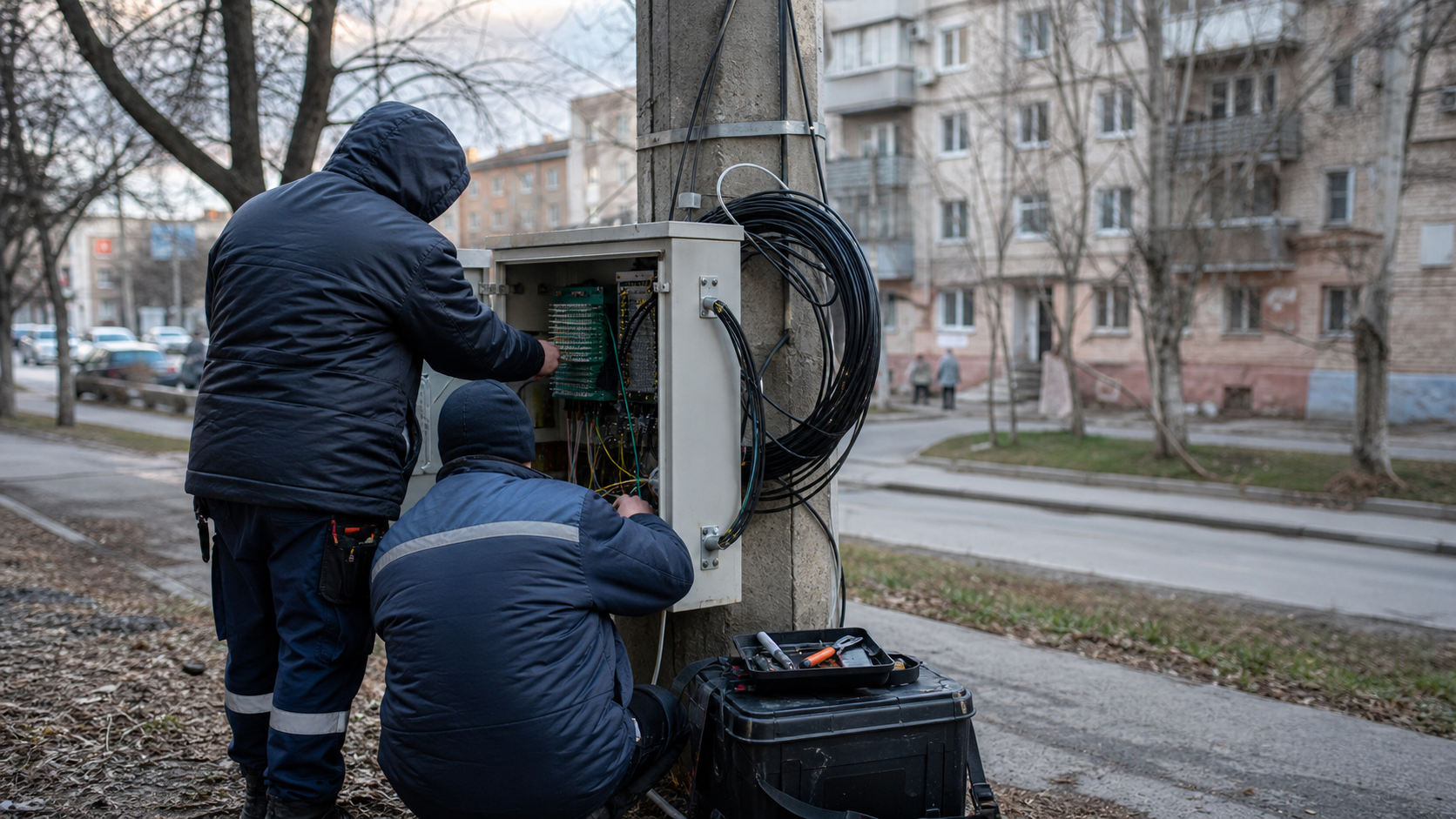
The connection page makes the cost base concrete. It says a standard connection includes optical cable for the subscriber line up to a specified distance, mounting from pole to premises, subscriber optical equipment, splicing, signal checking, a copper patch cord and initial setup of one device or router. It also excludes hidden cable routing, in-premises local-network construction and a router where the contract requires one. This is exactly where local ISP margin is won or lost. Every included installation item is a capital or labour claim on the provider.
Every excluded item is an attempt to stop the customer's premises from consuming unlimited unpaid work.
The service contract evidence cuts both ways. The public offer linked from the Civilization site is for internet-access service and describes subscriber payment, account balance, service activation, maintenance windows, fault handling, the provider's right to suspend service at zero balance, and the expectation that the service is available continuously. But the provider named in that public offer is not ALTAIR MEGA; it is another legal entity. This is not a reason to ignore ALTAIR MEGA.
The contact page lists ALTAIR MEGA as a payment recipient, the historical provider record links ALTAIR-MEGA to the same web address, and AS35319 routing data links ALTAIR MEGA to the network. It is a reason to avoid treating the website as proof that every subscriber contract belongs to ALTAIR MEGA.
That distinction is economically important. A group of local companies can share a brand, payment channels, network resources, staff, customers or infrastructure. The cash can flow through more than one entity. One company may hold resources, another may sign consumer contracts, another may handle a billing account, and another may maintain a segment of the network. Public readers do not see those internal allocations. The article can say that ALTAIR MEGA is part of the public evidence around Civilization's local access system. It should not say, without stronger documents, that ALTAIR MEGA alone books all Civilization subscriber revenue.
The tariff page still offers a useful lower bound on pricing power. Low monthly retail prices mean a provider needs either low support burden, high density, careful installation economics, strong payment discipline, cheap upstream terms, shared overhead or cross-entity cost allocation. If a 100 megabit household plan is priced at a few hundred hryvnia, the provider cannot afford enterprise-style support habits for ordinary accounts. It must standardise equipment, discourage preventable calls, automate payment, limit free premises work and design the network so that one field visit does not erase months of margin.
The site also points to a mixed household and small-business role. It offers fixed-address service, describes surveillance and security use cases, and gives practical advice around Wi-Fi and HD television. That mix can help margin if add-ons are profitable and support is disciplined. It can hurt margin if customers use the low monthly access price as an entitlement to unlimited device help. The provider's task is to sell access while charging for the extras that turn access into local reliability.
Number Resources Give Optionality, Not Free Cash
AS35319 and the linked IPv4 ranges are valuable because they give the local system an identity in global routing. Public network-intelligence pages show ALTAIR MEGA associated with 10 originated IPv4 prefixes and roughly 6,400 IPv4 addresses in visible AS-level summaries. Several listed ranges are marked as valid under route-origin authorization in those public views. Reverse-DNS patterns and IP-intelligence pages link many addresses to Civilization and DataSfera-style names. One BGP-intelligence service describes the network as active under RIPE and shows three upstreams in the public view.
That is real infrastructure evidence. An access provider does not need a huge national footprint to matter. A local network with its own ASN, addresses and upstream relationships can control routing policy, give customers stable addresses, manage local aggregation, host services, support business accounts and retain some independence from pure resale. In markets where IPv4 remains scarce, address control can also be a commercial asset. It gives the provider flexibility that a purely borrowed access service would lack.
But number resources are not cash by themselves. They create obligations and options. They require accurate records, contacts, abuse handling, invoices, route objects, RPKI discipline and operational staff who understand routing. They also create reputational exposure. If customer equipment scans the internet, if compromised devices send abuse, if hosting customers draw complaints or if routing records are stale, the resource holder can become the visible contact. The address block may make service possible, but it also brings administrative work that a simple reseller could avoid.
The apparent size of AS35319 is consistent with a local provider, not a national carrier. Ten IPv4 prefixes and no visible IPv6 origination in the public summaries can support a local access and hosting-adjacent business, but they do not show deep national scale. The upstream list also points to dependence rather than self-contained backbone control. RETN, Eurotranstelecom and Enterra appear in public views as relevant upstream or adjacent networks. That is normal for a local operator.
The economic question is whether ALTAIR MEGA or the related service structure buys upstream capacity well enough, engineers local aggregation efficiently enough and passes enough of the cost into customer prices.
There is also a difference between originated space and company-owned economics. Some prefixes in public AS summaries carry descriptions tied to DataSfera or Enterra, while others list ALTAIR MEGA directly. This does not undermine the network evidence; it reinforces the multi-entity reading. Local access networks often grow through history, acquisitions, reassignments, shared brands and related legal companies. From a customer's perspective, the service either works or it does not.
From an investor's or creditor's perspective, the question is which entity owns the cash flows, which owns the network obligations and which signs the supplier contracts.
The IPv4 footprint may be economically important for fixed-address add-ons. The Civilization tariff page lists a static-address product. That is a small line item, but it can matter in a low-price access model. Businesses, cameras, remote access, small servers and certain applications often need stable addressing. If the provider has address resources and can sell static service cleanly, it can improve average revenue per account. The fee is not large, but it helps convert scarce technical resources into recurring cash.
Resource control can also support data-locality and continuity arguments. Some Ukrainian customers prefer local reachability, local support and domestic routing. Others need cross-border resilience or cloud backup. A local network with its own resources can take part in that decision rather than merely pointing customers to a global platform. Again, the asset has value only if it is sold as a service that customers understand and pay for. A route object does not fund a repair van.
The Revenue Record Shows A Small Business Under Pressure
The financial figures reported for ALTAIR MEGA are the most sobering part of the record. Revenue of roughly UAH 7.97 million in 2025 is meaningful for a small Dnipro operator, but it is not large. The reported net profit of roughly UAH 316,900 implies a net margin of about four percent. That is better than a loss, but it leaves little room for mispriced installation work, bad debt, equipment shock, power resilience upgrades, wage pressure or a major supplier price increase. The business, as reported, is not throwing off excess cash.
The year-to-year movement also matters. Revenue rose sharply in 2024 and then fell in 2025, while net profit rose only modestly. The employee count reported by Opendatabot is especially hard to reconcile with the full service image of an access network. One employee on the legal entity in 2025 cannot, by itself, operate a support desk, field crew, routing function, billing operation and customer service for a retail access brand at scale. The likely explanations are shared labour across related entities, outsourced work, accounting classification or the fact that ALTAIR MEGA books only part of the wider service activity.
Each explanation is plausible. Each reduces the value of taking ALTAIR MEGA's standalone accounts as the whole network.
Low tariffs make the cash-flow test stricter. At a few hundred hryvnia per month, a residential customer contributes limited gross cash before value-added tax, payment costs, upstream costs, maintenance, equipment amortisation and support labour. If the customer churns quickly, installation costs may not be recovered. If the customer stays many years and rarely calls, the account can be attractive. If the customer requires repeated visits, router support, cable repairs and payment follow-up, the account can be value destructive. The provider's profitability depends less on headline speed than on average service minutes per account.
The tariff structure appears designed to segment by geography and capacity. City plans include higher speed options, while settlement plans include slower and moderate speeds at prices that reflect local affordability. Karnaukhivka plans are even lower in price. That may make sense for network utilisation and customer demand, but it also means rural or settlement accounts cannot be supported as if they were high-priced business links. Longer drops, lower density and more difficult field logistics have to be recovered through connection policy, efficient routing of service visits and disciplined limits on free work.
The static-address line shows one route to better economics. A fixed-address add-on at a small monthly price can carry strong margin if address inventory is available and support burden is controlled. It also attracts more technically demanding use cases: cameras, remote administration, small servers, VPN access and business systems. Those customers may be stickier and more willing to pay for help. They may also create more abuse, security and support work. A provider has to decide whether the add-on is a simple margin enhancer or the start of a more expensive managed-service relationship.
The corporate profit record suggests that pricing power is limited. A company with strong local monopoly characteristics, high density and low churn would normally aim for stronger returns unless it is reinvesting heavily, sharing costs with related entities or pricing aggressively to hold territory. The public data does not disclose capital expenditure, depreciation detail, supplier contracts or intercompany charges. It does show that the reported entity is not large enough to absorb repeated shocks casually. That should shape any assessment of reliability claims. The service can be real and still financially tight.
The important point is not that low profit proves weakness. Many small infrastructure businesses report modest profits while maintaining useful local networks. The point is that reliability has to be financed somewhere. If it is not in the monthly tariff, it must come from connection fees, static-address add-ons, business accounts, cross-entity support, low salaries, deferred renewal or owner tolerance. Only some of those are durable.
Supplier Dependence Defines The Control Surface
Public BGP views show AS35319 connected to larger upstream or adjacent networks, including RETN, Eurotranstelecom and Enterra in the sources used for this article. That is not a criticism. No local access network reaches the global internet alone. It buys transit, uses interconnection, depends on regional backhaul and coordinates with carriers. The issue is economic control. When an upstream path fails, when a route changes, when a supplier raises price or when a remote complaint arrives, the local provider's customer relationship is at risk even if the immediate cause sits elsewhere.
RETN is a large international network compared with a Dnipro local provider. Eurotranstelecom is a Ukrainian telecom carrier. Enterra is another Dnipro-linked network with public retail and service pages of its own. Those links can improve resilience and reach. They can also create dependency. The local provider needs enough redundancy and supplier leverage to avoid being trapped by a single path or a single commercial counterparty. It also needs enough technical skill to know when to escalate, when to reroute and when to tell customers the truth about a fault.
The Civilization site's own language makes the control challenge visible. It presents redundancy, backup power and trunk channels as part of the service promise. That promise costs money. Backup power means batteries, generators, monitoring, replacement and fuel logistics. Redundant backbone channels mean contracts, equipment ports, route policy and ongoing capacity management. A provider can write these words on a website more easily than it can fund them for every weak point in the network. The cash-flow test asks whether the monthly account base and add-ons are enough to make the promise operational.
Supplier dependence also matters for installation economics. The customer sees a single connection, but the provider may rely on pole access, building access, ducts, power, upstream fibre, wholesale internet and payment systems. Each dependency can become a bottleneck. If a pole route is damaged, the customer wants repair. If a building association delays access, the provider loses installation time. If power outages become frequent, the network needs extra resilience. If upstream rates rise, the tariff page does not automatically adjust. Local networks live inside supplier chains that are more complex than the subscriber invoice.
The multi-entity evidence adds another control question. If ALTAIR MEGA holds resources, another company signs the public offer, and related brands or entities share payment flows, then operational control may be distributed. That can be efficient. It can separate risk, history, licences, accounts and assets. It can also make outside analysis harder. A creditor, acquirer or large customer would want to know which entity owns fibre, electronics, subscriber contracts, support staff, IP resources, bank accounts and debts. Public records alone do not show this. The best public conclusion is that control appears local, but not fully transparent.
The downside of supplier dependence is not just outages. It is margin compression. A small provider cannot always pass through upstream cost increases immediately. Customers compare tariffs and may resist increases. If supplier prices, energy costs, wages or equipment prices move faster than consumer tariffs, margin narrows. The provider can respond by under-maintaining the network, raising prices, cutting support, delaying upgrades or trying to sell more add-ons. The durable answer is a customer base that values local reliability enough to accept price changes before service quality collapses.
The upside is asset-light flexibility. A local provider that uses larger carriers well can avoid building everything itself. It can focus on last-mile knowledge, customer support and neighbourhood coverage. That can be profitable where national providers are slower or less attentive. The skill is to sell local accountability without pretending to own the entire path. ALTAIR MEGA's public evidence fits that middle ground.
Field Work And Repair Burden Set The Real Cost Base
Local broadband is a field-work business hiding inside a data service. The Civilization connection terms list fibre from the pole to the premises, subscriber equipment, splicing, signal checking and initial device setup. Each installation consumes labour and materials before the first full month of revenue is earned. A dense apartment building can repay that investment quickly. A long individual drop in a settlement repays more slowly. A customer who cancels early, pays late or demands repeated device help can turn an apparently profitable account into a loss.
The repair burden is just as important. The public offer says the provider can pause service for maintenance and must address faults under defined conditions. Customers, however, experience service more bluntly: working or not working. They rarely distinguish between an upstream incident, a broken drop cable, a failed media converter, a weak Wi-Fi router, a power outage or a misconfigured device. The local provider has to make that distinction quickly because each category has a different cost owner. If the provider absorbs all categories as free support, the monthly tariff is not high enough.
Wi-Fi support is particularly dangerous for margin. The homepage and contact flows refer to router setup and Wi-Fi consultation. Customers judge broadband through wireless performance, but much of that performance is inside the home: router placement, interference, device age, walls, cheap repeaters and neighbour congestion. If the provider includes basic setup but does not charge for in-home troubleshooting beyond the standard scope, the help desk can become a free electronics support service. Good providers turn Wi-Fi help into paid installation, standard equipment and clear limits.
Television and device add-ons create another support tail. The site markets HD video, TV packages and set-top devices. These products can raise account value, but they broaden the fault surface. A subscriber may call because a television app fails, a set-top box freezes, a remote does not work or a third-party content service buffers. Some issues are network-related; others are not. The provider has to decide where paid connectivity ends and device support begins. Without that boundary, the highest-engagement customers can become the least profitable.
Power resilience is not optional in Ukraine. National and regional infrastructure has faced repeated stress from war, energy attacks and repair cycles. Even when the core network remains reachable, local nodes, access equipment and customer premises may lose power. Backup systems can keep aggregation alive for a while, but they cost money and need maintenance. A network that advertises stability must decide which nodes receive backup first, how long backup should last, how batteries are replaced and whether customers will pay for the level of resilience they expect.
Staffing is the hidden constraint. The corporate record's small employee count suggests that the wider service system must rely on shared labour, contracted work, related entities or unusually lean operations. None of those is impossible. But support responsiveness depends on people. A local network can carry many customers with a small technical team when systems are standardised and faults are rare. It can break down quickly when weather, power, construction damage or cyber incidents create simultaneous tickets. The cash-flow test should therefore include surge capacity, not just average-month labour.
Equipment replacement also has to be funded. Optical electronics, switches, routers, power supplies, batteries and customer devices do not last forever. Inflation and currency movement can raise replacement costs faster than tariffs. If reported profit is thin, renewal capital competes with owner income, taxes, supplier payments and routine repairs. The temptation is to delay upgrades until failure. That improves short-term cash and weakens long-term reliability. A serious provider prices renewal before the outage, not after it.
Customer Quality Matters More Than Customer Count
Public evidence does not disclose ALTAIR MEGA's subscriber count, churn, business share or customer concentration. The Civilization tariff pages show retail reach, but not how many accounts pay, how long they stay or which legal entity books them. The corporate accounts show revenue, but not the source mix. For a local access network, this missing information is central. Ten thousand low-price, high-churn accounts can be worse than fewer stable, low-support accounts. A small set of business or provider customers can support the network, but concentration creates cliff risk.
The public claim that the Civilization node serves commercial providers in the region is potentially important, but it is company-authored and not independently quantified in the evidence set. If the brand truly sells or supports services for other providers, the economics can be better than consumer-only access. Provider or business accounts may buy capacity, colocation, technical support or network services at higher value per relationship. They can also be demanding customers with stronger service expectations. Without contracts, traffic data or revenue segmentation, this remains an upside possibility rather than a settled fact.
Settlement coverage creates a different quality question. Serving villages and suburbs can build local loyalty. Customers may value a provider that knows the route, the poles, the buildings and the actual support constraints. Switching options may be fewer than in dense central Dnipro. That can improve retention. But lower density raises cost per connection and cost per repair. If one technician spends significant travel time on a low-priced account, the economics depend on clustering visits, reducing repeat faults and keeping installation standards high.
Payment discipline is also customer quality. The public offer's zero-balance suspension language shows a prepaid or balance-based mindset. That is rational. Low monthly tariffs leave little room for receivables risk. A provider that lets many accounts drift unpaid is financing customers with money that should fund suppliers and repairs. Automated personal-account payment and card payment help, but they do not remove affordability pressure. In a wartime economy, even good customers may delay payment.
Business customers can improve the mix if they buy fixed addresses, priority support, backup links, cameras, office wiring or managed equipment. They can also become costly if they expect enterprise service levels while paying household-style prices. The correct economic boundary is clear service packaging: ordinary access, paid add-ons, business support, installation extras and emergency work. The public pages show some segmentation, but not enough detail to judge business-service margins.
Customer concentration would be the most important hidden risk. If ALTAIR MEGA's reported revenue is supported by a few related entities, provider accounts or large local customers, the business may look stable until one relationship changes. If it is spread across many households, concentration risk is lower but support burden is higher. The article cannot answer this from public data. It can identify what the company would need to show: active accounts by tariff, monthly churn, average revenue per account, support tickets per hundred accounts, business share and revenue by legal entity.
The best customers for this model are those who pay on time, stay for years, use standard equipment, accept paid add-ons and value local repair. The worst customers are those who churn after installation, demand free device work, generate abuse complaints, delay payment and live on expensive-to-service routes. The same network can be attractive or unattractive depending on the mix.
Competition Comes From Bigger Networks And Nearby Substitutes
ALTAIR MEGA's service context faces competition from several directions. The first is national scale. Large Ukrainian operators and mobile networks can offer brand recognition, broader coverage, bundles and stronger capital access. They may be able to buy equipment and upstream capacity on better terms. They may also be less nimble in small settlements, slower on local repairs or less willing to solve individual premises problems. A local provider wins when hands-on accountability is more valuable than brand scale.
The second competitor is another local provider. Enterra's public site, for example, offers local fibre-style internet, television, static-address service and Dnipro-area customer propositions. Whether it is a competitor, supplier, neighbour or some combination in specific circumstances, it shows that local customers can compare similar practical offers. In a local broadband market, customers do not need a theoretical substitute; they need another provider willing to serve their building or street. Price pressure is strongest when two local networks overlap.
The third competitor is fixed wireless or mobile broadband. Mobile service can be good enough for some households, backup needs and low-usage accounts. It is weaker for heavy use, stable latency, cameras and large downloads. But if a household mainly uses phones and video, mobile bundles can limit what a fixed provider can charge. Fixed providers defend themselves through reliability, unlimited use, lower latency, home Wi-Fi quality and better support for devices that need stable addresses.
The fourth competitor is self-provision by small businesses. A business can buy a connection from a larger operator, install a router, use cloud services and call a freelancer for occasional support. That may be cheaper than a local managed relationship. It may also fail when a problem requires someone who knows the site. ALTAIR MEGA's ecosystem has to sell the value of being reachable and accountable. If customers think all access is the same, the lowest price wins.
The fifth competitor is cloud substitution. A small office that once needed local servers may now use SaaS and public cloud. That reduces some local hosting demand, but it increases dependence on stable access, identity management, backup and security. A provider can lose low-value server maintenance and still gain higher-value continuity work. The question is whether the provider has the skill and product structure to sell that transition, or whether it remains trapped in low-price access alone.
Competition also comes from customer tolerance of poor service. Many households do not switch immediately after inconvenience because switching takes time, wiring, appointments and uncertainty. This inertia can protect a local provider, but it is not true pricing power. It can disappear when a better alternative reaches the building. Durable pricing power comes from a service that customers would actively miss, not merely from the nuisance of changing provider.
The public tariff levels imply a market where affordability matters. A provider cannot simply raise prices to solve every cost problem. It has to earn increases through reliability, coverage, support and add-ons. In low-price access markets, the most valuable competitive asset is operational discipline. The provider that installs cleanly, bills accurately, repairs quickly and avoids repeated calls can survive on tariffs that would punish a disorganised operator.
Regulation, War And Abuse Handling Raise The Cost Of Reliability
Telecommunications regulation matters because customers buy a public service, not a private hobby network. The historical provider listing for ALTAIR-MEGA shows internet-access service in Dnipropetrovsk region under the older regulator framework. Current Ukrainian electronic-communications rules use a provider-register and notification logic, and the public offer on the Civilization site refers to the legal framework for electronic communications. For diligence, a current register extract would be essential. For economic analysis, the point is simpler: regulated public connectivity brings obligations that informal IT support does not.
Compliance is not just a legal formality. Providers must know who is responsible for customer contracts, quality terms, personal data, payment records, suspension, complaint handling and lawful service conditions. They must also keep resource and abuse contacts accurate in internet registries. These tasks do not always generate visible revenue. They consume administration time. In a small company, the same people who handle customers may also handle paperwork, suppliers and technical records. That means compliance competes directly with repair and sales work.
War increases the cost of every reliability promise. Ukraine's communications and energy environment has required resilience planning, backup power, repair coordination and operational flexibility. A local access provider may face power disruption, damaged infrastructure, supply delays, staff safety issues, customer relocation and changing demand patterns. Some of these pressures raise demand for stable connectivity. They also raise the cost of providing it. A customer may need internet more than ever and still resist a higher monthly price.
Power backup is one clear example. A provider can install batteries and backup systems at nodes, but those systems degrade and need replacement. Extended outages can exhaust backup. Fuel logistics and generator use add labour and cost. Customers may not understand why a nearby node works while their own premises equipment is dark, or why mobile networks behave differently from fixed access. The provider has to communicate these differences while under pressure. Communication itself is labour.
Abuse handling is another underpriced duty. Public IP-address reputation pages show complaints on individual addresses associated with ALTAIR MEGA ranges, including scanning or brute-force type reports. Such pages are noisy and should not be treated as proof that the provider is negligent. Any access or hosting network can receive complaints when customer devices are compromised or when attackers use hosted services. The economic point is that abuse handling costs time. Someone has to receive, classify, respond, suspend, clean up or educate. If the provider sells static addresses and hosts customer devices, the exposure rises.
Data locality also carries a cost. Ukrainian customers may want local service, local language support and domestic routing; others may want foreign-hosted continuity or cloud backup. A local network with its own resources can participate in that decision. But it must be honest about what it controls. Locality can help latency and support. It does not remove power risk, upstream risk or cyber risk. Cross-border routing can improve reach, but it adds supplier dependence. Customers pay for a practical trade-off, not a slogan.
Regulatory and wartime context also affects capital needs. Replacement equipment may be imported. Currency movements can make switches, optical equipment, batteries and routers more expensive in local terms. If tariffs are denominated in hryvnia and equipment is influenced by foreign-currency pricing, the provider needs either periodic tariff adjustments or enough margin to absorb shocks. Thin reported profit leaves little room for slow pricing response.
Unofficial Signals Need To Stay In Their Lane
The public record contains useful unofficial signals, but each has limits. One BGP-intelligence service tags AS35319 as home-ISP-like and reports rankings for estimated Ukrainian eyeballs, unique domains and originated IPv4 space. One IP-intelligence service reports hosted domains, pingable addresses, router addresses and a recent traceroute from Kyiv to an AS35319 address. Abuse-report pages show individual address complaints. IP-geolocation pages attach Dnipro location and ISP or hosting classifications to addresses. These signals help describe the network's public footprint.
They should not be treated as audited customer or revenue data.
The strongest use of unofficial network data is triangulation. If several independent routing and IP-intelligence sources show AS35319 originating address space, using upstreams and presenting Dnipro-linked reverse names, then a real network footprint is likely. If those sources differ on exact classification, peer counts, company labels or address descriptions, the safe conclusion is not that one page is absolutely right. The safe conclusion is that the network sits in a complex local ecosystem where resource history, brand history and related entities overlap.
The DataSfera and Enterra evidence also needs discipline. DataSfera appears in corporate, job and payment evidence around the local telecom ecosystem. Enterra appears as an adjacent network and has its own retail site. ALTAIR MEGA's contact-page payment role and RIPE records connect it to the same ecosystem, but public evidence does not show a full ownership chart or intercompany service agreement. It is fair to say the market evidence points to a Dnipro access group around Civilization, DataSfera, Enterra and ALTAIR MEGA records. It is not fair to assign every employee, customer or supplier obligation to ALTAIR MEGA without documents.
The job-market signal is especially easy to misuse. A call-center vacancy for DataSfera, with requirements around PC, internet and router configuration, supports the view that there is a local support operation in the broader environment. It does not prove ALTAIR MEGA's headcount. It does not prove customer count. It does, however, illustrate the real labour behind the tariff page: someone must answer calls, understand routers and solve subscriber problems. That is a cost signal, not a corporate-boundary proof.
Public reviews and complaint pages are also mixed. Sparse consumer feedback can mean a small market, low visibility, business-to-business relationships or simply poor review coverage. Abuse complaints can signal customer compromise, hosting exposure, scans or reporting noise. A serious evaluator would ask for internal ticket data, churn, net promoter feedback, outage logs and abuse-response records. Public unofficial signals tell us where to ask; they do not close the file.
The risk of overclaiming is highest when a small provider has more network evidence than financial transparency. It is tempting to infer a large business from an ASN and visible prefixes. It is equally tempting to dismiss the company because reported staff and profit look small. Both shortcuts miss the actual economics. Local network businesses can be small, useful and fragile at the same time. The question is how the cost stack is paid.
What Would Change The Judgment
The first fact that would change the judgment is a current legal and regulatory mapping of the Civilization service. The key questions are which entity signs subscriber contracts, which entity holds the current provider-register entry, which entity owns the physical network, which entity employs support and field staff, and which entity books the revenue. If ALTAIR MEGA is the central operating company, the standalone financials need to be reconciled with the service scope.
If it is primarily a resource or payment entity inside a group, the analysis should treat it as an infrastructure and cash-flow component rather than the whole retail operator.
The second fact is subscriber economics. Active accounts by geography, average revenue per account, static-address penetration, TV penetration, business share, churn and payment arrears would decide the quality of revenue. A few hundred stable, high-margin business and provider accounts would tell one story. Thousands of low-price household accounts with frequent support calls would tell another. Public tariffs show the offer; they do not show account quality.
The third fact is cost allocation. The reported ALTAIR MEGA accounts are small enough that shared costs may sit elsewhere. An evaluator would need upstream contracts, power costs, equipment purchases, depreciation, intercompany charges, payroll allocation, repair expenses and bad-debt history. A network can appear profitable in one entity if expensive labour or assets sit in another. It can also appear weak if one entity holds costs while another books customer revenue. Public accounts alone cannot answer this.
The fourth fact is technical resilience. AS35319's routing record is visible, but the public record does not show actual topology, backup capacity, node count, customer-density map, mean time to repair, outage frequency, battery autonomy or spare-equipment practice. The Civilization site claims redundancy and backup power. The economics depend on how much of that is implemented, where it is implemented and how it is renewed. Reliability is not a marketing line; it is an inventory and maintenance plan.
The fifth fact is supplier concentration. If one upstream or local partner carries most traffic, the business is more exposed. If the provider has practical redundancy and contractual alternatives, the risk is lower. The public upstream list is useful, but it does not disclose traffic share, contract terms or failover quality. A customer paying for critical service would ask for these facts before relying on the network.
The sixth fact is abuse and security discipline. Address space with consumer and hosting exposure needs clear response rules. How quickly are compromised subscribers contacted? How are static-address customers screened? Are repeat offenders suspended? Are routing records and contacts kept current? Does the provider have enough staff to handle complaints without distracting from normal support? These questions determine whether resource control is an asset or a recurring burden.
The seventh fact is pricing policy. The tariff page shows affordable offers, but not how often prices are updated, how connection costs are recovered, how installation promotions are accounted for, or how premium support is charged. A provider with courage to raise tariffs when costs rise may lose some accounts but preserve service. A provider that freezes prices too long may keep customers and lose the network.
The current judgment is therefore conditional. ALTAIR MEGA LLC is not a blank RIPE record. It is a Dnipro company with visible network, regulatory, retail-access and payment evidence. It also has boundary ambiguity and thin reported standalone economics. The business can work if subscriber density, shared operations, upstream contracts and add-on revenue are strong enough to turn low monthly fees into reliable cash. It weakens if the same fees have to pay for too much field work, too much supplier risk and too much renewal capital.
The Cash-Flow Test Is The Investment Case
The investment case is not glamour. It is whether local reliability can be priced. ALTAIR MEGA's public evidence points to a company near the practical side of Ukrainian connectivity: last-mile access, Dnipro-area coverage, RIPE resource governance, AS routing, static addressing, customer support and a billing role inside a visible local access brand. That position can be valuable because customers need someone nearby when connectivity fails. It can also be unforgiving because customers often pay as if internet access is a commodity while expecting repair as if it is a utility.
The reported accounts suggest a business with little surplus. A few hundred thousand hryvnia of net profit does not leave much protection against a serious equipment cycle, supplier shock or support surge. If related entities carry staff and assets, the group economics may be stronger than ALTAIR MEGA's standalone accounts imply. If not, the reported entity is operating with tight financial oxygen. Either way, the cash-flow question remains: who pays for the next upgrade, the next battery replacement, the next field crew and the next routing administration burden?
The best reading is cautiously constructive. The company has durable public evidence: a long-registered Dnipro legal entity, wired-telecommunications classification, historical provider status, visible retail access evidence, AS35319 and a meaningful IPv4 footprint for local scale. It is not a speculative shell in the public record. It is also not proven as a transparent standalone carrier with clearly disclosed scale. The facts justify attention, not a blank cheque.
For customers, the practical question is service accountability. The Civilization service material tells customers what they can buy, where they can apply and how tariffs work. Customers should care less about abstract routing than about whether support responds, whether installation is clean, whether backup power works, whether bills are clear and whether faults are fixed without finger-pointing among related entities. A local provider that solves these problems earns loyalty even at modest scale.
For suppliers, the question is payment discipline and operational maturity. Upstream networks, equipment vendors and service partners need a customer that pays, communicates and manages incidents. A small provider with stable local demand can be a good counterparty. A provider with weak margins and growing repair demands can become a difficult one. The difference is not visible in an ASN table. It shows up in invoices, escalation history and maintenance practice.
For investors or acquirers, the key asset would be the account base, local route knowledge, customer trust, address resources and any physical infrastructure that is actually owned or controlled by the operating structure. The key risk would be unclear entity boundaries, thin profit, undocumented shared labour, underfunded renewal and low-price tariffs that cannot carry future costs. Before any valuation, the public evidence would need to be reconciled with contracts and books.
The bottom line is simple. ALTAIR MEGA LLC's public footprint supports a real local network-reliability story, but the story is only attractive if each paying account contributes to the cost of staying reliable. If the subscriber bill merely buys bandwidth while the provider quietly absorbs upstream risk, installation work, router support, abuse handling, power resilience and renewal capital, the economics are fragile.
If the bill is part of a disciplined service model with paid add-ons, low churn, standard equipment, clear support boundaries and sensible supplier contracts, a small Dnipro-centered operator can be more durable than its headline size suggests.