
Summary
- Alnakel Co. Ltd is most strongly evidenced as a Syrian RIPE NCC member and IPv4 resource holder, with four visible provider-aggregatable address blocks, repeated Damascus addresses, and routing dependence on Syrian Telecommunications records rather than a clear standalone autonomous-system position.
- The economic question is not whether an address block exists. It is whether Alnakel can turn resource control, local support, and service continuity into prices that cover upstream access, power instability, billing friction, compliance overhead, customer churn, and renewal capital.
- The public record links Alnakel to the HiFi operating name and domain signals, but those signals do not by themselves prove the scale, tariff book, customer mix, or profitability of any retail or enterprise internet business.
- The judgment would improve with audited subscriber revenue, upstream contracts, uptime data, local service licenses, traffic volumes, customer concentration, and capex plans; without those facts, Alnakel should be read as a small resource-backed local connectivity platform with high supplier and operating risk.
A subscription has to carry more than bandwidth
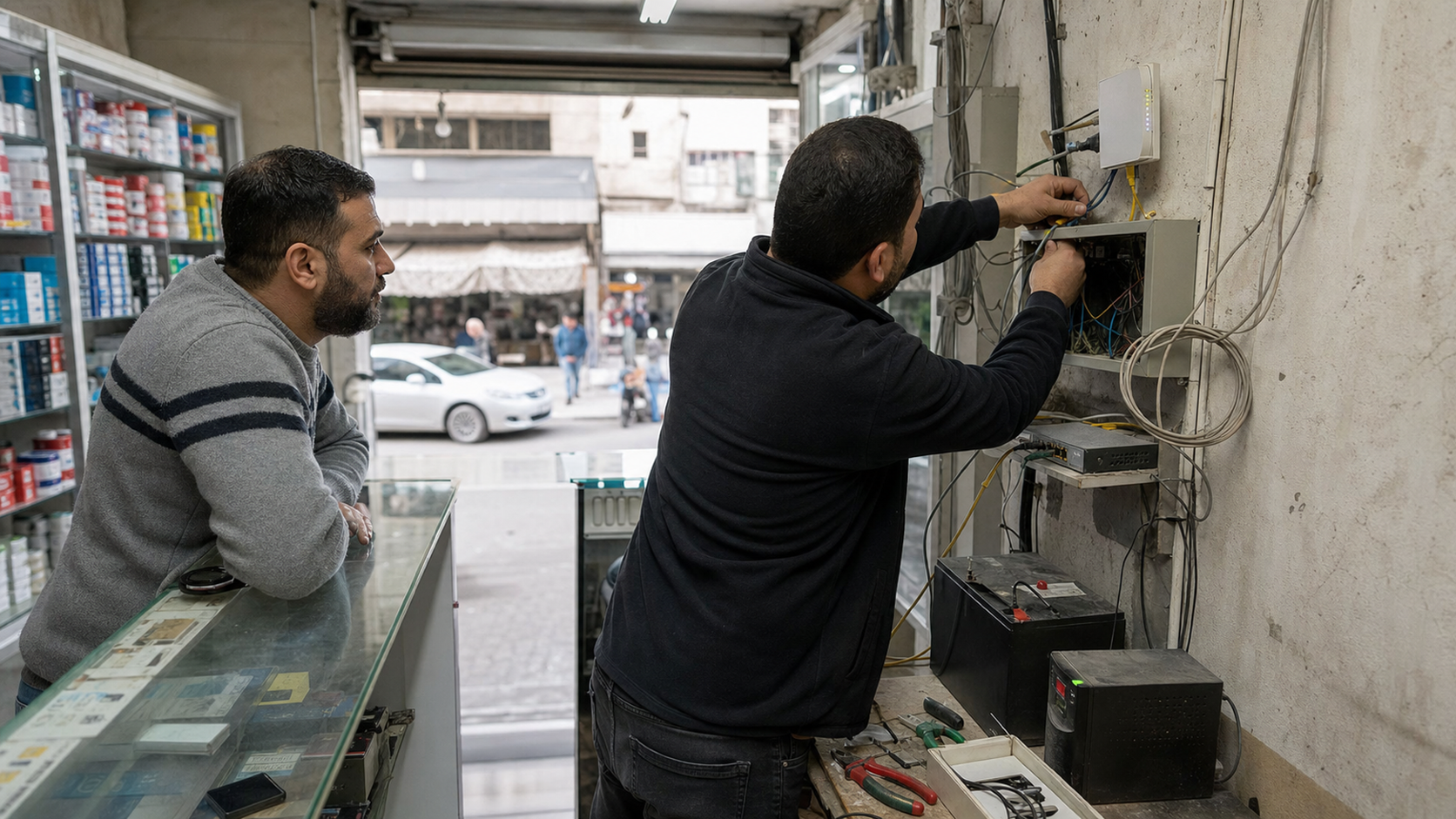
Start with one paying account in Damascus: a small office, a clinic, a pharmacy, a repair shop, or a family that needs a connection stable enough to keep payments, messaging, cloud documents, voice calls, and everyday browsing alive. The monthly fee from that account is not simply buying bits. It must carry the cost of upstream capacity, access to the incumbent fixed network, local support time, routers and replacement equipment, billing collection, taxes or regulatory charges, and the overhead of keeping internet number resources in good standing.
It must also carry the unpriced work of answering complaints when the failure is not inside the provider's own equipment: a cut line, a weak copper loop, a power outage, a congested exchange, an upstream routing issue, a damaged cabinet, or a national connectivity interruption.
That is the cash-flow test behind Alnakel Co. Ltd. A local provider can look important in registry data because it holds scarce IPv4 addresses. It can appear visible in public geolocation records because its address blocks are associated with Syrian users or Syrian cities. But none of that automatically means it has pricing power. The hard question is whether the customer fee is high enough, collectible enough, and stable enough to pay for the whole stack that sits behind a working line. In Syria, that stack is unusually demanding.
The country has a constrained telecom market, damaged infrastructure, weak fixed-power reliability, shifting sanctions treatment, and a reconstruction story that may attract larger regional capital over time. A smaller company has to sell reliability in that environment without controlling every layer that creates or destroys reliability.
For a household, the service may be judged by speed, video quality, and whether the connection works after sunset. For a business, the service may be judged by downtime, repair time, upload stability, and whether the provider can produce a human answer when a payment terminal or cloud accounting system stops syncing. Those expectations make local support valuable. They also make local support expensive. If one technician visit consumes the margin from several subscriptions, the provider needs either scale, strict service rules, high-value customers, or a way to push repair cost back to the layer that caused the fault.
If it cannot do that, reliability becomes a promise that customers demand but do not fully fund.
Alnakel's public evidence should therefore be read as a starting point, not a verdict. The strongest record shows a resource footprint in the RIPE NCC service region and several IPv4 allocations tied to the company name. That matters. IPv4 remains economically scarce, registry membership imposes obligations, and address continuity is a real asset when customers depend on stable connectivity. But the evidence is weaker on the commercial side.
It does not show a public tariff book under the Alnakel name, a customer count, a traffic bill, a balance sheet, an enterprise contract list, or an independent network under its own autonomous-system brand. The article's judgment has to separate what is proven from what may be operationally true but is not yet documented in public records.
What is proven, and what is not
The proved facts are narrow but meaningful. Alnakel Co. Ltd appears repeatedly in RIPE NCC membership and allocation material for the Syrian Arab Republic. Public allocation tables list four Alnakel LIR codes and four IPv4 provider-aggregatable blocks: one allocated in 2016, another in 2017, and two more in 2018. Each block is a slash twenty-two, or one thousand twenty-four IPv4 addresses, giving the visible Alnakel footprint a combined four thousand ninety-six addresses. The membership records point to Damascus addresses, including Abou Remmaneh and a Tyjara building near Maza Restaurant, and show contact data using a HiFi email domain.
That is not a vague web directory mention; it is a number-resource governance trail.
The corporate identity record is more complicated. A commercial business directory entry for Alnakel Co for Import and Export uses the doing-business-as name Alnakel Co Ltd and places the company at a similar Damascus address. It classifies the business in warehousing, storage, wholesale, freight arrangement, and related commercial activities, not as a pure telecom operator. That does not defeat the telecom evidence, because private companies can have legacy names, mixed activities, affiliates, or separate operating brands. It does, however, widen the boundary of uncertainty.
The name Alnakel may be the legal resource-holder record behind an internet-service activity; it may also sit inside a broader corporate structure whose public business classification is not telecom-specific. Either way, the commercial directory record should not be treated as proof of broadband revenue.
The public service trace is strongest around the HiFi name. RIPE contact data for Alnakel uses a HiFi email address, and public profile material for HiFi Internet Service Provider describes a Damascus-based internet provider founded in 2016, offering internet service to individuals, companies, and organizations. Domain data for hifi dot sy shows a live local internet domain with mail hosts and Syrian server location signals, while a public profile gives the slogan High and Fast Internet. Those facts suggest an operating connection between Alnakel's resource records and the HiFi market-facing name.
But the relationship is not fully documented in public material. A cautious reader should say that Alnakel is publicly linked to HiFi contact and domain evidence, not that every HiFi customer, asset, employee, or tariff belongs legally to Alnakel.
That distinction matters for valuation and risk. Registry membership proves standing in the resource governance system. It does not prove retail subscribers. A routed prefix proves that addresses can be visible in the global routing table. It does not prove that Alnakel controls the underlying transport, owns last-mile assets, runs an independent backbone, or earns the full end-user bill. A public internet-service profile proves market messaging. It does not prove collection rates, churn, gross margin, enterprise concentration, or the level of dependence on Syrian Telecommunications infrastructure.
The fair conclusion is that Alnakel has a credible resource-holder footprint and a plausible service connection, but the commercial boundary remains partly opaque.
This opacity is not a minor detail. In a mature market, a small ISP may lease wholesale access, manage customer premises equipment, operate support, and still build a profitable business by bundling responsiveness and local knowledge. In a stressed market, the same model can become fragile because every fault looks like the local provider's fault even when the provider does not control power, international capacity, national routing, or copper quality. Alnakel's public record proves enough to justify monitoring. It does not prove enough to grant it a carrier moat.
The network footprint visible in public resource records
The visible network footprint has four main elements. First, public RIPE allocation material lists Alnakel as the holder of four provider-aggregatable IPv4 blocks. The blocks are 185.150.140.0 slash twenty-two, 185.204.88.0 slash twenty-two, 178.218.252.0 slash twenty-two, and 194.61.124.0 slash twenty-two. In aggregate, that is a modest but useful pool. It is not national-carrier scale. It is enough, however, to support broadband customers, business links, customer premises equipment, or address assignments behind a local service operation if routed and managed effectively.
Second, public routing records place those prefixes in the orbit of AS29256, identified as INT-PDN-STE-AS and associated with Syrian Telecommunications. BGP views show AS29256 as a large Syrian network with hundreds of originated IPv4 prefixes and no visible IPv6 origination in the public summaries reviewed. The same views show peers and upstream relationships that are dominated by Syrian network entities, including another Syrian Telecommunications AS and Syriatel. Alnakel's visible address blocks appear as prefixes under that wider AS29256 environment, which makes the supplier-dependence point unavoidable.
The address resources may be Alnakel's registry assets, but the public routing picture does not show Alnakel as an independent global transit actor.
Third, the routing evidence says little about last-mile ownership. A slash twenty-two allocation can support many commercial patterns. It can be used behind DSL resale, fixed wireless, enterprise leased lines, customer NAT pools, hosted services, or internal infrastructure. Without customer records, access contracts, router configurations, or public service maps, the address blocks cannot identify the precise business model.
The safest interpretation is that Alnakel has number resources that can support internet service or local connectivity, while its routing visibility depends on a national telecom AS rather than a clearly separate Alnakel AS.
Fourth, geolocation and threat-intelligence records create market signals but not hard operating proof. Several lookup services associate Alnakel IPs with Damascus, Aleppo, or Rif Dimashq and classify usage as fixed-line ISP or broadband. That is consistent with a Syrian access-service footprint. But geolocation databases infer location and usage from routing, registry, commercial feeds, and measurement. They can be wrong at the city level, and they do not prove where equipment sits. Similarly, abuse-report pages showing isolated low-confidence reports against individual Alnakel addresses are not proof of systemic network abuse.
They are weak signals that the address space is in live internet use and that the operator may face ordinary abuse-handling overhead.
The more important economic point is the absence of visible IPv6 weight in the main routing summaries tied to the relevant AS. Syria as a market also shows very low IPv6 adoption in public internet-health reporting. For a small provider, that keeps IPv4 valuable but also keeps growth tied to a scarce and administratively sensitive resource. Customers may not care whether they are served through public IPv4, carrier-grade NAT, or dual-stack access as long as applications work. Enterprises do care when VPNs, payment terminals, cameras, hosting, whitelisting, or remote access require stable addressing.
If Alnakel can allocate scarce addresses to higher-value accounts, the resource can support margin. If most addresses are consumed by low-priced mass access, the resource becomes a constrained inventory item rather than a premium product.
The footprint therefore supports a limited thesis. Alnakel matters because its public records connect it to scarce resources in a difficult market. It should not be inflated into a national backbone story. The assets are meaningful; the control surface is narrower than the registry line might suggest.
The business model is a resale and governance margin until proved otherwise
The most likely business model is not pure infrastructure ownership. It is a layered margin: access to number resources, use of an incumbent or national routing layer, local installation and support, billing relationships, and a customer promise built around stable internet service. That model can work. It is common in markets where the incumbent owns much of the fixed infrastructure while smaller providers compete on sales, local service, distribution, or specialized accounts. It can also fail when the provider is squeezed between a powerful upstream and price-sensitive customers.
The revenue side likely divides into household subscriptions, small-business broadband, and possibly higher-value business links or managed connectivity. The public HiFi profile describes service to individuals, companies, and organizations, which is exactly the customer mix a local ISP would want. Households provide volume but low margin and high complaint frequency. Small businesses provide better willingness to pay, especially when service failure disrupts card payments, messaging, inventory, or customer contact. Organizations may provide larger contracts, but they raise procurement, compliance, and service-level expectations.
The economics improve materially if Alnakel or the HiFi operation can sell business continuity rather than raw speed.
Raw speed is a poor moat in this setting. Public competitor pricing shows low nominal fees for fixed internet packages in Syria and dollar-priced wireless substitutes offering modest speeds. Customers who buy only on speed and price can churn when a competing local provider offers a cheaper plan, a mobile bundle becomes temporarily attractive, or a wireless provider reaches an underserved street. A small operator earns a better margin when it sells installation reliability, responsive repairs, static addressing, business support, router configuration, and a single local contact.
Those features are difficult for a large incumbent to personalize but expensive for a small provider to deliver.
Number resources can strengthen that margin if used carefully. A customer that needs stable addressing for remote access, security systems, payment systems, or branch connectivity may value a provider that can allocate and maintain address continuity. A provider with its own resource-holder relationship can also preserve continuity through changes in upstream arrangements, at least in principle. But that advantage depends on technical and contractual control.
If routing remains dependent on Syrian Telecommunications and if customers do not understand or pay for address stability, the registry asset does not automatically convert into pricing power.
There may also be a hosted-service or local-cloud angle, but the evidence is not strong enough to assert it. The article topic includes cloud service dependency and data locality because every local connectivity provider now sits inside those forces. Syrian businesses increasingly rely on messaging platforms, cloud documents, hosted accounting, web portals, remote education, and cross-border applications. A local provider benefits when customers need steady access to those services; it does not necessarily benefit from hosting them.
Without data-center evidence, server product pages, or hosting customer lists, the correct conclusion is that Alnakel's customers are likely exposed to cloud dependency, not that Alnakel is a cloud provider.
The business model should therefore be underwritten as a narrow spread. Cash comes from subscriptions and business accounts. Costs go to upstream access, labor, power mitigation, equipment, compliance, registry fees, and replacement capital. The profit depends on whether the company can keep the support burden below the fee level and whether it can reserve scarce resources for customers who pay for reliability.
Unit economics: small payments against hard-currency obligations
Unit economics in Syrian connectivity are harsh because the revenue and cost currencies do not naturally match. Many residential and small-business payments are local-currency payments. Many critical inputs are linked directly or indirectly to hard currency: routers, wireless gear, optical modules, servers, batteries, inverters, generators, fuel, software subscriptions, registry fees, and imported spare parts. Even when a bill is paid locally, the replacement cost behind it may move with exchange rates, customs friction, and import availability. That creates a silent squeeze.
A plan can look profitable at the tariff level and become loss-making when equipment replacement is due.
The RIPE NCC fee is small in the context of a large network but not irrelevant for a small operator in a weak-currency market. The 2026 membership fee is expressed in euros per LIR account, with separate charges for certain resources. Alnakel appears in public allocation data under four LIR codes. The public record does not by itself tell us the current billing position, whether the accounts are all active in the same legal and billing structure, or whether any changes occurred after the allocation snapshot.
But the economic principle is clear: number-resource governance has an annual cash cost, and that cost must be funded by customers who may not know that such governance exists. The more fragmented the LIR footprint, the more administration matters.
The address pool itself creates opportunity and constraint. Four slash twenty-two blocks are useful, but they are not a bottomless inventory. If every customer expects public addressing, the pool can be exhausted quickly. If customers are placed behind shared translation, the pool stretches further but becomes less valuable to business accounts needing inbound reachability or clean reputation. If some addresses accumulate poor reputation, the provider must spend time on abuse response and customer education. If addresses are underused, the company may be carrying registry and governance costs without fully monetizing the asset.
Good address management is a commercial discipline, not just a technical habit.
Support labor is the other large unit-cost variable. A low-fee customer who requires repeated home visits is expensive. A business customer who pays more but receives remote support, scheduled maintenance, and a well-configured router can be attractive. The best small-provider economics usually come from segmenting support: clear installation standards, paid site visits for customer-caused faults, priority support for business packages, and disciplined use of remote diagnostics. In Syria, that discipline is hard because faults may be caused by power, line quality, or upstream issues outside the provider's direct control.
Customers still call the provider they pay.
Power changes the arithmetic again. A provider that operates local equipment, wireless points, office infrastructure, or any hosting nodes must budget for backup power. Batteries degrade. Fuel is costly and logistically exposed. Solar can help, but it requires capital upfront and maintenance over time. A provider that merely resells access may have a lower power burden, but it still needs enough resilient operations to answer customers, configure accounts, and keep support running when the local grid is unreliable. The World Bank's electricity material underlines the depth of the national power problem.
Connectivity cannot be separated from energy economics.
The result is a business where headline demand can be strong but cash conversion can still disappoint. People need internet. Businesses need internet. That does not mean every local ISP earns attractive returns. The return depends on collecting enough cash from the right customers, controlling visits, preserving address reputation, replacing equipment before failures multiply, and not being trapped by upstream terms.
Supplier dependence is the strategic center
Supplier dependence is the central risk in Alnakel's public profile. The visible routing evidence points to AS29256, Syrian Telecommunications' internal public data network AS, as the environment in which Alnakel address blocks appear. The routing pages also show relationships with other Syrian ASes rather than a diversified list of global upstreams under an Alnakel name. For customers, this may be invisible. For the business model, it is decisive.
If the incumbent or national telecom layer controls transport, routing, international exit, or fixed access, Alnakel's service quality is partly a resale of someone else's reliability. The company can improve the customer experience with good installation, support, address management, and local troubleshooting. It cannot fully control congestion, international reachability, cable breaks, national policy changes, or incumbent maintenance cycles. A customer outage caused by the upstream can still produce a refund request, a complaint, or a lost account. That asymmetry weakens pricing power.
Supplier dependence also affects negotiation. A small provider with a few thousand addresses and a local customer base may have limited leverage over wholesale pricing, repair priority, or routing options. The larger supplier can treat it as one of many downstream service channels. If the downstream provider has valuable customers, a strong local sales network, or scarce addresses, it has some bargaining position. If it is mainly a pass-through brand, the upstream captures much of the economics. Public records do not reveal Alnakel's contract terms, so the conservative assumption is that supplier leverage is significant.
The Syrian market context reinforces that assumption. Public internet-health sources describe weak market competition for end users, low IPv6 adoption, and a market where Syrian Telecommunications has a very large observed footprint. Freedom-on-the-net reporting from earlier years described the central role of STE and state-controlled gateways in government-held areas. Even with more recent reform and sanctions relief, the physical and institutional legacy of that structure cannot be wished away. Local providers still operate within a market whose core infrastructure is not fully plural.
Future infrastructure investment could cut both ways. The SilkLink project announced by stc Group promises regional fiber, data centers, and submarine-cable stations. A new Zain mobile license and associated investment may modernize mobile broadband and raise consumer expectations. If those projects improve wholesale capacity and reduce bottlenecks, smaller providers may benefit from better upstream options and more reliable service. If they concentrate capital and customer attention in larger regional players, smaller local providers may face tougher competition.
In either case, Alnakel's economics depend on whether it can convert future infrastructure improvements into better margins rather than being bypassed by them.
Supplier dependence also shapes the business continuity story. A provider that controls only the customer edge must be honest about what it can guarantee. It can guarantee response, configuration, local support, and escalation. It cannot guarantee that every national route or international application will remain reachable under stress. The most credible commercial promise is not perfect uptime; it is disciplined handling of faults, clear support boundaries, and enough redundancy where customers pay for it. If Alnakel sells enterprise reliability without paid redundancy, the downside risk sits on its own support team.
Customers, concentration, and the repair burden
The customer base is not visible, so the analysis has to work from likely segments. The public HiFi profile points to individuals, companies, and organizations. That mix is sensible but risky. Individuals bring broad demand. Companies and organizations bring higher value. The unknown is concentration. A provider can look healthy because it has many household users, yet earn little after support and collection costs. It can also look small but be profitable if a handful of business customers pay for static addressing, priority support, leased-line substitutes, or managed routers.
Without a revenue schedule, subscriber count, or customer list, both possibilities remain open.
Customer concentration is especially important where public procurement, NGOs, schools, clinics, financial offices, and import businesses need stable service. A few large accounts can fund a small network's fixed costs. They can also create cliff risk. If one anchor customer migrates to mobile broadband, a wireless competitor, a direct incumbent contract, or a regional provider after new investment arrives, the local provider loses not only revenue but also the justification for certain support staff and resource allocations.
The right question is not how many customers Alnakel might serve; it is how much gross margin the top twenty accounts contribute and how hard they would be to replace.
Repair burden is the daily expression of that risk. In a stable market, a broadband provider can model expected trouble tickets per hundred customers and staff accordingly. In Syria, outages can be caused by weak electricity, damaged infrastructure, old copper, local wireless interference, equipment scarcity, payment interruptions, or upstream congestion. The user experiences one thing: the internet is down. The provider experiences a cost allocation problem: which fault belongs to the customer, which to the access network, which to the upstream, which to power, and which to its own configuration?
The more the provider sells to businesses, the more urgent the repair burden becomes. A home user may tolerate slow service if the alternative is worse or if the fee is low. A shop using cloud point-of-sale, social-media sales, video calls with suppliers, and messaging with customers experiences downtime as lost trade. That customer may be willing to pay more, but only if the provider answers quickly and communicates honestly. Local trust can beat national scale when the local provider is responsive. It can collapse when repeated faults produce vague explanations.
Customer education is therefore part of unit economics. A provider that explains backup power, router placement, fair-use limits, static-address charges, and support boundaries can reduce conflict. A provider that sells a simple speed number and absorbs every complaint may win customers quickly but lose money through service visits. In the Syrian context, where many users may already be frustrated by infrastructure constraints, transparency is a commercial asset. It tells customers what they are buying: not a magic escape from national constraints, but a better-managed local connection.
The ideal Alnakel customer is likely not the cheapest household subscriber. It is a small institution or business that values continuity, needs a local contact, may need stable addressing, and understands that resilience costs more than nominal speed. If Alnakel's book tilts toward that segment, the resource footprint has economic value. If it tilts toward low-fee, high-complaint mass access, the company is more exposed to churn and repair leakage.
Competition is local, mobile, wireless, and eventually regional
Competition in Syria is not a simple list of ISPs. It is a set of substitutes. A household can use fixed broadband, mobile data, a local wireless provider, a neighbor-reseller arrangement, office access, or public connectivity. A small business can use a fixed line, mobile failover, a wireless link, a direct contract with a larger provider, or multiple low-cost connections rather than one premium connection. Alnakel's competitive position depends on where it sits in that substitution map.
Public RIPE membership lists show many Syrian resource holders and service providers: AYA, Charif and Fakir, Concurrence Telecom, Dunia, HiFi, Hyper Technology, Integration for Trading, Lazer Net, OMNIYA, Pharoun, Professionals Company, RCell, RUNNET, SCS-NET, Tawasol Nas, Syriatel, Syrian Telecommunications, and others. Not all are direct retail rivals in every district or product category. The list still shows that Alnakel is not alone in the resource-holder layer. Customers and upstreams have alternatives, and resource ownership alone does not ensure a protected market.
The visible tariff environment also pressures pricing. Public pages for Hypernet show low local-currency package prices for fixed internet speeds, with clear caps and speed reductions after quota use. A wireless provider, SkyLink One, advertises dollar-priced wireless packages and emphasizes service where cables do not reach, broad coverage, rooftop equipment, and support. These offers are not direct proof of Alnakel's prices, but they frame customer expectations. One competitor tells customers that internet should be cheap and packaged. Another tells them that wireless can solve geography and last-mile weakness.
Alnakel has to answer both stories.
Mobile substitution is likely to become more important. The announced Zain license, if executed, would add a large-capital mobile operator with a long concession, spectrum, and an investment program. Mobile broadband does not replace every fixed or business connection, especially where cost, latency, usage caps, or indoor coverage matter. But it changes the fallback option. If mobile data improves, a small shop may accept a mobile router rather than waiting for fixed repair. A household may downgrade fixed service. A business may use mobile backup and demand lower fixed prices.
That compresses the margin for local fixed providers unless they move up into business support and reliability packages.
Regional fiber and data-center investment could also alter competition. Better international connectivity may improve the whole market, making local broadband easier to sell. It may also enable larger operators to bundle connectivity, hosting, cloud access, and enterprise services in ways small providers cannot match. A local provider can survive that by owning customer relationships, installation quality, and neighborhood response. It cannot survive by selling undifferentiated bandwidth at thin margins against better-capitalized players.
There is also a reputation component. Public profile traces for HiFi show a very small social following, which may reflect limited social-media use, language or platform choice, or simply a small public footprint. It should not be overread. But thin public visibility makes it harder for an outside buyer, lender, or partner to assess brand strength. A stronger public record of service areas, tariffs, support hours, business products, and license status would help convert the registry footprint into commercial credibility.
The competitive test is thus practical. Can Alnakel make a customer believe that its local support and address continuity are worth more than the cheapest DSL package, a mobile data bundle, or a new wireless service? If yes, it has a defensible niche. If no, it is a price-taker carrying support obligations created by infrastructure it does not fully control.
Regulation, sanctions relief, and the cost of being compliant
Regulatory risk has two layers. The first is domestic telecom licensing and oversight. Syrian regulatory material and public notices emphasize that communications services, networks, wireless equipment, and related activities require proper authorization. That matters for any provider selling connectivity, operating wireless links, handling spectrum, or providing telecom-like services. A resource-holder record is not the same as a full local service license. It supports identity and resource governance, but the commercial permission to sell and operate still depends on domestic rules.
The second layer is external sanctions and export controls. The situation has changed materially since the older sanctions environment. Public U.S. and EU material describes broad Syria sanctions relief in 2025, with U.S. measures removed effective July 2025 except for remaining designations and restricted parties, and EU economic restrictive measures lifted except for security-related grounds and continued listings tied to accountability and human rights. The UK record also shows amendments and continuing controls, especially around designated persons and sensitive goods or interception and monitoring technology.
For a local ISP, this creates opportunity and complexity at the same time.
Opportunity comes from easier access to suppliers, investors, software, and equipment than under a fully restrictive regime. Routers, power systems, monitoring tools, billing software, fiber equipment, and customer devices all become easier to source when sanctions relief reduces fear among counterparties. Complexity remains because telecom equipment can sit near dual-use, surveillance, encryption, and lawful-interception sensitivities. Banks, vendors, and shippers may still require due diligence.
The provider may be unsanctioned, the customer may be unsanctioned, and the equipment may be civilian, yet the transaction can still be delayed by compliance checks. Small providers often lack the administrative capacity to handle those checks efficiently.
Compliance also affects customers. An NGO, foreign-funded project, bank, medical supplier, or international business may require assurance that its local connectivity provider is not linked to designated persons and can document invoices, ownership, service location, and technology use. A provider with clean documents can win accounts that a cheaper informal provider cannot. A provider without clean documents may be locked out of higher-value customers even if its technical service is adequate.
For Alnakel, the public record's ambiguity between corporate trading identity, resource-holder identity, and HiFi operating identity is therefore not just an academic issue. Clear corporate documentation would have commercial value.
The regulatory upside is that Syria's reconstruction and telecom reform agenda could pull more investment into the sector. The announced mobile license, regional fiber initiative, and World Bank-supported infrastructure work all point toward a market trying to rebuild. Connectivity demand should rise as electricity, water, health, education, commerce, and public administration become more digitally dependent. A local provider with established resources and customers can benefit from that recovery.
The downside is that reform can invite bigger players. When capital is scarce, small local operators can survive because they know the neighborhood and can work around constraints. When capital returns, larger operators can professionalize service, improve mobile broadband, offer bundled products, and demand better wholesale terms. That may improve the country's connectivity while reducing the spread available to small providers. Alnakel's compliance and regulatory position must therefore support partnership, not just survival.
It needs to be credible enough to sell to regulated customers and, if necessary, to negotiate with larger infrastructure owners.
The cleanest regulatory posture would show current local authorization, ownership clarity, unsanctioned counterparties, lawful equipment sourcing, and documented service terms. Public records do not yet provide that package. Until they do, the risk discount remains.
Unofficial signals and what they can safely tell us
Unofficial signals are useful only when kept in their place. They can show whether an address space is live, whether a brand has public customers, whether users complain, or whether reputation problems appear. They cannot prove revenue, margins, license status, or network control.
The HiFi public profile is one such signal. It describes a Syrian internet service provider serving individuals, companies, and organizations, founded in 2016 and headquartered in Damascus. Its company-size range is modest, and its follower count is tiny. The useful inference is that the HiFi name has at least some public market-facing identity aligned with the timing of Alnakel's first visible allocation. The unsafe inference would be that the profile proves the current staff count, customer count, or financial scale.
Public social profiles are often stale, especially in markets where business is conducted through phone, branch offices, resellers, or messaging apps rather than formal social pages.
Domain records for hifi dot sy are another signal. They show an internet-facing domain, local DNS and mail infrastructure, and a Syrian hosting location. That supports the idea of an operating provider brand. But a domain's existence and age do not prove service quality or revenue. A provider can have a domain and weak operations; it can also have strong operations and a poor website. The failed or inconsistent accessibility of public sites in the region may reflect hosting, security, local routing, or simple maintenance. It should not be treated as a decisive business-quality measure.
Abuse reports against individual Alnakel IPs should be handled with even more caution. A low-confidence report or a single recent complaint can happen on almost any consumer ISP address block. It may reflect infected customer devices, web crawlers, misconfigured equipment, shared addresses, or false positives. It does not prove that the provider tolerates abuse. It does prove that address reputation is a real operating task. Every access provider must handle complaints, infected customer devices, and reputation cleanup.
For a small provider, this work consumes support time and can affect business customers if address ranges become blocked by remote services.
Geolocation and IP intelligence records also need discipline. They associate Alnakel addresses with Syrian cities and fixed-line ISP usage. That is consistent with local broadband use, but not facility proof. They do not identify which building contains equipment, which customer uses an address, or whether the service is directly retailed by Alnakel or by a related brand. They are directional, not conclusive.
The absence of richer unofficial chatter is itself a weak signal. There is no large public trail of English-language reviews, outages, service complaints, or independent technical discussion under the Alnakel name. That may be because the customer base is Arabic-speaking, local, offline, brand-named as HiFi, or not large enough to produce public noise. It may also mean the company is not primarily a retail ISP under the Alnakel name. The correct stance is agnostic: thin public chatter lowers confidence in the commercial story, but it does not disprove it.
For an investor, buyer, partner, or editor, the unofficial record should trigger verification questions rather than conclusions. Ask for current tariff sheets, customer contracts, trouble-ticket volumes, abuse-handling process, network diagrams, upstream invoices, and regulatory permits. If those documents align with the registry footprint, the company looks more substantial. If they do not, the registry footprint may be the main asset.
What would change the judgment
The first fact that would change the judgment is current revenue by product. A table showing household broadband, business broadband, static-address service, leased-line or wireless business links, support fees, installation fees, and any hosting or managed-service revenue would reveal whether Alnakel is a low-margin access reseller or a higher-value local reliability provider. Gross revenue alone is not enough. The key number is gross margin after upstream access, equipment, field labor, and collection losses.
The second fact is customer concentration. If the top ten customers account for most margin, the business is contract-risk heavy. If thousands of low-fee households account for most revenue, the business is support-heavy. If a balanced set of small businesses and institutions fund a large share of gross margin, the model is healthier. Customer churn by segment would be equally important. A provider with low churn among business accounts can justify continued investment even if residential churn is high.
The third fact is upstream contract structure. Alnakel's public routing dependence is not necessarily fatal. It becomes fatal only if the company cannot control price, repair priority, capacity upgrades, or escalation. A wholesale contract with clear service terms, predictable capacity pricing, and escalation rights would reduce the risk. A loose dependency on the incumbent with weak repair leverage would increase it. If Alnakel has multiple upstream options or can shift routing without service disruption, the value of its resource footprint rises.
The fourth fact is license and compliance documentation. A current domestic authorization for the services actually sold, clean ownership records, clear relation to the HiFi brand, and documented sanctions-screening procedures would make the company much easier to underwrite. If the corporate record remains split between import-export classification, resource-holder identity, and provider branding, higher-value customers may hesitate.
The fifth fact is network performance. Uptime, latency to key domestic and regional destinations, packet loss, repair time, and capacity utilization would show whether the company sells reliability or merely advertises it. For cloud-dependent customers, performance to regional data centers and major collaboration platforms matters more than a nominal access speed. For local data-sovereignty and locality questions, the relevant facts are where customer data, mail, billing, DNS, and any caches or servers are hosted. Public records do not answer these questions today.
The sixth fact is capital plan. A small provider in Syria must decide whether to invest in power backup, wireless last-mile, fiber extensions, customer-premises equipment, monitoring tools, IPv6 readiness, and staff training. Underinvestment preserves cash short term but raises fault rates. Overinvestment can trap capital in a market where customers may not pay enough. The best plan would link capex to paying business segments and to supplier changes expected from regional fiber and mobile investment.
The seventh fact is address utilization. Four slash twenty-two blocks can be valuable if assigned to paying customers who need them, conserved through technical design, and kept clean. A utilization report would show how many addresses are customer-facing, infrastructure-used, idle, translated, or reserved for business service. It would also show whether the company has a path to IPv6 that reduces long-run dependence on scarce IPv4 while preserving current revenue.
Any one of these facts could improve or weaken the thesis. Together, they would turn a registry-backed profile into a proper company judgment. Until then, Alnakel should be monitored as a resource-backed local connectivity actor with plausible service links and substantial economic uncertainty.
Bottom line: a resource-holder margin, not yet a carrier moat
Alnakel Co. Ltd is not an empty name. The RIPE and allocation trail is real, the IPv4 footprint is visible, the Damascus identity is repeated, and the HiFi connection gives the record a plausible operating face. In a country with scarce reliable connectivity, that combination matters. It gives Alnakel a claim on a local network reliability story and a possible place in Syria's rebuilding connectivity market.
But the public evidence does not yet justify a stronger claim. It does not show independent backbone control, audited subscriber revenue, clear retail tariffs under the Alnakel name, diversified upstreams, formal service levels, or a documented enterprise customer base. The visible address blocks sit inside a Syrian Telecommunications routing environment, which makes supplier dependence the central strategic issue. The commercial story is therefore a margin story: can the company use resource control, local support, and customer trust to earn enough spread over the cost of upstream access and operations?
The answer is probably mixed. Alnakel can have value if it serves customers who pay for continuity, static addressing, and local problem-solving. It is vulnerable if it mainly sells cheap access in a market where power, transport, and national routing problems create support costs it cannot bill back. It benefits from Syria's need for reconstruction and digital service recovery. It is threatened by the same recovery if larger mobile, fiber, or regional infrastructure players raise the competitive bar.
The economics-first conclusion is therefore cautious. Alnakel's resource footprint is worth tracking because it represents control of scarce IPv4 space and a potential local service base in Syria. The downside risk sits in supplier dependence, operating opacity, weak public commercial disclosure, and the repair burden of serving customers in a damaged infrastructure environment. The upside requires proof that paying accounts value reliability enough to fund the real cost of delivering it. Until that proof is visible, Alnakel is best understood as a resource-holder and local-provider candidate, not as a proven standalone carrier moat.