
Summary
Alaska Airlines flight 1282 departed Portland, Oregon, on January 5, 2024, with 171 passengers and six crew members aboard. About six minutes after takeoff, while the Boeing 737-9 was climbing through roughly 14,830 feet, its left mid-exit door plug separated from the fuselage. The cabin depressurized rapidly. The crews returned the airplane to Portland and landed safely. Seven passengers and one flight attendant sustained minor injuries, and the aircraft was substantially damaged.
Those facts, the recovery of the plug, and the absence of the four bolts intended to prevent its upward movement are established in the National Transportation Safety Board investigation record, which is now marked completed.
The plug did not fail because its primary structure fractured under an unforeseeable load. Investigators found that it moved upward until its stop fittings disengaged, then went outward and aft. Four securing bolts that should have prevented that movement had not been installed when the airplane left Boeing's Renton factory. The NTSB's final report, AIR-25-04, attributed the accident to Boeing Commercial Airplanes' failure to provide the training, guidance and oversight necessary for manufacturing personnel to comply consistently with the parts-removal process.
That process was supposed to create a record and ensure that hardware removed for rework was restored. The board identified ineffective FAA compliance surveillance and audit planning as a contributing factor.
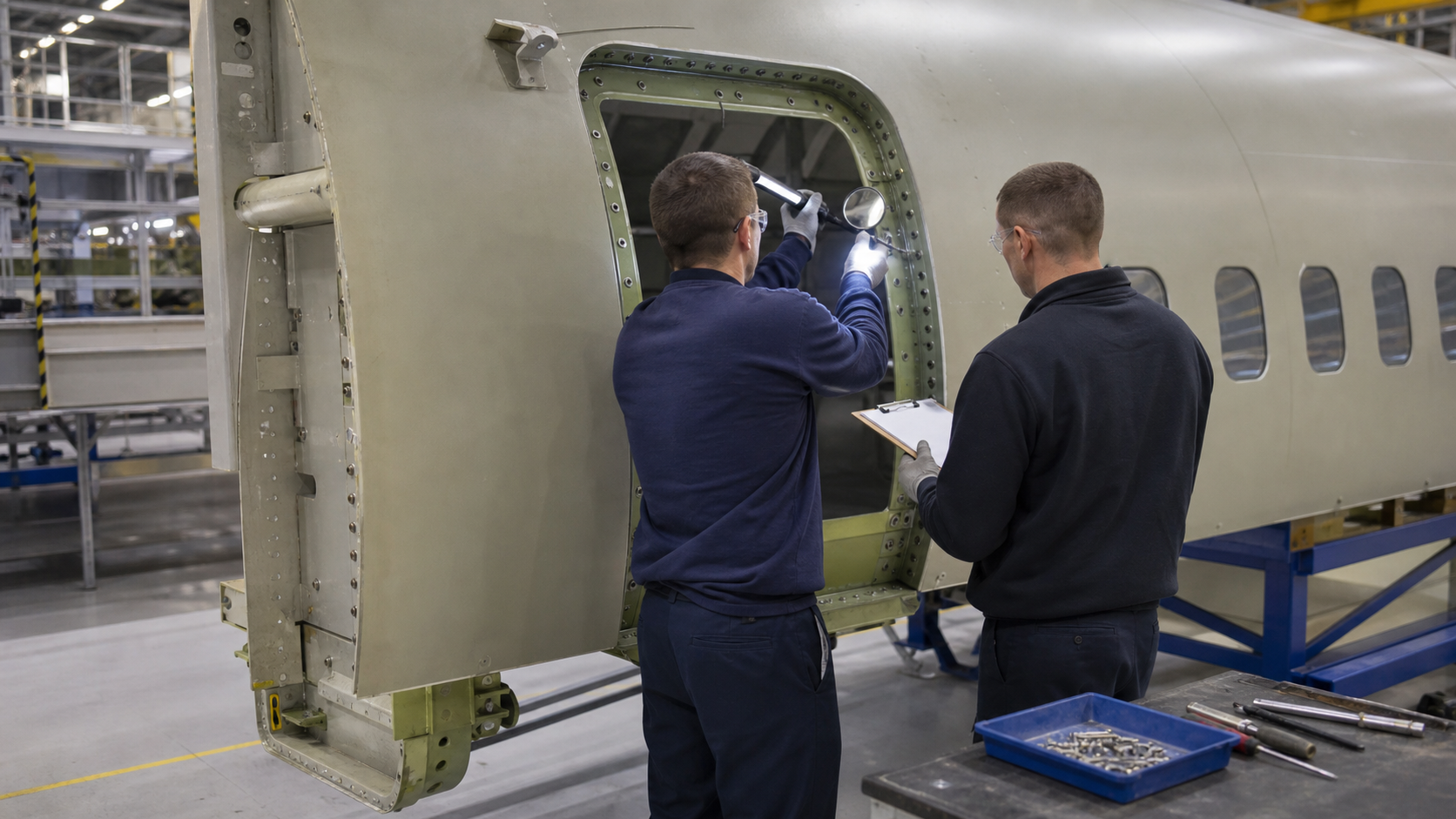
That determination is narrower, and more useful, than the shorthand that a door "blew off." It directs attention to control ownership. Spirit AeroSystems manufactured the fuselage section and initially installed the plug with its securing hardware present. Nonconforming rivets around the opening created the need for rework at Renton, but Boeing personnel opened the already accepted plug to give Spirit personnel access. No required removal record was created.
The plug was later closed without the bolts, apparently outside the normal door team's work pattern, and the cabin interior concealed the attachment points before any restoration inspection occurred. A downstream quality signoff addressed the rivet work; it did not verify the plug's restored configuration.
The event therefore tests more than workmanship. It tests whether a manufacturer can prove, through contemporaneous records and physical verification, that a safety-significant assembly remains in its approved state after work crosses teams, shifts, companies and software queues. It tests whether management sees recurring nonconformance as an isolated clerical issue or as a hazard capable of defeating inspection. It tests whether the regulator's data systems can identify repetition before an aircraft event supplies the signal. Finally, it tests whether announced remediation changes measurable behavior, or merely describes activity.
This account reconstructs the sequence before allocating responsibility. It distinguishes the physical trigger from the organizational cause, supplier defects from final-assembly control, detection failures from emergency response, and safety findings from legal judgments. It also treats corrective actions according to their evidentiary weight. A revised procedure is evidence of a changed instruction. Training completion is evidence that people attended. A declining escape rate, durable audit trail, independent verification and a certified fail-safe design would be stronger evidence that the risk is actually controlled.
The flight made a hidden configuration visible
Flight 1282 left Portland International Airport at about 5:07 p.m. Pacific time for Ontario, California. The airplane, registration N704AL, had entered Alaska service less than two months earlier. It had accumulated about 510 flight hours and 154 cycles. Nothing in the normal appearance of the finished cabin told passengers, cabin crew or flight crew that four pieces of retention hardware were missing behind the sidewall near rows 25 and 26. The plug was not an operable passenger door.
It filled an opening that can be configured as an exit on higher-density aircraft, and its fittings were designed to hold it against the fuselage under cabin pressure.
At approximately 5:13 p.m., as the aircraft climbed through about 14,830 feet, the left plug separated. Cabin pressure dropped. Loose items and interior panels moved toward the opening; two headrests, a seatback tray table and other cabin pieces left the aircraft. The flight-deck door opened under the pressure differential, pilots' headsets were displaced, and the sudden noise complicated communication. The flight and cabin crews used emergency oxygen and carried out decompression and return procedures under conditions they had not expected to encounter in a nearly new aircraft.
The NTSB structures factual report records the damage pattern around the opening and the recovered plug. The materials laboratory examination found contact and sliding signatures consistent with upward movement before separation. The stop fittings and stop pads were not destroyed in a way that suggested an initiating structural break. Multiple attachment components remained, while the two vertical-movement arrestor bolts and two upper guide-track bolts were not recovered. The physical record supported a missing-hardware sequence rather than a bolt fracture sequence.
That distinction matters. With the plug in its fully lowered position, 12 stop fittings transfer pressure loads into matching pads on the fuselage. The four bolts do not carry the cabin-pressure load in the same way. Their critical function is to prevent the plug from translating upward far enough for the stop fittings to disengage. The NTSB found that either one arrestor bolt or the two upper guide-track bolts would have prevented the upward travel needed for separation. Without all four, vibration and normal fuselage flexing could permit incremental movement over successive flights.
The accident flight supplied the final operating conditions, but ordinary operation was not the manufacturing defect.
The plug's departure was the trigger: upward travel, loss of stop engagement and separation under pressure loading. The missing bolts were the unsafe physical configuration. Neither statement, alone, explains how that configuration was created and accepted. A complete causal account must go backward through the records, photographs, work instructions, personnel availability and handoffs that preceded delivery.
The plug arrived in Renton secured
The manufacturing chain began well before the aircraft reached Alaska. Spirit AeroSystems' Malaysia operation manufactured the plug, and Spirit installed it in the fuselage section in Wichita. According to the NTSB's Manufacturing Records and Human Performance Factual Report, the plug was built in March 2023, the fuselage arrived in Wichita in May, and installation and closure work occurred in July. The fuselage section left Wichita in August and arrived at Boeing's Renton plant on August 31.
Investigators used manufacturing records and photographs to establish an important boundary. The plug and its surrounding structure conformed to the relevant engineering drawings when the fuselage was accepted in Wichita, and photographs showed the retention hardware installed before shipment. That evidence does not erase every supplier-quality issue later found on the fuselage. It does locate the missing-bolt configuration after arrival at Boeing rather than in the original plug assembly.
Five rivets along the forward edge frame near the opening were nonconforming. They had been installed by Quik Tek, a Spirit supplier. At Renton, Spirit personnel working within Boeing's production system were responsible for replacing them. A Spirit contractor initially recorded the rivets as replaced on September 6, but Boeing personnel found that they had instead been painted over. Boeing rejected that condition on September 11 and escalated the work. The false completion entry is a documented process failure. The final report did not determine it to be the probable cause of the accident, and it does not establish fraud or intent.
Its causal significance is that it prolonged and complicated rework and created the need to gain access behind the plug.
The rivets could not be driven correctly while the plug remained in place. On an assembly line, that access problem should not be extraordinary. Parts are opened or removed for rework. A functioning configuration-control system anticipates the practice and imposes a closed loop: identify the part, describe the reason, record every removed item, assign restoration work, require the right inspection, and prevent the build from advancing until the loop is closed. Boeing had a company-wide Business Process Instruction called "Perform Part or Assembly Removal" for that purpose.
The instruction required a removal record in the Common Manufacturing Execution System when an already installed and accepted part was opened or removed. The record was not simply a note that work had occurred. It was the mechanism for creating restoration steps, routing work to qualified personnel, capturing inspections and making unfinished configuration visible to later stations. The process had exceptions and judgment points, however, and personnel did not apply it consistently. The accident aircraft exposed what happens when the record is treated as administrative overhead rather than as a safety control.
A 36-hour opening left no restoration trail
Photographic and system evidence narrowed the crucial work to September 18 and 19, 2023. The plug was open by late morning on September 18 and remained open while the defective rivets were accessed. By early evening on September 19, a photograph showed it closed. In that image, three of the four attachment locations visible to the camera lacked their bolts; the fourth was obscured. Later examination and the accident evidence established that all four were absent at delivery.
No Boeing removal record documented who opened the plug, which pieces of hardware were taken out, where they were controlled, who was assigned to close it, or who would inspect the restored assembly. Investigators interviewed employees and reviewed records, messages and images, but no person identified themselves or another person as the individual who performed the final closure. That is not evidence that nobody touched the plug. It is evidence that the production system failed to preserve attribution for a safety-significant action.
The timing made the missing record more consequential. The most experienced door employee was absent. The NTSB found that no experienced mid-exit plug open-and-close personnel were on duty during the interval when final closure appears to have occurred. The plug was closed on second shift on September 19, when the regular door team was not working. Production pressure need not be alleged as an individual's motive to recognize the control problem: a task crossed organizational and shift boundaries without a durable owner, while the software object that would have carried its restoration requirements did not exist.
The absence of a record defeated several defenses at once. There was no electronic list of removed hardware to reconcile. There was no restoration order waiting in a queue. There was no mandatory inspection attached to plug closure. There was no visible incomplete status to block later interior installation. There was no reliable person-task-time history for supervisors to review. A physical omission and an information omission became the same failure.
The work package for the surrounding rivets continued. A short-stamp instruction intended to show that an area was ready for blankets and interior closeout was not correctly applied to the plug restoration. On September 20, a Boeing quality inspector reviewed the completed rivet documentation. The inspector's signoff concerned the nonconforming rivets and relied on records; it was not a physical inspection of the plug's attachment hardware. By then, insulation blankets and cabin sidewalls impeded access and visibility. The airplane advanced through final assembly with a finished-looking cabin and an unverified plug.
This sequence is supported by documents and testimony collected in the public NTSB docket for DCA24MA063. The board's two-day investigative hearing explored 737 manufacturing and inspection, safety management and FAA oversight. The first-day transcript and second-day transcript preserve sworn and unsworn factual testimony, but hearing testimony was evidence for the investigation, not a final causal judgment. Where witness recollections differed, the final report and physical evidence carry greater authority.
The record failure was repetitive, not unprecedented
The parts-removal instruction was not a stable, obvious rule that one employee inexplicably ignored. Boeing had substantively revised it 11 times between 2013 and 2023. Investigators identified 16 regulatory compliance matters associated with the process from 2018 through 2023: nine Boeing voluntary disclosures and seven FAA-initiated actions. Some involved the same basic failure to create a removal record. Corrective measures had been proposed, accepted and closed, yet nonconformance recurred.
Complexity did not excuse noncompliance, but it shaped the risk. Personnel had to decide whether an action counted as removal, when an exception applied, and which system entry was required. The instruction's definitions and decision logic were difficult enough that workers and managers described inconsistent understanding. In a high-variation production environment, a control dependent on discretionary classification needs especially strong training, supervision and error-proofing. Boeing instead relied on a process whose known ambiguity persisted through revisions.
Training provided another weak layer. Door-team on-the-job training was informal and experience-based. It lacked a standardized task inventory, structured progression, documented performance criteria and an archived record showing that a trainee could independently execute each safety-significant task. Experienced employees could transmit practical knowledge, but management could not readily demonstrate consistent competence across shifts or analyze where training failed. The manufacturing factual record also described a workforce whose average experience had declined as hiring increased.
The NTSB found that Boeing did not perform a change-management assessment responsive to that altered experience profile.
It is tempting to convert these conditions into a generalized culture verdict. The evidence supports a more precise conclusion. The removal process had a recurrence history; the procedure was difficult to apply; training did not assure or document task competence; staffing left the critical task without experienced coverage; the required digital record was not created; and later inspection relied on the wrong work scope. Those are identifiable management controls. "Culture" is useful only if it points back to who changes those controls, what evidence shows the change, and how escape risk is measured.
The NTSB announced its adopted findings in a June 24, 2025 board-meeting release. Its probable-cause language assigned the organizational failure to Boeing Commercial Airplanes: inadequate training, guidance and oversight for consistent compliance with parts removal. Its contributing-cause language assigned a separate oversight failure to the FAA. Neither finding says that an individual worker intentionally omitted bolts, that the supplier caused the final unsafe configuration, or that any party committed a crime. The report is an authorized safety finding, not a civil or criminal verdict.
A causal map prevents responsibility from collapsing into one label
The root cause, in the operational sense used here, was the failure of Boeing's production-control system to ensure that opening an accepted plug generated an unavoidable restoration record, qualified assignment and verified closeout. This formulation follows the NTSB's probable cause but makes the control loop explicit. The root was not merely that someone failed to install bolts. A process designed around perfect memory and discretionary record creation allowed that omission to pass every remaining gate.
The contributing conditions included ambiguous and repeatedly revised guidance, unstructured training, reduced experience, unavailable specialist coverage, cross-company rework, shift transition, incomplete hardware control and a final physical state concealed by interior closeout. Spirit's nonconforming rivets were a precursor because they created the rework demand. They were not the missing bolts, and the NTSB did not designate Spirit's rivet work as the probable cause. Petroleum jelly found on parts of the plug installation was another nonconformance, but investigators determined it was unrelated to the separation.
The physical trigger was the plug's progressive upward movement and ultimate disengagement during pressurized flight. Normal vibration and fuselage flexing acted on an already unsafe configuration. They did not create the missing-hardware condition. The absence of all four bolts removed the restraint intended to prevent movement; pressure loading then drove separation after the stops lost engagement.
Detection failed in stages. Boeing's removal process did not flag the open configuration. Hardware control did not force reconciliation. Supervision did not assign or observe a qualified closeout. Quality inspection followed the rivet paperwork rather than the restored plug. Cabin closeout made direct observation difficult. Delivery review accepted the aircraft. Alaska's routine preflight and line maintenance were not designed to dismantle interior panels to confirm hidden factory hardware, and the NTSB found no Alaska maintenance that required the plug to be opened.
Response began only after the hazard manifested. Crew actions contained immediate consequences; Alaska grounded its fleet; the FAA issued an emergency airworthiness directive; operators inspected affected aircraft; and investigators reconstructed the production history. Recovery returned individually inspected aircraft to service. Remediation, a different phase, concerns whether Boeing and the FAA changed the manufacturing and oversight systems that allowed the escape.
Keeping those categories separate prevents two accountability errors. The first is to blame the last person who may have touched the assembly while ignoring the system that left the task unattributed and uninspected. The second is to spread responsibility so broadly across "the industry" that no practical owner remains. Boeing owned final assembly, its removal procedure, qualification, work routing, configuration acceptance and delivery. Spirit owned the quality of its supplied structure and the rivet rework performed by its personnel. Alaska owned operational response and maintenance within its approved program.
The FAA owned the adequacy of regulatory surveillance and enforcement. Each role is different, and only some were causal.
Why ordinary operational detection did not catch it
After the accident, questions arose about pressurization warning events on earlier flights. The aircraft had experienced automatic pressure-control system faults, and Alaska had restricted it from extended overwater operations before January 5. The NTSB examined those events rather than assuming they were warnings of plug movement. Investigators found that intermittent faults in a cabin-pressure controller microchip likely caused the messages and that the alternate controller took over as designed. Recorded cabin pressure remained normal.
The final report found no evidence that the earlier controller faults were caused by plug displacement. It could not determine whether a small plug leak occurred and remained within the pressurization system's capacity, but that unresolved possibility is not proof of a leak. Treating the warnings as a missed direct diagnosis would overstate the record. Alaska's maintenance response was directed at the faults the system reported.
The plug also did not present an obvious external preflight cue. The stop fittings bore pressure loads while the plug sat in its lower position, and upward migration could be small until it became unstable. Interior trim hid key hardware. Routine airline inspections are risk-based and do not generally repeat every concealed factory acceptance check before each flight. Requiring operators to reopen finished interiors at short intervals would transfer the burden from manufacturing assurance without addressing why the configuration escaped delivery.
That does not mean airline controls were irrelevant. Alaska's restriction on overwater operation reduced exposure to a diversion over water, even though it addressed the pressure-control fault rather than a known plug defect. After the event, the carrier inspected both its 737-9 fleet and the related 737-900ER plug configuration and revised elements of emergency preparation. But the evidence does not support assigning Alaska the manufacturing root cause merely because it operated the airplane.
The distinction illustrates a broader accountability principle. Detection controls must be placed where the information and access exist. Boeing had the plug open, had the engineering definition, controlled the manufacturing execution system, could see the attachment points and could stop interior closeout. Alaska received a conforming-aircraft representation after those opportunities had passed. Operational monitoring can provide a backstop, but it cannot substitute for final-assembly configuration control.
Regulatory systems had the history but not the signal
The FAA's immediate authority was visible after the accident. On January 6, 2024, it grounded approximately 171 Boeing 737-9 aircraft operated by US airlines or in US territory. The agency's frozen original news URL, "FAA Orders Temporary Grounding of 171 Boeing 737-9 MAX Aircraft", returned HTTP 404 when checked on July 17, 2026. The action remains verifiable through the FAA's maintained 737-9 update record and the official Emergency Airworthiness Directive 2024-02-51 publication. The inaccessible page is not relied on alone.
The harder question is why oversight did not convert prior process failures into prevention. The NTSB reviewed FAA compliance and audit information concerning Boeing's parts-removal process. Corrective actions had been accepted in earlier matters, yet the same class of record failure returned. FAA audit planning did not surface the pattern for effective treatment. Records were distributed across systems, recurring discrepancies were difficult to identify, and some underlying material was retained for only five years. A regulator can close individual findings while remaining unable to see that their recurrence constitutes a systemic risk.
The board therefore identified FAA surveillance and audit planning as contributing to the accident. This was not a claim that an FAA inspector approved the missing bolts. It was a finding about institutional detection: oversight processes did not adequately identify and ensure correction of repetitive nonconformance associated with parts removal. The board recommended changes to compliance surveillance, audit planning, records retention, inspector guidance and recurrent training, as well as an independent review of Boeing's safety culture.
Independent oversight work had reached a related diagnosis. The congressionally directed FAA expert panel report, completed in February 2024 after work that began before the accident, found a disconnect between Boeing senior management and other employees on safety culture, confusing reporting channels and weaknesses in metrics. Those findings were broader than the plug sequence and were not an accident-cause determination. They nevertheless identified organizational conditions relevant to whether employees can raise and resolve production-safety concerns.
The Department of Transportation Office of Inspector General later concluded in its October 2024 audit of FAA oversight of Boeing 737 and 787 production that the agency's processes were not effective enough to identify and resolve production issues. It found that audit planning was not sufficiently comprehensive or data-driven, supplier and first-article surveillance was limited, and systems did not readily track repeated findings or corrective-action milestones. The OIG made 16 recommendations.
Its public page shows that some recommendations were later closed, including entries in 2026, while others do not show closure; it does not support a claim that every oversight deficiency has been resolved.
Regulatory legitimacy depends on this distinction between activity and detection. More inspections can matter, but inspection volume is not the same as a system that identifies recurrence, tests whether corrective action works, and escalates before an escape. The accident showed that both Boeing and the FAA possessed fragments of relevant history. Neither converted them into a control strong enough to stop this aircraft.
Grounding contained fleet risk; it did not cure the production system
Alaska voluntarily grounded its 737-9 fleet on the night of the accident. Its maintained flight 1282 operational update records the grounding, cancellations, inspections and phased return. The carrier cancelled about 160 flights affecting roughly 23,000 passengers on January 6 and about 170 flights affecting approximately 25,000 on January 7. Those figures capture only the first operational shock. They do not measure the fear experienced in the cabin, the burden on crew, or the longer disruption to travelers.
The FAA then made the fleet action mandatory. It increased oversight of Boeing production and manufacturing, opened an audit involving the 737-9 line and suppliers, expanded monitoring of in-service events, and examined delegated oversight. Forty aircraft underwent an initial inspection process used to refine final instructions. On January 24, the agency approved a detailed inspection and maintenance process while halting MAX production expansion. Each grounded aircraft had to complete the work before returning to service.
The approved work included inspection of bolts, guide tracks, fittings and other components at both mid-cabin plugs, with corrective action for discrepancies and retorque requirements. Alaska returned its first 737-9 to service on January 26. That return meant the individual aircraft had completed the mandated inspection and was eligible to operate. It did not mean investigators had completed the causal analysis, that Boeing's factory controls were repaired, or that every recommendation later issued by the NTSB had been implemented.
The distinction between recovery and remediation is essential. Grounding reduced immediate exposure across the affected fleet. Inspection restored confidence in the physical configuration of aircraft already built. Airlines managed schedules, crews and passenger rebooking. Those actions addressed an installed-base hazard. The manufacturing system that produced the hazard required different interventions: process simplification, qualification, removal-record enforcement, supplier integration, closeout gates, audit analytics and design changes.
The commercial cost was substantial but should not displace the human impact. In an April 2024 SEC-filed earnings release, Alaska Air Group reported an adjusted pretax grounding impact of $162 million for the first quarter and an initial $162 million cash payment from Boeing. Those are company accounting figures, not an adjudicated damages measure and not a valuation of passenger or crew experience. The people aboard faced a rapid decompression and an open fuselage at altitude; eight sustained minor injuries under the NTSB's classification, and the absence of more severe harm does not reduce the seriousness of the escape.
Emergency response also left an evidence gap. The cockpit voice recorder retained only two hours of audio, and the accident recording was overwritten before its circuit breaker was pulled. Flight-data sources were preserved, but investigators lost the contemporaneous cockpit conversation. The NTSB treated that as a systemic preservation issue and recommended post-event procedures and longer-duration recorders. It was not a cause of the separation. It affected detection and learning after the event.
Control ownership after the accident
Boeing's first responsibility was containment: support inspections, ensure operators could identify missing or loose hardware, and prevent similarly configured aircraft from flying until checked. Its deeper responsibility was to redesign the production controls whose failure the NTSB identified. In its 737-9 updates, Boeing described actions involving quality stand-downs, additional inspections, supplier work and production-system changes. These are first-party accounts. They establish what the company says it did, not independent proof of sustained effectiveness.
Boeing revised the parts-removal instruction in June 2024 and added training. It changed the manufacturing execution system so that only trained personnel could initiate certain removal records. It introduced more structured door-team on-the-job training, including repeated observation, assistance and supervised performance of tasks. It added alerts and signoffs for removal and rework, additional inspections at critical build points, and controls intended to keep work from advancing with incomplete tasks.
Those changes target real failure modes. Restricting record initiation to trained users can improve quality, but it can also create a bottleneck if qualified users are unavailable. A robust implementation therefore needs a rapid escalation route and a physical stop that prevents unrecorded work, not an informal workaround. Repeated task demonstration is better than undocumented shadowing, but competence criteria, trainer calibration and archived outcomes determine whether repetition is meaningful. Additional inspections can catch escapes, but they should not become permanent compensation for a confusing primary process.
Boeing's May 2024 Safety and Quality Plan executive summary organized actions around workforce training, process simplification, defect elimination, supplier oversight and employee reporting. It identified six production-health indicators, including proficiency, rework hours, supplier shortages and work traveling beyond planned positions. The FAA said it would review those indicators in weekly and monthly meetings and maintain increased floor presence. Metrics can create accountability only if definitions remain stable, denominators are disclosed to the overseer, adverse trends trigger action, and the regulator can test the underlying data.
The FAA's May 30, 2024 account of the corrective plan stated that its special audit found noncompliance in manufacturing process control, parts handling and storage, and product control. Because that audit remained part of an investigation, the agency did not release every detail. Public observers can therefore verify the categories and the oversight structure, but not independently reproduce the full audit or evaluate every closure decision.
Practical ownership can be stated without assigning unproved individual blame. Boeing manufacturing leadership owns procedure clarity and staffing. Quality leadership owns inspection independence, hold points and escape analysis. Information-system owners control whether work can proceed without a restoration object and whether the audit trail is immutable. Supplier-management leaders own accepted-condition definitions and cross-company rework routing. Program leadership owns production pacing and risk review when experience or staffing changes.
The FAA certificate-management team owns surveillance design, recurrence analysis and enforcement follow-through. Boards and senior executives own whether resources and incentives support those controls.
The strongest fix may be one the cabin cannot conceal
Process controls remain necessary because aircraft maintenance and production require parts to be opened. Yet the accident also exposed a design vulnerability: after interior installation, the absence of the four retention bolts was not readily visible, and a plug could appear closed while lacking its upward-movement restraints. The NTSB recommended a design enhancement that would make complete closure harder to miss and provide protection if the original bolts were absent.
Boeing developed a concept with two secondary retention features intended to block upward plug movement and interfere with sidewall installation unless engaged, along with more visible bolt-control features. At the time of the final report, development was described as complete but certification work and compliance planning continued. The board recommended that Boeing continue certification, equip new production after approval and issue a service bulletin for the in-service fleet. It recommended that the FAA mandate retrofit once certification was complete.
That procedural status is important. A design under development is not an installed barrier. A planned service bulletin is not a completed retrofit. The NTSB case page lists recommendations A-25-15 through A-25-33 and preserves their official records; public closure must be assessed recommendation by recommendation. As of the material checked for this article, the available official sources did not establish completion of certification and fleetwide retrofit. The remaining uncertainty should be stated, not filled with an assumption.
A certified physical interlock would not absolve the production organization. It would add a defense against human and record failure. The best control architecture is layered: clear work definition, authenticated removal record, controlled hardware, qualified execution, independent physical inspection, interior-closeout interlock, trend monitoring and a design that remains safe after a plausible omission. Each layer should fail visibly rather than silently.
This is also where enterprise software automation becomes safety infrastructure. The manufacturing execution system should know that an accepted assembly has changed state, associate every removed component with a serialized or otherwise controlled location, require authorized restoration, route inspection, preserve a timestamped audit history and block incompatible downstream work. Automation should reduce ambiguity without hiding judgment. If workers can perform the physical action while the system remains unaware, the digital record is not the configuration; it is an optional narrative after the fact.
Software cannot inspect a bolt by itself. It can, however, force a qualified person to attest to a defined step, require a second independent verification, capture images where appropriate, flag an impossible sequence, prevent cabin closeout and aggregate recurrence across programs. The important design question is not whether the factory uses advanced technology. It is whether the technology makes the unsafe state difficult to create, easy to detect and impossible to normalize.
Evidence of repair must extend beyond announced actions
By late 2024, the FAA said it was maintaining a larger on-site presence, conducting weekly senior reviews and monthly performance reviews, and withholding approval for production expansion. These controls increased regulatory contact. Their effectiveness should be judged by outcomes: fewer configuration escapes, fewer traveled tasks, more reliable first-pass completion, rapid closure of repeated findings, demonstrated workforce proficiency and regulator-confirmed improvement rather than company-only reporting.
The public record later became more complicated. In September 2025, the FAA proposed $3.1 million in civil penalties against Boeing for alleged safety violations occurring from September 2023 through February 2024, including alleged quality-system violations at Boeing and Spirit and pressure on an Organization Designation Authorization unit member. A proposed penalty is an enforcement allegation, not a final adjudication. Boeing had an opportunity to respond, and the official sources reviewed for this article did not establish a final resolution by July 17, 2026.
Also in September 2025, the FAA allowed Boeing limited resumption of issuing certain airworthiness certificates, initially on alternating weeks, after reviewing the company's processes and performance. The agency said it retained direct oversight and could change the arrangement. That step is evidence that the FAA judged a bounded delegation appropriate. It is not proof that every quality-system weakness, NTSB recommendation or OIG recommendation had been closed.
Boeing's 2025 Form 10-K, filed in January 2026, reported that the 737 production rate reached 42 aircraft per month in the fourth quarter of 2025 after Boeing and the FAA agreed on readiness indicators. The company said further increases would require FAA concurrence. This is a securities filing and carries disclosure obligations, but the production and remediation narrative remains Boeing's account. A rate increase can coexist with better quality, but rate itself is not a quality metric.
The same filing reported that Boeing completed its acquisition of Spirit AeroSystems in December 2025. Bringing a major supplier under common ownership may simplify authority, data access and rework routing. It does not retroactively merge the accident-era responsibilities or prove integration is effective. Supplier accountability still requires accepted-condition records, defect traceability, unambiguous work ownership and independent verification when tasks move across organizational boundaries.
Strong remediation evidence would connect interventions to the specific escape. For the removal process, Boeing and the FAA should be able to show how many removals were initiated, how many records were opened late, how many hardware discrepancies were found, how often work attempted to travel without restoration, and whether recurrent problems fell after training. For qualification, they should show task-level competence and trainer consistency. For oversight, the FAA should show that recurrence analytics alter audit plans and that corrective actions are tested after closure.
For the design change, certification and installed-fleet status should be public and current.
No single public document presently supplies that complete proof chain. That does not mean remediation failed. It means some evidence is company-controlled, some remains nonpublic because of regulatory investigations, some recommendations are still tracked individually, and some outcomes require time. Accountability reporting should preserve that uncertainty rather than treating either announced reform or continuing criticism as conclusive.
Public impact widened with every control boundary
The immediate users of the system were the passengers and crew. They depended on a hidden manufacturing assurance claim: that the fuselage configuration matched its approved design. They could not inspect the claim themselves. Their exposure illustrates why manufacturing records are not merely internal business data. A missing or inaccurate record can become a physical cabin hazard months later and thousands of miles from the factory.
Airlines carried the operational consequences. Grounded aircraft disrupted schedules, imposed inspection labor, stranded capacity and required passenger rebooking. Airline maintenance teams had to execute a regulator-approved program for a condition introduced before delivery. Workers at Boeing, Spirit and carriers faced intensified inspection, retraining and production changes. Suppliers faced increased scrutiny and altered acceptance controls. Regulators diverted personnel into audits, floor surveillance and enforcement. Shareholders absorbed compensation, disruption and legal uncertainty.
Institutional legitimacy was also at stake. The production certificate system allows a manufacturer to demonstrate conformity through approved processes rather than having a government inspector personally watch every fastener installation. Delegation and risk-based surveillance are necessary at industrial scale. They remain legitimate only when records are trustworthy, delegated personnel can act without improper pressure, recurring findings are visible, and the regulator intervenes before the public supplies the detection signal.
The event therefore cannot be reduced to a dramatic image of a missing panel. The more durable question is whether every organization can produce a traceable account of control: who knew the plug had changed state, who owned restoration, what blocked unfinished work, who independently verified closure, how prior nonconformances changed oversight, and what measurable evidence now shows lower risk. Where the answer is absent, the accountability gap is itself a finding.
Safety findings are not legal judgments
The NTSB investigates to determine probable cause and issue safety recommendations. It does not assign civil liability or criminal guilt. Federal law, including 49 U.S.C. section 1154, restricts the use of NTSB accident reports in civil damages litigation. The factual docket can inform public understanding, but the board's probable-cause statement should not be recast as a court judgment.
Likewise, the FAA's regulatory actions have distinct statuses. An emergency airworthiness directive imposed binding operating conditions. An announced audit described regulatory findings and ongoing review. A proposed civil penalty asserted alleged violations subject to response and process. Limited delegation reflected an agency decision under continuing oversight. Treating all four as the same kind of "finding" would blur legal and evidentiary boundaries.
The Department of Justice boundary is separate again. The DOJ's United States v. The Boeing Company case page concerns the 737 MAX fraud case tied to the Lion Air 610 and Ethiopian Airlines 302 crashes, not a criminal charge arising from flight 1282's missing door-plug bolts.
The page records that DOJ notified the court on May 14, 2024 that Boeing had breached the 2021 deferred prosecution agreement, that the court rejected a proposed plea agreement on December 5, 2024, that DOJ reached a May 29, 2025 non-prosecution agreement, that the district court granted dismissal of the Information on November 6, 2025, and that the Fifth Circuit denied mandamus petitions on March 31, 2026 while later withholding its mandate pending rehearing process.
That procedural record matters for Boeing's broader criminal-compliance posture, but it does not convert the NTSB's door-plug findings into a criminal conviction, charge or adjudication for the Alaska 1282 manufacturing sequence.
Boeing's SEC filing states that investigations and legal proceedings arising from the accident continued and that outcomes could not be estimated with certainty. That disclosure confirms procedural uncertainty, not wrongdoing. Civil claims may resolve questions under different legal standards and evidence, but this article does not infer outcomes. Nothing in the public safety, regulatory or DOJ procedural record cited here establishes criminal, fraudulent or intentional conduct in the missing-bolt sequence.
The supplier boundary requires the same discipline. Spirit and its supplier were responsible for nonconforming rivets and failed rework documentation that generated the access problem. The evidence also indicates that the plug arrived at Renton with bolts installed and that Boeing controlled the opening, restoration process and final aircraft acceptance. Responsibility should follow those established acts and control rights, not the convenience of attributing every factory defect to one company.
What remains unresolved
The identity of the person or people who opened and finally closed the plug was not established in the final report. That absence limits individual attribution but strengthens the finding that traceability failed. It would be speculation to infer intent, motive or exact conduct beyond the photographic time window and missing hardware. Organizational responsibility does not require inventing an individual culprit when the organization failed to preserve the record that would answer the question.
The precise flight-by-flight progression of plug movement is also unknowable. Physical evidence supports incremental upward movement, and investigators explained how normal vibration and fuselage flexing could produce it. They could not reconstruct an exact displacement for every cycle or prove that earlier pressure-controller messages indicated leakage. Those messages should not be promoted into warnings that the record does not support.
The long-term effectiveness of revised removal controls remains a measurement question. Public sources describe training, software restrictions, inspections and metrics, but do not expose all underlying data. A defensible conclusion requires enough time and independent access to distinguish sustained improvement from temporary attention after a high-profile event.
The status of each design and oversight recommendation also matters. Certification, service-bulletin issuance, an airworthiness directive and fleet retrofit are separate milestones. So are revision of FAA record systems, inspector training, safety-culture review and integration of Boeing's safety and quality management systems. A completed final accident report closes the causal investigation; it does not automatically close the recommendations.
The accountability test
Alaska 1282 was survivable because the aircraft remained controllable, crews responded and the flight was close enough to return quickly. That favorable outcome cannot be used to downgrade the manufacturing escape. A few missing bolts defeated the assumptions embedded in final assembly, delivery, airline operation and regulatory surveillance. The event happened early enough in the climb to avoid a more hostile pressure differential and operating environment, but prevention cannot depend on favorable timing.
The most important lesson is not that workers should remember bolts. It is that a safety-critical production system must expect memory, classification and handoff errors and make them recoverable. A removed assembly needs an unavoidable digital and physical identity. Hardware needs custody. Restoration needs qualified ownership. Inspection needs the actual configuration, not adjacent paperwork. Closeout needs an interlock. Repeated nonconformance needs to change both corporate risk assessment and regulatory audit planning.
Boeing's responsibility is demonstrated where its control was greatest: final assembly, parts-removal rules, manufacturing software, worker qualification, supervision, inspection gates and delivery conformity. The FAA's contributing responsibility lies in the oversight mechanisms that did not identify and resolve recurrence. Spirit's responsibility lies in supplier workmanship and rework records that were deficient but did not create the final missing-bolt state. Alaska's responsibility lies in operational response, maintenance of reported faults and fleet recovery, not factory installation.
By July 2026, the public record shows substantial action: fleet inspections, revised instructions, more structured training, additional quality gates, intensive FAA presence, production constraints, a corrective roadmap and development of a physical design enhancement. It also shows open evidentiary limits: incomplete public data on control performance, recommendation-by-recommendation work, an unresolved public enforcement status in the sources reviewed, and no official confirmation in those sources of a completed fleetwide design retrofit.
That mixed record is not a reason to suspend judgment. It defines the standard for judgment. Announcements establish intent and activity. Audited recurrence data, verified competence, effective escalation, independent physical checks, certified design defenses and transparent closure evidence establish control. The door-plug opening made the absence of four bolts visible. The continuing accountability test is whether the institutions involved can make the condition that allowed those bolts to disappear visible before another aircraft leaves the factory.
Source notes
This article privileges the NTSB final report and physical-evidence documents for accident facts and causal findings. Hearing transcripts are used as investigative context, FAA and Federal Register records for regulatory acts, DOT OIG material for independent oversight findings, SEC filings for bounded company disclosures, and company pages only for first-party accounts of response or remediation. Access status and source-specific limitations are documented in the companion source ledger.