
Summary
- Al Wafai is most interesting when treated as a Saudi local implementation account, not as a pure cloud or bandwidth brand. The buyer is paying for line installation, customer-premises coordination, vendor sourcing, monitoring, support escalation and service handoff around connectivity.
- The public record supports a real operating footprint: WafaiCloud pages advertise DIA, SD-WAN, 5G site connectivity, cloud, VPS, colocation and support; RIPE records identify AS202105 and AS212889 for the company; RIPEstat shows AS202105 announced while AS212889 is not visibly announced; PeeringDB lists Wafai Net at SAIX Jeddah with a 10 Gbps entry and public support contacts.
- The commercial test is substitution. Al Wafai must make sense against a direct stc, Mobily or Zain business account, a one-off freelance installer, an in-house IT/support employee, and a bundled global integrator. Its value rises when local labour and support continuity prevent downtime and coordination cost; it weakens when the buyer only needs a standard national-operator circuit.
- Public evidence does not disclose revenue, margin, SLA performance, install backlog, customer concentration, churn, contract value, supplier pricing or audited uptime. A buyer should ask for address-level serviceability, support logs, escalation paths, service credits, vendor responsibilities and proof of upstream resilience before treating the offer as more than a plausible local account.
The deadline is the product
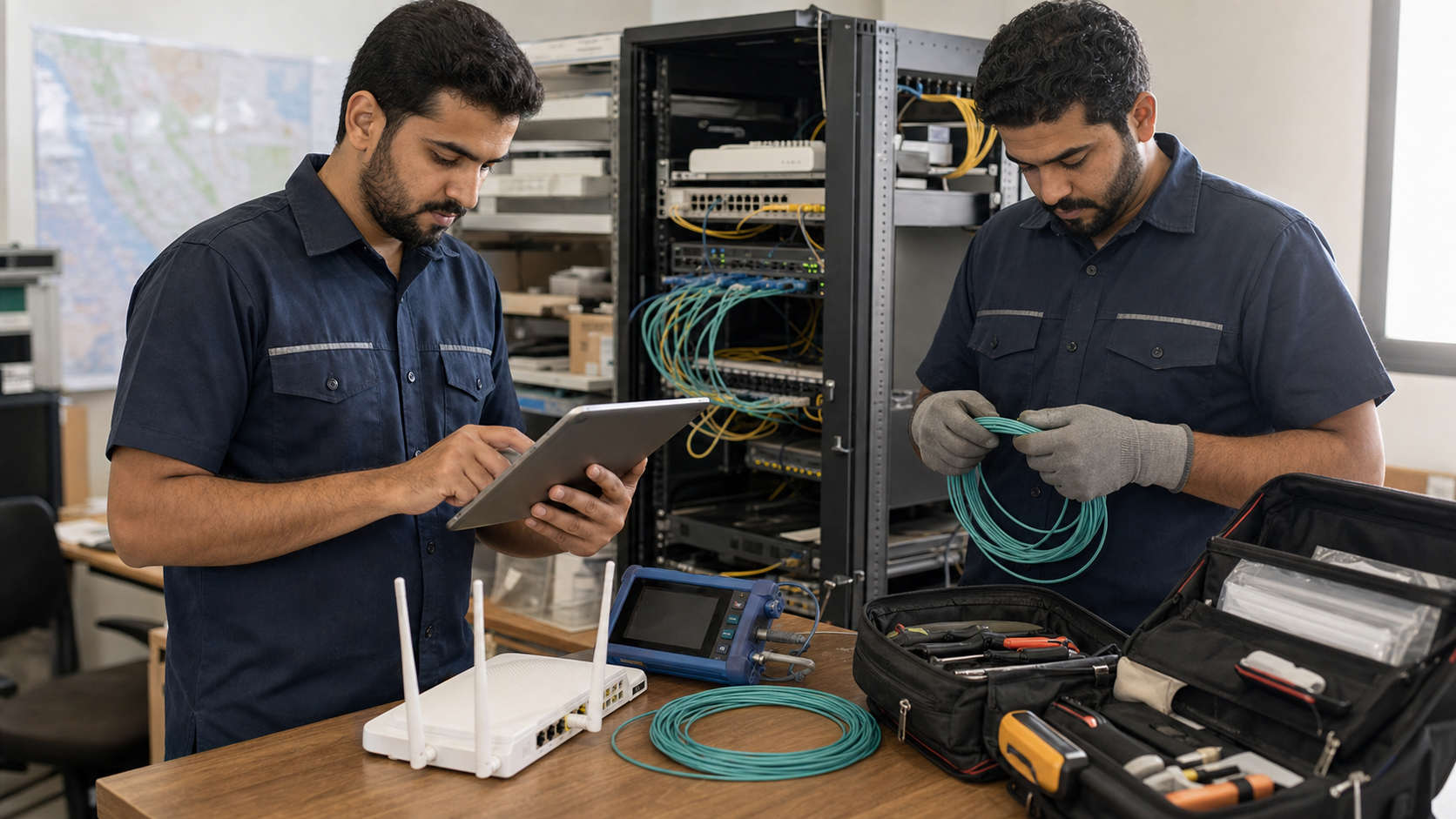
Imagine a Saudi SME opening a new medical branch, design studio, logistics office or retail back room in Jeddah, Riyadh or Khobar. The fit-out contractor is nearly finished. The payment terminal must work. Staff need cloud accounting, WhatsApp Business, email, CCTV remote access, Microsoft 365 or Google Workspace, a printer, a Wi-Fi router, perhaps a small server or hosted application, and a reliable way to speak to one technical party when something fails. The manager does not want a theory of internet access. The manager wants the branch live before the first customer appointment.
That is the setting in which Al wafai International For Communication and Information Technology LLC, trading through WafaiCloud and Wafai Net in public material, should be judged. The direct national-operator substitute is obvious: stc, Mobily or Zain can sell a business dedicated internet or fixed connectivity account. The freelance-installer substitute is also real: a local technician can mount a router, run cable, configure Wi-Fi and disappear after the invoice. The in-house substitute is to hire or assign an IT employee who handles connectivity, vendors, security patches and fault calls.
The global-integrator substitute is a bundled managed service from a larger IT services firm, usually with more process, more paperwork and a higher minimum engagement.
Al Wafai matters only if the local account is cheaper than those substitutes after implementation friction is counted. "Cheaper" does not mean the lowest monthly line price. It means the total cost of getting a site operational and keeping it operational: site survey, access medium, router or SD-WAN appliance, public IP or firewall rule, failover design, business-hours and after-hours response, vendor escalation, cloud or hosting adjacency, invoice clarity, support handoff and recovery from failed assumptions. A provider that sells all of those items coherently can beat a lower headline tariff.
A provider that cannot will be reduced to a reseller or commodity line.
The company's own public service pages support this account-based reading. WafaiCloud's Direct Internet Access page says its DIA offer includes dedicated, high-speed business internet, fiber, microwave, VSAT and 5G media, service-level claims, redundancy/failover language, static IP addresses, 24/7/365 support, installation within two days for some media and up to seven days for fiber, and more than 5,000 business connections deployed (https://wafaicloud.com/wafainet-direct-internet-access-dia). Its SD-WAN page presents centralized management, traffic prioritization, dynamic path selection, security integration and application-based routing (https://wafaicloud.com/sd-wan). Its 5G site-connectivity page sells a local alternative for connecting sites quickly when fixed access is difficult (https://wafaicloud.com/connect-5g). Those pages are company-published claims, not audited performance data, but they identify the actual commercial unit: local implementation plus managed connectivity.
The opening price question is therefore not "how many megabits for how many riyals?" It is "how much internal time and risk does this account remove?" If the office manager chooses a national operator directly, they may get the strongest network brand and scale, but still need someone to coordinate router placement, Wi-Fi, static IPs, cloud access, troubleshooting, CCTV vendor demands and post-install support. If they hire a freelancer, they may save cash on day one but retain escalation risk when the underlying carrier, router vendor or hosted application fails.
If they hire in-house IT, they convert vendor friction into payroll. If they buy from a bundled global integrator, they may receive process discipline, but also pay for a service architecture designed for larger accounts. Al Wafai has to live in the middle: local enough to move quickly, technical enough to own handoff, and disciplined enough not to become an informal contractor with an ISP logo.
What the company is visible as
The public identity is a Saudi communications, cloud and hosting provider, not a listed telecom incumbent. WafaiCloud's about page says it has provided cloud computing, internet and communication services since 1999, lists six data centers or points of presence, more than 200 partners, more than 8,000 customers and more than 25 years in business, and describes business services that include standard virtual machines, dedicated CPU options, object storage, GPU capabilities, Kubernetes and managed databases (https://wafaicloud.com/about-us). LinkedIn's WafaiCloud page describes a Saudi-based Middle East company with branches in Bahrain, Oman and the UAE, 51-200 employees, Jeddah headquarters, a 1999 founding date and specialties including cloud, internet and networking, ISP, wireless, hosting, PaaS, IaaS and infrastructure (https://www.linkedin.com/company/wafaicloud). The separate Wafai Net LinkedIn page describes internet, hosting and phone services, lists 51-200 employees, Jeddah headquarters, a 1992 founding date and specialties including IPVPN, ISP and IP PBX (https://www.linkedin.com/company/wafai).
Those public profiles are useful, but they must be ranked below official technical records and the company's own service pages. Third-party directories and social profiles can preserve old names, marketing descriptions and employee-count ranges; they do not prove revenue, active contracts or support quality. KSA Directory lists Al Wafai International Company LLC and describes cloud services plus Dedicated Internet Access and SD-WAN, reseller discounts, white-label services and a self-management portal (https://www.ksa.directory/al-wafai-international-company-llc/i/2952). About.me presents WafaiCloud as an internet service provider in Jeddah and lists virtual private server, managed database, cloud provider, web hosting, Kubernetes and Docker container keywords, with point-of-presence language for Jeddah, Riyadh, Khobar and London (https://about.me/wafaicloud). These sources support the market-facing story, not the balance sheet.
The official site gives the sharper operating view. The home page sells local Saudi hosting, cloud infrastructure, dedicated servers, colocation, Tier III data center claims in Riyadh and Jeddah, a 99.98 percent uptime claim, 24/7 Saudi-based support, free migration and a "host locally" proposition (https://wafaicloud.com/). The contact page says the sales team handles large deployments, volume discounts, migrations and proof-of-concept requests, and it repeats the claim that Saudi-based engineers provide support for servers, cloud infrastructure, websites and related services (https://wafaicloud.com/contact-us). The terms page says WafaiCloud is licensed to provide cloud services in Saudi Arabia under a Class A license from the Communications, Space and Technology Commission, and describes backup replication across opposite locations every 24 hours (https://wafaicloud.com/legal/terms-of-services). The CST's own cloud-registration service page says cloud providers can submit registration requests and lists Class A data-center document requirements including a constructed facility certificate Tier 2 or above or ISO/IEC 27001 for data centers (https://www.cst.gov.sa/en/business/services/Cloud-Computing-Registration).
For a buyer, that means Al Wafai is not only a field installer. It is selling a stack: access line, support account, cloud adjacency, hosting, security and managed networking. The danger is that a broad stack can blur accountability. When one company sells DIA, SD-WAN, VPS, WAF, load balancing, colocation, SSL, backup and migration, the buyer must ask which services are provided on Al Wafai-owned infrastructure, which are white-labeled, which rely on third-party platforms, and which are merely resold with support. The answer matters because the cost structure differs.
Owning the line, platform and support desk gives margin but requires capital and operations. Reselling a vendor product lowers engineering burden but leaves less gross margin and can create escalation delay.
The working judgement is therefore cautious. Al Wafai is visible enough to be analysed as a real Saudi local connectivity and cloud account provider. It is not visible enough to be valued as a transparent telecom company with disclosed financials, installed-base metrics or audited service levels. The correct diligence posture is to use the public material to identify the economic levers, then demand buyer-side proof for the line items that determine whether the account is truly cheaper than the substitutes.
The product is the handoff, not just the line
The strongest commercial case for Al Wafai sits in the handoff between connectivity, equipment and support. A national operator can supply a strong circuit, but the buyer still has to make the connection usable inside a branch. A freelance installer can make the Wi-Fi work today, but may not own the carrier ticket tomorrow. An in-house IT employee can coordinate vendors, but the employee's cost continues every month whether the site has a fault or not. A global integrator can coordinate the stack, but may turn a small Saudi branch into a larger managed-services engagement than the site needs.
Al Wafai's opportunity is to price the messy middle as a single local account.
The DIA page gives the clearest evidence. It says WafaiNet DIA can be delivered over fiber optic, microwave, VSAT and 5G; that the service offers dedicated bandwidth, static IP addresses, redundancy/failover and 24/7/365 support; and that installation can occur within two days, with fiber taking up to seven days (https://wafaicloud.com/wafainet-direct-internet-access-dia). In commercial terms, those claims price four things. First is access selection: deciding whether a site should use fiber, microwave, 5G or satellite-like VSAT for the business need. Second is field labour: surveying the site, installing the handoff, checking signal and placing the router. Third is configuration: public IPs, failover, bandwidth, internal routing and security basics. Fourth is support handoff: knowing who takes the call when the site fails.
That fourth component is often underpriced by buyers until the first outage. A low-cost line without handoff can turn the customer into the coordinator among carrier, router vendor, cabling technician, POS supplier, CCTV vendor and software provider. Every finger-pointing loop costs management time. If Al Wafai can own enough of the path to shorten that loop, it creates economic value beyond bandwidth.
The value is highest in SMEs that do not have a deep IT bench but have real service-continuity exposure: clinics, training centers, logistics desks, local professional firms, retail branches, small hotels, cafes with ordering systems, and offices that depend on payment terminals or cloud ERP.
The SD-WAN proposition adds a second handoff layer. WafaiCloud's SD-WAN page describes centralized management, application-based routing, dynamic path selection, security integration, QoS and optimization (https://wafaicloud.com/sd-wan). Turnium's February 2024 partnership announcement says WafaiCloud signed a multi-year term and volume commitment with Turnium, that the partnership was aimed at secure on-ramps, optimized connectivity and managed SD-WAN service delivery across the Middle East, and that WafaiCloud had 200 sites already in service with an aggressive growth forecast for SD-WAN sales (https://turnium.com/turnium-and-waifaicloud-announce-partnership-across-middle-east/). The same announcement says Turnium was selected as a white-label solution integrated into WafaiCloud's environment and aimed at instant failover, traffic prioritization, visibility across multiple underlay connections and faster managed implementation.
This is material because SD-WAN is often sold as software, but its economic value depends on implementation. A small branch does not benefit from path selection if no one chooses the underlay links, places the appliance, configures policy, monitors failure and answers the first ticket. The partner announcement is not independent proof that all WafaiCloud SD-WAN customers receive excellent service. It is, however, direct evidence that WafaiCloud was pursuing a vendor-backed managed SD-WAN model rather than merely advertising generic connectivity terms. That improves the plausibility of the local implementation-account thesis.
The route evidence shows a real network, with limits
The technical record supports a live network footprint, but it also shows why the article should not overstate scale. RIPE RDAP identifies AS202105 as WafaiNet-AS, active, registered to Al wafai International For Communication and Information Technology LLC, with Jeddah address data and a 2014 registration event (https://rdap.db.ripe.net/autnum/202105). RIPEstat's AS overview for AS202105 identifies the holder as WafaiNet-AS Al wafai International For Communication and Information Technology LLC and marks the resource as announced on July 6, 2026 (https://stat.ripe.net/data/as-overview/data.json?resource=AS202105). RIPEstat's announced-prefixes data for AS202105 shows dozens of /24 routes visible over the two-week query window ending July 6, 2026, including prefixes in the 87.237.224.0/24, 185.11.120.0/24, 185.51.204.0/24, 185.82.116.0/24, 185.108.240.0/24, 185.133.84.0/24, 185.164.20.0/24, 185.203.108.0/24, 185.206.28.0/24, 185.217.8.0/24 and 185.238.68.0/24 families (https://stat.ripe.net/data/announced-prefixes/data.json?resource=AS202105).
PeeringDB adds a more market-facing network view. The PeeringDB API record for network 35086 lists "Wafai Net", aka "WafaiCloud & Wafai Net", long name Al wafai International For Communication and Information Technology LLC, website https://wafaicloud.com, ASN 202105, network types Cable/DSL/ISP, Content and Enterprise, Middle East scope, IPv4 and IPv6 support, public support and NOC contacts, one exchange entry, and an operational 10 Gbps entry at SAIX Saudi Arabia Jeddah with IPv4 and IPv6 addresses (https://www.peeringdb.com/api/net/35086 and https://www.peeringdb.com/net/35086). Bgp.tools lists AS202105 with Wafaicloud's website, many Saudi prefixes with valid RPKI certificate indicators, two upstreams and two peers; its visible upstream and peer tables show Zain Saudi Arabia and Etihad Etisalat/Mobily in the current page view (https://bgp.tools/as/202105). Globalping has a looking-glass page for Al Wafai International For Communication And Information Technology, which indicates the network is present in a public measurement context even if the page itself is light on location detail (https://globalping.io/networks/al-wafai-international-for-communication-and-information-technology).
The second ASN is more limited. RIPE RDAP identifies AS212889 as WafaiNet-AS, active and registered to the same organisation, with a 2020 registration event (https://rdap.db.ripe.net/autnum/212889). RIPEstat's AS overview for AS212889 identifies the same holder but says it is not announced on July 6, 2026 (https://stat.ripe.net/data/as-overview/data.json?resource=AS212889), and RIPEstat's announced-prefixes endpoint returns no prefixes for the visible period (https://stat.ripe.net/data/announced-prefixes/data.json?resource=AS212889). Ipgeolocation.io likewise describes AS212889 as WafaiNet-AS with zero IPv4 and zero IPv6 routes in its public lookup (https://ipgeolocation.io/browse/asn/AS212889). That should be read carefully. It is not a negative service finding; many ASNs are reserved, idle, used for future design, or used in ways not visible in public routing collectors. But it means AS202105 is the live public routing evidence, while AS212889 is registry evidence rather than visible production reach.
The route evidence changes the buyer's due-diligence questions. Al Wafai appears to have address space, RPKI-visible routes, public peering information and upstream dependence through Saudi operators. That is more substantial than a storefront-only reseller. But routing visibility does not prove last-mile ownership, access coverage, uptime, customer count, revenue or customer-service quality. It proves that the company participates in the internet routing system. For the local implementation-account thesis, that matters because it gives Al Wafai a technical operating surface to coordinate.
It does not eliminate the need to verify each site address, each access medium and each support obligation.
The upstream evidence also creates a competitive paradox. If the live upstreams include national operators such as Zain and Mobily, a customer may ask why it should not buy directly from those operators. The answer has to be implementation, account handholding and multi-vendor coordination. Al Wafai cannot beat national operators merely by depending on them. It has to turn that dependence into a managed service for buyers who want a local party to select access, coordinate installation and handle escalation.
The national operator substitute is powerful
Saudi national operators are not weak substitutes. stc's Dedicated Internet Access page says Shamil DIA provides guaranteed quality and continuous stability, with value-added services such as router management, cloud services, managed Wi-Fi, cybersecurity and other services (https://www.stc.com.sa/en/business/connect/internet-voice/dedicated-internet-access-shamel.html). stc also has managed infrastructure offerings, including a Managed NOC page that sells 24/7 control rooms and managed infrastructure service (https://www.stc.com.sa/en/business/monitor/managed/managed-infrastructure-service-mis.html). Its business SLA page says settlement for breach of service quality standards is handled through the company's process and CITC regulations (https://www.stc.com.sa/en/business/static/service-level-agreement.html). For a buyer, this is the incumbent-scale path: one of the country's central telecom groups, a broad product catalog, formal contracts and large support machinery.
Zain's business DIA page says its Dedicated Internet Access provides guaranteed dedicated duplex bandwidth, unlimited data within the specified speed, value-added services such as static IPs, managed router services, anti-DDoS protection, link monitoring and cloud services, and delivery technologies including microwave, fiber optics, 5G and advanced LTE (https://sa.zain.com/en/business/fixed-connectivity/dedicated-internet-access). Zain's business fixed-solutions page similarly positions dedicated internet access as symmetrical, no-sharing, no-FUP connectivity (https://sa.zain.com/en/business/fixed-solutions). Mobily's business DIA page for event and conference connectivity advertises dedicated symmetric connectivity, 100 Mbps to 10 Gbps speeds, three- to 90-day durations and payment for the event-service duration (https://www.mobily.com.sa/wps/portal/web/business/fixed/internet-services/details/direct-internet-access). Mobily's wholesale DIA page says dedicated internet can be delivered through fiber, Ethernet, microwave or VSAT, with symmetrical and scalable bandwidth customizable for business requirements in Saudi Arabia (https://www.mobily.com.sa/wps/portal/web/wholesale/products-services/data-connectivity/dia).
These operator pages prove the direct substitute is not imaginary. Any serious Al Wafai sale has to explain why the customer is not simply buying stc, Zain or Mobily. The answer can be price, but only if "price" includes all the customer's coordination cost. A national operator may be cheaper for a standard circuit in a well-served building. It may be more expensive or slower for a small buyer that needs someone to handle Wi-Fi, SD-WAN policy, public IP requests, router management, cloud migration, security defaults and practical troubleshooting.
A national operator may also be attractive for customers who care mainly about brand, formal SLA process and network scale. Al Wafai's niche is narrower: customers who need a local party to integrate connectivity into the site's working environment.
The direct-operator substitute also pressures Al Wafai's gross margin. If Al Wafai buys or depends on national-operator transport, it must add value above that input cost. The add-on value can come from engineering, support, bundling, white-label SD-WAN, hosted infrastructure, reseller discounts, faster site coordination or lower customer-acquisition cost in SME channels. If customers compare only the base line, the provider may be squeezed. If customers compare the finished account, the provider can earn a margin by saving the customer's labour and downtime.
That is why the account must be priced against avoided payroll and avoided management time. The buyer who chooses a direct national operator may still need to pay a cabling contractor, a network technician, a managed-service firm or an internal employee to keep the branch working.
The buyer who chooses Al Wafai should ask for an explicit responsibility map: what is included in the monthly line, what counts as one-time installation, what support response is promised, what is excluded, what requires a paid visit, who owns the router, who manages firmware, who calls the upstream operator, and what happens if the fault sits outside Al Wafai's direct control. Without that map, the apparent account can turn into a chain of exclusions.
The freelance and in-house substitutes price labour directly
A freelance installer is usually the cheapest-looking substitute. The installer can run cable, mount access points, configure a router, activate a CCTV recorder, fix an RJ45 termination, set up a printer and leave the site working. For a tiny site with a simple national-operator circuit, that may be enough. The problem is continuity. A freelance installer is not usually paid to monitor the line, own carrier escalations, keep spares, manage security patches, interpret BGP or upstream issues, or coordinate with a cloud-hosting platform. When the problem is outside the physical cable, the buyer may be back to call queues and vendor blame.
Al Wafai's public pages position support as part of the account, not a separate emergency visit. The Direct Internet Access page advertises an average ticket response time under 15 minutes and 24/7/365 support for DIA connections (https://wafaicloud.com/wafainet-direct-internet-access-dia). The WAF page says WafaiCloud offers round-the-clock support for critical infrastructure with average ticket response under 15 minutes (https://wafaicloud.com/web-application-firewall). The load-balancer page repeats the under-15-minute support claim for load balancing services (https://wafaicloud.com/load-balancers). The contact page says experienced Saudi-based engineers know the customer's infrastructure and respond when it matters most (https://wafaicloud.com/contact-us). These claims are useful but not self-proving. They should be tested through support logs and references. Still, they identify the service that a freelancer usually cannot package at monthly scale.
The in-house substitute prices labour even more directly. Public salary guides vary widely, but they show the buyer's internal alternative is not free. GulfTalent lists average Saudi Arabia IT Support Engineer salary at SAR 5,000 per month, going up to SAR 7,000 (https://www.gulftalent.com/saudi-arabia/salaries/it-support-engineer), and average Network Engineer salary at SAR 7,000 per month, going up to SAR 10,000 (https://www.gulftalent.com/saudi-arabia/salaries/network-engineer). SalaryExpert's 2026 network-engineer page estimates much higher annual compensation for Saudi network engineers, with entry-level and senior ranges far above basic helpdesk pay (https://www.salaryexpert.com/salary/job/network-engineer/saudi-arabia). Hays' Saudi salary-guide page presents itself as an annual remuneration guide for over 200 roles, reinforcing that the Kingdom's technology labour market is tracked as a material hiring cost (https://www.hays.ae/salary-guide/saudi-arabia-salary-guide).
Those salary sources should not be treated as precise payroll quotes for a specific company. They are market references. Their economic use is to show that even a modest in-house support function has a monthly cost floor, and a competent network engineer costs more than a basic line. For a small branch or SME, hiring a full-time employee to manage connectivity may be inefficient. For a multi-site business, in-house IT may be justified, but the employee still needs vendors to execute last-mile work, provide cloud infrastructure and solve upstream faults.
Al Wafai's account has to price below the avoided portion of that payroll while still being responsive enough that the buyer does not need to hire around it.
The in-house comparison also disciplines support expectations. A buyer cannot expect a low-cost external provider to behave like a dedicated employee unless the contract pays for that level of attention. The right question is which tasks the provider removes from in-house work. If Al Wafai removes site surveys, line ordering, router management, SD-WAN policy, cloud migration, public IP coordination, first-line triage and carrier escalation, the retained in-house function can be smaller. If Al Wafai only supplies a line, the buyer still carries most coordination labour.
The global integrator substitute tests scale
The bundled global-integrator substitute sits at the opposite end from a freelancer. A larger systems integrator or managed-service provider can design WAN, security, cloud, endpoint management, identity, monitoring and vendor contracts as a full programme. That is attractive for banks, large retailers, logistics networks, government-adjacent entities and multinationals. It may be excessive for a Saudi SME with one or five sites. The account may be too small for the integrator's best team, too large for the customer's budget, or too process-heavy for a branch that needs practical activation.
Al Wafai's partner and white-label evidence is relevant here. The WafaiCloud partner page says it supports resellers and emerging technology providers, offers cloud solutions, virtual private servers and dedicated internet access, references CST compliance, dedicated support, competitive pricing and a broad product portfolio (https://wafaicloud.com/partners-resellers). KSA Directory repeats reseller discounts, white-label services and a self-management portal (https://www.ksa.directory/al-wafai-international-company-llc/i/2952). Turnium's partnership release says WafaiCloud selected a white-label SD-WAN solution to help customers move away from MPLS toward flexible wireline and wireless combinations, and to improve reliability, visibility and troubleshooting across customer networks (https://turnium.com/turnium-and-waifaicloud-announce-partnership-across-middle-east/).
This evidence suggests Al Wafai is trying to borrow some integrator capability without forcing every customer into a full integrator engagement. That can work if the company has repeatable implementation playbooks. A site manager does not need a bespoke global architecture for every branch. They need a tested package: order access, choose primary and backup media, configure SD-WAN or router, document the handoff, migrate workloads if needed, set monitoring, train the local contact, define who opens tickets, and test failover.
If Al Wafai can deliver that package repeatedly, it can undercut the bundled integrator while being more durable than a freelancer.
The risk is vendor stacking. A white-label SD-WAN appliance, a national-operator underlay, a cloud platform, a WAF service, a load balancer, a VPS and a migration project can produce an excellent account or a support maze. If each vendor's boundary is unclear, the customer pays for integration but still coordinates the failure. The provider has to hold the accountability layer.
In practical terms, Al Wafai should provide a customer-facing runbook: line identifier, underlay provider, router or appliance ownership, cloud service identifier, escalation contacts, normal response target, emergency response method, maintenance windows, and what evidence the customer must provide during a fault.
The global-integrator comparison also helps define Al Wafai's ceiling. If a customer needs regulated enterprise architecture, multi-country WAN governance, audited SOC processes, formal change management, procurement-scale indemnities and board-level reporting, a small local account may not be enough. If the customer needs a working Saudi site, local cloud adjacency, managed connectivity and responsive handoff, a full global integrator may be overbuilt. Al Wafai's commercial position is strongest in that middle band.
Pricing evidence is explicit in cloud, implicit in connectivity
Public pricing is clearest for cloud and VPS, less clear for DIA and managed connectivity. WafaiCloud's General Cloud VPS page says reliable cloud VPS in Saudi Arabia starts from SAR 70 per month in the title, and the visible table lists monthly plans such as SAR100 for 2 vCPU, 2 GB memory, 90 GB disk and 100 GB bandwidth, rising through SAR1,210 for 16 vCPU, 64 GB memory, 1,000 GB disk and 100 GB bandwidth, with annual discounts and local Saudi data-center claims (https://wafaicloud.com/general-cloud-server-vps). Its NVMe VPS page lists monthly plans such as SAR89 for 1 vCPU, 2 GB memory, 35 GB NVMe disk and 100 GB bandwidth, SAR149 for 1 vCPU and 4 GB memory, SAR212 for 2 vCPU and 4 GB memory, and higher tiers up to SAR1,248 in the visible section (https://wafaicloud.com/nvme-cloud-vps). The VPS hosting page lists Jeddah and Riyadh cloud plans, including Jeddah plans from SAR125 to SAR1,895 in the visible range and Riyadh examples such as SAR117, SAR201 and SAR291 (https://wafaicloud.com/vps-ssd).
These cloud prices are not DIA prices, and the article should not pretend they are. Their relevance is that they reveal the provider's price architecture: monthly recurring units, local data-center positioning, annual discounts, full-root access, migration and support. The connectivity pages use quote-led language: order now, contact sales, customized support, large deployments, volume discounts and proof-of-concept requests. That is normal for DIA because the cost depends on address, access medium, capacity, install difficulty, backup path, CPE, public IPs, router management and contract term.
A building already on a route can be cheap to connect; a remote or complex site can be uneconomic without a higher install or recurring fee.
For a buyer, this means the quote should be decomposed. The first line is recurring access: bandwidth, primary medium, contention or dedicated status, static IPs and SLA. The second is installation labour: site survey, cabling, hardware, activation, documentation and customer testing. The third is managed equipment: router, firewall, SD-WAN device, Wi-Fi access points, firmware and replacement responsibility. The fourth is support: ticket response, remote diagnostics, onsite visit terms, after-hours support and escalation to upstreams.
The fifth is adjacent services: VPS, hosting, WAF, load balancer, backup, DNS, SSL, mail, cloud migration or vendor coordination.
If Al Wafai bundles those lines into a single monthly account, it should show what is included. If it separates them, it should show where the customer can reduce scope. A customer with in-house IT may want only line and upstream escalation. A customer with no IT function may want router management, Wi-Fi, hosting migration and handholding. A customer with multiple branches may want SD-WAN and link visibility. The same provider can serve all three, but only if the account is priced by actual support load rather than by a generic label.
The company's SLA page adds another pricing clue. It states a 99.741 percent uptime guarantee applied individually to each service item, with exclusions for access to web properties, DNS servers, API services and control-panel functionality, and credits calculated for qualifying downtime within scope (https://wafaicloud.com/sla/uptime). The exact guarantee is less important than the structure: service-level remedies are tied to defined service items and exclusions. A serious buyer should compare that structure with the proposed DIA or managed connectivity contract. Is the line covered? Is the router covered? Is cloud covered? Are support tools covered? Is failover covered? Which downtime creates a credit? A vague promise of uptime is not enough when the economic product is continuity.
Cost base explains where the margin can disappear
Al Wafai's cost base has several layers. The first is network input cost: upstream transit, peering, last-mile or transport arrangements, address-space administration, RPKI and routing operations. The PeeringDB and RIPE records show AS202105 is not just a brochure, but they also show dependence on upstream and peering relationships (https://www.peeringdb.com/api/net/35086, https://bgp.tools/as/202105 and https://stat.ripe.net/data/as-routing-consistency/data.json?resource=AS202105). If traffic grows faster than revenue, the provider must buy more capacity, tune routes or tolerate congestion. If the access path relies on a national operator, the margin between wholesale/input cost and retail account price must fund Al Wafai's value-add.
The second layer is field labour. Installation promises are expensive because they consume technician time, travel, test equipment, router stock, cabling materials and coordination with building access. A two-day or seven-day install target is commercially powerful, but only if the provider has the labour bench and route availability to meet it. Each failed visit destroys margin. Each unclear site scope creates dispute. A customer who changes requirements after installation can consume support hours that were not priced into the first quote.
The third layer is support. The company repeatedly sells 24/7 and under-15-minute ticket response across DIA, WAF and load-balancer pages (https://wafaicloud.com/wafainet-direct-internet-access-dia, https://wafaicloud.com/web-application-firewall and https://wafaicloud.com/load-balancers). A support desk that answers quickly needs staffing, monitoring, tools and escalation playbooks. If support is lightly staffed, response claims become fragile during a regional or upstream incident. If support is properly staffed, payroll becomes a fixed cost that requires enough recurring accounts to absorb it. This is the central economics of a local service provider: labour is the product, but labour is also the cost.
The fourth layer is vendor licensing and platform dependence. Turnium SD-WAN, Virtuozzo/Jelastic-style PaaS, cPanel, SSL, backup, WAF, load balancing and monitoring all carry platform or operational costs. Virtuozzo's WafaiCloud partner page lists WafaiCloud in a PaaS partner context, shows a Saudi Arabia application platform entry, says WafaiCloud charges in SAR, and describes reserved/dynamic cloudlets, disk and traffic charging mechanics (https://www.virtuozzo.com/paas-partners/wafaicloud/). This is not a current WafaiCloud financial disclosure, but it illustrates that the provider's cloud stack can involve third-party platform economics. Margin depends on buying, packaging and supporting those platforms efficiently.
The fifth layer is compliance and facilities. The terms page's Class A cloud-license claim and CST's cloud-registration requirements imply regulatory and data-center documentation work (https://wafaicloud.com/legal/terms-of-services and https://www.cst.gov.sa/en/business/services/Cloud-Computing-Registration). The colocation page claims Saudi colocation with ISO 27001, Tier III data-center certification and PCI DSS compliance (https://wafaicloud.com/colocation). These claims need buyer verification for the specific facility and service, but they point to a cost base beyond simple resale. Facility, security, backup and compliance claims help win Saudi customers that care about data locality, but they require documentation and operational expense.
Those cost layers define the failure modes. If Al Wafai underprices installation, it loses money on the first month. If it underprices support, service quality falls or payroll overruns. If it underprices upstream, congestion appears. If it over-bundles vendor products, customers compare it with national operators or hyperscalers. If it cannot separate one-time and recurring value, buyers will bargain the account down to a line price and then expect managed-service support. The provider's success depends on making the hidden labour visible without making the quote feel complex.
Customer dependence is local and service-sensitive
The most plausible customer base is not a single monolith. It includes Saudi SMEs that need reliable internet, local hosting, VPS or cloud, small multi-site firms that want SD-WAN, resellers that need white-label infrastructure, developers who want local Saudi compute, and businesses that need support in Arabic/English operating contexts. The company also publicly speaks to partners and resellers, which means some revenue may come indirectly through other technology providers rather than only end customers (https://wafaicloud.com/partners-resellers). PeeringDB's note says Wafai Net focuses on Saudi Arabia and Middle East markets and offers low-latency transit connectivity, metro and long-haul wave services, bare-metal hosting, DNS, WAF, CDN and cloud hosting (https://www.peeringdb.com/net/35086). That is a broader market than basic SME internet.
But customer dependence cannot be measured from public material. The company does not disclose churn, contract duration, revenue by product, reseller share, customer concentration, unpaid invoices, average revenue per connection, install conversion, renewal rate or enterprise versus SME mix. The about page's more than 8,000 customers claim and the DIA page's more than 5,000 business connections claim may be true, but they are company-published marketing figures without audit context (https://wafaicloud.com/about-us and https://wafaicloud.com/wafainet-direct-internet-access-dia). A buyer or investor should treat them as leads for diligence rather than as settled market share.
The customer economics differ by segment. A small office can be profitable if installation is simple, support demand is low and the customer stays. It can be unprofitable if the building is difficult, staff call repeatedly, or billing is slow. A reseller can scale sales but may demand discounts and create indirect support complexity. A larger enterprise can buy more services but demand formal SLAs, security documents and account management. A developer or cloud customer can scale compute but churn quickly if pricing or performance disappoints. A multi-site SD-WAN customer can be sticky but consumes implementation discipline.
This diversity is an advantage only if the provider can segment support. If every customer receives the same manual care, growth creates service drag. If every customer is pushed into self-service, the local implementation thesis weakens. The correct model is likely tiered: self-service VPS and cloud for simpler users, managed connectivity for SMEs, SD-WAN projects for multi-site buyers, and custom accounts for larger customers. Public pages hint at this, but do not provide the customer-contract detail to confirm it.
Market dependence also includes Saudi policy and buyer preference for local hosting. WafaiCloud's pages repeatedly emphasize Saudi data centers, local hosting, data-sovereignty compliance and moving servers away from abroad (https://wafaicloud.com/ and https://wafaicloud.com/general-cloud-server-vps). The Saudi Cloud First Policy states that cloud-service-provider registration is handled under the cloud regulatory framework and that government entities should consider cloud options for new IT investment decisions (https://mcit.gov.sa/sites/default/files/cloud_policy_en.pdf). That national context helps local cloud and hosting providers, but it does not guarantee any one provider wins. It raises the minimum proof threshold: customers will care about certifications, data location, controls and contract terms.
Unofficial signals are helpful only at the edges
Unofficial market signals for Al Wafai are present but not load-bearing. LinkedIn posts from Wafai Net in 2026 include security-update messaging around cPanel/WHM, migration claims, Saudi-hosted cloud and bare metal themes, and links back to WafaiCloud (https://www.linkedin.com/company/wafai). Facebook search snippets show similar "zero downtime and zero cost" migration language and Saudi-hosted cloud-service promotion (https://www.facebook.com/wafai.cloud/). X/Twitter and Instagram profiles exist as market-presence signals (https://x.com/CloudWafai and https://www.instagram.com/wafaiclouds/). About.me lists social channels and 24/7 hours (https://about.me/wafaicloud).
These signals do not prove service quality. Social posts are marketing. LinkedIn employee counts and follower activity can lag reality. Directory profiles can preserve old claims. The absence of a large public review corpus is also not proof of poor service; B2B connectivity providers often have few public reviews because support occurs through tickets, account managers and private procurement. The correct use of unofficial signals is to detect whether the company is actively presenting itself as a local cloud/connectivity provider and what themes it emphasizes.
On that test, the signals are consistent: local Saudi cloud, migration, support, dedicated connectivity, SD-WAN and business infrastructure.
There is one meaningful market-signal weakness: the public record is heavy on company and partner claims and light on independent customer references. The Turnium announcement is stronger than a social post because it is a named vendor partnership and includes specific claims about sites, white-label implementation and growth expectations (https://turnium.com/turnium-and-waifaicloud-announce-partnership-across-middle-east/). But it is still a partner press release. The next tier of proof would be named Saudi customer case studies, public procurement awards, independently measured uptime, outage archives, support-response distributions, or third-party benchmarks. Those were not robustly visible in this pass.
For customers, the lack of public review proof changes the procurement process. Do not ask only for a price. Ask for two references in the same city or sector, a sample implementation plan, a support escalation matrix, anonymized ticket metrics, and evidence of successful failover testing if SD-WAN is part of the package. Ask who owns the router and who replaces it. Ask whether onsite work after installation is included or billed. Ask how upstream incidents are communicated. Ask which pages or clauses define service credits. Those questions are normal, not hostile, because the public record does not answer them.
What would change the judgement
The judgement would improve materially with five categories of proof. First, address-level installation data: median install time by access medium, percentage of installs completed inside the promised window, reasons for delay, and repeat-visit rates. The DIA page's two-day and seven-day language is commercially important, but actual install data would decide whether it is operationally reliable (https://wafaicloud.com/wafainet-direct-internet-access-dia). Second, support data: first meaningful response time, time to remote diagnosis, time to onsite dispatch, time to resolution, repeat-fault percentage, after-hours staffing and escalation success. The under-15-minute ticket claim needs evidence from actual tickets.
Third, network resilience data: upstream capacity, diverse paths, peering utilization, RPKI/IRR hygiene, outage history, failover testing and congestion metrics. Public routing data shows AS202105 is active and visible, but not whether the service is uncongested or resilient under peak load (https://stat.ripe.net/data/announced-prefixes/data.json?resource=AS202105 and https://stat.ripe.net/data/as-routing-consistency/data.json?resource=AS202105). Fourth, contract and margin data: revenue by product, average recurring revenue per account, gross margin after upstream and vendor costs, churn, bad debt, customer concentration and reseller share. Fifth, compliance and facility proof: current certificates, scope of the CST Class A claim, data-center locations, backup test evidence and specific service-level documents for each purchased item.
The judgement would worsen if the installation claim is mostly marketing, if support is outsourced or lightly staffed, if national operators handle most meaningful faults directly while Al Wafai adds little coordination value, if SD-WAN is sold without genuine monitoring, if cloud services are mainly third-party resale without clear accountability, or if price pressure forces the company to sell below the cost of local labour. It would also worsen if the company relies on a few large customers or resellers without disclosure, because customer concentration can make support and cash flow fragile.
The judgement would also narrow if the buyer's need is simple. A single office in a building already well served by stc, Zain or Mobily may be better off buying directly from the national operator and hiring a one-time installer. A technically mature company with a network engineer may need only a circuit and public IPs. A large enterprise with multi-country governance may need a global integrator. Al Wafai's value is not universal. It is specific to buyers whose main cost is coordination friction and support continuity.
Final judgement
Al Wafai's defensible position is a local Saudi connectivity implementation account. The strongest evidence is not any one marketing claim. It is the combination of visible public routing through AS202105, PeeringDB presence at SAIX Jeddah, service pages for DIA, SD-WAN, 5G site connectivity, cloud, VPS, colocation and support, a Turnium SD-WAN partnership, and repeated messaging around Saudi-based engineers, migration and local hosting. Taken together, those facts support the thesis that the company can sell more than a line.
The buyer's price test should be explicit. Against a direct national-operator account, Al Wafai must justify its markup by reducing install coordination, router management, support escalation and adjacent cloud/security handoff. Against a freelance installer, it must provide continuity after the initial configuration. Against in-house IT, it must remove enough recurring vendor-management work to offset payroll. Against a bundled global integrator, it must deliver a simpler local package without losing accountability. If it cannot do those things, the customer should buy the substitute.
The public record is strong enough to say Al Wafai is a real Saudi regional ISP/cloud and managed-connectivity provider with a plausible local implementation niche. It is not strong enough to prove the niche is consistently profitable or operationally excellent. The article's answer is therefore conditional: Al Wafai matters when the customer is really buying a working branch under time pressure, with installation labour, vendor coordination and support handoff priced into one accountable Saudi relationship.
It matters less when the buyer only needs a commodity circuit, already has competent internal IT, or can obtain a standard national-operator service without hidden coordination cost.