
Summary
- A support ticket arrives during a power cut: a buyer cannot reach its accounting system, phones are dropping, staff are moving between mobile hotspots, and the first question is not whether a technician can close a line item. The paid unit is the service ticket, network support and wartime continuity account: a reachable support channel, remote diagnosis, field escalation, communication while the fault is still unresolved, and enough continuity planning to keep the customer's business useful during electricity, routing, hosting or local-equipment disruption.
- The direct company evidence supports a Ukrainian IT support and systems-integration business. IT Spektr's official site says it helps business customers with IT tasks, has more than 10 years of experience, keeps hundreds of PCs under service, offers technical support and administration, uses a Service Desk, supports remote and on-site work, monitors workstations, network and server equipment, services communication equipment, offers cloud and server placement advice, and can agree an SLA at a customer's request (https://itspectr.com.ua/ and https://itspectr.com.ua/services/it-structure/).
- Aiti Spektr's RIPE NCC record gives a separate public network-resource identity: the RIPE member page identifies Aiti Spektr ltd as a Local Internet Registry, gives a Kyiv postal address, contact phone and the email
[email protected], and lists Ukraine as the serviced area (https://www.ripe.net/membership/member-support/list-of-members/ua/aitispektr/). That record bounds public number-resource accountability; it does not prove uptime, customer count or internal architecture. - The cost stack is mostly local support labour plus uncertainty. Remote diagnosis saves travel only if power, user access and upstream paths survive. Field repair adds transport, fuel, replacement parts and safety constraints. Backup power and alternate connectivity change a ticket from a simple help request into a continuity account.
- Substitutes are visible: a national operator such as Kyivstar or Ukrtelecom, a mobile backup, a separate ISP, a hyperscale cloud account, a freelance administrator, an internal IT hire, or delayed repair. Aiti Spektr's renewal case strengthens when the customer needs named local support and communication more than a cheaper access line.
- The final judgement is conditional. Aiti Spektr matters if its service desk, field knowledge and number-resource accountability make Ukrainian SME and public-facing operations more reliable during disruption. The open proof gaps are economic margin, real response times, backup coverage, incident history, customer retention and evidence that customers renew because continuity was measurably better than the alternatives.
The ticket is the paid unit
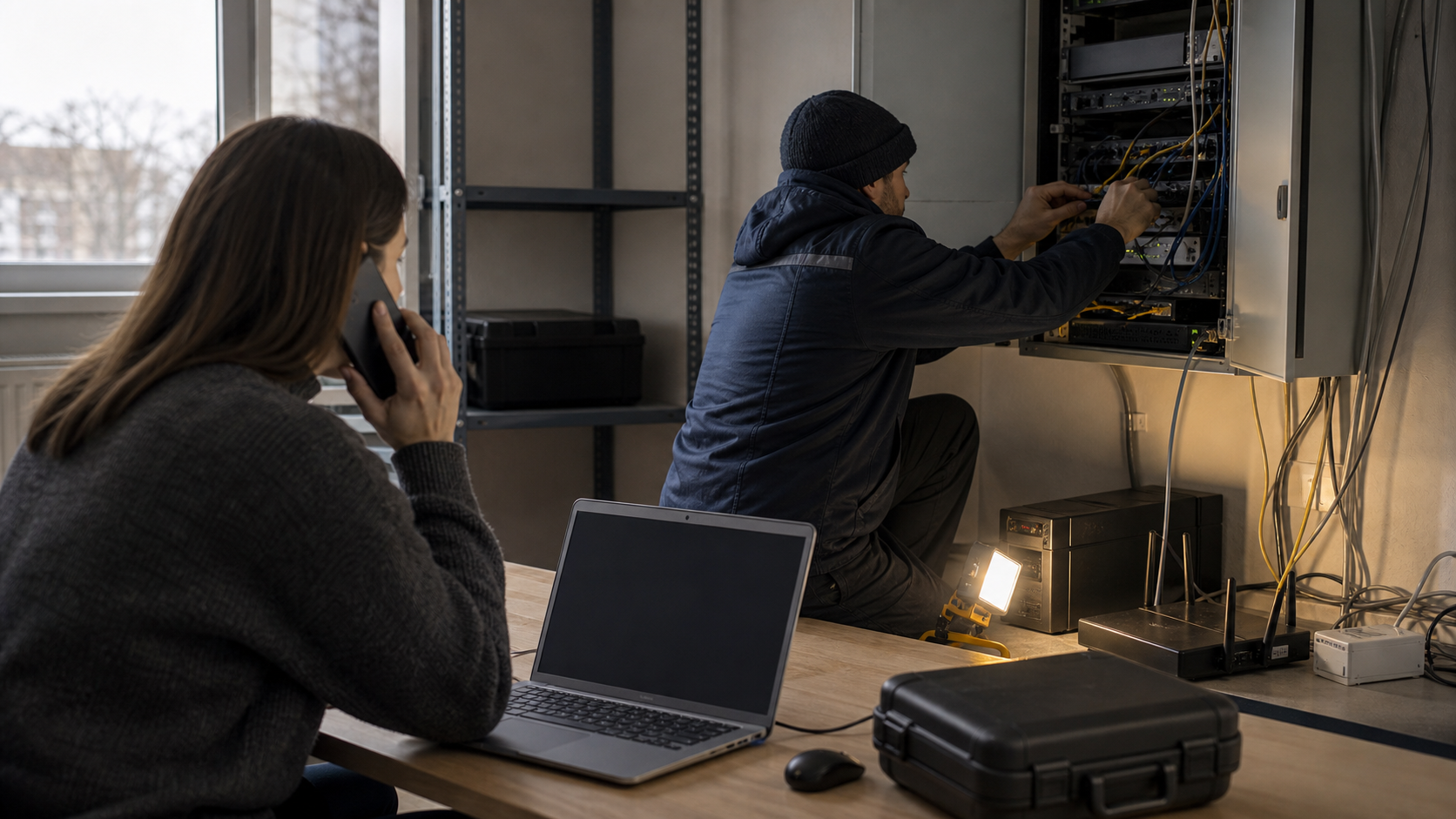
The working scene is ordinary and severe at the same time. A small manufacturer, clinic, school supplier, retail office, logistics desk or municipal contractor loses access to a shared business system during a scheduled or unscheduled power interruption. A router is still blinking, but the phones are not stable. One employee can reach the service through a mobile hotspot; another cannot. The owner's question becomes blunt: can someone who knows the environment tell the staff what is broken, what can be bypassed, and when a normal workday can resume?
That is the point at which the service ticket becomes the commercial unit. It is not merely a record in a queue. It is the customer's claim on local support labour, technical memory, communication discipline and escalation. If the incident can be solved remotely, the buyer pays for diagnosis and access to someone who understands the workstation, server, router, application, cloud account, user permissions and telecom dependency. If it cannot be solved remotely, the buyer pays for the judgement that sends a field technician, parts, replacement power equipment or a connectivity workaround to the right place.
Aiti Spektr's public evidence supports this account better than it supports a pure access-provider story. The official site, under the IT Spektr brand, describes a systems integrator that works with business IT rather than a retail consumer broadband catalogue. Its homepage presents IT support for business tasks, more than 10 years of experience, hundreds of PCs under service and confidentiality as a selling point (https://itspectr.com.ua/). The support and administration page says the company provides technical support and system administration in Ukraine and abroad, handles customer requests by phone, email, online services, applications or website, and has a Service Desk for convenient and fast handling of requests (https://itspectr.com.ua/services/it-structure/). Those are service-ticket economics in direct form.
The wartime part changes the value of the ticket. In a normal city, a support request can be judged by response time and technical competence. In Ukraine, the same request can carry power instability, staff displacement, curfews, air alerts, fuel availability, damaged infrastructure, supplier delays and recurring cyber risk. The customer is not buying only repair. It is paying for continuity under conditions where the usual boundary between office IT, network access, electricity, cloud hosting and customer communication breaks down.
This makes the price less transparent than a monthly broadband bill. A monthly line may be compared by speed, contention, static IP option or tariff. A support-continuity account is priced by the cost of a person who can answer, the knowledge already held about the customer's environment, the probability of field travel, the cost of backup hardware, the credibility of remote access, and the customer's pain if the failure continues. Aiti Spektr wins only if that bundle feels cheaper than confusion.
Public evidence gives a service business, not a mystery network
The strongest company-specific source is the official site. It says the business works with small, medium and large companies, names services including Odoo implementation and development, IT security, IT consulting, technical support and administration, web development and site promotion, and describes customers in production, retail and services (https://itspectr.com.ua/). The service pages are not a complete contract, but they are enough to identify the business surface: application implementation, support, administration, consulting, security and web work around customer operations.
The technical-support page is especially specific. It says IT Spektr provides support quickly both at the workplace and remotely, performs preliminary setup of computers and software, diagnoses faults, connects and maintains office equipment and communication equipment, supplies consumables and components, performs preventive visits, repairs warranty and non-warranty equipment, monitors workstations plus network and server equipment, offers remote equipment placement and secure communication, supports server and client operating systems as well as cloud options including Azure, Amazon, OVH and Office365, and installs and supports analogue, digital and IP PBX systems (https://itspectr.com.ua/services/it-structure/). That is a broad support-account claim.
The consulting page reinforces the continuity lens. It says the company audits existing IT services, equipment, software, networks and providers; evaluates corporate information systems; develops IT strategy; researches modernization; aligns network communications and IT processes to support business services; helps with licensing; optimizes upgrade costs; and provides business continuity by developing and implementing data-protection measures (https://itspectr.com.ua/services/it-consulting/). The article does not have to infer continuity from a slogan; the site uses the business-continuity idea directly.
The Odoo page adds an application layer (https://itspectr.com.ua/services/odoo-development/). For a customer using Odoo or a similar business system, continuity is not only whether the internet is reachable. It is whether accounting, inventory, sales, CRM, payroll, procurement, reporting and access rights keep functioning when staff change location, power conditions shift and telecom backups vary by office. A support ticket can therefore touch business software, user permissions, hosting, database backups and network availability in one incident.
The RIPE NCC page creates a second evidence lane. It identifies Aiti Spektr ltd as a RIPE NCC Local Internet Registry, with address box 39, 02167 Kyiv, Ukraine, phone +380672458557, email [email protected], and area serviced UA - Ukraine (https://www.ripe.net/membership/member-support/list-of-members/ua/aitispektr/). The wider RIPE member list also places Aiti Spektr ltd among Local Internet Registries offering services in Ukraine (https://www.ripe.net/membership/member-support/list-of-members/ua/). This matters because it links the company to public internet-number governance and a contactable operational identity.
That RIPE evidence must be bounded. A Local Internet Registry record is not a promise that the company sells retail internet service, publishes transit, hosts every customer service on its own network, or maintains a particular uptime level. It shows membership and number-resource context. It also connects the RIPE contact email to the official site domain, which increases confidence that the RIPE record and IT Spektr site describe the same public operating surface. It does not reveal revenue, headcount, support roster, outage history, customer retention or whether the company owns, leases or resells each layer used by customers.
The public DNS and BGP evidence also has to stay in its lane. The official domain resolves publicly to 217.147.163.133; its mail host resolves to 217.147.160.80; reverse DNS for the web address points to da1.intersv.com; and public whois output places those networks in 217.147.163.0/24 and 217.147.160.0/24, described as Intersvyaz Internet Service Provider in Kyiv/Ukraine, originated by AS21379. Hurricane Electric's public BGP page for AS21379 lists Ukraine as country of origin, four IPv4 originated prefixes, no IPv6 originated prefixes, valid RPKI originated routes, observed peers and the prefixes that include 217.147.160.0/24 and 217.147.163.0/24 (https://bgp.he.net/AS21379). That shows public hosting and mail dependence on another visible Ukrainian network. It does not prove Aiti Spektr's customer architecture or resilience.
The useful conclusion is not "Aiti Spektr is a large network operator." The useful conclusion is narrower: public records show a Ukrainian IT support business with a RIPE LIR identity, a Kyiv contact, a support-service catalogue and observable dependence on external network infrastructure for its own public site and mail. That is enough to discuss continuity economics. It is not enough to claim hidden scale.
What IT Spektr says it does
The support page reads like a catalogue of ticket types. A customer may call because a workstation is unusable, a business application is misconfigured, a router or switch is unstable, a server is not responding, a PBX is failing, remote access is broken, office equipment needs replacement, or a cloud service must be reconnected. The page says the company services workstations, network and server equipment; connects and maintains office and communication equipment; performs diagnostics; and uses remote and workplace support (https://itspectr.com.ua/services/it-structure/). That is the practical basis for treating the paid unit as a support ticket.
The same page says small companies can contact a specific specialist directly, without spending time registering a request and waiting for a return contact. In normal conditions, that line is a convenience claim. In a blackout or outage, it becomes economic. A named specialist can reduce the customer's search cost. The buyer does not have to explain the entire environment to a new operator while the office is already disrupted. The value is the saved time between "something is down" and "here is the likely failure path."
Service Desk language matters because it gives the buyer a mechanism for communication. A ticket is useful only if it creates state: who owns the issue, what has been tried, whether remote access works, whether a field visit is needed, what the user should do while waiting, and when the next update will arrive. Without state, support becomes a series of calls. With state, the ticket becomes a continuity object the customer can use to manage staff, sales promises and public-facing commitments.
The page's cloud and server-placement language widens the cost stack. IT Spektr says it can take into service server and client operating systems and cloud options including Azure, Amazon, OVH and Office365, and can choose an optimal placement option for a customer's data and services, on servers or cloud storage in Ukraine or abroad (https://itspectr.com.ua/services/it-structure/). That means a ticket may have to distinguish between a local power issue, local internet access, hosted server failure, cloud account incident, application problem and user-device problem. Each diagnosis has a different cost and escalation path.
The consulting page adds supplier and budget discipline. It says the company audits IT services, equipment, software, networks and providers, evaluates information systems, develops IT strategy, and optimizes upgrade costs (https://itspectr.com.ua/services/it-consulting/). A continuity account is stronger when the support provider already knows the customer's providers, equipment age, software versions, backup position and internal support gaps. It is weaker when every ticket starts from discovery.
The site also says IT Spektr can agree an SLA at the customer's request and set quality criteria for IT services (https://itspectr.com.ua/services/it-structure/). That sentence is important but incomplete. It shows that the company understands the buyer's need for measurable service. It does not publish sample response times, coverage tiers, escalation windows, penalties, exclusions or actual SLA performance. For a public reader, the SLA claim supports the service-account thesis but leaves proof gaps around execution.
Local labour is the first cost line
The first hard cost in the account is not a router, a cloud subscription or an IP record. It is a person who can diagnose the problem. Local support labour has to know Windows or Linux endpoints, network addressing, cabling, VPNs, firewalls, PBX systems, business software, office printers, security controls, backups, cloud accounts and the customer's habits. The more layers the provider covers, the more valuable the first diagnostic hour becomes.
IT Spektr's public pages describe a broad team model. The homepage says technical specialists, analysts and programmers work on customer projects; the support page says technical support and administration are delivered by phone, email, online services, applications or website; and the consulting page says the company examines IT staff productivity and can help select new employees (https://itspectr.com.ua/, https://itspectr.com.ua/services/it-structure/ and https://itspectr.com.ua/services/it-consulting/). The economic claim is local competence across business IT, not a single narrow access product.
For customers, that labour competes with three alternatives. The first is an internal hire. An internal administrator can learn the business deeply, but salaries, backup coverage, training and specialist depth can be expensive for a small or medium organisation. The second is a freelancer. A freelancer may be cheaper and fast, but key-person risk can be severe if wartime pressures, relocation or competing obligations make the person unavailable. The third is a larger managed-service provider or national operator. That can offer scale, but it may treat a small customer's application or office-specific history as out of scope.
Aiti Spektr's potential advantage sits between these alternatives. It can sell local familiarity without requiring the customer to employ a full IT staff, and it can offer a named support relationship without making the customer depend entirely on an informal contractor. The weakness is the same as the strength: if the company has limited staff depth, the account can become concentrated around a small number of specialists. The open evidence does not show staffing levels, after-hours roster, subcontractors or backup coverage.
Wartime conditions raise the labour cost because the support person spends more time separating symptoms from causes. When electricity is unstable, many failures look like IT failures: a switch loses power, a UPS battery is depleted, a router reboots, Wi-Fi coverage changes, laptops drain, desktop PCs cannot be used, a printer returns with a stale address, or a server recovers before the application does. The technician's work is to decide whether to restore, bypass, wait, escalate or tell the customer that the real bottleneck is outside the office.
That decision has value even when nothing is physically repaired. A customer may need to know that the hosted system is reachable from outside the office, that only one local switch failed, that mobile backup can carry the payroll team but not the whole office, or that staff should move to offline work for two hours. The ticket prices judgement.
Remote diagnostics only work when the path survives
Remote support is cheaper than a field visit because it saves travel time and allows a specialist to handle more than one customer. IT Spektr's support page says it provides quick support at the workplace and remotely (https://itspectr.com.ua/services/it-structure/). That promise is economically important, but wartime disruption makes it conditional. Remote diagnosis needs at least one working path: a user's mobile data, a functioning office line, a VPN, a cloud console, a remote desktop session, a phone call or email.
When those paths are unstable, the provider has to switch from ordinary remote support to continuity guidance. The first question becomes: what still works? Can a manager reach the application from a phone? Can the office router be power-cycled safely? Is the server local or hosted? Is the mail service reachable from outside? Can staff authenticate if the domain controller is offline? Is the fault with the customer's equipment, the upstream provider, the cloud service, the power supply or the user's device?
This is where network-resource evidence helps but does not settle the matter. Aiti Spektr's RIPE record says it is a Local Internet Registry and services Ukraine (https://www.ripe.net/membership/member-support/list-of-members/ua/aitispektr/). The official domain's public hosting and mail records show dependence on Intersvyaz/AS21379 for at least those public services, and Hurricane Electric lists AS21379's Ukrainian routes and observed connectivity (https://bgp.he.net/AS21379). Those facts help a researcher bound public dependency. They do not prove that a customer's service is hosted on the same network, that remote support will survive a given outage, or that the company has redundant support channels.
The cost implication is that remote support has hidden prerequisites. The customer may need backup power for routers, charged laptops, a mobile plan with enough data, a second administrator account, documented VPN access, external DNS control, cloud admin credentials, and a known phone channel. If those are not prepared before the incident, the ticket begins with access recovery instead of repair.
Remote diagnosis also creates a communication burden. A technician may be unable to see the device. The user may not know which cable is which. A power cut may mean the user is speaking from a phone while standing in a corridor, not sitting at the admin desk. Each step must be simple enough to execute under stress. That turns support into translation: the specialist has to convert infrastructure detail into instructions the customer can follow safely.
This is why the paid unit is not only technical skill. It includes patience, documentation, customer education and pre-incident preparation. The cheapest ticket is the one that was partly solved before it was opened, because the customer already had labelled equipment, backup credentials, power priorities and clear escalation contacts.
Field repair prices danger, fuel and parts
Some tickets cannot be closed remotely. A switch may have failed, a UPS may be depleted or damaged, cabling may need repair, an office server may not boot, a PBX may need physical attention, or a customer may need replacement components. IT Spektr's support page says the company supplies components and consumables, performs operational replacement, makes preventive visits, repairs warranty and non-warranty equipment, and works with structured cabling of any complexity (https://itspectr.com.ua/services/it-structure/). Those claims move the account from phone support into field service.
Field repair is where wartime continuity becomes expensive. Travel time can be unpredictable. Fuel may be costly or scarce. A technician may need to plan around power schedules, air alerts or access restrictions. Replacement parts may not be immediately available. The provider may have to decide whether to send a generalist first, wait for a specialist, ship a part, ask the customer to perform a temporary bypass, or declare that repair should wait until conditions are safer.
The customer sees only the ticket. The provider carries the cost of dispatch discipline. A wasted visit can destroy margin. Sending the wrong part, arriving when the building has no power, discovering that the customer lacks access to the equipment room, or finding that the fault belongs to an upstream provider all consume labour without solving the problem. Good support firms therefore price field repair by readiness: inventory, remote triage, customer instructions, travel planning and escalation rules.
Field repair also changes the customer's perception of value. A remote-only provider may be cheaper until the customer needs someone physically present. A national operator may repair its own line but refuse to troubleshoot the customer's internal network, server or application. A cloud provider may be healthy while the office cannot reach it. Aiti Spektr's support case is strongest when the problem crosses those boundaries and a local technician can own the practical fix.
That strength has limits. Public pages do not show vehicle coverage, stock levels, geographic dispatch radius, emergency-call pricing or average repair time. A buyer should ask those questions directly. The existence of field-service claims is evidence of capability category, not proof of service performance.
The most valuable field visit may be preventive rather than reactive. IT Spektr says it practices additional preventive visits and monitors infrastructure components (https://itspectr.com.ua/services/it-structure/). Preventive work can replace weak UPS batteries before a blackout, label equipment, document network topology, test restore procedures, identify a single point of failure, install spare hardware and teach staff how to switch to mobile backup. The customer pays for fewer emergencies, not only faster emergencies.
Power backup turns support into continuity
Power disruption is the difference between a normal support account and a wartime continuity account. When the power fails, the customer's IT stack is no longer a simple chain from device to network to application. It becomes a prioritisation problem. Which systems must stay online? Which can wait? Which devices need UPS power? Which routers and switches matter most? Can staff work from laptops? Is mobile backup enough? How long can batteries carry the office? What data could be corrupted if a server shuts down badly?
IT Spektr's site does not publish a backup-power catalogue. But its service claims cover the infrastructure around the problem: workstation, network and server equipment monitoring; remote equipment placement; secure communication; server and client operating systems; cloud solutions; and data/service placement options in Ukraine or abroad (https://itspectr.com.ua/services/it-structure/). That is the layer where power resilience is designed and supported.
The wider Ukrainian context makes this central. RIPE NCC's Ukraine/Russia page says the organisation made clear to Ukrainian members that accounts would not be closed if members were unable to pay on time or respond to administrative requests because of the conflict or sanctions, and that keeping members and critical services operational was a main focus (https://www.ripe.net/membership/member-support/the-ripe-ncc-and-ukraine-russia/). This is not an Aiti Spektr performance claim. It shows that number-resource governance itself had to account for wartime disruption.
Power backup is expensive because it is both hardware and maintenance. A UPS must be sized correctly. Batteries age. Generators need fuel and safe operation. A router may stay up while the upstream street cabinet fails. A laptop fleet may work but printers and desk phones may not. A mobile backup may keep email alive but not heavy application traffic. Cloud hosting can move compute away from the office but still depends on local access and identity systems.
The support ticket prices these tradeoffs. A technician can tell the customer that buying a larger UPS for every desk is wasteful, but backing up the fibre terminal, router, core switch and Wi-Fi access point is essential. Or the answer may be that the application should be hosted off-site, while the office needs only enough power to reach it. Or the answer may be that an old local server is too risky and should be migrated before the next outage.
The customer is really buying a continuity plan in pieces. Each ticket reveals another weakness. The first ticket closes the incident. The second asks why it happened. The third funds a battery replacement, a network diagram, a cloud migration, a mobile backup, a second administrator account or a tested restore. Aiti Spektr's renewal case depends on turning repeated disruption into a stronger operating position rather than endless break-fix billing.
Upstream dependence sets the limit
No local support provider can repair every dependency it touches. A customer's service may depend on a national operator, a regional ISP, a data centre, a cloud platform, a domain registrar, a mail provider, a software vendor, a payment processor, a mobile network or a public electricity grid. The best support account does not pretend those dependencies disappear. It identifies them early and communicates the limits.
The public DNS evidence for IT Spektr's own domain is a useful example. The website and mail records point to external network infrastructure rather than proving a self-contained Aiti Spektr network. Public whois and BGP evidence associate the web and mail addresses with Intersvyaz/AS21379, and Hurricane Electric's page for AS21379 lists a modest Ukrainian IPv4 network with two upstreams and no IPv6 originated prefixes (https://bgp.he.net/AS21379). That tells us the official site has observable upstream dependence. It does not tell us where customer systems live.
The same kind of dependence will exist for customers. If a customer's office uses Kyivstar, Ukrtelecom, Vodafone, lifecell, a local fibre provider, a mobile router, Starlink, Azure, Amazon, OVH, Office365 or another hosted system, Aiti Spektr can often diagnose and coordinate, but it cannot single-handedly restore an upstream outage. The support value is in knowing when the local environment is healthy and when the incident must be escalated elsewhere.
This matters because false ownership is costly. If a provider keeps troubleshooting local devices while the real fault is a regional upstream outage, the customer loses time. If a provider blames an upstream too early, the customer may miss a solvable local fault. Good support narrows the uncertainty quickly and records what evidence supports each conclusion.
The official consulting page says IT Spektr audits networks and providers (https://itspectr.com.ua/services/it-consulting/). That is exactly the precondition for good dependency management. A customer should know which provider carries the primary line, which carries backup, who has admin access, what phone number is used for escalation, where account credentials are stored, and whether static IPs, VPNs, firewall rules or hosted services depend on a single route.
The wartime version of upstream management includes substitutes. A mobile backup can handle some workloads but not all. A satellite terminal can help in damaged areas but may be expensive and policy-constrained. A cloud migration can move a server away from local power but can increase dependence on identity, billing and external access. A second fixed ISP can improve office continuity but may share ducts, poles, power or upstream transit with the first. The ticket is valuable when it tells the customer which substitute actually reduces risk.
Customer communication is part of the product
During a disruption, a customer pays for information as much as repair. A service ticket has to answer basic management questions: Is this our fault? Is customer data at risk? Can staff keep working? Should we send people home, move to mobile data, switch to paper, postpone deliveries, call clients, delay payroll or wait? A support provider that cannot communicate leaves the buyer to improvise.
IT Spektr's public site emphasizes contact channels: phone, email, online services, applications and website support (https://itspectr.com.ua/services/it-structure/). The homepage also invites customers to leave a request and says a consultant will call back within one business day (https://itspectr.com.ua/). Those are marketing statements, not performance proof, but they show that the public offer is built around reachable support rather than only equipment resale.
Wartime communication has an extra duty: it must be honest about uncertainty. The technician may not know whether an upstream provider will restore service in thirty minutes or six hours. The power situation may change. A field visit may be unsafe. A cloud platform may be healthy but unreachable from one locality. The customer does not need overconfident promises. It needs the current assessment, next update time, temporary workaround and business implication.
This is why service desk discipline is economically important. A well-run ticket stores facts: time opened, affected users, systems affected, power state, network state, tests performed, advice given, escalation owner, next step and closure reason. It also prevents repeated explanation when the customer calls again. In a small company, the ticket may be less formal than in an enterprise help desk, but the function is the same.
Customer communication also protects the provider's margin. If the customer understands that a ticket is waiting on a third-party line repair, it is less likely to blame the support provider for delay. If the provider explains that remote work is possible only for certain staff, the customer can allocate scarce connectivity. If the provider documents that a UPS failed because its batteries were beyond service life, the next invoice for replacement parts is easier to justify.
The public proof gap is response quality. The site says support is fast and uses a Service Desk, but no public status history, response-time data, ticket closure rates or customer reviews surfaced in the public evidence set. That does not mean support is weak. Many local IT firms operate on referrals and private contracts. It means the reader should treat communication claims as a diligence area.
Ukraine's public-sector continuity raises the standard
Ukraine's digital life gives continuity work a public-sector dimension even for private suppliers. Businesses interact with tax systems, electronic documents, public procurement, digital identity, banking, logistics and municipal services. Citizens use digital public services such as Diia (https://diia.gov.ua/). An SME that loses connectivity may lose more than internal convenience; it may lose the ability to file, sign, pay, verify, communicate with suppliers or serve customers who themselves depend on digital channels.
This does not make Aiti Spektr a public operator. It means its customer environment is shaped by a country where digital services have become essential during war. A clinic, school supplier, shop, contractor, manufacturer or nonprofit may need IT support because its public-facing obligations continue even during disruption. The continuity account is therefore not only about a private office. It is about the customer's place in a wider service chain.
The RIPE NCC wartime page helps explain why internet governance continuity matters. RIPE said its registration and information services remained authoritative and that it kept critical services operational under the circumstances of the war (https://www.ripe.net/membership/member-support/the-ripe-ncc-and-ukraine-russia/). For a Ukrainian Local Internet Registry such as Aiti Spektr, that wider governance context matters because number-resource and contact records are part of internet accountability.
Ukraine's connectivity demand is broad. DataReportal's Digital 2025 Ukraine report is a market source for internet adoption and user context (https://datareportal.com/reports/digital-2025-ukraine), while World Bank data for fixed broadband subscriptions per 100 people gives a separate public statistical reference point for fixed connectivity (https://data.worldbank.org/indicator/IT.NET.BBND.P2?locations=UA). These are country-level sources, not Aiti Spektr metrics. They show why local continuity support sits inside a large connected society rather than a niche hobby market.
Public-sector continuity also changes customer tolerance for downtime. A retailer can sometimes wait to update a website. A medical supplier, payroll office, legal practice, school contractor or logistics desk may not. When public forms, bank payments, air-alert communication, staff coordination and customer messaging depend on digital channels, a support ticket becomes part of operational resilience.
The question for Aiti Spektr is whether it can convert this context into retained accounts. The public evidence shows service categories that fit the need: support, administration, provider audits, secure communication, data placement, cloud options, PBX support and Service Desk handling. It does not show public-sector customer contracts, public procurement awards, government references or regulated critical-infrastructure role. The analysis should therefore treat public-sector continuity as demand context, not as proven customer mix.
Substitutes define the ceiling
The first substitute is a national operator. Kyivstar, Ukrtelecom, Vodafone Ukraine and lifecell can sell broad connectivity, mobile service and business products at a scale a local systems integrator cannot match. National operators may have stronger network monitoring, more field crews and larger procurement. They also may limit support to their own service boundary. If the customer's line works but the office network, server, PBX or Odoo instance is broken, a national operator may not own the fix.
The second substitute is a separate ISP or mobile backup. For some customers, continuity is best improved by buying a second connection, a mobile router, better Wi-Fi or a satellite terminal. That can reduce dependence on one path. It does not remove the need to configure failover, prioritize traffic, protect credentials and train staff. Aiti Spektr can defend its account by helping the customer make backup connectivity usable rather than merely purchased.
The third substitute is cloud migration. IT Spektr's own support page names Azure, Amazon, OVH and Office365 as cloud options it can support (https://itspectr.com.ua/services/it-structure/). A customer can move a server or application away from a fragile office. The tradeoff is new dependence on cloud billing, identity, security configuration, internet access and migration labour. Cloud can reduce local power exposure while increasing the need for disciplined account management.
The fourth substitute is an internal IT hire. For a larger customer, that can be the right choice. An employee can be present every day and learn business specifics. The cost is salary, training, backup coverage and specialist limits. A small or medium customer may not have enough work for a full team but may still need enterprise-style continuity. That gap is the support-provider opportunity.
The fifth substitute is a freelancer. A freelancer can be flexible, cheap and highly skilled. The risk is availability and continuity. If the freelancer is unavailable during a wartime incident, the customer may have no second line of support. Aiti Spektr's company account is stronger if it can show team depth and documented service handling. Public pages imply a team, but do not prove its size.
The sixth substitute is delayed repair. It is often the cheapest option until it becomes the most expensive. A customer may tolerate slow systems, old routers, weak batteries, undocumented servers and manual workarounds because replacement feels discretionary. A blackout or network failure reveals the real price. Aiti Spektr's account is strongest when it turns delayed repair into staged continuity investments: label equipment, document providers, replace weak batteries, test backups, configure mobile backup, move selected services off-site and train staff.
These substitutes cap pricing. Aiti Spektr cannot charge indefinitely for local support if a customer can move cleanly to a national operator bundle, a managed cloud service, a bigger MSP or an internal hire. Its defensible price is the difference between a cheaper substitute's invoice and the customer's total cost after migration, retraining, hidden support gaps, outage risk and communication failure.
What remains unproved
The direct evidence is enough to describe the service surface. IT Spektr's official site and service pages support a business built around technical support, system administration, Service Desk handling, remote and on-site diagnosis, communication equipment, server and network monitoring, cloud support, consulting, data protection and SLA options (https://itspectr.com.ua/, https://itspectr.com.ua/services/it-structure/ and https://itspectr.com.ua/services/it-consulting/). The RIPE NCC page supports Aiti Spektr ltd as a Local Internet Registry with Kyiv address, Ukraine service area and contact email on the same domain (https://www.ripe.net/membership/member-support/list-of-members/ua/aitispektr/). Public DNS and BGP evidence support external network dependence for the official site and mail, with AS21379 visible as the originating network for the relevant prefixes (https://bgp.he.net/AS21379).
The direct evidence does not prove economics. It does not show support revenue, margin per ticket, labour utilization, cost of field visits, cost of backup equipment, spare-parts inventory, customer concentration, payment terms, bad debt, price increases or the share of recurring support versus one-off project work. Without those numbers, the article can explain the cost stack but not compute profitability.
The direct evidence does not prove reliability. It does not show uptime, response times, restore times, incident frequency, after-hours coverage, remote-access success rate, field dispatch times, backup test results, escalation history, security incidents or SLA compliance. A buyer should ask for incident examples, support hours, emergency procedures, restore evidence and escalation contacts before relying on the account for critical operations.
The direct evidence does not prove retention. The homepage displays customer logos and says the company works with businesses in production, retail and services (https://itspectr.com.ua/), but public pages do not provide dated case studies, renewal cohorts, customer references, churn data or proof that clients stayed because service continuity improved. Retention is the metric that would most change the judgement. A support ticket matters commercially only if customers renew after seeing value in disruptions.
The direct evidence also does not prove internal architecture. RIPE membership and public DNS/BGP observations are valuable accountability signals, but they cannot show where customer workloads are hosted, how many upstreams protect each service, whether customer backups are off-site, whether monitoring is redundant, or whether Aiti Spektr has independent continuity if its own public site, mail host or office loses service. Network records bound public service surface and dependency; they cannot certify hidden design.
The final judgement is therefore practical. Aiti Spektr's public record supports a Ukrainian service-ticket account in which buyers pay for local support labour, remote diagnostics, field repair, power-aware continuity planning, upstream coordination and communication under wartime pressure. The account is economically attractive when the customer values a named support relationship more than a cheaper line, generic cloud plan or ad hoc freelancer. It is vulnerable when the customer can standardize on a national operator, a larger managed-service provider, a clean cloud migration or an internal IT function.
The proof gaps are the same three gaps a buyer should care about before renewal. Economics: what does the customer pay for recurring support, emergency work, field repair, backup hardware and cloud coordination, and how predictable is the invoice? Reliability: how quickly are incidents acknowledged, diagnosed, escalated and closed when power and connectivity are unstable? Retention: do customers keep paying after real outages because Aiti Spektr made their operations more continuous, or do they leave once the immediate repair is finished?
Until those answers are public, Aiti Spektr should be read as a credible but still under-documented Ukrainian continuity support account.