
Summary
- Affinity VoIP Telecom, Inc. should be priced as a local access and field-support account, not as a generic bandwidth line. The customer buys a bundle of installed access, voice continuity, configuration memory, outage recovery and supplier coordination; the costly part is the labour required to make those things work when a small business cannot tolerate a failed phone or internet day.
- The public record proves a real network-resource footprint but not the full business model. ARIN records Affinity VoIP Telecom, Inc. as the registrant of AS30478 and the assigned IPv4 block 69.30.55.0/24, with a Hillsboro, Oregon address and validated administrative, technical and abuse contacts at
affinityvoip.com; RIPEstat shows AS30478 announced and the same /24 visible in BGP. - The routing evidence should be treated as a diligence signal. RIPEstat's routing-consistency data for AS30478 showed AS6423 as the observed BGP import and export peer, and RIPEstat identifies AS6423 as Digital Fortress. That supports an upstream-dependence discussion, but it does not prove a current commercial contract, a service-level commitment, customer count, revenue, margins or outage history.
- The company-domain signal is mixed. DNS for
affinityvoip.comresolved to the Affinity /24 and the domain has Google mail-exchanger records, but HTTP and HTTPS checks on the public site did not return a working service page during this review. That gap makes private evidence such as support history, ticket response, installation records and churn more important than public marketing copy. - The retention test is whether Affinity can make a local outage visit cheaper than switching. National cable or fiber, mobile broadband, satellite broadband, cloud-phone platforms, another local ISP, an in-house private link and a delayed installation all compete with the account. Affinity's value improves if it can show faster recovery, better site memory, better VoIP emergency-location discipline and credible upstream escalation.
The Retention Moment Is The Product
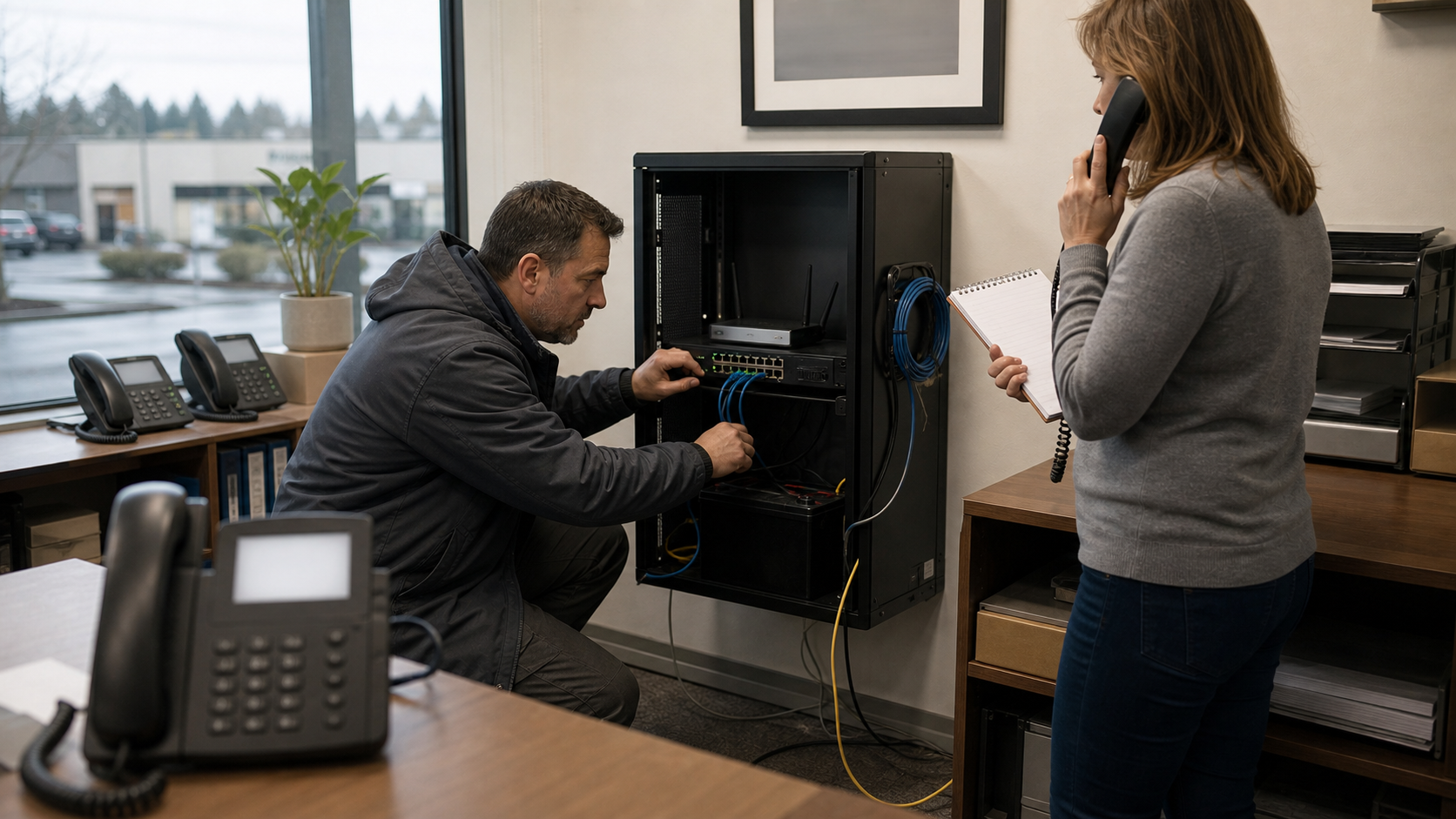
The useful way to begin is not with a company description. It is with a Monday morning visit to a small office whose phones stopped behaving after a weekend power event. The internet may be partly alive. One desk phone can call out, another cannot receive calls, the payment terminal works intermittently, and the owner is trying to decide whether to keep paying the provider that installed the service or move the account to a national brand that promises a simpler bundle. The invoice line says voice or internet.
The decision is really about whether the person who arrives on site can reconstruct how the location was wired, how the router was configured, which handsets were provisioned, which upstream path was in use, and what has to be changed without making the outage worse.
That is the economic unit for Affinity VoIP Telecom, Inc. The customer is not only buying megabits or minutes. The customer is buying a local access and field-support account: a combination of access line, voice service, installed equipment, emergency calling settings, route and address continuity, troubleshooting memory, supplier escalation and the practical assurance that someone will own the messy boundary between the customer's premises and the wider network. The company matters if that bundle reduces the cost of the bad morning.
It matters less if a customer can switch to a cheaper national, mobile, satellite or cloud-phone alternative without losing configuration knowledge or recovery speed.
The public BTW directory page at https://btw.media/en/directory/affinity-voip-telecom-inc identifies the existing directory entity as Affinity VoIP Telecom, Inc. and frames it around network infrastructure. That page is not independent proof of revenue or quality; it is the internal public context for the entity being analysed. The independent public evidence is stronger on number resources than on retail packaging. ARIN's RDAP autnum record at https://rdap.arin.net/registry/autnum/30478 records AS30478 with the name AVT and lists Affinity VoIP Telecom, Inc. as the registrant. ARIN's entity record at https://rdap.arin.net/registry/entity/AVT-5 ties the organisation to the same AS and to the IPv4 network 69.30.55.0/24. The public address in those records is in Hillsboro, Oregon, and the contact records use [email protected].
Those facts matter, but they do not answer the commercial question by themselves. A registered autonomous system and a /24 assignment are evidence of a responsible operator for number resources. They are not proof that the company has a large access network, a profitable voice base, a field force, an active retail website, a data centre, an audited service level or a particular customer count. The article therefore has to work in two layers. The first layer says what the public record can prove: identity, resource registration, visible routing, an observed upstream peer and formal contacts.
The second layer prices the business mechanism that could make the account valuable: local installation labour, VoIP continuity, upstream coordination and retention after an outage.
The retention moment is where those layers meet. If the customer has ordinary broadband and a phone number that can be moved cleanly to a cloud-phone provider, the outside option is strong. If the customer has a brittle local installation, legacy handsets, alarm lines, point-of-sale equipment, static addressing, firewall rules, emergency-location obligations and staff who need a known technician more than they need a new portal, the outside option weakens. Affinity's possible value is in that difference. It can turn an outage visit into retention if the visit proves that staying avoids more risk than switching saves.
What The Public Record Proves
ARIN gives the clearest company-specific evidence. The RDAP autnum record for AS30478 at https://rdap.arin.net/registry/autnum/30478 shows AS30478 as active, registered in March 2008 and last changed in May 2024. It lists Affinity VoIP Telecom, Inc. as the registrant through ARIN organisation handle AVT-5. The nested contact information shows validated administrative and technical or abuse contacts, both using the affinityvoip.com domain and the same Hillsboro address as the registrant. That establishes a public number-resource administration surface.
The organisation record at https://rdap.arin.net/registry/entity/AVT-5 adds the associated resource inventory visible from ARIN: AS30478 and the network 69.30.55.0/24. The IP network record at https://rdap.arin.net/registry/ip/69.30.55.0 shows 69.30.55.0 through 69.30.55.255 as an active IPv4 assignment, registered in June 2010, with Affinity VoIP Telecom, Inc. as the registrant. A /24 has 256 addresses before unusable-address and operational conventions are considered. In access and VoIP economics, such a block can be useful for customer endpoints, voice infrastructure, management addresses, static services, firewall rules, monitoring, reverse DNS and continuity. It is not, by itself, evidence of how many customers exist or how many addresses are actively used.
RIPEstat confirms that the AS is publicly visible. Its AS overview endpoint at https://stat.ripe.net/data/as-overview/data.json?resource=AS30478 identifies the holder as "AVT - Affinity VoIP Telecom, Inc." and marked the AS as announced in the query window ending July 7, 2026. RIPEstat's announced-prefixes endpoint at https://stat.ripe.net/data/announced-prefixes/data.json?resource=AS30478 returned one visible prefix, 69.30.55.0/24, across the two-week window from June 23 to July 7, 2026, with the caveat that RIPEstat excludes very low-visibility routes. The prefix-overview endpoint at https://stat.ripe.net/data/prefix-overview/data.json?resource=69.30.55.0/24 also showed the prefix announced by AS30478.
That is enough to say Affinity is not merely a name in an old registry row. It has a public resource footprint and a visible route. It is not enough to say the business is healthy, growing or profitable. The public record does not show subscriber lines, voice seats, monthly recurring revenue, support response time, active installation geography, upstream contract terms, service-level credits, historical outages, churn, customer concentration or whether the company's offer is mainly voice, broadband, managed access, wholesale, private customer service or a legacy account base.
The public PeeringDB API at https://www.peeringdb.com/api/net?asn=30478 returned no public network entity for AS30478 during this review. That does not mean Affinity lacks peers or upstreams. Many small networks do not maintain PeeringDB profiles. It does mean a buyer cannot rely on PeeringDB to understand the company's interconnection policy, facility presence, traffic ratios or open-peering posture. In this case, the routing view is more useful than the peering-profile view.
The company-domain signal is also partial. DNS lookups for affinityvoip.com resolved to 69.30.55.21, and www.affinityvoip.com resolved through the same domain to that address. The domain's mail-exchanger records pointed to Google mail service. But public HTTP and HTTPS requests to http://www.affinityvoip.com and https://www.affinityvoip.com did not return a reachable service page during this review. That is not proof of inactivity, because a domain can be used for email, internal tools or customer-specific portals. It is, however, a commercial visibility gap. A buyer comparing providers would have less public product evidence than it would have from a national operator, a mobile broadband carrier, a cloud-phone platform or a heavily marketed local ISP.
The Costly Unit Is Installed Continuity
The first question is what the customer actually buys. In the strongest version of the Affinity case, the customer buys installed continuity. That means a working access path, configured customer premises equipment, static addressing or stable service identifiers where needed, voice settings, emergency-location discipline, documented equipment, a support contact that knows the site, and the ability to coordinate with an upstream provider when the problem is outside the building. The nominal product may be internet access, VoIP service or managed local connectivity. The paid unit is the reduction in operational uncertainty.
The second question is why that unit is costly. Installation labour is expensive because it is local, interrupt-driven and memory-heavy. The technician may need to visit a site, identify cable paths, examine a small rack, recover passwords, reconcile old diagrams with reality, map phones to extensions, check power and battery backup, update router firmware, test failover, verify call routing, confirm emergency-address information and document what changed. None of that looks like scarce infrastructure from a distance. It becomes scarce when the customer is down and every hour carries business cost.
The third question is what the public evidence can prove about whether the unit is worth paying for. Public evidence can show that Affinity has number resources, a visible route and formal ARIN contacts. It can show that a single /24 is announced and that a specific upstream peer appears in observed routing. It can show that the company's web presence is not carrying a large public marketing load.
It cannot show how often Affinity visits sites, how quickly it answers calls, whether customers receive clean handover documents, whether backup access exists, whether VoIP location records are accurate, whether the upstream responds quickly, or whether customers renew because Affinity solves hard local problems.
That distinction is central. Many small providers survive because the installed base is sticky. Some are sticky because they are good: they know the customer's equipment, answer the phone, coordinate suppliers and prevent outages from spreading. Others are sticky because leaving is painful: configurations are undocumented, numbers are hard to move, contracts are unclear, and customers delay the migration until the next failure. The same retention rate can mean trust or inertia. The public record does not tell which one applies to Affinity.
The buyer's diligence should therefore translate technical evidence into operating questions. Does the provider maintain a current inventory of devices on site? Does it document router rules and VoIP credentials in a way that the customer can recover? Does it test emergency calling after moves and equipment changes? Does it provide a support path for after-hours outages? Does it know which upstream ticket queue to use if BGP or transit is the problem? Does it explain which parts of the service are Affinity's responsibility and which depend on another network? A provider that answers those questions well is selling continuity.
A provider that cannot answer them is selling a fragile bundle with a familiar name.
The substitute price has to include those questions. A cloud-phone plan can look cheaper until the customer pays an installer to replace handsets, clean up old wiring and move emergency-location records. A mobile broadband device can look convenient until it fails under building penetration, congestion, static-IP limitations or voice-quality expectations. A national cable or fiber package can look safer until the first outage requires the customer to navigate a large support queue with no knowledge of the old site. A satellite backup can look resilient until obstruction, power, equipment placement and support terms are counted.
Affinity's possible value is not that it beats every substitute on headline price. It is that it may reduce the hidden migration and outage costs for a particular local account.
Installation Labour Is The First Margin Test
Installation labour is where local telecom economics becomes concrete. A new access or VoIP account is not finished when the order is accepted. Someone has to make the service work in the physical location.
The office may have old telephone wiring, multiple tenants, a landlord-controlled demarcation point, unmanaged switches, consumer routers, a payment terminal, an alarm panel, a fax line, a door-entry system, a small firewall, Wi-Fi dead spots and a staff member who knows only that "the phones worked before." A national provider can ship equipment and schedule a technician, but the economics of the account depends on how much local interpretation is needed.
For a small provider, that interpretation can become both advantage and burden. It is an advantage because site memory creates differentiation. If Affinity installed the router, knows the voice endpoints, remembers which cable run is unreliable, and has already learned which upstream symptoms produce which customer complaints, it can solve problems faster than a substitute starting cold. It is a burden because every site-specific exception consumes labour that cannot be used elsewhere.
A small account can become unprofitable if it repeatedly requires truck rolls, handholding, emergency changes and custom documentation without paying for those services.
The public ARIN record does not reveal whether Affinity has a field staff, contractor network or support desk. It does reveal a local address and a resource footprint. The business judgement therefore has to be conditional. If Affinity's installation work is light and mostly remote, then national operators and cloud substitutes become more competitive. If Affinity's customers have messy local installations, then the provider's knowledge of those installations may be the main retention asset.
The strongest retention moment is the outage visit that prevents a larger migration discussion. A customer may have been considering a cheaper plan. Then a technician arrives, finds that the failed voice service is tied to a power supply, a switch port, a stale router rule, a mislabelled cable, a blocked SIP path or a broadband issue upstream, and restores service before the business loses the day. The customer renews not because the invoice is the lowest, but because the visit demonstrated avoided loss. The next sales call from a substitute provider has to overcome that memory.
The weakest retention moment is the visit that exposes dependence without value. If the provider arrives late, cannot explain the configuration, blames an upstream without escalation evidence, or tells the customer that old equipment must be replaced without a clear plan, the customer learns that staying only preserves uncertainty. In that case a national provider, a managed cloud-phone installer or a different local ISP can win by making the migration look controlled.
Installation labour also affects pricing. If Affinity charges too little for installation, it may subsidise the customer with future support hours. If it charges too much upfront, the buyer may choose a self-installing mobile broadband device, a cloud-phone provider with shipped handsets, or a national provider with promotional installation. The durable model is to price installation as risk reduction: document the site, test voice, map failure modes, provide backup instructions and explain exit options. Customers may pay for that when they understand the cost of a bad outage.
VoIP Continuity Is Different From Ordinary Broadband
The company name makes voice part of the analysis, but the public record does not prove the current mix of voice and data services. The right way to handle the name is to examine what VoIP continuity would require if the service includes interconnected voice or managed business phones. Voice is less forgiving than ordinary web browsing because the failure is visible immediately. A slow web page irritates staff. A broken phone path can stop customer calls, emergency calls, appointment confirmations, card-terminal support, supplier calls and after-hours forwarding.
VoIP also creates compliance and responsibility questions that ordinary broadband does not. The eCFR Title 47 Part 9 API at https://www.ecfr.gov/api/versioner/v1/full/2026-07-06/title-47.xml?part=9 sets out 911, E911 and next-generation 911 requirements, and its definitions include interconnected VoIP service as real-time two-way voice that requires broadband and IP-compatible customer premises equipment and permits users generally to receive or terminate calls with the public switched telephone network. That does not determine Affinity's exact legal obligations in any given service arrangement. It does show why a business voice account is not just another application running over broadband.
The outage context is similarly broader than a speed test. The eCFR Title 47 Part 4 API at https://www.ecfr.gov/api/versioner/v1/full/2026-07-06/title-47.xml?part=4 covers disruptions to communications, and the text identifies interconnected VoIP providers among communications providers covered by the requirements of the part. Again, that is not a company-specific legal conclusion. It is operating context. A provider selling voice continuity has to think about customer reachability, emergency calling, outage thresholds, supplier dependencies and the documentation needed to keep a failure from becoming a public-safety or compliance problem.
For a buyer, VoIP continuity should be priced through four practical questions. First, does the phone service survive a local broadband interruption, or is there a tested failover path to mobile forwarding, another access link or a backup connection? Second, are emergency-location records accurate after office moves, handset changes and remote-work changes? Third, does the provider control enough of the access path to troubleshoot voice quality, or does it depend on another broadband provider and a cloud voice platform?
Fourth, will the provider send someone who understands both the customer's physical installation and the upstream voice dependencies?
This is where a local provider can beat a large substitute. A cloud-phone platform may have excellent software, rich features and transparent pricing, as RingCentral's public pricing page at https://www.ringcentral.com/office/plansandpricing.html demonstrates for AI-powered calling, messaging and video conferencing packages. But a software platform does not automatically solve the local access problem, the old wiring problem, the building power problem, the customer's emergency-location discipline or the question of who visits the site when phones and internet fail together. A national provider may offer a bundled voice and broadband package, but the customer still has to test whether the support path understands its actual installation.
The same point cuts against Affinity if it cannot show operational maturity. A small VoIP provider cannot rely on familiarity alone when cloud-phone substitutes are visible, feature-rich and increasingly easy to buy. It has to prove continuity: call routing, number porting, emergency calling, device replacement, after-hours forwarding, outage communication, and the ability to separate a voice-platform problem from an access problem. If those proofs are weak, the customer may decide that software scale and a new access line are safer than staying with a local bundle.
Upstream Dependence Is The Network Price
RIPEstat's AS routing-consistency endpoint at https://stat.ripe.net/data/as-routing-consistency/data.json?resource=AS30478 is the key upstream-dependence source. For the July 7, 2026 query time, it showed 69.30.55.0/24 as both in BGP and in whois, with ARIN and RADB listed as IRR sources. It also showed AS6423 as the observed import and export peer in BGP, while not shown in whois for that relationship. RIPEstat's AS overview for AS6423 at https://stat.ripe.net/data/as-overview/data.json?resource=AS6423 identifies that AS holder as Digital Fortress and marks it announced.
The cautious interpretation is that AS30478's visible internet reachability depended, at that moment, on a route observed through AS6423. The public data does not prove a contract, pricing, capacity, service-level agreement, cross-connect location, reseller relationship or support escalation path. It does support a buyer question: if Affinity is responsible for local access or VoIP continuity, how does it coordinate with the upstream network when the visible route is affected?
Upstream dependence is not a weakness by itself. Small providers routinely depend on larger networks for transit, colocation, transport, DDoS handling, route propagation and facility operations. The issue is whether the dependence is designed and managed. A single visible route may be sufficient for a narrow service if the customer's risk tolerance is modest, the upstream is reliable, and failover can move voice or critical functions elsewhere. It is less sufficient if the customer thinks it is buying resilient business continuity.
The /24 also shapes the economics. A small IPv4 block can be commercially useful because IPv4 addresses remain operationally valuable even when new address demand has moved toward IPv6 in policy discussions. Static addresses can support VPNs, firewall rules, VoIP infrastructure, monitoring, customer appliances, reverse DNS and partner allowlists. But a /24 is not a large pool, and public routing data does not show how the addresses are used. If the addresses support many customer-specific configurations, they can increase stickiness. If they are lightly used or mostly internal, their commercial role is smaller.
Upstream dependence therefore interacts with retention. A customer with a static address on 69.30.55.0/24 may have more migration friction than a customer using ordinary dynamic access. Moving could require firewall updates, partner coordination, DNS changes, email reputation work, VPN changes and testing. That friction can help Affinity keep the account, but it also raises the provider's responsibility. If the route fails, the customer's dependence on the provider becomes painfully visible.
The buyer should ask for the route story in plain language. Which provider carries the customer's traffic to the wider internet? Is there more than one upstream? If only one is visible, is there a contractual or practical backup? How are route changes communicated? Who handles routing security, IRR objects and any route filters? How quickly can the upstream be escalated? Does the customer have a backup voice route if the data path fails? The public RIPEstat data gives the questions; the private service file has to give the answers.
Substitutes Set The Retention Price
Affinity's retention power can only be judged against substitutes. The assignment's substitute set is the correct one: national operator, mobile broadband, satellite, another local ISP, in-house private link and delayed installation. For a voice-heavy account, cloud-phone service is also a practical substitute. Each one prices a different part of the local outage visit.
A national cable or fiber provider prices brand scale and packaged support. A buyer may look at a large provider's business internet page, such as Comcast Business at https://business.comcast.com/learn/internet/business-internet, and see a familiar procurement path, a clearer product menu and a larger service organisation. The tradeoff is that scale can reduce site-specific memory. A national provider can be excellent at installing standard service and still struggle to understand a legacy local voice configuration, a niche static-address requirement or a customer that expects one technician to own the whole problem.
Mobile broadband prices speed of deployment and independence from the wired path. T-Mobile's small-business internet page at https://www.t-mobile.com/business/solutions/business-internet-services/small-business-internet describes 5G and LTE connectivity, easy setup and no annual contracts in the page metadata. That is a real substitute for some small sites, especially as a backup or a rapid install. But mobile broadband can be weaker for static addressing, voice quality under congestion, indoor signal reliability, router integration, service-level commitments and customers whose continuity depends on a known fixed path. It is a powerful threat to providers that sell only basic connectivity; it is less decisive against a provider that sells installed voice and access continuity.
Satellite broadband prices geographic independence. Starlink's business page at https://www.starlink.com/business positions satellite connectivity as a business option, and low-earth-orbit satellite service can be attractive where terrestrial options are slow, unavailable or vulnerable to local construction cuts. For an urban or suburban Hillsboro-area business, satellite may be more useful as backup than as the primary path, depending on installation, sky view, equipment cost, latency expectations, power and support. The point for Affinity is that satellite lowers the customer's fear of being trapped by a local wire. It does not replace local VoIP installation memory unless paired with a well-designed voice and network setup.
Cloud-phone platforms price software features and procurement clarity. RingCentral's public pricing page at https://www.ringcentral.com/office/plansandpricing.html makes the substitution obvious: business phone service can be bought as a transparent package with calling, messaging and video features. That pushes local voice providers to justify the physical and operational part of the bundle. If the buyer's phones are already softphones on laptops and mobile devices, a local VoIP access provider may have less leverage. If the buyer still depends on desk phones, local wiring, emergency-location discipline, alarm or door systems and a combined voice-access repair path, local support retains value.
Another local ISP prices comparable intimacy with perhaps better product visibility. A customer can seek a provider that promises both local support and clearer modern packaging. This is the most direct threat because it attacks Affinity's likely advantage rather than bypassing it. If another local provider can document the site, port numbers, install backup, explain emergency calling and take over static addressing cleanly, Affinity's installed memory becomes transferable. If no one else wants the messy account, Affinity's retention position improves.
An in-house private link prices control but often hides labour. A business owner may think owning a router, server, PBX or private link reduces dependence. In practice it transfers operations to the customer. The customer must manage monitoring, security patches, backup, carrier coordination, power, cooling, documentation and staff turnover. A small provider can win against this substitute by showing the true labour cost of self-management. It loses if its own service is so opaque that the customer feels self-management is the only way to regain control.
Delayed installation is the quietest substitute and often the most dangerous. The customer may not switch this month. It may simply defer the decision, renew reluctantly and keep collecting reasons to leave. That is retention without loyalty. A provider that mistakes delay for satisfaction will be surprised when a later outage triggers a fast migration. The way to convert delay into loyalty is to use the renewal period to document the account, test backup, clean up old settings and prove that the next outage will be smaller.
Customer Retention Depends On Trust, Not Just Friction
Switching friction can keep a local telecom customer for years. Numbers must be ported. Handsets must be replaced or reprovisioned. Routers must be reconfigured. Static addresses may change. Staff need new instructions. Emergency-location records must be checked. Billing and support contacts change. For a small business, that friction is real. The danger for the provider is assuming that friction equals trust.
Trust is built when the provider reduces the customer's uncertainty. A retention visit should leave behind clearer documentation, a known support path, a tested failover idea and an explanation of what caused the problem. A friction-based visit leaves behind fear: the customer learns that moving is hard but staying is not necessarily safe. Over time, fear-based retention invites a competitor to sell migration as relief.
The public evidence around Affinity makes this distinction especially important because the company does not appear to be carrying a rich public product narrative. The affinityvoip.com domain resolves, and mail records exist, but the website did not present a working public service page during this review. A thin storefront can be acceptable for a referral-led infrastructure provider, but it shifts the burden of proof to private account evidence. Customers should ask for references, incident histories, support examples and clear service descriptions. Affinity's best answer would be evidence that customers stay after problems because support reduces loss, not because nobody has time to leave.
Retention also depends on customer type. A small professional office may care most about phones, payment systems and appointment calls. A retail business may care about point-of-sale uptime and Wi-Fi. A clinic or service contractor may care about after-hours forwarding and emergency contact. A software shop may care about static IPs and VPN access. A property manager may care about tenant support and onsite visits. Each type values a different combination of access, voice, field labour and supplier coordination. A provider that understands those differences can price the account more intelligently than a provider selling one generic plan.
Churn facts would change the judgement quickly. If Affinity can show low churn after outages, high renewal rates for accounts that use voice and access together, short ticket resolution times, documented successful number ports, and customer references that mention site knowledge, the retention thesis strengthens. If churn spikes after service incidents, if customers complain about unreachable support, if number ports are difficult, or if the provider cannot separate access failures from voice failures, the thesis weakens. None of those facts is visible in the public network record.
The same is true of utilisation. The announced /24 may be central to customer service, lightly used, used for internal infrastructure, or partly historical. Public route visibility cannot tell whether the addresses support revenue-bearing accounts. A buyer or investor would want utilisation by address purpose, not just a route table. How many addresses support customer endpoints? How many are reserved, idle or infrastructure-only? How many customers rely on static addressing for partner access? How many would churn if renumbering became necessary? Those are retention economics, not registry facts.
Regulation And Operating Risk Add Hidden Cost
Regulatory context matters because local access and VoIP continuity intersect with public-safety expectations. The article should not imply a company-specific compliance failure; no such evidence was found. The point is that business voice service has more obligations and reputational risk than an ordinary internet pipe. A provider that supports interconnected voice has to handle emergency calling, customer-location information, service disclosures, number portability, outage communication and dependency management with enough discipline that a local fault does not become a larger public-safety problem.
Part 9 of Title 47, accessed through the eCFR API, frames 911, E911 and next-generation 911 requirements across telecommunications carriers, commercial mobile radio service providers, interconnected VoIP providers, internet-based relay services, multi-line telephone systems and satellite service providers. That breadth is important for substitute pricing. A buyer comparing a local VoIP provider with a cloud-phone platform or a national operator is not just comparing call features. It is comparing who will own emergency-location setup, system configuration and outage responsibility at the customer premises.
Part 4 of Title 47 frames communications disruptions and includes interconnected VoIP providers among covered communications providers. It also defines outage in terms of significant degradation in the ability of an end user to establish and maintain a communications channel as a result of network failure or degradation. That language maps directly onto the customer's lived experience: the service is not merely down when every light is off; it is economically down when the customer cannot maintain the communications channel needed to run the business.
Operational risk also comes from upstream dependence. If AS30478's visible route depends on AS6423 at a given moment, an Affinity customer is exposed to at least three layers of responsibility: the customer premises, Affinity's own configuration and resource administration, and the upstream network carrying the route. A well-run provider explains those layers. A weak provider lets the customer discover them during a failure.
Cybersecurity and abuse handling add another layer. The ARIN entity record includes technical and abuse contact roles. For a provider with IP resources and VoIP services, abuse handling can involve spam, phishing, compromised devices, SIP scanning, credential theft, denial-of-service attempts, blacklisting and upstream complaints. A bad actor on or near the network can create collateral damage for legitimate customers if addresses are blocked or routes are filtered. A strong provider responds quickly, isolates the problem and protects the customer base. A weak provider lets abuse risk become a retention problem.
Equipment lifecycle is an operating risk that rarely appears in public records. Customer premises routers, analog telephone adapters, handsets, switches, power supplies and battery backups age. Firmware becomes stale. Documentation disappears when staff leave. A local provider's value depends on knowing when to replace equipment before it fails and how to do it without disrupting voice service. Installation labour that looked expensive at the start can become cheap if it prevents a weekend outage.
Public Silence Is A Diligence Signal
The lack of a working public service page at the obvious company domain should be interpreted carefully. It is not evidence that Affinity lacks customers. Many small infrastructure providers operate through referrals, legacy accounts, private portals, direct contact or wholesale relationships. A web server can be down, retired or intentionally unused while email and customer service continue. The DNS and MX records show the domain still has operational signals. The ARIN and RIPEstat records show current resource visibility.
But public silence is still a diligence signal. A buyer cannot easily compare plans, support hours, installation fees, service-level terms, voice features, emergency-calling disclosures, outage procedures or coverage from the public website. That weakens the public sales case and increases the need for direct evidence.
A customer should ask Affinity for the things a public site would normally summarize: what service is included, what is excluded, what support hours apply, how emergency calls are configured, what backup options exist, what installation labour costs, what upstream dependencies exist, and what happens if the customer later wants to leave.
Public silence can even be part of the value proposition if the customer wants a quiet specialist. Some businesses prefer a provider that does not oversell, does not advertise customer names and works through direct operational relationships. In that model, the proof is not a glossy page. The proof is the support record. The provider should still be able to show documentation, references and technical clarity under a normal commercial conversation.
The risk is that silence lets weaker operations hide. A provider can avoid public scrutiny while keeping customers only because their configurations are hard to move. That is why the retention article has to focus on facts that would change the judgement. A working product page would help, but it would not be decisive. More decisive would be anonymised service metrics: median ticket response, outage response by severity, number-port timing, backup test frequency, failed install rate, repeat-truck-roll rate, upstream escalation time, customer renewal after outages, and churn after price changes.
Unofficial market signals should be used only as signals. If reviews, forums or local business comments mention support quality, they can colour the risk assessment. They cannot prove the company's financial position or technical quality. In Affinity's case, the exact-name public chatter found in ordinary search was limited. That silence should be priced as uncertainty. It should not be turned into either praise or accusation.
What Would Change The Judgement
The most important missing fact is revenue composition. If Affinity earns most of its revenue from local business access and voice accounts that require site visits, the thesis is strong. If the company is mostly a resource holder with a small or inactive customer base, the thesis is weaker. Public registry data cannot answer that question. The buyer or analyst needs revenue by service line: access, voice, managed equipment, installation, repair, wholesale, colocation, static addressing, or other services.
The second missing fact is gross margin after labour. A local account can produce recurring revenue and still be unattractive if every renewal requires unpaid support. The right metric is contribution after truck rolls, support hours, upstream fees, equipment replacement, number-port costs, regulatory fees, abuse handling and billing overhead. A provider that prices installation and support transparently can protect margin while making the customer safer. A provider that bundles everything into a low monthly rate may create hidden liabilities.
The third missing fact is outage history. A single visible BGP route does not reveal reliability. The useful records would include customer-impacting incidents, duration, root cause, supplier involvement, mean time to restore, number of affected lines, whether voice failed separately from data, and whether customers received clear communication. If Affinity has few incidents and fast recovery, the upstream-dependence concern becomes manageable. If incidents are frequent or opaque, the customer should discount the service heavily.
The fourth missing fact is installation quality. Completed installation records, site diagrams, equipment inventories, emergency-location confirmations and post-install tests would be valuable evidence. They would show that field labour is not just reactive repair but structured continuity work. Without that evidence, a buyer has to assume more migration and outage risk.
The fifth missing fact is upstream design. The public route view points to AS6423 as an observed peer. The private question is whether Affinity has contractual redundancy, backup access, facility diversity, route-filter discipline, DDoS response and escalation contacts. If there is only one practical upstream path, customers need to know what services fail when that path fails and what alternatives exist. If there are private backups not visible in the RIPEstat window, Affinity should explain how they are tested.
The sixth missing fact is customer retention quality. Renewal rates, churn by cohort, churn after outages, reasons for cancellation and win-back records would separate trust from inertia. A high renewal rate is valuable only if customers renew because the service lowers risk. If customers renew because they fear migration, a competitor with a better migration offer can unlock churn quickly.
The seventh missing fact is substitute success. How often does a customer successfully move from Affinity to a national operator, mobile broadband, satellite, another local ISP, cloud-phone provider or in-house link? What breaks during the move? Which substitute wins and why? Those cases would reveal whether Affinity's account knowledge is genuinely hard to replace.
The Investment-Style View
Viewed as an investment or supplier-risk question, Affinity's public evidence supports a narrow but real proposition. The company has a named ARIN resource identity, AS30478, a visible /24 and formal contacts. The route is visible. The resource record has not simply disappeared. The business name and number-resource footprint are consistent with a small local communications provider whose value, if present, would sit in installed customer relationships rather than public marketing scale.
The strengths are specificity and operational relevance. The record points to one company, one AS, one visible prefix and one observed upstream peer. That lets the analyst ask disciplined questions. It avoids the vague claim that a small provider matters because "local is better." Local is better only when the provider's site knowledge, response speed and supplier coordination reduce real customer loss. Affinity's evidence base is exactly the kind that should lead to that test.
The weaknesses are visibility and proof. There is no public revenue, no customer count, no visible product page, no public support metrics, no PeeringDB profile and no direct evidence of service-level performance. A buyer has to collect private records before assigning high confidence to the continuity thesis. The public network record can open the door; it cannot close the case.
The competitive threat is broad. National operators can bundle business internet and voice. Mobile broadband can make a rapid backup cheap. Satellite can reduce dependence on local terrestrial infrastructure. Cloud-phone platforms can replace local PBX functions. Another local ISP can attack the same support niche. In-house private links can appeal to customers who want control. Delayed installation can defer the decision until the next failure. Affinity has to beat all of those not by being larger, but by being more useful at the moment when the customer is deciding whether the last outage changed the relationship.
The opportunity is that small-business telecom is full of underpriced continuity. Owners often buy the cheapest visible package and then discover that the real cost is staff time, missed calls, failed payments, lost appointments and awkward supplier conversations. A provider that can translate those losses into clear service work can earn retention without pretending to be a national carrier. The work is unglamorous: documentation, emergency-location checks, route discipline, backup planning, equipment replacement, after-hours contact and honest communication. But those are exactly the tasks that turn an outage visit into renewal.
Pricing The Outage Visit
The clearest commercial test is to price one outage visit as if the customer had to buy each piece separately. A national access provider may repair the access circuit but not the phone configuration. A cloud-phone platform may troubleshoot call routing but not the local switch, router, battery backup or physical wiring. A mobile broadband provider may restore internet reachability but not the customer's desk-phone estate. A satellite provider may bypass a terrestrial failure but not solve indoor cabling, emergency-location records or local handset provisioning.
Another local ISP may offer the closest substitute, but it still has to rediscover the site. Affinity's retention value is the cost avoided when one accountable provider already understands the full local service stack.
That price has several components. The first is response time. If the business loses calls, payment traffic or appointment bookings for four hours, the outage cost is not measured only by the monthly telecom bill. It is measured by staff idle time, missed revenue, customer frustration and the owner's attention. A provider that can cut four hours to one hour has created value even if its monthly invoice is higher than a self-installing alternative.
The second component is diagnostic scope. The person on site has to decide whether the fault is power, cabling, customer equipment, router configuration, voice registration, DNS, upstream reachability, route propagation or a remote platform issue. Narrow substitutes often stop at their boundary. Local continuity work is valuable when the provider can cross boundaries without wasting the customer's time.
The third component is replacement risk. A migration may require number ports, new handsets, new firewall rules, new emergency addresses, new vendor support contacts and new staff instructions. If the customer has old settings that nobody remembers, the migration itself can create the outage it was meant to prevent. Staying with Affinity is rational only if the provider uses its memory to reduce that risk rather than to trap the customer.
The fourth component is proof after the repair. A good outage visit ends with a cause, a fix, a prevention step and a record the customer can read later. That record is part of the product because it turns a stressful visit into institutional memory. A bad visit restores service but leaves the customer no wiser. The difference determines whether the renewal feels like trust or delay.
Those components explain why the public record cannot finish the assessment. ARIN and RIPEstat can identify the resource operator and visible route, but they cannot price the technician's judgement, the customer's missed calls or the quality of the after-action record. The article's judgement therefore remains tied to private operating facts. Affinity is attractive where its outage visit lowers the total cost of staying below the total cost of moving. It is vulnerable where the visit merely reminds the customer that every substitute is becoming easier to buy.
Final Judgement
Affinity VoIP Telecom, Inc. matters if its paid unit is the local continuity account. The public evidence shows an organisation responsible for AS30478 and 69.30.55.0/24, a visible route for that prefix, and an observed upstream dependence through AS6423. It also shows limited public commercial packaging and an unreachable public service page at the obvious domain during this review. That combination calls for a cautious but serious assessment.
The base case is not that Affinity is a large regional ISP. The base case is that Affinity may be a small communications provider whose value sits in a local installed base. Such a company can be economically important to its customers even if it is almost invisible to the broader market. The evidence needed to validate that importance is practical: how many customers rely on the service, what they buy, how much support labour they consume, how often outages occur, how quickly they are restored, what upstream arrangements exist, and whether customers stay because the provider reduces risk.
The retention thesis is strongest when the customer has voice and access tied together, a legacy installation, static addressing, local equipment, emergency-calling obligations, staff who cannot self-manage the network and a high cost of missed calls. In that setting, a competent local provider can beat a cheaper substitute because the substitute does not arrive with the account memory needed to avoid a bad migration. The thesis is weakest when the customer has simple broadband, cloud-ready phones, portable numbers, little need for static addressing and a willingness to self-install mobile or national service.
The judgement therefore remains conditional. Affinity should not be valued on raw bandwidth. It should be valued on whether a local outage visit reveals durable trust. If the visit brings documented installation memory, quick voice recovery, clear upstream escalation, honest backup advice and a customer who renews because the business risk fell, the account is worth more than a commodity line. If the visit reveals opaque configuration, single-path dependence, slow support and no public or private proof of continuity, the substitute set becomes stronger.
That is the price of the company in practical terms. It is the spread between a bad outage and a controlled recovery; between a customer trapped by migration fear and a customer retained by demonstrated competence; between a visible ARIN route and a service whose economics are proven by support history. Public network records can point to the operator. They cannot prove the margin. The margin lives in the labour that keeps a local voice and access account from becoming the next churn event.