
Summary
- ADERTIS Kft. has enough public evidence for a Cloud Service article because its own pages describe a cloud-based customer-service and call-centre platform, monthly subscription packages, per-user fees, AI functions priced by usage, support without implementation charge in the standard offer, and more than 200 customers using the service.
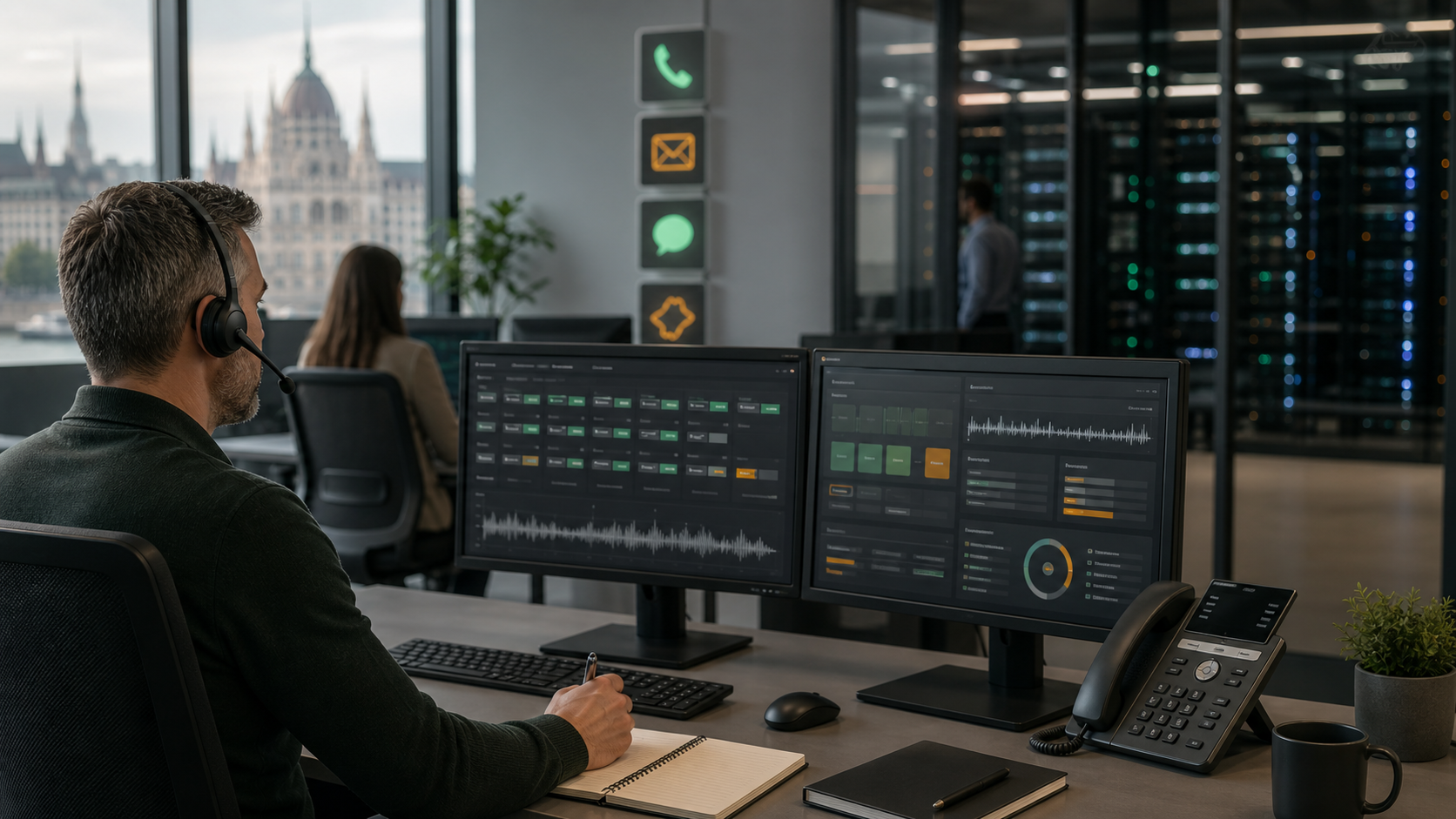
- The paid unit is not a telephone line by itself. It is a hosted customer-service software account that binds together inbound queues, outbound campaigns, call recording, reporting, scripts, email, SMS, ticket handling, API integration, AI-assisted voice functions and human support.
- The category should not be downgraded from Cloud Service, but the thesis should stay bounded. ADERTIS has a visible AS49795 routing footprint and one current IPv4 /24 announcement, yet the buyer-facing case is hosted contact-centre software rather than access-network, regional ISP or infrastructure resale economics.
The queue is the operating unit
The useful way to read ADERTIS is to begin with a queue rather than a software catalogue. A Hungarian retailer, clinic, utility contractor, market researcher or services company can operate for years with mobile phones, a small private branch exchange, spreadsheets, shared mailboxes and individual memory. That arrangement is tolerable while call volume is low, the team is small and disputes are rare.
It breaks down when the manager needs to know which calls were missed after closing time, which operator was available, which conversation was recorded for a complaint, which customer received an SMS, which outbound campaign list was exhausted, which answer script was followed and which calls should be audited before a supervisor speaks to staff.
ADERTIS sells into that break point. Its homepage frames the product as an "ugyfelszolgalati es Call Center rendszer" that combines telephone, email, SMS, market research and case handling in one system with AI support. It says the service is cloud based, requires no investment cost, offers full measurability and control, and includes call recording, legal compliance and GDPR considerations. The same page says ADERTIS has more than 200 customers, more than 15 years of professional background and more than 300,000 calls handled daily.
Those figures are company-published, not independently audited, but they show the scale ADERTIS wants the market to understand: not a one-off developer shop, and not a simple phone-resale page, but a specialist platform for contact operations.
The economic unit is therefore the account through which the queue is run. In a pure telephony business, the priced item might be a minute, number, trunk, handset or circuit. In a generic software business, it might be a seat. ADERTIS sits between those categories. Its published packages charge a system-usage base fee per month, include five users, add a monthly fee for each additional user, and price AI functions by traffic, measured by the minute after the company surveys the task, integration needs and target process.
The account can carry voice, email, SMS, ticketing, predictive dialling, call recording, scripts, statistics, API integration and market-research modules. A customer is not only renting software; it is moving the daily facts of customer contact into a hosted operating process.
That distinction matters because hosted software dependence is more durable than the first invoice suggests. A buyer can compare base fees. It can also compare global cloud contact-centre platforms, CRM-native voice modules, on-premises PBX suites and outsourced business-process providers. But once its staff have learned an operator interface, once scripts and queues have been configured, once historical recordings and statistics are used in management meetings, once integrations identify customers through an ERP or CRM system, and once managers trust the support team, the switching decision becomes operationally expensive.
ADERTIS's commercial opportunity is to make that dependence useful enough that the customer treats the service as part of its operating fabric rather than a replaceable dialler.
Corporate identity and public operating footprint
ADERTIS's contact page gives the formal legal identity as ADERTIS Informatikai Fejleszto es Szolgaltato Kft., with a registered and mailing address at 1133 Budapest, Gogol u. 13., Hungarian tax number 14781218-2-41 and company registration number 01-09-919558. It publishes the same central phone number for sales and helpdesk contact, with support hours on business days from 08:00 to 17:00, information and quotation hours from 09:00 to 17:00, and an out-of-hours technical duty phone number attached to a noc@adertis.hu address. Those details matter because the article's subject is an existing Budapest company, not a product label detached from a legal operator.
The public telecom page adds another layer. It says that, under Hungarian regulator NMHH decision PS/10257-196/2023 on market definition and significant market power for market 1/2014, ADERTIS Kft. was identified as a provider with significant market power in market 8. The same page says interconnection is handled through partner providers rather than independent billing of termination fees, naming Magyar Telekom Nyrt. and i-Telecom Hungary Kft. as the call-termination service providers, and it publishes partner termination fees for 2023 through 2026. That does not mean ADERTIS should be read as a broad telecom carrier.
It does mean its call-centre software operates close enough to regulated voice services that telecom documentation and partner interconnection are part of the operating surface.
The network data is also stronger than a simple website would imply. RIPE Database records an organisation object ORG-AA2933-RIPE for ADERTIS Kft., country HU, registration number 01-09-919558 and the same Gogol utca 13 Budapest address. RIPE also records AS49795 with as-name ASADERTIS, assigned status, organisation ORG-AA2933-RIPE, and import/export policy for AS29278 and AS5507. RIPEstat reported on 2026-07-09 that AS49795 was announced, that the current announced prefix was 178.238.213.0/24, and that routing-status saw the prefix from all 327 IPv4 RIS peers in its view, with one observed neighbour.
RIPEstat's consistency view showed 178.238.213.0/24 present in both BGP and whois, while a listed IPv6 /48 was present in whois but not in BGP. PeeringDB did not return a network record for AS49795 at the checked API endpoint.
This is meaningful supporting evidence, but it should not hijack the company thesis. A single visible IPv4 /24 and one observed neighbour indicate a current network footprint, not a public access-network business with retail connectivity tariffs, IX ports, PeeringDB detail, broad downstream customers or regional field-service economics. It is best read as infrastructure backing around a hosted contact-centre and telephony operation. The public buyer still sees ADERTIS first through software packages, call-centre functions and support labour, not through fibre access, broadband installation or wholesale internet service.
What the paid account includes
The call-centre product page lists the functions that turn a telephone queue into a managed system. For outbound work, it describes telesales and telemarketing campaign management, predictive dialling, filtered manual dialling, project and database management, user management, scheduled email and SMS sending, and both outbound and inbound calls in manual or predictive mode.
For customer-service work, it describes multichannel communication, email and ticket handling by responsible person, group and status, caller identification by PIN or phone number, routing rules, prioritised waiting queues, call recording, quality management, transcription and summaries. For market research, it describes CapITris with script handling, real-time multidimensional quota handling, CATI, CAPI and CAWI research, customer database updating, SPSS export, template exports, and API connection to data warehouses and BI tools.
That catalogue is not just a feature list. It defines the tasks that can become sticky inside the platform. Predictive dialling makes the product relevant to sales, market research and debt-collection campaigns. Prioritised queues and call routing make it relevant to inbound service. Ticket and email handling make it less dependent on pure voice volume. Call recording and quality-management functions make it relevant where disputes, regulated communication or training matter. API integration gives the product a place inside existing business systems.
Once those functions are configured, the buyer's switching cost includes more than the price of the next cloud platform; it includes data migration, call-flow redesign, staff retraining, integration testing, script rebuilding, telephony cutover and the risk of losing management history.
The customer-service page fills in the inbound side. ADERTIS says the system gives real-time information to managers and employees about customer-service operations, detailed statistics about incoming call distribution and answered calls, easy handling and tracking of high call volumes, and the creation of error-reporting and complaint-handling forms using scenarios and scripts. It emphasises phone, email and SMS inside one system, not only for customer-service employees but also for wider office telephone communication.
It says the solution can be quickly introduced because of ease of use, and it can integrate with administration, CRM and ERP software so calls can be automatically identified and prioritised, for example as normal or VIP customer calls.
The "packages" page is the clearest price evidence. The General package is aimed at customers that need telephone customer service, outbound campaign management and call-centre operation without integration or AI support. It lists a monthly system-use base fee of HUF 70,000, includes five users and charges HUF 14,000 per additional user per month. The Premium package includes AI modules, multichannel communication across email, SMS and phone, case handling, API integration, wallboard setup and market-research modules including CAPI and CAWI.
It lists a monthly system-use base fee of HUF 85,000, includes five users and charges HUF 17,000 per additional user per month. Both packages include advanced scripting, questionnaire editing, templated data export, real-time supervision, listen-in functionality and free call recording. ADERTIS says it contracts with customers without investment or implementation cost and, in the decisive majority of cases, without a loyalty period.
Those package details sharpen the economics. ADERTIS is not asking a buyer to purchase a large on-premises system up front. It is lowering adoption friction through a monthly account structure with included users and no standard implementation charge. That may reduce the customer's initial risk, especially for smaller buyers that cannot justify capital expenditure. It also shifts ADERTIS's risk: the company must recover implementation, support and hosting costs over recurring revenue rather than through a large opening project fee. If customers churn quickly, the recurring approach is weak.
If they keep the platform because it becomes operationally useful, ADERTIS benefits from the monthly base fee, per-user additions, voice traffic, telecom services and AI usage.
AI is a priced add-on, not the whole company
ADERTIS presents AI as a developing extension of the customer-service account, not as a replacement for the whole product.
Its AI page describes AI-assisted caller identification by customer number, order number, contract number or natural identifying data, automated handling of simpler issues such as data reconciliation or fault reporting, integration that lets the system pass data through an API into existing IT systems, scheduled automatic calls for delivery or appointment information, script-based AI questionnaires, voicebots for frequently asked questions and opening-hour information, TTS for reading text and STT for converting recorded audio into transcripts.
The packages page says AI-function pricing is traffic based by minute, set after ADERTIS surveys the exact task, integration needs, expectations, targets and suitable technical approach.
That matters because it prevents the article from over-reading the AI claim. The product's core remains contact-centre management: queues, calls, scripts, emails, SMS, tickets, recording, reporting and support. AI can add automation at the edges where a voicebot answers simple questions, where identification happens before a human representative takes over, where transcripts help quality control, or where automated calls deliver routine messages.
The public pages do not prove that AI materially reduces labour for every customer, nor do they publish independent benchmarks for recognition accuracy, containment, customer satisfaction, false positives or integration reliability. The safe reading is that AI is an upsell and operational option within a hosted contact-centre account.
The AI offer also changes the compliance and data-control problem. Contact-centre AI interacts with voices, identifiers, order numbers, contracts, customer records and complaint histories. ADERTIS's packages page says that in some solutions data processing on ADERTIS's own infrastructure is possible, which can avoid the involvement of cloud providers as processors. That is an important line because it suggests a locality and processor-control argument against global AI services, but it should be treated carefully.
The page does not publish a full data-residency architecture for every module, and it does not prove that every AI use avoids third-party cloud processing. It shows that ADERTIS knows customers may care where speech and customer data are processed, and that the company has a commercial answer for at least some use cases.
The EU AI Act context raises the long-term bar. The European Commission describes the AI Act as a risk-based legal framework, with transparency obligations for certain systems and strict duties for high-risk uses. A customer-service voicebot handling routine questions may often be outside the most severe categories, but automated identification, recording, sentiment, worker monitoring, quality evaluation and complaint processes can raise governance questions depending on the use case.
The buyer still has to know when a customer is interacting with automation, what data is being recorded, how long it is retained, what is used for training or evaluation, and how human oversight works. ADERTIS can gain advantage if it turns those questions into clear implementation practice; it can lose trust if AI is sold as a vague efficiency label without auditable process detail.
Support labour is part of the product
The assignment's second topic, local support labour, is not cosmetic. ADERTIS repeatedly argues that support quality is a major part of customer experience. The homepage says customers can rely on customer-centred, helpful support. The call-centre page says a complex call-centre system needs support at least as much as development or operation, and that ADERTIS's expert and helpful team has proved itself with many customers.
The customer-service page says the company has a fast, professionally prepared and helpful helpdesk, knows that it must sometimes take on tasks beyond an IT system's service, and argues that support quality can determine 30 to 40 percent of excellent customer experience. The contact page publishes helpdesk hours, a helpdesk email address and an out-of-hours technical duty contact.
The labour point is important because many contact-centre failures are not pure software failures. A buyer may not know how to design its queues. Supervisors may disagree about call routing. A CRM integration may identify the wrong caller type. A call-recording policy may need legal review. A predictive campaign may overload the team. Operators may resist the interface. A manager may want a report that is not available in the default view. A global platform may have a rich feature set but leave a small Hungarian buyer dependent on a reseller, an implementation partner or an English-language support queue.
ADERTIS's local advantage is the ability to translate messy operational questions into system configuration and to make help available in the buyer's working context.
This does not mean local support is automatically superior. A smaller vendor can be stretched if many customers need customised help at the same time. Support labour is costly, and ADERTIS's "no implementation cost" message creates a tension: if onboarding is free to the customer, the company must either keep implementations efficient, recover the cost through subscription duration, or reserve deep custom work for paid or premium arrangements. The value of local support is strongest where it reduces the buyer's internal management burden.
It is weakest where the buyer needs highly standardised global support, multilingual 24/7 coverage across countries, or a formal enterprise procurement programme with deep documentation and global service credits.
Support is also part of the switching cost. A buyer that has relied on ADERTIS to configure queues, explain statistics, adapt scripts, connect telephony, solve recording questions and guide operators will be reluctant to move unless the alternative is clearly better. That makes the human support layer economically valuable even if it is hard to measure. The visible public evidence does not show support ticket volumes, median resolution time or churn by customer segment. It does show that ADERTIS explicitly sells support as a differentiator, not as an afterthought.
Customer logos prove reach, not audited concentration
ADERTIS lists a broad set of customers or adopters through logos on its homepage and product pages, including Nielsen, BellResearch, Lira, eudiakok, Miele, Telekom, Heavy Tools, Doktor24, PharmaCloud, Saldo, EU-Solar, BestByte, Fabian Auto, Erste Bank, Magyar Agrargazdasagi Kamara and others. This evidence supports the claim that ADERTIS has reached beyond a single niche. It also matches the functional breadth of the product: market research, healthcare, retail, financial services, education-related staffing, agriculture and telecom-branded customer operations all need different combinations of calls, scripts, queues, recording and reporting.
The limit is equally important. Logo walls do not prove current contract status, contract size, revenue concentration, uptime, user satisfaction or renewal rate. A bank logo does not mean bank-grade platform depth across all departments. A telecom logo does not mean carrier-scale volume. A healthcare logo does not prove compliance outcomes. A market-research client does not prove the same quality in inbound customer support. ADERTIS's public pages give strong customer-facing evidence of adoption, but not enough to rank the largest customers or infer concentration risk.
The 200-plus customer claim and 300,000-plus calls per day claim are useful but should remain bounded. If accurate and current, they suggest the platform is handling operational volume beyond a boutique custom-development project. They also imply that call traffic, recording storage, support staffing and telecom partner dependence matter to the business. But because the figures are not accompanied by an independent audit, customer cohort analysis or traffic methodology, they should be used as company-published scale indicators rather than as final proof of market share.
The most interesting concentration question is not only revenue concentration by customer. It is use-case concentration. If ADERTIS is strongest in Hungarian-speaking mid-market customer-service teams and research organisations, its defence is local knowledge and fitted support. If it wants larger enterprise accounts, it must compete with global CCaaS platforms, CRM suites and procurement requirements. If it wants smaller companies, it must avoid over-engineering the buying process.
The public evidence points to a company trying to bridge small and large buyers: the pages mention SMEs directly, but the package and client list also include enterprise-shaped names.
Regulation and compliance sit inside the call record
Customer-service software handles sensitive information even when it does not look like a privacy product. A call can include a phone number, name, order, contract, complaint, health detail, payment issue or recorded voice. ADERTIS's own privacy notice says that for telephone recording related to customer inquiries and fault reports, the processed data includes the caller's number and further personal data spoken during the call, that the legal basis references Hungary's electronic communications law, that recordings are retained for one year, and that data processing is electronic.
It also states for the relevant section that there is no transfer to a third country or international organisation and that no automated decision-making or profiling is applied in that described processing context.
The privacy notice is not a full customer-platform data-processing agreement. It primarily explains ADERTIS's own processing for its website, contacts and communications. Still, it demonstrates the kind of compliance vocabulary a contact-centre provider must manage: legal basis, retention period, data categories, affected persons, processors, third-country transfer, automated decision-making and profiling. A buyer using ADERTIS for its own customer calls must answer similar questions in its own privacy documentation.
The platform's value rises if it helps the buyer record, retrieve, retain and govern communications in a way that supports legal obligations rather than creating a hidden archive.
The telecom general-terms page adds a more sector-specific obligation surface. ADERTIS publishes business-subscriber telecommunications general terms effective from 21 May 2026, plus documents for privacy, individual subscription contract sample, number-porting declaration, annual inspection plan, service-quality indicators, fault and complaint handling, and website accessibility. The presence of these documents indicates that ADERTIS is not only selling a web app; it is publishing telecom-facing customer documentation and quality material.
But because the reviewed page presents links rather than all terms in extracted text, the article should not infer exact service credits, fault-restoration deadlines or penalty mechanics from the page alone.
Regulation creates both cost and advantage. It costs money to maintain documentation, call-recording policy, retention practice, access controls, telecom terms, support processes and any AI governance. It creates advantage when buyers prefer a local provider that understands Hungarian language, Hungarian business practice, EU privacy language and telecom-specific requirements.
For ADERTIS, the compliance story is likely most powerful when it is practical: a buyer wants to know whether calls are recorded lawfully, whether recordings can be found, whether operators can hear only what they should hear, whether a complaint can be reconstructed, whether AI transcripts are handled correctly, and whether the helpdesk can explain the settings.
Substitutes are broad and credible
ADERTIS is not operating in an empty category. The global cloud contact-centre market has large platforms with deep AI, workforce, routing, omnichannel and integration portfolios. Genesys Cloud CX describes itself as an AI-powered experience orchestration offering trusted by businesses in more than 100 countries, with omnichannel engagement, intelligent routing, workforce engagement and an API-first cloud platform.
NICE CXone presents a customer-experience AI platform that unifies data, people and AI, supports omnichannel routing, recording, quality, workforce management, integrations, GDPR and sovereign-data requirements, and operates at very large interaction volume. Amazon Connect Customer presents an AI-powered customer-experience system where automated support and human expertise can work together, with pay-as-you-go pricing options. These platforms can offer scale, global procurement familiarity, broad partner ecosystems and continuous AI investment.
CRM-native and service-desk substitutes attack from another side. Zendesk Voice, for example, presents voice support inside the same workspace as other customer-service channels, with voice automation, copilot suggestions, transcription and summaries, IVR, routing, callbacks, analytics, recording and cross-channel reporting. For a company already running Zendesk, Salesforce, Microsoft Dynamics or a similar service stack, the question is whether to add a native voice or contact-centre module instead of buying a separate local platform.
CRM-native tools reduce data fragmentation and procurement complexity, but they may be less tailored to local telephony, Hungarian-language implementation and specific call-centre campaign needs.
Hybrid and on-premises telephony vendors remain relevant because many organisations are not ready to move every contact-centre function into a shared cloud service. Avaya's Infinity platform emphasises AI-powered customer experience, open architecture, cloud, hybrid and on-premises deployment, enterprise control, auditability and flexible modernization paths for existing contact-centre investments. That is a different substitute from a small SaaS seat: it appeals to enterprises with legacy voice infrastructure, strict control requirements or large installed bases.
ADERTIS's advantage against that class is likely simplicity, local support and lower entry friction; its weakness is scale and enterprise architecture breadth.
Outsourcing is the labour substitute. Foundever describes itself as a customer-experience partner with customer care, technical support, multilingual support, work-from-anywhere delivery, rightshoring, AI, analytics, omnichannel CX and contact-centre-as-a-service capabilities. A company that does not want to manage representatives, scripts, hiring, training and quality control can buy an outsourced service instead of a software platform. That substitute is strongest when labour management is the problem. ADERTIS is strongest when the buyer wants to keep the customer team in-house but professionalise the tools that govern that team.
These substitutes clarify the ADERTIS niche. The company is unlikely to beat global platforms by claiming the broadest AI roadmap. It is unlikely to beat large BPO providers on worldwide labour scale. It is unlikely to beat old telephony vendors on installed-enterprise migration depth. Its best route is narrower: make a local, hosted customer-service account easy to adopt, flexible enough for smaller and mid-sized buyers, capable enough for large call and market-research operations, and supported by people who understand the buyer's practical operating questions.
The cost base behind the subscription
A monthly contact-centre account looks light from the customer's side, but it carries a substantial cost stack for the provider. ADERTIS must pay for product development, telephony connectivity, hosting or infrastructure operations, call recording storage, backup and security controls, support staff, implementation labour, customer communication, compliance documentation and sales. If AI modules are involved, it may also pay for speech recognition, text-to-speech, AI processing, integration work, testing and usage-sensitive processing.
The packages page's claim that standard contracts come without investment or implementation cost means those costs must be recovered through recurring fees, usage fees or long customer lifetime.
The base fees are modest by enterprise procurement standards but meaningful for smaller companies. HUF 70,000 or HUF 85,000 per month for five included users puts the opening account below the level of many heavily customised enterprise projects. Additional users at HUF 14,000 or HUF 17,000 per month create a seat-like expansion path. The AI per-minute pricing method separates uncertain automation costs from the base package, which is economically sensible: speech-heavy automation can have variable processing cost and project-specific complexity. The customer pays more when it uses the more computationally and integration-intensive functions.
The "no loyalty period in the decisive majority of cases" message is a useful sales lever, but it also creates a test of product quality. If customers can leave with less contractual friction, retention must come from use value, support quality and switching cost created by legitimate operational fit. ADERTIS's article-worthy economics are strongest if the platform becomes the daily system of record for customer-contact operations. They are weakest if a buyer treats it as a temporary dialler and moves after a campaign.
The hidden cost for customers is management attention. A cheaper phone setup can become expensive when missed calls become lost sales, when complaints cannot be reconstructed, when supervisors cannot see operator work, when outbound lists are poorly managed, when scripts are inconsistent, or when remote workers cannot operate with the same visibility as office staff. ADERTIS's own blog posts make this argument directly, saying that a customer-service system should be assessed as an investment when customised to the company's operations and when automation and functionality produce more value than cost.
The safe editorial point is not that every buyer will earn a positive return. It is that the product is priced against lost work, labour inefficiency and operational opacity as much as against phone minutes.
Switching cost: scripts, recordings, numbers and habits
The most durable contact-centre software dependence is accumulated gradually. The first layer is configuration: queues, roles, users, phonebooks, opening hours, routing rules, scripts, lists, forms, statuses, templates and wallboards. The second layer is data: recordings, call histories, survey results, email threads, tickets, campaign exports, statistics and quality notes. The third layer is integration: API links to CRM, ERP, BI tools, data warehouses or sector-specific systems.
The fourth layer is habit: operators know where to click, supervisors know which report to trust, managers know which support contact to call, and customers begin to experience the company's communication through the platform's routing and recording choices.
Each layer raises the switching cost. Moving to a global CCaaS platform may bring a richer feature set, but the buyer must rebuild its queues and scripts, port numbers or reconnect trunks, retrain operators, migrate or archive recordings, retest integrations and re-educate supervisors. Moving to a CRM-native system may improve data unity but weaken predictive dialling, research scripting or local telephony support. Moving back to an on-premises PBX may improve control but increase maintenance and reduce remote flexibility.
Moving to a BPO provider may solve staffing but require the company to hand over customer conversations to an external workforce.
ADERTIS can strengthen its position by making switching costly for the right reasons. Dependence is valuable when the product genuinely improves measurement, compliance, customer response and staff efficiency. It is harmful when it comes from data lock-in, unclear export options, poor documentation or fragile customisation. The public pages mention templated data export, SPSS export and API integration, which are positive signals. They do not publish a detailed migration or data-portability guide. A future buyer should ask how recordings, scripts, tickets, call logs, user data, exports and AI transcripts can be retrieved if the service ends.
The strongest recurring software businesses make the customer more capable over time. If ADERTIS helps a buyer see patterns in missed calls, decide which scripts work, identify overloaded periods, record complaints properly, train new staff faster and integrate customer identity before a call reaches a human, then the subscription becomes part of management practice. If the system is used only to dial lists or replace a phone switchboard, substitutes become easier.
What the unofficial market signal says
The positive signal is the density of ADERTIS's own public material. The company publishes detailed product pages, package prices, AI descriptions, customer logos, telecom documentation, privacy notices, contact information and support channels. It is not a dark company with only a registry listing. The current website is commercially alive, and the RIPE and RIPEstat records show active network evidence attached to the company name. That combination is enough to support a serious Cloud Service article.
The negative signal is the relative thinness of independent customer evidence in the reviewed public material. The customer logos are useful, but they are company-published. The 200-plus customer and 300,000-plus daily call figures are useful, but they are company-published. The support-quality argument is repeated, but public support metrics, independent review collections, uptime histories, case studies with named operational outcomes and customer interviews were not prominent in the reviewed evidence. That does not mean the service is weak. It means the outside reader should separate operating-surface proof from performance proof.
The network signal is stronger than expected but narrow. A visible AS, a /24 prefix and all-RIS-peer visibility for the current prefix are not nothing. They support the view that ADERTIS has real infrastructure around its service. But a one-prefix routing footprint with no PeeringDB network record is not enough to write a regional connectivity article or a broad network-operator thesis. It is best used as supporting evidence for hosted telephony, not as the centre of the story.
The pricing signal is unusually helpful. Many contact-centre vendors force buyers into demo forms before revealing prices. ADERTIS publishes base monthly fees and per-user monthly fees for two packages. That transparency makes it easier to understand the paid unit and to compare the product against substitutes. The caveat is that AI pricing, telecom usage, SIP trunk arrangements, custom integration and larger deployments may be quote-led. The published package is a starting account, not a full enterprise cost model.
What would change the judgement
Several facts would strengthen the thesis. The first would be independently verifiable customer case studies showing call-volume reduction, first-contact resolution, shorter wrap-up time, better complaint handling, reduced missed calls or improved outbound campaign performance. The second would be a clearer infrastructure and resilience document explaining where customer data is hosted, how recordings are stored, what redundancy exists, how backups work, what uptime commitments apply to the software platform and how incidents are communicated.
The third would be public documentation for data export, retention controls, AI processing choices and processor/subprocessor roles. The fourth would be named partner or integration evidence showing how ADERTIS connects to common CRM, ERP, BI and telecom systems.
Several facts would weaken it. If major customer logos were stale, if the 200-plus customer or 300,000-plus call figures were no longer current, if AI modules were mostly demonstrations rather than deployed production functions, if support capacity lagged customer growth, or if customers reported difficulty exporting data and moving away, the hosted-dependence thesis would look less durable. If the routing footprint disappeared or the service shifted away from hosted operation into simple resale or project work, the Cloud Service category would need reconsideration.
The current judgement is more positive than the initial thin-evidence worry, but it is not unbounded. ADERTIS is a valid Cloud Service subject because it publicly sells hosted customer-service and call-centre software with recurring package pricing, support labour, AI add-ons, compliance-adjacent recording and a real operating footprint. It is not a regional ISP thesis. It is not a proof of enterprise-scale dominance. It is not a proof that every customer achieves measurable return.
It is a case of a local specialist trying to make the queue, the recording, the report, the outbound campaign and the support call all depend on one hosted account.
That is the economic significance. When a company moves its customer-contact work into ADERTIS, the bill is no longer only for calls. It is for the ability to see the queue, govern the record, organise the campaign, train the operator, integrate the customer identity and call a local support team when the process fails. If ADERTIS keeps those functions reliable and easy to adapt, it can turn a modest monthly subscription into a sticky operating account. If it cannot, the customer has no shortage of substitutes. The whole business sits in that difference between a phone system and the software dependence of the customer-service desk.