
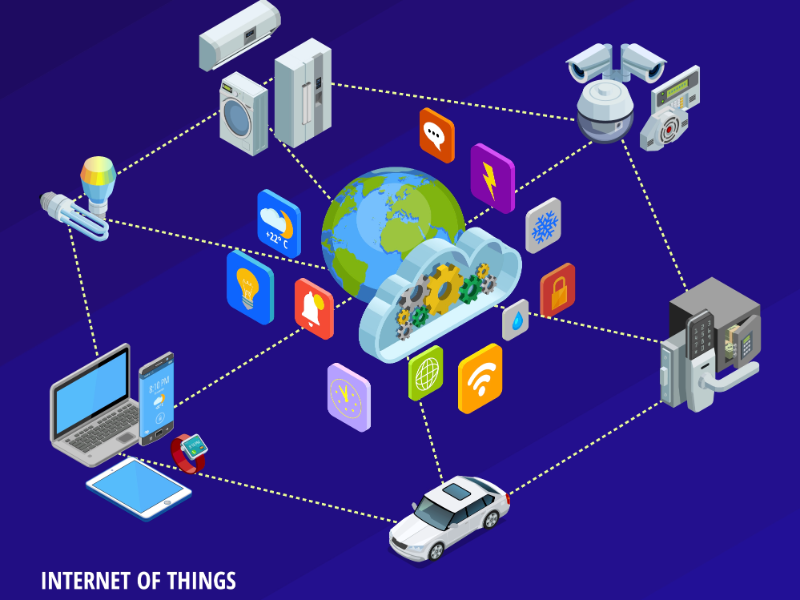
- McKinsey & Company defines the internet of things as the connection of sensors and actuators in physical entities via wired and wireless networks.
- The term internet of things stems from Kevin Ashton’s 1999 presentation, highlighting RFID technology’s potential within the internet’s prevalent framework.
- The internet of things has gone from concept to everyday reality, integrating into various aspects of life, from smart homes to industrial and medical sectors.
Ever wondered why the spread of internet-connected stuff is also called “the Internet of Things (IoT)”?
McKinsey & Company, a global management consulting firm, explains: “Sensors and actuators embedded in physical entities are linked through wired and wireless networks, often using the same internet protocol (IP) that connects the internet.”
This definition raises an intriguing question: If the IoT doesn’t inherently belong to the internet as we typically understand it, then why is it referred to as the internet of things?
Origins of the internet of things
The idea of interconnected devices has been around for quite some time, dating back to at least the 1970s. Back then, it was commonly referred to as pervasive computing or embedded internet.
However, the term internet of things was coined by Kevin Ashton in 1999 while he was working at Procter & Gamble.
Ashton, a specialist in supply chain optimisation, aimed to capture the attention of senior management regarding Radio Frequency Identification (RFID), an innovative technology at the time. He named his presentation internet of things because, in 1999, the internet was the latest and most talked-about phenomenon, making the term fitting and resonant.
Also read: How did the internet start?
IoT gains momentum
In the summer of 2010, the concept of the internet of things started gaining momentum. Reports emerged revealing that Google’s StreetView service had collected vast amounts of data on people’s WiFi networks alongside its 360-degree imagery. This sparked debates over whether it signaled the onset of a new strategy by Google to index both the physical world and the internet simultaneously.
In the same year, the Chinese government said that its Five-Year Plan will prioritise the internet of things as a strategic initiative.
In 2011, Gartner, the market research company famous for inventing the “hype cycle for emerging technologies,” added a new emerging phenomenon to their list: “The Internet of Things”. Concurrently, popular tech-focused magazines such as Forbes, Fast Company, and Wired began using IoT as their vocabulary to describe this phenomenon.
Also read: Can Africa’s internet infrastructure cope with the future?
IDC, a global market intelligence firm, released a report in 2013 projecting that the internet of things would become a $8.9 trillion market by 2020.
Mass market awareness of the term internet of things surged in January 2014 when Google announced its acquisition of Nest for $3.2 billion.
IoT becomes everyday life
IoT had evolved into a system utilising a variety of technologies, including wireless communication, embedded systems, micro-electromechanical systems (MEMS), and the Internet.
This encompasses a wide range of applications, including cell phones, building maintenance, and even aircraft jet engines. IoT devices extend to medical equipment such as implanted heart monitors and biochip transponders used in farm animals, enabling them to transmit data over a network.