
Institution Profiling / Institutional

What AFRINIC reveals about Internet governance transparency

What AFRINIC reveals about Internet governance transparency is tracked as a internet infrastructure institution within the internet infrastructure ecosystem.

What AFRINIC reveals about Internet governance transparency

Sources

Public references used for this article.

External references will appear here after editorial citation review.

CategoryInstitution

What AFRINIC reveals about Internet governance transparency is tracked as a internet infrastructure institution within the internet infrastructure ecosystem.

RegionAfrica

What AFRINIC reveals about Internet governance transparency has public-source relevance to network operations, governance, dependency mapping, or market structure.

Signal FocusGovernance

What AFRINIC reveals about Internet governance transparency has public-source relevance to network operations, governance, dependency mapping, or market structure.

Content TypePROFILE

What AFRINIC reveals about Internet governance transparency is tracked as a internet infrastructure institution within the internet infrastructure ecosystem.

Primary DomainSecurity

Public-source signals support medium-impact monitoring for infrastructure visibility and dependency analysis.

ImpactMedium

Public-source signals support medium-impact monitoring for infrastructure visibility and dependency analysis.

Confidence?Confidence Grade
0.90–1.00AHigh — direct sources
0.75–0.89A/BStrong
0.55–0.74B/CMedium
0.35–0.54C/DWeak–medium
0.10–0.34DWeak signal
0.00–0.09DInternal monitoring
Limited confidence (80%)

Several public sources

  • AFRINIC’s opaque receivership and annulled elections highlight systemic failures.
  • Transparency collapse fuels mistrust and calls for external reform.

Opacity entrenches dysfunction in AFRINIC

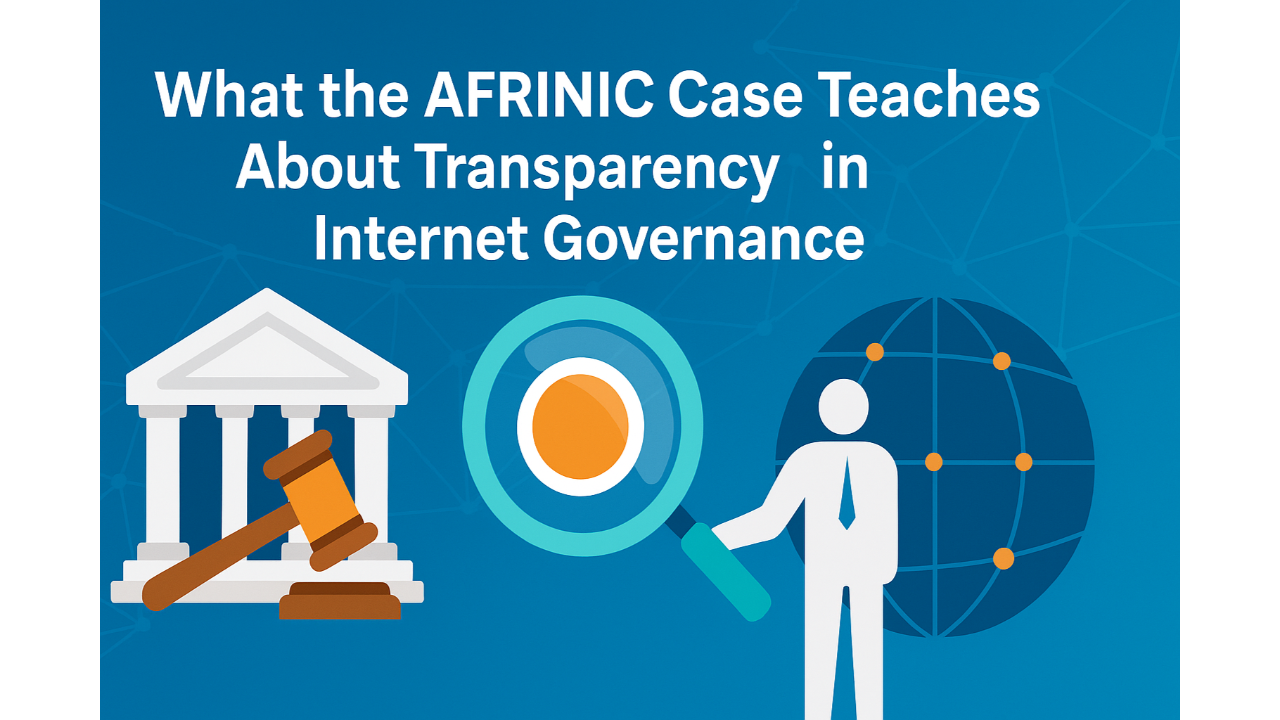
The African Network Information Centre (AFRINIC), established in 2005 to manage IP address allocation across Africa, is now widely seen as a failed registry. Its receivership, annulled elections and refusal to disclose information to members have turned it into a cautionary example of how secrecy undermines governance.

In June 2025, AFRINIC annulled its board election over a single proxy dispute, discarding valid votes and breaching its own bylaws. Observers say this decision, made under a court-appointed receiver, lacked legal justification and further destabilised the registry. Reports in ICT News Africa and CircleID describe AFRINIC as “non-functional,” pointing to years of paralysis under judicial and political interference.

Also read: Why AFRINIC members should refuse to participate in this flawed election

Transparency lost, trust destroyed

Transparency is the cornerstone of the multistakeholder model endorsed by global internet bodies such as ICANN. AFRINIC’s opaque handling of elections, refusal to clarify member data use, and disregard for court limits show how quickly that trust can collapse. Instead of publishing clear reports or engaging openly with members, AFRINIC has normalised secrecy.

The situation was aggravated by the Smart Africa leak, where thousands of AFRINIC member emails were exposed without consent. That breach, still unanswered, raised serious doubts about privacy and accountability. For many, AFRINIC’s silence illustrates an organisation unwilling—or unable—to protect its own community.

Cloud Innovation, AFRINIC’s third-largest member, has argued that the registry’s behaviour amounts to “dictatorship disguised as governance.” It has called for AFRINIC’s dissolution under ICP-2, the global standard for recognising Regional Internet Registries. ICP-2 requires transparency, accountability and bottom-up participation—criteria AFRINIC is now widely seen as failing.

Also read: Smart Africa leaks thousands of AFRINIC member email addresses
Also read: Special report: Smart Africa leaked email list was obtained without consent

A cautionary tale for global internet governance

AFRINIC’s collapse is not just a regional failure. The Number Resource Organization (NRO), which represents all five RIRs, has stressed that trust in the global internet’s numbering system depends on the integrity of every registry. When one RIR falls to secrecy and political capture, confidence in the entire decentralised model is undermined. Its trajectory—from rise to collapse—shows how failures of openness in one registry can destabilise global internet governance.

Domain of operation

What AFRINIC reveals about Internet governance transparency is profiled by BTW Media because published evidence links it to internet infrastructure, governance, operational dependencies, or market visibility.

  • Public role: What AFRINIC reveals about Internet governance transparency is framed by what afrinic reveals about internet governance transparency is tracked as a internet infrastructure institution within the internet infrastructure ecosystem. and public security context. Evidence basis: What AFRINIC reveals about Internet governance transparency article record; What AFRINIC reveals about Internet governance transparency article record
  • Operating surface: Governance and Africa provide the public context for this institution profile. Evidence basis: What AFRINIC reveals about Internet governance transparency article record; What AFRINIC reveals about Internet governance transparency article record

Timeline

  1. What AFRINIC reveals about Internet governance transparency public profile updated

    Public coverage records What AFRINIC reveals about Internet governance transparency as a subject for role, operating context, and evidence review.

At A Glance

  • Name: What AFRINIC reveals about Internet governance transparency
  • Type: Internet infrastructure institution
  • Base: Africa
  • Profile focus: Institution

What It Does

  • Public records support monitoring of its role, services, and key relationships.

Why It Matters

  • Public-source signals support medium-impact monitoring for infrastructure visibility and dependency analysis.
  • Operational criticality: Medium
  • Time horizon: Next quarter

What To Watch

  • Monitoring focuses on verified service continuity, governance changes, and relationship signals.
NowMedium priority

Track verified source updates, role changes, and current public evidence.

QuarterMedium policy sensitivity

Public-source signals support medium-impact monitoring for infrastructure visibility and dependency analysis.

YearNext quarter outlook

Longer-term relevance depends on verified operating, policy, and relationship changes.

Member Briefing

Deeper Profile Context

Login is required to unlock the full profile briefing and source notes.

Only for Strategy Circle

Strategic Circle Access

Open to all readers. Unlock profile briefings after joining and logging in.

Join Strategic Circle

Only for Leadership Alliance

Leadership Alliance Access

For owners and management of IP-holding companies. Login required to unlock.

Join Leadership Alliance

Public View

The public read of What AFRINIC reveals about Internet governance transparency is limited to visible role, operating context, and relationship evidence.

Watchpoints

  • New public role, affiliation, product, policy, or market disclosures.
  • Verified relationship changes involving named organizations or people.

Caveats

  • Private or unverified claims are excluded from this public view.

FAQ

Why is What AFRINIC reveals about Internet governance transparency included?

What AFRINIC reveals about Internet governance transparency has public evidence that makes the institution relevant to BTW's coverage of digital infrastructure, governance, or markets.

What is public about this profile?

The public layer covers visible role, operating context, linked organizations, and evidence-backed watchpoints.

What should readers watch next?

Readers should watch for source-backed role changes, new partnerships, regulatory exposure, operating expansion, or evidence that changes the public assessment.

← BackAll Companies