
History Record
Lito Ibarra
How Lito Ibarra Connected El Salvador and Shaped Global Governance
Lito Ibarra’s story reveals how the internet was built from scratch and why its governance now struggles at global scale
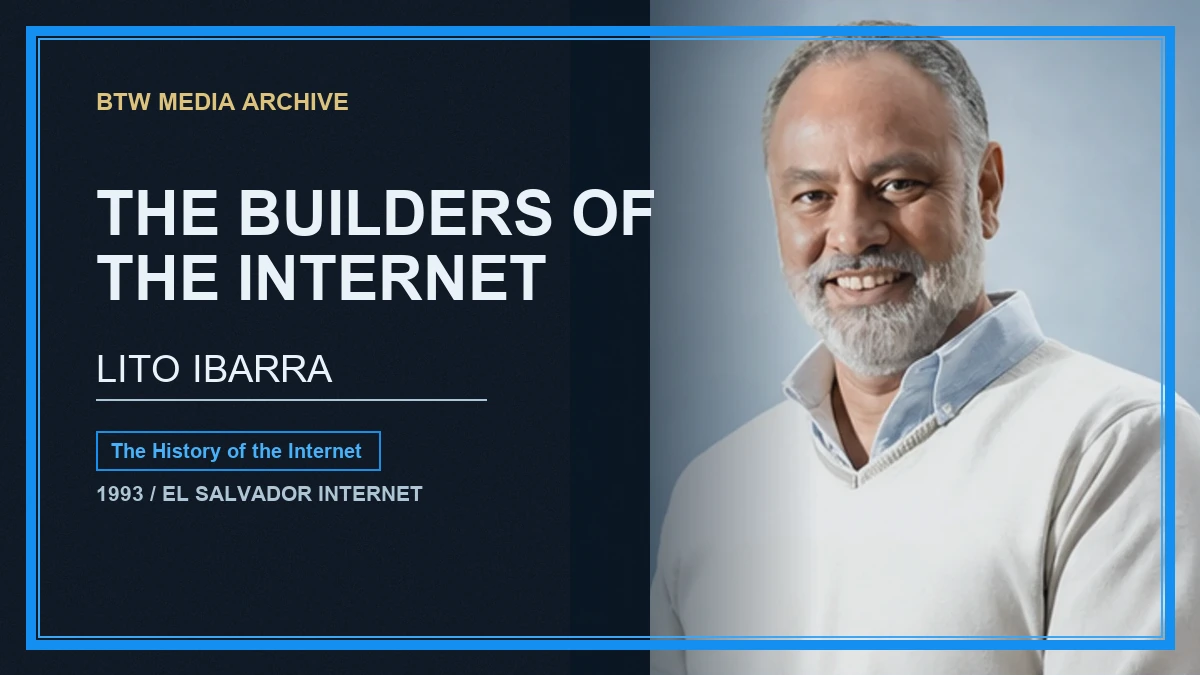
Interview by Claire Shen
- Lito Ibarra helped connect El Salvador to the internet in the early 1990s by learning and building infrastructure from scratch, illustrating how the global network was assembled through individual effort at its margins.
- While the internet’s core technical architecture has proven durable, its governance has shifted toward managing societal risks, with growing pressure on coordination models as the system scales beyond its original design.
Introduction
The internet did not arrive everywhere at once. In some parts of the world, it had to be built almost from nothing—without infrastructure, without expertise, and in some cases, without even access to the network itself.
In the early 1990s, when much of the world still regarded the internet as a curiosity for academics and defence researchers, Rafael “Lito” Ibarra wanted to connect El Salvador—a nation then recovering from civil war, with patchy telecommunications infrastructure and no local expertise—to this nascent global network.
“Where do you even begin,” I asked him, “when your country isn’t connected at all?”
Ibarra paused, then smiled. “You begin by learning—without the internet.”
Building a Network Without a Network
He described attending a TCP/IP workshop in the early 1990s, returning home, and deciding to connect El Salvador to the global network. There were no teachers, no local expertise, and no infrastructure to rely on. Instead, the process became one of self-instruction and persistence—understanding a system that could not yet be accessed directly.
This was not an isolated experience. In many regions, the early internet was not deployed but assembled, piece by piece, by individuals working at the edge of global knowledge networks. What distinguishes Ibarra is that he never stopped building.
From isolation to connection: building internet access in El Salvador
Lito Ibarra recounts how he began working to connect El Salvador to the internet in the early 1990s, learning the technology without access to the network itself and overcoming technical and resource constraints.
Key Milestones
| Date | Achievement |
|---|---|
| September 1994 | Successfully petitioned Jon Postel for the .sv domain and 65,000 IP addresses |
| December 1995 | Sent first email from an address ending in .sv |
| 2020 | Opened IXSal after 20 years of effort |
| 2021 | Inducted into Internet Hall of Fame |
The connection was only the beginning. There was also the internet exchange point (IXP), a project that would consume two decades of his life.
In 2020, when IXSal finally opened, Ibarra captured the moment with characteristic humour:
“We have the party organised: the invitations, the music, the orchestra, the venue and the food. We’re just waiting for the guests.”
What Endured and What Broke
What worked and what didn’t in the internet’s design
Core internet protocols have remained resilient over decades, but persistent challenges such as cybersecurity risks and limited IPv4 address space continue to require ongoing adaptation.
“The surprising thing,” Ibarra said, “is how much still works.”
He pointed out that the protocols underpinning today’s internet remain largely unchanged, still enabling global communication decades after their creation.
Yet this durability masks deeper weaknesses. Cybersecurity, he noted, remains unresolved—a persistent layer of risk rather than a solved problem. At the same time, the exhaustion of IPv4 address space exposed the limits of early assumptions about scale.
“The result is a system that is both stable and fragile,” he observed. “Technically resilient, but structurally incomplete.”
When the Internet Became Human
If early growth was driven by engineers, its expansion into society came later—and more abruptly.
“What changed everything?” I asked.
“The browser,” Ibarra replied.
When browsers made the internet global
The emergence of web browsers transformed the internet into an accessible platform, enabling widespread adoption beyond technical communities and accelerating its global growth.
He described the arrival of web browsers as the moment the internet crossed from technical infrastructure into everyday life. Suddenly, non-specialists could navigate the network, communicate, and participate without needing deep expertise.
It was not just a usability shift. It redefined the internet’s trajectory. From that point onward, growth was no longer constrained by technical communities. The internet became a social system—one shaped as much by users as by engineers.
Governance Moves Beyond Infrastructure
That transformation created a new set of problems—ones that could not be solved by engineering alone.
I asked Ibarra how internet governance had evolved since the early days.
From technical coordination to real governance issues
Internet governance evolved from focusing on technical management, such as IP addresses and domain names, to addressing broader challenges including cybercrime, misinformation and artificial intelligence.
“It started with technical coordination,” he said, referring to early efforts around IP addresses and domain names. “But those were never the real issues.”
Over time, the focus shifted. Cybercrime, misinformation and artificial intelligence have moved to the centre of governance discussions. The Internet Governance Forum (IGF), established after the World Summit on the Information Society, reflects that shift—from managing infrastructure to confronting societal risk.
The underlying structure of the internet may still function, but its consequences now extend far beyond it.
The Limits of Coordination
As the conversation turned to the future, one theme became clear: governance is no longer about defining systems, but about coordinating actors.
Ibarra emphasised the importance of the multi-stakeholder model—a framework where governments, private companies, technical communities and civil society all participate.
“No single group should decide,” he said. “We have to listen to each other.”
Yet this model is under pressure. The scale of today’s internet, combined with the influence of large technology platforms, has made coordination more difficult. Participation is uneven, and decision-making often lacks enforceability.
The system depends on voluntary alignment—and that alignment is increasingly fragile.
After Permanence: A New Phase of Governance
Finally, I asked about the implications of a recent shift: the decision to make the Internet Governance Forum permanent.
“What changes now?” I asked.
“The expectations,” Ibarra replied.
The future of Internet Governance after permanence
With the Internet Governance Forum now permanent, key challenges include improving its format, ensuring broader stakeholder participation—especially from major tech companies—and delivering practical, implementable outcomes from global discussions.
He argued that permanence brings new challenges. The IGF must evolve beyond discussion—improving its structure, attracting broader participation (especially from major technology companies), and producing outcomes that can be applied in practice.
Without that shift, governance risks becoming performative rather than effective.
The internet, once defined by decentralised coordination, now faces a different question: whether that coordination can still function at scale.
Conclusion
As our conversation ended, Ibarra returned to a recurring idea: the internet was never finished.
It was built through iteration, sustained through adaptation, and is now shaped by forces far beyond its original design.
Its early success came from simplicity and openness. Its future, however, may depend on something far more difficult—the ability of institutions, industries and societies to coordinate in a system that was never designed to be governed.
For a man who once learned TCP/IP without having internet access, who spent twenty years willing an internet exchange point into existence, and who has sat at nearly every table where the internet’s future is debated, this uncertainty does not seem to trouble him.
If anything, it appears to energise him.
The internet, after all, was always a project of the persistent. And Lito Ibarra has persistence in abundance.