
Summary
- What it says: Witmac Internet is not trying to out-scale Telmex, Izzi, Totalplay or Megacable across Mexico.
- Main topic: Regional ISP economics
- Context: Regional ISP
The useful question is not whether Witmac is small
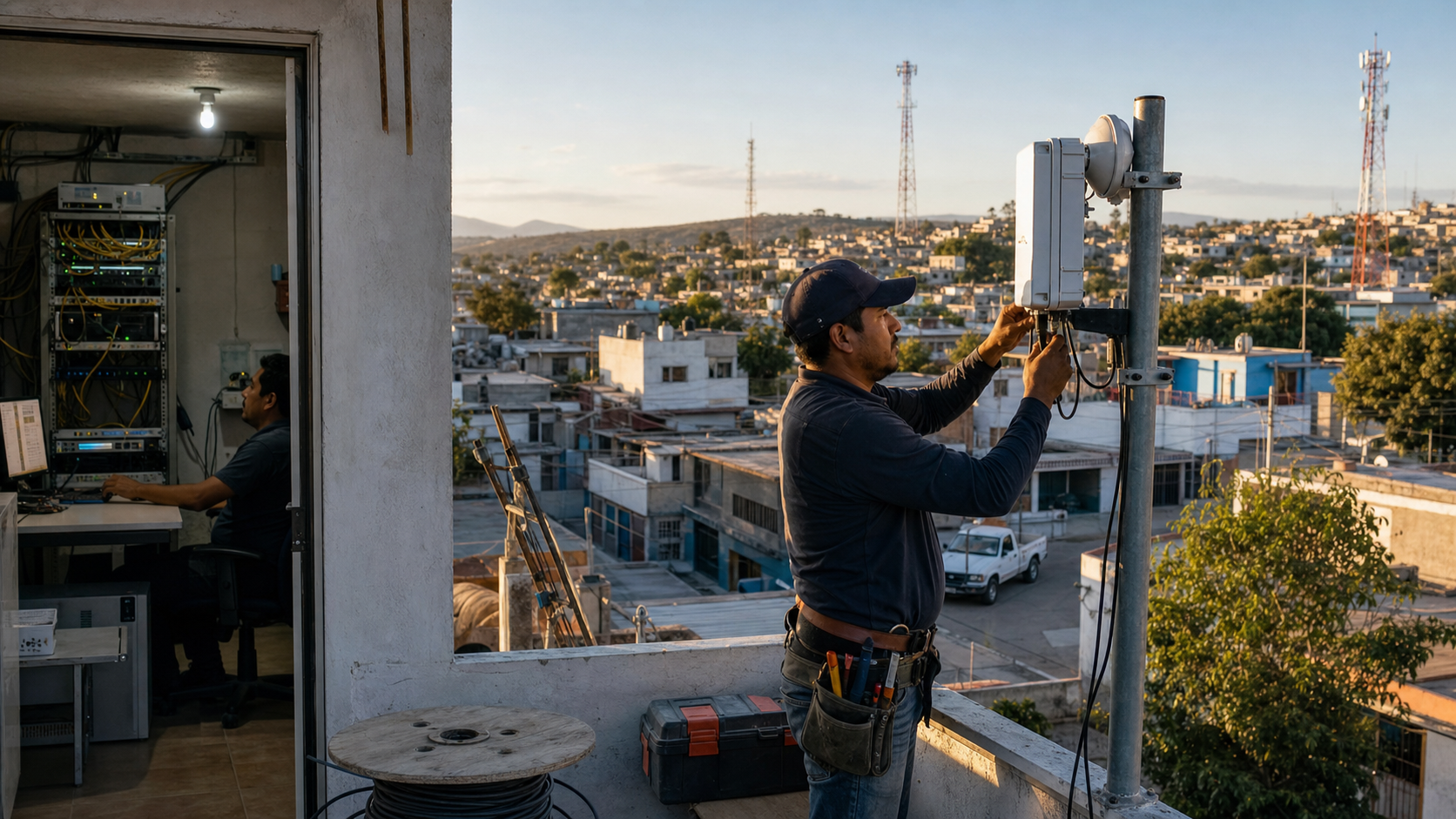
Witmac Internet should be read as a local-margin business before it is read as a speed plan. The company advertises home internet in Tehuacan, Puebla, with prices beginning at 399 pesos per month, no forced contract terms, free installation under a promotion, support in the same city, and coverage built with fiber optic and multipoint wireless infrastructure (https://www.witmac.mx/). Its public commercial-practices page says the service may be delivered by wireless link or fiber optic depending on the customer's location, and it lists household, business and dedicated plans from low-cost residential access to 10 Gbps campus or ISP-grade service (https://www.witmac.mx/politica). That combination is the core economic signal. Witmac is not just a reseller landing page. It is presenting itself as a local access operator that sells both mass-market household connectivity and higher-value business capacity in a city where national carriers also compete.
The question for readers is therefore not whether Witmac is larger than the national operators. It is not. The question is whether a regional operator can defend a useful pocket of broadband economics against Telmex-style incumbent reach, Izzi cable and bundle offers, Totalplay fiber performance, Megacable's cable and fiber footprint, and Telcel home-wireless substitution. In that contest, Witmac's best defense is not abstract bandwidth.
It is the ability to know the neighborhood, install quickly, answer locally, collect cash or transfer payments without making the customer navigate a remote bureaucracy, and reach homes or small businesses where the national offer is either unavailable, slow to install, or less responsive after a fault.
That defense has limits. A regional ISP that advertises 399, 499 and 599 peso home plans cannot absorb unlimited truck rolls, equipment replacement, tower rent, power backup, transit cost, customer-premises hardware, unpaid accounts and neighborhood build expense. The same local presence that creates trust also creates cost. Field technicians, office staff, support channels, tower or rooftop sites, fiber drops, wireless radios, routers, customer visits and payment reconciliation are real margin drains.
If national operators bring comparable prices and stable service to the same streets, the regional operator must prove that its local execution is worth choosing even when the brand is smaller.
Witmac matters because it sits exactly in that narrow space. It is local enough for neighborhood trust to matter, but network-visible enough to have a registered routing identity, public IP resources and business-facing dedicated offers. It sells affordable household access, but it also advertises symmetric dedicated lines with public IPv4 and IPv6 blocks. It claims local support, but its upstream and interconnection position still depends on a broader wholesale and regulatory environment. That makes it a useful case for Mexican regional broadband margin: the profit does not come from simply buying bandwidth cheaply and reselling it.
It comes from turning messy local operations into customer retention.
Identity: Witmac is the trading name, TMAC is the legal and operating context
The public identity chain is reasonably clear. Witmac's own site uses the brand "WITMAC Internet" and gives its contact address as Manantiales de Tehuacan #704, Puebla, with the support email soporte@witmac.mx and phone number 238 689 00 80 (https://www.witmac.mx/). Its commercial-practices page says WITMAC is a division of Grupo TMAC and states that it has more than five years of experience in internet service and network infrastructure (https://www.witmac.mx/politica). The same page identifies the business as an IFT-authorized company and links a Profeco adhesion-contract document.
The Mexican telecom registry gives the formal name. The Registro Publico de Concesiones entry lists Tecnologia Multitransaccional Aplicada al Comercio, S.A. de C.V. as the concession holder, WITMAC as the commercial name, and the registration as an authorization to establish, operate or exploit a telecommunications-service reseller. It shows an active status, authorized services including internet, local fixed telephony, data transmission and dedicated links, a national coverage entry in the authorization record, a 19 March 2020 grant date, and a term ending on 19 March 2030 (https://rpc.ift.org.mx/vrpc/RpcSearchController/showConcesionInfo?idConcesion=FET099178AU-518642). A 2021 registration document adds Tehuacan, Puebla as the area where the additional services were reported for commencement (https://rpc.ift.org.mx/vrpc//pdfs/99178_211023015426_5399.pdf).
The older TMAC corporate page helps explain why the access brand has this name. TMAC says Tecnologia Multitransaccional Aplicada al Comercio S.A. de C.V. was incorporated in 2011, describes a history that began with electronic airtime recharge services in Tehuacan, and says the company signed agreements with America Movil and Radiomovil Dipsa in 2015 (https://tmac.mx/about). That history does not by itself prove anything about Witmac's present broadband capacity. It does, however, explain the local-commerce DNA behind the broadband offer. A company that grew from recharge distribution, payment points, server administration and local technical service will naturally pay attention to collection, counter service and practical customer handling.
Network records point to the same entity. PeeringDB lists Witmac Internet, also known as Witmac, with ASN 270151, a website override of http://www.witmac.mx, traffic level of 20-50 Gbps, balanced traffic ratios, open peering policy, IPv4 and IPv6 support, and a public contact for Enrique Carrera at a Witmac peering email address (https://www.peeringdb.com/asn/270151). BGP.Tools identifies AS270151 as Tecnologia Multransaccional Aplicada Al comercio SA de CV, registered on 3 January 2022, active under LACNIC, and classed as an eyeball network (https://bgp.tools/as/270151). The spelling variations across Spanish accents and registry capitalization are not meaningful enough to create separate public subjects. The practical subject is one business: the Witmac Internet access brand operated in the Tecnologia Multitransaccional Aplicada al Comercio and TMAC context.
That reconciliation matters because broadband directories can easily over-model infrastructure. The company is Witmac Internet. The autonomous system, website, prefixes, payment pages, contact handles, customer forms and technologies are evidence about the company, not separate actors. A reader trying to understand the business should follow the service chain: a Tehuacan brand, a Mexican corporate operator, a valid public telecom authorization, a local office, a residential offer, a business offer and a routed network footprint.
The product is deliberately local and deliberately mixed
Witmac's home page sets the consumer promise in plain language: high-speed home internet from 399 pesos per month, no forced terms and local support in Tehuacan (https://www.witmac.mx/). The listed home plans are Basic Home at 399 pesos per month for up to 40 Mbps, Gamer Fiber at 499 pesos per month for up to 200/100 Mbps, and Gamer Pro at 599 pesos per month for up to 200/200 Mbps symmetric service. The page says the 650 peso installation charge is waived under a promotion valid until December 2026, and it frames the network as "fiber optic and multipoint" coverage in Tehuacan. The FAQ says a customer's home may receive either a receiving antenna or an optical outlet plus a Wi-Fi modem, depending on the package and coverage.
That mixed delivery model is a clue to cost control. Pure fiber expansion has better long-term capacity and customer experience, but every new street requires rights-of-way, make-ready work, distribution plant, drop cable, customer-premises equipment and repair obligations. Fixed wireless can reach pockets faster, especially where density or pole access makes immediate fiber unattractive, but it carries tower or rooftop cost, radio planning, line-of-sight issues, weather exposure, spectrum coordination and capacity constraints. Witmac's public pages do not give a detailed map of each access technology by colony or neighborhood.
They do make the business logic visible: fiber is the quality anchor, while multipoint wireless gives the operator a way to cover customers where a fiber drop is not yet economical or technically straightforward.
The official commercial-practices page reinforces this. It says the company provides internet by wireless link and/or fiber optic, with the technology and installation depending on the customer's geographic location or address (https://www.witmac.mx/politica). It also says the installation response averages 24 to 48 business hours depending on location and availability. That is not a minor detail. For a regional ISP, installation speed is a sales weapon. A national brand may have a larger footprint, but if the customer waits for a distant schedule, misses callbacks, or hears that coverage is not yet active in that exact street, the local provider can win the order by sending a crew quickly.
Witmac also tries to climb the value ladder. Its business packages listed in the commercial-practices page are 200 Mbps at 799 pesos per month, 500 Mbps at 1,199 pesos, and 1 Gbps at 1,999 pesos, each described with a main zone, managed LAN and managed Wi-Fi (https://www.witmac.mx/politica). The dedicated service page advertises 1:1 symmetric business connections with availability guarantees and engineer/NOC support; the listed tiers are 200 Mbps at 6,000 pesos, 500 Mbps at 11,000 pesos, 1 Gbps at 15,000 pesos, and 10 Gbps at 90,000 pesos per month, with public IPv4, public IPv6 /48, dedicated bandwidth and additional IPs on request (https://www.witmac.mx/dedicados). It also says dedicated links can be delivered by fiber or licensed microwave near its points, following a feasibility study.
This tiering matters for margin. A 399 peso household plan can build brand recognition and density, but it may not generate enough surplus to fund the whole network if churn, support load and unpaid accounts are high. Business and dedicated accounts can add more predictable revenue per site, especially schools, clinics, offices, shops, warehouses, campuses and smaller local networks that need support from someone who can actually visit. The risk is sales complexity. Selling a dedicated line with a public IP and service expectation is not the same as installing a home router. The higher the promise, the more a fault becomes expensive.
The routing record shows a real access network with upstream dependency
Witmac's public routing footprint is stronger than that of a marketing-only reseller. BGP.Tools lists AS270151 as active, registered under LACNIC, with seven originated IPv4 prefixes, three originated IPv6 prefixes, four /24s worth of IPv4 addresses, and 768 /48s worth of IPv6 space. It lists originated IPv4 routes including 190.102.32.0/24, 190.102.32.0/23, 190.102.32.0/22, 190.102.33.0/24, 190.102.34.0/24, 190.102.34.0/23 and 190.102.35.0/24, and IPv6 routes including 2806:3e1:1100::/40, 2806:3e1:bb00::/40 and 2806:3e1:da00::/40 (https://bgp.tools/as/270151). It also shows valid RPKI indicators for those routes and identifies the network as an eyeball network, meaning the public routing view sees it as an end-user access network rather than a pure hosting or transit shop.
PeeringDB tells a slightly different but still useful story. It lists one IPv4 prefix and one IPv6 prefix in the profile, a traffic level of 20-50 Gbps, balanced traffic ratios and no public exchange or interconnection facility entries visible in the profile (https://www.peeringdb.com/asn/270151). Differences between PeeringDB self-reported fields and live routing views are common. The safe reading is not that every number is a precise audited capacity measure. The safe reading is that Witmac has a publicly maintained peering identity, an autonomous-system number, public contact data, IPv4 and IPv6 routing, and enough internet presence for independent routing tools to track the network.
The dependency is also visible. BGP.Tools lists a single upstream, AS32098 Flo Networks, described as Transtelco Inc. (https://bgp.tools/as/270151). That does not mean Witmac has no other commercial arrangements, nor does it prove that every customer packet always follows one path. It does show that the public BGP view sees a narrow upstream surface. For a regional ISP, that is a key operating exposure. If upstream transport, handoff economics or commercial terms change, the local operator has less bargaining power than a national carrier. If a fault occurs in the wholesale path, Witmac may own the customer relationship even when the immediate problem sits outside its last-mile plant.
The upstream point also changes how to judge "independence." Witmac can be a real access operator and still depend on suppliers. The fact that it originates prefixes and advertises business dedicated plans does not mean it owns every kilometer of fiber, every tower path or every core route. Regional broadband is usually a stack: customer relationship, local drop, access radio or fiber, aggregation, backhaul, upstream transit, DNS and customer support. Witmac's strategic question is how much of that stack it can control tightly enough to protect experience, while buying enough outside capacity to avoid overbuilding.
For customers, the network evidence matters in a practical way. A neighborhood provider with a routed network can offer public IP arrangements, IPv6, business routing support and better troubleshooting than a purely informal shared line. But if the provider has limited upstream diversity, customers with mission-critical needs should ask about backup paths, service-level commitments and escalation. Witmac's dedicated page says it can provide high-availability schemes using BGP redundancy and alternate media such as fiber plus wireless (https://www.witmac.mx/dedicados). The business opportunity is there. The proof for each customer will be in contract terms and actual route diversity, not in the headline plan alone.
Cash collection is part of the network
One of the most important public details about Witmac is not technical. It is payment handling. The commercial-practices page says the service can be contracted in the customer-service center or through electronic communication, and that the process collects the customer's name, address, phone numbers, selected package, contact references, proof of identity and proof of address (https://www.witmac.mx/politica). It says the adhesion contract is registered with Profeco and includes a promissory note covering terminal equipment and installation, valid only for equipment provided on loan while the service is active. The FAQ says customers pay every 30 days from the hiring date and have five days of tolerance to avoid service cuts (https://www.witmac.mx/).
The payment channels are even more revealing. Witmac lists cash deposits through OXXO or establishments with Santander deposits, payment at the Witmac building, Recargalos y Pagalos points, and bank transfer to a STP account under the name Witmac Internet (https://www.witmac.mx/politica). It asks customers who pay at OXXO or payment points to send a photo of the receipt so the company can correctly apply the payment to the account. That workflow looks old-fashioned if judged from a big-city app-payment perspective. For a regional ISP, it is a margin-control system. It acknowledges that customers may pay in cash, through convenience stores, at a counter, or by transfer, and it creates a manual reconciliation process so paid accounts are not cut off by mistake.
This is where local broadband economics become very specific. A household paying 399 to 599 pesos a month is not just a revenue line. It is a monthly collection event. If the provider loses track of a receipt, keeps a paid customer suspended, lets unpaid accounts run too long, or requires customers to navigate a hard-to-reach national call center, churn rises. If the provider spends too much staff time reconciling payments and chasing proof, the low plan price becomes unprofitable. The five-day tolerance window is therefore a pricing and retention mechanism.
It keeps the customer relationship alive long enough to collect, but it limits the free-credit period.
The equipment-return rule is also important. The FAQ says equipment installed at the home belongs to Witmac and must be returned at cancellation (https://www.witmac.mx/). For a small ISP, routers, optical terminals, antennas, radios and installation materials are working capital. Losing customer-premises equipment after churn can erase months of gross margin from a low-price household plan. The Profeco-linked adhesion contract and the commercial-practices page's promissory-note language are attempts to reduce that loss. They may also create friction for customers, but without some equipment discipline, free installation at the low end can become a subsidy to churn.
Cash collection and hardware control are not separate from network quality. If the operator cannot collect reliably, it delays buildout. If it cannot recover equipment, it spends more on replacement. If customers do not understand their payment date, support calls rise. If the payment process is too strict, customers defect to prepaid mobile or another fixed provider. Witmac's local-office model gives it a chance to turn payment into service contact rather than conflict. The danger is labor intensity. Every receipt photo and account reconciliation is a human process unless the system is automated well.
The competitive wall is national bundling
Witmac's price ladder sits directly below, beside and sometimes above national offers, depending on technology and package composition. The IFT's 2025 fixed-services tariff report, based on offers available as of 29 August 2025, identified 48 fixed-internet single-play plans across 11 operators and 28 triple-play plans across four operators, with Telmex-Telnor, Izzi, Megacable, Totalplay and Wizz visible in the national comparison set (https://www.ift.org.mx/sites/default/files/reporte_de_planes_y_tarifas_fijos_2025_1.pdf). The same report says triple-play offers were present in many states: Megacable in 29, Totalplay in 27, Izzi in 19 and Wizz in 15. It also says triple-play rents ranged from 545 pesos for Wizz's low-speed plan to 1,860 pesos for an Izzi 1,000 Mbps plan, with Izzi ranging from 690 pesos for 60 Mbps to 1,860 pesos for 1,000 Mbps, Megacable from 665 pesos for 100 Mbps to 1,170 pesos for 1,000 Mbps, and Totalplay from 710 pesos for 200 Mbps to 1,640 pesos for 1,200 Mbps.
Those figures frame Witmac's problem. A 399 peso 40 Mbps home plan is cheaper than most national bundle examples, but it is also lower speed than many fiber offers. A 499 peso 200/100 Mbps fiber plan, if available at a specific address, is aggressive. A 599 peso 200/200 Mbps symmetric plan is potentially attractive for home workers, gamers, creators and small shops. But national operators can counter with television, fixed phone, streaming promotions, mobile discounts, brand familiarity and deeper marketing budgets.
Telmex can leverage household recognition, legacy fixed-line presence, Claro Video, Telcel adjacency and a massive fiber backbone. Izzi can wrap broadband with television and streaming. Totalplay can lean on fiber performance and high-speed positioning. Megacable can bundle cable, internet and telephony across large regional footprints.
The IFT report also shows why bundles are dangerous to a local ISP. In triple play, all Izzi, Megacable and Totalplay plans in the report are in the greater-than-50 Mbps speed range (https://www.ift.org.mx/sites/default/files/reporte_de_planes_y_tarifas_fijos_2025_1.pdf). That means the national pitch is no longer just "more channels." It is high-speed broadband plus other services. Witmac's answer cannot be to copy every bundle. A regional operator with limited scale will struggle to buy or package premium content on the same terms. The better answer is to make the broadband itself feel less bureaucratic, more address-specific and easier to repair.
Totalplay's own investor disclosures show the scale of the opponent. In the third quarter of 2025, Totalplay reported 5.39 million residential subscribers, including small and medium businesses, 17.63 million homes passed, 30.6 percent penetration of homes passed, residential ARPU of 598 pesos, and a large fixed-asset base tied to fiber and subscriber acquisition costs (https://www.irtotalplay.mx/en/Comunicado/21580). That is the economics of a national fiber machine. It can spend on brand, absorb subscriber-acquisition costs, optimize utilization of an existing network and push service upgrades across a giant footprint. Witmac cannot outspend that. It has to out-localize it.
Out-localizing has real value in cities like Tehuacan. Coverage in a national map can still fail at the exact house, shop, courtyard, rental unit, school annex or edge street. A local provider can know which rooftops see a tower, which blocks already have fiber, which customer needs a payment reminder, which family moved address, and which small business needs help after hours. But local knowledge only defends the account if the service is stable. If a national operator offers similar speed, clean installation and fewer outages in the same colonia, local familiarity will not be enough.
Mobile and home wireless are the substitution threat
The second competitive wall is not another fiber line. It is wireless substitution. Telcel's home internet pages advertise WiFi Telcel and Internet en tu Casa as household internet that can be connected without cable installation, with plans from 399 pesos per month and a modem that plugs into power (https://www.telcel.com/personas/planes-de-renta/tarifas-y-opciones/wifi-telcel and https://www.telcel.com/personas/telcel-en-tu-casa). That offer attacks exactly the friction regional ISPs try to solve. If a household can buy a modem, plug it in and avoid an installation appointment, the local ISP loses one of its strongest conversion tools.
Wireless substitution is not the same in every home. Fixed wireless over mobile networks may have usage policies, congestion, indoor signal limits, variable upload, cell-sector capacity and location restrictions. A good fiber or well-engineered fixed wireless ISP can still win on consistency, latency, upload and support. But the customer's first decision may be convenience, not engineering. If the family needs internet this weekend, a plug-in modem with a familiar mobile brand may beat a technically better service that requires a site visit.
Witmac's defense is to reduce installation and support friction until wired or fixed-wireless local service feels just as easy. The home page's promise of no forced contracts and local support is part of that defense (https://www.witmac.mx/). The commercial-practices page's 24 to 48 business-hour average installation response is another part (https://www.witmac.mx/politica). The dedicated page's feasibility workflow is a third part for business customers (https://www.witmac.mx/dedicados). The company is signaling that it can move quickly, tailor the connection to the location and keep support local.
Still, mobile substitution changes the margin equation. A regional ISP used to be compared mainly with DSL, cable or fiber. Now it is compared with a box that may need no visit, no drop cable, no roof access and no waiting for a technician. That pressures installation fees, contract terms and cancellation policies. Witmac's free-installation promotion may help win new subscribers, but it shifts more upfront cost onto the company. If customers churn quickly to a mobile substitute, the operator loses the installation recovery period. This is why the equipment-return and payment-discipline language matters.
The offer has to feel flexible to the customer while still protecting the operator from subsidizing short-lived accounts.
Mobile substitution also creates an opportunity. If a household tries plug-in wireless and finds it unstable at peak hours, it may value a local ISP that can install a better antenna, a fiber drop or a managed router. The key is timing. Regional operators win when they intercept frustration quickly: "your street is covered, installation is soon, support answers here." They lose when the first contact is slow or unclear.
Cost structure: towers, fiber, power and people
Witmac's cost base is likely split across four practical buckets: access plant, upstream capacity, customer operations and working capital. Access plant includes fiber routes, drops, optical equipment, wireless radios, antennas, rooftop or tower sites, masts, cabling, power supplies and installation materials. Upstream capacity includes transit or wholesale connectivity, public IP resource administration, routing equipment and transport. Customer operations include installers, support, NOC or engineering escalation, office service, sales, payment reconciliation and account management.
Working capital includes free installation, loaned equipment, unpaid balances and inventory.
The company's pages expose each bucket indirectly. "Fiber optic and multipoint" coverage in Tehuacan points to mixed access plant (https://www.witmac.mx/). The dedicated page's mention of licensed microwave, BGP redundancy and alternate routes points to transport and resilience spending (https://www.witmac.mx/dedicados). The FAQ and commercial-practices page point to installation crews, customer service, payment handling, equipment loans and cancellation visits (https://www.witmac.mx/politica). BGP.Tools and PeeringDB point to routed network administration and upstream dependency (https://bgp.tools/as/270151 and https://www.peeringdb.com/asn/270151).
The margin challenge is that low-price broadband has many small costs that arrive before the revenue is secure. A home installation requires a visit, equipment and activation. If the monthly plan is 399 pesos, the provider may need several paid months before the customer becomes profitable. If the customer cancels quickly, does not return equipment, pays late, or requires repeated support, the account can become negative. A 499 or 599 peso fiber plan helps, but it also raises customer expectations around latency, upload, gaming and streaming. Support quality has to rise with the promise.
Wireless access can improve payback if it reduces civil work and reaches homes quickly. It can also backfire if capacity saturates, signal quality varies, radios need realignment, or weather causes service calls. Fiber can improve lifetime value if it locks in a stable connection and supports upgrades, but fiber is capital intensive and slow to deploy street by street. Witmac's likely advantage is using both selectively. It can cover a price-sensitive home by wireless where fiber is not ready, deploy fiber where density justifies it, and sell dedicated or business service where the route can support higher ARPU.
Power reliability and site access sit behind the public offer. Tehuacan is not an isolated mountain market, but any regional network with rooftop radios, tower sites, active cabinets or customer equipment has to manage power interruptions, storms, heat, physical access and local maintenance. The customer does not care whether the fault is at the radio, upstream link, router, pole, fiber splice or payment suspension. The customer experiences one thing: the internet is down. This is why local support is not just a marketing phrase. It is the operating surface where the margin is won or lost.
People are the hardest cost. The home page says support is local in Tehuacan, and the dedicated page advertises direct sales contact and engineer/NOC support (https://www.witmac.mx/ and https://www.witmac.mx/dedicados). If those claims are backed by skilled staff, they create differentiation. But skilled technicians are expensive, and low-end household plans do not leave much room for repeated visits. A regional ISP has to triage well: fix true network faults fast, reduce unnecessary truck rolls, teach customers simple router checks, and avoid letting billing confusion become a technical ticket.
Customer dependency is household first, but small business may be decisive
Witmac's public messaging speaks to households, gamers, streamers, creators and multiple-device homes. That is understandable. Household density creates route economics and brand visibility. But the more strategically important customer may be the small local business that needs internet every day and has enough willingness to pay for managed service. Witmac's business packages include managed LAN and managed Wi-Fi, while dedicated plans offer symmetric capacity, public IP resources and availability commitments (https://www.witmac.mx/politica and https://www.witmac.mx/dedicados). That tells readers where the company wants to capture more value.
For Tehuacan businesses, the choice is not only price per Mbps. A school, clinic, restaurant, warehouse, local office or store needs someone to fix Wi-Fi dead spots, payment-terminal connectivity, cloud POS access, video calls, cameras, reservations, online orders and back-office systems. National carriers can serve many of these needs, but a local provider may have an advantage if it bundles broadband with site-level attention. The TMAC history in recharge, payment systems, server administration and local technical service makes that customer segment plausible (https://tmac.mx/about).
The risk is overpromising. "Managed LAN" and "managed Wi-Fi" can mean anything from basic router setup to real network design. If the service is sold cheaply but expected to solve every in-building issue, support cost can explode. If dedicated customers expect corporate-grade service levels but the provider has narrow upstream diversity, the account can become reputationally dangerous. The right model is disciplined segmentation: simple home plans with clear support boundaries, business plans with defined managed services, and dedicated links with explicit feasibility, backup and escalation terms.
Customer dependency also works the other way. Witmac depends on customers who are willing to trust a local brand with their home or business connection. That trust can be stronger than national advertising when neighbors recommend the service, when the office is visible, or when a technician resolves a problem quickly. It can disappear quickly after repeated outages or billing mistakes. Local reputation compounds in both directions.
Social channels show that Witmac is actively trying to stay visible in Tehuacan. Its Facebook and Instagram presence includes recent posts around business dedicated internet, 1 Gbps speed, symmetric connections, schools, gaming, easier contracting, local office visibility and support messaging (examples include https://www.facebook.com/WiTmacMexico/ and https://www.instagram.com/witmac_teh/). Search snippets and public posts should not be treated as audited performance evidence. They are useful market chatter because they show the themes Witmac believes will convert customers: local presence, sport and gaming use, school connectivity, business continuity and fast support.
Regulatory position is an asset, but transition adds uncertainty
Witmac's authorization record is an important asset. The telecom registry shows an active registration under Tecnologia Multitransaccional Aplicada al Comercio, S.A. de C.V., with WITMAC as the commercial name and services including internet, local fixed telephony, data transmission and dedicated links (https://rpc.ift.org.mx/vrpc/RpcSearchController/showConcesionInfo?idConcesion=FET099178AU-518642). The commercial-practices page says the company has IFT authorization and a Profeco-registered adhesion contract (https://www.witmac.mx/politica). That gives customers and counterparties more to rely on than a social-media-only provider.
The details matter. The registry category is an authorization for a telecommunications-service reseller, and the 2020 record includes any public telecom service acquired from public telecom networks operated by authorized concessionaires. The 2021 service notice adds internet, local fixed telephony, data transmission and dedicated links. This fits the earlier economic reading: Witmac can operate a real customer-facing network while still relying on authorized public networks and upstream suppliers.
It should not be mistaken for a nationwide facilities-based incumbent simply because the registry shows national coverage in the authorization record.
Mexico's regulatory environment is also changing. Public legal summaries and official-law listings show that a new telecommunications and broadcasting law was published in July 2025 and that the old IFT framework has been moving into a new regulatory arrangement involving the Agencia de Transformacion Digital y Telecomunicaciones and the Comision Reguladora de Telecomunicaciones (https://www.diputados.gob.mx/LeyesBiblio/ref/lmtr.htm and https://sidof.segob.gob.mx/notas/5776710). For a regional ISP, the near-term question is not the politics of the reform. It is administrative continuity: license records, contract registration, consumer complaints, interconnection rules, competition enforcement, equipment approval and reporting obligations need to remain predictable.
Regulatory transition can cut both ways. If the new framework simplifies procedures, local ISPs may benefit. If it creates uncertainty, larger operators with stronger legal teams may adapt faster. Witmac's practical exposure is compliance bandwidth. A small company must keep its customer terms, privacy practices, payment handling, service claims, equipment loans and advertised plans aligned with consumer and telecom rules without diverting too much management attention from operations.
The Profeco-facing contract and commercial-practices page are therefore not paperwork decoration. They are part of market trust. Customers comparing a local ISP with Telmex, Izzi or Totalplay may ask whether the smaller provider has a clear cancellation path, equipment policy, complaint channel and service-quality remedy. Witmac publishes those elements. The next test is whether the lived customer experience matches the documents.
What would change the judgement
The base judgement is cautiously constructive. Witmac has a coherent local broadband proposition: low entry price, mixed fiber and wireless coverage, local support, public authorization, visible routing identity, business and dedicated tiers, and payment workflows suited to Tehuacan households and small businesses. Its strongest defense against national operators is not scale. It is the ability to translate local knowledge into lower installation friction, faster support, better collections and coverage where a national brand is less responsive.
The judgement would improve if public evidence showed several additional facts. First, a clearer coverage map by neighborhood and technology would show how much of the offer is fiber, how much is fixed wireless, and where upgrades are planned. Second, public uptime or service-quality reporting would support the dedicated-service promise. Third, evidence of upstream diversity beyond one visible BGP upstream would reduce supplier risk. Fourth, customer reviews with stable patterns around installation, support and outage resolution would validate the local-trust thesis.
Fifth, more transparent terms for business managed Wi-Fi and dedicated service levels would clarify how the company protects higher-value customers.
The judgement would weaken if several signals emerged. Repeated complaints about slow repairs, receipt misapplication, equipment-return disputes, billing confusion, congested evening speeds, wireless instability or unfulfilled installation times would directly attack the model. So would evidence that national operators now cover Witmac's strongest neighborhoods with comparable prices and faster service. A loss of routing visibility, regulatory irregularity, contract-registration issue, or upstream concentration problem would also matter. The company's economics depend on being small but operationally sharp.
If it becomes small and operationally overloaded, the advantage disappears.
The most important unknown is churn. Public pages can show prices, plans and authorization, but they do not reveal how long customers stay, how often they pay late, how many require truck rolls, or how much equipment is lost after cancellation. Those variables decide margin. A 399 peso customer who stays for years and rarely calls support can be profitable. A 599 peso customer who churns after two months, keeps equipment and demands repeated visits may be unprofitable. Regional broadband is a retention business disguised as an access business.
That is why the article's economic lens should stay grounded. Witmac is neither a fragile informal reseller nor a national-scale fiber challenger. It is a Tehuacan regional ISP trying to make neighborhood availability, local support and flexible payment channels into a defensible broadband relationship. The model can work if the company keeps build costs disciplined, upgrades fiber where density supports it, uses wireless where it fits, diversifies upstream risk for higher-value accounts, and treats payment and repair workflow as seriously as routing.
Public evidence
The company website at https://www.witmac.mx/ supports the consumer identity, Tehuacan focus, 399 peso starting price, no forced-term positioning, local support claim, home plan ladder, free-installation promotion, mixed fiber and multipoint network language, FAQ details on installed equipment, monthly payment timing and the five-day tolerance window.
The commercial-practices page at https://www.witmac.mx/politica supports the link to Grupo TMAC, the stated IFT and Profeco positioning, service delivery by wireless link and/or fiber optic, home, business and dedicated plan tables, customer-service-center address and hours, contracting requirements, equipment-loan and promissory-note language, payment channels, receipt-photo handling, cancellation process, average installation response and service-quality remedy language.
The dedicated-service page at https://www.witmac.mx/dedicados supports the 1:1 symmetric business offer, 200 Mbps to 10 Gbps price ladder, public IPv4 and IPv6 terms, NOC/engineer-support framing, fiber or licensed-microwave feasibility language, 5 to 10 business-day delivery estimate, and backup schemes using BGP redundancy and alternate media.
The Mexican telecom registry entry at https://rpc.ift.org.mx/vrpc/RpcSearchController/showConcesionInfo?idConcesion=FET099178AU-518642 supports the formal concession-holder name, WITMAC commercial name, active status, authorization type, authorized services, national coverage entry, 2020 grant date and 2030 term. The 2021 service document at https://rpc.ift.org.mx/vrpc//pdfs/99178_211023015426_5399.pdf supports the additional-service notice for Tehuacan, Puebla.
PeeringDB at https://www.peeringdb.com/asn/270151 supports the Witmac Internet network profile, ASN 270151, also-known-as field, website, reported traffic level, IPv4/IPv6 support, peering policy and public contact. BGP.Tools at https://bgp.tools/as/270151 supports the AS270151 routing identity, active LACNIC status, eyeball classification, originated prefixes, RPKI-valid route indicators and visible upstream relationship with Flo Networks/Transtelco.
The TMAC corporate page at https://tmac.mx/about supports the broader Tecnologia Multitransaccional Aplicada al Comercio and Grupo TMAC context, the Tehuacan origin story, recharge/payment-service background, server-administration experience and Enrique Carrera leadership reference.
The IFT 2025 fixed-services tariff report at https://www.ift.org.mx/sites/default/files/reporte_de_planes_y_tarifas_fijos_2025_1.pdf supports the Mexico fixed-broadband competitive context, single-play and triple-play plan analysis, national operators used for comparison, triple-play coverage breadth, plan price ranges and speed categories. Totalplay's Q3 2025 investor release at https://www.irtotalplay.mx/en/Comunicado/21580 supports the national-fiber scale comparison, including subscriber base, homes passed, ARPU, capex and fixed-asset context.
Telcel's home-internet pages at https://www.telcel.com/personas/planes-de-renta/tarifas-y-opciones/wifi-telcel and https://www.telcel.com/personas/telcel-en-tu-casa support the mobile and fixed-wireless substitution analysis: household internet positioned around plug-in setup, no cable installation and plans from 399 pesos per month.
Public Facebook and Instagram pages at https://www.facebook.com/WiTmacMexico/ and https://www.instagram.com/witmac_teh/ support only market-chatter analysis around Witmac's current public messaging, including local office visibility, support, gaming, schools, business connectivity and dedicated internet. They are not used as audited proof of performance.