
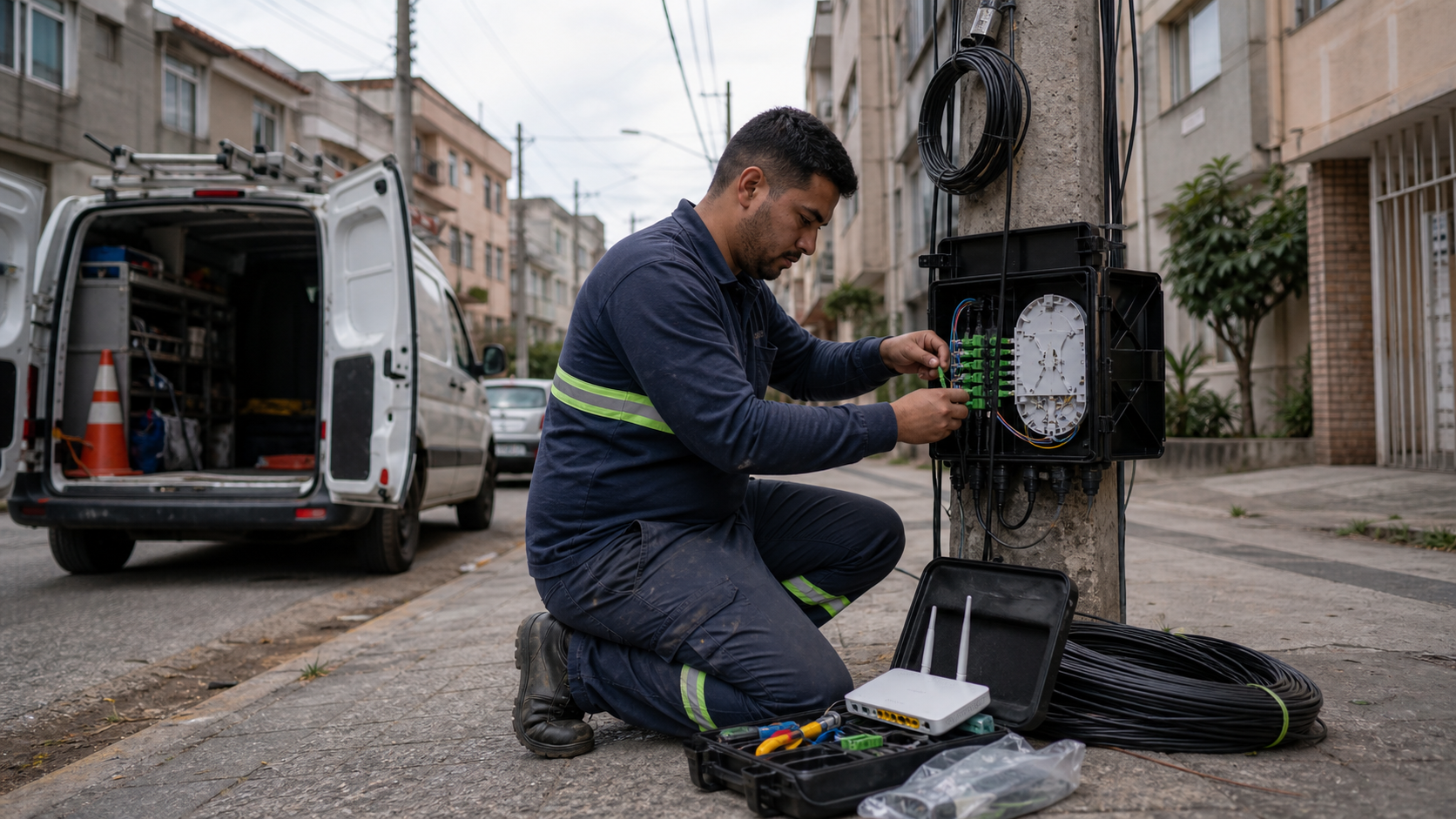
The real unit of analysis is a Roraima fibre bill after the customer has already needed one repair visit
A household in Boa Vista or a small shop in Mucajai does not buy a balance sheet. It buys a monthly promise: the router works tonight, the payment page opens, the children can stream, the card terminal stays online, the camera feed reaches the phone, and the line still works after the first service call. Webfiber Telecom's public offer makes that promise look simple. The company's own plans page advertises residential tiers from 300 Mbps at R$109.90 to 1 GB at R$250.00, with free installation and a free Wi-Fi 5 or Wi-Fi 6 unit depending on the plan (https://webfibertelecom.com.br/planos). Its business tiers start at 300 Mbps for R$129.90 and run to 1 GB at R$499.00, again pairing the advertised download speed with included installation and Wi-Fi equipment (https://webfibertelecom.com.br/planos). Those prices are the visible retail side of the business. The economic question is whether the same bill still carries profit after the second truck roll.
That second visit is the useful unit because it forces the whole model into one measurable sequence. A 300 Mbps residential account at R$109.90 can absorb routine billing, backhaul, pole-rental, customer-care and network-maintenance costs only if the installation is clean and the customer does not churn. If the first installation includes an optical drop, in-home Wi-Fi placement, customer education, and enough testing to reduce repeat calls, the monthly bill can become an annuity. If it produces an early complaint, the economics change: a support employee answers the message, a field team schedules the return, a vehicle reaches the address, the technician tests optical power and the in-home router, and the company loses the same afternoon that could have installed another paying customer. The official contact page matters here because Webfiber sells not just bandwidth but availability through phone, WhatsApp, e-mail and extended technical support hours (https://webfibertelecom.com.br/contato). Its customer area, hosted under an IXC subscriber portal, suggests a conventional Brazilian ISP back office for bills, service status and account interaction (https://ixc.webfibertelecom.com.br/central_assinante_web/login). That is a signal of operational form, not proof of service quality.
The first 800 words therefore should not start with incorporation dates. They should start with the bill that must survive repair friction. Webfiber's own home page says it sells high-speed fibre internet for homes and businesses, and its site metadata describes "Internet de fibra optica" with coverage and plans (https://webfibertelecom.com.br/home). The commercial page names six coverage municipalities in Roraima: Boa Vista, Mucajai, Iracema, Caracarai, Rorainopolis and Pacaraima, a footprint that combines the state capital with smaller, more field-intensive towns (https://webfibertelecom.com.br/home). That geography is not incidental. A dense urban neighbourhood can spread splicing, support and pole-access costs over many active ports. A road-linked interior town can make the same retail price less forgiving if each fault requires more travel time, more rescheduling and more inventory held locally.
The included Wi-Fi unit is also central. A customer often experiences an internet plan through the CPE, not through the BGP table. Webfiber's plan cards distinguish Wi-Fi 5 from Wi-Fi 6 equipment and bundle that equipment without a separate visible charge (https://webfibertelecom.com.br/planos). That makes the router part of acquisition cost, retention strategy and support risk at once. If the provider chooses equipment that works well in concrete houses, through humid weather and around noisy 2.4 GHz environments, support calls fall. If the equipment is underpowered, poorly placed or not explained to the customer, the subscriber may interpret in-home Wi-Fi loss as a failed fibre line. The difference between those outcomes is not academic. It is the difference between a bill that renews automatically and a bill that becomes a complaint, a missed payment, a modem swap or a cancellation.
The hard evidence says Webfiber is not merely a resale brand on someone else's website. PeeringDB lists WEBFIBER TELECOMUNICACAO LTDA - ME as the organization behind a network named WEBFIBER TELECOMUNICACAO, with ASN 268421, cable/DSL/ISP network type, South America scope, heavy inbound traffic ratio, 5-10 Gbps traffic level, IPv4 and IPv6 support and an IX.br Boa Vista connection (https://www.peeringdb.com/net/17448). The PeeringDB API record is more explicit: the network has a 10 Gbps entry at IX.br Boa Vista, public policy contact information, and the company website as the declared network site (https://www.peeringdb.com/api/net/17448). For an operator whose retail economics depend on local retention, that is a meaningful public signal. It shows a local access provider with its own autonomous-system identity and an exchange presence, not just a marketing front.
But the bill remains fragile. A R$109.90 or R$159.90 monthly plan is not a data-centre contract. The customer can compare it against Allfiber's public Boa Vista offer, which markets local support, 100% fibre, business and residential plans, high upload claims and awards language (https://www.allfiber.com.br/). The customer can compare it against InfoRR or other regional names on local ranking pages such as MelhorPlano's Iracema page, where InfoRR appears as a leading option rather than Webfiber (https://melhorplano.net/internet-banda-larga/rr/iracema). The customer can compare it against mobile broadband, a national carrier bundle, a neighbour's Starlink anecdote, or a cheaper plan found on WhatsApp. Webfiber's economic problem is therefore not only to acquire a port. It is to keep that port quiet after the first repair call.
The public identity is a small Roraima ISP with legal, brand and network evidence pointing in the same direction
The corporate identity is reasonably clear, though the typography is not always consistent. The assignment name uses WEBFIBER TELECOMUNICACAO LTDA - ME; public CNPJ mirrors normally show Webfiber Telecomunicacao LTDA with the trade name Webfiber Telecom. CNPJ.biz lists CNPJ 28.399.307/0001-26, legal name Webfiber Telecomunicacao LTDA, trade name Webfiber Telecom, opening date 11 August 2017, micro-enterprise size, active registration, Simples option, R$100,000 share capital, and the main activity "Servicos de comunicacao multimidia - SCM" (https://cnpj.biz/28399307000126). Perfill repeats the active status, Boa Vista address on Rua Severino Mineiro in Mecejana, SCM activity, micro-enterprise size and R$100,000 capital (https://www.perfill.com.br/empresa/28399307000126). Econodata likewise places the main CNPJ in Boa Vista and ties it to the same corporate record (https://www.econodata.com.br/consulta-empresa/28399307000126-webfiber-telecomunicacao-ltda).
The company also appears to have branch registrations aligned with its stated operating geography. CNPJ.biz says the main company has four active branches in Caracarai, Mucajai, Pacaraima and Iracema (https://cnpj.biz/28399307000126). Perfill shows the Mucajai CNPJ 28.399.307/0002-07 as active, opened on 5 July 2021, with SCM as principal activity and an address on Avenida Nossa Senhora de Fatima in the Centro area (https://www.perfill.com.br/empresa/28399307000207). Perfill shows the Caracarai CNPJ 28.399.307/0003-98 as active, also opened on 5 July 2021, with an Avenida Dr Zany address in Centro (https://www.perfill.com.br/empresa/28399307000398). Perfill shows the Pacaraima CNPJ 28.399.307/0005-50 as active, opened on 6 April 2023, with a Vila Nova address (https://www.perfill.com.br/empresa/28399307000550). Serasa's public pages for Mucajai and Pacaraima show the same CNPJ branch pattern and towns, providing a second public mirror for those branch claims (https://empresas.serasaexperian.com.br/consulta-gratis/WEBFIBER-TELECOMUNICACAO-LTDA-ME-28399307000207 and https://empresas.serasaexperian.com.br/consulta-gratis/WEBFIBER-TELECOMUNICACAO-LTDA-ME-28399307000550).
That footprint matters because the website's marketing coverage is not just a loose claim. It overlaps with corporate branch records and with network evidence. The company says it covers Boa Vista, Mucajai, Iracema, Caracarai, Rorainopolis and Pacaraima (https://webfibertelecom.com.br/home). Public registry mirrors show branches in four of those interior municipalities and the main office in Boa Vista (https://cnpj.biz/28399307000126). The missing part of the public registry picture is Rorainopolis: the site names it, but the easily visible branch mirrors reviewed here do not show a dedicated Rorainopolis CNPJ. That does not mean the company does not serve the town; it means the public corporate evidence is stronger for Boa Vista, Mucajai, Caracarai, Iracema and Pacaraima than it is for Rorainopolis.
The legal and brand identity also matters for a different reason: Webfiber is a common-looking name. There are other WebFiber-branded operators in Brazil. The Rio de Janeiro site at webfiberprovedor.com.br, for example, advertises unrelated 700 Mega and 1 Giga offers and should not be blended into this Roraima company (https://webfiberprovedor.com.br/). The article's operating subject is the Roraima Webfiber tied to CNPJ 28.399.307/0001-26, ASN 268421 and webfibertelecom.com.br, not every company with a similar string in its name. For a small ISP, this distinction is practical: wrong-brand evidence can lead to wrong prices, wrong service territory and wrong assumptions about scale.
The regulatory label is also visible, albeit more through public mirrors and Anatel-derived lists than through a directly rendered Anatel company page. Teleco's Anatel-sourced SeAC provider list includes Webfiber Telecomunicacao Ltda (Webfiber Telecom) with date 12 April 2018 and labels the source as Anatel (https://www.teleco.com.br/seac.asp?a=t). The CNPJ and Perfill records classify the main activity as SCM, the Brazilian multimedia communication service activity used by fixed broadband operators (https://www.perfill.com.br/empresa/28399307000126). This combination is enough to analyze Webfiber as a fixed-broadband and fibre ISP. It is not enough to infer every regulatory authorization, every product class or every municipality where the company currently has active subscribers.
The public internet-number identity is stronger than the corporate prose. LACNIC's public member list includes BR WEBFIBER TELECOMUNICACAO LTDA - ME near other Brazilian members (https://milacnic.lacnic.net/lacnic/asociados/publico?locale=EN). NIC.br's current origin list includes AS268421, the legal name, CNPJ 28.399.307/0001-26, IPv4 block 45.160.184.0/22 and IPv6 block 2804:50f4::/32 (https://ftp.registro.br/pub/numeracao/origin/nicbr-asn-blk-latest.txt). The company is therefore visible as a holder or operator of public number resources, which is more durable than a social-media biography and more relevant to network economics than a generic business directory listing.
The network footprint looks like an eyeball ISP that buys reach from larger carriers and uses local interconnection to control latency
Webfiber's network evidence is compact but economically useful. BGP.tools identifies AS268421 as WEBFIBER TELECOMUNICACAO LTDA - ME, registered on 9 August 2018, active under NIC.br, with a network type of "Eyeball," five IPv4 and six IPv6 originated prefixes, two upstreams, and peers including Lumen, V.tal, RNP and Link Brasil Telecomunicacoes (https://bgp.tools/as/268421). Hurricane Electric's BGP page shows the same country of origin, the same website, 11 originated prefixes in total, four observed IPv4 peers, two observed IPv6 peers, and 1,024 IPv4 addresses originated (https://bgp.he.net/AS268421). CAIDA AS Rank presents a similarly small profile: one-AS customer cone, 1,024 addresses in the cone, two providers and no observed transit role (https://asrank.caida.org/asns/268421).
Those numbers are not just trivia. They describe a company whose economics depend on access customers, not on selling wholesale transit. An eyeball ISP is paid by local subscribers and then buys or peers for reach to the wider internet. PeeringDB says Webfiber's traffic ratio is heavy inbound, which is exactly what one expects from a consumer and small-business access provider: Netflix streams, game updates, cloud backups, WhatsApp video and software downloads come into the access network more than the customers send out (https://www.peeringdb.com/net/17448). That ratio makes upstream cost, cache locality and exchange routing important to margin. A marginal improvement in local interconnection can reduce transit load or improve latency, while a weak upstream or congested handoff can turn into evening complaints.
The IX.br Boa Vista entry is especially important. PeeringDB's API record lists a 10 Gbps operational connection at IX.br (PTT.br) Boa Vista, with IPv4 address 200.219.146.3 and IPv6 address 2001:12f8:0:36::3 (https://www.peeringdb.com/api/net/17448). That does not prove how much traffic Webfiber actually exchanges there, nor does it prove a measured customer experience. It does show that the company is connected at a local exchange point in the same city as its headquarters. For a regional ISP, local exchange connectivity can reduce dependence on a distant path for domestic traffic, improve performance to networks present at the exchange, and give engineers another lever when upstream quality varies.
The upstream mix also gives a clue about bargaining power. BGP.tools and HE both show major carriers such as Lumen/Level 3 and V.tal in the path picture (https://bgp.tools/as/268421 and https://bgp.he.net/AS268421). A small Roraima access network buying from large upstreams cannot set global transit prices. It can shop, multihome, tune routing and use local exchange participation, but it remains exposed to supplier terms, maintenance windows and the price of growth capacity. The heavy-inbound profile means the customer may think of Webfiber as a local utility, while the company must manage a wholesale internet input that is national or international in nature.
This is where the local bill and the network table meet. The residential Giga plan at R$250.00 and business 1 GB plan at R$499.00 are not equivalent products simply because both say 1 GB (https://webfibertelecom.com.br/planos). The business tier is priced at roughly twice the residential Giga tier, implying that Webfiber expects more support intensity, more willingness to pay for continuity, or both. The public pages do not publish service-level commitments, static-IP policy, upload ratio or contention. That absence matters. If a small store uses the line for card payments, cameras, SaaS inventory and WhatsApp orders, its willingness to pay may be closer to business-service logic. If the business plan is mostly the same access circuit with faster support and better Wi-Fi equipment, the margin rests on whether the support promise is real enough to keep churn low.
IPinfo's ASN page lists the name, Brazil country, website/domain association and one hosted domain for AS268421 (https://ipinfo.io/AS268421). IP2Location classifies AS268421 as a fixed-line ISP and shows 1,024 IPv4 addresses plus a very large IPv6 allocation count derived from the IPv6 block (https://www.ip2location.com/as268421). These third-party views should not be treated as company disclosures. They are useful corroboration: the public internet sees AS268421 as a small Brazilian ISP network associated with Webfiber's domain and its number-resource assignments.
The route record also leaves gaps. Public BGP pages do not show the split between residential, business and institutional traffic. They do not reveal last-mile fibre route kilometres, optical-line terminal count, split ratios, customer churn, repair time, field-team capacity or cache deployments. That is the evidence ceiling. The visible network suggests a real access operator with local exchange presence and carrier upstreams. It does not allow a precise operating model.
The analysis must therefore stay close to what can be proved: small public address scale, local Roraima footprint, retail fibre plans, branch records, and evidence of local support and customer-service exposure.
Density, not headline speed, is the lever that decides whether small-town expansion compounds or dilutes value
Roraima makes density a harder problem than a simple coverage map implies. IBGE lists Roraima with 636,707 people in the 2022 census, a vast territory of more than 223,000 square kilometres and a density of only 2.85 inhabitants per square kilometre (https://www.ibge.gov.br/cidades-e-estados/rr.html). Boa Vista is the anchor, with 413,486 people in the 2022 census and a density of 72.71 inhabitants per square kilometre (https://cidades.ibge.gov.br/brasil/rr/boa-vista). The state capital offers the best chance to turn fibre deployment into a dense access business. The interior towns listed on Webfiber's site are strategically valuable, but they stretch the repair and inventory problem.
The branch pattern suggests a deliberate effort to convert town presence into legal and operating presence. Mucajai, Caracarai and Pacaraima branch records line up with the company's claimed coverage (https://www.perfill.com.br/empresa/28399307000207, https://www.perfill.com.br/empresa/28399307000398 and https://www.perfill.com.br/empresa/28399307000550). That matters because small-town broadband competition often turns on being physically reachable: a customer wants to know who will come to the pole, who knows the neighbourhood, and whether the help desk has authority to send a technician. A national carrier may have a stronger brand and more capital, but a local provider can win if it resolves the fault before the customer becomes a public complaint.
The problem is that each town adds two kinds of cost. The first is capex: distribution fibre, splitters, drop cable, network cabinets, optical equipment, CPE stock and sometimes new backhaul. The second is opex: pole rental and regularization, outage response, customer care, vehicle time, splicing, equipment replacement and billing follow-up. When the plan price is low, the company needs enough customers per route kilometre and enough paid months per installation. A cheap plan sold on a road where every fault takes a half-day to inspect is not the same business as the same plan sold in a dense Boa Vista neighbourhood.
Webfiber's public coverage map creates a useful question rather than a final answer. Boa Vista is large enough to support multiple fixed-broadband competitors. The speedtest server list captured in a public speedtest-cli server inventory shows several Boa Vista servers or providers, including Webfiber, 73s Internet Provedor, BAKANAS.NET, Amazonia Telecom, Eletron Luz, RoraimaNET Telecomunicacoes, INFORR Telecom and Claro (https://gist.github.com/ofou/654efe67e173a6bff5c64ba26c09d058). That is not a subscriber-share ranking, and it is a maintained list rather than a regulator record. Still, it shows the market is not empty. The customer has alternatives.
The same local alternatives show up on consumer comparison pages. MelhorPlano's Boa Vista page presents Allfiber Telecom as the provider with the largest stability result in Boa Vista and frames the city around multiple providers rather than one incumbent (https://melhorplano.net/internet-banda-larga/rr/boa-vista). Minha Conexao's Roraima ranking lists Impactusnet, Amazonia Telecom, 4W Net Es, Nio Fibra, Soter Net, Tim, V.tal, RORAIMANET, Allfiber, Net LC, Vivo, 73S Telecom and others among the fastest measured providers in the state (https://www.minhaconexao.com.br/ranking/rr). These are consumer-data signals with their own methodologies, not audited market shares. They are nevertheless relevant because churn happens in the customer's comparison set, not in the regulator's taxonomy.
Caracarai is the interesting counterpoint. MelhorPlano says Webfiber Telecom had the largest stability result in Caracarai, based on the site's measurement methodology and stability index (https://melhorplano.net/internet-banda-larga/rr/caracarai). That is a positive non-official signal for the company because it comes from one of the towns where public branch records exist. It also clarifies the economics: Webfiber may have better competitive position in selected interior towns than in Boa Vista, where Allfiber and larger names appear more prominently in public comparison pages. The value of Webfiber's expansion depends less on the number of towns named and more on whether each town reaches enough take-up and stability to avoid becoming an expensive support outpost.
This is why the "second visit" framing is more useful than a generic profile. In a dense cluster, the same truck can clear several jobs, carry spare ONTs and routers, and return quickly to the office. In a thinner settlement, a second visit absorbs the margin of several subscribers. If the first visit solves the optical signal, in-home Wi-Fi, customer education and payment setup, the bill renews. If the first visit leaves ambiguity, every future speed complaint becomes a field-cost option. Webfiber's plan page is attractive because prices look competitive (https://webfibertelecom.com.br/planos). Its durability depends on whether the field model is as disciplined as the pricing is simple.
The price ladder is aggressive only if equipment, pole access and support labour are controlled
Webfiber's plan ladder has an unusual-looking ordering that is worth noticing. The residential "Basico" plan is 300 Mbps at R$109.90, "Premium" is 600 Mbps at R$159.90, "Ultra" is 800 Mbps at R$179.90, and "Giga" is 1 GB at R$250.00 (https://webfibertelecom.com.br/planos). The business ladder prices 300 Mbps at R$129.90, 600 Mbps at R$189.90, 800 Mbps at R$250.00 and 1 GB at R$499.00 (https://webfibertelecom.com.br/planos). The price jumps tell us what Webfiber probably wants: entry-level affordability to acquire homes, a mid-tier sweet spot around 600-800 Mbps, and a premium business Giga tier where support expectations and willingness to pay are higher.
The economic risk is that headline speeds have become cheap to promise in Brazil's fixed-broadband market. Teleco's Anatel-based broadband pages report Brazil with tens of millions of fixed-broadband accesses, with data updated monthly and market share spread across large and small providers (https://www.teleco.com.br/blarga.asp and https://www.teleco.com.br/blarga1.asp). Base dos Dados hosts Anatel's fixed-broadband access data and describes it as data on fixed broadband access, also called SCM, from Anatel (https://basedosdados.org/dataset/4ba41417-ba19-4022-bc24-6837db973009). The market has enough providers that speed alone is not a moat. If Webfiber sells 800 Mbps at R$179.90, the moat must come from installation discipline, support, local trust, route quality and not overloading shared segments.
Equipment is one cost lever. Webfiber bundles Wi-Fi 5 or Wi-Fi 6 equipment with every visible plan and says installation is free (https://webfibertelecom.com.br/planos). That is a customer-friendly acquisition offer, but it front-loads cost. In practice, the provider must decide how much hardware quality to give away, how to recover hardware when a customer cancels, whether to charge for misuse or replacement, and how to handle customers who need mesh coverage or a better router. The page does not publish those rules. The missing information is material because the router sits between the operator's optical network and the customer's perceived experience. A technically sound fibre drop can still look bad if a cheap router is placed behind a TV in a thick-walled house.
Pole access is another lever. Brazil's old joint Anatel-ANEEL rule established a R$3.19 reference price per pole attachment point and set rules for occupation, safety distances, one attachment point per provider group and regularization responsibilities (https://informacoes.anatel.gov.br/legislacao/resolucoes/resolucoes-conjuntas/820-resolucaoconjunta-4). ANEEL approved a new joint pole-sharing proposal in 2025 and sent it to Anatel for final decision, showing that pole occupation remains an active regulatory and operational issue rather than a settled background matter (https://www.gov.br/aneel/pt-br/assuntos/noticias/2025/proposta-de-resolucao-conjunta-sobre-compartilhamento-de-postes-e-aprovada-pela-aneel-e-segue-para-decisao-da-anatel). For Webfiber, pole access is not an abstract compliance topic. It is where the last-mile fibre lives, where weather and vehicle accidents create repairs, and where regularization costs can turn rapid expansion into later cleanup.
Support labour is the third lever. The company's contact page lists phone and WhatsApp numbers, e-mails, weekday hours, Saturday hours and technical support language (https://webfibertelecom.com.br/contato). The public site also markets "Suporte Rapido" in a banner slide and says the technical team is ready to assist (https://webfibertelecom.com.br/home). Those promises are commercially necessary, but they create operating exposure. The more Webfiber competes on fast human support, the more its cost base depends on shift coverage, triage quality and technician productivity. A support model that solves faults remotely protects margin. A model that escalates too many Wi-Fi complaints into field visits burns it.
Billing is the quieter lever. A low monthly fibre price only works if cash collection is boring, repeatable and tied to a subscriber record that support can read quickly. Webfiber's public customer-area link points to an IXC subscriber portal, a common operating layer for Brazilian ISPs that can handle invoices, account access and customer requests (https://ixc.webfibertelecom.com.br/central_assinante_web/login). The public link does not expose delinquency, payment-method mix or cancellation rules, but it shows that the company is not asking customers to manage the relationship only through informal chat. That distinction matters in small-town access networks. If a customer can pull a bill, confirm a plan, open a support interaction and pay without waiting for a person, the provider saves labour and reduces avoidable churn. If billing is confusing, every payment problem becomes a support ticket, and every support ticket competes with installation and repair work. In a business whose revenue arrives one month at a time, a good billing loop is as important as a fast optical signal.
Currency and supplier dependence sit behind the visible prices. The public record does not disclose vendors, CPE purchase terms, OLT equipment, fibre-cable suppliers, vehicle leases, debt, or contract currency. But a Brazilian ISP that includes Wi-Fi equipment and operates public internet links is exposed to imported electronics, dollar-sensitive equipment pricing, and replacement-cycle risk. This is an inference from the business model, not a company-specific disclosure. It belongs in the analysis because the retail prices are in reais, while much network equipment and CPE supply is linked to global electronics markets.
A price cut can win a customer this month and weaken the future equipment-replacement cycle if the company underprices the box it gives away.
The customer-dependency question is different for residential and business plans. A household can tolerate a slower repair if mobile data covers the evening. A market, clinic, small school, workshop or guesthouse may treat a broadband outage as lost transactions. Webfiber's business tiers therefore need to justify their premium through better continuity, not just higher advertised download speed. The public site does not prove that premium. It only proves the existence of separate business pricing (https://webfibertelecom.com.br/planos). The judgement must remain conditional: the business plan can be attractive if Webfiber can deliver a visibly better support experience; it is vulnerable if customers perceive it as the same shared best-effort circuit with a higher label.
Competition comes from local fibre rivals, national brands, consumer rankings and substitutes that do not need Webfiber's poles
The competitive set is crowded. In Boa Vista, Webfiber competes with other local or regional ISPs, national fixed and mobile brands, and substitutes that do not rely on the same local pole route. Allfiber's public page is a good example of local pressure. It advertises 100% fibre, residential and business offers, local support in Boa Vista, high upload claims, more than 90% neighbourhood coverage, award language and business-origin positioning (https://www.allfiber.com.br/). Even if every claim is marketing, it gives customers a nearby alternative with a professional public pitch. Webfiber cannot win merely by saying "fibra optica"; rivals say it too.
The comparison sites reinforce that point. MelhorPlano's Boa Vista page highlights Allfiber for stability in Boa Vista (https://melhorplano.net/internet-banda-larga/rr/boa-vista). MelhorPlano's Iracema page highlights InfoRR for speed, gamer latency and stability rather than Webfiber (https://melhorplano.net/internet-banda-larga/rr/iracema). Minha Conexao's Boa Vista page names Impactusnet Internet as the best residential internet by average speed in Boa Vista and presents a ranking context for local choices (https://www.minhaconexao.com.br/ranking/rr/boa-vista). These pages are not definitive operating truth. They are signals of what price-sensitive consumers may see when they search before switching.
Caracarai gives Webfiber a better-looking signal, as MelhorPlano names Webfiber Telecom as the largest-stability provider in that town (https://melhorplano.net/internet-banda-larga/rr/caracarai). That suggests the company may have pockets where local operations are strong enough to rank well. The strategic question is whether Webfiber can replicate that kind of performance in each coverage town or whether some towns dilute the brand. In a regional ISP, uneven town quality is a serious risk. A strong reputation in Caracarai does not automatically fix a bad repair story in Boa Vista or Mucajai, especially when social media and complaint sites flatten local experience into one public brand.
National carriers create a different pressure. Claro appears in the Boa Vista speedtest-server list and as a major Brazilian network in BGP country views (https://gist.github.com/ofou/654efe67e173a6bff5c64ba26c09d058 and https://bgp.he.net/country/BR). Vivo, Tim and V.tal appear in state-level broadband or speed contexts from Minha Conexao and public BGP records (https://www.minhaconexao.com.br/ranking/rr and https://bgp.he.net/country/BR). The national names may not outserve every neighbourhood, but they have capital, brand recognition, mobile bundles, and sometimes enterprise relationships. If Webfiber's local support is excellent, national scale can look impersonal. If Webfiber's support stumbles, national scale looks reassuring.
Starlink and mobile broadband are harder to pin to one local public page, but they matter as substitutes. They are not the same product as fixed fibre. Satellite can be costlier and has different latency and installation requirements; mobile broadband depends on coverage and data policy. Still, they change the customer's threat point. A rural edge customer or a business that cannot wait for pole repairs may use an alternative connection as backup or replacement. The article does not need to prove that every Webfiber customer considers those options.
It only needs to recognize that the regional fibre bill competes against more than fibre bills.
Webfiber's own marketing seems aware of customer comparison pressure. Its site emphasizes speed, stability, free installation, free Wi-Fi, support and multiple plan tiers (https://webfibertelecom.com.br/home and https://webfibertelecom.com.br/planos). Those are the standard purchase criteria for a household choosing between providers. The problem is that standard criteria invite standard competition. If all local providers say "stable fibre," customers decide on price, first-month experience, neighbour testimony and repair outcomes. That is why one bad second truck roll can outweigh a clever tariff table.
The company's network posture gives it some tools but not immunity. IX.br Boa Vista presence can help latency and path control for reachable networks (https://www.peeringdb.com/api/net/17448). Multi-homing via upstreams such as Lumen and V.tal can reduce single-supplier risk (https://bgp.tools/as/268421). IPv6 support can modernize the access network and reduce address scarcity pressure (https://bgp.he.net/AS268421). But none of those tools prevent a customer from churning after repeated Wi-Fi complaints, a slow repair, a confusing bill, or a better price from a competitor. Network engineering creates the possibility of good service; field and support execution convert it into revenue retention.
Regulation, poles and Roraima's energy transition turn infrastructure discipline into a strategic asset
The Roraima setting adds an infrastructure layer that many metropolitan ISP profiles would not need to emphasize. EPE's Roraima planning page describes studies to connect Boa Vista to Brazil's national grid, noting that Boa Vista was the only capital still not connected to the SIN in that planning context and outlining a 500 kV transmission line project from Lechuga to Equador to Boa Vista (https://www.epe.gov.br/pt/publicacoes-dados-abertos/publicacoes/roraima-planejamento-energetico). The federal government later announced Roraima's integration into the SIN through the Manaus-Boa Vista line in September 2025, framing it as an energy milestone and potential support for new investment (https://www.gov.br/mdr/pt-br/noticias/roraima-entra-no-sistema-eletrico-nacional-se-torna-polo-estrategico-de-energia-e-abre-espaco-para-novos-investimentos). For an ISP, better power reliability can lower generator dependency and improve site uptime, but it does not erase local distribution faults, customer-premises power problems or the need for backup at network nodes.
Power matters because broadband failure is often experienced as one undifferentiated event. A customer rarely separates a grid dip, a powered cabinet issue, an OLT site outage, a damaged drop, an in-home router problem and an upstream routing event. Webfiber's support team has to make that separation quickly. A regional ISP with good fault isolation can preserve trust even during external problems. A provider that cannot explain or triage faults loses credibility even when the underlying cause is outside its network.
Pole regulation is equally practical. The Anatel-ANEEL joint rule on pole sharing sets technical and economic conditions for telecom use of electric distribution poles, including attachment prices used in disputes, safety distances and responsibility for regularization (https://informacoes.anatel.gov.br/legislacao/resolucoes/resolucoes-conjuntas/820-resolucaoconjunta-4). ANEEL's 2025 proposal process confirms that the issue remains live and contested (https://www.gov.br/aneel/pt-br/assuntos/noticias/2025/proposta-de-resolucao-conjunta-sobre-compartilhamento-de-postes-e-aprovada-pela-aneel-e-segue-para-decisao-da-anatel). For a company serving towns across Roraima, pole discipline is both a cost and a reputation issue. Messy drops, crowded attachments and slow regularization become accidents, outages and conflict with the power distributor.
Brazil's fixed-broadband regulation and market structure also keep entry barriers low enough that a local operator cannot rely on scarcity alone. Convergencia Digital reported Anatel's view that the cost of a national fixed-broadband authorization is low and that the market is fragmented, with a tendency toward consolidation (https://convergenciadigital.com.br/internet/anatel-brasil-esta-longe-de-ter-concentracao-na-banda-larga-fixa/). That national statement does not reveal Webfiber's finances, but it describes the competitive environment around small providers. If authorization and basic entry are not the main barrier, operational excellence becomes the barrier. The company that controls truck rolls, CPE quality and pole regularity survives price pressure better than the one that merely launches cheaper plans.
The public evidence does not reveal whether Webfiber owns ducts, leases poles in each town, rents transport, uses third-party field contractors, or holds dark fibre in any segment. It does show retail fibre plans, own ASN, IX.br Boa Vista connection, branch records and several towns of claimed coverage. That is enough to infer a business exposed to last-mile civil and electrical infrastructure. It is not enough to quantify capex per home passed or opex per active subscriber.
A fair judgement has to stay qualitative: the company looks real and locally embedded; the investment case depends on operating discipline that public pages only partially reveal.
Reputation signals show why service recovery is more important than the first activation
Non-official market signals are mixed in a way that suits the economics. Reclame Aqui hosts a Webfiber Telecomunicacao complaint page and a list of complaints (https://www.reclameaqui.com.br/empresa/webfiber-telecomunicacao/lista-reclamacoes/). Individual complaints include interruption or no-service narratives such as a seven-day unresolved internet interruption and older complaints about daily drops or service not functioning (https://www.reclameaqui.com.br/webfiber-telecomunicacao/urgente-interrupcao-do-servico-de-internet-webfiber-telecom-7-dias-sem-solucao_AMBNaKOtWS1h2efj/ and https://www.reclameaqui.com.br/webfiber-telecomunicacao/internet-horrivel-nao-tem-um-dia-que-ela-nao-caia_x0sdYDhv47C1t3X6/). These are customer allegations on a complaint platform, not verified operating statistics. They are still relevant because they reveal the specific failure mode a fibre ISP must avoid: extended outage, poor communication and repeated instability.
Glassdoor provides a tiny labour-market signal rather than a service record. Its Webfiber Telecom page shows one employee rating, a Boa Vista headquarters label, a 1-to-50 employee range and one review (https://www.glassdoor.com.br/Vis%C3%A3o-geral/Trabalhar-na-Webfiber-Telecom-EI_IE3372942.13%2C29.htm). That is far too small to generalize about culture or field quality. It does, however, match the public picture of a small local operator rather than a national carrier. Small teams can be fast and personal; they can also become bottlenecks when faults cluster after storms, power issues or backbone events.
Positive signals exist too. The Caracarai stability recognition on MelhorPlano is a direct positive third-party signal for one town in Webfiber's apparent branch footprint (https://melhorplano.net/internet-banda-larga/rr/caracarai). Webfiber's own site claims thousands of active customers and multiple years of service since 2017, though such marketing claims are less robust than registry or network records (https://webfibertelecom.com.br/sobre). The official site also presents news and banners through a modern public front end, suggesting the company is investing in a more polished customer interface than many small ISPs (https://webfibertelecom.com.br/home). The caution is not that the company lacks evidence. The caution is that public evidence is stronger for existence, network identity and retail offers than for field-service consistency.
The reputation economics are asymmetric. A positive speed ranking or a polished site can help acquisition. A bad outage story can accelerate churn among customers who were already comparing cheap plans. A customer does not need to understand AS268421 to cancel after repeated failures. The operating target is therefore not perfection; every access network has faults. The target is credible recovery. If Webfiber responds quickly, explains the cause, fixes the in-home or drop issue, and keeps the customer for the next twelve months, the second truck roll becomes a retention investment.
If it is slow, missed or ambiguous, it becomes a margin leak and a public signal for rivals to exploit.
The facts that would most change the judgement are operational, not cosmetic
The most important missing facts are not a new slogan or a bigger social-media audience. They are operational. First, the ratio of repeat truck rolls to new installations would change the analysis immediately. A low repeat-visit rate would support the thesis that Webfiber's pricing can be profitable across both Boa Vista and interior towns. A high repeat-visit rate would imply the plan ladder is buying growth at the expense of field labour and customer trust.
Second, churn and payment delinquency by town would matter. The branch evidence suggests town-level operations in Mucajai, Caracarai and Pacaraima (https://www.perfill.com.br/empresa/28399307000207, https://www.perfill.com.br/empresa/28399307000398 and https://www.perfill.com.br/empresa/28399307000550). If those towns have high retention, Webfiber's multi-town footprint is valuable. If they have low density or high support cost, expansion could dilute the more efficient Boa Vista base.
Third, upstream utilization and IX.br traffic would clarify network quality. Public BGP and PeeringDB data show connectivity, but not congestion or traffic engineering quality (https://www.peeringdb.com/net/17448 and https://bgp.he.net/AS268421). If Webfiber has enough upstream headroom, good cache reach and disciplined evening capacity planning, its small scale can still deliver strong customer experience. If links run hot, the retail speed claims become more fragile.
Fourth, business-plan service terms would change the view. The public business plans are priced meaningfully above residential plans (https://webfibertelecom.com.br/planos). If they include faster repair windows, stronger CPE, static addressing, better upload, or managed failover options, they could anchor higher-margin local business revenue. If they are mainly a tariff label, business customers may defect to national carriers, local rivals or backup-heavy self-managed setups.
Fifth, pole-regularization status and network mapping would reveal whether growth is clean. The national pole-sharing framework makes regular occupation a cost and risk issue (https://informacoes.anatel.gov.br/legislacao/resolucoes/resolucoes-conjuntas/820-resolucaoconjunta-4). A tidy, documented pole footprint is a strategic asset because it reduces fault risk and conflict with utilities. A messy footprint can look cheap during expansion and expensive during regularization.
On the evidence now visible, Webfiber is best understood as a real Roraima regional ISP with its own network identity, official-looking retail offers, a multi-town footprint, and a business model that is attractive only if service recovery is disciplined. The company is neither a hyperscale infrastructure platform nor a mere page with a phone number. It is a local access operator whose economics sit in the unglamorous gap between a cheap fibre tariff and the second support visit. The upside is that local density, branch presence, IX.br Boa Vista connectivity and competitive pricing can create a defensible neighbourhood business.
The risk is that every low-priced fibre bill quietly contains a field-service option. When the customer exercises that option twice, the margin has to be earned all over again.