
Summary
- What it says: Brazilian fibre consolidation has moved past the easy prize of simply passing more homes.
- Main topic: Regional ISP economics; Network-resource evidence; Peering and transit; Operator consolidation
- Context: Regional ISP
Virtua Internet is a small Brazilian access-provider case where the hard problem is not whether fibre can be sold. It is whether fibre can be sold, installed, supported and retained at a profit in a market that already has national brands, large local leaders, satellite substitution and dozens of formal fixed-broadband rows. The company-facing surface is modest: a website aimed at customers in Parauapebas, Para, specifically the Vila Sansao locality, with WhatsApp-led sales, contact numbers, a support-hour page and plan tiles labelled 20, 40 and 80 on the public plan page at https://virtuainternet.net.br/planos-parauapebas-pa-vila-sansao/. The network-facing surface is also modest but real: AS272500, an IPv6-only visible route profile, one observed upstream/peer relationship and number-resource records tied to CNPJ 31.845.566/0001-48.
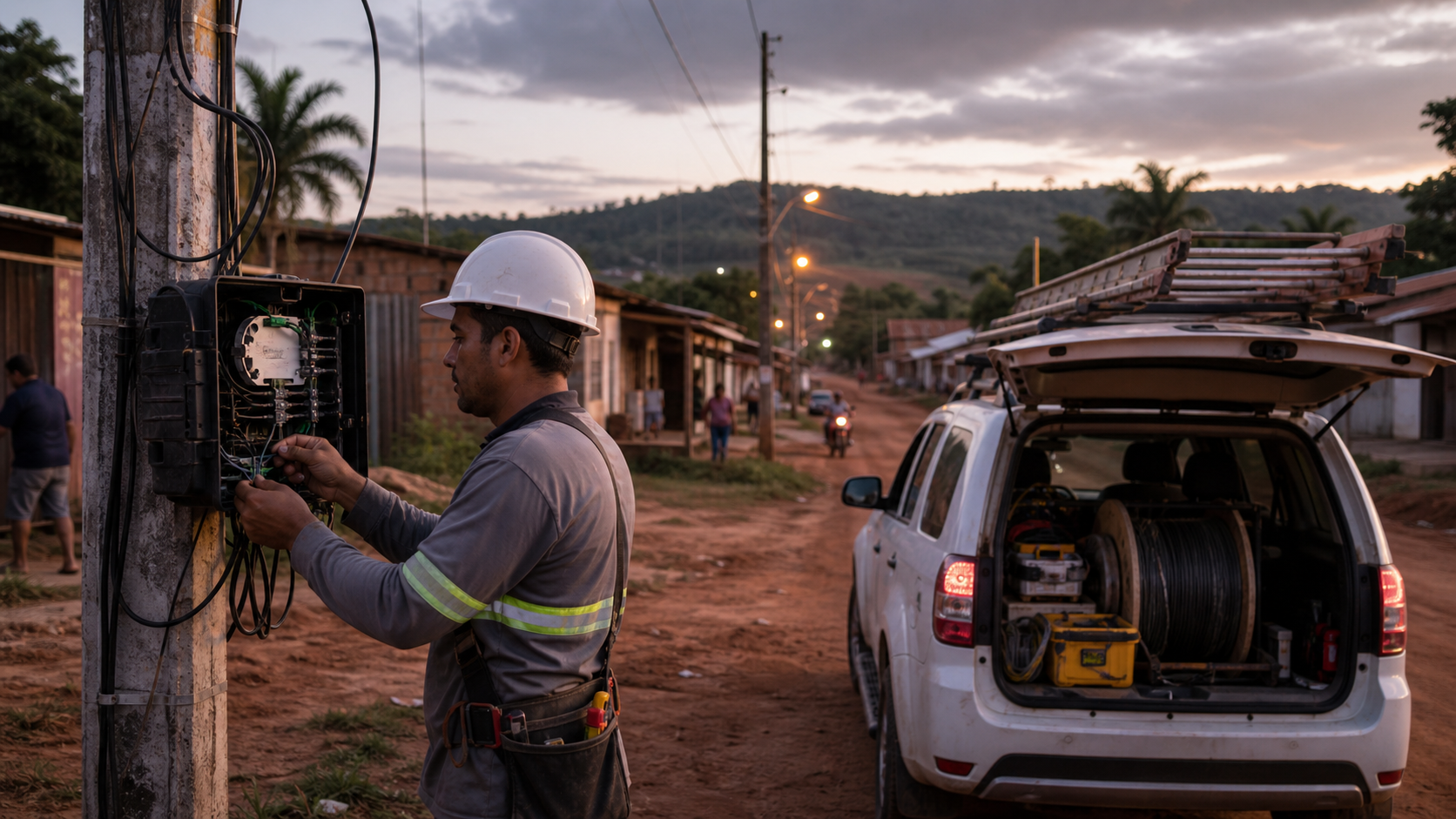
The judgement is deliberately narrow. Virtua Internet looks like a real micro-ISP, not a paper name. The value question is whether it owns enough local trust and density in Vila Sansao to overcome the lack of visible scale in the broader Parauapebas table. Passing a rural settlement with fibre is useful only if the provider can collect monthly revenue for long enough to repay the drop, optical equipment, router, installation labour, pole work, truck roll risk, billing friction and upstream share. Scale savings help a large operator buy cheaper equipment and negotiate better transit.
They do not remove the local cost of driving to a fault, replacing customer equipment, chasing late payments or persuading a household not to switch after a promotion from Claro, Vivo, UltraNet, Jupiter Internet, Fibralink or Starlink.
The public identity is real but has to be reconciled
The first issue is continuity of name. The customer-facing brand uses Virtua Internet. The domain is https://virtuainternet.net.br/. The public site says users can connect with Virtua, asks visitors to choose the locality "Parauapebas/PA - Vila Sansao", and lists contact channels including (94) 99172-7774, (94) 99662-5739 and comercial@virtuainternet.net.br at https://virtuainternet.net.br/ and https://virtuainternet.net.br/contato/. The same site footer carries CNPJ 31.845.566/0001-48. The plan page for Parauapebas/Vila Sansao carries the same CNPJ and directs signups through WhatsApp at https://virtuainternet.net.br/planos-parauapebas-pa-vila-sansao/.
Brazilian company-data pages use a slightly different public name. Econodata identifies the legal company as Wireless Provedor de Acesso As Redes de Comunicacao Ltda, with the trade name Virtu@net Provedor de Internet, CNPJ 31.845.566/0001-48, founded on October 24, 2018, headquartered on Rua A07 in Parauapebas, PA, CEP 68.515-000, with the main activity J-6110-8/03, services of multimedia communication, at https://www.econodata.com.br/consulta-empresa/31845566000148-wireless-provedor-de-acesso-as-redes-de-comunicacao-ltda. The same Econodata page says the company is active, small, has R$250,000 of share capital, and names Adiane da Silva Goncalves Mendes as administrator. CNPJ.biz and Serasa Experian corroborate the CNPJ, founding date, Parauapebas base and trade-name/legal-name relationship at https://cnpj.biz/31845566000148 and https://empresas.serasaexperian.com.br/consulta-gratis/WIRELESS-PROVEDOR-DE-ACESSO-AS-REDES-DE-COMUNICACAO-LTDA-EPP-31845566000148.
That reconciliation matters economically because the local brand, legal company and network-resource holder need to point to the same operating business. Here they mostly do. Registro.br RDAP for AS272500 names Wireless Prov de Acesso as Redes de Com Eireli as the registrant, uses public ID 31.845.566/0001-48, names Adiane da Silva Goncalves as legal representative, and links the autonomous system to 2804:8220::/32 at https://rdap.registro.br/autnum/272500. Registro.br's RDAP entity record for the same CNPJ carries the organization name and Adiane contact record at https://rdap.registro.br/entity/31845566000148. The legal suffix and spelling vary across sources, and some directories still show older or alternate wording, but the core trail is coherent enough: Virtua/Virtu@net is the customer brand, Wireless Provedor de Acesso as Redes de Comunicacao is the corporate holder, and AS272500 is the network-resource expression of that company.
The public site adds one more date. Its "Sobre" page says Virtua Internet began operating in 2021, with internet service as the main service, at https://virtuainternet.net.br/empresa/. That fits the network timeline better than the 2018 incorporation date. A company can be formed before it operates the current broadband service, and an ASN can arrive after early local access work. AS272500 was registered in July 2021 in Registro.br RDAP, while the site says operations started in 2021. For a reader trying to understand current economics, this means the important company is not an old inactive registration. It is a relatively young operating ISP with a pre-2021 legal shell and a 2021 network-resource footprint.
A narrow network record can still be commercially meaningful
The network record is not large. BGP.Tools describes AS272500 as Wireless Prov de Acesso as Redes de Com Eireli, registered on July 29, 2021, active under NIC.BR, website http://www.virtuainternet.net.br, and tagged "IPv6 only" at https://bgp.tools/as/272500. It shows zero originated IPv4 prefixes, one originated IPv6 prefix, 2804:8220::/32, 65,536 /48 IPv6 blocks in the address calculation, and one upstream: AS262462, Aranet Play. Hurricane Electric's BGP Toolkit gives a similar view: one originated prefix, zero IPv4, one IPv6, one observed IPv6 peer, and AS262462 Aranet Play as the peer at https://bgp.he.net/AS272500. IP2Location also reports no known IPv4 addresses for the ASN and lists the IPv6 range 2804:8220::/32 at https://www.ip2location.com/as272500.
This is not a backbone story. It is a last-mile story. An ISP can serve local customers without originating IPv4 under its own ASN if it uses upstream-assigned IPv4, carrier-grade NAT, reseller arrangements, or other addressing arrangements. But zero visible IPv4 origination has economic consequences. Residential users may not know or care which registry owns an address, yet troubleshooting, gaming, remote access, business VPNs, reputation management, abuse handling and upstream bargaining can all become harder when the provider's public routing surface is thin.
In a price-sensitive local access market, technical constraints do not need to break the service to affect margin. They only need to add support calls and limit the provider's ability to differentiate.
PeeringDB strengthens the micro-ISP reading. Its API record for ASN 272500 names "Virtua Internet", gives "Adiane da Silva Goncalves" as the long name, lists the website, classifies the network as Cable/DSL/ISP, shows zero IPv4 prefixes, one IPv6 prefix, IPv6 enabled, open general policy, no exchange count and no facility count at https://www.peeringdb.com/api/net?asn=272500. The record was created in November 2021 and updated in July 2022. That means Virtua has a public interconnection identity, but not a disclosed exchange or facility footprint. The absence of IX and facility rows does not prove weakness by itself; many small operators depend on a regional upstream and do not maintain a visible peering profile. It does show that the company's economics depend heavily on local access execution and upstream reliability rather than on a diversified wholesale network position.
The single observed upstream is therefore material. AS262462, Aranet Play, appears as Virtua's only observed upstream and peer in BGP.Tools and Hurricane Electric. Radar da Telecom's Parauapebas API separately shows ARANET SOLUCOES EM INTERNET with only 14 fixed-broadband accesses in the municipality in April 2026, at https://www.radardatelecom.com/api/v1/municipio/pa/parauapebas. That municipal access row is not evidence of a customer relationship between Aranet and Virtua. It is a reminder that the upstream name visible in BGP is also a regional market participant rather than a global transit platform. Virtua's retail service will be shaped by the quality, pricing, fault response and redundancy terms it can secure from that upstream path.
The technical upside is discipline. If Virtua can keep a small IPv6 allocation clean, manage customer-premises equipment well, operate NAT and IPv6 support predictably, and monitor upstream failure quickly, the narrow route table may be enough for a Vila Sansao customer base. The technical downside is bargaining power. A small access provider with one observed upstream and no visible exchange/facility footprint has less room to absorb a commercial repricing, routing problem, maintenance window or capacity bottleneck. Scale savings belong to the operators that can buy backhaul, transit and equipment on better terms.
Local costs remain with the installer who answers the WhatsApp call.
Parauapebas is not an empty buildout frontier
The local market is the main reason Virtua should not be evaluated as a simple growth story. Radar da Telecom's Parauapebas page reports 65,547 fixed-broadband accesses in April 2026, 95.71 percent fibre, a 2022 IBGE population of 267,836, 89,279 households, 73.4 accesses per 100 households, 51 operators with access rows, and an ARPU indicator of R$61 per month at https://www.radardatelecom.com/municipio/pa/parauapebas. The same page says Jupiter Internet Imperatriz led with 16,465 fixed-broadband accesses and 25.12 percent share, FIBRALINK had 16,120 and 24.59 percent, and Claro had 6,569 and 10.02 percent. The API exposes the longer table, including WKVE Telecom, Garra Telecom, Vivo, MABNET, Carajasnet, Apex Net, Starlink Brazil, Link One, UltraNet, Coelho Tecnologia, JM Telecom, Velocitynet, Norte Telecom and many smaller rows at https://www.radardatelecom.com/api/v1/municipio/pa/parauapebas.
Those numbers change the frame. In some rural markets the first fibre route creates the category. In Parauapebas, fibre is already the category. A provider serving Vila Sansao may still have a strong local reason to exist, especially if the settlement is distant enough from dense urban routes to make support and installation more personal. But it cannot rely on a general scarcity premium. The formal market already has large local access counts and high fibre penetration. The leaders have enough scale to shape customer expectations on speed, price, installation speed and service restoration.
A micro-ISP's advantage has to be sharper: local trust, faster field response, fewer missed appointments, better Wi-Fi setup, and an account relationship that survives the next rival offer.
The top of the table also creates consolidation pressure. Jupiter Internet Imperatriz and FIBRALINK together account for roughly half of Radar's formal fixed-broadband access count in Parauapebas. Claro adds national-brand presence and 10 percent share. Vivo is present. Starlink has more than 1,000 fixed-broadband access entries in Radar's April 2026 data, growing 6.12 percent month over month. Link One and JM Telecom show sharp monthly percentage gains from smaller bases. The implication for Virtua is not that every competitor reaches the same street in Vila Sansao.
The implication is that customers in the municipality see many credible alternatives and that larger providers can turn local acquisition into a scale exercise.
Minha Conexao's April 2026 Parauapebas ranking reinforces the same point from the speed side. It names UltraNet Telecom as the fastest residential internet in Parauapebas with an average 393.42 Mbps, followed by Jupiter Internet at 288.51 Mbps, the municipal government connection at 275.72 Mbps, Claro at 216.98 Mbps, Rede Sivnet at 210.45 Mbps, Wkev Telecom at 203.01 Mbps, Vivo at 201.72 Mbps and other providers below that at https://www.minhaconexao.com.br/ranking/pa/parauapebas. MelhorPlano's Parauapebas page says UltraNet stood out in 2025 for speed, satisfaction, stability and gaming, with a 362 Mbps speed claim, 4.99 out of 5 satisfaction score and 13 ms ping result, while also noting that Parauapebas averaged 343 Mbps, above the Para and Brazil averages shown on that page at https://melhorplano.net/internet-banda-larga/pa/parauapebas.
Virtua does not appear among the visible high-speed names on those ranking excerpts. That absence is not proof of poor service. It may reflect small sample size, a narrower Vila Sansao footprint, different naming, low test volume, or a customer base that does not use the ranking tools. But it is a commercially relevant absence. In a market where comparison sites create social proof around UltraNet, Jupiter, Claro, Vivo and others, Virtua's public claim has to be built from proximity and support rather than from citywide ranking visibility.
Small local ISPs can win without being in a top-ten speed table, but they need a reason customers can feel.
The plan surface suggests a local sales machine, not a national product set
Virtua's own site is useful because it exposes how the company wants to sell. The home page lists one locality, Parauapebas/PA - Vila Sansao, and highlights ultra speed, affordable plans and qualified support at https://virtuainternet.net.br/. The plans page asks visitors to select that same locality at https://virtuainternet.net.br/planos/. The specific Vila Sansao plan page presents three plan images with alt labels 20, 40 and 80, uses the line "Conheca a melhor internet da regiao", and routes the signup button to WhatsApp at https://virtuainternet.net.br/planos-parauapebas-pa-vila-sansao/. The public page does not expose a clean current price table in text. That is an evidence boundary and an economic clue.
For a national or larger regional operator, a weak public tariff page can be a minor website issue. For a micro-ISP, the website is part of the sales funnel, but not necessarily the whole funnel. Many Brazilian local providers sell through WhatsApp, neighbourhood referrals, technician relationships and direct conversations. That can reduce formal marketing cost and let the provider quote availability street by street. It can also make acquisition less scalable and harder to compare. Customers who want instant plan transparency may drift to price-comparison sites or larger operators.
Customers who want someone local to answer a message may prefer Virtua.
The plan labels also suggest that Virtua may be serving a different demand band from the high-speed comparison leaders. If the tiles represent 20, 40 and 80 Mbps offers, they are not competing directly with 600 Mbps and 750 Mbps city offers advertised by Claro, Vivo and Garra Fibra on Minha Conexao's cheap-plan section at https://www.minhaconexao.com.br/ranking/pa/parauapebas. If the labels mean something else, the public page does not make the distinction clear enough in text. Either way, the site presents a practical local access offer, not a premium-speed citywide challenge to UltraNet or Jupiter. That makes retention and cost control more important than headline speed leadership.
The support page is another piece of the business model. Virtua's contact page lists service hours Monday to Friday from 08:00 to 12:00 and 14:00 to 18:00, Saturday from 08:00 to 12:00, and Sunday and holidays for network monitoring only at https://virtuainternet.net.br/contato/. That is a credible small-operator pattern. It is not a 24/7 national call centre. It may be sufficient for residential customers if the network is stable and fault handling is fast when needed. It may be limiting for businesses that need guaranteed restoration, after-hours support or formal service-level terms. The economics depend on matching the customer promise to the field capacity.
This is where the difference between scale savings and local costs becomes clear. A larger operator can spread monitoring systems, support platforms, billing tools, spare inventory and call-centre staff over many customers. Virtua can perhaps avoid some of that overhead by staying local, but it cannot avoid the physical cost of each field visit. If a Vila Sansao customer needs an installation, the provider still needs a technician, cable, connectors, CPE, transport and time. If the customer churns after a few months, the installation subsidy becomes a loss.
If the customer stays for years and pays reliably, the same installation becomes profitable infrastructure.
Passing a home is cheaper than keeping the account
The easy fibre-build era often rewards visible coverage. The harder era rewards payback discipline. A provider can pass a street and still lose money if take-up is low, installation is slow, CPE is wasted, support calls are frequent, pole access is contested, or the customer leaves before acquisition cost is recovered. Virtua's public record does not disclose subscriber count, churn, ARPU, gross margin, route kilometres or CPE cost. That means the analysis has to start from the cost structure common to a micro-ISP in a crowded local market.
The first cost is installation. Even a low-speed residential connection requires a customer visit, a drop from the access network, termination, optical equipment or wireless equipment depending on the last segment, a router or Wi-Fi device, testing, account setup and billing activation. The second cost is maintenance. Rural or peri-urban routes face weather, power instability, pole changes, vegetation, road access, customer-side Wi-Fi problems and occasional damage. The third cost is customer service. A household may call about speed that is really Wi-Fi interference, a device issue, a payment delay or a streaming platform problem.
Each call consumes margin even when the access network is not at fault.
The fourth cost is upstream. Virtua's observed public routing depends on Aranet Play. Without public terms, no one can say whether the upstream bill is cheap, expensive, bundled with transport, capacity-based, volume-based or part of a broader local arrangement. What can be said is that a provider with one visible upstream path has limited public evidence of redundancy. If capacity is constrained, the customer experiences congestion. If the upstream path fails, the customer blames Virtua. If the upstream price rises, Virtua has to absorb the cost, raise prices or reduce margin.
That is the supplier dependency hidden behind a simple plan tile.
The fifth cost is churn. Parauapebas customers have many alternatives. Radar's formal count includes 51 fixed-broadband rows and 95.71 percent fibre. Minha Conexao and MelhorPlano put several providers in front of customers with named speed, price and award signals. Starlink is visible in the municipal access table and has a different value proposition for farms, rural sites and customers who do not trust local fixed networks. When alternatives are abundant, a local provider has to be good enough every month, not just on installation day. A no-friction customer relationship is valuable only if it produces voluntary loyalty.
Virtua's best possible answer is density. If the company serves a compact pocket of Vila Sansao where customers know the provider, technicians are nearby, routes are short and word-of-mouth acquisition is cheap, the small scale can be rational. A dense pocket lets one support visit fix multiple issues, lets installation teams reuse route knowledge, reduces travel time and keeps the company close to payment and service problems. If customers are scattered across difficult roads or low-density branches, the same number of accounts becomes much less attractive. The public site proves the locality. It does not prove the density.
The payback arithmetic is unforgiving because the monthly revenue ceiling is low. Radar's Parauapebas page shows an ARPU indicator of R$61 per month for fixed broadband at https://www.radardatelecom.com/municipio/pa/parauapebas. That is a city-level indicator, not Virtua's tariff. It still gives the right order of magnitude for competitive pressure. At that level, a single installation that requires extra travel, a long drop, a second visit, a replaced router and several support calls can consume many months of gross revenue before upstream, taxes, payment processing and staff time are even considered. A local provider can survive that if most customers are easy to install and stay for years. It cannot survive that pattern if every new account behaves like an expensive exception.
The field-cost problem is especially sharp in a locality marketed through WhatsApp rather than through an automated national sales funnel. A direct chat can qualify the address, confirm availability and build trust. It can also hide friction. If a salesperson promises service before checking route capacity, the installer inherits the cost. If the customer needs a better Wi-Fi layout, the technician becomes the margin shock absorber. If payment reminders, speed complaints and home-router support all arrive through the same channel, the apparent low-cost sales model becomes a support queue.
Virtua's local model is therefore only cheap if it is disciplined. The public website shows the sales path; it does not show the back-office controls.
This is why the first month of revenue is less important than the twelfth. A customer who pays installation, accepts a modest plan and remains for several years can be a good account even if the monthly fee is not high. A customer won by a low entry price who leaves after a competitor promotion can destroy value even if the initial order looked like growth. In a 95.71 percent fibre market with 51 formal access rows, the scarce asset is not just coverage. It is customer patience.
Virtua's economic task is to make the local account feel less risky than switching, while keeping each account cheap enough to serve that loyalty actually turns into margin.
The customer base is tied to a mining-region economy
Parauapebas is not an ordinary small town. It is a large municipality in southeastern Para, closely associated with the Carajas mining economy. Radar's page uses the 2022 population figure of 267,836 and 89,279 households at https://www.radardatelecom.com/municipio/pa/parauapebas, and IBGE's city page confirms the 2022 population at https://www.ibge.gov.br/cidades-e-estados/pa/parauapebas.html. Vale announced in February 2025 a R$70 billion New Carajas Program in Para by 2030, including maintaining iron ore production volumes and expanding copper output, with the announcement tied to operations in Parauapebas at https://www.vale.com/at-a-ceremony-with-president-lula-vale-announces-70-billion-reais-in-investments-in-the-nova-carajas-program-in-para-by-2030.
That industrial context matters for broadband demand even when Virtua is not selling to Vale or large contractors. Mining regions generate commuting households, service businesses, lodging, construction crews, rural settlements, public services, security activity and local commerce. Reliable internet becomes part of household income, school coordination, banking, Pix, WhatsApp commerce, health appointments and transport logistics. Vila Sansao is public enough to appear in municipal-service coverage: the Parauapebas city government reported more than 700 services delivered to the community in October 2021, including documents, consultations and vaccination, at https://parauapebas.pa.gov.br/seguranca-e-defesa-do-cidadao/vila-sancao-e-contemplada-com-servicos-do-governo-municipal/.
The opportunity is that a local provider in such a settlement can become a practical utility. Customers may value a nearby installer more than a national call centre. Small shops may care more about card-machine continuity and WhatsApp support than about the largest advertised download number. Families may choose the provider that answers the phone and reaches the house. The risk is that the same customers are price-aware and reliability-sensitive. If a rival reaches Vila Sansao with higher headline speed, a cheaper promotion or stronger after-hours service, the local brand has to defend the account with trust, not nostalgia.
Public-sector and business demand could improve the economics, but the reviewed public evidence does not prove a strong business-customer mix for Virtua. The site is residential in tone. The plan page says to sign one of the plans and uses consumer-style WhatsApp calls to action. The contact page has ordinary office hours. There is no visible dedicated-business page, enterprise SLA table, public contract list or institutional customer case study on the reviewed pages. That does not mean such accounts do not exist. It means the article should not assign Virtua a business-revenue cushion without evidence.
Competition defines the revenue ceiling before Virtua sets a price
Virtua's own current prices are not visible in text on the reviewed plan page. The competitive price environment is visible. Minha Conexao's Parauapebas page lists cheap local offers including Claro Fibra 600 Mega at R$69.90 and Vivo Fibra 600 Mega at R$100.00, while also showing a Garra Fibra 750 Mega promotional line that appears unusually low and should be treated as a promotion rather than a stable market price at https://www.minhaconexao.com.br/ranking/pa/parauapebas. Radar's Parauapebas page gives an ARPU indicator of R$61 per month for fixed broadband at https://www.radardatelecom.com/municipio/pa/parauapebas. Those numbers set the customer's outside option.
If Virtua sells lower-speed plans at low prices, the company must keep installation and support cost extremely tight. If it sells at a premium for local service, it must prove the premium in response time and reliability. If it tries to match large-provider speed claims, it needs upstream capacity, access electronics and CPE quality that may not be economical for a small base. None of these strategies is impossible. The mistake would be to confuse availability with profitability. A 20, 40 or 80 tier can be profitable if the local account stays, pays and rarely needs a second visit.
A 600 Mbps plan can be unprofitable if it requires expensive backhaul, heavy usage and frequent support under a low promotional price.
Starlink is a special competitor because it changes bargaining power at the rural edge. Radar shows Starlink Brazil with 1,023 fixed-broadband accesses in Parauapebas in April 2026 and month-over-month growth of 59 accesses, or 6.12 percent, at https://www.radardatelecom.com/api/v1/municipio/pa/parauapebas. Starlink is unlikely to be cheaper than a basic local fixed plan for most households, but it can be attractive to customers outside reliable fibre coverage, to farms, to businesses that need backup, or to households frustrated by local outages. For Virtua, Starlink does not need to win the whole market. It only needs to make the customer feel that leaving a weak fixed provider is possible.
Claro and Vivo matter differently. They bring brand recognition, bundled mobile relationships, sales infrastructure and comparison-site visibility. Jupiter and FIBRALINK matter because they already hold large formal access counts. UltraNet matters because speed and award pages give it consumer proof. Local providers such as WKVE, Garra, MABNET, Carajasnet, Apex Net, Link One, JM Telecom and many smaller rows matter because they create street-level competition and acquisition noise. In such a market, Virtua's price cannot be set only by its own cost. It is capped by what customers believe they can get elsewhere.
The national cycle reinforces that pressure. TeleSintese's January 2026 analysis of Brazilian fixed broadband says the market added about 2.02 million fixed-broadband accesses in the first ten months of 2025, while fibre added about 2.49 million net additions, but it also argues that the easy differentiators of the 2020-2025 boom are fading as large operators migrate legacy bases to fibre, converged fixed-mobile sales become more powerful, and growth becomes more selective at https://telesintese.com.br/banda-larga-fixa-2025-deixou-sinais-claros-do-que-esperar-do-mercado-em-2026/. For a small provider, that means the next phase is less forgiving. It rewards retention, not just construction.
Informal signals are useful, but not the same as verified scale
The informal signals around Virtua point to a hands-on local provider. The public Instagram search result for @virtuanetoficial associates Virtua Internet with Parauapebas, PA and uses a WhatsApp-led sales invitation, at https://www.instagram.com/virtuanetoficial/. The official website routes sales and contact to WhatsApp and ordinary phone numbers. The support-hour page names concrete office hours and network monitoring on Sundays and holidays. The public plan page chooses one locality rather than a long list of cities. These are not audited service-quality facts. They are market signals about how the provider likely acquires and supports customers.
Those signals fit a micro-ISP playbook. A small provider can convert local trust into lower customer-acquisition cost. It can install where a large operator has not prioritised a rural or peri-urban pocket. It can answer problems through a person rather than a ticket queue. It can know which road, pole, transformer or household cluster is causing trouble. These advantages are real when the provider is operationally disciplined. They disappear quickly when the provider misses appointments, lets WhatsApp queues pile up, or sends the same technician back repeatedly for avoidable in-home Wi-Fi problems.
The same informal signals also expose risk. A company whose public site does not show a current text price table depends on direct response. If the WhatsApp team is quick, that can be effective. If it is slow, the site leaks demand to competitors. A company with finite office hours can manage cost, but customers may compare it with providers promising broader support. A company with no visible citywide speed ranking may be locally reliable, but it has less public proof. In a crowded market, public proof lowers acquisition cost. Virtua has to substitute local reputation for that proof.
The broader Brazilian data boundary also deserves attention. ISP Solution, summarizing Radar da Telecom's June 2026 estimate, says about 5.77 million fixed-broadband accesses may be outside official Anatel records, with the North region showing an estimated 26.9 percent subnotification level at https://ispsolution.com.br/577-milhoes-de-acessos-invisiveis-o-que-o-mercado-informal-de-banda-larga-revela-sobre-o-futuro-do-provedor/. That does not prove Virtua has hidden access counts. It warns against over-reading formal tables as complete truth in northern Brazil. Virtua may be below visible thresholds, counted under a different naming convention, absent from the formal municipal access table, or smaller than its website presence suggests. The evidence supports caution, not speculation.
Regulation and operating hygiene are part of margin
Virtua's main legal activity is multimedia communication service, according to Econodata's CNAE description at https://www.econodata.com.br/consulta-empresa/31845566000148-wireless-provedor-de-acesso-as-redes-de-comunicacao-ltda. That is not just a label. In Brazil, small ISPs face regulatory, tax, municipal, pole-sharing, consumer-protection and numbering-resource obligations that become more demanding as the business grows. Compliance does not generate revenue on its own, but non-compliance can turn into fines, service restrictions, lost wholesale terms or failed enterprise sales. For a micro-ISP with limited capital, boring regulatory work is part of the cost base.
Route hygiene is also part of credibility. Hurricane Electric reports zero RPKI-originated valid routes for AS272500 at https://bgp.he.net/AS272500. Many small networks have incomplete RPKI, and the absence of visible valid origin status does not mean customers lose service. It does mean there is a low-cost improvement available. Clean route-origin validation, current PeeringDB contacts, accurate RDAP contacts and clear abuse handling help a small network look more professional to upstreams and technically literate customers. When the public route profile is already narrow, each hygiene signal matters more.
The IPv6-only public route profile is an opportunity and a constraint. It can be a sign of modern addressing discipline if customers receive working IPv6 and the provider manages transition mechanisms well. It can also hide practical dependence on upstream IPv4 or NAT arrangements if the service still has to support ordinary residential applications. The public record does not show customer experience. It shows that the company's own visible number resources are IPv6.
That should push Virtua toward careful support scripts, router configuration discipline and clear escalation paths, because customers will not diagnose address-family issues for the provider.
There is also a disclosure issue. PeeringDB lists an open general policy but no exchange or facility count, while BGP.Tools and Hurricane Electric both show the Aranet Play path as the public interconnection surface at https://www.peeringdb.com/api/net?asn=272500 and https://bgp.tools/as/272500. A small ISP does not have to publish every transport arrangement to be credible, but buyers with higher uptime needs look for signs of redundancy. The less Virtua says publicly about routes, capacity and escalation, the more the sales conversation has to rely on personal trust. That can work in a settlement where people know the technician. It is harder when a shop owner is comparing backup options, payment-terminal continuity and the cost of one lost business day.
The local physical layer is less visible but more expensive. Pole attachment, route maintenance, splicing, power, CPE inventory, weather damage and technician scheduling drive the economics of Vila Sansao service. Those are not solved by an ASN. They are solved by route planning, spare parts, reliable staff, good installation standards and customer education. This is why small ISPs can be profitable with limited public route evidence and also why they can fail despite real technical legitimacy. The unit economics are decided on the road and in the home, not only in the registry.
The facts that would change the judgement
Several facts would improve the investment-style judgement. First, a current text price table showing plan speeds, monthly fees, installation fees, equipment policy and contract terms would clarify whether Virtua competes on budget access, local service or premium reliability. Second, public evidence of active customers in Vila Sansao, preferably from Anatel/Radar naming continuity or a credible municipal table, would show whether the customer base is material or only a narrow pocket. Third, visible business or public-sector contracts would improve the revenue-mix case.
Fourth, RPKI validation and a more complete interconnection profile would reduce technical-control concerns. Fifth, customer-review evidence about restoration speed and billing fairness would turn local-service claims into measurable trust.
Several facts would weaken the judgement. If Virtua's active customer base is very small, the installation and support burden may not justify the network identity. If the company depends on one upstream without a practical backup, outages or repricing could quickly hit service quality and margin. If the 20/40/80 plan labels are the current residential speed ceiling, and if rivals can reach the same households with 300-600 Mbps offers at comparable prices, Virtua will need a very strong local-service advantage. If WhatsApp sales and support are slow, the company's low-overhead model becomes a demand leak.
If formal access counts remain absent while the broader Parauapebas fibre market keeps consolidating around larger names, the provider may be defending a legacy pocket rather than building a durable franchise.
The base case is not that Virtua disappears. The base case is that it remains a real, narrow local provider whose value is concentrated in a specific place and in the quality of its field operations. The company has legal identity, a public website, contact routes, a named locality, an ASN, an IPv6 allocation and public interconnection records. Those are enough to justify tracking it as an operator. They are not enough to justify a scale story. The next proof has to come from customers, density, retention and cleaner technical disclosure.
The upside case is focused and practical. Virtua could own a Vila Sansao pocket by making the service easy to buy, easy to pay for, fast to repair and honest about speeds. It could use WhatsApp as an advantage rather than a bottleneck. It could make plan economics transparent, keep installation standards high, reduce repeat visits, validate routes, maintain spare CPE, and turn local knowledge into low churn. In that scenario, scale savings are less important because the provider's costs are controlled locally. A dense, trusted micro-ISP can be more profitable than its public route table suggests.
The downside case is also practical. The company keeps a website and an ASN, but larger providers absorb most new demand, comparison sites shape customer expectations around faster plans, Starlink takes rural-edge customers who want autonomy, and the local support load rises. The route profile stays narrow, price transparency stays weak, and new customers require too much field work for the monthly fee. In that scenario, the brand can remain alive while the economic reason to invest fades. The business becomes a maintenance book rather than a growth platform.
Virtua Internet therefore matters as a small test of post-boom Brazilian access economics. The first phase of fibre rewarded providers that reached places others ignored. The next phase asks whether those providers can keep accounts after the easy build is over. In Parauapebas, the formal market is already fibre-heavy and crowded. In Vila Sansao, a small provider may still be the right answer for a household or shop that values proximity. The commercial question is whether enough of those households and shops stay long enough to repay the physical cost of being local.
Evidence register
- https://virtuainternet.net.br/ supports the public brand, one visible locality, contact details, customer-facing value claims and CNPJ footer.
- https://virtuainternet.net.br/planos-parauapebas-pa-vila-sansao/ supports the Vila Sansao service page, WhatsApp-led signup, plan tiles labelled 20, 40 and 80, contact channels and CNPJ footer.
- https://virtuainternet.net.br/empresa/ supports the statement that Virtua says it began operating in 2021 and presents internet service as the main service.
- https://virtuainternet.net.br/contato/ supports the contact numbers, email and support-hour schedule.
- https://www.econodata.com.br/consulta-empresa/31845566000148-wireless-provedor-de-acesso-as-redes-de-comunicacao-ltda supports the legal name, trade name, CNPJ, founding date, address, CNAE, active status, small-company profile, R$250,000 capital and administrator name.
- https://cnpj.biz/31845566000148 and https://empresas.serasaexperian.com.br/consulta-gratis/WIRELESS-PROVEDOR-DE-ACESSO-AS-REDES-DE-COMUNICACAO-LTDA-EPP-31845566000148 corroborate the CNPJ, founding date, Parauapebas base and trade-name relationship.
- https://rdap.registro.br/autnum/272500 supports AS272500, the direct allocation, registrant CNPJ, legal representative, administrative contact and link to 2804:8220::/32.
- https://rdap.registro.br/ip/2804:8220::/32 supports the IPv6 allocation, registrant CNPJ, allocation status, Brazil country code and technical/abuse contact.
- https://rdap.registro.br/entity/31845566000148 supports the CNPJ entity record and organization name in Registro.br.
- https://bgp.tools/as/272500 supports the AS272500 route profile, zero IPv4, one IPv6 prefix, 2804:8220::/32, one upstream/peer and Aranet Play visibility.
- https://bgp.he.net/AS272500 supports the Hurricane Electric view of one IPv6 prefix, zero IPv4, one observed IPv6 peer, Aranet Play and no visible RPKI-originated valid route.
- https://www.ip2location.com/as272500 supports the zero IPv4 and IPv6-range public-network view, with a caution that databases differ on domain/upstream display.
- https://www.peeringdb.com/api/net?asn=272500 supports the PeeringDB profile: Virtua Internet, AS272500, Cable/DSL/ISP, zero IPv4 prefixes, one IPv6 prefix, IPv6 enabled, open policy and no visible IX/facility count.
- https://www.radardatelecom.com/municipio/pa/parauapebas and https://www.radardatelecom.com/api/v1/municipio/pa/parauapebas support the April 2026 Parauapebas market totals, fibre share, household/population context, operator count, top providers, ARPU indicator and long provider table.
- https://www.minhaconexao.com.br/ranking/pa/parauapebas supports the April 2026 speed-ranking and competitor price signals.
- https://melhorplano.net/internet-banda-larga/pa/parauapebas supports the 2025 award and quality context for UltraNet, city average speed and comparison-site consumer signals.
- https://telesintese.com.br/banda-larga-fixa-2025-deixou-sinais-claros-do-que-esperar-do-mercado-em-2026/ supports the national fixed-broadband cycle context and consolidation-pressure reading.
- https://ispsolution.com.br/577-milhoes-de-acessos-invisiveis-o-que-o-mercado-informal-de-banda-larga-revela-sobre-o-futuro-do-provedor/ supports the market-data boundary around underreported fixed-broadband accesses in Brazil, especially the North region.
- https://www.ibge.gov.br/cidades-e-estados/pa/parauapebas.html and https://www.vale.com/at-a-ceremony-with-president-lula-vale-announces-70-billion-reais-in-investments-in-the-nova-carajas-program-in-para-by-2030 support Parauapebas population and Carajas-region economic context.
- https://parauapebas.pa.gov.br/seguranca-e-defesa-do-cidadao/vila-sancao-e-contemplada-com-servicos-do-governo-municipal/ supports Vila Sansao's public local-service context.