
Summary
- What it says: Vianet Internet Solutions is investable only if its legal identity, AS5690 control, Ontario service footprint and customer billing surface continue to point to the same operating company.
- Main topic: Regional ISP economics; Operator consolidation
- Context: Regional ISP
The Customer Is Locked In By The Install
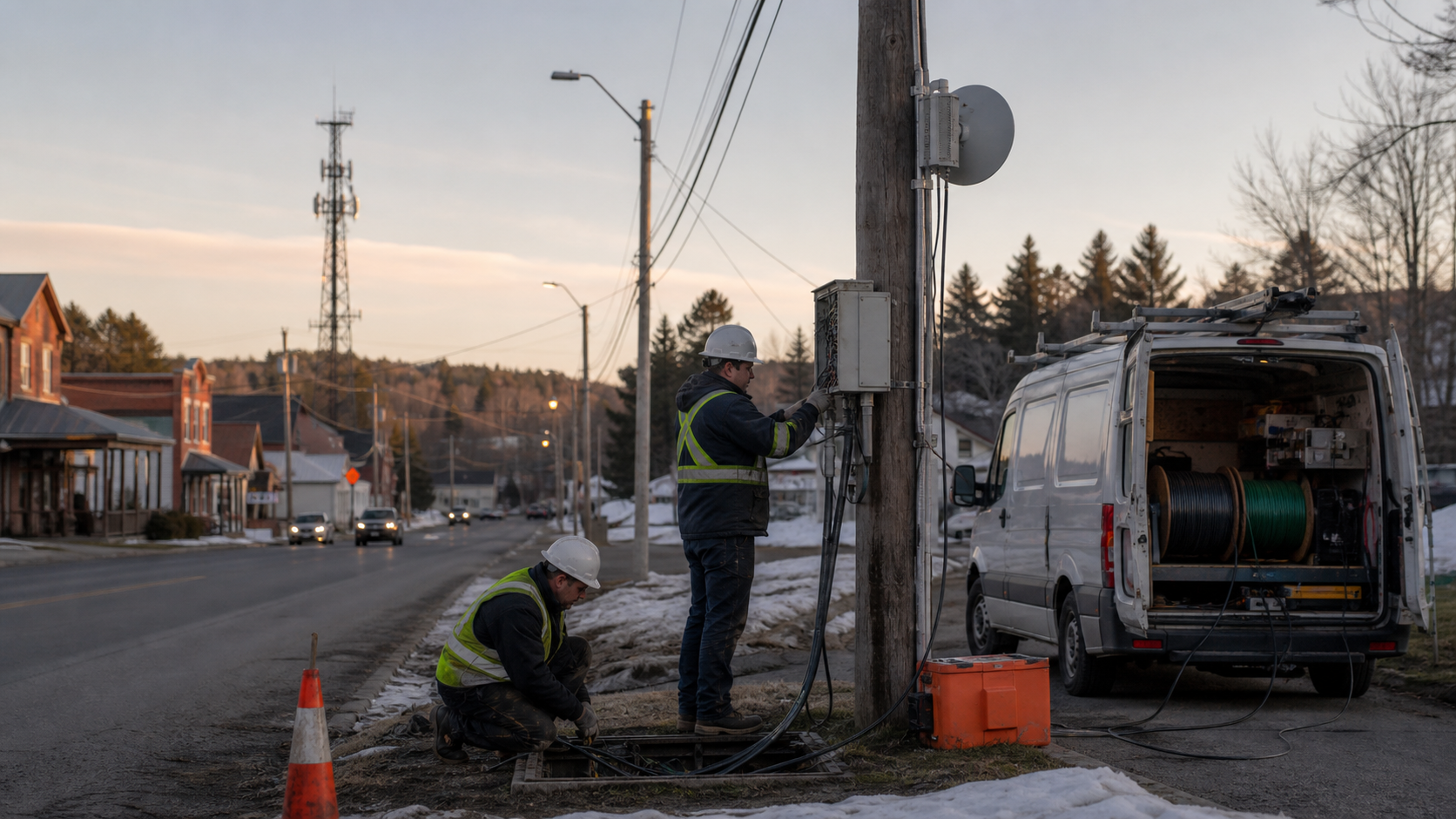
Vianet Internet Solutions should be judged from the customer's driveway, not from the scale implied by its name. A household in Copper Cliff, a business in Sudbury, a cottage owner near Parry Sound or a farm on the edge of fibre coverage does not buy "global" connectivity in the abstract. It buys a drop, a router, a technician visit, a monthly bill, a support number and a promise that the service will still work when the weather is bad and the family needs to work, stream, call or take payments. That is where the economic test starts.
The operator wins if the customer stays long enough for the installation cost, network share, support burden and future fault risk to be repaid. It loses if a cheaper national offer, a better fibre footprint or a bad service visit turns that installation into an unrecovered cost.
The public evidence resolves the company as an Ontario access provider rather than a vague global network label. PeeringDB lists Vianet Internet Solutions on AS5690 with the website www.vianet.ca, a Cable/DSL/ISP network type, regional scope, 50-100 Gbps traffic, 175 IPv4 prefixes, 10 IPv6 prefixes and an open peering policy at TorIX (https://www.peeringdb.com/net/8364). IPinfo identifies AS5690 as Vianet Inc., country Canada, ASN type ISP, 109,312 IPv4 addresses and an allocation date of August 24, 1995 (https://ipinfo.io/AS5690). Hurricane Electric's BGP Toolkit also points AS5690 to Vianet Inc., Canada, the same website, one exchange, 81 originated prefixes and 28 observed BGP peers (https://bgp.he.net/AS5690). Those records matter because they tie the customer-facing brand to real network resources.
The business surface ties the same network to ordinary telecom revenue. Vianet's homepage sells internet, telephone, television and business solutions, and describes the company as an alternative to large telecom companies with local support and community presence (https://www.vianet.ca/). Its residential internet page offers fibre, cable, DSL and wireless service categories (https://www.vianet.ca/residential/internet/). Its fixed-wireless page says the service connects customers to a wide network of towers for underserved areas across Ontario and highlights rural terrain, Georgian Bay shorelines and Central Ontario farmland as target geographies (https://www.vianet.ca/residential/internet/wireless-internet/). Its business page says Vianet's own networks power fibre up to 10 Gbps-plus, fixed wireless up to 1 Gbps-plus where available, private network products and custom business networking (https://www.vianet.ca/business/).
That combination creates a very specific economic judgement. Vianet is not a commodity reseller if the customer is on Vianet-built fibre, fixed wireless, acquired tower infrastructure or business network service. It is also not insulated from commodity pressure, because the same public site acknowledges third-party last-mile relationships when its network does not reach the customer (https://www.vianet.ca/business/). The value lies in deciding where Vianet owns enough infrastructure, support density and local trust to earn recurring revenue above the cost of keeping scattered Ontario customers connected. The risk is that the company carries the cost structure of a facilities-based local operator while the customer's comparison set increasingly includes Bell fibre, Eastlink cable, Starlink satellite, NetSpectrum legacy service, Sunwire history, partner-carrier options and other local substitutes.
A Global-Sounding Name With An Ontario Address
The first task is identity reconciliation. "Vianet Internet Solutions" sounds broad, and the BTW directory entry marks the company under a global regional-ISP category, but the public record points to Vianet Inc. in Ontario. OECM lists Vianet Inc. at 128 Larch Street, Suite 202, Sudbury, Ontario P3E 5J8, and describes it as an independently owned and operated ISP providing fibre and fixed-wireless services across its own network to thousands of residential and business customers in Ontario (https://oecm.ca/supplier-partners/vianet-inc/). The same OECM page says Vianet is registered as a CLEC and BDU, provides telephone and television services to the same customer base, and sells wholesale services to customers ranging from small integrators to large national carriers.
The company's own privacy policy gives the legal name behind the consumer surface. It says Vianet Inc., referenced as Vianet, provides telecommunications services including internet access, television and local and long-distance services in Canada (https://www.vianet.ca/legal/privacy-policy/). The contact page lists a public sales and support phone number, office locations in Chapleau, Fort Frances, Huntsville, Marathon, Midland, North Bay, Parry Sound, Pembroke, Sault Ste. Marie, Schomberg, Sudbury and Timmins, plus hardware depots in towns including Bracebridge, Elliot Lake, Kapuskasing, Mattawa, Nestor Falls, Parry Sound, Sturgeon Falls and Terrace Bay (https://www.vianet.ca/contact/). That is not the footprint of a borderless internet abstraction. It is an Ontario access network built around offices, depots and field work.
The company history is consistent with that reading. Vianet says it became an ISP in Timmins in February 1995 and expanded to Sudbury in March 1995, after forming in 1988 as a computer and networking dealer (https://www.vianet.ca/about/company/). The same timeline says it added telephone service by becoming a Competitive Local Exchange Carrier in Sudbury in 2001, purchased Muskoka.com in 2008, began building fibre in Sudbury business areas in 2008, built its first fibre-to-the-home network in Chapleau in 2011, turned up first FTTH service in Chapleau and Sudbury in 2012, and bought Zing-Net in 2013 to expand wireless coverage north of the Greater Toronto Area (https://www.vianet.ca/about/company/). A 2013 Northern Ontario Business report independently described the Zing purchase as giving Vianet more than 100 antenna sites and 7,500 square kilometres of south-central Ontario wireless coverage, with Vianet planning $4 million of fibre and wireless upgrades in that territory (https://www.northernontariobusiness.com/regional-news/sudbury/vianet-purchases-southern-ontario-internet-provider-369635).
That history is economically important because it shows Vianet has grown through both organic network build and customer-base acquisition. A small or regional ISP can create value if it keeps acquired accounts, upgrades weak access loops and spreads support operations over a larger but still coherent territory. It can also destroy value if acquisitions add service promises, old equipment, rural fault surfaces and customer expectations faster than the operator can standardize them.
Vianet's identity is therefore strong enough to trust the basic operating perimeter, but the operating perimeter is complex enough that counterparties should not read AS5690 as a simple map of revenue quality.
The Network Record Is Real
The network evidence supports the conclusion that Vianet is an operating network, not just a retail brand. PeeringDB's AS5690 profile records a regional Cable/DSL/ISP network with 50-100 Gbps of traffic, mostly inbound traffic, 175 IPv4 prefixes, 10 IPv6 prefixes, TorIX participation and an open peering policy (https://www.peeringdb.com/net/8364). The PeeringDB API shows the TorIX connection as operational, with 100G speed, IPv4 address 206.108.34.15, IPv6 address 2001:504:1a::34:15 and route-server participation (https://www.peeringdb.com/api/net/8364). The public TorIX PeeringDB page separately shows Vianet Internet Solutions, AS5690, with a 100G entry at the exchange (https://www.peeringdb.com/ix/24).
Hurricane Electric's BGP view provides another control surface. It lists AS5690 with one internet exchange, 81 originated prefixes, 101 announced prefixes, 109,312 originated IPv4 addresses and observed peers including Cogent, Zayo, Hurricane Electric, Toronto Internet Exchange Community, GoCodeIT, FiberSpeed, Netspectrum, Videotron, TekSavvy and other networks (https://bgp.he.net/AS5690). The same page shows announced Vianet ranges including 66.159.112.0/20, 66.185.192.0/19, 66.186.64.0/19, 66.225.160.0/19, 68.235.176.0/20, 142.51.192.0/18, 173.0.208.0/20 and 209.91.128.0/18. IPinfo's AS5690 page independently reports 109,312 IPv4 addresses, the vianet.ca domain, ARIN registry status and 2,072 hosted domains (https://ipinfo.io/AS5690).
The routing record should be used carefully. BGP tables do not reveal churn, gross margin, customer service quality, network congestion, tower lease terms or the exact portion of addresses used by retail broadband customers. They also mix old acquisitions, downstream relationships, legacy allocations, hosted domains and business customers. Still, the record reduces one major risk in the assignment brief: the name "Vianet Internet Solutions" is not merely a generic phrase. It is associated with AS5690, a long-running Canadian ISP network, TorIX interconnection and a customer-facing domain used by Vianet Inc.
The network evidence also reveals dependency. Vianet is not vertically integrated from the customer's device to every destination on the internet. It uses upstream and peer relationships, regional exchange connectivity, business partnerships and partner-carrier last-mile service where its own network does not reach (https://www.vianet.ca/business/). That is normal for an ISP. The economic issue is whether Vianet controls enough of the layers that matter to the customer. In its own fibre and fixed-wireless areas, Vianet can control installation, support, CPE choice, local backhaul design, tower upgrades and business account handling. In third-party cable, DSL or partner-delivered locations, the customer may still buy from Vianet, but the margin and service control are likely thinner.
This distinction explains why the company emphasizes local support. A customer rarely cares whether a TorIX port is open, but the exchange evidence matters indirectly: it shows Vianet is not simply mailing bills while someone else operates the whole network. At the same time, the customer's actual switching decision is shaped by the last mile. If a Bell fibre representative offers a faster plan on the same street, if Eastlink has coax that is already installed, or if Starlink can serve a rural property outside fibre reach, the customer compares lived access quality, not just AS numbers.
Vianet's route record is a necessary proof of operating substance. It is not sufficient proof of durable pricing power.
Revenue Comes From Bundles And Visits
Vianet's public product structure points to a mixed revenue model: residential broadband, business broadband, voice, television, hosted phone, private networks, managed Wi-Fi, custom networks, domains, hosting and wholesale arrangements. The residential internet page separates fibre, cable, DSL and wireless service (https://www.vianet.ca/residential/internet/). The fibre page says fibre internet has unlimited data, a $75 one-time order processing fee, optional phone add-on at $12.50 per month and optional Wi-Fi router rental at $9.95 per month, while warning that taxes and extra fees may apply and that speeds are estimates (https://www.vianet.ca/residential/internet/fibre-internet/). The billing policy says service agreements generally become month-to-month at the current market price after term expiry, and that customers can face remaining monthly charges, installation or one-time charges and equipment-return obligations if they cancel early (https://www.vianet.ca/legal/billing-policy/).
Those details show the revenue mechanics. A fibre broadband customer is not just a monthly speed plan. The company can earn recurring access revenue, router rental, telephone add-ons, television revenue and installation or processing charges. It also carries customer-equipment risk and cancellation risk. The billing policy says a customer who does not provide reasonable access for Vianet-owned hardware pickup or does not return that property may be charged replacement value (https://www.vianet.ca/legal/billing-policy/). That is not a footnote. In a regional ISP, router inventory, truck rolls and returned equipment affect cash economics.
Business customers can be more valuable because they buy around continuity and service dependency rather than entertainment speed alone. Vianet's business page says business fibre can reach up to 10 Gbps-plus, can be built and operated by Vianet, can support small-business or enterprise bandwidth, can be asymmetrical or symmetrical, and can include static IPs, VLANs and service-level agreements (https://www.vianet.ca/business/). The same page says business fixed wireless can reach up to 1 Gbps-plus where available, is backed by a fibre backbone and can include static IPs and VLANs (https://www.vianet.ca/business/). It markets private network, custom network, managed Wi-Fi and wholesale television offerings. Business telephone pages list business phone service from $25 per month, hosted PBX from $100 per month, remote call forwarding from $22.95 per month and ViaFAX from $9.95 per month (https://www.vianet.ca/business/telephone/).
The business case examples on Vianet's site are economically revealing. The business page describes Holland Marsh Wineries, 911 Construction, Horodynsky Farms and Inventure Engineering & Machinery as customers needing fibre or private network capability for operations, large files, packaging, communication and growth (https://www.vianet.ca/business/). These are not hyperscale-cloud buyers. They are local businesses whose broadband dependency is direct and practical. When a farm, construction company or engineering shop cannot move drawings, coordinate orders or process operations, the cost of downtime is visible. That gives a local ISP a better chance to earn trust and retention than in a purely residential market where a household can chase a lower advertised price.
The revenue logic is still constrained by customer choice. A household or business may value local support, but it will not pay unlimited premiums. Vianet's own "Proudly Independent" note says it builds fibre, offers fixed wireless beyond fibre reach, and uses third-party last-mile relationships so customers can choose Vianet as their ISP with the best available technology (https://www.vianet.ca/about/news-and-regulatory/proudly-independent/). That is a good customer message but a mixed margin message. Owned infrastructure can create control and margin. Resale or partner-delivered access can extend the billing relationship, but it usually gives the provider less physical control and less room for pricing independence.
Cost Lives In Poles, Towers And People
The cost base behind Vianet's local moat is physical. Fibre builds require design, permits, make-ready work, construction crews, optical equipment, drops, customer premises equipment, splicing, testing and repairs. Fixed wireless requires towers or tower access, radios, spectrum planning, backhaul, power, weatherproofing, line-of-sight checks and installation labour. Business services require account managers, network engineers and escalation support. Television and telephone add regulatory, content, switching, support and customer equipment obligations.
The company can describe itself as local and independent, but that identity only has economic value if it keeps utilization high enough across this cost base.
Public broadband projects show how capital-intensive the opportunity is. SWIFT announced in 2020 that Vianet would deploy more than 34 kilometres of fibre along underserved roads in Albion and Centreville Creek to serve more than 470 households, and would also install nearly 26 kilometres of fibre in Mount Wolfe through a $1.9 million project expected to serve about 370 households (https://swiftruralbroadband.ca/swift-announces-6-2-million-broadband-investment-for-caledon/). Vianet's own Caledon project page says the Mount Wolfe project involved over 26 kilometres of fibre and a $1.9 million Vianet and SWIFT commitment to about 370 households by the end of 2021 (https://www.vianet.ca/about/projects/caledon/). Even with funding support, the per-household capital intensity is meaningful.
Carling shows the hybrid cost logic. CENGN said a Vianet project in Carling Township built a new tower for fixed wireless and installed a 4 km fibre ring for fibre-to-the-home, with new FTTH at 50/10 Mbps for $99.99 per month and fixed-wireless tiers at 50/10 for $129.95, 25/5 for $99.95 and 10/2 for $79.95, all with unlimited data (https://www.cengn.ca/information-centre/news/press-releases/cengn-announces-new-northern-ontario-broadband-services-in-carling-township/). CENGN also said fibre service would reach up to 300 homes, while fixed wireless would reach another 517 homes and businesses within 5 km of the tower and potentially another 80 homes within 8 km. Those figures explain the tradeoff: fibre is stronger but expensive to extend; fixed wireless reaches low-density customers faster but depends on tower economics and line-of-sight quality.
The CRTC Broadband Fund decision adds another current cost signal. In June 2025, the CRTC approved up to $1,372,704 for Vianet to build about 17 kilometres of fibre infrastructure for high-capacity transport service to Carling, Ontario, covering an eligible community of about 864 households (https://www.crtc.gc.ca/eng/archive/2025/2025-150.htm). In April 2026, the CRTC approved Vianet's finalized statement of work for that project, noted a minor cost increase offset by lower equipment costs, said Vianet increased its own contribution so the fund amount stayed the same, and recognized an increase in transport capacity that could support higher-speed fibre-to-the-home later (https://www.crtc.gc.ca/eng/archive/2026/2026-76.htm). This is exactly the kind of project that can strengthen Vianet's network, but it also shows that rural transport expansion depends on public funding, quarterly reports, conditions and disciplined execution.
Labour is the other hard cost. Vianet's contact page lists offices and hardware depots across Ontario towns (https://www.vianet.ca/contact/). The NetSpectrum acquisition note says Vianet has local Ontario-based support teams and more than 400 towers across the province (https://www.vianet.ca/about/news-and-regulatory/we-are-growing-again/). That support footprint is a commercial asset only if it lowers churn and reduces fault duration. It is a liability if it becomes underutilized overhead. For an operator with rural coverage, seasonal homes, farms, small towns and acquired networks, dispatch efficiency can decide margin more than the headline price of a plan.
Acquisition Scale Is A Repair Test
Vianet's recent acquisition activity is the most important current signal. On July 2, 2026, Vianet announced that it had acquired NetSpectrum, describing it as the third strategic expansion of the year after a February acquisition of Barrie-based Point to Point Broadband and the April integration of Sudbury ISP Sunwire's third-party customers (https://www.vianet.ca/about/news-and-regulatory/we-are-growing-again/). The company said it had resold NetSpectrum's wireless service for more than ten years, that the acquisition includes FTTH networks recently built by NetSpectrum, and that the NetSpectrum network spans mainly between North Bay, Sudbury and Parry Sound. It also said the network fits Vianet's existing wireless infrastructure of more than 400 towers across the province (https://www.vianet.ca/about/news-and-regulatory/we-are-growing-again/).
This is a powerful strategic claim. If true in operating terms, Vianet is not merely buying disconnected subscribers. It is consolidating adjacent rural Ontario footprints where it already understands the infrastructure and support model. That can improve scale, route density, call-centre utilization, field dispatch, procurement and television add-on potential. The same July 2026 note says NetSpectrum customers should see no immediate disruption and will receive direct transition details (https://www.vianet.ca/about/news-and-regulatory/we-are-growing-again/). Transition quality will be a near-term test of management. If customers feel continuity, Vianet gains trust. If billing, support, plan migration or equipment handling goes badly, the acquisition can create churn at the moment the company most needs retention.
The February 2025 NetSpectrum transaction is a useful predecessor. Vianet announced the acquisition of NetSpectrum's third-party internet division, covering cable and DSL customers, and said customers would be integrated after continuing to be served by NetSpectrum during February (https://www.vianet.ca/about/news-and-regulatory/vianet-expands-acquisition-netspectrum-third-party-internet/). That deal was not the full 2026 NetSpectrum network acquisition. It was a customer-base and third-party internet division transfer. Economically, it shows Vianet has been using acquisition to pull more Ontario customers into its billing and support surface before the larger 2026 network transaction.
The 2023 Indigiinet acquisition gives a similar pattern in fixed wireless. Vianet said it acquired the Ontario division of Indigiinet, a Wahta First Nations based ISP serving Wahta and Moose Deer First Nations plus Waubaushene and Penetanguishene areas, and formally took over service and customer support on March 1, 2023 (https://www.vianet.ca/about/news-and-regulatory/vianet-expands-fixed-wireless-network-with-isp-acquisition/). Vianet framed that deal as expanding the network between its Northern and Southern Ontario footprint. The strategic logic is coherent: join rural and regional pockets into a more continuous operating field. The execution risk is also coherent: every acquired network brings its own equipment age, customer expectations, terrain, support habits and local trust.
This acquisition path changes the valuation lens. A company that grows only by new greenfield fibre may face slow payback but cleaner control. A company that grows through acquisition can buy customer books and operating assets faster, but must prove it can keep the acquired base. Vianet's best version is a disciplined regional consolidator that improves acquired networks with stronger support, fibre backhaul, television bundles and business products. Its weaker version is a roll-up of difficult rural footprints where each transaction adds customer-service complexity and makes the company more exposed to field labour bottlenecks.
Competition Turns Local Trust Into A Price Ceiling
Vianet's competition is not theoretical. Greater Sudbury Economic Development lists local internet providers including Agilis Networks, Bell Fibre, Eastlink, Execulink, NetSpectrum, Northern Internet Solutions, Spectrum Group, Sunwire, Vianet and Starlink (https://movetosudbury.ca/live/stay-connected/). The same page says Greater Sudbury has excellent broadband service in urban and smaller community areas, with a survey of 75,029 households showing 99.43 percent access up to 50/10 Mbps and 99.88 percent 4G cellular availability, while some rural properties still lack high-speed internet (https://movetosudbury.ca/live/stay-connected/). That is the market structure Vianet faces: high headline availability in core areas, but real gaps and terrain problems outside the urban core.
The customer tradeoff is visible in unofficial Sudbury discussions. In one Reddit thread, a new Vianet customer said a Bell salesperson offered 1 Gbps internet at the same price as the customer's 100 Mbps Vianet connection, triggering a question about switching after only two weeks (https://www.reddit.com/r/Sudbury/comments/1ednfm2/vianet_internet_switch_provider/). In another thread, commenters praised Vianet's fibre where available but also compared Bell reliability, Eastlink cable and reseller arrangements (https://www.reddit.com/r/Sudbury/comments/10xh1n5/best_internet_provider_in_sudbury/). These are not audited facts and should not be treated as service-quality proof. They are market signals about customer psychology: Vianet competes in a world where door-to-door offers, speed comparisons, equipment rental, fibre availability and local support are all part of the switching equation.
That equation is tougher than it looks. A customer who has already booked an installation has some friction: a modem or router, a service date, equipment-return obligations, an email address, a phone line, TV service, a business static IP or a support relationship. But much of the market is trained to compare speeds and monthly prices. If a household can get a higher nominal speed at similar monthly cost, local trust must carry real weight. If a business can get symmetrical fibre, static IPs, service-level terms and faster escalation from Vianet, it may stay.
If the offer is only a slower plan plus a local logo, the customer has little reason to absorb the opportunity cost.
Vianet's public message tries to answer this by positioning the company as independent, local and human. Its "Proudly Independent" note says Vianet is headquartered in Northern Ontario, offers internet, television, telephone and business solutions, invests in fibre and fixed wireless, collaborates with governments, municipalities and residents, and provides eight additional office locations plus hardware depots (https://www.vianet.ca/about/news-and-regulatory/proudly-independent/). Its homepage says the choice rests on better personal local support, ease of working with the company, giving back to the local community and being an alternative to big telecom companies (https://www.vianet.ca/). This is a rational wedge, but it creates a high bar. A provider that sells local support has to deliver local support.
Starlink changes the rural edge. It is not necessarily cheaper than fibre or fixed wireless, and it is not a substitute for every business or household. But it gives rural customers an outside option where terrestrial coverage is weak or where an operator's support reputation breaks down. Greater Sudbury's economic development page includes Starlink in its provider list (https://movetosudbury.ca/live/stay-connected/). Reddit and local discussions also mention Starlink as part of the option set. For Vianet, this means the rural customer is no longer trapped between local wireless and no service. The company must make its fibre and fixed-wireless service more dependable, cheaper to support and easier to contact than a satellite alternative.
Regulation Helps And Compresses
Regulation gives Vianet opportunity and obligation at the same time. The CRTC's universal service objective recognizes that Canadians using fixed internet should be able to access speeds of at least 50 Mbps download and 10 Mbps upload and subscribe to an unlimited data allowance (https://www.crtc.gc.ca/eng/archive/2025/2025-150.htm). That target supports public funding for rural transport, fibre and fixed-wireless expansion. It also turns minimum service quality into a public benchmark. A provider cannot claim rural virtue while delivering materially below the standard once funding, competition and technology make better service possible.
Funding programs can improve Vianet's economics by lowering the capital barrier to hard routes. The 2021 Universal Broadband Fund announcement said Vianet received $576,000 for the Killarney region to connect 176 households, with Vianet saying the investment would bring a 1 Gbps backbone feed into the community and allow faster, more reliable broadband meeting the CRTC 50/10 target (https://www.canada.ca/en/innovation-science-economic-development/news/2021/03/universal-broadband-fundsupported-projects-will-bring-high-speed-internet-to-1257-homes-in-killarney-east-ferris-redbridge-and-sagamok-anishnawbek-.html). The 2025 and 2026 CRTC Carling decisions add another funded transport project (https://www.crtc.gc.ca/eng/archive/2025/2025-150.htm and https://www.crtc.gc.ca/eng/archive/2026/2026-76.htm). These programs can turn marginal rural builds into bankable projects, especially where public authorities value redundancy, coverage and local economic development.
The same rules compress excuses. CRTC funding requires statements of work, progress reports, cybersecurity consideration, holdbacks, conditions and final implementation reports (https://www.crtc.gc.ca/eng/archive/2025/2025-150.htm). Vianet's April 2026 Carling order requires quarterly progress reports beginning no later than July 22, 2026, and a final implementation report within 90 days of construction completion and service launch (https://www.crtc.gc.ca/eng/archive/2026/2026-76.htm). That oversight can improve discipline, but it also exposes delays, cost overruns and compliance failures. A regional ISP using public funds is not merely a private seller; it is part of a public connectivity program.
Consumer regulation and complaint handling also matter. Vianet's complaints page directs unresolved customer complaints to the Commission for Complaints for Telecom-television Services and explains that customers should first try to resolve telephone, wireless, internet or TV disputes with the provider before going to the CCTS (https://www.vianet.ca/complaints-and-assistance/). The CCTS said in January 2026 that it accepted a record 23,647 complaints between August 1, 2024 and July 31, 2025, with billing issues up 16 percent and service delivery issues representing 25 percent of complaint issues (https://www.ccts-cprst.ca/telecom-and-tv-complaints-continue-to-rise-across-canada-ccts-annual-report/). Those industry numbers are not specific to Vianet, but they highlight the risks most likely to erode a local support premium: billing confusion, contract terms, missed service expectations and installation or outage friction.
The regulatory conclusion is balanced. Vianet benefits from public policy because rural broadband is a social and economic priority, and because local providers can win funded builds that national operators may not prioritize. Vianet is also constrained by the same public mission. Once a funded project is promised, the operator must deliver capacity, reports and service continuity. Once customers are sold on local transparency, billing and contract confusion become disproportionately damaging. The company's local identity is an advantage only while it behaves like a more accountable alternative.
Market Signals Are Mixed But Useful
Unofficial market signals broadly fit the economic picture. Reddit comments around Sudbury include praise for Vianet's local support, criticism of specific service experiences, comparisons with Bell and Eastlink, and claims that Vianet is attractive where its fibre is available (examples include https://www.reddit.com/r/Sudbury/comments/wpn2ef/internet_providers/ and https://www.reddit.com/r/Sudbury/comments/1ffaurj/best_internet_in_sudbury/). These comments are not a scientific customer-satisfaction sample. They are useful because they show what customers discuss when switching: available technology at the address, price, equipment rental, fibre versus cable, customer service, speed and whether a local office can solve problems.
Community voting signals show similar colour. CommunityVotes Sudbury's 2026 internet-service category lists Bell Fibe, NetSpectrum, Eastlink, Vianet and Sunwire among recognized local choices (https://sudbury.communityvotes.com/2026/02/services/internet-service-providers). This should not be read as market share or service quality. It does show that Vianet is part of the consumer consideration set rather than an invisible legacy brand. The same list includes NetSpectrum, which Vianet announced it had acquired in 2026 (https://www.vianet.ca/about/news-and-regulatory/we-are-growing-again/). That creates a future brand-transition question: will local customers continue to associate the acquired network with the service qualities they valued, or will they re-evaluate once billing and support shift to Vianet?
The stronger official reputation signal is procurement eligibility. OECM's supplier page says Vianet provides broadband internet and related services, is independently owned and operated, serves thousands of residential and business customers in Ontario through fibre and fixed wireless, and provides wholesale services up to large national carriers (https://oecm.ca/supplier-partners/vianet-inc/). That statement does not disclose revenue, customer counts by market, churn or margin. It does show that Vianet is legible to public-sector purchasing channels, which matters for schools, municipalities, health-related entities and other institutional buyers.
The weaker signals are around financial transparency. No public audited revenue, EBITDA, customer count, churn, capex, network utilization or acquisition purchase price was found in the reviewed public record. ZoomInfo and other commercial profile sites publish revenue or employee estimates, but those estimates are not reliable enough to anchor valuation. The best evidence is therefore operational: AS5690, public network resources, service pages, funded projects, acquisitions, office locations, support claims, business products and regional customer discussion. That is enough to form a strategic view.
It is not enough to underwrite a precise financial forecast.
The market signal that matters most over the next year is the NetSpectrum integration. Vianet's July 2026 announcement says the acquisition includes wireless and FTTH footprints, a decade-long resale relationship and more than 400 Vianet towers across the province (https://www.vianet.ca/about/news-and-regulatory/we-are-growing-again/). If local comments, complaint volumes and customer retention remain stable after integration, the deal will support the thesis that Vianet can consolidate rural Ontario access. If forums, complaint pages and social chatter turn toward billing, support or transition pain, the deal will instead expose the limits of acquisition-led scale.
What Would Change The Call
The upside case is clear. Vianet can create durable value if it uses its Ontario identity, AS5690 control, TorIX presence, tower footprint, fibre investments and acquisitions to build dense local clusters where customers stay because service and support are better than the large-provider alternative. The most valuable customers are likely businesses, farms, local institutions, public-sector sites, rural households with few equivalent terrestrial options, and residential customers in areas where Vianet owns the fibre or fixed-wireless infrastructure rather than simply reselling someone else's last mile.
In those pockets, switching is costly because the customer would be changing not just speed, but technician trust, account history, phone, television, router, static IP, installation timing and fault handling.
The downside case is also clear. Vianet can look strong in network records while producing weak economics if acquisitions add scattered customers, older equipment, inconsistent plans and difficult service geographies. A 100G TorIX entry does not make a distant rural tower profitable. A long office list does not guarantee field capacity. A local-support message does not survive billing errors or long outages. A funded transport project does not guarantee profitable last-mile penetration.
If customers use Vianet as a temporary bridge until Bell fibre, Eastlink, Starlink or another local provider reaches them, every installation becomes a race against churn.
The facts that would strengthen the judgement are concrete. First, current customer-count or access-count data showing stable growth in Vianet-built fibre and fixed-wireless territories would show that the payback base is expanding. Second, evidence that NetSpectrum, Point to Point Broadband and Sunwire customer integrations kept churn low would prove acquisition discipline. Third, public case studies for business customers with service-level terms, private networks or high-capacity fibre would support better revenue quality.
Fourth, clear publication of service availability, outage communication and transition terms would reinforce the local accountability message. Fifth, routing hygiene improvements, including visible route-origin validation, would strengthen the technical-control signal around AS5690.
The facts that would weaken the judgement are equally concrete. If acquired customers report billing confusion, plan changes or support degradation, the acquisition strategy becomes suspect. If Vianet's owned fibre footprint grows slowly while partner-delivered access becomes a larger share of sales, the margin story weakens. If public funding projects slip, the rural expansion thesis loses credibility. If national fibre providers keep matching or beating Vianet on price and speed in core towns, local support has to carry more of the value proposition.
If Starlink becomes cheaper or materially more reliable at the rural edge, fixed-wireless retention becomes harder.
The final call is therefore positive but bounded. Vianet Internet Solutions is a real Ontario ISP with a credible public network, a long operating history, active broadband funding, a broad service mix and an increasingly important consolidation role in Northern and regional Ontario. Its economic moat is not global scale. It is local dependency: customers who need a provider that can install, repair, answer, bundle and understand difficult Ontario geographies. That moat earns value only where Vianet controls enough infrastructure and support to make local trust economically real.
The company deserves attention because AS5690, Vianet Inc., vianet.ca, the office footprint and the acquisition path line up. It also deserves caution because every part of that alignment has to be proven one customer, one tower, one fibre route and one billing cycle at a time.
Evidence register
- https://www.vianet.ca/ supports the current customer-facing service surface, local-support positioning, internet/telephone/television/business product categories, and latest-news references including the July 2026 NetSpectrum acquisition.
- https://www.vianet.ca/about/company/ supports the long company history from 1988 formation, 1995 ISP entry, 2001 CLEC expansion, 2008 Muskoka.com acquisition, 2011-2012 FTTH build and 2013 Zing-Net acquisition.
- https://oecm.ca/supplier-partners/vianet-inc/ supports Vianet Inc.'s Sudbury address, independent ISP status, fibre and fixed-wireless service across its own network, CLEC/BDU status and wholesale-service claim.
- https://www.vianet.ca/legal/privacy-policy/ supports the legal name Vianet Inc. and the broad telecommunications service description.
- https://www.vianet.ca/contact/ supports office and hardware-depot geography, the public support phone number and customer contact channels.
- https://www.vianet.ca/residential/internet/ supports the residential service categories: fibre, cable, DSL and wireless.
- https://www.vianet.ca/residential/internet/fibre-internet/ supports unlimited fibre data, order processing fee, phone add-on, router rental and pricing caveats.
- https://www.vianet.ca/residential/internet/wireless-internet/ supports the fixed-wireless value proposition for underserved Ontario terrain.
- https://www.vianet.ca/business/ supports business fibre, fixed wireless, private network, custom network, partner-carrier last-mile and business-case positioning.
- https://www.vianet.ca/business/telephone/ supports hosted PBX, business phone, remote call forwarding and ViaFAX pricing signals.
- https://www.vianet.ca/legal/billing-policy/ supports cancellation, term, equipment-return, demarcation and billing-risk analysis.
- https://www.peeringdb.com/net/8364 and https://www.peeringdb.com/api/net/8364 support AS5690 network type, traffic, prefix counts, TorIX connection, peering policy, route-server participation and operational exchange details.
- https://bgp.he.net/AS5690 supports AS5690 country, prefix counts, observed peers, originated address ranges, TorIX reference and routing surface.
- https://ipinfo.io/AS5690 supports the AS5690 Vianet Inc. identity, Canada country, ARIN registry, ISP type, IPv4 address count, allocation date and vianet.ca domain association.
- https://www.vianet.ca/about/news-and-regulatory/we-are-growing-again/ supports the July 2026 NetSpectrum acquisition, 2026 Point to Point Broadband and Sunwire integration references, NetSpectrum FTTH inclusion, geographic fit and 400-plus tower claim.
- https://www.vianet.ca/about/news-and-regulatory/vianet-expands-acquisition-netspectrum-third-party-internet/ supports the February 2025 NetSpectrum third-party internet division acquisition and support-transition details.
- https://www.vianet.ca/about/news-and-regulatory/vianet-expands-fixed-wireless-network-with-isp-acquisition/ supports the 2023 Indigiinet Ontario division acquisition and Wahta/Moose Deer/Waubaushene/Penetanguishene fixed-wireless context.
- https://www.northernontariobusiness.com/regional-news/sudbury/vianet-purchases-southern-ontario-internet-provider-369635 supports the 2013 Zing acquisition, 100-plus antenna sites, 7,500 square kilometres of south-central Ontario coverage and planned $4 million upgrades.
- https://swiftruralbroadband.ca/swift-announces-6-2-million-broadband-investment-for-caledon/ and https://www.vianet.ca/about/projects/caledon/ support the Caledon fibre build, kilometres, funding and household targets.
- https://www.cengn.ca/information-centre/news/press-releases/cengn-announces-new-northern-ontario-broadband-services-in-carling-township/ supports Carling tower, 4 km fibre ring, FTTH and fixed-wireless pricing, reach and community-impact claims.
- https://www.crtc.gc.ca/eng/archive/2025/2025-150.htm and https://www.crtc.gc.ca/eng/archive/2026/2026-76.htm support the Carling Broadband Fund approval, funding amount, 17 km fibre project, 864-household community, reporting obligations and statement-of-work approval.
- https://www.canada.ca/en/innovation-science-economic-development/news/2021/03/universal-broadband-fundsupported-projects-will-bring-high-speed-internet-to-1257-homes-in-killarney-east-ferris-redbridge-and-sagamok-anishnawbek-.html supports the Killarney UBF award and 1 Gbps backbone/50-10 target context.
- https://movetosudbury.ca/live/stay-connected/ supports Greater Sudbury broadband availability context and the local provider option set including Vianet, Bell Fibre, Eastlink, NetSpectrum, Sunwire and Starlink.
- https://www.ccts-cprst.ca/telecom-and-tv-complaints-continue-to-rise-across-canada-ccts-annual-report/ supports industry complaint context around billing, service delivery and customer expectation risks.
- https://www.vianet.ca/complaints-and-assistance/ supports Vianet's customer complaint path and CCTS escalation language.
- https://www.reddit.com/r/Sudbury/comments/1ednfm2/vianet_internet_switch_provider/, https://www.reddit.com/r/Sudbury/comments/10xh1n5/best_internet_provider_in_sudbury/, https://www.reddit.com/r/Sudbury/comments/wpn2ef/internet_providers/ and https://www.reddit.com/r/Sudbury/comments/1ffaurj/best_internet_in_sudbury/ support unofficial local switching and provider-comparison signals only.
- https://sudbury.communityvotes.com/2026/02/services/internet-service-providers supports local-recognition colour for Vianet and peer brands, not market share or verified quality.