
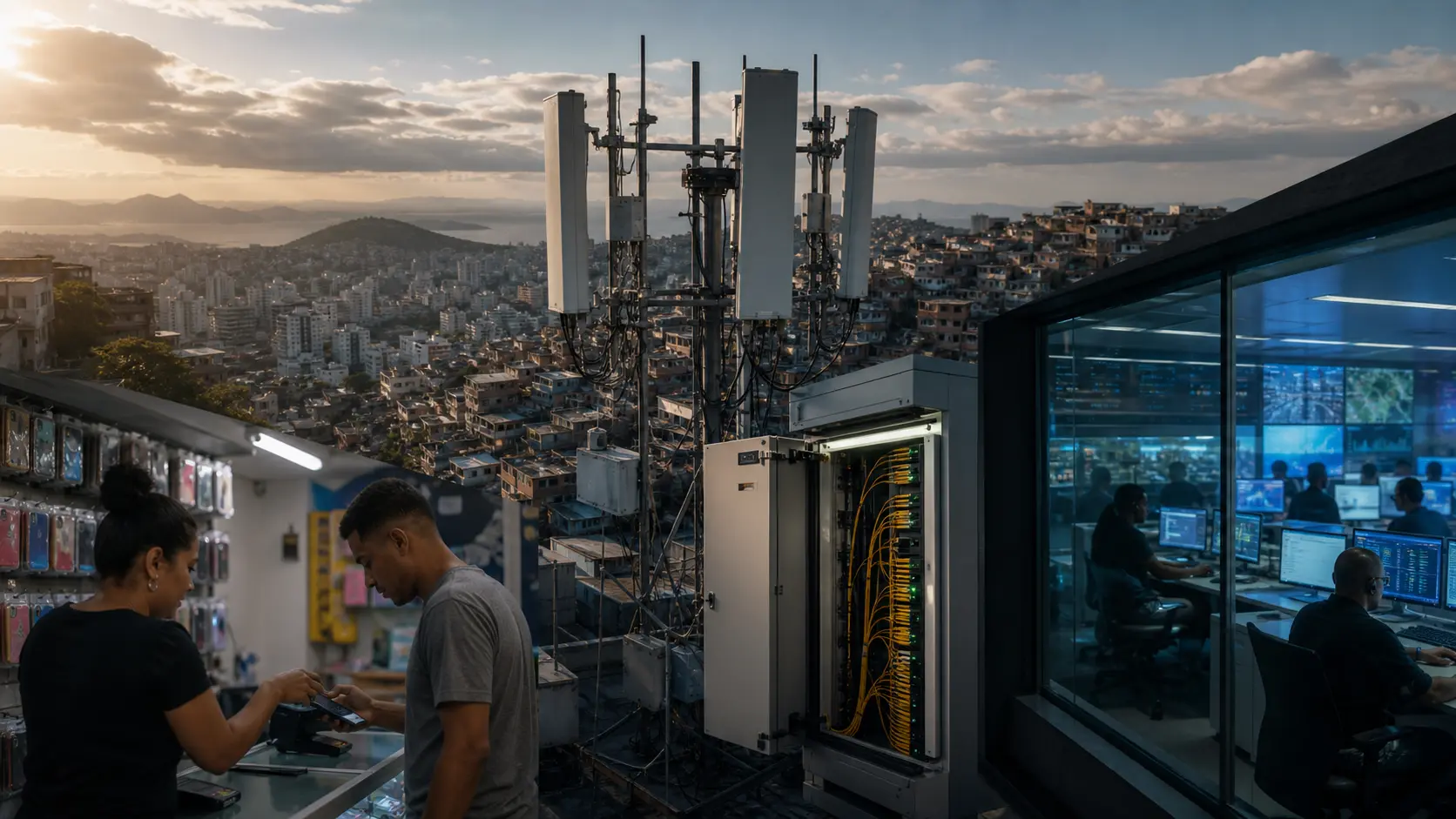
The cheap recharge is the hard part
The economic unit that matters for TIM S/A is not the advertising slogan, the national 5G map, or the investor-day phrase about becoming Brazil's preferred operator. It is the ordinary prepaid recharge: a small packet of mobile data bought by a Brazilian customer who expects video, payments, messaging, authentication and maps to work with little ceremony. In the first quarter of 2026, Anatel's sector data put Brazil's average mobile price proxy at R$5.46 per gigabyte, down 10.93% year on year, while average mobile data consumption rose 21.23% to 6.51 GB per user. Prepaid ARPU for the mobile market was only R$12.12, while postpaid ARPU was R$49.81. That is the bargain the customer sees; it is also the compression the operator has to finance (https://teletime.com.br/03/07/2026/preco-medio-gb-telefonia-movel-diminui/).
TIM's own numbers make the mechanism sharper. In 1Q26, the company reported 28.871 million prepaid lines and 33.116 million postpaid lines. Prepaid revenue was down 6.5% year on year even though prepaid ARPU rose 1.6% to R$14.1; postpaid revenue rose 7.5%, with postpaid ex-M2M ARPU at R$55.1 and postpaid lines up 7.6%. On the other side of the same ledger, TIM spent R$1.354 billion of capex in the quarter, including R$1.044 billion on network investment, and said 5G coverage had reached 1,094 cities by the end of March 2026 (https://api.mziq.com/mzfilemanager/v2/d/4c4aa51f-1235-4aa1-8b83-adc92e8dacc3/e997ff09-2b2b-cf3c-f82e-168ca5a465db?origin=2). A customer can experience TIM as a cheap data line; TIM must operate it as a capital cycle in which spectrum rights, towers, transport, handset channels, stores, billing, power, leases and regulatory duties all have to be recovered from monthly revenue that is still low by international standards.
That is why a company research view on TIM Brasil should start with cost recovery, not with brand scale. TIM says it has more than 60 million mobile customers, roughly 180,000 kilometers of fiber and around 30,000 sites, with 4G present in 100% of Brazilian municipalities and 2025 mobile market share of 22.9% (https://ri.tim.com.br/en/our-tim/profile/). Those figures are useful only if they explain why prepaid data can remain cheap without becoming value destructive. TIM's reported 2025 capex was R$4.541 billion, almost flat with 2024, while mobile service revenue grew 5.4% and full-year normalized EBITDA margin rose to 51.0% (https://api.mziq.com/mzfilemanager/v2/d/4c4aa51f-1235-4aa1-8b83-adc92e8dacc3/2ab8458a-35dd-030a-fe04-048ab5cb3eab?origin=2). The company is trying to prove that the prepaid bargain can be cross-subsidized by postpaid migration, network efficiency, lease renegotiation, fiber control and a stronger B2B layer, rather than by reckless price increases that would simply drive churn.
This makes TIM a cleaner test case than a generic telecom profile. The firm is a national Brazilian mobile operator with public shares in Sao Paulo and ADRs in New York, controlled through the Telecom Italia group, but the corporate chain is less important than the operating bargain. TIM inherited a larger spectrum and customer base from the Oi Mobile asset division in 2022, became more credible in 4G and 5G coverage, and now has to convert network leadership claims into cash returns. The strategic question is whether TIM can make a low-price prepaid market behave like a high-utilization infrastructure business.
If yes, the cheap gigabyte is not a sign of weakness; it is a utilization engine. If no, it is a warning that customers have captured the productivity gains while shareholders and creditors carry the replacement cycle.
TIM's business model is a conversion machine
TIM's public disclosures show a company that wants to be read through conversion metrics: service revenue into EBITDA, EBITDA after leases into operating cash flow, and network spending into usable capacity. In 2025, total net revenue was R$26.625 billion, service revenue was R$25.856 billion, mobile service revenue was R$24.519 billion, normalized EBITDA was R$13.577 billion, capex was R$4.541 billion, and normalized EBITDA-AL minus capex was R$6.032 billion. The headline is not just growth; it is the spread between service revenue growth of 5.2%, normalized operating expense growth of 1.8%, and stable capex (https://api.mziq.com/mzfilemanager/v2/d/4c4aa51f-1235-4aa1-8b83-adc92e8dacc3/2ab8458a-35dd-030a-fe04-048ab5cb3eab?origin=2).
That spread is the investment case. TIM cannot escape the fact that telecom is a high-fixed-cost, regulated, asset-heavy sector. It can only make each unit of network capital carry more traffic and more revenue categories. In the 2026 strategic plan, management guided to roughly 5% service revenue growth, 6% to 8% EBITDA growth, R$4.4 billion to R$4.6 billion of nominal capex, and 11% to 14% growth in EBITDA-AL minus capex, while explicitly excluding potential new spectrum assignments from capex guidance (https://api.mziq.com/mzfilemanager/v2/d/4c4aa51f-1235-4aa1-8b83-adc92e8dacc3/9ba618ca-8902-7370-3e68-ee5f6b4f3f41?origin=2). The exclusion matters. A 5G operator can look disciplined in normal capex and still face step changes when a regulator auctions scarce frequencies or imposes coverage requirements.
The revenue architecture also matters. In 1Q26, mobile customer lines were basically flat year on year, but the mix improved: prepaid lines fell 7.7%, while postpaid lines rose 7.6%. Mobile service revenue rose 6.9% to R$6.466 billion, and mobile ARPU reached R$33.2. That means TIM is not primarily winning by adding many more Brazilian SIMs. It is trying to improve the yield and quality of an installed base, especially by moving customers to higher-value plans and defending network perception (https://api.mziq.com/mzfilemanager/v2/d/4c4aa51f-1235-4aa1-8b83-adc92e8dacc3/e997ff09-2b2b-cf3c-f82e-168ca5a465db?origin=2).
This is why prepaid is not a disposable segment. TIM's prepaid base was still nearly 29 million lines in 1Q26. The segment is weaker in ARPU, more sensitive to household cash flow, and more exposed to recharge behavior, but it supplies scale, coverage utilization and a migration reservoir. The company described 1Q26 prepaid as stabilizing after 3Q25, despite the continuing postpaid migration. In 4Q25, prepaid revenue had fallen 6.5% year on year, less severe than earlier quarters, and full-year prepaid revenue fell 9.3% (https://api.mziq.com/mzfilemanager/v2/d/4c4aa51f-1235-4aa1-8b83-adc92e8dacc3/2ab8458a-35dd-030a-fe04-048ab5cb3eab?origin=2). The softer decline is economically important: a collapsing prepaid base would make 5G densification harder to amortize outside wealthier postpaid clusters.
The same logic explains TIM's interest in fixed broadband and B2B, even though mobile remains the core. TIM Ultrafibra had 880,000 customers in 1Q26, up 11.4% year on year, with ARPU of R$94.4. Fixed service revenue is much smaller than mobile service revenue, but it is a useful convergence option in selected geographies and a hedge against mobile-only commoditization (https://api.mziq.com/mzfilemanager/v2/d/4c4aa51f-1235-4aa1-8b83-adc92e8dacc3/e997ff09-2b2b-cf3c-f82e-168ca5a465db?origin=2). The acquisition of V8 Consulting and the emphasis on IoT, managed services and network-as-a-service in management's 2026 plan show a similar desire to get more revenue per network asset from enterprise users (https://api.mziq.com/mzfilemanager/v2/d/4c4aa51f-1235-4aa1-8b83-adc92e8dacc3/9ba618ca-8902-7370-3e68-ee5f6b4f3f41?origin=2).
Spectrum turned coverage into a dated liability
Brazil's 5G auction was not just a spectrum purchase; it was a schedule of public duties. Anatel's coverage page says the November 2021 auction established national and regional coverage commitments for winners. The timetable includes 5G for all 5,570 municipal seats, phased requirements for municipalities above 30,000 people, obligations to cover 1,700 non-seat localities by 2030, 4G or better in 7,430 localities, 4G across 35,784 kilometers of paved federal highways, fiber backhaul in 530 municipal seats, and R$3.1 billion of public-school connectivity commitments across the relevant winning lots (https://www.gov.br/anatel/pt-br/regulado/universalizacao/compromissos-do-leilao-do-5g). These obligations transform spectrum from an intangible right into a dated construction and performance liability.
TIM's Form 20-F language is cautious for the same reason: Anatel auction conditions require price payment and minimum investment commitments, and failure to meet them carries compliance risk (https://www.sec.gov/Archives/edgar/data/1826168/000129281426001915/timbform20f_2025.htm). The public investor release can celebrate 1,094 5G cities; the finance team must still model the later stages, where coverage moves from capitals and dense municipalities to smaller towns, roads and backhaul. In dense cities, 5G can reduce unit data cost by shifting heavy traffic from congested 4G to higher-capacity equipment. In lower-density areas, the same spectrum can create coverage expense before enough usage arrives.
TIM's own network language confirms the economic trade. In a network update, the company said it had activated 5G in 1,000 cities, covered all neighborhoods in the 27 state capitals, covered about 75% of the urban population, and had more than 40% of mobile traffic in the capitals running on 5G. It also said 5G cost per gigabyte is one-third of 4G, with more capacity and lower energy consumption (https://ri.tim.com.br/en/tim-continues-expanding-its-network-with-a-focus-on-becoming-brazils-preferred-operator/). That is the central productivity claim. The cheap prepaid data bargain is viable only if the traffic actually migrates to the lower unit-cost layer fast enough to offset spectrum, site, power and equipment costs.
The 5G timetable also changes how to read capex. A single quarter of R$1.354 billion is not a discretionary marketing spend; it is the visible part of a multi-year build. TIM's 2026 strategic plan describes site modernization across 6,500 4G and 5G sites in 15 state capitals and metropolitan areas through 2027, with roughly 12 million customers affected, a 38% increase in 5G coverage, and a 40% improvement in capacity (https://api.mziq.com/mzfilemanager/v2/d/4c4aa51f-1235-4aa1-8b83-adc92e8dacc3/9ba618ca-8902-7370-3e68-ee5f6b4f3f41?origin=2). The immediate cost is capex and implementation risk. The possible benefit is a lower cost per bit, fewer quality complaints, more postpaid upgrades, and a stronger enterprise proposition.
Regulatory expansion also creates a geographic dilemma. TIM says it is the only operator with 4G coverage in 100% of Brazilian municipalities and has first-mover claims in 5G milestones (https://ri.tim.com.br/en/our-tim/profile/). That supports brand trust, especially outside the richest cities, but national coverage can also become a margin drag when usage density is low. A purely financial operator might avoid such edges; a licensed national mobile carrier cannot. TIM has to keep investing where the regulator, brand promise and customer base require presence, while making sure the heaviest data traffic runs on the most efficient layer.
Towers, leases and fiber are where the balance sheet speaks
TIM's capital cycle is shaped by a long series of make-or-buy choices. The most obvious one is towers. TIM Brasil approved the sale of thousands of towers to American Tower in 2014 for about R$3 billion, with a long leaseback structure; the reported program later involved the transfer of 5,873 towers by 2017 (https://www.telecompaper.com/news/tim-brasil-to-sell-towers-to-american-tower--1051005). Sale-and-leaseback gives a mobile operator cash and reduces direct ownership of passive infrastructure, but it turns part of network presence into long-term lease payments. When traffic rises, the commercial question is not only whether a tower exists. It is who owns the passive asset, what contract governs it, and how flexible TIM is when it wants to add equipment, consolidate sites or leave redundant locations.
The January 2026 American Tower agreement shows TIM trying to regain flexibility inside an outsourced structure. TIM announced that a new arrangement with American Tower do Brasil covered approximately 9,000 towers, about 30% of TIM's infrastructure, and consolidated prior contracts into one framework with a unified term until 2034. TIM linked the arrangement to a Lease Efficiency Plan including other contract negotiations, infrastructure sharing and "make" initiatives for its own sites (https://www.stocktitan.net/sec-filings/TIMB/6-k-tim-s-a-current-report-foreign-issuer-4aa0c5c83e87.html). In plain economics, TIM is trying to make outsourced towers behave less like a fixed rent trap and more like a managed input.
The 1Q26 release gives the financial echo. Network and interconnection costs rose 13.2% year on year and represented 22.0% of net revenue, partly because of higher infrastructure-sharing expenses. Other operating expenses improved partly because of a favorable contractual renegotiation with American Tower do Brasil, while net lease interest rose 24.5% year on year to R$463 million (https://api.mziq.com/mzfilemanager/v2/d/4c4aa51f-1235-4aa1-8b83-adc92e8dacc3/e997ff09-2b2b-cf3c-f82e-168ca5a465db?origin=2). That is the tension: lease optimization can lift operating performance, but leased infrastructure still sits inside the economics of debt-like obligations, interest and long-dated commitments.
Fiber has moved in the opposite direction. TIM helped create FiberCo, later I-Systems, as a shared optical-fiber infrastructure platform and sold 51% to IHS Fiber Brasil in 2021 while retaining 49% (https://ri.tim.com.br/en/our-tim/profile/). In February 2026, IHS announced an agreement to sell its 51% stake back to TIM, saying I-Systems covered about 9.3 million homes passed, including about 6.4 million FTTH homes passed, and 22,250 route kilometers, with a 100% enterprise value of $452.6 million (https://www.ihstowers.com/support-and-info/media/press-releases/2026/ihs-towers-agrees-to-sell-its-51-percent-stake-in-i-systems-to-tim-sa). IHS then announced completion of the sale in May 2026 (https://www.businesswire.com/news/home/20260507340429/en/IHS-Towers-Completes-Sale-of-Its-51.0-Stake-in-I-Systems-to-TIM-S.A.).
That reversal is instructive. TIM sold fiber control when a neutral-network thesis and balance-sheet discipline looked attractive; it bought control back when broadband optionality, end-to-end quality and possible consolidation became more important. The strategic plan says I-Systems could add more than 9 million homes passed, improve operational discipline and performance monitoring, and enable potential future inorganic moves (https://api.mziq.com/mzfilemanager/v2/d/4c4aa51f-1235-4aa1-8b83-adc92e8dacc3/9ba618ca-8902-7370-3e68-ee5f6b4f3f41?origin=2). The risk is that fiber control demands capital and managerial attention in a fixed broadband market with many small providers and aggressive incumbents. The opportunity is that TIM can improve mobile backhaul, fixed customer experience and convergence without waiting on a partner's capital priorities.
The Oi inheritance still matters
TIM's 2022 purchase of part of Oi's mobile assets changed the starting point for the present cycle. The company says the transaction included spectrum, customers and network usage contracts, and that integration focused on mobile network integration, customer migration and decommissioning of overlapping sites (https://ri.tim.com.br/en/our-tim/profile/). The logic was straightforward: the mobile market moved from four major national operators toward three, and TIM obtained spectrum depth and customers that could improve capacity and scale if integration was handled well.
The benefit of the Oi deal is visible in spectrum and share, but the liability is visible in site rationalization and lease complexity. Acquired mobile assets are rarely clean additions. Some towers are useful because they fill coverage gaps or relieve congestion; others duplicate existing locations and create lease or shutdown costs. A network can therefore become stronger and messier at the same time.
TIM's emphasis on decommissioning overlapping sites after Oi, and later on American Tower contract simplification, belongs in the same story: the company is trying to capture the spectrum and customer upside without paying indefinitely for redundant passive infrastructure.
That integration history also changes the meaning of market share. TIM's mobile market share rose from 20.4% in 2021 to 24.8% in 2022 after the Oi transaction, then drifted to 24.0% in 2023, 23.6% in 2024 and 22.9% in 2025, according to the company's profile data (https://ri.tim.com.br/en/our-tim/profile/). This is not necessarily failure. If TIM sheds lower-quality prepaid lines, raises ARPU and cuts redundant network costs, a lower line share can still be compatible with better cash flow. But it does mean scale is no longer a simple victory metric. The question is which customers remain and how much traffic and revenue they bring to the network.
The most valuable Oi inheritance may be optionality. More spectrum lets TIM offload traffic, support 5G, reduce congestion and defend service quality against Vivo and Claro. But optionality must be exercised. The company has to push compatible handsets into the base, create offers that make 5G more than a logo, and keep postpaid churn low. TIM said postpaid ex-M2M churn was 0.8% in 4Q25 and that postpaid migration from prepaid rose 11.9% in the quarter (https://api.mziq.com/mzfilemanager/v2/d/4c4aa51f-1235-4aa1-8b83-adc92e8dacc3/2ab8458a-35dd-030a-fe04-048ab5cb3eab?origin=2). Those are the kind of details that show whether spectrum is becoming cash.
Competition is a three-player squeeze with different strengths
Brazil is now a concentrated mobile market. Anatel said in its competition monitoring report for 2Q25 that Vivo, Claro and TIM controlled 95.2% of mobile telephony, while fixed broadband remained much less concentrated (https://www.gov.br/anatel/pt-br/assuntos/noticias/anatel-divulga-relatorio-de-monitoramento-da-competicao). Concentration helps rational pricing, but it does not remove rivalry. The three operators are competing for the same postpaid upgrades, the same 5G perception, the same family bundles, and in many cities the same fiber or fixed-wireless households.
Vivo's 1Q26 results define the high-end benchmark. Telefonica Brasil reported R$15.457 billion of net revenue, up 7.4% year on year, with postpaid and FTTH as the main drivers; it ended the quarter with 117.4 million total accesses, 103.7 million mobile accesses, 72.1 million postpaid accesses, 31.5 million fiber homes passed and 8.0 million homes connected. Vivo's postpaid ARPU excluding M2M and dongles was R$52.6, and churn was described as historically low at 1.0% (https://api.mziq.com/mzfilemanager/v2/d/24165f81-24d6-4648-bf9f-66712905d5a2/10197118-fa36-7b1a-0863-a2d95945ea83?origin=2). TIM's postpaid ARPU is comparable, but Vivo's absolute customer and fiber scale are larger.
Claro's pressure comes through America Movil's balance sheet and Brazil growth. America Movil said Brazil led its 1Q26 postpaid net additions with 1.3 million clients and contributed 115,000 new broadband accesses; the group also disclosed an agreement to acquire about 73% of Desktop, subject to CADE and Anatel approvals (https://s22.q4cdn.com/604986553/files/doc_financials/2026/q1/1Q26.pdf). Business press framed the Desktop move as a way for Claro to strengthen fixed broadband in Sao Paulo after Vivo had also been active in fiber assets (https://elpais.com/economia/2026-03-26/america-movil-arrebata-a-telefonica-la-brasilena-desktop.html). For TIM, this is not a minor fixed-line footnote. If competitors own stronger household relationships, they can bundle mobile more effectively and raise the cost of defending postpaid.
Network quality is TIM's counterweight. Opensignal's January 2026 Brazil report gave TIM and Vivo six awards each out of 14. TIM led in consistent quality, reliability experience, time on network and 5G availability, while Vivo led several 5G speed and experience categories; the same report put TIM third in overall download speed and third in 5G download speed, behind Vivo and Claro in those speed measures (https://insights.opensignal.com/reports/2026/01/brazil/mobile-network-experience). This is a nuanced position. TIM can claim reliability and availability, which matter for everyday prepaid and postpaid usage, but it cannot assume a permanent speed halo.
That nuance is the investment risk. TIM's network modernization can support a differentiated brand if customers notice fewer dead zones and more stable video. If speed rankings or consumer perception move decisively to Vivo or Claro, TIM may have to spend more on commercial subsidies, handset offers and media campaigns to maintain migration momentum. In 4Q25, TIM itself described its mobile strategy around network, service and offer, with sponsorships and brand campaigns supporting the technical story (https://api.mziq.com/mzfilemanager/v2/d/4c4aa51f-1235-4aa1-8b83-adc92e8dacc3/2ab8458a-35dd-030a-fe04-048ab5cb3eab?origin=2). In a three-player market, perception is not decoration; it is part of the customer acquisition cost.
Prepaid is not dead; it is the price discovery layer
The temptation is to treat prepaid decline as a simple path toward better economics. That is only partly right. TIM's postpaid migration improves revenue visibility and lower churn, but prepaid remains the place where Brazil's affordability constraint is clearest. Teletime's March 2026 mobile-access report, using Anatel data, said Brazil had 179.8 million postpaid accesses against 93.2 million prepaid mobile phones, and that among the three large telecom operators TIM was the only one whose prepaid base remained larger than its postpaid base (https://teletime.com.br/11/05/2026/mercado-movel-acelera-marco-2026/). TIM's own reporting counts M2M differently, but the market point stands: TIM still has more exposure than peers to recharge-sensitive demand.
Prepaid therefore plays three roles. First, it is an affordability product. A household with volatile income can buy connectivity in small doses without taking a monthly bill. Second, it is a migration funnel. Customers who use more data, trust the network and want better offers can move into control or postpaid plans. Third, it is a competitive warning system. If recharge levels weaken, TIM learns quickly that pricing, employment or offer design is under stress.
The company's 1Q26 language on prepaid stabilization is useful because it avoids pretending the segment is growing. Prepaid revenue still fell, but ARPU rose modestly and management emphasized stabilization after prior quarters (https://api.mziq.com/mzfilemanager/v2/d/4c4aa51f-1235-4aa1-8b83-adc92e8dacc3/e997ff09-2b2b-cf3c-f82e-168ca5a465db?origin=2). The key question is whether a smaller prepaid base can consume more data at lower unit network cost without requiring constant promotional giveaways. If 5G traffic is materially cheaper per gigabyte, then prepaid users can be economically useful even at R$14 monthly ARPU, especially in dense cities. If handset affordability or coverage limits slow 5G migration, prepaid remains on the older cost curve longer.
This is where handset distribution enters the economics. TIM's 1Q26 product revenue rose 13.3% year on year, while cost of goods sold rose 7.6%, driven by higher handset and accessory sales (https://api.mziq.com/mzfilemanager/v2/d/4c4aa51f-1235-4aa1-8b83-adc92e8dacc3/e997ff09-2b2b-cf3c-f82e-168ca5a465db?origin=2). Handsets are not the main profit pool, but they shape which network layer customers can use. A prepaid customer with an older 4G phone consumes capacity differently from a postpaid customer with a 5G device. Device distribution can therefore be a hidden capex amplifier or a capex relief valve.
TIM's retail and digital channels also matter. The company wants selective expansion of physical channels combined with stronger digital and remote sales, according to its 2026 guidance presentation (https://api.mziq.com/mzfilemanager/v2/d/4c4aa51f-1235-4aa1-8b83-adc92e8dacc3/9ba618ca-8902-7370-3e68-ee5f6b4f3f41?origin=2). For prepaid customers, the channel is not merely a storefront; it is where recharge, SIM replacement, device financing, plan migration and problem resolution interact. Bad service pushes churn. Good service can turn a cheap data line into a longer customer relationship.
The cost base is more exposed to infrastructure than the brand suggests
Telecom brands sell ease; telecom accounts disclose friction. In 1Q26, TIM's normalized operating expenses were R$3.517 billion, up 6.4% year on year. Personnel costs fell 1.0%; selling and marketing rose 2.9%; customer services and billing fell 2.3%; network and interconnection rose 13.2%; G&A rose 4.9%; cost of goods sold rose 7.6%; and bad debt rose 23.8%. The bad-debt ratio reached 2.1% of gross revenue, with management linking the increase to a higher postpaid exposure, which represented 53% of the total base (https://api.mziq.com/mzfilemanager/v2/d/4c4aa51f-1235-4aa1-8b83-adc92e8dacc3/e997ff09-2b2b-cf3c-f82e-168ca5a465db?origin=2).
This cost mix explains why postpaid is not a free lunch. Postpaid lifts ARPU and reduces recharge volatility, but it introduces credit risk, collection cost and a larger billing relationship. TIM's 1Q26 bad-debt increase is not alarming by itself, but it reminds investors that migration from prepaid to postpaid changes risk form rather than eliminating risk. A prepaid user may stop recharging; a postpaid customer can become delinquent.
Network and interconnection are the more strategic pressure points. Higher roaming traffic, digital content provider spending and infrastructure-sharing expenses can rise with usage even when unit technology improves. TIM can reduce cost per bit on 5G, but if video, cloud apps and enterprise traffic grow faster, absolute network costs still rise. The company's promise is operational leverage: revenue and traffic grow, while each additional gigabyte is cheaper to carry. The risk is that suppliers, leases, content, energy and coverage duties absorb too much of that gain.
Energy deserves special attention. TIM's strategic materials say the Sao Paulo modernization increased capacity by 40% and reduced energy consumption by 15% across the upgraded area (https://ri.tim.com.br/en/tim-continues-expanding-its-network-with-a-focus-on-becoming-brazils-preferred-operator/). That is precisely the kind of operational gain a low-ARPU market needs. A lower energy curve does not simply improve sustainability optics; it can make the difference between profitable and unprofitable data growth when users consume more traffic without paying much more per gigabyte.
The finance line also matters. TIM's 1Q26 net financial result was a R$530 million expense, improved from R$598 million a year earlier, but net lease interest rose to R$463 million. Total post-hedge debt including net derivatives was R$17.191 billion at March 2026, and TIM had R$5.871 billion of cash and securities (https://api.mziq.com/mzfilemanager/v2/d/4c4aa51f-1235-4aa1-8b83-adc92e8dacc3/e997ff09-2b2b-cf3c-f82e-168ca5a465db?origin=2). The company has room to invest, but it is not free from the cost of capital. Lease-heavy telecom infrastructure carries an after-lease discipline that equity stories sometimes understate.
Supplier dependence is concentrated but manageable
TIM is not vertically integrated in all the inputs that determine customer experience. It depends on tower companies, equipment vendors, fiber construction, handset supply, power reliability, software platforms, civil works, and regulatory coordination. The Nokia partnership is one example. Nokia said in August 2024 that it had been selected to expand TIM's 5G radio access coverage across 15 Brazilian states from January 2025, using AirScale baseband, Massive MIMO radios and other equipment, while also providing management, deployment, optimization and support services (https://www.nokia.com/newsroom/nokia-and-tim-partner-to-expand-5g-coverage-in-brazil-in-2025/). TIM's 2026 strategic plan also refers to contracts with Nokia and Huawei for modernization (https://api.mziq.com/mzfilemanager/v2/d/4c4aa51f-1235-4aa1-8b83-adc92e8dacc3/9ba618ca-8902-7370-3e68-ee5f6b4f3f41?origin=2).
Vendor dependence is not automatically dangerous. Large radio suppliers can deliver scale, energy improvements and modernization know-how that an operator cannot easily build alone. But the operator remains exposed to equipment pricing, deployment timing, software reliability, geopolitical constraints and technology roadmap choices. Brazil's telecom politics are not insulated from global debates around vendors, cybersecurity and supply-chain resilience. TIM's best defense is diversification, contract discipline and enough internal network capability to avoid being a passive buyer.
The LACNIC member record for TIM S/A is a narrower piece of evidence, but it reinforces the infrastructure character of the company. TIM appears in LACNIC member records for Brazil, which is consistent with a company that operates public internet-number resources and network infrastructure rather than merely reselling a branded service (https://milacnic.lacnic.net/lacnic/asociados/publico?locale=EN). That evidence should not be overread as a consumer-service claim; it is useful because it places TIM in the internet addressing and connectivity fabric that sits behind retail mobile service.
Transport and backhaul are equally important. 5G radio access is only as good as the fiber, aggregation, routing and core capacity behind it. TIM's move to full ownership of I-Systems therefore has a mobile logic, not only a fixed-broadband logic. More control over fiber routes and homes passed can improve the ability to manage end-to-end quality, support enterprise connectivity and prepare for future traffic. The risk is capital complexity: fiber networks require maintenance, commercial loading and local execution.
Power resilience is the under-discussed input. Brazil's climate, distance and urban complexity make network uptime a practical operating challenge. Opensignal's emphasis on time on network, reliability and consistent quality is useful because it measures the lived result of all these dependencies, not just theoretical coverage (https://insights.opensignal.com/reports/2026/01/brazil/mobile-network-experience). For a prepaid customer, the network either works when the recharge is needed or it does not. For an enterprise, reliability can be the entire product.
Market talk points toward fiber consolidation and spectrum scarcity
Unofficial market signals are most useful when they reveal where capital wants to move. The recurring market talk around Brazilian fiber assets, including America Movil's move for Desktop and TIM's move to reacquire I-Systems, suggests that mobile-only economics are not enough for the leading carriers. Operators want household relationships, backhaul optionality, enterprise access and a way to defend mobile ARPU through bundles. The Desktop reports also show that Sao Paulo remains a decisive battlefield because fixed broadband scale there can influence mobile competition in Brazil's richest state (https://elpais.com/economia/2026-03-26/america-movil-arrebata-a-telefonica-la-brasilena-desktop.html).
The same is true of spectrum. Anatel's 5G commitments already stretch toward 2029 and 2030, while market reports point to future auctions, including residual 700 MHz and possible 6 GHz discussions. Opensignal noted that Anatel had future auctions on the horizon, including delayed residual 700 MHz spectrum and a potential 6 GHz tender later in 2026 (https://insights.opensignal.com/reports/2026/01/brazil/mobile-network-experience). TIM's guidance excludes new spectrum assignments, which is financially clean but analytically important. If Brazil puts attractive low-band or mid-band spectrum into the market, TIM may need to bid to protect coverage economics.
The data-price discussion also matters. A July 2026 Teletime report said mobile price per gigabyte fell in 1Q26 while average consumption rose; the prior cycle had seen price pressure move differently in some quarters (https://teletime.com.br/03/07/2026/preco-medio-gb-telefonia-movel-diminui/). A falling price per GB is good for digital inclusion and traffic growth, but it tightens the operator's payback math unless cost per GB falls faster. TIM's assertion that 5G cost per GB can be one-third of 4G is therefore not just technology marketing. It is the bridge between customer affordability and investor returns.
There is also a labor and service signal. TIM wants to redesign customer care and reduce friction through more automation, but its real economics will show up in churn, collection, complaints and channel conversion rather than in slogans. If service improvements reduce churn and support postpaid migration, the customer-care investment is productive. If it merely cuts cost while complaints rise, the network brand can weaken. In concentrated telecom markets, a small quality reputation change can move high-value customers at the margin.
Finally, shareholder remuneration is part of market talk because it constrains capital flexibility. TIM distributed R$4.7 billion to shareholders in 2025 and guided to R$5.3 billion to R$5.5 billion in 2026 remuneration, subject to corporate approvals and business performance (https://api.mziq.com/mzfilemanager/v2/d/4c4aa51f-1235-4aa1-8b83-adc92e8dacc3/9ba618ca-8902-7370-3e68-ee5f6b4f3f41?origin=2). That is a sign of confidence in cash conversion, but it raises the hurdle for incremental spectrum, fiber or network spending. A generous distribution policy is sustainable only if operating cash flow keeps rising after leases and capex.
Geography decides whether the bargain scales
Brazil's geography is not a backdrop for TIM; it is an input cost. The company can report one national customer base, but the economics of a recharge in a dense Sao Paulo neighborhood are different from the economics of a recharge in a small municipality, along a federal highway, or in a rural agribusiness area. Dense urban traffic can justify radio upgrades because many users share the same site and the same fiber path. Sparse coverage can be politically and socially necessary while taking longer to fill with traffic. Anatel's 5G obligations make this explicit by pushing winners beyond capitals into smaller municipalities, non-seat localities, road corridors and backhaul gaps (https://www.gov.br/anatel/pt-br/regulado/universalizacao/compromissos-do-leilao-do-5g).
That geography is why TIM's 4G-in-all-municipalities claim and 5G-city count should be read as operating commitments, not only marketing assets. Coverage breadth improves trust and can make TIM the default option for customers who travel, work outside core urban zones, or need mobile data as their only reliable broadband. It also increases the number of sites, power arrangements, maintenance visits and transport routes that must be kept running regardless of short-term recharge behavior. The economic question is whether national reach produces enough brand preference and traffic density to justify the extra edge cost (https://ri.tim.com.br/en/our-tim/profile/).
The company is trying to make that edge less expensive through modernization. TIM's Sao Paulo update is framed around a 40% capacity increase and 15% lower energy consumption after replacing technology in 3,000 sites across 64 cities in area code 11 (https://ri.tim.com.br/en/tim-continues-expanding-its-network-with-a-focus-on-becoming-brazils-preferred-operator/). Sao Paulo is not representative of all Brazil, but it is the best laboratory for the broader model: if a denser, more modern network can carry more traffic at lower energy cost and better quality, then the same playbook can be selectively moved to other high-traffic capitals and corridors.
The rural story is more delicate. TIM says its B2B coverage includes more than 26 million hectares covered with 4G, more than 10,000 kilometers of roads covered and connected-vehicle growth in 2025 (https://api.mziq.com/mzfilemanager/v2/d/4c4aa51f-1235-4aa1-8b83-adc92e8dacc3/2ab8458a-35dd-030a-fe04-048ab5cb3eab?origin=2). These are not just social-good statistics. Agribusiness, mining, logistics and connected vehicles can raise the revenue density of non-consumer coverage. A rural site that serves only low-ARPU prepaid traffic is harder to justify. A rural site that also carries enterprise IoT, logistics, private-network traffic or vehicle connectivity can become part of a broader industrial connectivity platform.
That is the most plausible way to reconcile inclusion and returns. TIM cannot charge a low-income prepaid user enough to fund every remote coverage obligation by itself. It can, however, use the same coverage footprint to serve farms, roads, mining sites, government obligations and enterprise customers, while keeping prepaid service affordable. The risk is execution: enterprise sales cycles are slower than prepaid recharges, specialized solutions require support, and competitors are chasing the same verticals. The fact that TIM calls B2B a growth path in the 2026 plan is relevant; the proof will be whether those contracts fill capacity outside the densest consumer zones (https://api.mziq.com/mzfilemanager/v2/d/4c4aa51f-1235-4aa1-8b83-adc92e8dacc3/9ba618ca-8902-7370-3e68-ee5f6b4f3f41?origin=2).
The shareholder promise raises the operating bar
TIM's shareholder-return policy is not separate from the prepaid-data question. A telecom operator can always make coverage look better by spending more and distributing less. TIM is attempting the harder version: invest around R$4.4 billion to R$4.6 billion in 2026, keep modernizing the network, absorb the I-Systems move, comply with coverage duties, and still distribute R$5.3 billion to R$5.5 billion to shareholders if approvals and business performance allow it (https://api.mziq.com/mzfilemanager/v2/d/4c4aa51f-1235-4aa1-8b83-adc92e8dacc3/9ba618ca-8902-7370-3e68-ee5f6b4f3f41?origin=2). That promise is attractive only if the operating model is genuinely self-funding.
The 2025 numbers support the ambition but do not remove the risk. Normalized net income rose 37.4% to R$4.343 billion, normalized EBITDA rose 7.5%, capex was almost flat, and operating cash flow as measured by normalized EBITDA-AL minus capex rose 15.7% (https://api.mziq.com/mzfilemanager/v2/d/4c4aa51f-1235-4aa1-8b83-adc92e8dacc3/2ab8458a-35dd-030a-fe04-048ab5cb3eab?origin=2). This is exactly the pattern a capital-intensive operator wants: more profit and cash without a proportionate capex increase. But a single strong year can be flattered by timing, integration benefits, working-capital movements or delayed investment needs.
The 1Q26 cash-flow bridge is therefore important. TIM reported operating cash flow of R$1.169 billion, up 16.8% year on year, and operating free cash flow of R$453 million, up 54.0%, while leases payment was R$788 million and working capital plus income tax consumed R$686 million (https://api.mziq.com/mzfilemanager/v2/d/4c4aa51f-1235-4aa1-8b83-adc92e8dacc3/e997ff09-2b2b-cf3c-f82e-168ca5a465db?origin=2). The positive reading is that operating performance is still converting. The cautious reading is that after-lease cash flow remains exposed to working capital, tax timing, and lease obligations that customers never see.
Investors should also distinguish dividends from industrial strength. A large distribution can signal management confidence; it can also reflect pressure to show discipline in a sector where growth options are expensive. If TIM's 5G modernization lowers cost per bit, if I-Systems improves end-to-end control, and if tower renegotiation lowers lease drag, distributions can coexist with investment. If those levers disappoint, the same distribution target could narrow room for future spectrum or force sharper tradeoffs between urban capacity and coverage obligations.
This is where prepaid becomes a leading indicator again. A company can defend dividends for a while through cost cuts and balance-sheet management, but it cannot create a durable national mobile business if a large prepaid base keeps eroding without profitable upgrades. TIM does not need prepaid revenue to grow strongly. It needs prepaid decline to be orderly, migration to remain healthy, recharge behavior to stabilize, and 5G usage to move traffic onto a cheaper layer.
The ordinary data recharge is therefore a small transaction with an outsized signaling role: it shows whether affordability, network quality and capital discipline are still aligned.
Evidence weight and uncertainty
The strongest evidence in TIM's favor is company-specific and current. TIM's own 1Q26 release supplies the central mechanism: prepaid ARPU of R$14.1, postpaid ex-M2M ARPU of R$55.1, R$1.354 billion quarterly capex, 1,094 5G cities, higher operating cash flow, rising lease interest, and the explicit cost lines that show where network economics are tightening (https://api.mziq.com/mzfilemanager/v2/d/4c4aa51f-1235-4aa1-8b83-adc92e8dacc3/e997ff09-2b2b-cf3c-f82e-168ca5a465db?origin=2). Those are not generic telecom claims; they tie the low-price customer unit to TIM's capital and cost base.
The second strongest evidence comes from independent or external operating context. Anatel supplies the coverage obligations and competition structure; Opensignal supplies user-experience comparisons; IHS and Business Wire confirm the I-Systems transaction; America Movil and Telefonica filings show how Claro and Vivo are growing; Nokia confirms a supplier role in 5G expansion (https://www.gov.br/anatel/pt-br/assuntos/noticias/anatel-divulga-relatorio-de-monitoramento-da-competicao) (https://insights.opensignal.com/reports/2026/01/brazil/mobile-network-experience) (https://www.businesswire.com/news/home/20260507340429/en/IHS-Towers-Completes-Sale-of-Its-51.0-Stake-in-I-Systems-to-TIM-S.A.).
The weakest evidence is market talk around future consolidation and spectrum. It is still useful because telecom capital often moves before official strategy catches up, but it should be weighted differently from filings. Claro's Desktop move is a real announced transaction subject to approvals; broader expectations about future fiber consolidation or spectrum auctions are directional rather than settled. The article therefore uses that material to identify pressure points, not to assert outcomes.
The residual uncertainty is that customer behavior can move faster than infrastructure plans. A prepaid customer does not care whether TIM's cost per GB is falling if a rival offers a better bundle, a better handset, or stronger indoor coverage. A postpaid customer does not care about capex discipline if service quality declines. A regulator does not care about shareholder distributions if license duties are missed. TIM's management problem is to satisfy all three at once. That is why the research judgment should stay conditional even when the latest numbers are favorable.
What would change the judgment
The constructive case for TIM is that Brazil's prepaid data bargain can be made profitable by moving traffic to 5G, migrating enough users to postpaid, renegotiating leases, integrating fiber control, and preserving network reliability. The company has evidence for each part of the case: 1,094 5G cities by March 2026, postpaid growth of 7.6%, 2025 normalized EBITDA-AL minus capex growth of 15.7%, American Tower contract simplification, and full I-Systems ownership after May 2026 (https://api.mziq.com/mzfilemanager/v2/d/4c4aa51f-1235-4aa1-8b83-adc92e8dacc3/e997ff09-2b2b-cf3c-f82e-168ca5a465db?origin=2) (https://www.businesswire.com/news/home/20260507340429/en/IHS-Towers-Completes-Sale-of-Its-51.0-Stake-in-I-Systems-to-TIM-S.A.).
The first fact that would weaken the case is a renewed prepaid revenue slide without offsetting postpaid gains. A falling prepaid base is acceptable if customers upgrade or if remaining prepaid users consume efficiently on 5G. It is not acceptable if customers churn to Claro, Vivo, MVNOs or informal substitutes while TIM still carries the coverage and lease burden. The monthly Anatel access data and TIM's own operational tables are the right places to watch this (https://informacoes.anatel.gov.br/paineis/acessos/telefonia-movel).
The second fact is capex creep. TIM's 2026 guidance of R$4.4 billion to R$4.6 billion nominal capex is credible only if modernization stays inside plan and new spectrum does not force a reset (https://api.mziq.com/mzfilemanager/v2/d/4c4aa51f-1235-4aa1-8b83-adc92e8dacc3/9ba618ca-8902-7370-3e68-ee5f6b4f3f41?origin=2). If capex rises while service revenue growth remains near 5%, the cash conversion story weakens. If capex stays flat because the company underinvests and network quality slips, the weakness will show later in churn and brand perception.
The third fact is lease discipline. The American Tower agreement creates predictability through 2034 for roughly 9,000 towers, but the value depends on commercial terms and execution (https://www.stocktitan.net/sec-filings/TIMB/6-k-tim-s-a-current-report-foreign-issuer-4aa0c5c83e87.html). Investors should watch lease payments, net lease interest, site decommissioning costs and infrastructure-sharing expenses. TIM's network can be technically excellent and still produce disappointing returns if passive infrastructure rents capture too much of the benefit.
The fourth fact is competitive bundling. Vivo's fiber and postpaid scale, and Claro's Desktop move, are direct threats to TIM if they produce stickier converged households and better device economics (https://api.mziq.com/mzfilemanager/v2/d/24165f81-24d6-4648-bf9f-66712905d5a2/10197118-fa36-7b1a-0863-a2d95945ea83?origin=2) (https://s22.q4cdn.com/604986553/files/doc_financials/2026/q1/1Q26.pdf). TIM does not need to match every fiber home passed, but it needs enough fixed and enterprise presence in the right places to keep mobile from becoming a standalone commodity.
The fifth fact is regulation. Anatel's 5G obligations extend deep into small municipalities, roads, localities, backhaul and schools (https://www.gov.br/anatel/pt-br/regulado/universalizacao/compromissos-do-leilao-do-5g). Enforcement delays can improve short-term cash flow but create later cliffs. Accelerated compliance can improve brand and public standing but absorb capital. The right outcome is steady compliance with enough commercial loading to justify the build.
The bottom line
TIM S/A is not a story about a Brazilian customer paying too little for data. It is a story about whether an operator can industrialize cheap data without destroying its return on capital. The customer sees a low monthly spend and more gigabytes. TIM sees a network in which 5G must lower unit cost, postpaid migration must lift revenue quality, prepaid must stop shrinking too quickly, towers must become more flexible, fiber must improve control, and regulatory obligations must be met without swallowing the cash flow.
The current evidence is cautiously favorable. TIM's 2025 and 1Q26 results show service revenue growth, high EBITDA margins, rising operating cash flow, disciplined capex, a more valuable customer mix, and visible 5G expansion. The company has also taken concrete action on two of the hardest infrastructure inputs: it reset a large tower relationship with American Tower and completed the reacquisition of I-Systems. Those moves fit the thesis that TIM is trying to control the cost curve behind the prepaid bargain.
The uncertainty is equally concrete. Vivo and Claro have stronger or broader positions in parts of postpaid, fiber and fixed-mobile bundling. TIM's prepaid exposure remains higher than peers. Lease interest and network costs can rise even when operational metrics improve. New spectrum or regulatory enforcement can change capex needs. Customer perception can turn quickly if 5G leadership becomes less visible. The company has to keep proving that every extra gigabyte is cheaper to carry and easier to monetize than the last one.
For BTW's lens, TIM Brasil matters because it shows how a national telecom operator translates public connectivity into financial discipline. Brazil wants cheap mobile data, broader 5G, road coverage, school connectivity and resilient national infrastructure. Customers want low-cost recharges that work. TIM wants cash conversion and shareholder returns. The business is investable only if those demands reinforce rather than consume one another.
As of mid-2026, TIM has a plausible mechanism; the next proof will come from prepaid stabilization, postpaid churn, lease savings, 5G traffic share, capex discipline and whether the price per gigabyte keeps falling faster than TIM's cost per gigabyte.