
Summary
- What it says: The Prepaid Coverage Bargain Behind Tigo Bolivia
- Main topic: Network-resource evidence
- Context: National Telecom
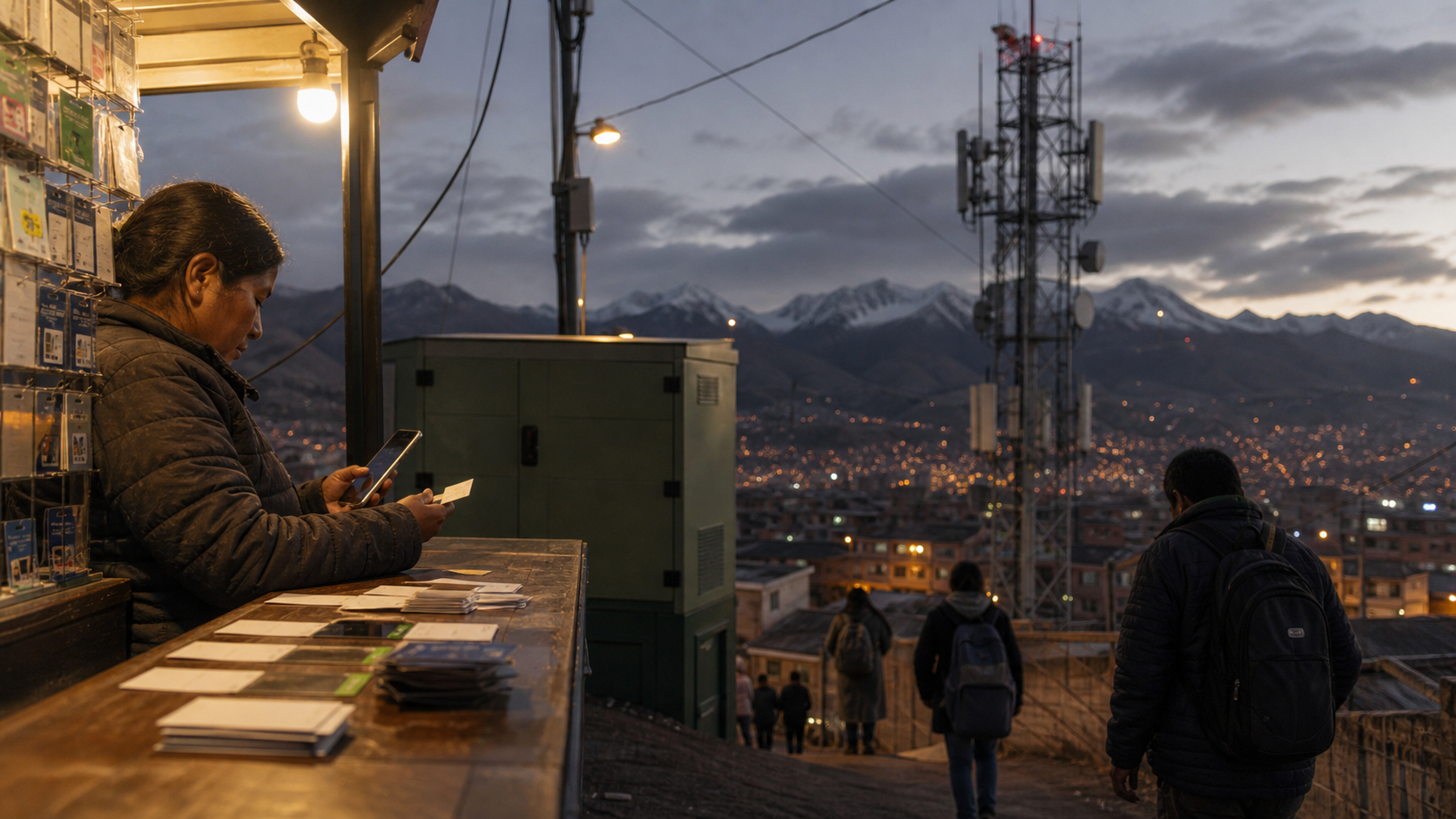
The kiosk finances the mountain
Telefónica Celular de Bolivia S.A., the Bolivian company behind Tigo Bolivia, is a test of whether a national mobile network can be financed by very small, very frequent acts of payment. The company sells national coverage, home broadband, pay television, mobile data and a wallet-like payments product, but its hardest economic problem starts at a simpler place: a prepaid customer buying a few days of data, a neighborhood shop handling a recharge, and that cash having to support radio sites, fiber routes, spectrum fees, power resilience, imported equipment, customer care and a regulatory bargain that expects coverage even where the direct return is thin. https://www.tigo.com.bo/mundo-tigo/conocenos/quien-es-tigo
The point is not that Bolivia is unusually connected in headline terms. ATT, the national telecom regulator, reported 108 active mobile lines per 100 inhabitants at the end of 2024 and 11.25 million mobile lines with internet access, equivalent to 99 lines with mobile internet per 100 inhabitants. https://www.att.gob.bo/sites/default/files/archivos_listados_pdf/2025-10-28/Estado%20de%20situacion%20de%20las%20telecomunicaciones%20en%20Bolivia%202024.pdf That is broad reach. The more important figure is the payment mix. ATT said prepaid users represented 90.9 percent of mobile users in December 2024, leaving postpaid at only 9.1 percent. https://www.att.gob.bo/sites/default/files/archivos_listados_pdf/2025-10-28/Estado%20de%20situacion%20de%20las%20telecomunicaciones%20en%20Bolivia%202024.pdf In a market like that, coverage is not financed mainly by long contracts and predictable monthly household bills. It is financed by a rolling stream of small decisions: three-day, seven-day and twelve-day data bundles; occasional voice minutes; low-denomination top-ups; and bundles that must feel useful enough to be renewed before the household decides that the cash has a better use.
That mechanism is visible on Tigo's own retail pages. The company markets prepaid "Paquetigos" with three-day unlimited mobile data at Bs 15, seven-day offers at Bs 30 and twelve-day offers at Bs 50, alongside add-ons for sports, voice, hotspot usage, SMS and music. https://www.tigo.com.bo/prepago Its homepage sells a broader identity - mobile, internet, television, entertainment, bill payment and Tigo Money - but the prepaid page is where the national coverage bargain becomes tangible. https://www.tigo.com.bo/ If a customer in El Alto, Santa Cruz, Cochabamba, Oruro or a smaller town buys a few days of data, that purchase is not only a consumption event. It is the last step of a financing chain that began with spectrum access, tower leases or owned sites, imported radio and routing equipment, backhaul, power, field maintenance and the working capital needed to keep a high-altitude, lower-income market online.
Millicom's public filings sharpen the company-specific picture. Telefónica Celular de Bolivia S.A. is wholly owned by the Millicom group, operates in Bolivia under Tigo, and has been in the country since 1991. https://www.sec.gov/Archives/edgar/data/912958/000162828025017048/tigo-20241231.htm At the end of 2024, Millicom reported that the Bolivian operation served 3.9 million mobile subscribers and was the second-largest mobile provider in Bolivia by subscribers. https://www.sec.gov/Archives/edgar/data/912958/000162828025017048/tigo-20241231.htm It also reported that it was the largest provider of broadband and pay-TV services in Bolivia by subscribers, with 683,000 fixed-service customer relationships, using HFC, FTTH and DTH technologies. https://www.sec.gov/Archives/edgar/data/912958/000162828025017048/tigo-20241231.htm That is a converged operator, not a narrow mobile reseller. Yet convergence does not erase the cash-flow reality. Mobile remains the country's mass product, and the national customer base is overwhelmingly prepaid.
The company's economic question is therefore not "does Bolivia need connectivity?" It plainly does. ATT's 2024 report showed mobile internet, fixed internet and mobile voice produced Bs 4.267 billion, Bs 2.452 billion and Bs 1.485 billion of sector revenue respectively, together accounting for 76 percent of the telecom sector's total revenue. https://www.att.gob.bo/sites/default/files/archivos_listados_pdf/2025-10-28/Estado%20de%20situacion%20de%20las%20telecomunicaciones%20en%20Bolivia%202024.pdf The question is whether Tigo Bolivia can keep converting low-denomination prepaid demand into enough cash to maintain coverage quality, extend fiber where it is rational, defend fixed broadband leadership, absorb dollar-linked technology costs and keep customers from switching in a market where prepaid users have little contractual friction.
That is why the company's prepaid problem is also a national infrastructure problem. Bolivia's geography turns coverage into a capital discipline. The population and revenue base are concentrated in the central axis: ATT reported that La Paz, Santa Cruz and Cochabamba together held about 75 percent of active mobile lines at the end of 2024. https://www.att.gob.bo/sites/default/files/archivos_listados_pdf/2025-10-28/Estado%20de%20situacion%20de%20las%20telecomunicaciones%20en%20Bolivia%202024.pdf But a national telecom operator cannot behave as if only the central axis matters. It has to maintain a presence across high-altitude cities, valleys, lowland departments and sparsely populated areas where tower power, transport, travel time and equipment support can cost more per user. If the customer pays in scattered top-ups, the operator must make the prepaid grid do the work of a longer-term financing product.
Why this is not just another Tigo market
Tigo Bolivia belongs to a regional Millicom system, but it is not simply a smaller copy of Guatemala, Colombia or Paraguay. The Bolivian operation has a particular mix of high mobile reach, unusually heavy prepaid exposure, meaningful fixed broadband assets, a demanding regulatory environment and macroeconomic stress that became more visible in 2025 and 2026. For Millicom, Bolivia is one country segment among a wider Latin American portfolio.
For Bolivian customers, Telecel is one of the few companies whose network quality directly determines whether a mobile wallet works, a household can study online, a football stream runs, a small business can collect payments, or a rural customer can stay connected without committing to a postpaid bill.
The official Tigo Bolivia "who is Tigo" page says the company has operated in Bolivia since 1991 and today offers mobile and high-speed mobile internet, unlimited fixed internet, subscription television, entertainment content, mobile wallet services and corporate services. https://www.tigo.com.bo/mundo-tigo/conocenos/quien-es-tigo That breadth matters because it gives Tigo more than one route to customer value. A pure prepaid mobile operator would live and die by recharge frequency. Tigo can cross-sell a household broadband line, a television package, a mobile add-on and an app-based payment path. The home plan pages show bundled prices such as Bs 249 for fixed internet and mobile features, and higher plans in the Bs 289 to Bs 439 range that combine internet, television, mobile data and streaming benefits. https://www.tigo.com.bo/planes
But a converged offer can also expose the company to multiple cost curves at once. Mobile requires spectrum, radio access equipment, tower operations, backhaul and customer acquisition. Fixed broadband requires last-mile build, customer premises equipment, installation labor, home support, HFC-to-fiber transition decisions and local competition from smaller fiber providers. Pay television adds content rights, some of which Millicom says can be dollar-priced and exposed to foreign exchange.
Tigo Money and app-based billing add product value and transaction data, but they also increase customer expectations for reliability: a network outage is no longer just a dropped entertainment session; it can interrupt payment, top-up and service management.
The Millicom filing shows the Bolivian business already has a material fixed position. It reported 683,000 fixed-service customer relationships at year-end 2024 and described Bolivia as the group's largest broadband and pay-TV position in that country by subscribers. https://www.sec.gov/Archives/edgar/data/912958/000162828025017048/tigo-20241231.htm It also reported that mobile broadband penetration among its Bolivian customer base was about 73 percent, while residential fixed broadband penetration in the country, using its own data and market intelligence, was about 33 percent and pay-TV penetration about 15 percent. https://www.sec.gov/Archives/edgar/data/912958/000162828025017048/tigo-20241231.htm The implication is that mobile data is mature enough to be a core utility, while fixed broadband still has room to grow but needs disciplined capital allocation.
That gap is the opening for Tigo Bolivia's strategy. If a prepaid mobile customer becomes a home broadband customer, the company gains a more predictable bill and a stronger relationship. If a home customer adds mobile service, Tigo can reduce churn and sell convenience. If Tigo Money is used for recharges and bills, the company can pull the customer into its own transaction environment. Millicom, at the group level, has repeatedly emphasized fixed-mobile convergence and prepaid-to-postpaid migration. In Bolivia, those themes are not just investor vocabulary.
They are practical ways to lower dependence on the smallest and least predictable prepaid recharge.
Still, Bolivia is a harder market than the convergence story suggests. Income is lower than in many of the region's larger telecom markets, imported technology depends on dollar access, and the exchange-rate regime changed just days before this article's publication. The country moved from a long fixed-rate period toward a flexible exchange-rate regime in late June 2026, after a period of dollar scarcity and parallel-market pressure. https://www.economiayfinanzas.gob.bo/sites/default/files/2026-06/RM_245_2026.pdf For a telecom operator, that is not an abstract macro event. Radio equipment, routers, fiber electronics, set-top boxes, handsets, software, content and some supplier contracts are connected directly or indirectly to foreign currency. Customers pay in bolivianos. The spread between local cash generation and external cost commitments is now more visible.
The network is a cash commitment before it is a product
Telecom networks are often described through coverage maps and speed claims, but the investment decision comes first. Before Tigo can sell a three-day prepaid data bundle, it has to hold spectrum rights, mount radios, light backhaul, interconnect with other networks, maintain routing infrastructure, power sites and provide customer systems that know whether a user has paid for a bundle, exhausted it or accepted a new one. The public record around Telefónica Celular de Bolivia shows a dense operating footprint rather than a simple brand presence.
ATT's public license registry lists Telefónica Celular de Bolivia S.A. with active national mobile-service authorization, mobile-access-band permissions, carrier services, value-added signal-distribution authorizations, terrestrial radio-link permissions across departments and satellite-related radio-link permissions. https://plataformas.att.gob.bo/index.php/Rul/publicos Millicom's annual filing says the Bolivian business holds a license to provide telecommunication services until 2051, mobile authorization and spectrum licenses until 2028 and 2031, cable and voice-over-internet authorizations until 2028, and internet authorizations until 2046. https://www.sec.gov/Archives/edgar/data/912958/000162828025017048/tigo-20241231.htm Those dates matter because they define the investment horizon. The company can plan long-term infrastructure, but specific mobile and spectrum renewals are nearer and can demand cash, negotiation and compliance.
Internet routing evidence points to the same conclusion from another angle. PeeringDB lists Telefónica Celular de Bolivia S.A., also known as Tigo Bolivia, as a regional cable, DSL and internet service network with the company website attached. https://www.peeringdb.com/net/26735 Hurricane Electric's BGP view lists the company's routing presence with hundreds of originated and announced IPv4 and IPv6 prefixes and observed peers; BGP.tools similarly shows a live routed footprint, upstream dependence and extensive RPKI-valid route origination. https://bgp.he.net/AS27882 https://bgp.tools/as/27882 This is not a minor retail label sitting on someone else's network. It is an operating communications network with public-number resources, external connectivity and a regional internet-service posture.
The hard part is making that network earn in the right rhythm. ATT's 2024 sector report shows why the revenue mix is changing. Mobile voice still generated Bs 1.485 billion, but internet was the sector's growth engine. Mobile internet revenue reached Bs 4.267 billion and increased 9.9 percent from 2023, while fixed internet revenue reached Bs 2.452 billion. https://www.att.gob.bo/sites/default/files/archivos_listados_pdf/2025-10-28/Estado%20de%20situacion%20de%20las%20telecomunicaciones%20en%20Bolivia%202024.pdf Fixed internet connections almost doubled from 2019 to 2024, reaching 1.444 million connections and growing 5.8 percent in 2024. https://www.att.gob.bo/sites/default/files/archivos_listados_pdf/2025-10-28/Estado%20de%20situacion%20de%20las%20telecomunicaciones%20en%20Bolivia%202024.pdf Voice traffic and fixed telephony lines continued to weaken. Tigo is therefore maintaining a legacy of national voice reach while pushing money into mobile data and fixed broadband, the two products that customers actually use more intensely.
The capital challenge is that mobile data growth does not automatically mean high incremental profit. More data consumption can require spectrum efficiency, densification, backhaul upgrades and customer support. Fixed broadband growth can require trucks, trenching, aerial fiber, modems, HFC maintenance, FTTH overlays and local permitting. In Millicom's own risk language, broadband build-out through HFC, FTTH and fixed wireless is capital intensive, and local or regional fiber providers can compete with equal or higher speeds at aggressive prices.
That risk is especially relevant in Bolivia, where urban neighborhoods can be contested one street at a time by cable operators, cooperatives, local fiber firms and national brands.
Tigo's network advantage is breadth. It can combine mobile, fixed, television and payments. Its disadvantage is that breadth demands management attention and cash. A narrow fiber challenger can focus on a neighborhood and avoid national obligations. A state-owned mobile rival can tolerate returns that a private operator would reject. A prepaid customer can switch after the last bundle expires. A national operator has to keep quality acceptable everywhere because a visible outage in one region damages the brand nationally, even if the underlying cost base differs sharply by geography.
Bolivia's physical geography turns that breadth into an operating test. La Paz and El Alto sit at an altitude where power, access and weather can complicate field work; Santa Cruz brings density and growth but also competitive pressure; Cochabamba is a central market with household broadband potential; Beni and Pando require a different logic of reach, travel and resilience. The network cannot be managed only from a national average because the cost of one usable gigabyte is not the same everywhere. A tower in a dense urban corridor can amortize power, backhaul and maintenance across many customers.
A site serving a thin corridor may be strategically necessary but financially dependent on the whole national cash pool.
This is why the ATT department data matter beyond demography. When La Paz, Santa Cruz and Cochabamba represent about three quarters of mobile lines, they also become the economic engine that helps support the wider service obligation. The operator has to win enough share and usage in the densest departments to maintain credibility elsewhere. If those urban customers migrate to cheaper neighborhood fiber, buy fewer mobile bundles, or punish outages by shifting usage to another SIM, the cross-subsidy logic weakens. National coverage is therefore not a charitable layer on top of a profitable urban business.
It is a portfolio that depends on keeping the strongest local markets strong enough to carry harder geographies.
Power is another hidden variable in the prepaid bargain. Mobile customers usually experience the network as signal bars and data speed, but towers and cabinets experience Bolivia as electricity availability, backup power, fuel logistics, battery replacement, theft risk, storms, road access and spare-part lead times. A few bolivianos of prepaid data must help pay for all of that. When foreign exchange is scarce or devaluation raises replacement costs, the decision to replace batteries, upgrade radios or improve backhaul can no longer be treated as routine. It becomes a choice among service quality, cash conservation and regulatory risk.
The result is a business in which technical resilience and financial resilience are the same problem. Tigo Bolivia does not need to be the cheapest operator in every micro-market. It needs customers to believe that its network is reliable enough, its recharge path is easy enough and its bundle value is fair enough that they keep renewing. Every operational failure increases the discount customers demand before they trust the next offer. Every visible improvement gives the company more room to sell a bigger bundle, a household plan or a converged relationship.
Pricing is a discipline, not only a tariff sheet
Tigo Bolivia's retail pricing shows a company trying to match the cash habits of its customers without turning the network into a giveaway. Prepaid packages at Bs 15, Bs 30 and Bs 50 are not random promotions. They are duration-based products built around the way many customers manage liquidity. https://www.tigo.com.bo/prepago A customer may not want a monthly commitment, but may be willing to buy three or seven days of data when wages, remittances, informal income or household priorities permit. The operator's task is to make those small purchases frequent enough that the customer lifetime value supports the network.
The regulatory environment makes this more delicate. Millicom disclosed that in 2022 Bolivia's regulator prohibited operators from automatically deducting prepaid balances for on-demand data once a user's package was exhausted unless the user had expressly opted in. https://www.sec.gov/Archives/edgar/data/912958/000162828025017048/tigo-20241231.htm After the customer uses a data allowance, the operator must cut data access until the customer buys another package or accepts on-demand data. Consumer protection logic is clear: prepaid users should not unexpectedly lose balance. The business effect is also clear: the operator loses a frictionless revenue path and must persuade the user to make a new purchase. That raises the importance of app design, recharge channels, bundle clarity and customer trust.
This is where Tigo Money and Mi Tigo become more than convenience tools. Tigo Money markets sending and receiving money, bill payment, recharges, Paquetigos and merchant promotions. https://www.tigomoney.com/bo/ Tigo's own pages encourage customers to use digital channels for recharges, bill payment and service management. https://www.tigo.com.bo/recargas-y-pagos The economic reason is straightforward. If a prepaid customer can recharge immediately after a bundle expires, Tigo reduces leakage. If the customer must walk to a shop, wait for cash, or compare another operator's offer, the renewal moment becomes a churn moment. In a 90.9 percent prepaid market, the company is always one inconvenience away from lost usage.
Postpaid is attractive because it changes that rhythm. Tigo's postpaid and bundled home offers use monthly prices, add-ons and service combinations to create a more regular bill. But postpaid growth cannot be assumed. In lower-income markets, customers may avoid fixed commitments because income is uncertain or because mobile numbers are used tactically across operators. ATT's data show the prepaid share has remained broadly stable over recent years.
That means Tigo cannot simply migrate the market by preference; it must earn migration through perceived value, coverage reliability, handset affordability, household broadband, entertainment rights and customer service.
The home broadband offer is a partial answer. Fixed internet can produce a predictable monthly bill and a stronger relationship, especially in households where streaming, work, school and gaming require more stable service. Tigo's home plans with 100 Mbps, 150 Mbps, 300 Mbps and 500 Mbps tiers show the company trying to place itself inside the household rather than only in the handset. https://www.tigo.com.bo/planes The risk is that fixed broadband also invites direct comparison. A customer can test speed, complain about latency, compare neighborhood fiber prices and demand a technician. Mobile prepaid customers tolerate more variation because the product is short duration; fixed customers expect permanence.
The better judgment is that Tigo Bolivia's pricing architecture is not a race to the bottom but a portfolio of cash rhythms. Prepaid bundles monetize the mass market. Home broadband stabilizes the household relationship. Pay television and sports rights make the bundle more emotionally sticky but can raise content costs. Tigo Money and apps reduce payment friction. Corporate services and B2B connectivity diversify revenue. The company is healthiest when these layers reinforce each other, and weakest when they become separate cost centers that customers can unbundle without penalty.
The customer-dependence risk is unusually immediate because prepaid users make a purchasing decision every time service expires. A bank, a utility or a postpaid telecom company may lose trust slowly; a prepaid mobile operator can lose spend by the next afternoon. That changes how to read customer satisfaction. A complaint about slow internet is not only reputational. It is an indicator that the next Bs 15 or Bs 30 may go to another operator, or may not be spent at all. A household that loses confidence in fixed broadband may keep a Tigo SIM but move the home connection.
A small business that uses mobile payments may keep the wallet but change the data connection if reliability falls.
This is also why Tigo Money is strategically useful but not a cure-all. A wallet and recharge product can make the renewal loop easier, and it can extend Tigo's relevance beyond connectivity. Yet the wallet depends on network trust and institutional trust. If the mobile service is unreliable, the payment product loses some of its halo. If customers are worried about income, exchange-rate effects or household prices, convenience does not guarantee more spending. The wallet is most valuable when it shortens the distance between intention and renewal: the customer decides to stay connected and can act immediately.
It is less valuable if the customer has already decided that the service is not worth the next small payment.
The supplier bill is global, the customer wallet is local
Telefónica Celular de Bolivia earns in bolivianos. Much of what it must buy is priced, benchmarked or financed through global supply chains. Millicom identifies key suppliers across its networks, including Huawei, Ericsson, Nokia, PPC, Fiberhome, Harmonic, Kaon, Vantiva, Juniper, Intraway and VMware. That list spans mobile radio, core network, cable, fiber, customer equipment, software and video delivery. Even when local invoices are settled through intermediaries, the underlying equipment economy is global.
This is where Bolivia's exchange-rate shift becomes central. The country operated for years with an official dollar rate that diverged from market pressure. IMF material in 2025 highlighted scarce foreign exchange, low reserves and disruptions involving fuel and other inputs. https://www.imf.org/en/news/articles/2025/05/30/pr-25168-bolivia-imf-concludes-2025-art-iv-consult In late June 2026, the government and central bank moved toward a flexible exchange-rate system, with the initial official rate reported around Bs 9.73 per dollar rather than the old fixed level near Bs 6.96. https://www.vision360.bo/noticias/2026/06/26/55249-este-lunes-bolivia-iniciara-de-forma-oficial-el-regimen-cambiario-flexible-del-dolar-con-un-tipo-de-cambio-de-bs-9_73 For Tigo Bolivia, the timing is important. A flexible exchange rate can improve macro adjustment over time, but it can also reprice imported equipment, dollar-linked leases, content, software, handsets and financing assumptions quickly.
The company cannot pass every external-cost increase through to prepaid users. A three-day Bs 15 package is psychologically different from a Bs 20 package. A fixed broadband plan can be repriced, but local fiber competitors and household incomes constrain the move. A pay-TV bundle can absorb content cost for a while, but dollar-priced sports and entertainment rights eventually demand margin recovery or portfolio changes. The operator's answer must be procurement discipline, network standardization, selective capex, energy management and better customer segmentation.
Millicom has been moving in that direction regionally. Its latest group messaging emphasizes stronger cash generation, cost efficiency, fixed-mobile convergence, prepaid-to-postpaid migration and disciplined capital allocation. Its 2025 annual-report announcement highlighted $5.8 billion of revenue, $1.3 billion of net profit and $916 million of equity free cash flow, while the Q1 2026 release pointed to $2.0 billion of quarterly revenue, $857 million of adjusted EBITDA and $225 million of equity free cash flow. https://www.globenewswire.com/news-release/2026/03/24/3261824/0/en/millicom-tigo-publishes-its-2025-annual-report-highlighting-record-financial-results-and-expanded-regional-footprint.html https://ml-eu.globenewswire.com/Resource/Download/a631f71d-c04b-4be4-8835-a8ff1a7c9db8 Those are group numbers, not Bolivia numbers, but they define the capital culture around the Bolivian subsidiary. A country operation has to compete for investment within a regional group that is also integrating acquisitions and managing leverage.
Bolivia's attractiveness inside that portfolio comes from an existing scaled position. The company is not building from scratch. It has 3.9 million mobile subscribers, 683,000 fixed-service customer relationships, a large broadband and pay-TV position and long-dated telecom authorization. Its weakness is that much of the future upside requires more capital precisely when foreign-currency costs are harder to forecast. Fiber extension, mobile capacity, customer equipment and reliability investment all become more expensive if the boliviano weakens materially against supplier currencies.
The best way to read Tigo Bolivia's cost base is as a series of conversion tests. Can the company convert prepaid demand into reliable data revenue? Can it convert mobile-only users into fixed or converged households? Can it convert urban broadband leadership into enough cash to cross-subsidize harder geographies? Can it convert app and wallet usage into lower payment friction? Can it convert regional procurement scale into lower Bolivia unit costs? The answer does not have to be perfect, but it has to be better than the rate at which inflation, exchange-rate adjustment, equipment aging and competition eat the margin.
Competition is state scale, private urgency and low switching cost
Bolivia's mobile market is concentrated around Tigo, state-owned Entel and Viva/Nuevatel. That structure gives the sector fewer national mobile brands than some larger markets, but it does not make competition soft. In prepaid markets, a customer can carry more than one SIM, switch usage by offer, or let one operator become the data SIM and another the voice or coverage fallback. Number portability and recharge availability raise that pressure. The customer does not need to dislike Tigo to reduce Tigo's share of wallet; the customer only needs a better short-term bundle elsewhere.
Entel's state ownership changes the competitive benchmark. A state-owned operator can be asked to serve social coverage goals, absorb political expectations and price with a different tolerance for return. It can also benefit from national recognition and public-sector relationships. Tigo, by contrast, must satisfy customers, regulators and Millicom's capital discipline. That can produce sharper operating urgency, but it also means investment decisions are judged against returns and cash generation.
Viva/Nuevatel adds another private-market reference point, and local fixed competitors add pressure in broadband. Millicom's filing warns that local and regional fiber providers can offer equal or higher data speeds at competitive prices. That is particularly relevant in dense urban areas where a smaller provider can target attractive neighborhoods without carrying the same national mobile obligations. A household may buy Tigo mobile for coverage but choose a neighborhood fiber provider for home internet. Or it may keep Tigo home internet but use another SIM for a promotional mobile bundle.
Convergence is powerful only if the customer believes the combined product is better than shopping each line separately.
Coverage is also not a simple national average. ATT's department data show the central axis dominates mobile lines, while rural and lower-density areas produce different economics. The departments with lower mobile penetration are not necessarily unattractive, but they may require a broader social and operational logic. A private operator that cuts too much investment outside core urban areas risks regulatory pressure and brand damage. A private operator that overinvests without revenue risks margin damage.
The correct posture is disciplined coverage: enough quality to defend the brand and license bargain, enough selectivity to avoid building capacity where short-term data demand cannot pay.
Unofficial market signals point to a low-tolerance customer environment. Bolivian press and social channels have repeatedly carried complaints about Tigo service interruptions, internet failures and customer frustration, including reports in 2025 and 2026 that users complained about mobile and fixed internet problems. https://www.eldiario.net/portal/2026/03/11/tigo-presta-servicio-pesimo-a-usuarios/ ATT and local news also reported regulator coordination with Tigo during a May 2026 service disruption affecting mobile and fixed internet. https://abi.bo/att-coordina-acciones-tecnicas-con-tigo-ante-afectaciones-en-servicios-de-internet/ These items should not be treated as a full quality audit; complaints cluster around bad moments and do not measure routine service. They are still economically meaningful because they show what kind of trust reserve the operator has. In a prepaid market, a bad week can become an immediate revenue event.
The same caution applies to travel forums and local online discussions comparing Tigo, Entel and Viva. Some users praise Tigo or place it among the better options; others say Entel has better coverage in certain areas or that Tigo fixed internet can vary by neighborhood and technology. https://www.reddit.com/r/BOLIVIA/comments/1e62uyk/internet_tigo/ https://www.losviajeros.com/foros.php?sm=Bolivia-Tarjeta-Sim That is not audited market research, but it captures the practical way customers choose: by city, district, building, trip route, price, and whether the last problem was resolved. For a national operator, perceived reliability is therefore granular. A strong national network can still lose a building, a neighborhood or a family if the local experience is poor.
Regulation is part of the product
Telecom regulation in Bolivia is not only a background condition; it shapes the product customers receive. ATT supervises the company, publishes sector statistics, maintains public licensing records, handles customer-protection infrastructure and has rules that directly affect prepaid monetization. https://www.att.gob.bo/en/situacion-de-las-telecomunicaciones-en-bolivia Tigo's website itself notes that Bolivia Telecel S.A. is regulated and supervised by ATT. https://www.tigo.com.bo/
The 2022 prepaid data rule is the clearest example. A regulator can decide that balance protection matters more than frictionless data charging. That changes how an operator designs packages, alerts, app flows and renewal notices. It also changes how customers understand fairness. If users believe an operator consumes balances without consent, they may reduce trust and buy smaller bundles. If rules protect them but data stops abruptly when a bundle ends, the operator must make the next purchase easy. Regulation therefore becomes part of the user experience.
License duration also shapes investment. Long service authorization until 2051 supports a long horizon, but mobile authorization and spectrum expiration dates in 2028 and 2031 create nearer checkpoints. Spectrum is finite, politically sensitive and expensive. Millicom's general risk disclosure says available spectrum is limited, closely regulated and can require significant capital expenditure to acquire or renew. Bolivia's own spectrum renewals and authorizations will need to be weighed against the company's ability to monetize more data in a prepaid-heavy market.
There is also a social expectation embedded in national coverage. ATT's 2024 report speaks in terms of digital divide, mobile penetration, department-level line distribution and internet access. When a regulator frames the sector around inclusion, operators inherit more than a commercial opportunity. They inherit expectations around coverage, affordability, consumer protection and service continuity. That can be positive for Tigo if public policy supports rational investment, protects legal operators and discourages destructive price wars.
It can be negative if obligations expand faster than revenue or if political pressure forces retail prices below sustainable levels.
The exchange-rate transition adds another regulatory layer. A flexible currency regime can shift consumer prices, wage pressure, import costs and public sensitivity to tariff increases. Telecom operators may need to adjust prices to preserve investment, but regulators and politicians may resist visible price increases in essential services. The tension is obvious: if Tigo cannot recover dollar-linked costs, service quality and investment suffer; if it raises prices too aggressively, prepaid users reduce consumption or switch.
The company will need a careful blend of package redesign, segmentation, efficiency and evidence-based regulatory engagement.
There is a second-order issue that can be easier to miss: regulation also affects the credibility of long-term investment. A company can accept demanding service rules if it believes authorizations will be renewed predictably, spectrum will be priced rationally and consumer-protection decisions will be paired with a realistic view of network economics. It becomes harder if rules are retroactive, pricing becomes politicized or the cost of compliance is not matched by a path to recover capital.
Bolivia's long telecom-service authorization gives Tigo a foundation, but the nearer mobile and spectrum horizons mean the operator still has to negotiate the next phase of the network. Investors will care not only about license dates but also about the quality of the regulatory bargain.
For customers, that sounds remote, but it determines whether the next network upgrade arrives. The public wants affordable data, strong coverage and quick repairs. The operator wants enough return to keep buying equipment, paying for spectrum, improving backhaul and staffing field teams. The regulator wants inclusion and fairness. Those goals can align, but only if the economic chain is visible. In a prepaid-heavy market, the chain begins with small customer payments and ends with national infrastructure. If any link is treated as unlimited, the system becomes brittle.
What facts would change the judgment
The current judgment is that Telefónica Celular de Bolivia is strategically important, commercially real and economically constrained. It has scale, a broad service portfolio, national network evidence, long-dated authorizations, a strong fixed broadband and pay-TV position, and a valuable role inside Millicom's Latin American footprint. Its main vulnerability is not a lack of demand. It is the difficulty of translating small prepaid payments into enough durable cash to fund coverage, capacity, fixed broadband upgrades and imported technology in a volatile macro environment.
Several facts could improve that judgment. The first would be clear evidence that prepaid-to-postpaid migration is accelerating in Bolivia without large subsidies or bad debt. A rising postpaid share would lengthen customer cash flows and support handset, data and convergence economics. The second would be stronger fixed-mobile convergence data: more home broadband customers also taking Tigo mobile, lower churn among converged households and higher average revenue per household. The third would be stable post-exchange-rate pricing, where Tigo can adjust bundles or plan tiers without losing volume.
The fourth would be visible network quality improvement, especially if regulator complaints and public outage chatter decline.
Other facts would weaken the judgment. If the boliviano depreciates further and equipment, content or financing costs rise faster than retail revenue, Tigo's investment case becomes harder. If ATT or political actors pressure operators to hold prices while costs rise, the company may protect short-term customer affordability at the expense of network quality. If Entel uses state-backed scale to price aggressively, Tigo may have to choose between margin and share. If local fiber competitors continue to cherry-pick urban neighborhoods, Tigo's fixed broadband leadership may be less valuable than subscriber counts suggest.
If repeated outages damage trust, prepaid users can punish the company immediately by buying their next bundle elsewhere.
The most ambiguous signal is Bolivia's new exchange-rate regime. In the short term, it raises uncertainty and may reprice imported inputs. In the medium term, if it eases dollar scarcity and normalizes access to foreign currency, it could help operators plan procurement more honestly. A distorted exchange-rate system can hide costs until the day a spare part, router, content contract or vendor invoice has to be paid. A more realistic system can be painful but investable. Tigo Bolivia's outcome depends partly on whether the macro transition becomes a controlled adjustment or a recurring shock.
Two operational facts would be especially telling over the next twelve to eighteen months. One is whether Tigo can keep prepaid bundles psychologically affordable while protecting unit economics. If the company can redesign allowances, durations and app-based renewals so that customers feel continuity rather than price shock, it will have more room to protect network investment. The other is whether fixed broadband growth continues without a visible increase in public frustration. Fixed service has the potential to deepen household relationships, but it is also less forgiving than prepaid mobile.
When a home line fails, the whole household notices; when installation or repair is slow, the customer compares the experience with every local alternative.
The strategic upside would be a Bolivia business that becomes more stable than its prepaid mix suggests. In that version, Tigo keeps enough urban broadband leadership to support cash generation, uses Tigo Money and app channels to lower recharge friction, nudges valuable customers into monthly relationships, and treats rural and high-cost coverage as a managed national obligation rather than an afterthought. The downside version is a business squeezed between a state rival, local fiber challengers, higher dollar-linked costs and customers who remain loyal only until the next bundle expires.
The difference between those outcomes will be decided less by slogans than by repair times, recharge ease, bundle design, exchange-rate management and disciplined capital allocation.
The judgment
Telefónica Celular de Bolivia is not best understood as a generic national telecom company. It is a prepaid cash-flow machine attached to a capital-intensive national network. The machine is valuable because Bolivia uses mobile data heavily, because Tigo has a large mobile base and because the company has built a real fixed and pay-TV position.
The machine is fragile because prepaid customers finance the system in small increments, because coverage outside the richest corridors costs real money, because the supplier bill is globally priced, and because regulatory and macro conditions can change the economics faster than a three-day bundle can be repriced.
That makes Tigo Bolivia a company to watch for operating discipline rather than headline subscriber growth alone. More mobile lines are useful, but only if they buy data often enough. More home broadband customers are valuable, but only if installation, support and equipment costs are controlled. More entertainment content is sticky, but only if rights costs do not outrun household willingness to pay. More app and wallet usage is attractive, but only if reliability is strong enough that customers trust the digital loop.
The company's strongest asset is its position at the intersection of daily necessity and national infrastructure. A prepaid top-up in Bolivia is small, but it is not trivial. It is how a household buys participation in the digital economy for the next few days. Tigo's challenge is to gather millions of those decisions and turn them into a network that remains reliable, investable and competitive. If it can do that while managing foreign-currency pressure and moving enough customers into deeper relationships, the Bolivian business remains a defensible part of Millicom's regional portfolio.
If it cannot, the same prepaid flexibility that gives Tigo reach will become the channel through which customers express disappointment one recharge at a time.