
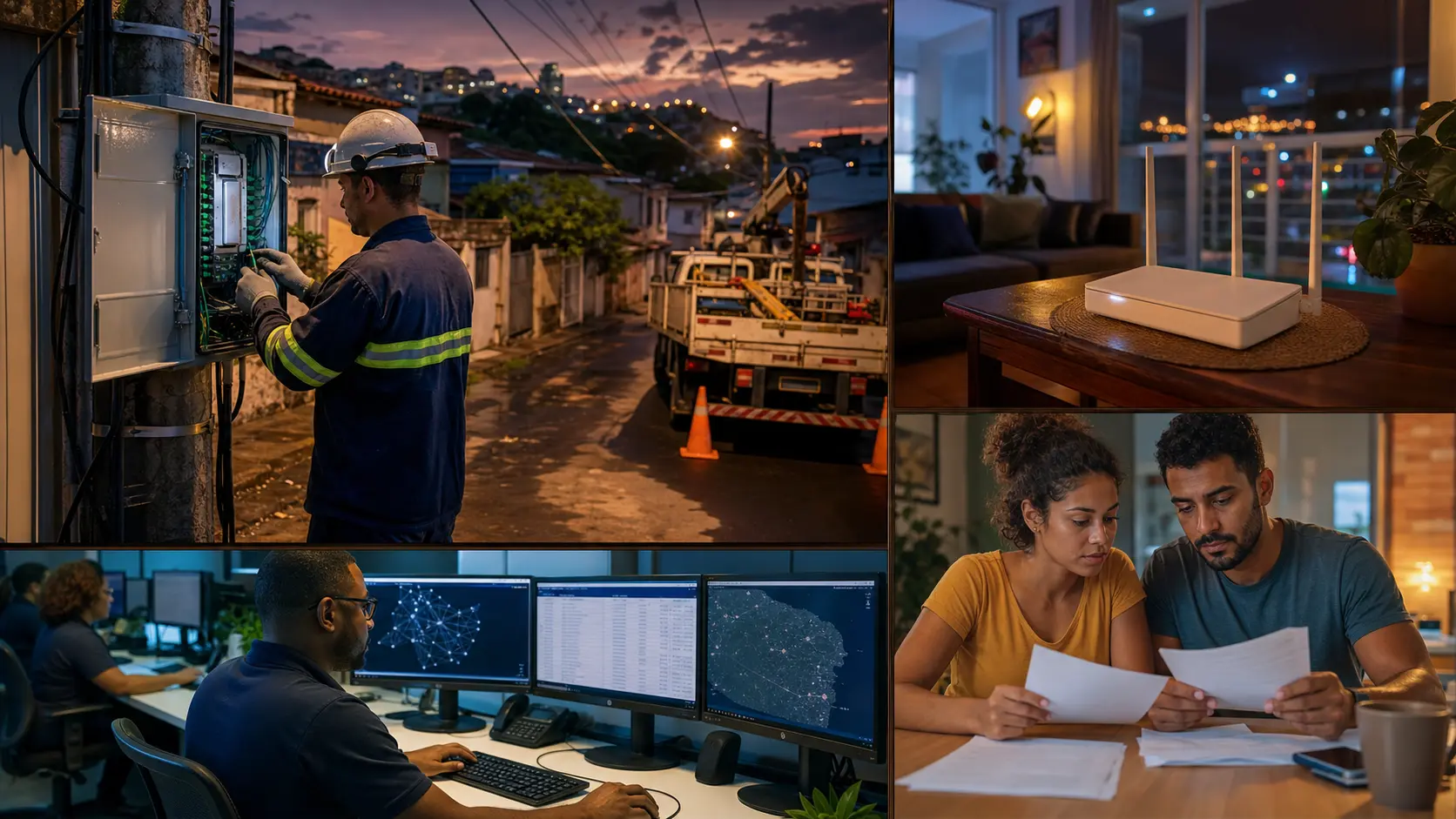
The household bill is the economic unit
A TELY story starts most cleanly at a kitchen table in northeastern Brazil, not in a routing table. A household in Joao Pessoa, Cabedelo, Mamanguape, or a smaller Paraiba municipality is not buying an abstract backbone. It is comparing a monthly fibre bill, the installation conditions, the streaming bundle, the WhatsApp sales path, the repair experience after a rainstorm, and the likelihood that someone local will answer when the connection fails during work, study, gaming, or family video calls. TELY's own consumer plan page sells exactly that bundle: fibre internet, free installation in the advertised offers, Wi-Fi, and support claims rather than only raw megabits https://tely.com.br/planos. Independent plan listings show the same retail battleground in sharper price terms: in Joao Pessoa, Minha Conexao listed TELY offers around R$79.90 to R$119.90 per month for 500 Mbps to 1 Gbps packages with streaming or gaming add-ons, while noting 12-month loyalty periods and cancellation penalties for several offers https://www.minhaconexao.com.br/planos/provedores/tely. MelhorPlano separately showed TELY's 500 Mega and 1 Giga offers clustered around the same affordability band, reinforcing that the operator is competing in a price-sensitive household category where national operators and other regional fibre builders can undercut, bundle, or overbuild quickly https://melhorplano.net/provedores/tely.
That price band is the first mechanism. A regional fibre operator such as TELY wins a household only if the customer believes the local service delta is worth as much as the national brand, and sometimes worth more than a slightly cheaper offer. Its public positioning leans hard into that local trust claim. The company says it has connected people since 2004 and presents itself as serving families, businesses, providers, and individuals, a wider identity than a pure last-mile retail ISP https://tely.com.br/sobre-nos. Its support page says customer service runs from 06:00 to 23:59, gives a phone and WhatsApp route, names a Joao Pessoa physical service unit, and describes a footprint of about 200 municipalities and more than 20,000 km of fibre network https://tely.com.br/atendimento. In a household comparison, those claims matter because the customer is buying not just speed but the perceived cost of failure: missed work, children losing a class, a home business losing card payments, or a streaming night collapsing into a support queue.
The opening evidence is company-specific because the public facts do not fit a generic small-provider template. TELY is not merely a storefront reselling connectivity under a local brand. Its public network identity is AS53087; Registro.br/LACNIC RDAP shows the autonomous-system allocation for 53087 in Brazil, names TELY Ltda. as registrant, ties it to CNPJ 06.346.446/0001-59, and names Leonardo Stefanis Farias Lins in the registration contact structure https://rdap.lacnic.net/rdap/autnum/53087. RDAP also shows TELY as registrant for IPv4 space 177.75.64.0/20 and IPv6 space 2804:298::/32, which are not marketing claims but number-resource evidence that the company operates internet infrastructure under its own public network identity https://rdap.lacnic.net/rdap/ip/177.75.64.0 and https://rdap.lacnic.net/rdap/ip/2804:298::. BGP.tools reports AS53087 as active, registered in October 2009, with 42 IPv4 and 3 IPv6 originated prefixes in its visible table, 248 peers, 8 upstreams, and 115 downstreams, which makes the economics of TELY partly retail and partly interconnection https://bgp.tools/as/53087.
The judgment therefore begins with a tension. TELY's local retail promise depends on intimacy: the user wants a company that understands the municipality, the neighbourhood, and the repair path. TELY's cost structure increasingly depends on scale: backbone, traffic engineering, exchange ports, equipment refresh, pole access, field crews, billing systems, and enough traffic density to make the incremental home profitable. A regional ISP that stays too small can be loved but subscale. A regional ISP that chases scale too aggressively can become the same distant service machine it was supposed to beat.
TELY's investment case, operating risk, and strategic value sit in that narrow space between trust and scale.
The business is retail access plus transport optionality
TELY's public pages show a company trying to avoid being trapped in one margin pool. The consumer page sells home fibre. The enterprise page sells connectivity, telephony, cybersecurity, Wi-Fi enterprise, cloud/VPS, and a broader "Tely Total Pro" bundle to businesses that need more than a household broadband line https://tely.com.br/suaempresa. The provider-facing page offers services for other providers, which is a clue that TELY thinks of its network as wholesale infrastructure as well as a retail access product https://tely.com.br/seuprovedor. Tely Americas describes the cross-border and wholesale logic even more explicitly, saying it uses extensive fibre capillarity to help global carriers, infrastructure companies, and content businesses operate in Brazil while keeping corporate structures abroad https://www.telyamericas.com/. That is not the business model of a corner ISP whose only asset is a few last-mile cabinets.
The wholesale angle changes the economics. Residential broadband produces monthly recurring revenue but is exposed to churn, promotional pricing, truck rolls, and customer-service cost. Enterprise and carrier services can carry higher unit economics, but they demand reliability, contractual discipline, route diversity, and credible network engineering. PeeringDB places TELY at AS53087, lists it as Cable/DSL/ISP, gives the company website, reports 200-300 Gbps traffic levels, "heavy inbound" traffic ratio, South America geographic scope, AS-TELY as the IRR set, selective peering policy, 1,200 IPv4 and 500 IPv6 prefixes as recommended session limits, and public contacts for NOC and network engineering https://www.peeringdb.com/net/9889. Its API entry also lists the organization address on Avenida Sao Paulo in Joao Pessoa, facilities in Joao Pessoa, Fortaleza, Salvador, Sao Paulo, Rio de Janeiro, Cotia, Barueri, and Santana de Parnaiba, and seven public exchange LAN entries https://www.peeringdb.com/api/net/9889.
Those details matter because the operator's ability to sell trust at the edge depends on hidden middle-mile and interconnection costs. If the household is watching a streaming platform, the traffic pattern is often heavy inbound: content comes into the access network from caches, transit, and peering. If TELY can place ports and equipment near content, exchange points, and wholesale customers, it can improve quality and reduce transit cost per bit. If it cannot, retail growth can become a punishment: more customers produce more traffic without enough gross margin to fund the next backbone upgrade.
The PeeringDB and BGP evidence suggests that TELY has built a real interconnection surface rather than relying only on one upstream path, but the same evidence also shows why the business is capital-hungry. Multiple facilities, exchange points, and upstream relationships are not free options; they are recurring commitments.
The equipment-refresh story reinforces the same point. Padtec said in 2025 that TELY was modernising and expanding its DWDM optical network, described a backbone of about 25,000 km, said the network connected ten states, and said Padtec was supplying 43 TM800G transponders plus additional high-capacity optical equipment https://www.padtec.com.br/en/tely-one-of-the-largest-telecommunications-companies-in-the-northeast-modernizes-and-expands-its-optical-network-with-padtec-solutions/. Ciena's customer story described TELY using coherent optical technology to increase capacity for demanding cloud and data-service traffic, with Leonardo Lins arguing that the solution let the company move more capacity at long distance with quality and cost efficiency https://www.ciena.com/about/customer-stories/tely-turns-to-ciena-for-capacity-boost. Vendor case studies are promotional by nature, but the underlying signal is still important: a provider selling both households and wholesale capacity must keep reducing cost per transported bit. Otherwise, a network that was an advantage during early fibre growth becomes a fixed-cost burden.
This is why TELY is better understood as a regional fibre operator with retail exposure, not simply as a consumer ISP. The household bill is where trust is won or lost, but the value of the company is in how many different revenue streams can ride the same fibre, optical equipment, exchange presence, and support organisation. A pure household provider has to recover its build cost through one monthly subscription. TELY's stronger version recovers it through households, SMEs, enterprise connectivity, wholesale backhaul, content and carrier relationships, and other providers that need reach in the Northeast and beyond.
The weaker version is a company forced to spend like a backbone operator while competing like a neighbourhood broadband brand.
Local trust has to survive the price screen
Brazilian fixed broadband is no longer an easy-growth market where almost any fibre build can fill quickly. Radar da Telecom's Anatel-derived national broadband page showed 55.44 million fixed-broadband accesses in May 2026, a 79.40% FTTH share, Claro as national share leader at about 19.45%, and a market where large operators, aggressive regional groups, satellite providers, and small local ISPs all show up in city-level competition https://www.radardatelecom.com/servico/banda-larga. That national picture is crucial for TELY: fibre penetration is high enough that growth now often comes from stealing customers, upgrading households, entering uncovered pockets, or serving higher-value business and wholesale demand, not simply stringing fibre into virgin territory.
The Joao Pessoa data shows the challenge in TELY's home city. Radar's city page, citing Anatel and IBGE, reported 288,600 fixed-broadband accesses in Joao Pessoa, fifteen active operators, Brisanet with 49% share and 141,536 accesses, Claro with 24% and 69,246, Vivo with 8.8% and 25,443, and TELY fourth with 6% and 17,381 accesses as of the July 2026 page update https://www.radardatelecom.com/banda-larga/joao-pessoa-pb. That is the uncomfortable evidence for the local-trust thesis. TELY may be headquartered in Joao Pessoa and may have deep local brand history, but the customer table is led by Brisanet and national-scale brands. If a Joao Pessoa household sees TELY as one provider among many, then the company cannot rely on local identity alone; it must either offer better reliability, better support, better bundles, or sharper price-value clarity.
Cabedelo gives a more favourable but still competitive example. Radar reported 27,369 fixed-broadband accesses in Cabedelo, fifteen active operators, Brisanet with 50.5% share and 13,832 accesses, and TELY second with 16.5% and 4,525 accesses https://www.radardatelecom.com/banda-larga/cabedelo-pb. Mamanguape gives the stronger version of TELY's regional model: Radar reported 9,157 fixed-broadband accesses, TELY leading with 58.9% share and 5,391 accesses, and fifteen active operators in the city https://www.radardatelecom.com/banda-larga/mamanguape-pb. The pattern is not a simple victory lap or a simple failure. TELY appears capable of local dominance in some municipalities, meaningful challenger position in others, and weaker share in the capital. The economic question is whether the company can turn the strong smaller-market positions into a scaled regional network advantage without losing the service intimacy that made those positions possible.
Radar's company page captures the growth signal behind that question. It lists TELY at 37,175 broadband accesses in May 2026, up from 29,935 twelve months earlier, across fourteen states, and cites Anatel open data for the company page https://www.radardatelecom.com/empresa/tely. A 24% access increase from a relatively small base is good evidence of commercial momentum, but it also raises the follow-on cost problem. Growth requires new customer-premise equipment, installation crews, drop fibre, splitters, back-office capacity, cash tied up in acquisition, and a larger maintenance surface. The first 10,000 customers in a region can be added by dense, obvious demand. The next 10,000 often include more price-sensitive households, more contested streets, more apartment-building access constraints, and more service calls as the installed base ages.
The retail price screen is therefore harsher than a headline growth number implies. If TELY uses promotional prices to enter or defend a city, it may gain access share but dilute payback periods. If it refuses price competition, it may preserve margin but leave the field to Brisanet, Claro, Vivo, Oi/Nio-related fibre assets, and local independents. If it sells premium support as the differentiator, it has to fund that support with real people and systems. If it leans on entertainment and gaming bundles, it takes on partner economics and customer expectation risk. The plan-comparison pages are useful market chatter precisely because they reveal the customer's shopping experience: the product is collapsed into speed, monthly price, installation, app bundle, loyalty period, and WhatsApp button https://www.minhaconexao.com.br/planos/provedores/tely and https://melhorplano.net/provedores/tely. TELY's brand story has to survive that compressed comparison.
The cost stack gets heavier after easy growth
The most important cost in a regional fibre operator is not one line item. It is the interaction of civil work, electronics, support, power, pole or duct access, customer equipment, capacity upgrades, and churn. A dense neighbourhood with aerial fibre and fast take-up can look excellent. A scattered edge municipality with low ARPU, long truck rolls, and frequent weather damage can consume cash. TELY's own contractual language points to the discipline required: its terms for promotional coupons say discounts are conditioned on technical feasibility and network coverage at the customer location, that plan availability can change, and that benefits may be tied to a 12-month loyalty period and early-termination rules https://tely.com.br/termos-de-uso. Those are not unusual telecom clauses; they are the commercial guardrails of a network business that cannot profitably serve every address at every promotional price.
The field-service burden is also part of the product. TELY's support page names phone and WhatsApp contact, email, a response expectation for email, a physical Joao Pessoa service unit, an ombudsman route for unresolved cases, and a customer portal for bills and payments https://tely.com.br/atendimento. Each support channel is a cost centre, but in regional broadband it is also a retention tool. When a large national operator underperforms, the customer's expectation may already be low. When a regional operator sells closeness, a bad support experience damages the entire brand promise. This is why TELY's "local trust into scale" problem is operational, not only marketing. The company can add cities, exchange points, and backbone capacity, but the household still judges it by the repair appointment and the bill.
Backbone cost is the other side of the same equation. TeleSintese reported in 2021 that TELY had expanded from Joao Pessoa into Paraiba, other northeastern states, and southeastern states, with a national backbone of 25,000 km, traffic-exchange points in four states, and plans for new points of presence in the South and Center-West https://telesintese.com.br/com-backbone-nacional-tely-quer-ser-fornecedora-de-infraestrutura-no-5g/. In 2022, TeleSintese described TELY expanding traffic capacity in the Northeast and said it served states including Ceara, Rio Grande do Norte, Paraiba, Pernambuco, Alagoas, Sergipe, Bahia, Sao Paulo, Rio de Janeiro, and Minas Gerais https://telesintese.com.br/tely-amplia-capacidade-de-trafego-de-dados-no-nordeste/. These reports support a real scale ambition, but they also explain why TELY cannot be analysed only by broadband access count. A 25,000 km backbone is useful if it sells capacity, improves retail quality, reduces transit cost, and attracts enterprise or carrier demand. It is heavy if it outruns paying traffic.
The PeeringDB facility list makes the fixed-cost problem tangible. Presence in Joao Pessoa, Fortaleza, Salvador, Sao Paulo, Rio de Janeiro, and major data-centre locations creates route diversity and commercial reach, but every facility implies cross-connects, ports, colocation, power, maintenance processes, and engineering attention https://www.peeringdb.com/api/net/9889. BGP.tools' view of eight upstreams, hundreds of peers, and public exchange presence in Fortaleza, Sao Paulo, Rio de Janeiro, and Joao Pessoa shows useful redundancy and bargaining position, but it also shows operational complexity https://bgp.tools/as/53087. A small access ISP can outsource much of that complexity to one or two upstreams. TELY appears to have chosen the more ambitious model, which can create stronger margins at scale but leaves less room for operational sloppiness.
The cost-per-bit logic is especially important because consumer traffic keeps growing faster than willingness to pay. Streaming, cloud backup, app updates, online gaming, video calls, and 4K household consumption all push traffic upward. A customer who paid for 500 Mbps because the headline price was attractive may not increase monthly spend when usage doubles. The operator must therefore lower transport cost per bit faster than traffic rises. Padtec's description of 800G transponders, WSS-based optical modernization, and high-capacity DWDM equipment is exactly the kind of capital cycle that follows this traffic curve https://www.padtec.com.br/en/tely-one-of-the-largest-telecommunications-companies-in-the-northeast-modernizes-and-expands-its-optical-network-with-padtec-solutions/. The problem is timing: invest too late and quality deteriorates; invest too early and capital sits underutilised.
Interconnection is a competitive weapon, not a technical footnote
For TELY, AS53087 is not a back-office identifier. It is one of the public proofs that the company controls a network surface large enough to affect customer experience. RDAP's autonomous-system and prefix records show a company with direct number resources and Brazilian allocation history dating back to 2009 for the AS and to 2010-2011 for key IPv6 and IPv4 resources https://rdap.lacnic.net/rdap/autnum/53087 and https://rdap.lacnic.net/rdap/ip/2804:298::. BGP.tools adds the live-routing view: originated prefixes, upstreams that include global and Brazilian carriers, downstreams, peers, and exchange points https://bgp.tools/as/53087. PeeringDB adds policy and commercial context: selective peering, 200-300 Gbps traffic level, heavy inbound ratio, and South America scope https://www.peeringdb.com/net/9889.
The economic implication is direct. If TELY can peer efficiently with content networks and other operators, a household in Paraiba may experience lower latency and better streaming performance than the same headline speed would suggest. If it can sell transport to other providers, it can monetise backbone routes that would otherwise exist only to serve its own customers. If it can keep multiple upstreams and exchange points active, it has more resilience when one path fails or becomes congested.
If it cannot manage that complexity, the public routing surface becomes a liability: outages, route leaks, congestion, support escalations, and enterprise-credit damage all travel faster than marketing.
This is where regional operators can beat national operators in selected markets. A national operator has scale, procurement leverage, and brand recognition. A regional operator with a dense local access network and a serious interconnection strategy can sometimes offer better routes to local content, faster field response, and more flexible wholesale arrangements. TELY's exchange presence in Joao Pessoa and Fortaleza is especially relevant because northeastern traffic does not always need to be backhauled through Sao Paulo if local peering and content paths are well designed https://bgp.tools/as/53087. That can become a quality advantage, but only if it is reflected in real-world performance and not just exchange membership.
The risk is that interconnection quality is hard for consumers to observe before purchase. Shoppers see megabits and price. Gamers notice latency after installation. Businesses notice packet loss after the contract is signed. Streaming households blame the brand when buffering appears, even if the root cause is Wi-Fi placement, device congestion, content-server load, or a third-party path. This asymmetry gives regional operators an opening to win by reputation but also exposes them to reputation shocks. A few local support failures can travel through WhatsApp groups and social pages faster than an official outage note. TELY's active Instagram and visible consumer campaigns show it is fighting in that social-market arena as much as in formal telecom datasets https://www.instagram.com/somosmaistely/.
For wholesale buyers, the evidence burden is more technical. They will examine AS paths, facilities, NOC responsiveness, maintenance windows, commercial SLAs, and the operator's ability to deliver capacity where it claims to have reach. TELY's public NOC and engineering contacts in PeeringDB are therefore more than administrative details https://www.peeringdb.com/net/9889. They are part of the sales infrastructure for carriers, content networks, and ISPs evaluating whether to treat TELY as a reliable regional partner. That is why the company's wholesale-facing pages and Tely Americas positioning matter. The operator is trying to convert regional fibre and interconnection into a platform other networks can buy, not just a brand households can subscribe to https://www.telyamericas.com/.
Satisfaction is an asset, but it has to be renewed every year
TELY's strongest public consumer-quality signal came from the 2024 Anatel satisfaction cycle. TELETIME reported in March 2025 that regional providers led fixed-broadband satisfaction, with BrSuper first, TELY second, and Unifique third; it said TELY was based in Joao Pessoa, had 28,000 customers in January according to Anatel, and was being evaluated by the agency for the first time https://teletime.com.br/14/03/2025/provedores-regionais-lideram-satisfacao-na-banda-larga-em-2024/. RTI/Aranda separately summarised the 10th Anatel satisfaction edition by reporting BrSuper at 8.65, TELY at 8.15, and Unifique at 8.13 in internet-fixed satisfaction, ahead of large national operators https://www.arandanet.com.br/revista/rti/noticia/10554-Anatel-divulga-os-resultados-da-10%C2%AA-edicao-da-Pesquisa-de-Satisfacao-e-Qualidade-Percebida.html.
That result matters because satisfaction is not soft decoration in broadband. It affects churn, word-of-mouth, installation conversion, willingness to tolerate a higher price, and the credibility of enterprise upsell. TELETIME quoted Leonardo Lins saying TELY chose to participate because the survey gives voice to the customer and helps evaluate brand-quality perception, which fits the company's trust-based commercial thesis https://teletime.com.br/14/03/2025/provedores-regionais-lideram-satisfacao-na-banda-larga-em-2024/. A regional operator that scores well in a national regulator's satisfaction survey gains a sales argument that is stronger than a self-awarded marketing badge. It can tell a household that its local service promise is visible in an external measurement.
But the 2025 table complicates the story. Anatel's latest public satisfaction page says the 11th edition ran from July 2025 to February 2026 with 58,000 consumers across fixed and mobile services, included TELY among the fixed-internet providers, and lists TELY's 2025 internet-fixed general satisfaction score at 7.70 https://www.gov.br/anatel/pt-br/consumidor/pesquisa-de-satisfacao-e-qualidade. That is still a respectable score, but it is not the same high-outlier position that made the 2024 story so powerful. The change is strategically important. Satisfaction can validate the regional-trust model, but it is not a permanent moat. As the company grows, the service base becomes broader, expectations rise, and operational variance increases.
The market should therefore treat TELY's satisfaction record as a renewable asset. The positive case is that the 2024 and 2025 data together show a provider visible enough to be measured by Anatel and strong enough to remain above some national fixed-internet scores while growing access count. The negative case is that a regional operator can lose its edge as it becomes more complex, particularly if customer-service systems, field operations, and network investment do not scale with the subscriber base. The most useful question is not whether TELY once ranked highly.
It is whether the company can keep customer experience high while moving from local challenger to broader infrastructure operator.
Unofficial signals point in the same direction. Minha Conexao's TELY page lists city ratings, plan details, and warnings about availability by CEP, making it part of the consumer discovery funnel rather than a formal regulator dataset https://www.minhaconexao.com.br/planos/provedores/tely. MelhorPlano compresses TELY into comparable offer cards, also emphasising that availability and final terms need confirmation https://melhorplano.net/provedores/tely. Social posts from TELY highlight promotions, new neighbourhood availability, satisfaction claims, and local identity, which indicates that the company understands the importance of community-level attention https://www.instagram.com/somosmaistely/. These signals do not replace regulator data, but they reveal the battlefield where households actually choose.
Competition is local, national, and increasingly overbuilt
TELY's competitive set changes by city. In Joao Pessoa, the immediate pressure is Brisanet's large local share, Claro's national brand, Vivo's fibre base, and a long tail of smaller operators https://www.radardatelecom.com/banda-larga/joao-pessoa-pb. In Cabedelo, Brisanet still leads but TELY is a stronger second-place competitor https://www.radardatelecom.com/banda-larga/cabedelo-pb. In Mamanguape, TELY appears as the dominant fixed-broadband provider in the Radar page's Anatel-derived table https://www.radardatelecom.com/banda-larga/mamanguape-pb. Across the national market, the company is a small player by access share, with Radar showing 37,175 broadband accesses against a country market above 55 million accesses https://www.radardatelecom.com/empresa/tely and https://www.radardatelecom.com/servico/banda-larga.
That mix produces a strategic paradox. TELY can be highly relevant in a particular municipality and still tiny nationally. This is normal for regional fibre, but it affects financing, procurement, and valuation. A small national share does not make a company weak if its local clusters are profitable and defensible. But it does mean that national operators can cross-subsidise campaigns, large regional groups can bring procurement advantages, and new entrants can attack a municipality without caring about TELY's wider backbone economics. The market share that matters for the household is street-level.
The market share that matters for equipment, finance, and content relationships is regional or national.
Overbuild is the structural threat. Once one fibre network proves demand in a town, others can follow, especially where poles, ducts, or aerial routes are accessible. A regional provider can start with a first-mover advantage, then face second and third networks offering introductory prices. If TELY's early growth came from under-served areas, the next phase is more about defending share and raising ARPU than simply connecting unserved homes. Radar's city pages show fifteen active fixed-broadband operators in Joao Pessoa, Cabedelo, and Mamanguape, which is a clear overbuild and choice signal even in towns where one brand leads https://www.radardatelecom.com/banda-larga/mamanguape-pb.
The company has three possible responses. First, it can defend the household base through service and local brand. Second, it can deepen enterprise and wholesale revenue so that residential price pressure does not control the whole company. Third, it can use network scale to lower unit cost, improve routing, and offer packages that smaller local rivals cannot match. TELY's public site suggests all three responses are in motion: residential plans, business solutions, provider services, and a broad support surface https://tely.com.br/, https://tely.com.br/suaempresa, and https://tely.com.br/seuprovedor. The unanswered question is execution balance. Too much emphasis on wholesale may weaken local household focus. Too much emphasis on retail promotions may starve backbone investment. Too much emphasis on geography may create operational sprawl.
Brisanet is the most relevant regional comparison because it shows how a northeastern provider can become a much larger access machine. Claro and Vivo are relevant because national operators can bundle, advertise, and procure at scale. Starlink and satellite services are relevant at the edge because they change the fallback option for rural or hard-to-reach customers, even if they do not replace low-latency urban fibre for most households. Smaller local ISPs are relevant because they can be closer to a neighbourhood than TELY if TELY becomes too broad.
The competitive map is therefore not one rival; it is a set of different economic attacks on the same monthly bill.
Regulation and public data make the market more transparent
Anatel's role in this story is not just licensing. Its open-data and satisfaction surfaces make the broadband market legible to competitors, customers, journalists, and investors. The regulator's open-data page lists fixed-broadband access quantities, quality indicators, satisfaction surveys, service codes, historical access numbers, funds such as Fust and Fistel, and other datasets as public information resources https://www.gov.br/anatel/pt-br/dados/dados-abertos. The satisfaction page gives a public table that includes TELY alongside national and regional operators https://www.gov.br/anatel/pt-br/consumidor/pesquisa-de-satisfacao-e-qualidade. Radar da Telecom turns those public datasets into city and company pages that make local share visible to anyone with a browser https://www.radardatelecom.com/empresa/tely.
This transparency cuts both ways. It helps TELY prove momentum when access count grows and when satisfaction is strong. It also lets rivals identify where TELY has meaningful share, where it is losing ground, and where a city has enough broadband spend to justify another build. In older telecom markets, local knowledge was often hidden inside sales teams and regulator filings. In Brazil's fixed-broadband market, the public data layer is thick enough that a competitor can target a city with more precision. TELY's strongholds are therefore visible. Its weak spots are visible as well.
Regulation also affects the household proposition. Consumer-protection rules, service-quality expectations, cancellation rights, loyalty-period limits, tax treatment, and telecom licensing requirements shape how promotional offers can be written and enforced. TELY's coupon and terms language repeatedly references Anatel regulation, the consumer code, technical feasibility, and communication duties https://tely.com.br/termos-de-uso. That kind of language looks routine, but it reveals a business where commercial flexibility has legal boundaries. A provider cannot simply promise any speed to any address, discount indefinitely without consequence, or ignore complaint escalation without regulatory risk.
The geopolitical layer is quieter but present. TELY's network depends on optical systems, routers, switches, transponders, software, data-centre facilities, energy, civil contractors, and global content traffic. Padtec is a Brazilian optical supplier with international reach; Ciena is a North American optical-network vendor; PeeringDB shows links into data-centre and exchange ecosystems that concentrate traffic in major Brazilian and international interconnection markets https://www.padtec.com.br/en/tely-one-of-the-largest-telecommunications-companies-in-the-northeast-modernizes-and-expands-its-optical-network-with-padtec-solutions/ and https://www.ciena.com/about/customer-stories/tely-turns-to-ciena-for-capacity-boost. A regional operator is therefore exposed to exchange-rate swings, equipment lead times, software support, import taxes, vendor roadmaps, and the strategic choices of cloud and content companies. The customer only sees a monthly bill, but the company manages a global supply chain.
There is also a cybersecurity and abuse-handling dimension. RDAP records name abuse and technical contact structures, including an abuse role for TELY's incident centre https://rdap.lacnic.net/rdap/autnum/53087. PeeringDB lists NOC and technical contacts https://www.peeringdb.com/net/9889. As a network grows, it becomes a surface for malware complaints, spam, denial-of-service incidents, route-security hygiene, customer-device compromise, and law-enforcement requests. TELY's business customers and wholesale partners will care about response maturity. Household customers usually notice only when their connection is blocked, throttled, or unstable. This makes operational governance part of the economic moat.
The upside case is disciplined regional infrastructure
The positive case for TELY is not that it becomes a national mass-market champion overnight. It is that the company has enough local retail trust, network ownership, and wholesale optionality to become a disciplined regional infrastructure operator. The ingredients are visible. It has a long operating history since 2004 on its own site https://tely.com.br/sobre-nos. It has direct public internet-number resources and AS53087 https://rdap.lacnic.net/rdap/autnum/53087. It has public exchange and facility presence beyond one city https://www.peeringdb.com/api/net/9889. It has vendor-backed evidence of backbone modernization and high-capacity optical investment https://www.padtec.com.br/en/tely-one-of-the-largest-telecommunications-companies-in-the-northeast-modernizes-and-expands-its-optical-network-with-padtec-solutions/. It has consumer satisfaction evidence that, while more mixed after 2025, still places it inside the nationally visible group of measured fixed-internet providers https://www.gov.br/anatel/pt-br/consumidor/pesquisa-de-satisfacao-e-qualidade.
In this upside case, TELY's smaller city strength is not accidental. The company uses local brand, field support, and municipal density to win households in places where national brands are slower, then connects those clusters to a backbone that also serves enterprises, other ISPs, and carrier traffic. Its exchange points and facilities reduce transport cost and improve quality. Its wholesale relationships help monetise capacity that retail alone could not absorb. Its enterprise products raise ARPU and reduce dependence on promotional household acquisition.
Its satisfaction investment lowers churn, making customer-acquisition spend more durable.
The best version of the company would be boring in the right way. It would avoid spectacular national expansion promises and instead show steady access growth, stable or rising customer satisfaction, falling cost per bit, rational capital expenditure, disciplined city selection, and wholesale contracts that fit the backbone. It would not need to beat Brisanet in every municipality. It would need to be locally strong in enough clusters, profitable enough in retail, credible enough in wholesale, and reliable enough in operations. That is how a regional fibre operator turns local trust into scale without burning the trust in the process.
The strongest evidence for this upside is the combination of access growth and real infrastructure. Radar's company page shows broadband accesses rising from 29,935 to 37,175 over twelve months https://www.radardatelecom.com/empresa/tely. BGP.tools and PeeringDB show a network surface more complex than a simple reseller https://bgp.tools/as/53087 and https://www.peeringdb.com/net/9889. The company's official pages show a multi-segment offer, from households to businesses to providers https://tely.com.br/planos and https://tely.com.br/suaempresa and https://tely.com.br/seuprovedor. Those facts do not prove durable profitability, but they do prove that the strategic substrate exists.
The downside case is operational dilution
The negative case is also straightforward. TELY may be trying to carry too many identities at once: local household brand, regional ISP, enterprise IT provider, wholesale carrier, international partner for foreign connectivity buyers, and backbone operator. Each identity has a different sales cycle, cost structure, service expectation, and failure mode. Households want cheap, fast, reliable service. Enterprises want contracts and responsiveness. Providers want capacity and route discipline. Global carriers want stable interconnection and professional operations.
A company can serve all these segments, but only if management systems, capital allocation, and technical operations are mature enough.
The 2025 satisfaction score is the warning light. A drop from the celebrated 2024 position to 7.70 in Anatel's 2025 table may be explainable by sample changes, broader participation, normal survey volatility, or actual service pressure https://www.gov.br/anatel/pt-br/consumidor/pesquisa-de-satisfacao-e-qualidade. Whatever the cause, it tells the market not to capitalise one good survey year as a permanent asset. For a regional operator whose thesis depends on differentiated service, satisfaction slippage is more consequential than it would be for a low-price commodity provider. If TELY becomes merely another fibre option at a similar price, its local history loses economic value.
The market-share data also warns against overclaiming. In Joao Pessoa, TELY is not the fixed-broadband leader in Radar's July 2026 city page; Brisanet is far ahead, and Claro and Vivo are also above TELY in reported accesses https://www.radardatelecom.com/banda-larga/joao-pessoa-pb. In Cabedelo, TELY is second but still behind Brisanet https://www.radardatelecom.com/banda-larga/cabedelo-pb. Mamanguape is strong, but one strong city does not define the whole portfolio https://www.radardatelecom.com/banda-larga/mamanguape-pb. The company must therefore defend different positions in different local markets. A one-size-fits-all growth playbook would be dangerous.
Capital intensity is the other downside. Backbone modernization, DWDM upgrades, exchange ports, facilities, routers, access network maintenance, customer equipment, and support centres all require cash. If access growth slows or promotional pressure rises, the fixed-cost base can squeeze margins. If wholesale demand disappoints, backbone assets may not produce enough incremental revenue. If a larger operator overbuilds TELY's stronger towns, the company could face both lower retail prices and higher retention spending. Regional broadband businesses often look strongest right before competition catches up.
There is also concentration risk in managerial reputation. Public reports and records repeatedly associate Leonardo Lins with TELY leadership, from RDAP contact structures to vendor and press quotes https://rdap.lacnic.net/rdap/autnum/53087 and https://teletime.com.br/14/03/2025/provedores-regionais-lideram-satisfacao-na-banda-larga-em-2024/. Founder or CEO visibility can help a regional operator signal continuity, local accountability, and technical ambition. It can also create succession and institutional-depth questions. As the company scales, the question becomes whether the operating system is institutional or still heavily dependent on a narrow leadership circle.
What would change the view
The first fact that would change the view is city-level access quality, not just total access growth. If TELY keeps growing from 37,175 accesses while improving or defending share in Joao Pessoa, Cabedelo, and its smaller strongholds, the retail thesis strengthens https://www.radardatelecom.com/empresa/tely. If growth comes mainly from promotional additions in low-margin or high-churn areas, the headline number is less valuable. The second fact is satisfaction. A return toward top-tier Anatel fixed-internet satisfaction would support the local-trust case; another decline would suggest that scale is diluting the very advantage TELY sells https://www.gov.br/anatel/pt-br/consumidor/pesquisa-de-satisfacao-e-qualidade.
The third fact is wholesale revenue quality. Public pages and vendor reports show wholesale ambition, but the economics would be much clearer with evidence of durable carrier, content, government, or enterprise contracts using the backbone at attractive margins https://tely.com.br/seuprovedor and https://www.telyamericas.com/. The fourth fact is cost per bit. Continued DWDM and interconnection investment makes sense if traffic growth and paying demand absorb it; it is value-destructive if upgrades merely chase congestion created by low-price retail growth https://www.padtec.com.br/en/tely-one-of-the-largest-telecommunications-companies-in-the-northeast-modernizes-and-expands-its-optical-network-with-padtec-solutions/.
The fifth fact is competitive response. If Brisanet, Claro, Vivo, or aggressive local ISPs intensify promotions in TELY's strong municipalities, the company's ability to hold ARPU will be tested. If TELY can remain second in overbuilt cities such as Cabedelo and dominant in smaller towns such as Mamanguape while still growing in the capital, the company's cluster strategy looks credible https://www.radardatelecom.com/banda-larga/cabedelo-pb and https://www.radardatelecom.com/banda-larga/mamanguape-pb. If it loses share in both strongholds and challenger cities, the backbone story becomes less convincing because the local access base is the demand anchor.
The sixth fact is operational evidence during adverse conditions. Regional fibre networks are judged during storms, power instability, cable cuts, city works, and customer-service surges. Public support claims are useful, but the market will care about outage frequency, repair times, complaint escalation, and whether TELY's physical service and digital support channels remain responsive as the base expands https://tely.com.br/atendimento. The seventh fact is route and security hygiene. A growing AS with many peers and downstreams must avoid route leaks, abuse-response failures, and repeated instability; PeeringDB and BGP visibility make those problems easier for partners to notice https://www.peeringdb.com/net/9889 and https://bgp.tools/as/53087.
The final judgment is balanced but not neutral. TELY has enough evidence to be treated as a serious regional fibre operator rather than a thin local broadband brand. Its network identity, public resources, interconnection surface, optical modernization, support footprint, and multi-segment public offer are real. The opportunity is to convert that infrastructure into a compound local advantage: reliable household service, enterprise and provider revenue, and lower unit transport cost. The risk is that the same scale ambition makes the company less local, more capital-hungry, and more exposed to overbuild.
In a market where the customer can compare R$79.90, R$89.90, and R$119.90 offers in minutes, TELY's durable asset is not just fibre in the ground. It is the ability to make a household believe the regional operator will still answer, still repair, and still route traffic well after the easy growth has passed.