
Summary
- What it says: Telefónica Chile and the margin squeeze after fibre became ordinary
- Main topic: Regional ISP economics
- Context: National Telecom
The household comparison that explains the company
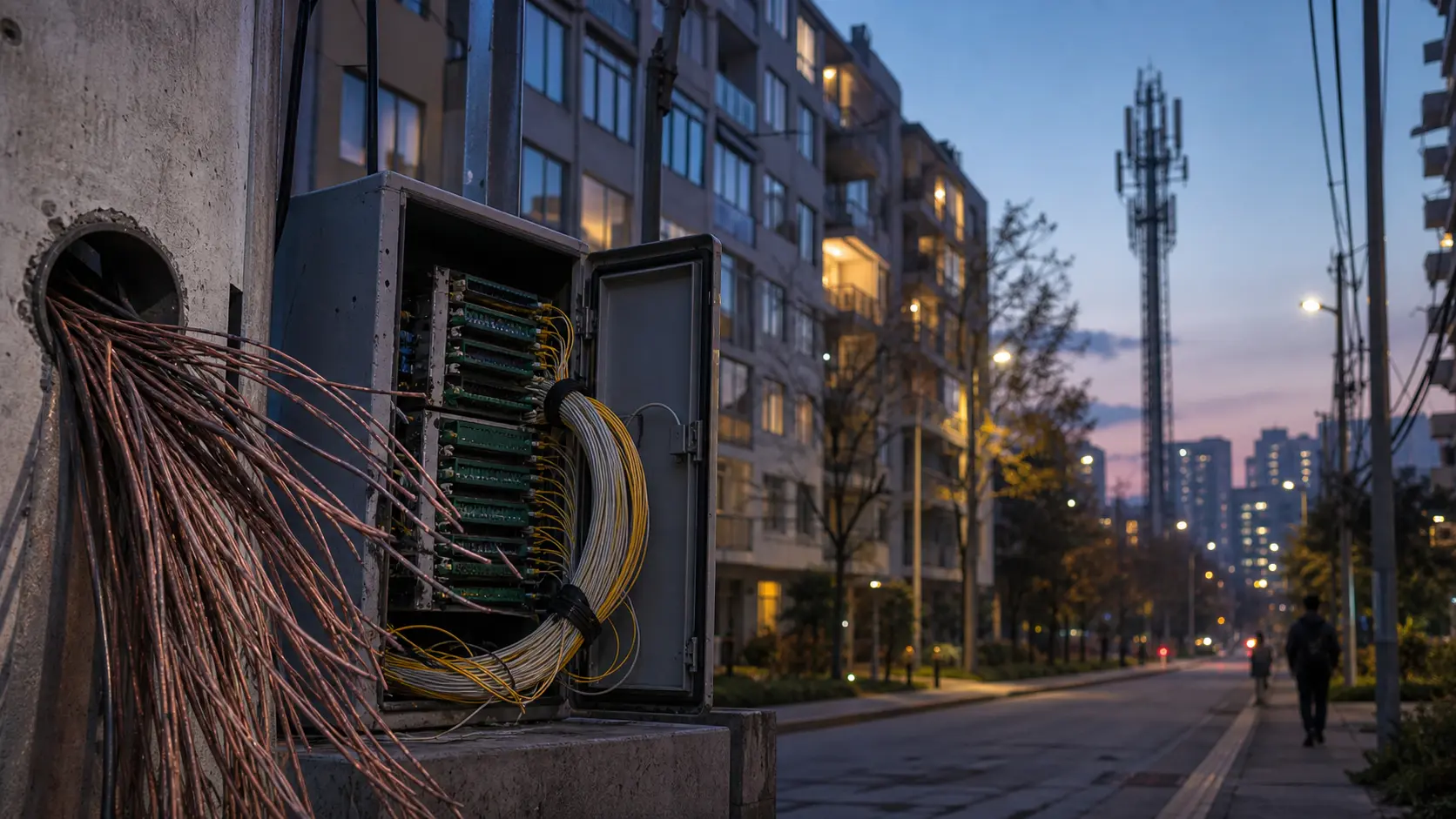
A Chilean household shopping for connectivity in 2026 does not begin with nostalgia for the old fixed-line incumbent. It begins with a bill comparison: Movistar fibre, Mundo fibre, a Claro-VTR bundle, an Entel offer, several mobile lines, maybe television or streaming, and the expectation that video calls, homework, banking, cloud backups and evening entertainment all work without drama. In that comparison, Telefónica Chile's economic problem is not a shortage of demand. It is that fibre broadband has become ordinary.
The former monopoly still carries old copper obligations, field-service complexity, pay-TV erosion, debt, regulatory visibility and a mobile arm fighting from a weaker market position, while customers bargain as if high-speed access were a commodity.
The squeeze is measurable. Subtel's first-quarter 2026 report lists Movistar as Chile's largest fixed internet provider by connections, with 27.4% share, ahead of Claro-VTR at 25.9%, Mundo at 22.7%, Entel at 10.7%, GTD at 5.6% and other providers at 7.7% (https://www.subtel.gob.cl/wp-content/uploads/2026/05/Informe-del-Sector-Telecomunicaciones-Mar26-1-1.pdf). That is the good news: Telefónica Chile still has the strongest fixed-broadband starting point in the country. The same report puts Movistar fourth in mobile internet connections at 18.8%, behind Entel at 35.2%, WOM at 24.3% and Claro-VTR at 20.7%. That is the warning: convergence is attractive, but the fixed base is defending a mobile position rather than being reinforced by mobile leadership.
The technology mix makes the incumbent burden sharper. Subtel says Chile had 4.86 million fixed internet connections at March 2026, up 4.6% year over year, and that fibre represented 85.3% of fixed connections, while cable modem fell to 12.2% and ADSL nearly disappeared at 0.04% (https://www.subtel.gob.cl/wp-content/uploads/2026/05/Informe-del-Sector-Telecomunicaciones-Mar26-1-1.pdf). The same regulator said in January 2026 that Chile's fixed internet was the cheapest in Latin America and that 66.4% of fixed-internet households were already taking 500 Mbps to 1 Gbps service (https://www.subtel.gob.cl/chile-supera-las-10-millones-de-conexiones-5g-y-cuenta-con-el-internet-fijo-mas-barato-de-america-latina/). For Chile this is a policy success. For Telefónica Chile it is harsher: the fibre migration succeeded so well that fibre stopped being a premium moat.
Telefónica Chile's own 2025 filing shows the margin effect underneath that success. The fixed-line group reported consolidated revenue of CLP 888,753 million for 2025, down 4.6% year over year, and EBITDA of CLP 68,033 million, down 30.3%, with EBITDA margin falling to 7.7% from 10.5% (https://telefonica.cl/wp-content/uploads/sites/11/2026/03/TCH-Analisis-Razonado-Diciembre-2025.pdf). Ordinary revenue was CLP 881,586 million, down 4.7%. The filing says the decline was driven largely by a 2024 revenue effect from inventory sales tied to the copper-network shutdown project; excluding that effect, ordinary revenue was only slightly lower. That qualification matters, but it does not rescue the economics. It means the copper-to-fibre transition itself is distorting revenue, while the company is still trying to lower the cost base that copper leaves behind.
The segment mix is even more revealing. In the fixed entity, revenue from telephony, fixed broadband, television and related services fell 11.2% in 2025, while enterprise data and technology-solutions revenue rose 16.5% (https://telefonica.cl/wp-content/uploads/sites/11/2026/03/TCH-Analisis-Razonado-Diciembre-2025.pdf). The profitable future is not the old household bundle as it stood; it is fibre, business connectivity, managed services and a cleaner operating platform. But the household still matters because the fixed access line is the anchor from which Movistar can defend mobile, Wi-Fi, television alternatives and small-business add-ons. If that access line becomes just another discounted commodity, the strategic value of the incumbent base falls.
The mobile side does not offset the pressure. Telefónica Móviles Chile reported consolidated revenue of CLP 1,565,008 million for 2025, down 4.0% year over year, while ordinary revenue fell 3.8%; within that, mobile telecommunications revenue slipped 1.2%, and the fixed/broadband/television/other block fell 12.3% (https://telefonica.cl/wp-content/uploads/sites/11/2026/03/TMCH-Analisis-Razonado-Diciembre-2025.pdf). EBITDA improved to CLP 86,564 million after a deeply negative 2024 comparison, but the company still reported an operating loss of CLP 264,966 million and a net loss of CLP 413,023 million, affected by goodwill impairment and a lower margin on inventory sales associated with the copper shutdown. That is not the profile of a mobile business strong enough to subsidize a relaxed fixed incumbent.
That is why the 2026 ownership transition is central to the judgment. Telefónica announced in February 2026 that it agreed to sell its Chilean operation to an entity controlled equally by Millicom and NJJ Holding, valuing the equity at zero and the enterprise value at roughly EUR 400 million, with about EUR 1.4 billion of debt deconsolidation expected from the transaction (https://www.telefonica.com/en/wp-content/uploads/sites/5/2026/02/other-relevant-information-20260210.pdf). The accounting headline is brutal but clarifying. Chile still offers fibre scale, mobile customers, brand familiarity, spectrum, enterprise relationships and network infrastructure. What it no longer offers is easy incumbent rent. The asset is valuable only if new owners can remove legacy cost faster than competition removes pricing power.
The article's judgment is therefore narrow but important: Telefónica Chile is not a simple declining operator, and it is not a straightforward recovery story. It is a scale platform trapped between two truths. Chilean households and businesses need more data every year, which protects demand. Yet Chile's fibre abundance, mobile rivalry, pay-TV decline and switching culture mean that demand does not automatically become margin. The company can still earn a serious return if fixed leadership becomes a disciplined convergence engine.
It will disappoint if copper retirement, wholesale fibre economics, supplier terms and customer service do not improve faster than ordinary fibre pricing compresses the old profit pool.
What the company is after the Telefónica era
TELEFÓNICA CHILE S.A. is best understood as the fixed-line and converged heart of the Movistar Chile business, with Telefónica Móviles Chile carrying the related mobile operating perimeter. The corporate brand in the consumer market is Movistar, and the economic reality is converged: households buy home internet, mobile plans, television add-ons, equipment, security services and customer support as parts of one decision even if the legal entities and internal accounting lines separate fixed and mobile activity.
For readers looking at the company as an infrastructure asset, the consumer brand is useful because it shows the retail relationship; the legal names matter because they show where the financial obligations and regulatory registrations sit.
The Chilean operation is no longer just a country unit inside a Spanish telecom group. In February 2026 Telefónica Hispanoamérica sold Telefónica Chile to a joint venture controlled 50% by Millicom and 50% by NJJ Holding. Telefónica said the Chilean company had an equity value of zero in the deal, while enterprise value was estimated at about EUR 400 million. Millicom separately described the deal as an acquisition by an entity controlled equally by Millicom and NJJ, with Millicom expecting to provide up to USD 50 million of equity, about USD 340 million of debt refinancing and further local working-capital support (https://www.millicom.com/news-releases/news-release-details/millicom-and-njj-acquire-telefonicas-chilean-operation/). The practical implication is that the asset moved from a global parent rationalizing Latin American exposure to owners that can look at Chile as a restructuring and convergence opportunity.
The seller's own history explains both the attraction and the burden. Telefónica Chile's public history says the company began private-sector operation after the late-1980s privatization of CTC, built fixed telephony, broadband, mobile and digital services under the Movistar brand, and helped connect Chile through decades of network investment (https://telefonica.cl/conocenos/historia/). That history produced brand familiarity and distribution reach. It also produced an incumbent's liabilities: old copper routes, fixed voice erosion, workforces and systems designed around older products, customer-service expectations formed over decades, and regulatory scrutiny that follows an operator with a central place in national connectivity.
The strategic frame changed again before the ownership transaction through the fibre partnership with ONNET Fibra Chile. Telefónica and KKR created ONNET Fibra Chile in 2021 as a wholesale fibre network platform in which Telefónica initially held 40% and KKR 60%. The aim was to accelerate fibre deployment, expand homes passed and give multiple operators access to a neutral wholesale fibre network (https://www.kkr.com/news/press-releases/telefonica-and-kkr-launch-chile-s-first-open-access-fiber-optic-network/). In January 2026, Telefónica Chile said creditors had approved the sale of its 40% participation in ON*NET Fibra Chile to KKR for USD 230 million, strengthening its financial structure and reducing leverage (https://telefonica.cl/telefonica-chile-fortalece-su-estructura-financiera-tras-aprobacion-de-la-venta-de-su-participacion-en-onnet-fibra/). That sale is an important clue: the company needed fibre reach, but it also needed balance-sheet relief.
This is the new version of an incumbent network. It is no longer a vertically owned copper monopoly with predictable voice cash flow. It is a retail-and-network operator that must combine its own assets, wholesale access, mobile resources, customer data, installation capability and financing discipline. The old model earned returns because local loops were scarce and voice revenue was durable. The new model earns returns only if fibre, mobile and service quality make the household stay long enough to pay back the cost of acquiring, connecting and supporting it.
Telefónica Chile's public financial reporting shows that the transition has been running for years, not months. The fixed entity's old household block, which includes telephony, fixed broadband, television and related services, fell 11.2% in 2025, while enterprise data and technology-solutions revenue rose 16.5% (https://telefonica.cl/wp-content/uploads/sites/11/2026/03/TCH-Analisis-Razonado-Diciembre-2025.pdf). Those details point to a business moving away from low-growth legacy services. They also reveal the core difficulty. Enterprise growth can be attractive, but it does not instantly replace the old mass-market bundle; and if television costs fall because customers are leaving pay TV, margin is protected in one line while a household retention tool weakens.
The mobile entity shows a related migration under more strain. Its 2025 filing shows mobile telecommunications revenue down 1.2%, enterprise solutions up 15.5%, and the fixed/broadband/television/other block down 12.3% (https://telefonica.cl/wp-content/uploads/sites/11/2026/03/TMCH-Analisis-Razonado-Diciembre-2025.pdf). This is a modern telecom mix, but not a high-margin escape hatch. Data usage grows faster than customers' willingness to pay for it. Handset and equipment activity can lift commercial relevance while adding working-capital and credit exposure. Mobile plans can be bundled with fixed broadband to defend customers, but discounts granted to win the bundle may dilute the economics. The story is better than pure decline, yet it is not a return to old monopoly rent.
Fibre won, and that is exactly the problem
Chile's fixed-broadband market is one of the most advanced in Latin America, which makes it harder rather than easier for Telefónica Chile to stand apart. Subtel's January 2026 release said Chile had one of the cheapest fixed internet markets in Latin America, reported that 66.4% of fixed-internet households subscribed to speeds between 500 Mbps and 1 Gbps, and described a fixed market where fibre dominated new access (https://www.subtel.gob.cl/chile-supera-las-10-millones-de-conexiones-5g-y-cuenta-con-el-internet-fijo-mas-barato-de-america-latina/). For public policy, that is a success. For Movistar, it means the market now expects a level of performance that used to justify premium pricing.
The fixed market's scale is favorable. At March 2026 Chile had 4.86 million fixed internet connections, with household penetration at 69.7%, fixed traffic per connection at 621 GB per month, and total fixed data traffic up 7.6% over the prior twelve months (https://www.subtel.gob.cl/wp-content/uploads/2026/05/Informe-del-Sector-Telecomunicaciones-Mar26-1-1.pdf). These figures show deep reliance on home connectivity. Remote work, schooling, streaming, gaming, small-business administration and cloud services have made fixed broadband a household necessity. A company with more than a quarter of fixed connections still has a major economic surface.
But ordinary necessity does not guarantee pricing power. Movistar's retail pages sell fibre plans in the same promotional theater as the rest of the market: high advertised speeds, discounted introductory pricing, add-on television, installation promises and bundled logic (https://ww2.movistar.cl/hogar/internet-hogar/). Entel, Mundo and Claro-VTR do the same on their own pages, each with variations on speed, price, portability, streaming or television (https://www.entel.cl/hogar/internet, https://www.tumundo.cl/hogar/2-mundo/, https://www.clarochile.cl/personas/servicios/servicios-hogar/internet/). In a market where the customer can compare several 500 Mbps to 1 Gbps offers, fibre is no longer enough. The profitable question is who can install quickly, repair fast, avoid billing friction, preserve Wi-Fi experience inside the home and cross-sell mobile lines without over-discounting.
Telefónica Chile has one structural advantage here: the fixed customer relationship is still the strongest part of the business. Subtel's Q1 2026 share table shows Movistar leading fixed internet by connections. Leadership in fixed broadband gives the operator a household anchor that pure mobile challengers do not always have. A household with Movistar fibre is a target for mobile upsell; a mobile customer with Movistar lines is a target for fibre retention; a small business using Movistar internet may also need mobile devices, backup connectivity, cloud services or security.
The economics improve when sales, support and billing reinforce one another.
The constraint is that Chilean fixed customers have become more willing to switch. Subtel reported that 844,415 fixed and mobile numbers were ported during the first quarter of 2026 and that cumulative porting since the system began had surpassed 43 million numbers (https://www.subtel.gob.cl/informe-de-portabilidad-de-subtel-mas-de-844-mil-numeros-fijos-y-moviles-cambiaron-de-compania-durante-el-primer-trimestre-de-este-ano/). Portability data is not the same as broadband churn, but it describes a consumer culture. Telecommunications service in Chile is not a one-time franchise; it is a contract customers are accustomed to revisiting.
The copper-to-fibre migration also changes the cost curve. Copper networks carry maintenance, power, fault and field-service burdens even as usage falls. Fibre is more efficient once deployed at scale, but the migration period is expensive because the operator must operate old and new networks together, move customers, retire plant, reconfigure systems and resolve installation failures. Telefónica Chile's fixed reporting shows broadband growth alongside declines in long-distance, corporate voice and other legacy services (https://telefonica.cl/wp-content/uploads/sites/11/2026/03/TCH-Analisis-Razonado-Diciembre-2025.pdf). That is the classic crossover: new revenue grows, old revenue falls, and margin depends on whether the old cost base can be removed fast enough.
This is why ONNET Fibra matters beyond the headline sale price. An open-access fibre platform can reduce duplication of civil works and help multiple retail operators reach customers without each building the same passive network. For Telefónica Chile, the original ONNET structure helped accelerate fibre coverage while bringing in KKR capital. The later sale of Telefónica's stake released cash and reduced leverage, but also means the company must increasingly think like a retail and active-network operator buying or using wholesale fibre where it does not own the passive layer. That can be efficient if wholesale terms are right. It can hurt if retail prices fall faster than wholesale input costs.
Mobile is the weaker leg of convergence
The mobile business is large enough to matter and weak enough to limit the story. Subtel's March 2026 numbers put Movistar at 18.8% of mobile internet connections, behind three rivals (https://www.subtel.gob.cl/wp-content/uploads/2026/05/Informe-del-Sector-Telecomunicaciones-Mar26-1-1.pdf). This is not a fringe position. It still gives Movistar millions of customer relationships and a national brand in mobile. But in a four-player market, fourth place matters. Entel can sell network confidence, WOM can keep pressure on price, and Claro-VTR can use its converged scale and América Móvil backing. Movistar's mobile role is therefore defensive and complementary: it protects fixed households, provides bundle economics and keeps the brand present in daily life.
Subtel's 5G and traffic data underline the pressure. Chile had 10.37 million 5G connections at March 2026, up 59.0% year over year, while mobile data traffic over the twelve months rose 15.4% and traffic per mobile connection reached 29.2 GB per month (https://www.subtel.gob.cl/wp-content/uploads/2026/05/Informe-del-Sector-Telecomunicaciones-Mar26-1-1.pdf). These are healthy usage numbers for the country. For operators, they mean capacity investment. The customer may pay a promotional plan price, but the network must handle video, uploads, navigation, payments and social-media traffic at much higher volumes than the voice era.
Movistar is not without technical credibility. Opensignal's March 2026 Chile mobile-network experience report found Entel winning the broadest range of awards, but it also reported that Movistar won 5G download speed and 5G video experience categories, while Claro won reliability experience and WOM led upload speed (https://insights.opensignal.com/reports/2026/03/chile/mobile-network-experience). The important reading is not that Movistar is universally best. It is that the network has visible pockets of strength in the 5G experience. That matters for a converged operator because a household may accept a mobile bundle if the phone performs well enough in daily use.
Retail competition makes those strengths hard to monetize. Movistar's own mobile page emphasizes 5G, gigabytes and bundle language (https://ww2.movistar.cl/movil/). Entel, WOM and Claro pages advertise the same broad themes: mobile data, 5G, portability, promotional discounts and additional-line benefits (https://miportal.entel.cl/personas/planes, https://store.wom.cl/planes/, https://www.clarochile.cl/personas/servicios/servicios-moviles/planes-moviles/). In such a market, a speed advantage does not automatically translate into pricing power. It can reduce churn, improve bundle conversion and support brand trust, but the customer still sees multiple plans that look functionally similar at first glance.
The mobile income statement reflects that tension. Telefónica Móviles Chile's 2025 revenue did not grow; consolidated revenue fell 4.0%, and the mobile telecommunications line fell 1.2% (https://telefonica.cl/wp-content/uploads/sites/11/2026/03/TMCH-Analisis-Razonado-Diciembre-2025.pdf). That matters because a fourth-place mobile operator cannot rely on volume alone. Device sales, data plans and bundles can anchor customers and stimulate upgrades, but they also create inventory, financing and support costs. Mobile data growth is strategically right, but the cost of data capacity is real. If data use rises while price per user is capped by competition, the operator gets traffic without equivalent economic relief.
The mobile unit also faces spectrum and infrastructure obligations that do not pause because the parent changes. Public routing and RIR evidence identifies Telefónica Chile and Telefónica Móvil de Chile as holders of internet-number resources, including AS7418 for TELEFÓNICA CHILE S.A. and AS27680 for TELEFONICA MOVIL DE CHILE S.A. in LACNIC records. Hurricane Electric and BGP.tools show AS7418 and AS27680 as active public networks with visible upstream and routing presence (https://bgp.he.net/AS7418, https://bgp.tools/as/7418, https://bgp.he.net/AS27680, https://bgp.tools/as/27680). These technical references should not be confused with consumer quality, but they support the larger point: Movistar's retail promises sit on real network infrastructure that has to be maintained, interconnected and secured.
The convergence story therefore depends on mobile being good enough, not necessarily dominant. If the new owners can use the fixed base to win family mobile lines, use mobile to lower household churn, and use 5G quality where it is genuinely strong, the fourth-place mobile position can still be economically useful. If mobile becomes only a discount attached to fixed broadband, it will dilute the fixed margin it was meant to defend.
Pay TV, enterprise service and the disappearing bundle
The old telecom bundle had a simple logic: fixed voice, broadband and pay television created a household relationship that was inconvenient to unwind. Chile has broken that logic. Fixed voice is structurally declining, streaming has weakened pay-TV loyalty, and broadband is the product customers actually need. Subtel's March 2026 report says pay-TV subscriptions fell 5.4% year over year to 2.72 million and that household penetration fell to 39.1% (https://www.subtel.gob.cl/wp-content/uploads/2026/05/Informe-del-Sector-Telecomunicaciones-Mar26-1-1.pdf). That is not an operator-specific failure; it is a market-wide shift in how households consume content.
For Telefónica Chile the effect is double-sided. Lower television content costs can support margins when subscribers leave. The fixed entity's 2025 analysis explicitly notes lower costs tied to a smaller pay-TV customer base (https://telefonica.cl/wp-content/uploads/sites/11/2026/03/TCH-Analisis-Razonado-Diciembre-2025.pdf). But a smaller television base weakens a classic retention lever. If a household uses independent streaming services, it can choose broadband as a price-and-quality product rather than as part of a sticky content bundle. The operator then has to win on access, support, installation and mobile integration.
Enterprise and small-business services offer a different route. Telefónica Chile's fixed filing reported 16.5% growth in services of data and technology solutions for enterprises in 2025 (https://telefonica.cl/wp-content/uploads/sites/11/2026/03/TCH-Analisis-Razonado-Diciembre-2025.pdf). That is important because enterprise customers can value reliability, service-level expectations, cybersecurity, cloud connectivity and managed services more than pure retail discounting. A national operator with fibre, mobile and business support can sell more than commodity access if it packages these capabilities well.
The risk is that enterprise transformation takes organizational discipline. Selling managed services, secure connectivity and business resilience is not the same as selling a household fibre discount. It requires consultative sales, technical support, clear billing, field reliability and credible service restoration. Telefónica's global group historically had strength in enterprise services, but the Chilean operation under new ownership will need to prove that local execution survives the change in control and balance-sheet restructuring.
The wholesale side is another possible margin defense. Open-access fibre and interconnection capacity can create economics beyond direct retail customers. But wholesale can also compress returns if retail competition drives prices down while the operator still pays for access, backhaul or passive infrastructure. The attraction of wholesale is stable volume and lower retail-support cost; the danger is becoming dependent on input contracts that leave little room for differentiation. Telefónica Chile's sale of the ON*NET stake makes this balance more important.
Retail Movistar can benefit from fibre reach, but it no longer owns the same share of the passive fibre platform's upside.
In practice, Telefónica Chile's post-2026 business must be selective. It cannot defend every legacy product with equal intensity. Fixed voice will continue to fade. Pay TV will remain useful for some households but cannot be the center of the strategy. Copper retirement should be accelerated where customer migration and service continuity allow it. Fibre broadband, mobile bundles, enterprise internet and service reliability are the places where the company can still build economic value. The issue is execution speed.
The supplier bill behind ordinary service
The less visible side of Chile's cheap, fast broadband is the supplier bill that makes it possible. A household sees a promotional monthly price. The operator sees civil works, fibre access, customer-premises equipment, technicians, routers, optical terminals, call-center capacity, billing systems, cybersecurity, content contracts, handset procurement, spectrum-related investment, power, sites, backhaul and interconnection. The fact that a customer can buy a high-speed plan at an ordinary price does not mean the input chain has become ordinary for the operator.
Telefónica Chile's fixed reporting gives a partial view of that cost transition. The filing says 2024 ordinary revenue included a larger effect from inventory sales tied to the copper-network shutdown project, and that excluding that effect left 2025 ordinary revenue only slightly lower (https://telefonica.cl/wp-content/uploads/sites/11/2026/03/TCH-Analisis-Razonado-Diciembre-2025.pdf). That is a mixed blessing. It confirms that copper retirement is financially visible, not just operational background. It also shows why the migration is hard to read: when copper customers migrate, the operator can eventually retire old maintenance cost, but only after installation, equipment, inventory, field-work and service-continuity costs have passed through the accounts.
The mobile entity has its own supplier exposure. Rising equipment revenue means the operator is involved in device distribution and financing economics, not just monthly service billing (https://telefonica.cl/wp-content/uploads/sites/11/2026/03/TMCH-Analisis-Razonado-Diciembre-2025.pdf). In a market where customers compare plans, devices and portability incentives together, handset terms can help win or keep subscribers. They can also create working-capital pressure and credit risk. A customer may think of the phone and plan as one purchase; the operator has to manage procurement, inventory, subsidies, financing recoverability and the network cost of the data that device will consume.
Fibre access is the most strategic supplier question because it determines whether retail growth carries attractive margin. ON*NET Fibra was designed as an open-access wholesale platform, which can reduce duplicate construction and improve coverage economics (https://www.kkr.com/news/press-releases/telefonica-and-kkr-launch-chile-s-first-open-access-fiber-optic-network/). After selling its 40% stake to KKR, Telefónica Chile gained financial relief but gave up ownership participation in the passive fibre platform's upside (https://telefonica.cl/telefonica-chile-fortalece-su-estructura-financiera-tras-aprobacion-de-la-venta-de-su-participacion-en-onnet-fibra/). The retail business can still benefit from network reach, but the economics depend on access terms, service control and the ability to add value above the wholesale layer.
There is also an upstream internet and interconnection dimension. Public routing references for AS7418 and AS27680 show that Telefónica Chile and its mobile affiliate sit in the operational internet, with visible routes and upstream relationships (https://bgp.he.net/AS7418, https://bgp.he.net/AS27680). These records are not a customer-quality score, but they remind investors that retail broadband is only the front end of a larger transport system. More household traffic means more pressure on aggregation, backhaul, peering, transit, caching, security and outage management. Subtel's 621 GB per fixed connection per month and 29.2 GB per mobile connection per month are not marketing abstractions; they are traffic loads that must be engineered and paid for (https://www.subtel.gob.cl/wp-content/uploads/2026/05/Informe-del-Sector-Telecomunicaciones-Mar26-1-1.pdf).
That supplier bill is where the new ownership can create or destroy value. A focused owner can renegotiate, simplify, migrate and standardize. It can remove legacy systems, concentrate procurement and push installation performance. A financially constrained owner can also cut too deeply, delay upgrades, frustrate suppliers and let service quality decay. The difference will not be visible first in a press release. It will show up in installation times, outage frequency, Wi-Fi complaints, mobile congestion, billing errors and the willingness of suppliers to keep extending normal commercial terms.
Debt, ownership and the value of a cleaned-up balance sheet
Telefónica Group's willingness to exit Chile with a zero equity value is the cleanest market signal in the story. It does not mean the Chilean business is worthless in an operating sense. It means the existing capital structure, expected cash generation, competitive conditions and group priorities left little value for Telefónica's equity after debt and required support were considered. The new owners are buying optionality: the possibility that a different capital structure, different strategic patience and sharper local execution can turn a pressured asset into a valuable converged platform.
Millicom's announcement sets out the buyer logic. The company said the acquisition, alongside NJJ, would expand its Latin American footprint and that it expected to contribute limited equity plus refinancing and local working capital support (https://www.millicom.com/news-releases/news-release-details/millicom-and-njj-acquire-telefonicas-chilean-operation/). Millicom already understands Latin American cable, mobile and fixed operations through the Tigo footprint. NJJ brings a telecom-investor profile associated with Xavier Niel's low-cost and disruptive telecom investments in Europe. The pairing suggests a belief that the Chilean asset needs both restructuring and commercial energy.
The audited statements underline that this is not just a change-of-control story. Telefónica Chile's 2025 financial statements say Telefónica Chile S.A. and Telefónica Empresas Chile S.A. were in tax-loss positions, with tax losses of M$98,839,312 and M$264,099,889 respectively at year end (https://telefonica.cl/wp-content/uploads/sites/11/2026/04/EEFF-TCH-12-2025-Signed.pdf). Telefónica Móviles Chile's statements also show tax losses at the mobile parent and a 38.4% decline in equity during 2025, mainly tied to accumulated losses and reserve movements (https://telefonica.cl/wp-content/uploads/sites/11/2026/03/TMCH-Estados-Financieros-Diciembre-2025.pdf). Tax losses are not the same as cash losses, but they confirm that the profit pool has been damaged deeply enough for refinancing and operating repair to matter together.
The risk is that Chile is not an empty market waiting for disruption. It already has WOM, the region's most visible challenger story; Entel, a strong local operator with network credibility; Claro-VTR, backed by América Móvil and a cable-fibre convergence agenda; Mundo, a fixed-broadband specialist that has gained share; and smaller providers attacking local niches. A new owner cannot simply cut prices and expect to rewrite the market. The market already knows low prices.
The new owner must reduce structural cost, simplify offers, improve service, migrate customers off expensive legacy platforms and avoid destroying revenue in the name of share.
The debt and refinancing question matters because telecom improvements consume cash before they show up in customer perception. Copper retirement saves money only after migrations, field work and system changes. Fibre customer growth requires installation and customer-premises equipment. Mobile quality requires radio capacity, backhaul, optimization and site work. Billing and service improvements require IT investment. If refinancing only buys time, the result will be disappointing. If it funds a disciplined operating reset, the same asset can look materially different within a few years.
There is also a political and regulatory dimension to financial repair. Chilean regulators and consumers want continuity. Telecommunications services are essential, and a major operator cannot be treated like an ordinary distressed retailer. The buyer must maintain service, comply with consumer rules, honor network obligations and manage customer complaints during any restructuring. The state has an interest in preserving competition, but it will not reward a restructuring that translates into worse customer experience.
The sale also changes how suppliers assess Telefónica Chile. Network vendors, tower companies, fibre partners, device distributors, call-center providers and IT suppliers look at ownership and refinancing when deciding payment terms and project risk. A credible owner can lower friction. But suppliers will also know that the old incumbent margins are gone. They will price risk accordingly unless operating performance improves. The supplier base is therefore another audience for the turnaround, alongside customers and regulators.
The practical metric to watch is not a single headline valuation. It is whether service revenue stabilizes while legacy cost falls. If the household fixed block keeps declining faster than enterprise solutions grow, the migration is too slow or too discounted. If mobile data use grows while mobile market share and ARPU weaken, convergence is not working. If debt is reduced but capex starves service quality, the business will harvest rather than recover. If the company can lower legacy costs, keep fixed leadership, improve mobile attachment and reduce churn, the zero-equity sale could become the beginning rather than the verdict.
Customer dependence and the politics of service quality
Telecommunications incumbents are judged harshly because customers experience them in small failures. A slow installation, a missed appointment, a billing error, a weak Wi-Fi corner, an outage during work, a call-center loop or a confusing promotion can undo years of brand familiarity. Telefónica Chile's challenge is that the mass market no longer owes the incumbent patience. It has alternatives, it has number portability, and it has public complaint channels.
SERNAC's telecom consumer-rights guidance reminds customers that providers must respond to complaints within defined timelines and that consumers can escalate when companies do not resolve problems (https://www.sernac.cl/derechos-telecomunicaciones/). Subtel also maintains consumer procedures and market reporting that make service quality politically visible. For a large operator, this creates a hidden cost base: not just technical maintenance, but the cost of preventing, receiving, resolving and reporting service problems. Better service is not a soft brand expense. It is an economic lever because it reduces churn, truck rolls, compensation, complaints and regulatory friction.
Unofficial customer conversations reinforce the same point, even though they should never be treated as statistical proof. Reddit discussions about Chilean broadband and mobile service tend to compare Movistar, Entel, WOM, Claro and Mundo in practical terms: coverage by neighborhood, installation speed, router quality, call-center frustration, price after promotion and whether fibre is actually available at an address. These comments are anecdotal and location-specific, but their market signal is useful. Customers do not discuss telecom brands as ideology; they discuss them as household reliability problems.
That dependence cuts both ways. A large installed base gives Telefónica Chile opportunities to cross-sell and retain. The company can use customer data to identify households likely to add mobile lines, upgrade speed, add security or accept a device-financing offer. It can focus field operations on dense buildings where multiple customers can be migrated from copper or HFC-era configurations to fibre. It can defend enterprise and small-business customers with service bundles. But every operational failure is visible at scale. A challenger can sometimes ask forgiveness for patchy coverage if the price is low.
A former incumbent is expected to be competent.
This is why the first 800 words of the story lead back to the household bill. The customer comparison is the operating referendum. If Movistar fibre is reliable, priced fairly and bundled with mobile service that works where the household moves, the incumbent base is an asset. If the fibre price looks ordinary, the mobile network feels weaker than Entel, a cheaper Mundo offer arrives, or a WOM promotion looks good enough, the customer has little reason to subsidize Telefónica Chile's legacy burden.
Competition is no longer a three-player story
Chile's market structure leaves Telefónica Chile with little room for complacency. Entel leads mobile internet connections and mobile data traffic in Subtel's Q1 2026 report, giving it the strongest claim to mobile network leadership (https://www.subtel.gob.cl/wp-content/uploads/2026/05/Informe-del-Sector-Telecomunicaciones-Mar26-1-1.pdf). WOM remains a large challenger despite its own restructuring. Claro-VTR combines América Móvil's regional scale with a fixed and mobile convergence effort. Mundo has become a significant fixed-broadband competitor, with Subtel reporting 22.7% fixed internet share by March 2026. This is not a market where the historic incumbent can rely on inertia.
The fixed side is especially revealing. Movistar leads, but the lead is narrow. Claro-VTR is close, Mundo has grown into a major fixed competitor, and Entel has a smaller but meaningful fixed share. If fixed broadband were still a scarce asset, leadership would be safer. In a fibre-heavy market with several operators advertising high speeds, leadership must be defended every month through price, installation, retention and service quality.
The mobile side is more difficult. A fourth-place mobile share means Movistar cannot use mobile dominance to protect the fixed base. Instead, it must use fixed strength to rebuild mobile attachment. That is a subtle but important difference. A dominant mobile operator can pull households into fixed through convenience. Telefónica Chile must often persuade fixed households that the mobile offer is good enough to add. That requires credible 5G performance, attractive multi-line economics and simple bundles.
The competitive question around possible consolidation is therefore natural. Spanish business press and market chatter have repeatedly discussed interest in Telefónica Chile assets, potential bidders and regulatory complexity. Such reporting should be treated as market signal, not settled fact unless formal announcements or approvals exist. Before the 2026 deal, the chatter's significance was that rivals and investors saw the same thing: Chile has high connectivity demand, modern fibre penetration, expensive mobile-network requirements and too much margin pressure for every operator to behave as if the old returns remain available.
The actual Millicom-NJJ transaction may reduce uncertainty, but it does not remove the strategic question. Would the new owners eventually combine assets, pursue wholesale partnerships, reshape offers, sell non-core operations, or focus on operational turnaround? Each path has different implications for competition. Regulators will care about consumer choice, service continuity and market concentration. Customers will care about prices and reliability. Suppliers will care about payment discipline and investment plans. Telefónica Chile's future is therefore not just a company story; it is part of Chile's broader telecom-market design.
What would change the judgment
The bullish case is clear. Telefónica Chile keeps its fixed-broadband leadership, migrates remaining legacy customers onto efficient fibre economics, uses wholesale fibre intelligently, improves mobile attachment, stabilizes service revenue, lowers debt and uses new ownership to simplify operations. In that case, the zero-equity sale becomes a restructuring entry point. The company would not need to become the fastest-growing operator in every metric. It would need to turn fixed leadership into durable household economics.
The bearish case is also clear. Fibre prices remain low, Mundo and Claro-VTR keep taking fixed share, Entel and WOM pressure mobile, pay-TV decline removes bundle stickiness, copper retirement is slow, service quality remains uneven, and refinancing merely postpones underinvestment. In that case, the company becomes a large access provider with too much legacy cost and not enough differentiation. Scale would still matter, but it would not guarantee value.
The most important facts to watch are practical. First, fixed internet share: if Movistar remains near the top while total fixed revenue stabilizes, the fibre migration is working. Second, mobile attachment: if Movistar can raise household mobile penetration without sacrificing too much ARPU, convergence is real. Third, churn and complaints: falling churn and fewer service-quality disputes would indicate that customer experience is improving. Fourth, copper retirement and network simplification: margin improvement must come from taking old cost out, not only from cutting investment.
Fifth, debt and supplier terms: a healthier balance sheet should translate into better execution, not just cleaner accounting.
The company also needs to prove that wholesale dependence and asset sales do not leave it structurally squeezed. Selling the ON*NET stake strengthened the balance sheet, but the economics of retail fibre depend on access cost, operational control and the ability to differentiate service. If Movistar becomes just another retail brand riding common infrastructure at common prices, its historic advantages fade. If it uses wholesale and owned capabilities to reduce capital intensity while preserving service control, the model improves.
The final judgment is deliberately conditional. Telefónica Chile is not a simple declining incumbent, because Chile's demand for fixed and mobile data is strong and the company retains real assets. It is not a straightforward recovery story, because fibre abundance, mobile competition and legacy decline have weakened the old profit pool. The value sits in the transition: how quickly a new owner can remove the costs of the past while keeping the customers who still make the network worth owning.
For Chilean households, the result will show up in ordinary decisions: whether the Movistar bill still feels justified, whether the technician arrives, whether the router works, whether the mobile bundle is worth adding, and whether a cheaper rival looks safe enough to try. For investors and regulators, those household decisions aggregate into the future of a national telecom platform. Broadband became ordinary in Chile. Telefónica Chile's task is to make ordinary connectivity profitable again.