
Summary
- What it says: Talklink and the Expensive Work Behind Cheap Brazilian Broadband
- Main topic: Regional ISP economics
- Context: Regional ISP
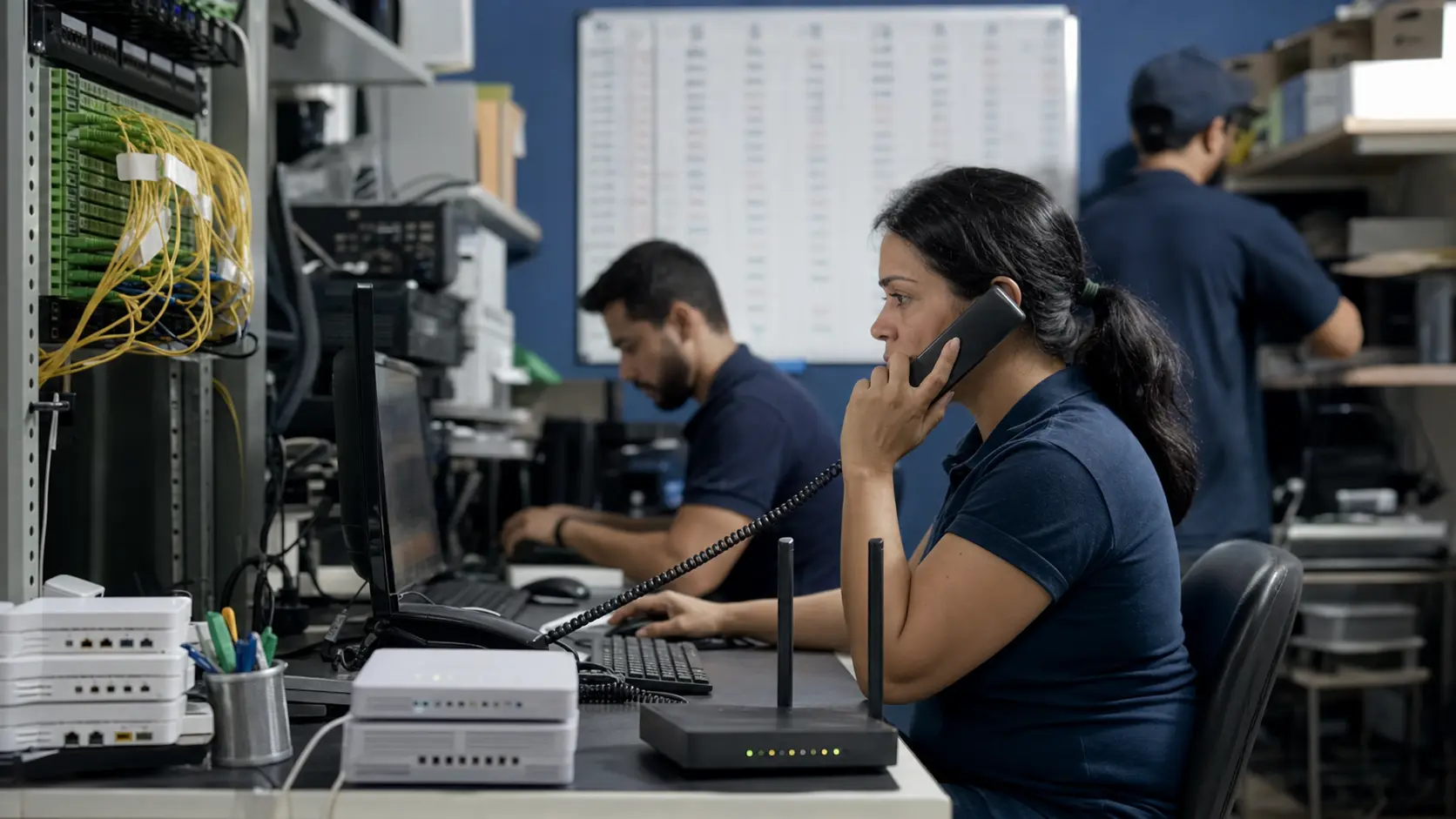
The most revealing moment in Talklink's business is not a fiber splice, a data-center rack or a glossy speed claim. It is the support call that begins when a household in the Rio Claro region needs three ordinary things to work at once: WhatsApp messages must keep flowing, a video stream must not stall, and a payment or second-copy boleto must be handled without turning a routine evening into a technical dispute. In that moment the customer is not buying an abstract megabit. The customer is asking a local operator to make a fragile bundle of radio, fiber, router, app, invoice, field visit, upstream capacity and human patience feel simple.
That is why Talklink Informática EIRELI ME. is more interesting than its size might suggest. Public routing and RDAP records identify Talklink with AS262809, country code BR, CNPJ-linked registrant data and related IPv4/IPv6 allocations. (https://rdap.registro.br/autnum/262809) The company's own site presents a regional retail broadband business centered on Rio Claro, São Paulo, with service claims around residential internet, business connectivity, events, TV/streaming bundles, smart-home installation and a fixed-plus-mobile offer. (https://www.talklink.com.br/) The economics are not those of a national carrier with a balance sheet built on spectrum auctions and national advertising. They are the economics of a local access provider trying to convert cheap, high-speed broadband offers into a defensible service relationship.
The judgment is therefore straightforward: Talklink's moat, if it has one, is not just local fiber. It is the ability to fund and organize support labor well enough that customers tolerate a low-price, high-expectation broadband product. The risk is equally direct. If support queues, field repairs, upstream congestion, billing friction or mobile-bundle confusion outrun the labor model, the advertised speed becomes a liability because it teaches customers to expect carrier-grade reliability at regional-ISP prices.
The public identity is a brand wrapped around changing legal labels
Talklink is visible through several public identities that have to be read together. The LACNIC member listing names Talklink Informática EIRELI ME. as a Brazilian member record, and RDAP/BGP data ties that name to AS262809. (https://milacnic.lacnic.net/lacnic/asociados/publico?locale=EN) (https://rdap.registro.br/autnum/262809) Talklink's own site footer uses the CNPJ 02.382.035/0001-68 and the corporate name Talklink Comercio de Equipamentos e Serviços de Comunicacao LTDA, with the main address at Rua Um, 2187, Centro, Rio Claro, São Paulo. (https://www.talklink.com.br/) Public CNPJ listings show the same CNPJ, active status, Rio Claro address, and primary activity as providers of access to communications networks. (https://cnpj.biz/02382035000168) The name difference is not a scandal by itself; Brazilian companies often change legal form or public-facing legal wording over time. For a reader, it means the stronger identity anchor is the combination of brand, CNPJ, Rio Claro address, Anatel authorization and internet-number records, not any single rendering of the historical company name.
The official authorization record also matters. Anatel's Term PVST/SPV No. 333/2010, tied to Ato No. 3.385/2010, authorized Talklink Informática LTDA. - EPP to provide Serviço de Comunicação Multimídia, or SCM, under Brazil's private-regime fixed multimedia communications framework. (https://www.anatel.gov.br/Portal/verificaDocumentos/documento.asp?documentoPath=247226.pdf&filtro=1&null=) The document states that the authorization is non-exclusive, allows multimedia transmission, emission and reception capacity to subscribers, and makes the provider responsible for service execution even where support networks involve third-party infrastructure. (https://www.anatel.gov.br/Portal/verificaDocumentos/documento.asp?documentoPath=247226.pdf&filtro=1&null=) It also embeds customer rights, including adequate information, complaint handling and service continuity under the applicable contract. This is not just regulatory paperwork. It defines the relationship between a regional ISP's sales promise and the obligations that follow when the customer calls.
The commercial site positions Talklink as a regional provider, not merely as a resource holder. It lists service presence in Ipeúna, Analândia, Ajapi, Ferraz, Cordeirópolis, Rio Claro, Corumbataí, Santa Gertrudes and Itirapina. (https://www.talklink.com.br/) It emphasizes "internet ultravelocidade," Wi-Fi included, support, flexible plans and service for businesses and events. The company also markets TalkMax, a TV and streaming product; Casa Inteligente, a smart-home configuration offer; and Talk Móvel, a fixed broadband plus mobile plan. (https://www.talklink.com.br/talkmax) (https://www.talklink.com.br/casainteligente) (https://www.talklink.com.br/talkmovel) That combination reveals the strategic direction. Talklink is trying to hold the household account by expanding from access into adjacent services that create recurring contact and reduce churn.
The service menu shows how a regional ISP tries to raise revenue per home
Cheap broadband is rarely profitable if it remains a single naked access line. The customer sees speed and price. The operator sees installation, CPE, drop cable, router replacement, Wi-Fi troubleshooting, billing calls, complaint handling, upstream bandwidth, taxes, city permissions, equipment inventory, truck rolls, fraud risk and late payments. The service menu on Talklink's site is best read as an attempt to make that equation less brutal.
Residential broadband is the anchor. The support page says Talklink's plans have no data franchise and are "100% ilimitados." It explains that a 1 Gbps plan is 1000 Mbps, positioned for many simultaneous devices, streaming, gaming and work-from-home use. (https://www.talklink.com.br/suporte) The page also tells customers that proper speed tests should preferably be done by cable, that Wi-Fi distance and 2.4 GHz versus 5 GHz constraints can lower performance, and that support can help with router changes. (https://www.talklink.com.br/suporte) That wording is commercially important because it transfers part of the perceived problem from the access line to the home network. A customer may buy a gigabit line, but the customer experiences Wi-Fi, the router, the walls, the phone, the TV box and the neighbor's interference.
TalkMax pushes the account beyond broadband. The TalkMax page describes online TV and streaming in one app, more than 90 channels, live TV, on-demand access, three simultaneous accesses and an optional streaming device in comodato. (https://www.talklink.com.br/talkmax) The primary business logic is simple: video increases customer stickiness, makes the household account feel bundled, and gives the local ISP a way to answer the national carriers' converged offers without owning national content assets. The cost side is less visible but just as real. Content rights, app support, device returns, HDMI and remote-control issues, password resets and customer education all add support work.
Casa Inteligente follows the same pattern. Talklink offers installation and configuration of connected devices such as cameras, lights, assistants and other home automation products. It promises that the customer need not understand the technology and that support will be available after installation. (https://www.talklink.com.br/casainteligente) That is a classic local-provider opportunity. A national carrier may sell speed, but a neighborhood technician can walk into a house, explain why the camera is offline, pair an assistant, rename Wi-Fi networks and leave the customer with a working setup. Yet the margin depends on whether this work is priced and staffed properly. Smart-home service can become a profitable add-on or an unpaid extension of broadband support.
Talk Móvel is the most revealing extension. The page sells "internet em casa + internet no celular" in one place. It advertises mobile data that accumulates while the invoice is current, unlimited voice and SMS, and "WhatsApp ilimitado" for messages, while clearly noting that WhatsApp voice and video calls consume the contracted data allowance. (https://www.talklink.com.br/talkmovel) The conditions list a 1000 MB fixed plan with router in comodato and a mobile plan with 30 GB for R$99.90 for the first three months and R$149.90 afterward, plus 650 MB and 400 MB bundles at R$139.90 and R$129.90. (https://www.talklink.com.br/talkmovel) For Talklink, mobile is likely less about becoming a mobile network owner than about protecting the fixed account from a national converged bundle. The company wants the customer to call Talklink first, not Vivo, Claro or TIM, when the household thinks about connectivity.
The network evidence points to a real access operator, not just a reseller page
The public internet-number evidence gives Talklink more substance than a simple marketing site. RDAP for AS262809 identifies a direct allocation in Brazil, lists Talklink Informática EIRELI ME. as registrant through CNPJ 02.382.035/0001-68, and links the ASN to related IPv4 and IPv6 allocations. (https://rdap.registro.br/autnum/262809) BGP data for AS262809 identifies Talklink Informática EIRELI ME. as the registered network, active under NIC.br, originally registered on 18 October 2010. (https://bgp.tools/as/262809) BGP.tools shows 28 IPv4 prefixes and 7 IPv6 prefixes originated, equal to 16 IPv4 /24 equivalents and a large IPv6 space. (https://bgp.tools/as/262809) IPinfo lists four /22 IPv4 blocks associated with the company, each with 1,024 addresses, plus IPv6 ranges. (https://ipinfo.io/AS262809) PeeringDB lists the network as "Talklink Telecom," tied to Talklink Informática EIRELI ME., with network type Cable/DSL/ISP, South America scope, 20-50 Gbps traffic level, heavy inbound ratio, IPv4 and IPv6 support, and an open peering policy. (https://www.peeringdb.com/asn/262809)
Those details do not prove subscriber count, revenue, profit or service quality. They do prove that Talklink sits on visible internet routing infrastructure and has enough scale to be seen in interconnection databases. (https://www.peeringdb.com/org/10429) The difference matters. Many regional access brands can sell connectivity by reselling someone else's last-mile or wholesale service without much independent routing identity. Talklink's public routing footprint suggests a more operationally involved ISP: it originates address space, appears in peering records, and has a public web of upstream and peer relationships. (https://bgp.he.net/AS262809)
The upstream picture is important because it places a ceiling on independence. BGP.tools lists upstreams including Link Brasil Telecomunicações, UFINET Panama and Peer 1031; IPinfo's view also includes Hurricane Electric and UFINET Brasil. (https://bgp.tools/as/262809) (https://ipinfo.io/AS262809) The two views are not identical, which is normal for public BGP aggregation at different moments, but their shared message is clear. Talklink is not a self-contained island. It depends on wholesale connectivity, peering choices and third-party networks to convert local access into usable internet. BGP.tools also shows presence at IX.br São Paulo with 40 Gbps ports, a sign that the operator uses Brazil's exchange fabric to control cost and latency for popular destinations. (https://bgp.tools/as/262809) For a regional ISP, the wholesale mix is a major determinant of both margin and customer experience.
The address space can also be read as a cost signal. RDAP links AS262809 to the 186.250.56.0/22 IPv4 network and the 2804:c40::/32 IPv6 network, while the same ASN page links 131.72.200.0/22, 138.121.60.0/22 and 170.244.192.0/22. (https://rdap.registro.br/ip/186.250.56.0/22) (https://rdap.registro.br/ip/2804:c40::/32) IPv4 is scarce and expensive. Owning or holding allocations gives an ISP room to serve customers without relying entirely on carrier-grade NAT, but the support page's "Guia Explicativo IPs" and the presence of IPv4, IPv6, CGNAT and public IP education show that address policy reaches the customer. (https://www.talklink.com.br/guia-explicativo-ips) A gamer, remote worker, camera user or small business may not understand routing, but may discover that NAT behavior affects port forwarding, VPN access, latency diagnosis or hosting. That means internet-number resources are not just backend assets. They become part of support scripts and customer segmentation.
RDAP also makes the support-labor thesis more concrete because it links the retail brand to operational accountability rather than only marketing language. A visible ASN, allocated IP blocks, abuse roles and technical contacts mean that complaints, security events, reverse-DNS problems, public-IP requests and connectivity disputes have to land somewhere inside the company. (https://rdap.registro.br/autnum/262809) A small access provider cannot treat this as a purely back-office burden. When a customer's camera, payment terminal, remote-work VPN or game console behaves differently behind CGNAT, the explanation becomes a support interaction; when an IP range is listed by a security tool or misgeolocated by a content platform, a network engineering issue can become a customer-service issue. The technical registry footprint is therefore part of the labor bill.
The hidden bill is labor, not bandwidth alone
The assignment's core question is the support-labor bill hidden inside cheap Brazilian broadband. Talklink's own support material makes that bill visible. The support page walks customers through cable-based speed tests, Wi-Fi limitations, fiber breaks, router resets, fatura blocks, opening technical tickets, and when a technician should be requested. (https://www.talklink.com.br/suporte) It states that support runs every day from 06:00 to 00:00. It tells customers that a fiber break may be resolved within 48 hours if no obstacle prevents repair. It also says customers can open tickets through chat, phone or WhatsApp, with support numbers published prominently. (https://www.talklink.com.br/suporte)
Those sentences describe a labor model. A support window from early morning to midnight means staffing outside standard office hours. WhatsApp support means written triage, screenshots, payment questions, message backlog and emotional tone management. Field repair promises require dispatch coordination, vehicle time, spare parts, fiber tools, customer scheduling and sometimes repeated visits when the fault is inside the house rather than in the outside plant. Router configuration is another cost line. The page says that changing Wi-Fi name and password is free when the router was acquired from Talklink, but that a R$35.00 fee applies for complete configuration of a router not purchased from the company. (https://www.talklink.com.br/suporte) That fee is small, but it tells the truth: support is not free, and unmanaged customer equipment can eat margin.
This is why a local broadband operator can look healthy in gross-add numbers and still be operationally thin. Low headline prices fill the installed base. Every additional household then carries a probability of calls, payment delays, router confusion, complaints, installation revisits and Wi-Fi education. The variable cost of support is lumpy. One customer may never call. Another may call three times in a month because video calls drop in a back bedroom, a second copy of the boleto is needed, a smart TV forgets a password and a mobile SIM promotion is misunderstood.
The broadband invoice is recurring; the support workload is episodic but unpredictable.
Talklink's job posting page reinforces the point. A listed internal sales role in Ajapi describes customer service by telephone, WhatsApp and other company channels, product and service presentation, negotiation and contract closing, with experience in customer service required. (https://www.talklink.com.br/vagas) The benefits list includes medical and dental plans, Talklink internet, food benefits, profit sharing, life insurance and other items. (https://www.talklink.com.br/vagas) It is only one vacancy, not a full headcount disclosure, but it shows the kind of labor the model needs: salespeople who are also service handlers, local staff who know the region, and an employment package that must compete with other service businesses.
WhatsApp turns support into part of the broadband product
The most important platform in Talklink's public service design may not be a router or an exchange port. It may be WhatsApp. The company's pages route commercial, financial and support contact through WhatsApp-style channels, while the mobile bundle advertises unlimited WhatsApp messaging and then clarifies that voice and video calls consume data. (https://www.talklink.com.br/talkmovel) (https://www.talklink.com.br/) This is not a minor marketing detail in Brazil. WhatsApp is where families coordinate, where small businesses receive orders, where installers confirm visits, where a customer asks for a second invoice copy, and where a support agent can turn a vague complaint into a ticket with photos, screenshots and a time window.
That makes the customer expectation more intense than an old telephone help line. A phone call ends when the call ends. A WhatsApp conversation can keep reopening. A customer can send one message before work, another after dinner and a screenshot at midnight. The provider then faces a queue that looks informal to the customer but must be managed like a formal service workflow. A slow answer can feel more personal because the chat thread remains visible on the phone. A clear answer can create trust because the customer has a written record. For a regional ISP, this is both an advantage and a liability.
The advantage is intimacy. A national carrier's app can feel distant. A local WhatsApp number can feel like the company is nearby and reachable. If Talklink can answer quickly, explain Wi-Fi problems in plain language, schedule field visits without friction and follow up after repairs, WhatsApp becomes a retention tool. It can also lower acquisition costs because a customer can forward a plan offer, ask a neighbor, and contact sales from the same environment where daily life already happens.
The liability is that every department becomes visible. Sales, finance, support and technical operations may all be judged in one thread. A billing block can become a support complaint. A mobile-data misunderstanding can become a broadband complaint. A smart-home device failure can become an internet complaint. A delayed technician can become a reputational event in a neighborhood group. The company can publish separate emails for commercial, financial, SAC, support, HR, contact and ombudsman functions, but the customer often experiences them as one brand on one phone screen.
This is the support-labor bill in its most modern form. The old ISP cost model counted call-center seats and truck rolls. The current regional-ISP cost model also counts message backlog, emotional labor, screenshot interpretation, after-hours escalation and the need for salespeople to understand service constraints before they close a contract. The company that sells cheap speed must also finance the conversation that cheap speed creates.
Geography makes the service promise concrete
Talklink's listed towns are not just market labels. They define the physical and social shape of the business. Rio Claro is the anchor, but the surrounding names -- Ipeúna, Analândia, Ajapi, Ferraz, Cordeirópolis, Corumbataí, Santa Gertrudes and Itirapina -- imply a service area where customers may live in smaller urban grids, semi-rural edges, business corridors and event locations that do not all have the same plant economics. (https://www.talklink.com.br/) A dense street in central Rio Claro can support fiber more efficiently than a scattered edge address. A business customer may need scheduled reliability; a residential customer may need evening Wi-Fi help; an event may need temporary capacity and on-site attention.
This geography gives Talklink a local operating advantage if the network is dense and well maintained. Technicians can know recurring fault spots. Salespeople can understand which neighborhoods are viable. The company can show up in person when a national carrier would route the customer through a distant process. It can sponsor local recognition, use local testimonials and turn service familiarity into brand equity. In towns where customers compare providers through neighbors, a fast repair can be better advertising than an online campaign.
But geography also makes failure concrete. If a backhoe cuts fiber in a small area, many affected customers may know each other. If a technician misses an appointment, the story can move through local groups. If a promotional price is understood differently by different neighborhoods, sales disputes can become community chatter. The same proximity that makes a regional ISP responsive also removes anonymity. Talklink cannot hide behind national scale; it has to be legible in the communities it serves.
The physical network also links support quality to capital discipline. Expanding to a new town is not just a line on a coverage map. It means route design, backbone capacity, power resilience, field tools, customer equipment, spare inventory, local permits, collection routines and people who can answer calls from that town. A national operator can amortize management overhead across millions of customers. A regional operator must decide town by town whether density, price and loyalty will cover the next layer of support.
This is why customer concentration is not only a risk. It is also the path to defensibility. A provider that serves a compact region well can build a service map that is more valuable than a scattered footprint. The key question is whether Talklink's operational attention grows with its coverage claims. If local density lets the company answer faster, install cleaner and explain problems better, geography is an asset. If coverage expands faster than dispatch and support capacity, geography becomes a promise the company cannot keep.
Pricing is a churn-control instrument as much as a revenue instrument
Public plan data should be treated carefully because broadband offers vary by address, campaign period, installation conditions and bundle. Even so, the visible pricing clues are useful. MelhorPlano pages list Talklink offers in some served towns, including 1000 Mega at R$39.90 in Ipeúna and Santa Gertrudes, 100 Mega at R$79.90, 300 Mega at R$89.90 and 650 Mega at R$99.90 in selected listings. (https://melhorplano.net/internet-banda-larga/sp/ipeuna) (https://melhorplano.net/internet-banda-larga/sp/santa-gertrudes) Talklink's own Talk Móvel conditions show a fixed-plus-mobile promotional price that rises after three months. (https://www.talklink.com.br/talkmovel) The company site also uses "consulte os valores" around add-on content and requests customers to contact sales for business and event connectivity. (https://www.talklink.com.br/)
The pattern is familiar in Brazilian regional broadband. A sharp headline price gets attention. A higher monthly price may arrive after the promotional period or when mobile is bundled. Add-ons then supply optional gross margin: TV, streaming, smart-home installation, mobile lines, business service, event service, public IP, router management, extra equipment or in-home technical work. The customer may think the decision is about monthly access price, but the operator is managing a portfolio of revenue opportunities across a household.
The risk is that promotional pricing compresses expectations into the wrong place. If a 1 Gbps offer is perceived as cheap and unlimited, customers expect everything to be immediate: WhatsApp messages, gaming, 4K video, smart cameras, streaming boxes, app login, remote work and payment support. The more the provider advertises speed, the less tolerance there is for explaining that a wall, an old phone, 2.4 GHz Wi-Fi or a congested destination can limit the experience. The support page tries to educate customers, but education itself is labor. A cheap plan becomes expensive when every performance dispute requires a human explanation.
There is also an important legal pricing frame. Anatel's authorization document allows promotions and seasonal reductions if offered under objective and non-discriminatory criteria, and it forbids conditioning SCM access on unrelated purchases in ways that violate the applicable rules. (https://www.anatel.gov.br/Portal/verificaDocumentos/documento.asp?documentoPath=247226.pdf&filtro=1&null=) In practice, a regional ISP must make bundles attractive without turning the base connectivity service into a confusing set of lock-ins. Talk Móvel's conditions mention fidelity, installation carência, technical viability, credit analysis and later price changes. (https://www.talklink.com.br/talkmovel) Those are normal commercial protections, but they create another support burden: customers need to understand what is promotional, what is permanent, what is bundled, what is mobile data, and what happens when a bill is late.
The cost base is local even when the internet is global
Talklink's cost base has four major layers. The first is local plant: fiber routes, radio infrastructure where still used, drop cables, routers, power, poles or building access, splicing, maintenance, vehicles and field staff. The second is customer equipment and in-home complexity: Wi-Fi routers, streaming devices, mobile SIMs or eSIMs, cameras, smart-home devices and app support. The third is upstream and interconnection: transit, peering, IX costs, port capacity, routing, DDoS exposure, DNS and address management.
The fourth is regulatory and administrative: Anatel compliance, taxes, billing, customer contracts, consumer complaints, collections and data-protection obligations.
Each layer has a different margin profile. Fiber already passed down a street is attractive because a new household may need only a drop and an installation visit. But that same household may be costly if the customer needs evening support, payment rescheduling and a field return. Transit can become cheaper with peering and scale, but only if the ISP has enough traffic engineering competence and enough port capacity in the right places. Mobile bundles may improve retention but likely depend on wholesale arrangements outside Talklink's direct network.
Smart-home service may carry hardware margin, yet it exposes the company to every future device malfunction that the customer treats as an internet problem.
The operational lesson is that local ISPs do not win merely by lowering price. They win by controlling the ratio of support minutes to recurring revenue. A R$149.90 fixed-plus-mobile customer who rarely calls and keeps the bill current can be attractive. A lower-priced customer who calls repeatedly about Wi-Fi, payment, mobile data carryover and streaming login can destroy margin. The public complaint and review environment makes this more sensitive because unresolved support frustrations are visible outside the company's own channels.
Talklink's business and event offers add another layer. The site says it has ultrafast internet for companies and infrastructure for events from small to large, with quotation requests through WhatsApp. (https://www.talklink.com.br/) These services can be higher margin than basic residential access because the customer may pay for reliability, installation planning and temporary capacity. They also raise execution risk. A failed event link or a business outage can damage local reputation faster than a residential complaint. For a regional brand, the same local proximity that helps sales also concentrates reputational damage.
Supplier dependence is spread across wholesale networks, platforms and devices
A regional ISP's supplier dependence is not limited to upstream transit. Talklink's public footprint shows several dependencies. At the network layer it relies on upstream networks and exchange connectivity visible in BGP and PeeringDB. (https://bgp.tools/as/262809) (https://www.peeringdb.com/asn/262809) At the customer layer it relies on routers, fiber equipment, mobile SIM/eSIM provisioning, payment tools, app platforms, streaming or TV partners and smart-home device ecosystems. At the digital-support layer it relies heavily on WhatsApp, because customer contact, sales requests and mobile-plan marketing all run through that expectation. (https://www.talklink.com.br/talkmovel)
This is strategically delicate. WhatsApp is a support channel and a traffic expectation. Brazilian households use it as default communications infrastructure. Talk Móvel even advertises unlimited WhatsApp messaging while noting that voice and video calls use data. That distinction is operationally hard. A customer who sees "WhatsApp ilimitado" may experience a video-call data charge or slowdown as a broken promise unless the salesperson, contract and support script all explain it the same way. In other words, the supplier platform's product language becomes Talklink's support problem.
The streaming bundle has similar risk. TalkMax points to online TV and streaming, live channels, on-demand content and a device in comodato. (https://www.talklink.com.br/talkmax) If the app fails, if authentication breaks, if a channel disappears, if a remote control is lost, or if a customer does not understand the difference between internet access and content service, the local ISP receives the call. A national content partner may be the technical origin of the issue, but the household relationship belongs to Talklink. That is the price of bundling.
Equipment dependence is more mundane but no less important. The support page spends time on Wi-Fi realities because the router is the point where the network promise meets the house. (https://www.talklink.com.br/suporte) If Talklink supplies and manages the router, it has better control but more asset cost. If the customer brings a router, the support problem may be harder and the R$35.00 configuration fee may not cover the full time cost. The smart-home page deepens that exposure by offering to configure cameras, assistants and devices. (https://www.talklink.com.br/casainteligente) Every device can become a future call.
Customer dependence is regional, which makes reputation dense
Talklink's served-city list points to a geographically concentrated regional business, and its LinkedIn page separately describes fiber and radio service for Rio Claro and nearby towns. (https://www.talklink.com.br/) (https://br.linkedin.com/company/talklink) The upside is local density. Technicians know the streets. Sales staff know the neighborhoods. Word of mouth can work. Fiber routes can be extended by adjacency. Business customers, municipal institutions, events and households may reinforce each other. A local provider can move faster in small service areas than a national operator that optimizes from a distant call center.
The downside is dependence on a finite set of communities. Rio Claro, Santa Gertrudes, Cordeirópolis, Itirapina, Ipeúna, Analândia, Corumbataí, Ajapi and Ferraz are not an infinite market. If Talklink saturates its practical footprint, growth must come from upsell, churn reduction, nearby expansion, acquisition, wholesale arrangements or new products. That makes customer satisfaction central. In a dense local market, a good technician can sell the brand. A bad support episode can also travel quickly through neighborhood groups.
Public sentiment signals are mixed, and they should be read as signals rather than audited truth. Talklink's own home page displays Google testimonials, a 4.4 rating and 1,171 comments, as well as a Reclame Aqui graphic showing 8.1/10, 27 complaints and 27 answered. (https://www.talklink.com.br/) Reclame Aqui search results also show a more recent 12-month score of 6.7/10 described as regular, and individual complaints include support delays, WhatsApp support dissatisfaction, speed, outages and billing or equipment disputes. (https://www.reclameaqui.com.br/empresa/talklink-internet-via-radio/lista-reclamacoes/?categoria=0000000000000000) (https://www.reclameaqui.com.br/talklink-internet-via-radio/suporte-tecnico-ineficiente-via-whatsapp_qNiHCQ3cni8ameSF/) (https://www.reclameaqui.com.br/talklink-internet-via-radio/isso-e-internet-mesmo_1UjJus3q6ZNHADp3/) MelhorPlano's Rio Claro page ranks Talklink fourth in user ratings among listed providers, while other MelhorPlano pages show Talklink plans and speed recognition in selected cities. (https://melhorplano.net/internet-banda-larga/sp/rio-claro) (https://melhorplano.net/provedores/talklink)
None of those signals should be treated as a comprehensive customer survey. Review platforms are biased toward people with strong views. Company-displayed excerpts select positive stories. Complaint pages overrepresent unhappy customers. Still, the pattern fits the business model. Customers praise fast local help when it works; they complain loudly when support does not match the promise. Talklink's social pages amplify the same local-reputation economy through store, award and product messaging, again useful as market signal rather than proof of service quality. (https://www.instagram.com/talklink_/?hl=en) (https://www.facebook.com/TalklinkBR/) That is exactly the support-labor sensitivity that defines the company.
Competition is fragmented, which helps and hurts Talklink
Brazil's fixed broadband market is unusually favorable to regional ISPs and unusually unforgiving for any one of them. OpenSignal described the market as extremely fragmented, with estimates from 10,000 to 19,000 ISPs and smaller providers holding about 57% of the market in the second quarter of 2025. (https://insights.opensignal.com/reports/2025/10/brazil/fixed-broadband-experience) Abrint, citing Anatel competition monitoring, said small providers had more than 56% national fixed-broadband share and more than 22,500 active providers, including nearly 12,000 formally authorized. (https://abrint.com.br/noticias/ppps-lideram-banda-larga-e-mantem-o-setor-como-o-mais-competitivo-confirma-relatorio-da-anatel/) Teletime's report on the same Anatel monitoring cycle put the second-quarter 2025 PPP share at 56.4%. (https://teletime.com.br/17/07/2025/brasil-fecha-segundo-trimestre-com-225-mil-ppps-na-banda-larga-fixa/) Radar da Telecom's April 2026 view, built from Anatel and IBGE data, showed about 56.0 million fixed broadband accesses, 79.4% fiber share, 8,721 operators and Claro as the largest broadband operator with 19.2%. (https://www.radardatelecom.com/en/broadband)
That environment explains why Talklink exists. Regional providers filled gaps, moved fiber into interior cities, knew local demand and competed aggressively where national carriers were slower or more bureaucratic. It also explains why Talklink cannot assume durability. If the market contains thousands of operators, a local customer may face alternatives from national carriers, nearby fiber providers, municipal specialists, fixed wireless, satellite for rural addresses, mobile 5G substitutes for some use cases, and resellers using the same channels. The entry barriers are not zero.
Fiber routes, permits, customer base, staff and network competence matter. But the competitive pressure is constant.
The national carriers compete on brand, content, mobile bundling and perceived reliability. Regional peers compete on speed, price, local service and informal reputation. Talklink's mobile bundle is therefore defensive. It prevents the household from seeing mobile as a reason to migrate to a national carrier. Its TV and smart-home offers are also defensive. They create a local bundle that can be compared not just on price per megabit but on convenience. The question is whether the bundle increases loyalty faster than it increases support burden.
Consolidation is another risk. Brazilian regional broadband has been moving through acquisitions and roll-ups as mid-sized platforms look for dense local networks, revenue bases and fiber assets. (https://www.capacitylatam.com/telecoms-brazil-latin-america/isp-market-brazil) A company like Talklink could be a consolidator in its micro-region, a target for a larger platform, or a standalone operator squeezed by better-funded rivals. The public evidence does not show a transaction, but the industry context makes ownership and capital structure important missing facts. If Talklink is undercapitalized, support and network quality may suffer. If it has patient local capital, the regional density may remain defensible.
Regulation turns local service into formal accountability
Anatel's SCM framework is often misunderstood by customers as a license badge. For a provider, it is an accountability structure. The authorization document says the service is private-regime and non-exclusive, but it also requires compliance with applicable regulations, customer rights, technical and economic information requests, quality parameters and service responsibilities. (https://www.anatel.gov.br/Portal/verificaDocumentos/documento.asp?documentoPath=247226.pdf&filtro=1&null=) It says the authorized provider is responsible to subscribers and Anatel for service execution, including correct operation of support networks even when those networks are owned by third parties. (https://www.anatel.gov.br/Portal/verificaDocumentos/documento.asp?documentoPath=247226.pdf&filtro=1&null=)
That last point matters for a regional ISP with upstream and supplier dependencies. A customer does not care whether a fault sits in the home router, the access line, the exchange, an upstream provider, a content server or an app partner. The provider may know the difference; the invoice holder rarely does. Regulation reinforces that the provider cannot simply blame the supplier. It must manage the service relationship, provide information and handle complaints. The support desk is therefore not just marketing. It is the operating interface through which compliance, consumer law and reputation are resolved.
Geopolitics is indirect but present. Brazil's broadband market depends on imported optical, routing and customer-premises equipment, global platform traffic, exchange connectivity and cloud/content concentration. Currency moves can raise equipment costs. Vendor restrictions, supply disruptions or security concerns can alter procurement. Popular traffic depends on foreign platforms, from WhatsApp to streaming services, while local political and regulatory debates influence consumer rights, data privacy, network neutrality, universalization funds and irregular-provider enforcement. Anatel's public data program makes the sector measurable, but it also reinforces that licensed providers operate under a live regulatory information environment. (https://www.gov.br/anatel/pt-br/dados/dados-abertos) Talklink does not need to be a geopolitical actor to be exposed to those forces.
Operational resilience is the more immediate governance issue. The support page's fiber-break guidance tells customers not to touch the broken fiber and to open a technical ticket. That is sensible, but it also exposes the fragility of last-mile plant. Storms, construction, pole work, vandalism, power outages and customer premises issues can all create service interruptions. Regional density helps because technicians are nearby. It hurts if many local customers are affected at once. A support desk designed for individual calls can be overwhelmed by a neighborhood fault.
What would change the judgment
Several facts would materially change the analysis. The first is subscriber count by city and product. Talklink's public site shows geographic reach and service breadth, but not active fixed subscribers, mobile bundle subscribers, business customers or event revenue. A 5,000-customer operator and a 50,000-customer operator face different economics even if their websites look similar. The second is churn. Low churn would validate the local-support thesis; high churn would suggest that cheap acquisition is masking weak retention.
The third missing fact is gross margin by product. Broadband access, TalkMax, Talk Móvel, Casa Inteligente, business links and event connectivity likely have very different economics. A provider can look diversified while actually subsidizing too many support-heavy services. The fourth is trouble-ticket volume and resolution time. Public reviews hint at support sensitivity, but internal support data would show whether the labor bill is controlled. A high first-contact resolution rate would be a strong positive. Repeated tickets per household would be a warning.
The fifth is upstream and peering cost per Mbps. Public BGP records show the relationships, not the prices. If Talklink has favorable regional transit, strong IX traffic offload and good cache relationships, it can support aggressive prices. If it is buying expensive capacity or underprovisioning peak periods, cheap speed becomes harder to sustain. The sixth is capital expenditure discipline. Fiber expansion can create durable value when built into dense streets with good take-up; it can also become stranded capital if overbuilt by competitors or deployed into low-income, high-churn areas without enough upsell.
The seventh is ownership and financing. The CNPJ and public records show identity, but not the current capital plan, debt burden or acquisition intent. A local owner-operator may prioritize reputation and steady cash flow. A financial owner may prioritize growth and sale value. A constrained balance sheet may defer maintenance. A well-capitalized platform may use Talklink's footprint as a base for consolidation. Without that fact, the safest judgment is operational rather than financial: the brand's strength is likely proportional to its ability to keep local support quality ahead of customer expectations.
The investment case is the help desk
Talklink's public story is easy to summarize as a Brazilian regional ISP in and around Rio Claro. That summary misses the mechanism. The company is selling a household operating layer for connectivity: fixed broadband, Wi-Fi, WhatsApp contact, payment support, TV, mobile, smart-home configuration, business links and event service. Its public network records show real internet infrastructure; its Anatel authorization gives the service legal standing; its website shows a broader bundle; its reviews show that customers judge the experience through support.
The company therefore sits in a familiar but demanding position. It benefits from Brazil's regional-ISP revolution, where local providers collectively took share by pushing fiber into towns and neighborhoods that national carriers did not fully serve. It also faces the next phase of that revolution: customers now expect the low price of a regional provider, the speed of fiber, the convenience of a mobile bundle, the polish of a streaming product and the responsiveness of a local technician. The more successful the sales message becomes, the heavier the support promise gets.
For Talklink, cheap broadband is not cheap to operate. It is a service contract with many small obligations attached. A household that only wants WhatsApp, video and boleto support to work at the same time is asking for more than bandwidth. It is asking for coordination across network design, upstream capacity, customer equipment, billing, field operations and human attention. If Talklink can keep that coordination local, fast and economically priced, the company can be more durable than a speed comparison suggests.
If it cannot, the same low-priced broadband offers that win customers will expose the cost of every unanswered message, every slow repair and every misunderstood bundle.
The final judgment is cautiously constructive. Talklink appears to be a genuine regional access operator with public routing evidence, an Anatel authorization history, an addressable local market and a service menu designed to deepen household accounts. Its vulnerability is not lack of a story. Its vulnerability is execution: support labor, upstream dependence, customer-equipment complexity and reputation management. In this kind of Brazilian broadband business, the strategic asset is not the advertised gigabit. It is the ability to answer the next call before the customer decides that cheap speed has become too expensive.