
Summary
- What it says: Sure Guernsey is best read as a small-market utility whose real product is not a headline broadband speed but restoration certainty.
- Main topic: Regional ISP economics; Cloud service dependency; Peering and transit; Operator consolidation
- Context: market / company research report / Guernsey / Channel Islands / Europe
A Monday outage would not be priced in megabits
The first number to hold in mind is not a download speed. It is the GBP37.5 million fibre build that Sure announced for Guernsey, supported by a capped States of Guernsey contribution of up to GBP12.5 million, with the public aim of taking fibre to every property on the island by the end of 2026 (https://www.sure.com/press-centre/sure-announces-guernsey-fibre-roll-out/ and https://www.gov.gg/CHttpHandler.ashx?id=144068&p=0). That is the island outage bill before the outage happens: a public-private wager that a small financial centre, public-service island and tourist economy cannot treat fixed connectivity as a discretionary retail product.
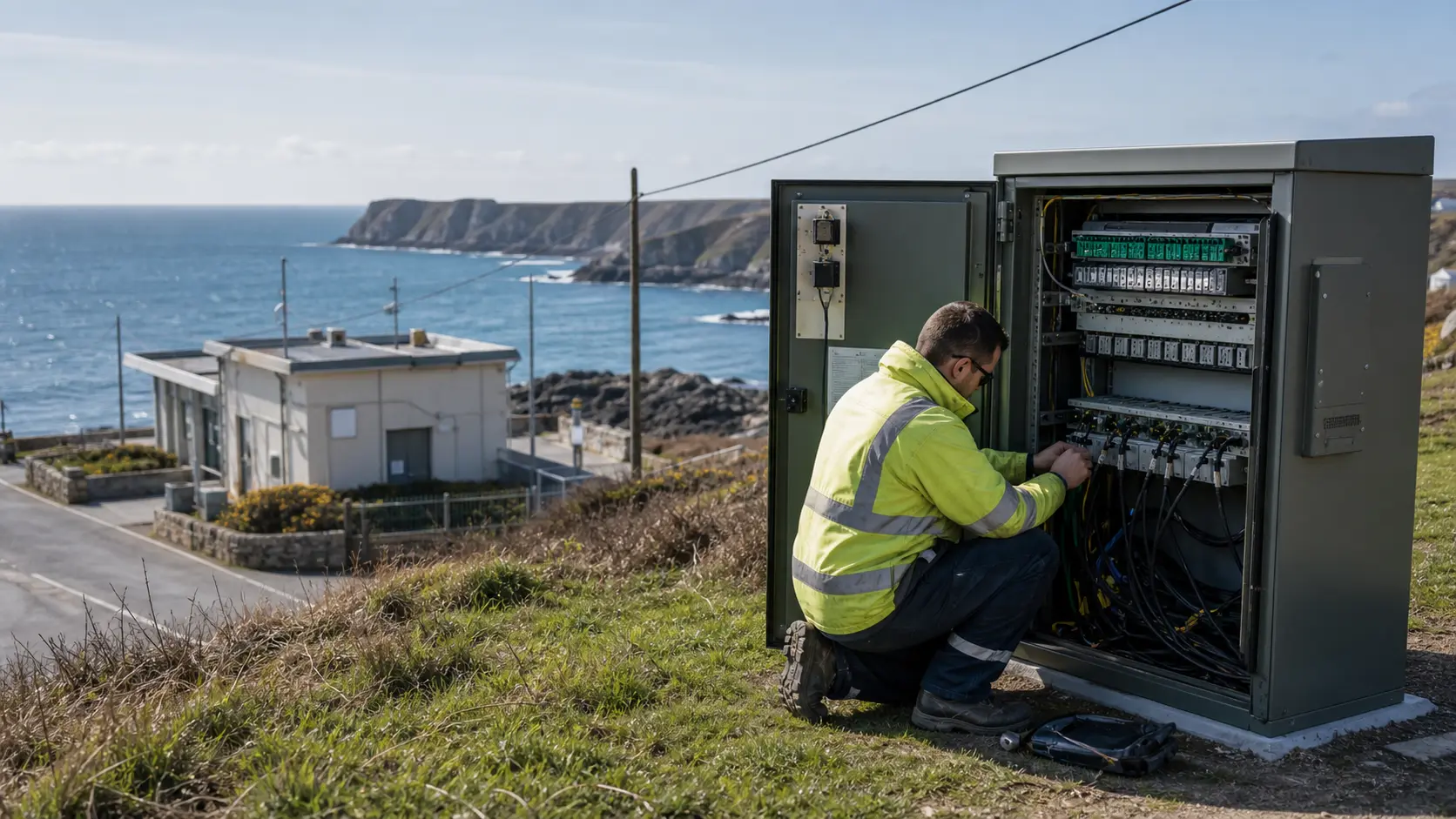
Imagine a Monday morning in St Peter Port. A private bank has client calls starting at 8:30. A harbour office has customs, weather, berth and freight traffic to handle. A hotel has card payments, booking platforms and guest WiFi running at once. A care service has staff using hosted systems and phones. The buyer in each case is not really purchasing "150Mbps" or "1Gbps".
The buyer is purchasing a probability distribution: how likely the service is to work, how quickly it can be restored, how many alternative paths exist when a route fails, and whether a local team can reach the cabinet, office or data hall while the business is losing money.
Sure's retail fibre table makes the commodity layer visible. The company advertises unlimited symmetric fibre packages from Basic at GBP39 per month for 30Mbps to Ultimate at GBP170 per month for 2Gbps, with intermediate plans at GBP50, GBP60, GBP70 and GBP80 (https://www.sure.com/guernsey/broadband-and-home/fibre-broadband/). Those prices matter because they set household expectations. They are not enough to explain the company. The more important public signals are the 98 percent fibre availability claim, 21,330 switched broadband connections and copper switch-off language on Sure's 2026 migration page (https://www.sure.com/guernsey/latest-news/2025/the-time-is-now-to-switch-to-fibre/), the fixed licence running from 1 October 2016 to 30 September 2031 on the GCRA licensed-operator page (https://www.gcra.gg/gcra/licenced-operators/sure-guernsey-limited), the 100Gbps ports listed for AS8680 at LINX and LONAP in PeeringDB (https://www.peeringdb.com/api/net/9549), and the GCRA's wholesale price controls on broadband and leased lines (https://www.gcra.gg/sites/default/files/case-document/final-decision-wholesale-broadband-pricing-non-confidential.pdf and https://www.gcra.gg/sites/default/files/case-document/t1621g-final-decision-wholesale-leased-line-pricing-non-confidential-version.pdf).
Those records change the economic decision. A lender, acquirer, regulator or large Guernsey customer should not value Sure mainly by comparing retail speed tiers against a UK mainland broadband table; it should value the company by the cost and proof of restoration certainty, wholesale access terms, route diversity, customer migration execution, and the discipline imposed on a near-utility operator in a geographically constrained market.
That is the governing argument. Sure Guernsey Ltd is tracked because the evidence points to a telecom operator whose footprint is too central to be measured like an ordinary broadband brand. Guernsey's population was 64,781 at the end of 2023 (https://www.gov.gg/population/). Its 2023 GDP was estimated at GBP3.488 billion, with GDP per head of GBP54,463 (https://www.gov.gg/gdp). A 2024 States economic-development statement described finance, legal and accounting activity as roughly GBP1.5 billion, or about 44 percent of island output, with 7,766 finance-sector jobs (https://gov.gg/article/202342/Statement-by-President-Committee-for-Economic-Development). The GFSC's first-quarter 2026 investment statistics put total net asset value of Guernsey funds at GBP272.6 billion (https://www.gfsc.gg/industry-sectors/investment/investment-statistics-summary-first-quarter-2026). Those are not Sure revenue numbers. They are a demand map: a small island with high-value work that makes downtime expensive.
The legal operator is also the utility surface
The identity evidence is unusually clear. The GCRA lists "Sure (Guernsey) Limited" as a telecoms operator at PO Box 3, St Peter Port, with the public website https://www.sure.com/ and contact address contact@sure.com (https://www.gcra.gg/gcra/licenced-operators/sure-guernsey-limited). The same page lists a fixed telecommunications licence with issue date 1 October 2016 and end date 30 September 2031, plus a mobile licence issued on 27 March 2015. The fixed licence itself says it is issued to Sure (Guernsey) Limited, formerly Guernsey Telecoms Limited and Cable & Wireless (Guernsey) Limited, and authorises the company to establish, operate and maintain the licensed telecommunications network and provide licensed services within, to and from the Bailiwick (https://www.gcra.gg/sites/default/files/licence/sure-fixed-clean-5th.pdf).
This matters because the public brand and the regulatory role are not separable. Sure's consumer site sells fibre, mobile, landline and home services. Its business site describes Sure by Beyon as a provider of telecommunications and IT solutions across Guernsey, Jersey, the Isle of Man and additional island markets including Diego Garcia, St Helena, Ascension Island and the Falkland Islands (https://business.sure.com/about/company-information/). The same company page says the business introduced a refreshed Sure by Beyon identity in 2025 and points to continued investment in GBP48 million of 5G and GBP37 million of fibre rollout. The business "Why choose Sure" page claims more than 200 dedicated staff across the islands plus global support, connections to partner networks in 153 countries, and Channel Islands data centres for local data residency (https://business.sure.com/why-choose-sure/).
That combination creates a particular kind of island telecom company. It is local enough to be expected to know the roads, buildings, cabinet locations and political sensitivities. It is group-backed enough to claim global partnerships and larger procurement scale. It is regulated enough that GCRA price and licence decisions define part of its commercial room. It is incumbent enough that other providers and public bodies must deal with its network even when they compete with its retail arm.
The fixed licence shows why the word utility is justified. Condition language in the licence includes continuity, availability, change-of-control notice, GCRA information rights, ring-fencing and the requirement that administration and management of the licensed business be conducted from the Bailiwick (https://www.gcra.gg/sites/default/files/licence/sure-fixed-clean-5th.pdf). A normal retail ISP can lose customers if it performs badly. A licensed incumbent of this type has a wider public obligation: its asset condition, ownership, emergency performance, wholesale behaviour and local management all matter to the island's public interest.
The mobile licence now carries the additional weight of the Airtel acquisition. GCRA's case page records case M1626G, "Sure (Guernsey) Limited acquisition of Guernsey Airtel Limited", opened on 19 June 2023 and closed on 1 September 2024 (https://www.gcra.gg/case/sure-guernsey-limited-acquisition-guernsey-airtel-limited). Sure's own Airtel page tells customers that Airtel is now part of Sure, that Airtel accounts have been moved to Sure systems, and that mobile, broadband and landline services should continue to work as normal during the migration (https://www.sure.com/guernsey/airtel/). That is not just a brand transition. It is the absorption of a rival customer base into the island's largest telecom platform.
Fibre turns copper retirement into a restoration contract
The fibre project is the clearest economic mechanism in the public record. The States policy letter "Delivering Next Generation Digital Infrastructure" described the recommended solution as a ubiquitous and equitable full-fibre broadband network. It said all licensed operators would have non-discriminatory access to the wholesale network at regulated GCRA-approved rates, that the target completion date was the end of 2026, and that all homes and businesses would need to agree to switch from copper to fibre (https://www.gov.gg/CHttpHandler.ashx?id=144068&p=0). It also described the States grant as a capped GBP12.5 million "Digital Accelerator Investment" and said Sure would bear the bulk of installation costs, estimated at about GBP37.5 million.
The public deal therefore has two faces. One face is consumer upgrade. Faster speeds, symmetric fibre, free switchovers for like-for-like service, and the option of higher paid tiers are easy to sell. The other face is copper retirement. The policy letter said the existing copper network would be retired in phases as fibre was rolled out, and Sure's 2026 page warns that anyone still using copper must move to fibre to keep broadband, landline and lifeline services working (https://www.sure.com/guernsey/latest-news/2025/the-time-is-now-to-switch-to-fibre/). The old copper network was powered differently from fibre. The GCRA fixed licence defines copper voice as not dependent on mains power at the premises, while fibre voice depends on ongoing mains power unless a battery back-up unit or uninterrupted power source is present (https://www.gcra.gg/sites/default/files/licence/sure-fixed-clean-5th.pdf). That is not a minor technical footnote. It changes emergency-calling and power-failure economics.
The GCRA's FTTP emergency-calls decision explains the issue directly. The regulator said Sure had a temporary exemption while trialling FTTP, then considered how vulnerable groups, landline-reliant users and emergency-service users should be protected in a fibre environment (https://www.gcra.gg/sites/default/files/case-document/t1557g-all-fixed-telco-licensees-fttp-emergency-calls-licence-modification-final-decision.pdf). The document noted that not all mobile masts have battery back-up and that mobile coverage and indoor reception can vary. A move from copper to fibre is therefore not only a capacity upgrade. It transfers part of resilience from the exchange-powered copper loop to batteries, mobiles, routers, premises power, customer education and operator response.
That is why the 98 percent availability and 79 percent customer switch figures matter. Sure says 98 percent of homes and businesses can connect to fibre and that 21,330 broadband connections, or 79 percent of broadband customers, had moved by the time of its 2026 notice (https://www.sure.com/guernsey/latest-news/2025/the-time-is-now-to-switch-to-fibre/). Local reporting added market pressure: Bailiwick Express said a fifth of households and businesses remained on copper and that services were being phased out in stages (https://www.bailiwickexpress.com/news-ge/time-is-running-out-for-the-old-copper-network/). Guernsey Press reported in November 2025 that 6,500 homes still needed to connect before copper switch-off, with up to three visits and three letters for holdouts (https://guernseypress.com/news/2025/11/11/6500-homes-must-connect-to-fibre-before-copper-switch-off). These are market signals rather than audited network KPIs, but they point to the real operating problem: the last 20 percent of migration can cost more per premises, carry more vulnerable users and create more reputational risk than the first 70 percent.
The fibre project also changes the competitive map. Other retail providers can buy wholesale access, but the States-supported physical rollout is Sure-led. The GCRA's proposed wholesale broadband decision said the FTTP rollout would be undertaken solely by Sure using Sure infrastructure and argued that this reduced the likelihood of other operators investing in rival FTTP infrastructure (https://www.gcra.gg/sites/default/files/case-document/proposed-decision-wholesale-broadband-access-pricing.pdf). It also said Sure continued to hold the vast majority of the wholesale broadband access market, at or above 93 percent. That means fibre is both a public upgrade and a wholesale bottleneck.
Submarine and backhaul dependency make the off-island route part of the balance sheet
An island network cannot be understood only by looking at the final drop into a home. Guernsey's fixed and mobile services need on-island access, power, cabinets, exchanges, radio sites and local support. They also need off-island backhaul. The States fibre policy letter explicitly described the fibre project as reinforcing Sure's critical network-infrastructure role by leveraging its existing subsea, fixed and mobile network assets (https://www.gov.gg/CHttpHandler.ashx?id=144068&p=0). That wording is important because it says what every island customer knows in practical terms: resilience is a route question, not only an access-line question.
The public routing records do not disclose private route contracts, exact cable capacity or all redundancy arrangements. They do show a meaningful off-island architecture. PeeringDB records Sure Guernsey Ltd as AS8680, with website https://business.sure.com/, network type NSP, mostly inbound traffic, European scope, IPv6 enabled, 200 IPv4 prefixes and 30 IPv6 prefixes in the operator-maintained PeeringDB fields, plus facilities at Equinix LD8 and LD9 in London and Equinix PA3 in Paris (https://www.peeringdb.com/api/net/9549). It lists 100Gbps ports at LINX LON1 and LONAP LON0, both route-server enabled (https://www.peeringdb.com/api/netixlan?net_id=9549). LONAP's member export also includes AS8680 and the Sure Guernsey name (https://portal.lonap.net/api/v4/member-export/ixf/).
RIPEstat gives the external observation layer. Its AS overview identifies AS8680 as "SURE-International-Limited Sure (Guernsey) Limited" and announced (https://stat.ripe.net/data/as-overview/data.json?resource=AS8680). Its routing-status API, queried for 3 July 2026, showed IPv4 visibility at 324 of 324 RIS full-feed peers, IPv6 visibility at 321 of 321, 69 IPv4 prefixes, three IPv6 prefix entries and 97 observed neighbours (https://stat.ripe.net/data/routing-status/data.json?resource=AS8680). These numbers do not prove every customer path or service-level promise. They do show that Sure's internet-facing network is not merely a local office and a homepage. It is a visible routed network with major London exchange presence and multi-country facility evidence.
The economics follow from that structure. Guernsey's local fibre drop can be perfect and still fail a customer's needs if off-island capacity, power, routing or upstream arrangements are weak. Conversely, a strong off-island peering and facility footprint has limited value if the access network, customer premises equipment or support desk cannot keep a household, care alarm, hotel or bank online. Sure has to fund both ends of the chain.
The public record suggests this is exactly the product it is trying to sell: fibre into premises, 5G overlay, enterprise circuits, local data-centre capacity and international connectivity rather than a single best-effort broadband line.
The business site reinforces the point. Sure's connectivity page says multi-million-pound investment and partnerships with networks worldwide connect Channel Islands and Isle of Man businesses to major international business centres, and it advertises dedicated uncontended IP feeds, Pro Broadband, point-to-point private circuits and MPLS, VPLS and SD-WAN multipoint connections (https://business.sure.com/products-and-services/telecoms-solutions/connectivity/). Its Guernsey data-centre page describes Tier III facilities, 24-hour security, individual halls or cages, inter-island connectivity, 2MW IT load, remote hands and cloud migration assistance (https://business.sure.com/products-and-services/offshore-data-centres/guernsey-data-centre/). For a regulated fund administrator or bank, those claims translate into a practical proposition: do not send every risk off-island, and do not keep every recovery dependency inside one office.
Retail prices reveal the household floor, not the whole margin
Sure's fibre price card is useful because it shows the retail floor under the public network. As of the researched page, the Basic fibre plan was GBP39 per month for 30Mbps with a GBP55 connection charge and GBP90 standard router; Starter was GBP50 for 75Mbps; Essential was GBP60 for 150Mbps with free connection; Family was GBP70 for 500Mbps; Power was GBP80 for 1Gbps; and Ultimate was GBP170 for 2Gbps (https://www.sure.com/guernsey/broadband-and-home/fibre-broadband/). The page says fibre is always unlimited and upload speeds match downloads. It also says prices include Sure Home phone, most plans have a 24-month minimum contract, and each July the monthly price can be reviewed and increased by up to the RPI inflation rate.
The household arithmetic is simple enough. A family that pays GBP70 per month for 500Mbps, plus a premium router charge, is buying a high-speed access bundle with landline. A power user paying GBP80 for 1Gbps or GBP170 for 2Gbps is buying headroom. A Basic user at GBP39 may be using the network as an essential utility. But the retail tariff is not where the island's risk fully sits.
The expensive questions are about the fibre build, backhaul, maintenance staff, support hours, vulnerable-customer migration, battery provision, wholesale controls, equipment procurement and the opportunity cost of retiring copper before every edge case is simple.
Small-market telecom economics make that hard. Guernsey has too few premises to spread large network investments like a mainland national carrier. The upside is high-value demand. The island's GDP and finance-sector role mean a significant number of customers can pay for business-grade reliability, hosted systems, cloud connectivity and recovery plans. The downside is that every fixed cost is divided across a small customer base, and political tolerance for high prices is limited because telecoms is now a public-service dependency.
This is the small island tension: the customers most able to pay for resilience make the network worth upgrading, but the network must still serve households, older users and public services that cannot absorb enterprise pricing.
The Sure price table also shows a bundle strategy. Discounts can apply when customers add an Unlimited mobile plan, with savings up to GBP25 per month on the Ultimate plan (https://www.sure.com/guernsey/broadband-and-home/fibre-broadband/). That matters after the Airtel acquisition because fixed-mobile bundling can reduce churn and raise household revenue per account, but it can also reduce effective competition if the largest fixed operator becomes the default mobile consolidator. A customer who has fibre, landline, mobile, account management and possibly home support in one place is less likely to leave after a small price move. That can fund investment. It can also weaken the discipline that a third mobile challenger used to provide.
Wholesale regulation decides how competition reaches the fibre network
Guernsey's retail customers see supplier names. Competitors see wholesale terms. The GCRA's wholesale broadband and leased-line decisions are therefore central to Sure's economics.
The wholesale broadband final decision says Sure was awarded a telecommunications licence for licensed services and that GCRA proposed a new price control commencing on 1 January 2024. The first proposed decision would reduce the charge made by Sure for wholesale broadband by 11 percent on average, but the second proposed decision set a weighted average cost-oriented charge for Sure's wholesale broadband market at GBP26.05 per month over the 2024-2028 price-control period, effectively a 32 percent average reduction to then-current prices (https://www.gcra.gg/sites/default/files/case-document/final-decision-wholesale-broadband-pricing-non-confidential.pdf). The same final decision projected fixed broadband demand on Sure's network rising from 26.1 thousand users in 2022 to 27.7 thousand in 2028, with customers migrating from copper to FTTP over time.
That is a direct squeeze on the incumbent's wholesale economics. A wholesale price cut can improve the ability of rivals to sell fibre to households and small businesses. It also changes Sure's recovery path on a network where the physical build cost and maintenance obligations remain large. The regulator's model must decide how much cost belongs in broadband, how much in wholesale line rental, how common costs are allocated, and what return is reasonable. Sure's commercial instinct is to protect recovery and investment certainty. Rival operators and consumers want lower access prices.
The public decision is the point where those claims become a price.
The leased-line decision adds the business layer. GCRA's final decision for wholesale on-island leased lines directed Sure to reduce wholesale leased-line product prices by 23 percent over 1 April 2024 to 31 December 2028 compared with the prices Sure would have applied if prices had increased with inflation from current levels (https://www.gcra.gg/sites/default/files/case-document/t1621g-final-decision-wholesale-leased-line-pricing-non-confidential-version.pdf). It set a decision period running from 1 April 2024 to 31 December 2028 and required Sure to provide details of agreements, net prices, revenues, promotions, new products and removed products. The decision also referenced a discounted cash-flow model, a 40-year modelling period, WACC of 8.8 percent, inflation assumptions falling from 6.3 percent in 2023 to a long-run 2.2 percent from 2026, and product-level maximum prices.
That leased-line decision is more than a technocratic schedule. It affects banks, fund administrators, public bodies, data-centre customers, rival operators and large businesses that need predictable fixed bandwidth. If wholesale prices are too high, retail competition struggles and business customers pay for the incumbent's position. If prices are too low, the incumbent argues investment and maintenance incentives weaken. In an island setting, either error is costly. A false saving today can create underinvestment; an excessive price today can tax the productive economy.
The GCRA's business-connectivity market review explains why it intervenes. It assessed the business connectivity market in Guernsey and considered market definition, significant market power and remedies (https://www.gcra.gg/sites/default/files/case-document/t1480gj-business-connectivity-market-review-market-definition-smp-assessment-final-decision.pdf). The public filings around wholesale leased lines and wholesale broadband repeatedly identify Sure as the regulated provider whose wholesale charges matter. That is the operating surface a lender or regulator should monitor: retail package tables are visible, but the wholesale price model tells competitors how much room they have.
Airtel integration makes mobile a test of restraint
The Airtel acquisition is the sharpest competition issue in the file. GCRA's April 2023 letter to the Committee for Economic Development warned that the proposed acquisition represented a more adverse outcome for consumers than alternatives, because a virtual monopoly would raise concerns about significant price rises and potentially lower quality for consumers and business (https://www.gcra.gg/sites/default/files/case-document/letter-from-gcra-to-cfed-22-april-2023.pdf). It said economic regulation could curb the worst excesses of concentration but was unlikely to compensate for all outcomes from an increase in market share by more than 20 percentage points to 80 percent through acquisition of a rival by the largest player. It also said Guernsey Airtel had played a challenger role, particularly on roaming, and that a comprehensive, ready-for-use MVNO arrangement should be a minimum prerequisite if the transaction proceeded.
That language is unusually direct. It does not say Sure is a bad operator. It says the structure after the deal is risky. A small island can struggle to support three full mobile network operators, but reducing the number of real mobile challengers reduces the threat that keeps prices, roaming terms and innovation in line. The public-policy case for the transaction was tied to security and investment arguments, but the regulator's concern was that the cure could create a dominant retail position.
The mobile licence now reflects conditions tied to the acquisition. The non-confidential mobile licence says the requirements in Schedule 4 took effect from completion of the Guernsey Airtel acquisition (https://www.gcra.gg/sites/default/files/licence/sure-licence-mobile-1-october-2024-non-confidential-version.pdf). The schedule includes spectrum relinquishment commitments, tariff protections for certain existing customers for up to 36 months subject to RPI rights, continued availability of Airtel's Basic Plan tariff for up to 36 months, Big Bundle discount eligibility communications, and a requirement that Sure have a new mobile network operational within 18 months of completion, meeting 4G service commitments. This is not ordinary post-merger branding. It is a licence-backed attempt to make a concentrated mobile market behave more competitively than it otherwise might.
Sure's Airtel customer page shows the practical work. It tells Airtel customers that services are now provided by Sure, that network and support should remain the same, that billing and account tools are moving to MySure, and that the Airtel store has closed with support moved to the Sure store at 27 High Street, St Peter Port (https://www.sure.com/guernsey/airtel/). It also says existing pay-monthly pricing will stay the same for affected customers and that Pay As You Go bundles will continue with adjustments. The economic risk sits behind the calm wording. Customer migration can produce support surges, bill confusion, SIM replacements, lost account access and churn opportunities. If handled well, Sure gains scale and customer stickiness. If handled badly, the very deal justified partly by continuity can become a service-quality liability.
The 5G record turns the acquisition into an investment test. Sure's 2025 "Building the digital future" page says the company is investing GBP48 million to build the Channel Islands' most advanced mobile network, targeting 100 percent 5G standalone coverage and combining Sure and Airtel infrastructure to increase coverage and capacity by up to 30 percent (https://www.sure.com/guernsey/latest-news/2025/building-the-digital-future/). GCRA's 19 November 2025 5G spectrum final decision approved Sure's spectrum application for 2x10MHz in the 700MHz band and 100MHz in the 3.6GHz band, and said the regulator remained satisfied that sufficient spectrum would remain available for further market entry or development if additional operators sought access later (https://www.gcra.gg/sites/default/files/case-document/Sure%205G%20Spectrum%20-%20Final%20Decision%20-%20Sure_0.pdf). This creates the next measurable question: does concentration convert into a better mobile network on time, or simply into higher customer lock-in?
A realistic failure day would expose the actual product
The public records do not prove a recent island-wide Sure failure. The more useful exercise is to price a plausible failure day. Suppose a storm or construction incident damages an on-island fibre route in the morning, while an off-island backhaul path is degraded and several enterprise customers are invoking recovery plans. A St Peter Port trust company cannot reach a hosted application. A hotel loses card-payment reliability. A public office has staff tethering to mobile data, but mobile cells are congested. A harbour user needs operational updates.
A care alarm customer has moved from copper to fibre and depends on premises power, battery provision or mobile fallback.
In that scenario, Sure's advertised speed tiers are almost irrelevant. The valuable evidence would be route maps, power autonomy, support ticket history, spare-part location, technician availability, traffic-engineering records, customer-notification performance, wholesale service restoration, data-centre remote hands and the commercial terms in enterprise recovery agreements.
A buyer or lender should ask one hard private-underwriting question: show the route contract, disaster-recovery contract and support ticket history that prove a Guernsey finance customer can be restored within the promised window when both a local access fault and an off-island capacity shock happen on the same business day.
That question is deliberately concrete. It avoids vague faith in "resilience" and asks for documents that would change a credit or acquisition view. Sure can point publicly to ISO 22301 business-continuity, ISO/IEC 27001 information-security and PCI-DSS claims on its risk and compliance page (https://business.sure.com/about/risk-and-compliance/). It can point to Tier III Guernsey data-centre features and 2MW IT load (https://business.sure.com/products-and-services/offshore-data-centres/guernsey-data-centre/). It can point to 100Gbps public exchange ports and visible AS8680 routes (https://www.peeringdb.com/api/net/9549 and https://stat.ripe.net/data/routing-status/data.json?resource=AS8680). Those are useful public indicators. They are not a substitute for the customer-specific proof that a regulated bank, fund administrator, payment-dependent hotel or public service would need before treating Sure as a restoration partner rather than just a telecom supplier.
The same failure day would also test the regulator's choices. If Sure owns the fibre layer used by competitors, wholesale restoration must be credible. If Sure's mobile market share rises after Airtel, mobile fallback capacity must be credible. If copper retirement increases reliance on powered customer equipment, vulnerable customers must understand and maintain the new fallback model. A small island has no room for neatly separated failure domains. Fixed, mobile, wholesale, cloud and emergency communications meet in the same place: a user who has to stay connected.
Enterprise upside sits in continuity services
The most attractive part of Sure's economics is not the lowest household package. It is the enterprise and public-service layer where customers pay for fewer surprises. Sure's business connectivity page advertises dedicated uncontended IP feed or Pro Broadband, point-to-point private circuits for large volumes of data, and multipoint WAN connections using MPLS, VPLS and SD-WAN (https://business.sure.com/products-and-services/telecoms-solutions/connectivity/). Its broader business pages list cloud solutions, private cloud, public vCloud, recovery as a service, online backup, cloud connectivity, Microsoft cloud services, S3 storage, data-centre services, managed IT, managed backup, managed network and cybersecurity (https://business.sure.com/why-choose-sure/).
This product set fits Guernsey's economy. Fund administrators, fiduciaries, insurers, law firms, accountants, public services, logistics users and hotels do not all need the same technical architecture. They do share one problem: the island is small, highly regulated and externally connected. Data residency can matter. Payment availability can matter. Audit trails can matter. A mainland hyperscaler may be an essential partner, but a local data centre with remote hands and known jurisdictional controls has a different risk profile. Sure's customer-story page says Saltgate selected Sure because of resilience from a dual-island data-centre network with diverse routing between Jersey and Guernsey, and says Estera needed data-centre and network connectivity platforms for global expansion (https://business.sure.com/testimonials/). Those are marketing case studies, but they show the accounts Sure wants: customers that turn network and hosting reliability into operating leverage.
The public sector is part of the same demand map. Sure's testimonials say its professional services team worked with the States of Guernsey and CT Plus on WiFi across Guernsey's bus network, with reliability and fair passenger speeds as part of the design (https://business.sure.com/testimonials/). That is a small example, but it illustrates how utility-like the operator becomes. Connectivity is not only a home subscription or enterprise circuit. It appears in transport, education, public administration, telecare, hospitality and emergency communications. Every such use case increases the value of a provider that can coordinate access, mobile, cloud and local support.
The drawback is customer concentration risk. In a market of 64,781 people, a relatively small number of high-value enterprise, public-sector and finance customers can drive disproportionate margin. Public sources do not disclose Sure Guernsey-specific enterprise revenue, gross margin, churn or customer concentration. The article can infer the logic from the product set and economy, but cannot quantify it.
If a large customer group shifts procurement, builds multi-provider redundancy, moves more workloads off-island, or demands price concessions under a regulated wholesale climate, Sure's enterprise upside would be less secure than the product catalogue suggests.
Competition is narrower after Airtel, but not gone
Guernsey is not a single-provider island in every sense. JT operates in Guernsey. Other licensed operators and retail providers can use regulated wholesale access. Starlink obtained a fixed telecom licence in 2022, according to the GCRA's wholesale broadband proposed decision, though the same document said subscriber numbers were low and had not materially altered market shares (https://www.gcra.gg/sites/default/files/case-document/proposed-decision-wholesale-broadband-access-pricing.pdf). The 5G spectrum final decision said spectrum remained available for further entry or development should additional operators seek access in future (https://www.gcra.gg/sites/default/files/case-document/Sure%205G%20Spectrum%20-%20Final%20Decision%20-%20Sure_0.pdf).
But competition is structured by the bottleneck. The GCRA wholesale broadband paper said the Sure-States FTTP arrangement made rival FTTP infrastructure less likely and that JT's alternative fixed network did not provide wholesale access (https://www.gcra.gg/sites/default/files/case-document/proposed-decision-wholesale-broadband-access-pricing.pdf). That leaves competition dependent on regulated access to Sure's network in many cases. Retail rivalry can still improve service and pricing, but it relies on the wholesale price, provisioning quality and repair performance of the same underlying network.
Mobile competition is even more sensitive after Airtel. The GCRA's April 2023 letter warned explicitly about the loss of a third challenger and the possibility that two remaining operators could coordinate behaviour or protect dominant positions in their home markets (https://www.gcra.gg/sites/default/files/case-document/letter-from-gcra-to-cfed-22-april-2023.pdf). Licence conditions are meant to mitigate that, but no licence condition is as fast-moving as a hungry rival with its own network, tariffs and roaming posture. Sure's 5G investment can improve coverage and capacity; it can also strengthen the bundle that makes customers less likely to switch.
This is why the next two years matter. If Sure delivers the mobile network it promised, keeps fibre migration orderly, supports wholesale rivals fairly and avoids exploitative price moves, the Airtel transaction may look like a small-market consolidation that paid back in network quality. If prices rise, service quality disappoints or wholesale access frictions increase, the same transaction will look like a transfer of market discipline from customers to regulators. The evidence does not settle that question yet. It sets up the watchpoint.
Public market signals are about switching anxiety and trust
Public chatter around Sure Guernsey is not a single clean dataset. Local news, operator pages and regulatory filings show a market concerned with fibre migration, copper retirement, Airtel account movement, mobile investment and price or quality discipline. Sure's pages urge customers to switch before copper services end, explain Airtel billing migration and tell customers to contact support if they cannot access expected messages (https://www.sure.com/guernsey/broadband-and-home/switch-to-fibre/ and https://www.sure.com/guernsey/airtel/). Bailiwick Express and Guernsey Press coverage of copper switch-off turns the same issue into a public story about households and businesses that could be left behind if they do not move in time (https://www.bailiwickexpress.com/news-ge/time-is-running-out-for-the-old-copper-network/ and https://guernseypress.com/news/2025/11/11/6500-homes-must-connect-to-fibre-before-copper-switch-off).
That market signal is useful because it shows where trust is won or lost. Most customers cannot audit an AS path, a data-centre certification or a wholesale price model. They can experience whether an engineer arrives, whether the router works, whether a bill changes unexpectedly, whether a mobile SIM keeps working and whether an older relative understands the fibre switch. In a small jurisdiction, those experiences travel quickly through families, offices, parish networks and business associations. An infrastructure project can be technically successful and still create reputational cost if the last users feel forced, confused or ignored.
The official pages also show a support-heavy model. Sure's fibre page offers Home Tech Team visits on selected plans, a mesh WiFi extender on higher tiers, phone and email contact for fibre questions, and explanatory fibre installation material (https://www.sure.com/guernsey/broadband-and-home/fibre-broadband/). The Airtel page points customers to store support, appointment booking, MySure account tools and specific billing guidance (https://www.sure.com/guernsey/airtel/). Those services are costs as well as customer comforts. In a dense mainland city, a provider can sometimes hide behind self-service. On a small island retiring copper and absorbing a mobile rival, support is part of the network product.
The unofficial evidence does not justify a conclusion that Sure is failing or excelling. It does justify a watchpoint: customer experience during forced or semi-forced migrations is an economic indicator. Fibre take-up, Airtel billing movement, Pay As You Go adjustments, router visits, vulnerable-user battery arrangements and mobile coverage changes will tell more about market power than a brand refresh will.
What a buyer, lender or regulator should demand
A buyer would pay for Sure's local rights, fibre footprint, mobile customer base, business accounts, data-centre and cloud surface, AS8680 routing presence, group-backed procurement and the public evidence of investment. A lender would like the essential-service character, RPI-linked price review language in consumer terms, high switching friction after bundle adoption, and the island economy's dependence on reliable connectivity. A large customer would value local support, data residency, dual-island or off-island routing options, private circuits, recovery services and accountable restoration.
The same parties should discount the company for concentration risk, regulatory intervention, integration execution, copper switch-off edge cases, power-backup obligations, small-market scale, customer concentration and the possibility that wholesale price controls reduce returns below the level assumed when capital was committed. The GCRA's broadband decision moved toward a GBP26.05 monthly weighted average cost-oriented wholesale broadband charge over 2024-2028 (https://www.gcra.gg/sites/default/files/case-document/final-decision-wholesale-broadband-pricing-non-confidential.pdf). The leased-line decision imposed a 23 percent reduction against inflation-uplifted prices over 2024-2028 (https://www.gcra.gg/sites/default/files/case-document/t1621g-final-decision-wholesale-leased-line-pricing-non-confidential-version.pdf). Those are not footnotes for valuation; they are public constraints on the revenue bridge from infrastructure to returns.
The regulator should demand proof on three fronts. First, wholesale: provisioning, repair, discount and product-change records should show that rivals are not disadvantaged. Second, mobile: post-Airtel tariff, roaming, MVNO access, network rollout and coverage data should show that concentration did not reduce pressure on Sure. Third, resilience: battery, emergency calling, backhaul, disaster recovery and support records should show that copper retirement and fibre migration improved service reliability rather than merely modernising the access medium.
The most important private evidence would be route contracts, incident logs, support ticket histories, customer concentration files, mobile migration metrics and recovery-test records.
Public evidence register
The legal identity evidence comes from GCRA's licensed-operator page and the fixed and mobile licence PDFs. The operator page records Sure (Guernsey) Limited as a telecoms licensee with fixed and mobile licences (https://www.gcra.gg/gcra/licenced-operators/sure-guernsey-limited). The fixed licence authorises Sure to establish, operate and maintain fixed telecommunications networks and services in the Bailiwick and includes conditions on availability, change of control, local management and ring-fencing (https://www.gcra.gg/sites/default/files/licence/sure-fixed-clean-5th.pdf). The mobile licence contains post-Airtel acquisition requirements, tariff protections, MVNO and new network obligations (https://www.gcra.gg/sites/default/files/licence/sure-licence-mobile-1-october-2024-non-confidential-version.pdf).
The fibre evidence comes from the States policy letter, Sure rollout announcements and Sure customer pages. The States document sets out the capped GBP12.5 million public investment, Sure's circa GBP37.5 million installation-cost burden, non-discriminatory wholesale access and end-2026 target (https://www.gov.gg/CHttpHandler.ashx?id=144068&p=0). Sure's announcement repeats the GBP37.5 million project and up to GBP12.5 million States support (https://www.sure.com/press-centre/sure-announces-guernsey-fibre-roll-out/). Sure's 2026 migration notice gives the 98 percent availability and 21,330 connection figures (https://www.sure.com/guernsey/latest-news/2025/the-time-is-now-to-switch-to-fibre/). The fibre package page gives retail plan prices, unlimited symmetric claims, landline inclusion and RPI review language (https://www.sure.com/guernsey/broadband-and-home/fibre-broadband/).
The network evidence comes from PeeringDB, LONAP and RIPEstat. PeeringDB records AS8680 as Sure Guernsey Ltd with 100Gbps ports at LINX and LONAP and listed London and Paris facilities (https://www.peeringdb.com/api/net/9549 and https://www.peeringdb.com/api/netixlan?net_id=9549). LONAP's member export includes AS8680 and Sure Guernsey (https://portal.lonap.net/api/v4/member-export/ixf/). RIPEstat identifies AS8680 as announced and shows July 2026 visibility, prefixes and observed neighbours (https://stat.ripe.net/data/as-overview/data.json?resource=AS8680 and https://stat.ripe.net/data/routing-status/data.json?resource=AS8680).
The regulatory economics evidence comes from GCRA wholesale decisions and merger files. The wholesale broadband decision supports the GBP26.05/month and 32 percent reduction discussion, expected user growth and copper-to-FTTP migration assumptions (https://www.gcra.gg/sites/default/files/case-document/final-decision-wholesale-broadband-pricing-non-confidential.pdf). The wholesale leased-line decision supports the 23 percent reduction, 2024-2028 period, WACC and reporting obligations (https://www.gcra.gg/sites/default/files/case-document/t1621g-final-decision-wholesale-leased-line-pricing-non-confidential-version.pdf). The Airtel case page, GCRA information note and April 2023 letter support the merger timeline, public-policy exemption context and GCRA's warning about market share, roaming, MVNO and quality risks (https://www.gcra.gg/case/sure-guernsey-limited-acquisition-guernsey-airtel-limited, https://www.gcra.gg/sites/default/files/case-document/sure-guernsey-limited-acquisition-of-guernsey-airtel-limited-information-note.pdf and https://www.gcra.gg/sites/default/files/case-document/letter-from-gcra-to-cfed-22-april-2023.pdf).
The enterprise and demand evidence comes from Sure Business, GFSC and States economic records. Sure Business supports the data-centre, cloud, connectivity, cybersecurity, managed-service, local staff, partner-network and case-study claims (https://business.sure.com/why-choose-sure/, https://business.sure.com/products-and-services/telecoms-solutions/connectivity/, https://business.sure.com/products-and-services/offshore-data-centres/guernsey-data-centre/, https://business.sure.com/about/risk-and-compliance/ and https://business.sure.com/testimonials/). States statistics support population, GDP and finance-sector contribution (https://www.gov.gg/population/, https://www.gov.gg/gdp and https://gov.gg/article/202342/Statement-by-President-Committee-for-Economic-Development). GFSC fund statistics support the scale of regulated financial assets using Guernsey as a domicile (https://www.gfsc.gg/industry-sectors/investment/investment-statistics-summary-first-quarter-2026).
The bottom line
Sure Guernsey is a small island telecom operator with large public consequences. Its fibre rollout is not just a broadband upgrade; it is the retirement of copper and a shift in how households, vulnerable users and businesses recover from power and access failures. Its AS8680 public routing and London exchange presence are not just technical trivia; they are part of the off-island resilience story. Its data centres and business connectivity products are not side services; they are how an island financial centre buys local accountability.
Its Airtel acquisition is not just consolidation; it is a live test of whether licence conditions and regulation can replace the pressure of a lost challenger.
The constructive case is clear. Sure has the incumbent network, public fibre programme, visible interconnection, enterprise product set, local staff, group backing and 5G investment plan needed to support Guernsey's next connectivity layer. The caution case is equally clear. The island is small, the wholesale bottleneck is real, mobile concentration is higher after Airtel, copper retirement creates edge-case risk, and public trust depends on migration execution rather than brand language.
The fact that would most change the judgement is not another marketing claim about speed. It is a verified restoration record: route diversity, outage history, battery and emergency-calling performance, wholesale repair timing, mobile migration metrics and enterprise disaster-recovery tests. If those records show that Sure can restore a bank, harbour office, hotel, public body and vulnerable household quickly during a compound island fault, the resilience premium is justified. If they do not, Guernsey has bought faster access without enough proof that the most expensive hour of connectivity will be handled when it arrives.