
Summary
- The paid unit that matters for Sileman is a local access account in Upper Silesia: a household, housing block, small office, local ISP or building manager paying for continuity, repair access and support responsiveness, not only headline throughput.
- Sileman's public materials support the view that the company is a regional business-connectivity and wholesale operator with its own fibre footprint, IP transit services, dark fibre, business support promises and a declared presence across 17 cities in the Katowice and Upper Silesia urban area.
- The residential cable and fibre comparison is best read through Elsat, the local consumer brand in the same Slaska Grupa Multimedialna setting, whose published offers put 300 Mbit/s, 600 Mbit/s and 900 Mbit/s services into a low double-digit monthly zloty corridor and expose the maintenance reality of apartment blocks, HFC, FTTH and local customer service.
- Poland's national context is favourable to fixed broadband but unforgiving for small scale: fibre reached about 80.1% of households by the end of 2025, more than 2,600 telecom entrepreneurs remained active, mobile and satellite substitutes were expanding, and national operators could discipline local pricing with promotions.
- Public ASN, PeeringDB and RIPEstat evidence proves that Sileman has a visible routed network and regional interconnection surface; it does not prove household economics, churn, service quality, building-level penetration or margin resilience.
- The investable judgement is conditional: Sileman can defend local-access accounts where building access, field labour, wholesale/backhaul purchasing and local trust reinforce one another, but its weak point is any neighbourhood where national fibre, mobile fixed-wireless, satellite backup, OTT-only service bundles or a delayed promotional switch make the local bundle feel optional.
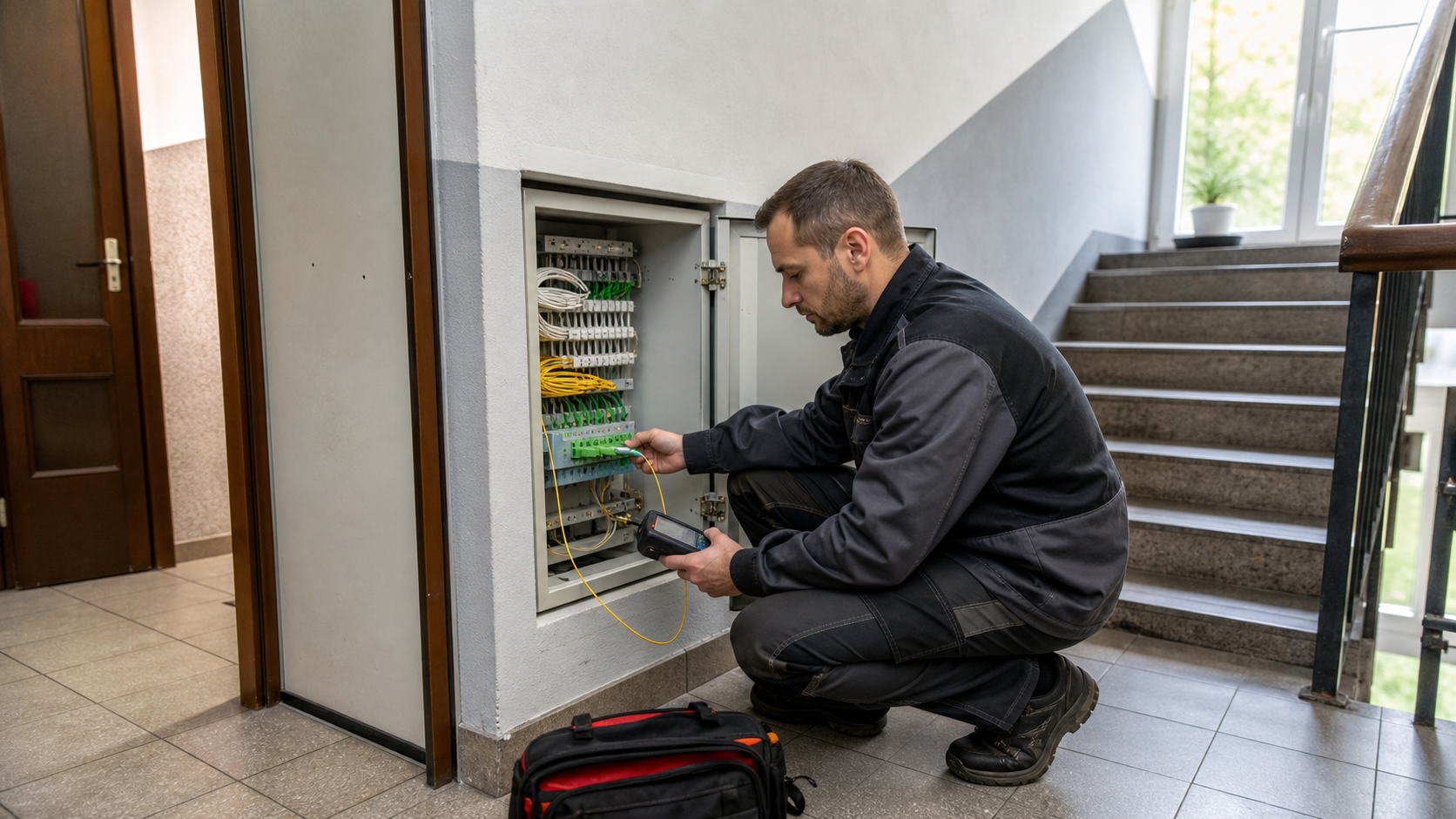
The renewal decision begins in the stairwell, not in the backbone map
Consider a small accounting office in Ruda Slaska that shares a converted ground-floor unit with two other tenants in a residential block. Its owner does not wake up thinking about autonomous systems, peering ports or route objects. She thinks about whether invoices can be sent at 8:30, whether the card terminal will work when a client arrives, whether the video call with a customer in Katowice will freeze, and whether someone local will answer if a modem, optical termination, coax segment or building switch fails.
In the next apartment block, a family with two remote-working adults and a teenager gaming after school faces the same decision in a different language: keep the familiar local cable or fibre account, move to a national fibre operator, use mobile fixed-wireless, add a satellite backup, strip television into an OTT-only service bundle, or wait for a promotional switch when a door-to-door sales campaign reaches the estate.
That is the economic unit for this article: a Polish local-access account attached to a building, household or small firm in Sileman's Upper Silesian operating environment. The account pays for a monthly access line, but the real purchase is a blend of last-mile reach, in-building permission, repair availability, upstream capacity, customer support, billing reliability and confidence that the provider will still care about the address after the initial installation. For a national operator, one more apartment can be a small addition to a large retail base.
For a regional operator, one housing association, one business customer, one local ISP buyer or one street cabinet can matter enough to shape routes, crews and pricing.
This is why Sileman should not be judged as if the whole question were simply whether its public network is visible. It is visible. Sileman describes itself as a business internet provider in the Katowice and Upper Silesia region, with services for businesses, institutions and local ISPs. The regulatory register lists the company as a telecommunications entrepreneur in Ruda Slaska. Peering records and RIPEstat data show public routing surface. Those facts matter because they show that Sileman is not merely a reseller with a website. But the household or small office does not buy a routed surface.
It buys the practical probability that a local access fault will be diagnosed, that field maintenance will not be stranded by scale, and that the monthly price will remain justified when Orange, Play, T-Mobile, Vectra, Netia, Plus, mobile routers, satellite service and streaming bundles all press on the same decision.
The public record is broad enough to support that operating frame, while still leaving the unit economics private. Sileman's own pages describe the regional footprint, business internet, wholesale ISP transit, dark fibre, developer connectivity and corporate contact details at https://sileman.pl/en/home/, https://sileman.pl/en/about-us/, https://sileman.pl/en/internet-for-businesses/, https://sileman.pl/en/internet-for-isps/, https://sileman.pl/en/dark-fibre/, https://sileman.pl/en/for-property-developers/ and https://sileman.pl/en/contact-us/. Elsat's consumer-facing material shows the related local residential access lens at https://elsat.pl/, https://elsat.pl/internet, https://elsat.pl/internet/budynki-wielorodzinne/silepro, https://elsat.pl/internet/budynki-wielorodzinne/sileprox2 and https://elsat.pl/internet/budynki-wielorodzinne/silefiber. The regulatory and network layer is visible through the UKE register and market reports at https://rejestry.uke.gov.pl/rejestr_rpt?page=4, https://www.uke.gov.pl/akt/raport-o-stanie-rynku-komunikacji-elektronicznej-w-2025-roku%2C670.html and https://www.uke.gov.pl/akt/raport-o-stanie-rynku-telekomunikacyjnego-w-2024-roku%2C590.html, plus public interconnection records at https://www.peeringdb.com/net/3394 and https://stat.ripe.net/data/as-overview/data.json?resource=AS30851. Those records prove public surface and commercial positioning; they do not prove churn, repair success or margin per account.
The business question is therefore narrow and concrete. Can Sileman, through its own business network and the local cable/fibre ecosystem associated with Elsat, turn regional familiarity into an account-level resilience premium? Or does the Polish access market, now rich in national fibre coverage and mobile alternatives, force the regional provider into a low-margin support business where every repair visit and every churned building consumes the advantage?
Sileman sells regional proximity as a business service, not just a speed tier
Sileman's own public materials put the company in a clear regional niche. It says it began operations in 2004, serves through its own fibre network, and is one of the leading business internet access providers in the Katowice and Upper Silesia area. Its declared customer set includes small and home businesses, corporations, government institutions, NGOs and local ISPs. Its listed city footprint is not national: Katowice, Mikolow, Chorzow, Swietochlowice, Ruda Slaska, Bytom, Piekary Slaskie, Radzionkow, Zabrze, Gliwice, Pyskowice, Myslowice, Sosnowiec, Czeladz, Siemianowice Slaskie, Dabrowa Gornicza and Bedzin.
The home page also reports 22 years on the market, 17 cities in Southern Poland, 903 km of optical fibre cables and 1,310 business customers.
Those numbers are not enough to value the company, and they are not a substitute for audited customer revenue, churn or network-level capex. They do, however, define the operating model. Sileman is not presenting itself as a mass national mobile bundle. It is presenting itself as a regional connectivity specialist with a business and wholesale bias: symmetric and asymmetric internet access with bandwidth guarantees, fixed telephony, VLAN and VPN services, dark fibre, wholesale internet for ISPs, and cooperation with property developers.
It also says that together with Elsat and SferaTV it forms Slaska Grupa Multimedialna, a consortium of local companies. That grouping matters because the economics of local cable and fibre access are shared across business connectivity, wholesale supply, consumer apartments and building relationships.
The consumer last-mile evidence sits more visibly with Elsat. Elsat's public site says Virtual Operator, owner of the Elsat brand, delivers television, internet and phone service in Ruda Slaska, Bytom, Radzionkow, Swietochlowice, Mikolow, Zabrze, Chorzow, Gliwice and Katowice. It says the brand has been on the market since 1991 and reaches about 32,000 apartments. Published product pages offer apartment-building internet tiers such as 300 Mbit/s for 55 zloty per month, 600 Mbit/s for 65 zloty per month and 900 Mbit/s for 85 zloty per month.
They also show a mixed technology base: FTTH for higher-grade fibre service and HFC or cable options for some tiers. The result is a useful practical lens for Sileman's local-access economics, even though Sileman's own site is aimed more directly at business and wholesale customers.
The regional model has three strengths. First, it can be close to the building. A local provider that knows which estates, risers, ducts, cabinets and housing managers are difficult can turn geography into lower response time. Second, it can sell a more legible support promise to small firms that are too small for national enterprise treatment but too dependent on connectivity to accept purely commodity service.
Third, it can combine wholesale and retail knowledge: the same operator that understands IP transit, dark fibre and local ISP needs may also understand why a particular apartment block needs practical maintenance more than a theoretical gigabit advertisement.
The weakness is the same scale. A national operator can spread marketing, systems, call-centre operations, modem procurement, backbone upgrades, TV rights, mobile discounts and promotional losses over millions of customers. A regional provider must be careful that local intensity does not become local fragility. The office in Ruda Slaska will pay a little for confidence, but it will not pay indefinitely for nostalgia. If the local account is priced too high, the substitute set becomes live. If it is priced too low, truck rolls, support calls, building maintenance and wholesale capacity can erode the margin.
The first cost is access to the building, and the second is staying welcome there
Local access begins before a packet moves. Someone has to reach the building, secure permission, place equipment, pull fibre or coax, identify ducts, keep records current, enter stairwells, label equipment, answer housing-association questions, repair vandalism or water damage, replace failing customer premises equipment and coordinate planned works. In older urban estates, the constraint is often not whether a provider knows how to deliver internet in principle. It is whether the provider can do so without creating repeated friction with building managers and residents.
Sileman's own dark-fibre page is revealing here. It says the company provides dark fibre through its own fibre optic cables in underground ducting and on utility poles, can terminate optical links in distribution hubs or points of presence, and offers outdoor infrastructure design, indoor cabling design, splicing, OTDR measurements, and management and maintenance of fibre networks. That language is not a residential sales banner. It is a list of the real activities that turn a local network from a map into a service. Splicing, measuring and maintaining fibre are not marketing abstractions.
They are labour, equipment, records and response time.
For an apartment-building account, the cost stack has several layers. There is a fixed access layer: rights, ducts, fibre, coax, switches, optical terminals, cabinets, power and installation labour. There is a maintenance layer: periodic modernisation, fault isolation, spare parts, on-site diagnosis, customer premises equipment replacement and cleaning up after construction damage. There is a support layer: calls about Wi-Fi, poor ping, slow laptops, billing, appointments, password resets and service changes. There is an upstream layer: backhaul, IP transit, peering, redundancy and capacity reserves.
There is a commercial layer: discounts, promotional months, contract handling, payment risk, churn and retention. A local operator wins only if the blended monthly revenue from enough accounts in enough concentrated buildings exceeds those recurring costs after allowing for failures, upgrades and churn.
Elsat's help material shows how support cost can migrate from the access network into the home. It explains that slow Wi-Fi or dropped Wi-Fi can come from modem placement, LTE-capable devices near the modem, walls between the modem and client devices, or the difference between wired access and local wireless conditions. This is normal for any broadband provider, but it matters for economics because customers often experience Wi-Fi as "the internet." A technically healthy line can still create a support call, a technician appointment, an irritated review or a churn risk.
The provider that bundles a low-cost access tier with local support must absorb part of that education burden.
Maintenance can also be visible before it becomes a fault. Elsat posted a July 2025 notice about overnight network modernisation affecting specific streets in Bytom, Chorzow, Gliwice, Ruda Slaska, Siemianowice Slaskie and Swietochlowice. Planned work is a positive signal in one respect: a local operator is investing in the physical network. But it also makes the economics tangible. Every modernisation requires scheduling, communication, labour and customer tolerance. The resilience account is not a promise that nothing ever interrupts. It is a promise that interruptions are managed, explained, limited and repaired.
This is where local scale can be either an advantage or a trap. If Sileman and its local ecosystem have dense clusters of customers in particular estates and business districts, each repair visit can support many accounts. The technician knows the route, the building manager knows the provider, spare parts match the local plant, and the customer sees a human response. If customers are too scattered, or if a building has low penetration, the same repair visit becomes expensive. A national operator can sometimes tolerate sparse accounts because it has broader coverage, mobile upsell and national retention machinery.
A local operator needs density and goodwill.
The operational test is not the advertised top speed. It is the ratio between revenue per served address and support minutes per served address. That private metric is not public. Still, the published evidence points to the right question. Sileman markets 24/7 technical support for business internet and an engineer on duty for wholesale internet. Elsat publishes local customer-service hours and a help centre. The local-access account becomes attractive when that support is responsive enough to reduce churn, but disciplined enough not to turn low-price residential service into an unlimited service desk.
Poland's fibre build-out helps Sileman and weakens it at the same time
Poland is no longer a market where fixed broadband scarcity alone protects a local provider. UKE's 2025 electronic communications market report says sector revenue reached 46 billion zloty, up 3.5% year on year, and telecom entrepreneurs invested 12.7 billion zloty, up 32.8%. Fibre reached 80.1% of households, about 13 million homes, and UKE described fibre as the basic fixed access technology in Poland. The same report says more than 2,600 telecom entrepreneurs operate in the market, many local or regional, and that micro, small and medium operators provide more than half of fixed internet services in rural areas.
This is a supportive macro story for a regional operator because fixed access remains important, public policy favours modern infrastructure, and local operators are recognised as part of broadband availability and resilience. The 2024 UKE report also showed continued demand for fixed internet: 9.8 million fixed internet users, revenue of 6.3 billion zloty, strong take-up of high-speed broadband and paid TV still reaching a large share of households. Consumers were buying bundles at scale, with 14.1 million bundled-service users and average monthly bundled-service revenue of 82.8 zloty.
A regional operator that can attach broadband to TV, fixed voice or business services has a familiar Polish bundle logic to work with.
The same data raises the competitive bar. If fibre is available to most households, a local provider can no longer assume that coax or legacy building access is enough. If national operators can sell 300 Mbit/s or 600 Mbit/s fibre at aggressive promotional prices, the local provider must explain why its access line is worth renewing. If mobile data and fixed-wireless routers improve, a household that used to need cable for every use case may decide that mobile is adequate for the second home, the student flat or the low-usage apartment.
If satellite service becomes cheaper and more familiar, a small firm may use it as backup or as a stopgap where fixed access is delayed.
UKE's 2025 satellite data is especially important for substitute analysis. The regulator reported that satellite internet was gaining popularity, with average revenue per user falling from 347 zloty to 128 zloty and individual users increasing by about 146% year on year, while business users still accounted for more than 71% of market value. That does not mean satellite replaces local fibre in an apartment block. It usually does not match the cost, latency or convenience of a good fixed line. But it changes the resilience conversation.
A small firm that once needed two terrestrial providers may now consider a terrestrial local line plus satellite backup. A household in a difficult building may use satellite as a threat in negotiation, even if it never installs it.
The national fibre operator is the most direct substitute. Orange, Play's fixed footprint after UPC integration, T-Mobile fixed services, Netia and Plus or Polsat-linked offers can all appear in local comparison pages. SpeedTest.pl's Ruda Slaska page, updated on 6 July 2026, showed a local comparison set that included Orange 600 Mbit/s at 80 zloty per month, Vectra's 1 Gbit/s plus TV and premium content at 89.99 zloty, T-Mobile 300 Mbit/s at 65 zloty, Orange 300 Mbit/s at 39.99 zloty and Plus 300 Mbit/s at 40 zloty.
Aggregator offers are not final contracted prices for every address, and they mix promotions, availability and partner economics. But they show the pressure: a local provider cannot simply say "we have fibre" when a household can see national fibre pricing in the same city.
For Sileman, this means the Polish market is both an enabler and a compression machine. Fibre adoption validates the product category. Local operators remain relevant. But every national upgrade narrows the room for a regional premium unless that premium is attached to something concrete: support, building knowledge, business-grade terms, public IPs, fixed voice, symmetric upload, wholesale flexibility, low-latency local routing, or faster local repair.
Price is the household's shorthand for all the hidden maintenance
Elsat's published apartment-building tiers provide a practical reference point for the Sileman local-access account. The 300 Mbit/s silePRO plan is listed at 55 zloty per month, with 300 Mbit/s download, 30 Mbit/s upload on FTTH, 12 Mbit/s upload on cable internet, no download limit and both FTTH and HFC listed as technologies. The 600 Mbit/s silePROx2 plan is listed at 65 zloty per month, with 60 Mbit/s upload on fibre and 20 Mbit/s upload on cable. The 900 Mbit/s sileFIBER+ plan is listed at 85 zloty per month, with 75 Mbit/s upload and FTTH.
TV-and-internet bundles in the navigation show offers from 65 zloty for 300 Mbit/s plus channels in apartment buildings, rising with more channels and higher speeds.
These prices place the local access account in a narrow corridor. At 55 to 85 zloty for standalone apartment internet, the customer is not buying a luxury enterprise connection. The monthly price must cover network use, modem or optical equipment, billing, support, field operations, marketing, customer acquisition, VAT handling, capex recovery and margin. A single truck roll can consume several months of gross contribution from a low-tier account. A difficult Wi-Fi complaint can do the same if it results in repeated calls and appointments. A building-wide outage can consume customer goodwill across many accounts at once.
The upside is density. If one building contains many paying accounts and the network plant is stable, the economics can be attractive. The provider amortises the riser, cabinet and backhaul over many customers, and local support can be efficient because the same technicians maintain familiar infrastructure. The field crew's trip to one block can resolve multiple issues or complete multiple installations. The provider can also use local reputation to reduce acquisition cost: residents ask neighbours, a housing association remembers past repairs, a small shop trusts the technician who fixed the connection last winter.
The downside is that every price promotion by a national operator resets the customer's reference point. If Orange or Plus appears with a lower promotional 300 Mbit/s price, if T-Mobile offers a simple fibre contract, if Vectra packages TV and streaming into a familiar bundle, or if Play can bundle mobile and fixed service under one account, the local provider must defend more than megabits. It has to defend why the customer should not wait for a promotional switch. Waiting is itself a substitute.
A household can let the current contract roll, delay a decision for three months, and use the threat of switching to seek a better retention offer. For a local operator with limited marketing budget, that waiting behaviour can depress effective ARPU even without actual churn.
The cost paragraph is therefore blunt. A resilient local-access account can support moderate pricing only if field maintenance is controlled, building density is high, upstream capacity is bought well, support contacts are resolved quickly, and promotional concessions are targeted rather than universal. Sileman's business services, wholesale transit, dark fibre and support claims suggest it has technical capabilities beyond a thin retail reseller. But the consumer price corridor visible through Elsat leaves little room for undisciplined service operations.
In a market where 300 Mbit/s offers can be advertised below or around 40 to 65 zloty and 600 Mbit/s offers can sit around 65 to 80 zloty depending on promotion, local resilience has to be operationally real, not just locally branded.
The same price evidence can be read positively. Elsat's 900 Mbit/s apartment fibre tier at 85 zloty is not obviously out of line with national bundle comparisons. If the service is available, stable and locally supported, a household may prefer the known provider over a promotional switch whose installation, customer service and contract terms are uncertain. Small firms are even more likely to price continuity over headline discount, especially if they need public IP addresses, fixed voice, predictable support or a business-grade relationship.
Sileman's own business internet page offers public IP addresses, no transfer limits, guaranteed service quality, 24/7 technical support and dedicated account managers for business customers. Those features are the place where a local provider can escape pure residential price comparison.
Wholesale and backhaul are the invisible margin behind local resilience
The local account only looks local at the wall socket. Behind it is a capacity chain. Sileman markets wholesale internet for ISPs as full IP transit to Polish and foreign networks, with deployments designed around the customer's network size, traffic patterns and other internet connections. It says it grows its network with redundancy and capacity reserve, offers commit and burst billing, supports dynamic BGP and static routing, provides an engineer on duty at all times, and can assign IP addresses from its PA pool or help with RIPE NCC requests.
That language matters because it turns Sileman from a mere access retailer into a supplier within the regional connectivity stack.
For local resilience, wholesale capacity is not a separate business line; it is part of the same economic engine. If Sileman buys or builds backhaul efficiently, peers locally where useful, and manages upstream diversity, it can support retail and business customers with lower latency and fewer congestion problems. If it supplies other local ISPs, it may gain volume that helps spread transit and backbone costs. If it leases dark fibre or provides VLANs and point-to-point links, it can monetise the same regional fibre footprint beyond household subscriptions.
But wholesale and backhaul also create dependency. "Own fibre" does not mean every traffic path, upstream link, content route or outage domain is under one operator's control. Local operators still depend on equipment vendors, power, ducts, poles, upstream transit, peering arrangements, data-centre presence, regulatory rights, building permissions and sometimes partner networks. Sileman's PeeringDB record says AS30851 is a regional NSP with a 20-50 Gbit/s traffic level, mostly inbound traffic, a restrictive peering policy, one listed exchange point at EPIX.Katowice and a listed facility presence in Katowice.
RIPEstat shows AS30851 announced public IPv4 and IPv6 space and had full visibility among RIS peers at the observed time. This is useful evidence of public surface, but it is not evidence of redundancy at a specific housing block.
The margin implication is straightforward. A local operator's resilience promise has to be bought before it is sold. Capacity reserve is not free. Diverse upstreams are not free. On-call engineering is not free. Spare optics, modems, switches and field vehicles are not free. Neither is accurate documentation. The business can work if those resilience costs are shared across business customers, wholesale buyers, dark-fibre leases, residential buildings and TV or voice bundles. It is weaker if the operator has to fund business-grade resilience from low-price consumer accounts alone.
This makes Sileman's mixed service portfolio important. Business internet, local ISP transit, fixed telephony, VPNs, dark fibre and property-developer cooperation can smooth the revenue base. A small enterprise that values support may contribute more predictable margin than a highly promotional household account. A local ISP buyer may consume capacity at scale. A developer or building manager can create multiple access accounts through one relationship. The operating question is whether those channels reinforce each other in the same geography or pull the company into too many small obligations.
The strongest version of the model is a dense regional fabric: Sileman carries business customers, local ISP traffic and building access across a fibre footprint it knows well; Elsat or the consumer-facing local brand monetises apartments and TV bundles; field crews and engineers serve overlapping physical areas; and upstream capacity is dimensioned for known regional demand. The weakest version is a fragmented model: business links here, isolated apartment accounts there, wholesale customers with demanding SLAs elsewhere, and a support organisation stretched across too many small exceptions.
Public evidence supports the existence of the fabric. It does not prove its density or profitability.
Substitutes discipline the account because each one attacks a different pain point
The substitute set for a Sileman-linked local access account is not one competitor. It is a menu. The national fibre operator attacks price, speed and brand reassurance. Mobile fixed-wireless attacks installation friction and contract simplicity. Satellite backup attacks resilience anxiety for business users and hard-to-serve locations. The OTT-only service bundle attacks the old cable-TV attachment by moving entertainment value away from the access provider. Waiting for a promotional switch attacks retention by making delay rational. Each substitute is imperfect, but each weakens a different part of the local operator's hold.
National fibre is the most direct threat because it can match the fixed-access use case. In Ruda Slaska and surrounding Upper Silesian cities, consumers can compare national offers through aggregators and operator campaigns. The exact availability will vary by building, and headline price can hide installation terms, router fees, contract length or post-promotion increases. Still, the customer sees a simple proposition: a known national provider, fast fibre, a discount period, perhaps a mobile or TV bundle, and a centralised app or support channel. For a household with ordinary needs, that may be enough.
Mobile fixed-wireless is weaker for heavy households but useful as a churn threat. UKE's 2024 report showed dedicated-device mobile internet users declining, while the 2025 report showed a large and growing mobile market overall. SpeedTest.pl's Ruda Slaska page showed mobile speed results that were respectable in download but weaker in upload and higher in latency than fixed services. That pattern is consistent with the practical choice: mobile can be good enough for some users, a backup for others and a bargaining tool for many.
A small firm that relies on cloud accounting and card payments may not want mobile as the primary line, but it may keep a router ready if the local fixed line fails.
Satellite is a different substitute. It is not normally the cheapest way to serve an apartment in a cabled building. It has installation, sky-view and equipment constraints. But UKE's 2025 report says satellite individual users grew sharply as ARPU fell, with business still representing most market value. This makes satellite more relevant to resilience than to everyday price competition. A small office may prefer a Sileman or Elsat fixed connection as the primary line and use satellite as a backup. In that case satellite can actually support the local fixed account by reducing the customer's fear of a rare outage.
But it can also reduce the willingness to pay for a second terrestrial provider or premium local SLA.
OTT-only service bundles attack the cable heritage. Elsat's proposition includes TV Smart, 4K television and premium channel packages, and Poland's paid-TV market remains large. But streaming services weaken the old lock-in of a cable TV bundle. If a household gets entertainment through independent apps, the access provider must win on broadband quality and price. The local operator can still sell set-top convenience, local channels or bundled value, but the customer no longer needs cable television to justify the access line.
This is particularly important for younger households that compare broadband as a utility and entertainment as a separate app budget.
Waiting for a promotional switch may be the most underestimated substitute. It is not a technology. It is a timing strategy. Customers know that telecom providers discount acquisition and retention. If a household is not angry enough to leave but not loyal enough to renew quickly, it can wait. A local provider then faces a retention dilemma. Offer too much discount and margin falls. Offer too little and the household may move to a national operator. This is why local support and building reputation matter: they create reasons to renew that are not reducible to this month's headline price.
In the opening decision, the household or small firm is not choosing perfection. It is choosing the least risky combination. Sileman and the local Elsat ecosystem can win when the customer values known building access, local repair and a fair price more than promotional novelty. They are vulnerable when the customer sees broadband as interchangeable and treats every support call as proof that the local premium has expired.
Regulation recognises local operators, but compliance still consumes attention
Sileman's entry in UKE's telecommunications entrepreneur register is useful because it shows the formal activity categories. The register lists the company with fibre and unlicensed wireless network activity, and services including fixed internet access at retail and wholesale, fixed interpersonal communication services, data transmission, leased lines and inter-operator traffic transport. The planned start date in the register is November 2004. This supports the view that Sileman is a long-running telecommunications operator with multiple service permissions, not a one-product consumer brand.
Poland's legal and regulatory environment has become more demanding, not less. UKE's 2025 report was the first after the new Electronic Communications Law entered into force, and the regulator expanded the scope of analysis to small and medium enterprises, pay TV, terrestrial TV and wholesale services such as BSA, LLU and MVNO. That broader lens is good for understanding local operators, but it also reflects a market where reporting, consumer rights, security, wholesale obligations and service transparency matter. Smaller operators do not get to ignore the administrative burden just because they are regional.
Sileman's own contact page includes DSA contact points for authorities and service recipients. Its privacy materials identify the company, register details, share capital and data-protection contact. These are ordinary corporate compliance facts, not investment catalysts. Still, they remind us that the local access provider is operating inside EU and Polish obligations around data, consumer communication, digital services and telecom rules. The cost of compliance is mostly fixed. That favours scale.
Regulation can also shape access economics through building rules and infrastructure access. Sileman's property-developer page says it can help design indoor cabling according to current Polish regulations and present tailored offers. This is a small sentence with large implications. In new buildings, early involvement can determine whether a local operator is part of the default connectivity menu. In older buildings, retrofitting is harder and often depends on housing managers, resident tolerance and existing cable routes. The operator that has local relationships can lower transaction costs.
The operator that misses those relationships may find that national fibre reaches the building before it does.
Local operators also sit in a policy paradox. UKE recognises their role in broadband availability and resilience. Yet policy success in fibre coverage increases competition in many buildings. Publicly funded or policy-supported network expansion can open areas that were once protected by scarcity. Open-access networks can create wholesale opportunities for regional providers, but they can also invite national retail brands into local territory. The result is not simply good or bad for Sileman.
It depends on whether the company can use its wholesale, business and local support capabilities to take advantage of new infrastructure rather than merely defend old plant.
The regulatory risk is therefore not that Sileman lacks formal presence. The public register suggests it has long-standing formal presence. The risk is that the cost of being a compliant, responsive, locally staffed operator rises while consumer willingness to pay for local distinctiveness falls. When that happens, the regional operator has to move up the value chain: business-grade support, wholesale, dark fibre, managed links, property-developer relationships and specialised local accounts. Pure low-price residential broadband is not enough.
Weak signals say customers remember repair speed, coverage limits and visible outages
Customer reviews and forums should be used carefully. They are not representative, they are often old, and they attract unusually happy or unhappy users. Still, weak signals are useful when the business being studied depends on local reputation. For Sileman and the local cable/fibre ecosystem, the public chatter is consistent with a simple pattern: customers notice repair response, availability limits, Wi-Fi frustration and regional outages.
One user review on Opiniuj.pl from 2021 praised Sileman for fast reaction to failures, guaranteed speed and long-running reliability, while listing limited availability as the drawback. That is almost the ideal local-operator reputation: good where present, constrained by footprint. It cannot be generalised into a measured service-quality score. But it matches the economic hypothesis that local resilience can be valuable when the provider is actually in the building.
Other weak signals point to the fragility of access service. A 2020 alert by CSK reported an internet-link outage involving Sileman across several Silesian cities, with later notice that the situation was returning to normal. Elsat's own 2025 modernisation notice listed planned overnight interruptions across multiple streets. Downdetector's Sileman Biznes page is not a scientific outage record, but it frames reported problems mainly around internet service when reports appear. Local social or forum posts ask whether Sileman or Elsat service is stable in specific districts. These fragments do not prove chronic weakness.
They prove that local broadband reputation is lived at district and street level.
Speed tests add another weak signal. The SpeedTest.pl Ruda Slaska page showed Sileman among measured fixed providers with roughly symmetric download and upload results and low ping in the displayed table, while national fixed providers showed higher aggregate download speeds in that particular sample. This is not a controlled benchmark. It depends on sample size, technology mix, user devices, Wi-Fi, time of day and reporting methodology. But it supports two useful points. First, local users are comparing providers at the city level.
Second, upload, ping and stability can matter alongside headline download speed, especially for remote work and small offices.
The article's judgement does not rest on these weak signals. It rests on the structure of the local access account and the documented service model. But weak signals influence churn because customers do not renew from audited reports. They renew from memory. Did the provider answer? Did the technician arrive? Did the building outage repeat? Did the neighbour say the national operator was cheaper? Did the office lose a morning of work? In a local market, these memories travel through stairwells, shop counters and housing association meetings.
Sileman's public position gives it a credible story in that social channel. It is regional, long-running, technically grounded and connected to local business and wholesale needs. The challenge is that every local failure is more personal than a national brand failure. A national operator can be disliked in general and still win on promotion. A local operator has to preserve trust in specific places.
ASN evidence proves public surface, not the economics of a cable account
Sileman's public network records are useful, but they have to be kept in their lane. PeeringDB identifies Sileman Sp. z o.o. as AS30851, a regional network service provider with a website at sileman.pl, a looking glass, an AS-SGMI IRR set, 40 IPv4 prefixes, two IPv6 prefixes, 20-50 Gbit/s traffic level, mostly inbound traffic, a restrictive peering policy, a listed 20 Gbit/s presence at EPIX.Katowice and a facility listing at Quicktel in Katowice. RIPEstat's AS overview identifies AS30851 as SILEMAN-RUDASL-AS and shows it as announced.
RIPEstat's routing status around 6 July 2026 showed announced IPv4 and IPv6 space and full visibility across observed RIS peers.
This evidence directly proves that Sileman operates a public routed network surface and appears in recognised interconnection databases. It supports the claim that Sileman is technically present beyond a local brochure. It also fits the company's own wholesale internet language: BGP, IP transit, RIPE NCC membership and address assignments.
What it does not prove is just as important. It does not prove how many households are active in a given block. It does not prove the outage rate on a specific HFC segment or FTTH drop. It does not prove customer churn, gross margin, installation backlog, support load, repair time, customer satisfaction, contract mix or wholesale profitability. It does not prove that a small firm in Ruda Slaska should choose Sileman over a national fibre provider. It proves that there is a public network on which such services can sit.
The temptation in telecom research is to overread network-resource data because it is clean, public and technical. A prefix list feels more concrete than a resident deciding whether to renew a 65 zloty plan. For Sileman, that would be the wrong hierarchy. The routing surface is a necessary condition for a serious operator, not the main business conclusion. The main conclusion lives in the field economics: where the provider has dense local access, reliable maintenance, disciplined support and good upstream purchasing, it can defend accounts. Where it lacks those, public BGP visibility will not save the customer relationship.
The best use of AS evidence is therefore comparative humility. It tells us Sileman has enough public technical surface to be treated as a real regional operator. It tells us the company participates in a regional internet ecosystem rather than only reselling another brand at the edge. It does not tell us whether the next stairwell visit will be fast, whether the next housing manager will grant access, or whether a household will accept a renewal price after seeing a national promotion.
The private facts that would change the judgement are operational, not cosmetic
The proof boundary is clear. Public sources directly prove Sileman's declared regional footprint, service portfolio, official address and registration, local consumer price references through Elsat, Polish market fibre coverage, national sector investment, satellite growth, public routing visibility and some weak customer-market signals. They imply, but do not prove, that Sileman's economic resilience depends on dense building access, business and wholesale cross-subsidy, controlled repair costs and local reputation. They do not reveal the private metrics that would settle the case.
The first private metric is churn by building and product. A regional operator can look healthy in aggregate while losing the buildings where national fibre has arrived. Conversely, it can look small while owning highly loyal clusters with strong word-of-mouth. Building-level churn would show whether local trust is durable or merely a temporary artefact of limited substitutes.
The second private metric is repair cost per active access account. That should include technician hours, repeat visits, customer premises equipment replacement, network plant faults, contractor costs, planned maintenance and customer support minutes. If this number is low because the network is dense and stable, Sileman's local model is stronger. If it is high because the footprint is fragmented or ageing, price promotions by national operators become more dangerous.
The third private metric is gross margin by channel: business internet, wholesale ISP transit, dark fibre, residential broadband, TV bundles, fixed voice and developer/building projects. If business and wholesale services carry a meaningful share of margin, Sileman can afford to maintain a high-quality regional network without relying only on low-price households. If residential accounts bear too much of the cost, churn and support load become more threatening.
The fourth private metric is upstream and backhaul resilience cost. Public records show interconnection surface, but not the cost, diversity or utilisation of upstream arrangements. A local provider can have a visible AS and still be exposed to concentration, congestion or expensive capacity if traffic grows faster than contracts. Conversely, a well-managed regional network can turn modest public scale into strong local performance.
The fifth private metric is win/loss against substitutes at renewal. How often does a customer leave for Orange, Play, T-Mobile, Vectra, Netia or Plus? How often does mobile fixed-wireless replace a fixed line rather than supplement it? How often is satellite used as backup by business customers? How often do customers drop TV for OTT-only subscriptions while keeping broadband? Without that data, the conclusion must remain conditional rather than absolute.
The Sileman account is defensible where local care is cheaper than national indifference
Sileman's strongest position is not that it can outspend national operators. It cannot. Its strongest position is that local care can be cheaper and more useful than national indifference in the right building or business cluster. A housing block that knows the local provider, a small firm that values a named support channel, a local ISP that needs flexible transit, or a developer that wants practical cabling help may all prefer a regional operator over a distant national bundle. The local operator wins when the customer's problem is specific enough that proximity matters.
The economic account also has strategic value beyond one monthly subscription. Local access resilience is part of regional digital infrastructure. UKE's 2025 report explicitly notes the role of local and regional telecom entrepreneurs in broadband availability and digital resilience. That does not make every local operator profitable, but it means the market is not only a race among national brands. Poland's broadband system still depends on operators that know smaller geographies, operate in apartment estates, serve small businesses, connect public institutions and supply other local networks.
For Sileman, the practical path is to avoid being trapped as a commodity access brand. The company should be judged on whether it can link its service lines: business internet with public IPs and support; wholesale transit for local ISPs; dark fibre and duct services for organisations that need control; property-developer relationships that shape new building access; and consumer-facing local broadband where Elsat provides a familiar residential surface. The more those lines share fibre routes, field teams, customer relationships and upstream economics, the stronger the model.
The risk is that the market pulls the pieces apart. National fibre operators can underprice entry tiers. Mobile fixed-wireless can absorb light users and provide backup. Satellite can handle edge resilience. OTT-only entertainment can detach TV value from broadband access. Waiting for a promotional switch can keep customers from renewing at sustainable prices. In that environment, a local provider's brand promise must be tested constantly against repair performance and price fairness.
The conclusion returns to the opening household and small office. If the family in the apartment block has had stable service, knows that the local technician can reach the building, values a bundled TV or internet plan, and sees national offers as only marginally cheaper after promotion, the Sileman-linked local access account is rational. If the accounting office depends on upload, public IPs, fixed voice or practical support, Sileman's business-oriented service model is even more credible.
But if either customer sees repeated faults, slow communication, unclear pricing or a national fibre offer that appears cleaner, the local account becomes vulnerable quickly.
That is the economic meaning of Sileman's cable account. It prices not only megabits, but the cost of staying present in a Polish building: field repair, in-building access, maintenance, support load, upstream dependence, local reputation, and the constant risk that scale economics from national operators will arrive at the door. The substitutes remain the same in the conclusion as in the decision: a national fibre operator, mobile fixed-wireless, satellite backup, an OTT-only service bundle, or waiting for a promotional switch.
Sileman can defend against them only where local resilience is visible enough for customers to remember it before the next renewal notice arrives.