
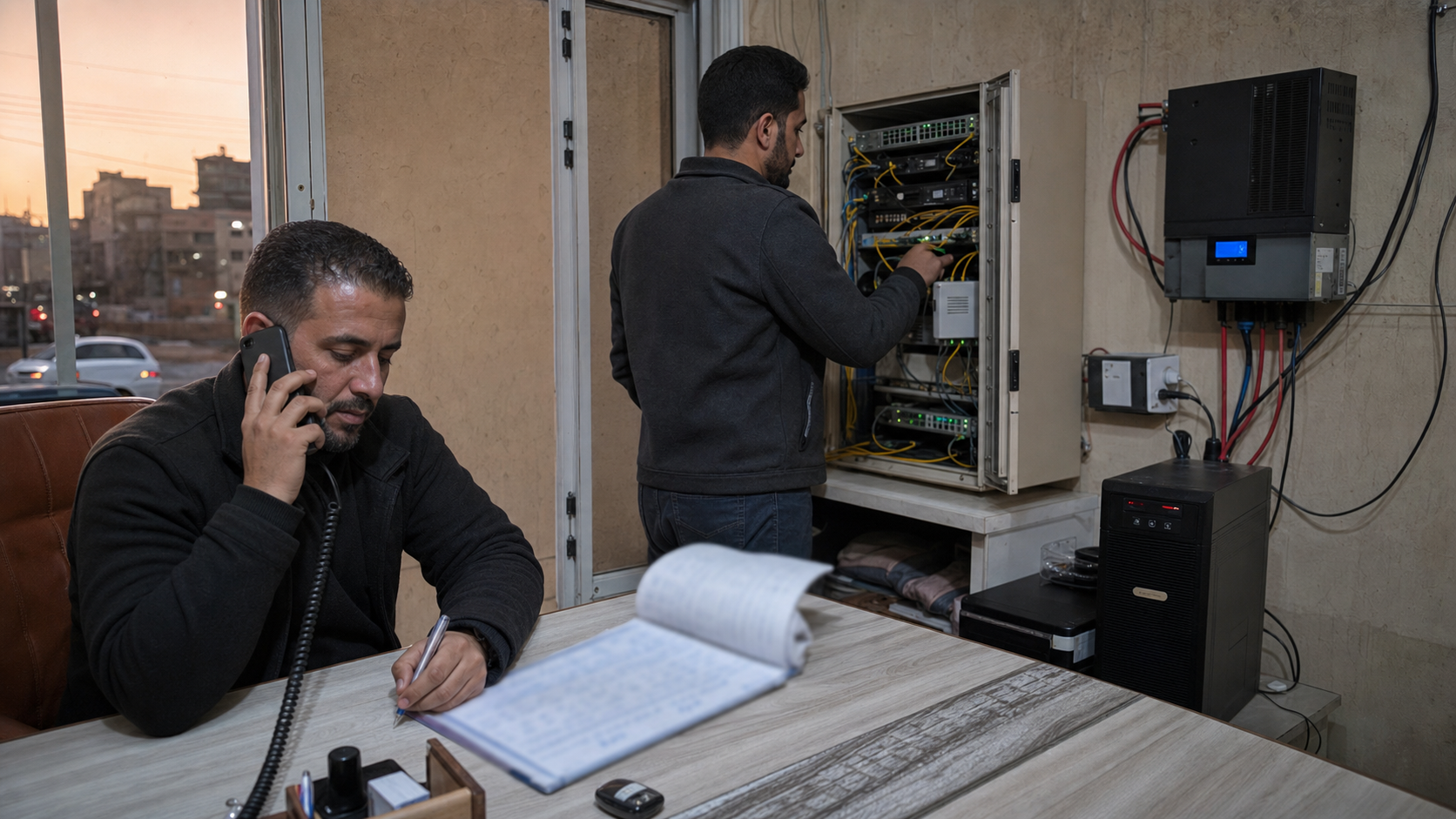
Summary
- ROYA Communications and Internet Services Company Ltd is best read through one concrete paid unit: a monthly local connectivity account in Nineveh that bundles international capacity, local/cache-heavy traffic, customer support, account administration and recovery from ordinary service failures.
- The buyer's substitute is not abstract. A business, reseller or household can try a larger national provider, rely more heavily on mobile data, use regulated satellite broadband where available, build its own wireless link, or accept unreliable access. ROYA has to make the avoided cost of those substitutes visible through continuity and support, not only speed.
- The strongest public evidence is ROYA's own package page, RIPE/RDAP registration for AS210837, PeeringDB's self-reported network and facility data, Hurricane Electric and Cloudflare public routing views, RIPEstat's current non-announcement signal, and Iraq market data from the Communications and Media Commission and the World Bank.
- The public record supports a small regional ISP and route-continuity thesis, but it does not prove unit economics, measured reliability or retention. The decisive missing metrics are monthly price and collection rate, outage frequency and repair time, and renewal or churn behavior by package.
The buyer is paying to avoid becoming the network operator
The practical decision starts with a buyer in Mosul or wider Nineveh deciding whether to keep paying for a ROYA connectivity account. The buyer may be a small enterprise that needs email, payments, cloud tools and messaging to keep working. It may be a local reseller that collects cash from homes and shops. It may be a household that has learned that a nominal speed tier is less important than whether the line still works at night, during school-exam shutdown rumors, after a power cut, or when a local distribution link needs a field visit.
In each case the account transfers an operating burden from the buyer to the provider: upstream reach, last-mile coordination, account status, help when the subscription fails, and recovery when the route or access path is degraded.
That is the paid unit. It is not a bare number resource and not a global internet trace. It is the monthly promise that a local user can buy a defined service tier and have someone else keep the access path, support channel, customer record and external reach usable. ROYA's English site presents Roaea NET as an internet service provider in Nineveh, Iraq, and advertises monthly packages named General, Express, Super and VIP. The packages show one-month duration and split capacity labels for international traffic, GGC and FNA, with total listed speeds of 7 Mbps, 11 Mbps, 14 Mbps and 20 Mbps; the same page says the company provides customer service around the clock and emphasizes service continuity (https://www.roya-isp.com/en). That is buyer-facing evidence. It says what the account is meant to be. It does not disclose the dinar price, actual throughput, contention ratio, repair time or renewal behavior.
The substitute is direct. A buyer can move to a larger carrier or a bigger Iraqi ISP, use mobile data as the main line, buy satellite connectivity if the license and equipment path is available, build or rent a private wireless link, or simply tolerate less reliable access. Each substitute has a cost. A larger provider may bring more scale but weaker local accountability at the exact street or reseller level. Mobile data can be quick to activate but is often a poor substitute for a shared premises connection, stable indoor coverage, predictable router placement, or a business account that needs multiple users. Satellite can avoid some terrestrial fragility, but Iraq's own Communications and Media Commission requires licensing for broadband services through satellite networks and asks Category A satellite-broadband applicants for infrastructure, personnel, a five-year business plan, support strategy, quality assurance, billing systems and pricing plans (https://cmc.iq/wp-content/uploads/2025/06/English-NGSO-Regulatory-framework.pdf). A self-built wireless link shifts installation, interference, power and repair work back to the buyer. Doing without reliable access is cheapest only until the first missed payment, delayed customer reply or unusable cloud tool costs more than the subscription.
The strongest public evidence for ROYA's side of this decision is not a testimonial. It is the convergence of several bounded records. RIPE's RDAP record for AS210837 names ROYA Communications and Internet Services Company Ltd, records the organization in Mosul, Nineveh, Iraq, and shows AS210837 registered on 2021-08-26 with a later change on 2023-03-20 (https://rdap.db.ripe.net/autnum/210837). PeeringDB lists the network as ROYA Communications, also known as Roya ISP, tied to AS210837, with a company website, route-server URL, looking-glass URL, Cable/DSL/ISP network type, Middle East scope, 5-10 Gbps self-reported traffic level, open peering policy and interconnection facility entries in Frankfurt, Istanbul and Sofia (https://www.peeringdb.com/net/30448). Hurricane Electric's BGP page reports AS210837 as Iraq-origin, with one IPv4 prefix originated and one observed IPv4 peer, while RIPEstat's as-overview and announced-prefixes views for the checked date say the AS was not announced and returned no prefixes above its low-visibility threshold (https://bgp.he.net/AS210837, https://stat.ripe.net/data/as-overview/data.json?resource=AS210837, https://stat.ripe.net/data/announced-prefixes/data.json?resource=AS210837). That disagreement is not a footnote; it is part of the route-continuity story. Public routing visibility for a small ISP can be thin, time-sensitive and hard to reduce to one static number.
The private metrics that would change the judgment fall into three groups. Economics: the actual monthly tariff, collection rate, wholesale bandwidth cost, support cost and margin by package. Reliability: measured outage frequency, mean repair time, packet loss, peak-hour throughput and whether failover works during route withdrawal or local-power disruption. Retention: renewal rate, churn after outages, reseller payment arrears and the share of customers who shift to mobile, satellite or a larger provider after service trouble.
Without those metrics, the article can test the public evidence for a continuity-account thesis, but it cannot prove that ROYA's account is profitable or that it performs better than substitutes.
What ROYA's public account menu really proves
ROYA's own pages are useful because they show the account as a packaged local service, not merely as a registry name. The English page says Roaea NET was founded in 2017, is privately owned, is located in Nineveh, Iraq, and offers internet access at what it calls reasonable rates with customer service around the clock (https://www.roya-isp.com/en). The Arabic home page gives a similar service description and places the company in Nineveh and Mosul, though it says the company was founded in 2016 rather than 2017 (https://www.roya-isp.com/). That one-year difference is not decisive for the economics, but it is a warning about copy quality. This article therefore treats the site as evidence of how ROYA markets the account and packages service tiers, not as audited proof of founding date, financial condition or service outcomes.
The package list is more important than the founding sentence. A customer sees a one-month account with named tiers. General lists 1 Mbps "interational", 3 GGC, 3 FNA and 7 total Mbps. Express lists 2 international, 5 GGC, 4 FNA and 11 total Mbps. Super lists 3 international, 6 GGC, 5 FNA and 14 total Mbps. VIP lists 5 international, 8 GGC, 7 FNA and 20 total Mbps (https://www.roya-isp.com/en). The spelling is rough, but the commercial structure is clear enough: the seller separates international reach from traffic categories that appear to correspond to large content-cache ecosystems. The public page does not expand the acronyms or explain whether those speeds are dedicated, shared, best-effort or subject to fair-use rules. The evidence only proves that the public offer is presented as a speed-and-service account with local services included.
That matters because an Iraqi buyer's perceived value is often shaped by the difference between international reach and local/cache-heavy experience. If messaging, video, education content and social traffic feel usable while general international browsing is slower, the account may still feel worth renewing for a household or shop. If international access fails during the workday, the same account may feel overpriced even if local entertainment services still work. The package menu therefore reveals the economic tension: ROYA can sell a cheaper or more local-feeling account only if the customer accepts that not all traffic is the same.
The account has to convert network asymmetry into a usable buying proposition.
The site also exposes a collection and support mechanism. It links to "User Information" and says customers can view their subscription type and expiration date (https://www.roya-isp.com/en). The Arabic page uses the same idea, telling users they can view subscription type and expiry (https://www.roya-isp.com/). That is a small sentence, but it goes to the heart of local ISP economics. A monthly account depends on activation, expiry, renewal and payment handling. The account is not only a pipe; it is a record of whether a customer is entitled to service today. In a market where many payments may still be cash-heavy or dealer-mediated, the collection system and customer-status page can be as commercially important as the upstream circuit.
The same page offers local services such as cinema, TV live, software, games, a library, audio and user information (https://www.roya-isp.com/en). Those should not be overstated. The public page does not prove content rights, usage, revenue share or customer engagement. It does show the provider trying to make the account feel like more than commodity bandwidth. Local services can reduce churn if they make the network more useful when international traffic is congested. They can also create obligations: if customers expect local content, user portals and support to remain available, the provider inherits more than basic access duty.
The contact section lists an address in Flowers neighborhood, Nineveh-Mosul, email addresses using roaea-isp.net, and a phone number (https://www.roya-isp.com/en). It also contains a stray reference to "FastNet" in the English contact paragraph. That inconsistency is another reason to keep the inference bounded. A buyer may care less about polished copy than about whether the phone is answered and the service returns after a failure. An analyst, however, should not treat the site as audited business disclosure. It is a front door into the paid unit, not a complete operating report.
The number-resource record confirms identity, not performance
The hard identity evidence comes from the public internet-number system. RIPE RDAP lists AS210837, the name ROYA-Communications-and-Internet-Services-Company-Ltd, active status, ROYA Communications and Internet Services Company Ltd as the organization, an address in Flowers neighborhood, 41002 Mosul, Nineveh, Iraq, and a registration date of 2021-08-26 (https://rdap.db.ripe.net/autnum/210837). The same RDAP record shows the organization handle ORG-RI63-RIPE and an abuse role. This is strong evidence that the directory entity is tied to AS210837 in the RIPE database. It is not evidence that any particular customer receives the advertised package speed.
RIPEstat's as-overview page adds a useful current-state signal. For AS210837, it identifies the holder as ROYA-Communications-and-Internet-Services-Company-Ltd / ROYA Communications and Internet Services Company Ltd and says "announced": false for the query date shown as 2026-07-06 (https://stat.ripe.net/data/as-overview/data.json?resource=AS210837). Its announced-prefixes API says results exclude routes with very low visibility, below ten RIS full-feed peers, and returns no prefixes for the two-week query window ending 2026-07-06 (https://stat.ripe.net/data/announced-prefixes/data.json?resource=AS210837). That does not prove the network was not reachable from every vantage point. It proves that in RIPEstat's public measurement lens, AS210837 was not visible enough to be treated as announced in that window.
Hurricane Electric shows a different public view. Its BGP page for AS210837 lists the country of origin as Iraq, reports one IPv4 prefix originated and announced, reports one RPKI-originated valid IPv4 route, reports one observed IPv4 peer, lists 256 IPv4 addresses originated, and identifies 193.30.241.0/24 as an IPv4 prefix (https://bgp.he.net/AS210837). It also displays RIPE aut-num text with import and export statements naming several upstream AS numbers, including AS200697, AS212890, AS202354, AS50597, AS59458 and AS203735 (https://bgp.he.net/AS210837). Those lines are useful because they show the intended upstream posture in registry text and one route-collector view. They still do not prove the private topology, outage handling or actual customer traffic.
BGP.Tools is useful precisely because it tightens the boundary. Its AS210837 page says the ASN is not currently in the global routing table, while showing the RIPE text, registration date, network status as active and allocated under RIPE, location of operation in Iraq, and no currently originated IPv4 or IPv6 prefixes in that view (https://bgp.tools/as/210837). Cloudflare Radar's routing page identifies AS210837 as ROYA-Communications-and-Internet-Services-Company-Ltd, aka Roya ISP, country Iraq, and links the website (https://radar.cloudflare.com/routing/as210837). IPinfo names ROYA Communications and Internet Services Company Ltd, gives Iraq as country of origin, identifies the registry as RIPE, says the ASN type is ISP, Business or Hosting, and marks the ASN inactive in its view (https://ipinfo.io/AS210837). CAIDA AS Rank identifies AS210837 with the ROYA name and Iraq country, but shows zero provider, peer and customer counts in its displayed topology data (https://asrank.caida.org/asns/210837).
These records should be read together. They are not a scoreboard where one source wins and all others lose. They show a small, lightly visible network whose public route state changes or appears differently depending on collector, time window and threshold. For a buyer, this is exactly why route continuity has value. The buyer cannot run a RIPEstat query before every payment, reconcile route collectors and maintain its own upstream alternatives. It needs the provider to do that work or to have arrangements that keep the account usable when the public route picture is messy.
PeeringDB shows route ambition, but not the private customer experience
PeeringDB is one of the most useful sources for ROYA because it is network-operator-facing and includes commercial routing posture. The organization page lists ROYA Communications and Internet Services Company Ltd, also known as Roya ISP, with website http://www.roya-isp.com, address in Flowers neighborhood, Mosul 41002, country code IQ, and one registered network, ROYA Communications, AS210837 (https://www.peeringdb.com/org/32823). The network page says the network type is Cable/DSL/ISP, geographic scope is Middle East, traffic level is 5-10 Gbps, traffic ratio is balanced, and the peering policy is open with no ratio requirement or contract requirement (https://www.peeringdb.com/net/30448).
The same PeeringDB page lists no public peering exchange rows in the visible table, but it lists interconnection facility entries for Equinix FR5 in Frankfurt, MedNautilus Istanbul, and TELEPOINT Sofia Centre, each tied to AS210837 (https://www.peeringdb.com/net/30448). That is strong bounded evidence for a cross-border interconnection posture. It suggests ROYA wants to be visible as a network with European and regional handoff points, not only as a local access brand. It does not prove that every customer packet follows those facilities, that capacity is currently lit, that routes are diverse, or that service recovers within a promised repair time.
The PeeringDB traffic and prefix numbers also need careful language. PeeringDB shows 22 IPv4 prefixes and 29 IPv6 prefixes on the network page (https://www.peeringdb.com/net/30448), while Hurricane Electric's current page reports one IPv4 prefix and zero IPv6 prefixes announced (https://bgp.he.net/AS210837), and RIPEstat returns no announced prefixes in its checked period (https://stat.ripe.net/data/announced-prefixes/data.json?resource=AS210837). That gap may reflect stale self-reported data, different definitions, inactive resources, route visibility thresholds or changes after the PeeringDB update. It should not be smoothed away. For the article's thesis, it makes the point stronger: the public record supports a route-continuity burden, not a clean capacity claim.
The commercial question is what the buyer receives from that posture. A local account can be cheaper than building private diversity only if the provider handles upstream choice, route registration, abuse contact, address use, local service access and recovery. A larger enterprise can buy dedicated circuits and multi-homing. A smaller business or reseller often cannot. It buys a package and expects the provider to turn a fragile route chain into ordinary service.
PeeringDB also supplies evidence about how ROYA wants counterparties to see it. The route-server URL and looking-glass URL on the page, http://r.roya-isp.com and http://lg.roya-isp.com, are not consumer package pages (https://www.peeringdb.com/net/30448). They are network-operator-facing signals. A looking glass allows outsiders to inspect routing from the network's point of view when it is working. A route server address signals a technical surface for route exchange or visibility. These tools do not guarantee uptime. They do show that ROYA's public identity includes route operations, which is consistent with a connectivity-account economics story rather than a pure retail-reseller story.
Iraq's market makes continuity a priced feature
The country context explains why a regional ISP account can matter even if the provider is small. World Bank data, sourced from the ITU, says individuals using the internet in Iraq reached 81.4745 percent of the population in 2024, up from 53.6778 percent in 2020 (https://api.worldbank.org/v2/country/IQ/indicator/IT.NET.USER.ZS?format=json&per_page=8). Fixed broadband subscriptions reached 17.6333 per 100 people in 2024, up from 11.0678 in 2019 (https://api.worldbank.org/v2/country/IQ/indicator/IT.NET.BBND.P2?format=json&per_page=8). Mobile cellular subscriptions were about 100.0803 per 100 people in 2024 (https://api.worldbank.org/v2/country/IQ/indicator/IT.CEL.SETS.P2?format=json&per_page=8). That mix matters. Iraq has broad internet use and high mobile-subscription intensity, but fixed broadband remains a lower-penetration service than mobile subscriptions.
The CMC's Iraq National ICT Industry Development Whitepaper gives a more operational view. It says 639,000 fixed broadband subscriptions provided speeds equal to or above 10 Mbit/s and that a greater proportion of fixed broadband users in Iraq are connected at lower speeds compared with other countries in the region (https://cmc.iq/wp-content/uploads/2025/08/The-role-and-importance-of-developing-broadband-infrastructure-in-the-ICT-and-digitization-sector-in-Iraq-in-English-white-paper.pdf). It also says all three mobile network operators launched 4G in January 2021, notes 4G and 4G+ upgrades by the large mobile operators, and records that the majority of mobile network subscriptions were still 3G-based at about 53 percent of total subscriptions in the cited 2023 period (https://cmc.iq/wp-content/uploads/2025/08/The-role-and-importance-of-developing-broadband-infrastructure-in-the-ICT-and-digitization-sector-in-Iraq-in-English-white-paper.pdf).
For ROYA, this means mobile is both substitute and complement. A customer can fall back to mobile data during a fixed-line problem, but a mobile-only substitute may not carry a shared premises, a reseller customer base, fixed router placement, low-latency office work, local content services, or monthly account controls in the same way. The presence of mobile alternatives raises price pressure on fixed accounts. It does not eliminate the value of a local ISP if the ISP can keep the account stable, collect payments efficiently and repair service faster than the buyer could coordinate alone.
The same CMC whitepaper identifies the sector's structural challenges. It says Iraq's geographic position near Gulf countries, the Levant and Europe could support cross-border connectivity and lower latency, but the country faces geographic challenges, political dynamics, infrastructure limitations and governance or regulatory framework problems (https://cmc.iq/wp-content/uploads/2025/08/The-role-and-importance-of-developing-broadband-infrastructure-in-the-ICT-and-digitization-sector-in-Iraq-in-English-white-paper.pdf). It points to mountainous and desert landscapes, rural access limited by low economic returns and high costs, infrastructure limitations including damage from historical conflict, bottlenecks in securing investment, and political uncertainty that can hinder investment and disrupt consistent technological progress (https://cmc.iq/wp-content/uploads/2025/08/The-role-and-importance-of-developing-broadband-infrastructure-in-the-ICT-and-digitization-sector-in-Iraq-in-English-white-paper.pdf).
Those are exactly the costs a buyer tries not to internalize. The account price has to cover more than wholesale bandwidth. It has to cover customer acquisition, local installation, help during failures, power and equipment risk, upstream purchase, route administration, abuse handling, compliance uncertainty, collection work and bad-debt risk. If the provider underprices those burdens, service degrades. If it overprices them, customers leave for mobile, satellite, a larger ISP or no fixed account. ROYA's published package menu is therefore not just a list of speeds. It is a public surface over a difficult cost stack.
Regulation and shutdown risk raise the value of local recovery
Iraq's regulatory setting does not give a clean public answer about ROYA's license status. The public sources reviewed did not reveal a CMC license row naming ROYA. The article therefore does not claim one. What the regulatory sources do show is that connectivity providers operate in a market where licensing, infrastructure ownership, service quality and government directions can directly affect the buyer's continuity risk.
Al Tamimi's overview of Iraq's communications sector says two government bodies are competent for telecommunications licensing: the Communications and Media Commission and the Ministry of Communications. It says the Ministry operates state-owned companies, including the Informatics and Telecommunications Public Company and the State Company for Internet Services, while the CMC regulates telecommunications and media, frequency policy and wireless and telecommunications licensing (https://www.tamimi.com/law-update-articles/an-insight-into-the-communication-sector-in-iraq/). The same overview describes the ITPC as responsible for fibre-optic network and microwave backbone functions, and the State Company for Internet Services as handling internet subscribers, wireless internet access for government agencies, DSL and dial-up VoIP services, and IP address registration (https://www.tamimi.com/law-update-articles/an-insight-into-the-communication-sector-in-iraq/). This is legal-market context, not proof of ROYA's local contract path.
The CMC's satellite-broadband framework shows how substitute connectivity is also regulated. It says no internet or satellite service provider may offer broadband services in Iraq without the appropriate license from the Commission, and that satellite broadband applicants may need to provide business plans, operational plans, customer support strategy, quality assurance, billing systems, pricing plans and risk management (https://cmc.iq/wp-content/uploads/2025/06/English-NGSO-Regulatory-framework.pdf). A buyer considering satellite as an alternative to local ISP service is therefore comparing not only technology but also licensing, equipment, installation, lawful-interception, national-security and billing compliance burdens.
Shafaq News reported in September 2023 that Iraq's Ministry of Communications rejected internet-service licensing regulations issued by the National Communications and Media Commission, citing lack of prior coordination over prices, service quality and implications for FTTH services, and warning that companies acquiring licenses could bear legal and financial responsibility for issues arising from the regulations (https://shafaq.com/en/Iraq/Iraqi-Ministry-of-Communications-rejects-licensing-regulations-for-internet-services). That report is not a technical measurement and not specific to ROYA. It is useful market color because it shows that ISP licensing and service-quality governance have been contested at ministry level.
Freedom House's 2024 Iraq report adds another continuity layer. It says ISPs were required in February 2023 to visit CMC headquarters to obtain licenses for sale and import of technological devices, including SIM cards, and that ISPs face legal consequences for contract noncompliance while contract conditions remain unknown (https://freedomhouse.org/country/iraq/freedom-net/2024). It also says regulatory obstacles often arise because infrastructural resources are managed in an unorganized way, that the Ministry of Communications owns infrastructure and sells access to ISPs, often for high prices, and that EarthLink is described in the report as the most popular ISP, serving at least 60 percent of Iraqi internet users via the national fibre-optic network (https://freedomhouse.org/country/iraq/freedom-net/2024). Again, those are market claims, not ROYA performance evidence. They frame the price pressure and scale disadvantage that a small regional ISP faces.
Shutdown risk is part of the buyer's mental model. Cloudflare's 2023 analysis of exam-related internet shutdowns said Iraq implemented a series of multi-hour shutdowns during exam periods, with traffic dropping to or near zero during four-hour windows and BGP announcement activity reflecting route withdrawals and restorations for impacted networks (https://blog.cloudflare.com/exam-internet-shutdowns-iraq-algeria/). SMEX reported in June 2024 that Iraq's Ministry of Communications announced internet shutdowns from 6:00 AM to 8:00 AM during parts of the exams period, and described the practice as recurring since 2015 for exam-related reasons (https://smex.org/will-iraq-shut-down-the-internet-during-the-2023-exams-period/). These reports do not say ROYA caused or avoided any shutdown. They show why customers in Iraq may value communication, warning, local fallback and fast recovery when national or regional disruption occurs.
The continuity account therefore includes a public-sector dimension even for private buyers. When official decisions, licensing disputes, backbone access, exam-season restrictions or local security conditions affect connectivity, the customer wants a provider that can explain what is happening, restore service when permitted, keep account records intact and avoid adding its own administrative failure to the external disruption. That is a product feature, even if it is not written as one on the package page.
Collection risk is part of the route-continuity product
The title uses "prices" because the account has to absorb collection risk as well as route risk. A local ISP can have a working upstream path and still fail commercially if renewals are slow, payments are missed, cash collection is expensive or resellers cannot reconcile customer status. ROYA's public "User Information" link and expiry-language show that the account is managed through subscription state (https://www.roya-isp.com/en). The public record does not show the payment method, discounting, reseller margin or arrears. But it does show that the customer account is not a vague arrangement. It has a type and an expiration date.
That matters in a monthly package model. The provider's bandwidth and upstream costs are not perfectly aligned with cash collection. Customer payments may arrive at different times, support calls cluster around expiry or outage periods, and a provider may have to carry enough upstream and local capacity before collecting every dinar due. If a shop or reseller delays payment, the provider still faces customer anger when accounts expire or service degrades. If the provider is too strict, customers may move to mobile data or a competitor. If it is too loose, working capital weakens.
The collection problem also affects reliability. A provider with weak collection may delay upgrades, underinvest in spares, carry fewer field staff or accept fragile upstream arrangements. A provider with better collection can buy more capacity, maintain customer equipment, answer support calls and pay upstreams on time. The public record does not let us compare ROYA with peers on those variables. It does let us identify why a local account is not simply the resale of bandwidth. It is a billing and recovery system wrapped around access.
ROYA's local-services menu may help collection if it gives customers a reason to keep the account active even when they could browse over mobile data. Cinema, TV live, software, games, library, audio and user-account tools create a local service environment (https://www.roya-isp.com/en). The risk is that local services can become another support burden if links break, content sources fail or customers expect more than the provider can legally or operationally deliver. The evidence does not prove usage. It indicates the retention strategy: make the account feel useful beyond raw internet access.
This is where the direct substitute comparison becomes sharper. A larger carrier may reduce route risk but may not care about a small buyer's local account problem. Mobile data may collect payment efficiently but may not offer shared premises control. Satellite may bypass local last-mile trouble but can create equipment, licensing and cost issues. A self-built wireless link can give control but shifts maintenance, interference, mast safety and upstream negotiation to the buyer. Doing without stable access reduces the invoice but raises operational downtime.
ROYA's account is valuable only if it performs the middle function: local enough to support the buyer, connected enough to reach the outside world, and organized enough to collect and restore service without making the buyer manage the whole chain.
Route continuity is fragile because the public footprint is small
Small footprint is not automatically weakness. A small provider can be close to customers, faster in local repair and less bureaucratic than a national carrier. But small public route visibility makes continuity harder to prove. ROYA's directory evidence points to one AS, one main public-facing website, a narrow package menu, and public route records that disagree about whether AS210837 is currently announced. That is a thin evidence base for any strong performance claim.
Hurricane Electric reports one observed IPv4 peer for AS210837, AS212330, Civilisation Information Technology, communication and internet services Co., LTD (https://bgp.he.net/AS210837). The RIPE aut-num text displayed by Hurricane Electric includes import and export statements for additional upstream AS numbers, but public route collectors do not always see every intended or historical upstream (https://bgp.he.net/AS210837). BGP.Tools displays those same RIPE import/export lines while saying the ASN is not currently in the global routing table (https://bgp.tools/as/210837). RIPEstat returns no announced prefixes above its threshold in the two-week window checked (https://stat.ripe.net/data/announced-prefixes/data.json?resource=AS210837). IPinfo marks the ASN inactive and shows no hosted domains, peers, upstreams or downstreams in its current page view (https://ipinfo.io/AS210837).
The cautious reading is that the route-continuity product may depend on arrangements not fully visible through one route-collector lens, or it may have periods of low or no public visibility. Either way, a customer cannot treat the public AS page as a full service guarantee. For an enterprise buyer, this creates a procurement question: is ROYA's local responsiveness enough to compensate for small-route visibility, or is the buyer better served by a larger provider with more public redundancy?
PeeringDB's facility list complicates the picture in a constructive way. Frankfurt, Istanbul and Sofia are plausible cross-border handoff locations for Middle East connectivity, and the page lists them as interconnection facilities for AS210837 (https://www.peeringdb.com/net/30448). If active and maintained, such a posture can help a regional ISP obtain better upstream diversity, reach content networks and reduce dependence on a single domestic path. But public PeeringDB entries are not enough to measure whether the ports are live, paid, protected or used for customer traffic. The right conclusion is not "ROYA has European-grade resilience." It is "ROYA's public network posture is consistent with a provider trying to manage cross-border reach, but the live resilience proof is missing."
That missing proof matters because Iraq's own policy documents frame cross-border connectivity as an opportunity and a challenge. The CMC whitepaper says Iraq's position near the Gulf, Levant and Europe can support last-mile and cross-border connectivity and reduced latency, but the country must address geographic, political, infrastructure and governance challenges (https://cmc.iq/wp-content/uploads/2025/08/The-role-and-importance-of-developing-broadband-infrastructure-in-the-ICT-and-digitization-sector-in-Iraq-in-English-white-paper.pdf). For ROYA, the economic value is not being a global network. It is making enough of that cross-border reach dependable for a local account to be worth renewing.
What the public evidence cannot tell us
The evidence gap should be grouped, not scattered. Economics is the first missing category. ROYA's package page lists speeds and one-month duration but not price, installation fee, customer-premises equipment cost, reseller margin, collection method, contract length, wholesale bandwidth cost or gross margin (https://www.roya-isp.com/en). PeeringDB's 5-10 Gbps self-reported traffic level gives scale color, but it does not disclose paid traffic, peak utilization, committed data rate or cost per Mbps (https://www.peeringdb.com/net/30448). A serious unit-economics conclusion would need the dinar price by tier, payment collection rate, upstream cost, field-service cost and bad-debt rate.
Reliability is the second missing category. ROYA's site says customer service is available around the clock and says the company is proud of service quality and continuity (https://www.roya-isp.com/en). Public routing sources show identity and route visibility, not measured customer uptime. They do not give outage frequency, mean time to repair, latency, packet loss, peak-hour throughput, power backup, field repair time, customer-premises equipment failure rate or whether route alternatives are active. Cloudflare's national shutdown analysis shows the kind of disruption environment Iraqi users can face, but it does not measure ROYA's own resilience (https://blog.cloudflare.com/exam-internet-shutdowns-iraq-algeria/).
Retention is the third missing category. The public record does not show active subscribers, monthly renewals, churn after outages, package mix, customer lifetime, reseller concentration, enterprise share or how many customers use mobile data as backup. The English page says more than 10,000 subscribers can join the newsletter, but that is generic website copy and should not be used as a subscriber count (https://www.roya-isp.com/en). A retention conclusion would need renewal behavior after failures, complaints resolved, package upgrades and customer migration to substitutes.
The most important discipline is that network records are evidence of public reachability and dependency, not customer satisfaction. RDAP can prove a named resource holder. PeeringDB can prove a self-reported network presence and facility claims. BGP collectors can show what routes were visible from their vantage points. They cannot prove internal architecture, service quality, customer contracts, data location, lawful compliance or repair accountability. Any article that turns AS210837 into a full quality claim would be stronger in tone than the evidence allows.
That limit does not make the article weak. It defines the investable question. ROYA appears to sell a local Iraqi connectivity account in a market where fixed access, mobile substitution, regulatory uncertainty, shutdown risk and cross-border routing all matter. The account is economically interesting because it bundles a small but high-friction set of jobs: keep the customer active, keep routes usable, keep local services reachable, answer support, collect payment, and recover when the broader environment fails.
Watchpoints for the next public record
The next useful signal would be a cleaner split between stale route evidence and live operating evidence. If AS210837 reappears consistently in RIPEstat, Hurricane Electric, Cloudflare Radar and BGP.Tools at the same time, the continuity thesis becomes easier to test because the public route surface would be less contradictory. If PeeringDB's facility and prefix fields are updated while route collectors still show no stable announcement, the opposite conclusion becomes more likely: the PeeringDB page would be useful historical or intended-routing context, not a live operating proxy.
The second watchpoint is the account page itself. A tariff table, installation term, fair-use term, outage contact, reseller instruction or service-status notice would improve the public economics evidence more than another directory mention. The package menu already names the buyer-facing unit. The missing layer is whether the account has clear price, support and recovery terms that a business can compare with mobile data, a larger provider or satellite service.
The third watchpoint is country-level disruption. If exam-season restrictions, licensing disputes or backbone-access changes recur, a local provider's value will depend on warning, restoration and account handling, not only raw speed. Public national reports can show the pressure, but only provider-level notices, customer-facing status records or consistent route recovery would show how ROYA handles it. Until then, the right stance is to monitor the account as a continuity claim with thin but meaningful public evidence.
Public evidence register
| Evidence area | Public record | What it supports | What it cannot prove |
|---|---|---|---|
| Buyer-facing service | ROYA English page: https://www.roya-isp.com/en | Nineveh location, internet-provider positioning, 24/7 support claim, monthly packages, account expiry page and local services. | Actual price, speed delivery, repair time, legal terms, active subscribers or customer satisfaction. |
| Arabic company page | ROYA Arabic page: https://www.roya-isp.com/ | Arabic-language confirmation of local service positioning, package menu and Mosul contact surface. | Audited founding date or financial position; it conflicts with English founding-year copy. |
| Resource identity | RIPE RDAP: https://rdap.db.ripe.net/autnum/210837 | AS210837, ROYA name, Mosul/Nineveh address, Iraq country, registration and last-changed dates. | Live customer service, route quality or local license status. |
| Routing state | RIPEstat overview and prefixes: https://stat.ripe.net/data/as-overview/data.json?resource=AS210837 and https://stat.ripe.net/data/announced-prefixes/data.json?resource=AS210837 | Current public-measurement view showing not announced and no prefixes above low-visibility threshold. | Total reachability from all networks or private routing arrangements. |
| Route collector view | Hurricane Electric: https://bgp.he.net/AS210837 | One visible IPv4 prefix, one observed IPv4 peer, Iraq origin and RIPE aut-num import/export text. | Internal topology, performance, uptime or subscriber count. |
| Operator-facing network data | PeeringDB network page: https://www.peeringdb.com/net/30448 | Cable/DSL/ISP type, traffic-level claim, open peering policy, route-server and looking-glass URLs, Frankfurt/Istanbul/Sofia facility entries. | Whether listed capacity and facilities are currently active, protected or used for customer traffic. |
| Cross-source routing caution | BGP.Tools, IPinfo, CAIDA and Cloudflare Radar: https://bgp.tools/as/210837, https://ipinfo.io/AS210837, https://asrank.caida.org/asns/210837 and https://radar.cloudflare.com/routing/as210837 | Confirms Iraq/ROYA identity while showing low or inactive public route visibility in several measurement views. | Customer experience, private upstream terms or service-level commitments. |
| Iraq demand context | World Bank internet and broadband APIs: https://api.worldbank.org/v2/country/IQ/indicator/IT.NET.USER.ZS?format=json&per_page=8 and https://api.worldbank.org/v2/country/IQ/indicator/IT.NET.BBND.P2?format=json&per_page=8 | Internet use and fixed-broadband penetration trends through 2024. | ROYA market share or customer growth. |
| Mobile substitute | World Bank mobile API: https://api.worldbank.org/v2/country/IQ/indicator/IT.CEL.SETS.P2?format=json&per_page=8 | Mobile-subscription density as a substitute and fallback pressure. | Whether mobile performs better than ROYA in a given neighborhood. |
| Telecom challenges | CMC Iraq ICT whitepaper: https://cmc.iq/wp-content/uploads/2025/08/The-role-and-importance-of-developing-broadband-infrastructure-in-the-ICT-and-digitization-sector-in-Iraq-in-English-white-paper.pdf | Fixed-broadband speed distribution, mobile upgrade context, geography, infrastructure and governance challenges. | ROYA-specific cost, license, service quality or funding. |
| Satellite alternative | CMC NGSO framework: https://cmc.iq/wp-content/uploads/2025/06/English-NGSO-Regulatory-framework.pdf | Satellite-broadband licensing, support, billing, quality assurance and pricing-plan obligations. | Whether a ROYA customer can obtain or afford a particular satellite substitute. |
| Market friction | Freedom House, Shafaq and Cloudflare: https://freedomhouse.org/country/iraq/freedom-net/2024, https://shafaq.com/en/Iraq/Iraqi-Ministry-of-Communications-rejects-licensing-regulations-for-internet-services and https://blog.cloudflare.com/exam-internet-shutdowns-iraq-algeria/ | Infrastructure, licensing, concentration and shutdown-risk color around Iraqi connectivity. | ROYA fault history or compliance status. |
The investment question is operational, not cosmetic
ROYA's public footprint is not large enough to support a grand claim. The company has a simple website, a narrow package menu, visible contact details, an AS registration, PeeringDB data, and a public routing picture that looks thin or inactive in several current measurement views. Those are not the records of a large national carrier. They are the records of a regional ISP whose value, if real, lies in local continuity and account handling.
That makes the account more interesting, not less. In a fragile connectivity market, the smallest paid unit can carry real economic weight. A shop does not need a global backbone; it needs card terminals, messaging, order systems and customer communications to work often enough to justify the monthly bill. A local reseller does not need a glossy managed-service brochure; it needs active subscriptions, clear expiry, reachable support and upstream paths that can be restored before customers defect.
A small enterprise does not need to read AS import policies; it needs a provider that turns upstream dependency into a phone number, a package and a repair path.
The evidence supports a cautious thesis: ROYA prices a local Iraqi connectivity account where route continuity and collection risk are part of the product. The account competes against larger carriers, mobile data, satellite, private wireless and the costly option of unreliable access. Its public pages show the customer proposition. RIPE, PeeringDB, Hurricane Electric, Cloudflare, BGP.Tools, IPinfo and CAIDA show the network identity and the limits of public route visibility. CMC, World Bank, Freedom House, Shafaq and Cloudflare market sources explain why continuity is a real economic burden in Iraq.
The thesis remains unproven at unit level because the public record does not disclose economics, reliability outcomes or retention behavior. A stronger conclusion would require monthly price by tier, customer count, renewal rate, collection arrears, upstream cost, route diversity, outage history, repair time and churn after failures. Until those numbers are visible, ROYA should be treated neither as a proven resilient operator nor as an empty registry name.
It is a small regional connectivity account whose public evidence is consistent with a route-continuity and collection-risk product, and whose real value depends on private operating metrics that buyers experience before analysts can measure.