
Summary
- The useful question about Oschadbank is not whether it is a large state bank in a country at war. It is whether an account at Oschadbank buys enough continuity for a pensioner, public-sector employee, small merchant, veteran family or displaced household to keep money reachable during wartime disruption.
- Public evidence supports the core continuity claim more strongly on branch fallback, state-payment relevance, liquidity and participation in national payment rails than it does on app uptime, customer retention and precise blackout performance at the individual branch level.
- Oschadbank's own 2024 disclosures say the bank had about 1,150 branches, more than 700 with alternative electricity, five mobile armored units in frontline regions, UAH 431 billion in assets and UAH 210 billion of individual customer funds, which makes the account a public-service access product as much as a banking product.
- The main substitutes are real: PrivatBank accounts, fintech wallets, cash, foreign bank accounts and delayed state payments. Oschadbank is worth paying for where the customer values physical fallback and sovereign-service reach more than the slickest app-only experience.
A pension payment is the right starting point
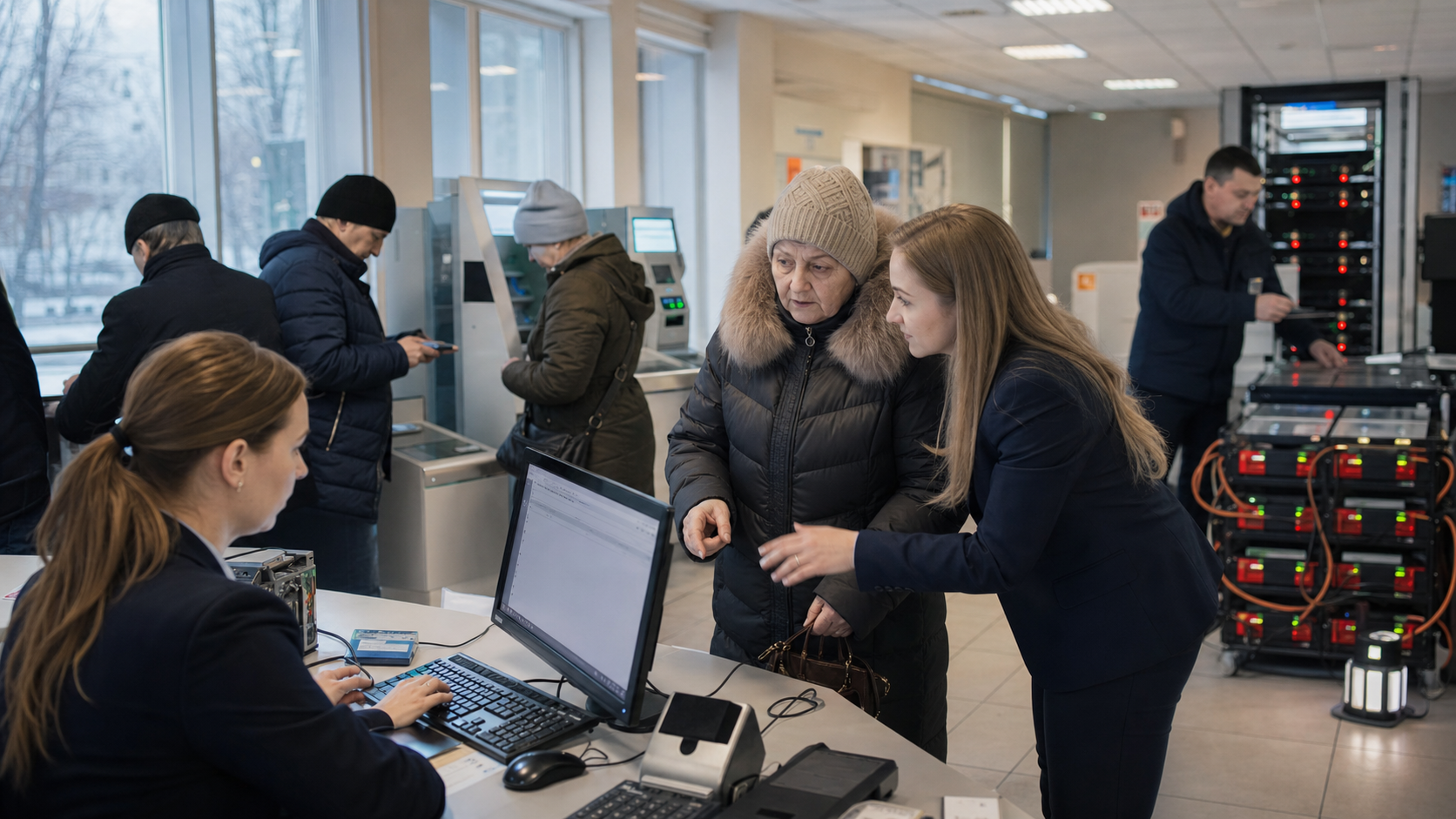
Imagine a pension payment arriving on a winter morning after another night of alerts and power cuts. The recipient is not asking whether the bank has a modern brand campaign. She is asking whether the money is visible on the account, whether the card works at a pharmacy, whether the nearby ATM has cash, whether a branch can help if the phone network fails, and whether a family member in another city can transfer money before the next outage.
That is the economic unit in this case: not a generic deposit account, but a payment-access and fallback account that has to stay useful in conditions where the customer cannot assume electricity, mobile data, transport, cash delivery or calm administrative service.
Oschadbank is a useful test because its public case is unusually concrete. On its own About the Bank page, it presents itself as a wartime institution that is profitable, liquid, operationally stable and built around resilience. The same page gives hard figures for 2024: more than UAH 18.6 billion in pre-tax profit, about UAH 8 billion in net profit, assets of UAH 431 billion, individual customer funds of UAH 210 billion, roughly 1,150 branches, more than 700 branches with alternative electricity and five mobile armored units serving frontline regions. Those numbers do not prove that every pension payment clears smoothly. They do, however, anchor the discussion in a bank whose account is being sold through scale, state-service reach and fallback capacity rather than through a narrow digital convenience story.
The customer is paying for a bundle of promises. One promise is liquidity: money placed in the account should be available when a household needs medicine, food, fuel or rent. Another is operational redundancy: if the app is slow, a branch, ATM, payment card, terminal or call center may still be available. A third is sovereign mandate: because the bank is state owned and deeply connected to public-service banking, it is expected to remain present where a purely commercial bank might rationally retreat.
The fourth is social familiarity: many older customers, recipients of benefits and war-affected households know the bank, know its branch routines and know that state payments have historically passed through it.
The price is not just the visible bank fee. It is the opportunity cost of choosing a less nimble app, waiting longer in a branch, accepting possible bureaucracy, carrying cash because digital channels might fail, or keeping money in a bank whose credit story is linked to sovereign risk. It is also the cost to the state and the bank of maintaining branches, armored mobile units, backup power, cash logistics, cyber defense, staff training and inclusion programs. The account is therefore expensive because it duplicates channels.
It needs digital banking and branches, cards and cash, local support and national rails, public credibility and commercial discipline.
The question is whether public evidence proves that this redundancy is worth paying for. The strongest proof is not a marketing claim. It is the convergence of several public facts: Oschadbank's scale; its branch and backup-power disclosures; the National Bank of Ukraine's Power Banking framework; NBU payment rails; public reporting on cyber and telecom shocks; and the bank's role among large state-owned competitors.
The weaker proof is more local: users and analysts still lack branch-by-branch continuity data, app uptime statistics, detailed failed-payment metrics, churn by customer group and an independent estimate of how many people choose Oschadbank because it is better rather than because it is administratively familiar.
What the customer is really buying
The Oschadbank customer buys time and optionality. In normal retail banking, that sentence can sound vague. In wartime Ukraine, it has practical meaning. A pensioner buys time when a benefit arrives before the cash runs out. A small grocery merchant buys optionality when a card terminal works long enough to avoid closing the store. A local authority employee buys continuity when payroll lands despite disrupted infrastructure. A displaced family buys a bridge between the town it left and the city where it now pays rent.
A veteran household buys a counterparty that is likely to understand public programs, compensation flows and accessible-service needs.
The bank's contact page helps ground the institutional identity behind that promise. It identifies the full legal name as Joint Stock Company "State Savings Bank of Ukraine," the short name as JSC "Oschadbank," the bank license number, SWIFT code COSBUAUK and a Kyiv legal address. That matters because an account is also a claim on a regulated, named institution. In an environment where customers worry about scams, broken links, spoofed messages and unstable vendors, official identity details are part of the trust infrastructure. They do not make the account superior, but they make it verifiable.
The second thing the customer buys is a branch option. Oschadbank's map of departments is not just a convenience feature. It is a public surface showing that the bank still organizes itself around physical access: branches, ATMs, terminals, accessibility filters, weekend work, currency services and inclusive departments. That physical presence has costs. Branches require premises, staff, security, cash, connectivity, backup power, customer flow management and local judgment. The economic value appears when the digital channel is unavailable, when the customer cannot authenticate remotely, when a card expires, when an older person needs assisted service, or when a displaced customer has to solve a documentary problem face to face.
The third thing the customer buys is a digital channel that is not standing alone. Oschadbank links customers to Oschad 24/7, the online banking surface. For many customers the app and web service are the first interface with wages, pensions, utility payments and transfers. But the value of that digital access is different from a pure fintech wallet. If it fails, the customer is meant to have fallback routes. If a phone is dead, there may be a branch. If a branch is closed, there may be card acceptance. If card acceptance is weak, there may be cash. This layered design is less elegant than a single high-performing app, but in wartime the lack of elegance is part of the product.
The fourth thing the customer buys is state-service adjacency. Oschadbank is not the only state-owned bank, and PrivatBank is a larger and more digital competitor in several respects. But Oschadbank has a long public-service association with pensions, social payments, branches and state programs. Its current wartime disclosures continue that theme through veteran business grants, accessibility programs, energy-efficiency lending, frontline mobile units and local cooperation with regional military administrations and municipalities.
The account therefore carries an administrative expectation: when public programs need a banking partner, Oschadbank is more likely to be in the conversation than a small private bank or foreign lender with a narrower Ukrainian footprint.
Liquidity is the first feature
Liquidity is the most basic reason the account matters. If the money is not available, the rest of the feature set is decorative. Oschadbank's own 2024 disclosure gives several indicators that support the liquidity side of the argument. Assets rose to UAH 431 billion. Funds on individual accounts increased to UAH 210 billion, including term deposits near UAH 90 billion and demand deposits of UAH 120.7 billion. The bank reported net profit of about UAH 8 billion after a heavier tax burden. It also reported growth in lending to businesses and individuals.
None of this proves that the bank can withstand every shock, but it shows that customers did not abandon the institution during the period being reported.
For a pension recipient, liquidity is not an abstract balance-sheet word. It means whether the bank can convert a state payment into spendable value. That may happen as a card transaction, a cash withdrawal, an account transfer, a utility payment or a branch counter operation. The bank's membership in Mastercard, Visa, PROSTIR and SWIFT, listed on its About page, matters because a customer account is useful only when it reaches payment networks. International card networks help where merchants accept them and where cross-border or displaced-customer needs arise. PROSTIR matters because it is the national card system for domestic hryvnia payments and settlements, described by the NBU on its PROSTIR page.
Liquidity also depends on the interbank settlement layer. The NBU's System of Electronic Payments page says SEP processes hryvnia settlements between banks and clients in Ukraine, is operated by the NBU, covers more than 99% of interbank payments in Ukraine, runs as a real-time gross settlement system and has operated around the clock since the SEP 4 launch in April 2023. For an Oschadbank account, this does not prove that every retail transaction is instant. It shows that the national settlement backbone has been deliberately upgraded toward continuous operation. A wartime account sits on that backbone.
The account is expensive because liquidity has to be maintained across more than one form. Digital balances have to reconcile. Cash has to be distributed. ATMs have to be filled and powered. Branch cash desks need security and staffing. Card rails need telecoms and power. The bank must monitor fraud and cyber pressure while avoiding false blocks that trap customers away from funds. These costs are usually invisible to a customer until they fail. In a war economy, they become the product. Oschadbank's claim is not that it is cheaper than every substitute.
It is that a state savings bank with branch scale, payment-rail memberships and capital resources can keep more paths open for more kinds of customers.
There is a sovereign overlay to liquidity as well. Ukraine's bank confidence regime changed during the full-scale war, and customers understandably focus on whether deposits are protected and whether large state-owned banks remain backed by public authorities. The Deposit Guarantee Fund's public site at fg.gov.ua/en is relevant to that confidence environment, even though deposit protection is not the same as day-to-day payment access. Deposit protection answers the failure question. A wartime access account must answer the hour-by-hour availability question. Oschadbank's value lies where the second question is urgent and cannot wait for a formal resolution process.
Branch fallback is costly because it is physical resilience
The most persuasive public evidence for Oschadbank's continuity thesis is physical. The bank says it has about 1,150 branches across government-controlled territory and that more than 700 are equipped with alternative electricity for blackouts. It also says more than 60% of its network meets state standards of inclusiveness and that 23 branches have super-inclusive status. This is not a small operational detail. It is the basis for a retail promise that many digital-first competitors cannot easily copy.
The bank is maintaining a distributed service network under conditions where rent, staff, fuel, security and maintenance costs are high and some territories remain near active risk.
The NBU's Power Banking site explains why that matters. The central bank initiative describes a combined network of Ukrainian bank branches that are intended to keep providing necessary services during a blackout. It says the network has about 2,400 branches equipped with alternative energy, backup communication channels, strengthened cash collection and additional staff. It lists available services such as cash withdrawals, payments, transfers, some currency exchange and financial consultation, and it points customers toward the idea of national ATM roaming within the network. Oschadbank's more than 700 alternative-power branches should be read against that national resilience design.
The customer value is not that every branch will be open during every strike or blackout. No public data can honestly support that statement. The value is that Oschadbank has enough physical nodes to make fallback plausible. If a branch in one district is dark, another may still operate. If a customer cannot use a phone, the branch may be the only place to solve an account problem. If a merchant's card terminal cannot process because telecom links are down, cash access becomes a liquidity bridge. If a displaced pensioner has lost documents, the human counter can become the difference between a frozen payment and a recovered account.
Physical resilience is also where the bank's public-service mandate becomes tangible. At the end of 2024, Oschadbank said five mobile armored units were operating in Donetsk, Sumy, Kherson, Kharkiv and Chernihiv regions, serving areas where no other bank operates. That is a narrow but significant claim. It describes banking as logistics under fire, not merely a product menu. Mobile armored units are expensive, limited and risky. They do not scale like an app. Their value appears precisely in places where normal branch economics would be weak and where private competitors may have fewer reasons to stay.
The limitation is that public evidence does not tell us how consistently those units reach people, how often they are delayed, what services they can perform in each location, how many customers they serve, or whether they are sufficient for the demand. The same is true for backup-powered branches. A count of branches with alternative electricity is valuable, but it does not disclose uptime, fuel reserves, telecom redundancy, cash stock, staffing coverage or queue times. For the customer pricing the account, this is the first missing-proof category: reliability at the point of need.
Mobile access is necessary but not sufficient
Digital access is still essential. A branch network does not remove the need for mobile banking. In fact, the more displaced and mobile the customer base becomes, the more important remote access is. A family that moved from Kharkiv to Lviv, or from Kherson to Kyiv, may not want to solve every issue at the old local branch. It needs account visibility, card management, transfers, utility payments and customer service across distance. Oschad 24/7 is therefore part of the account's value. Without it, the bank would risk becoming a fallback-only institution in a market where customers have learned to expect mobile control.
But mobile access has wartime dependencies. A smartphone needs power. The user needs mobile data or fixed broadband. The telecom operator needs functioning towers, backhaul, power and cyber defense. The bank needs its own systems, authentication flows and fraud controls. Merchants need terminals and connectivity. A digital balance can exist while the customer is practically unable to use it. That is why a wartime account should not be judged only by app features or user-interface polish. It should be judged by how the app, card, branch, ATM and cash desk work together when one layer is impaired.
The December 2023 Kyivstar cyber incident is the clearest public warning. The Associated Press reported that hackers knocked out phone and internet services at Ukraine's largest telecom provider, which served more than 24 million mobile customers, and that some ATMs of state-owned Oschadbank stopped working as a result of the Kyivstar attack, according to the bank's press office cited by Suspilne; the AP article is available at apnews.com. That incident does not prove a weakness unique to Oschadbank. It proves the opposite: even a bank with branches and cards depends on telecom infrastructure it does not fully control.
WIRED's reporting on the same incident, at wired.com, described claims by a Russian-linked hacker group and the disruption of a major Ukrainian mobile and internet provider. The details of attribution and technical damage are for cyber specialists, but the retail-banking implication is simple. A customer's account is only as reachable as the weakest active channel in that moment. If the phone network fails, app access may disappear. If ATM connectivity fails, cash access may be interrupted. If air-raid alerts and telecoms are affected at the same time, customers may be unable to travel safely to a branch.
This is why Oschadbank's branch-heavy design is not an anachronism. It is also why branch fallback cannot be oversold. Branches themselves need telecom links, payment terminals, security systems and power. Power Banking tries to address those dependencies through alternative energy and backup communications, but the public data does not let customers audit each branch's readiness. The right conclusion is measured: Oschadbank has a stronger fallback story than a purely digital account, while still depending on national telecom and power systems that can be attacked.
Card rails connect the account to everyday survival
A bank account in wartime becomes useful when it reaches everyday merchants. Customers need to buy food, medicine, fuel, phone top-ups, transport and repairs. That makes card rails central to the account's value. Oschadbank's listed memberships in Mastercard and Visa connect its customers to global card acceptance where Ukrainian merchants support those rails and where displaced customers or travelers need cross-border usability. Its participation in PROSTIR connects the account to the national hryvnia card system.
Its SWIFT membership matters more for cross-border and bank messaging contexts than for a pensioner's daily grocery purchase, but it is still part of the institution's reach.
The NBU's PROSTIR page says the national payment system is designed for hryvnia payments and settlements within Ukraine and is based on open international standards. In a normal economy, a domestic card system can be discussed as market infrastructure. In wartime, it also functions as resilience policy. Domestic rails reduce dependence on any single international card network for all local transactions, while international networks preserve customer utility in cross-border and merchant environments.
An Oschadbank account with access to both domestic and international card environments can serve more use cases than an account tied to a single narrow rail.
The card still depends on power and telecoms at the merchant point of sale. That is why cash remains part of the account's value. Power Banking's public explanation includes ATM and counter cash withdrawal and points to cash withdrawal at participating retail locations such as supermarkets, pharmacies, fuel stations and other shops. For a customer, this means the account has to be judged across three forms of spendability: card, cash and transfer. If cards work, the account is efficient. If cards fail but ATMs work, it remains useful.
If ATMs fail but a branch cash desk or retail cash-out option works, it may still support a household through the day.
Merchant acquiring and small-business service are also part of the account's economic unit. A small shop that can keep receiving card payments during partial disruption has a reason to stay open. A shop that can deposit cash, pay suppliers or receive working-capital support has a stronger chance of survival. Oschadbank's 2024 disclosures emphasize lending to entrepreneurs, partnership programs, agriculture and industry borrowers, energy-independence financing for businesses and local memoranda with regional authorities.
Those figures are not direct proof of merchant-payment uptime, but they show that the bank's wartime role extends beyond household accounts to the operating cash flows of local business.
The missing proof here is economics. Public filings and official pages do not give enough detail on the full cost of card acceptance for merchants, the relative fees and service quality versus competitors, the share of merchant flows processed through Oschadbank, or the effective cost of backup continuity. Customers can see the value of a working card terminal during disruption, but they cannot easily price the bank's contribution compared with payment processors, telecom operators, card networks and merchant-side preparations.
Cyber risk makes availability part of the product
Cyber pressure is not theoretical for Ukrainian banks. Axios reported in February 2022 that Ukrainian government agencies and several banks were hit by a distributed denial-of-service attack, and that the Armed Forces of Ukraine as well as PrivatBank and Oschadbank were named among targets by Ukraine's Centre for Strategic Communications and Information Security; the report is available at axios.com. The key point is not that Oschadbank was uniquely vulnerable. It is that banking availability became a direct pressure point in the pre-invasion period and has remained a central wartime concern.
For a customer, cyber defense is hard to observe. A person can see whether the app opens, whether a transfer completes, whether an ATM dispenses cash and whether a card is accepted. She cannot see web-application filtering, DDoS mitigation, fraud-detection rules, incident response, backup systems, identity controls or staff training. The value is visible mostly when nothing goes wrong. That creates an awkward pricing problem. Customers resent fees or slower authentication in normal use, but they need the bank to absorb cyber pressure in crisis.
Oschadbank's account is therefore partly an insurance product against service interruption, even if it is not sold that way.
The public record supports caution. Ukraine's banking sector has faced DDoS activity, telecom disruption and wartime cyber campaigns. Public outage reports can signal stress, but they cannot measure bank resilience alone. A failed card transaction during a mobile-network outage might be a telecom failure, a terminal issue, an acquiring problem, a card-network route, a bank authorization delay, a fraud block or a merchant-side power problem. This is why unofficial market chatter should be treated as early warning only.
Social posts and app-store complaints can show that customers are experiencing friction, but they are not enough to rank bank reliability without corroboration.
Oschadbank's public-surface network evidence should be used with the same restraint. Official websites, online banking entry points, payment-system pages and branch maps show the services customers are expected to reach. They do not reveal internal architecture, data storage, cyber governance, redundancy quality or actual transaction success rates. The public surface matters because customers rely on it. It should not be converted into technical claims that the public record cannot support.
This is where the bank's branch strategy again becomes relevant. A DDoS attack can make a website hard to reach. A mobile outage can make an app unusable. But a customer who knows there is a staffed branch with backup electricity has another route, assuming travel is safe and the branch has connectivity or a manual process for the service needed. That route is imperfect, but it changes the customer's risk. The bank account is not resilient because any one channel is invulnerable. It is resilient if the loss of one channel does not strand the customer completely.
The sovereign mandate is both comfort and constraint
Oschadbank's state ownership is central to the account's value proposition. Customers are more likely to expect continuity from a state savings bank than from a small private lender. Public authorities are more likely to use or support a bank with national reach. International partners and regulators are more likely to monitor a systemically significant state bank closely. In a crisis, those facts can support confidence. The public may believe that Oschadbank will be kept operating because its failure or withdrawal would damage social payments, local access and political trust.
That comfort has a cost. A state-owned bank may carry policy responsibilities that reduce pure commercial flexibility. It may be asked to maintain branches in difficult areas, support public programs, finance priority sectors, handle vulnerable customers and absorb reputational pressure from government decisions. It may have to balance financial discipline with visible national service. Those obligations can be valuable for customers who need the bank to stay close. They can be costly for taxpayers, shareholders and customers if they reduce efficiency or delay modernization.
The bank's 2024 results show this tension in a positive year. It reported profit and asset growth while also emphasizing accessibility, frontline mobile units, veteran programs, energy-independence lending and local cooperation. That is exactly the hybrid role a wartime public bank is expected to play. It is not enough to run a balance sheet. It must demonstrate relevance to the society under stress. The account earns loyalty if the customer believes the bank's public mandate increases the chance that payments, branches and cash access will remain available.
The sovereign mandate also affects sanctions and compliance pressure. Ukraine's financial sector operates in a wartime environment shaped by sanctions, financial monitoring, anti-fraud controls, donor scrutiny and cross-border payment restrictions. Customers may experience this as blocked transactions, extra documentation or delays. A public bank cannot simply optimize for convenience. It must also avoid illicit flows, sanctioned exposure, fraud and reputational harm. The public value of the account therefore includes controls that may annoy customers in the short term but protect access to payment rails and correspondent relationships.
For displaced customers and families with cross-border ties, the compliance burden is especially visible. A foreign bank account may be attractive if the person lives temporarily in Poland, Germany or another host country. But foreign banks may not be convenient for Ukrainian state benefits, local bills, hryvnia expenses or domestic cash needs. Oschadbank's account remains useful where the customer's economic life is still anchored in Ukraine even if the body has moved. The more fragmented the household's life becomes, the more valuable a domestic account with physical and digital access may be.
Displaced customers buy continuity across places
Displacement changes what a bank branch means. Before the full-scale war, a branch could be a neighborhood service point. For a displaced household, it becomes part of a national access network. A person may have opened an account in one city, fled to another, changed phone numbers, lost documents, changed income sources and acquired new expenses. The account has to travel with the customer. It also has to keep a link to the old administrative world: pensions, benefits, salary records, utility debts, family transfers, court or notarial documents and old addresses.
Oschadbank's branch map, national scale and accessible-service disclosures help explain why the bank remains relevant for these customers. The issue is not nostalgia for branches. It is the complexity of real lives under displacement. A fintech wallet can be excellent for fast transfers, but it may not solve a pension-document problem. Cash can be essential, but it cannot receive a digital state payment without a bank account behind it. A foreign account can help with wages abroad, but it may not be practical for Ukrainian public payments.
A delayed state payment is sometimes a default substitute, but it is not a product a customer chooses; it is a failure of timely access.
The bank's inclusion story is economically significant here. More than 60% of Oschadbank's network meeting state inclusiveness standards, 23 super-inclusive branches and programs aimed at veterans and people affected by war suggest that the bank is trying to price accessibility into the account. The value is not only moral. It is commercial and operational. A bank that can serve elderly customers, people with disabilities, veterans, caregivers and displaced families can retain customers who would otherwise be locked out of digital-first banking or pushed into cash dependence.
The missing proof is retention. Public evidence does not show how many displaced customers remain with Oschadbank because of satisfaction rather than inertia. It does not show churn to PrivatBank, monobank, cash or foreign banks by age, region or income group. It does not show whether accessibility investments translate into higher active-account usage, lower complaint rates or stronger deposit stability. The customer story is plausible and partly evidenced by network investment, but the public record cannot yet prove the size of the loyalty effect.
PrivatBank, wallets, cash and foreign banks are serious substitutes
The strongest competitor is not theoretical. PrivatBank is a state-owned giant with a powerful digital reputation and a huge customer base. Its public site at privatbank.ua presents a broad retail and business banking ecosystem. For many Ukrainians, a PrivatBank account may be the default choice for app convenience, peer transfers, merchant acceptance and daily banking familiarity. If the customer values speed and digital habit above physical fallback, PrivatBank can be a more compelling substitute than Oschadbank.
Fintech wallets and app-led banking services are also real substitutes. Monobank has shaped Ukrainian expectations for simple mobile banking, fast onboarding and customer-friendly app design. For a young urban customer with stable connectivity, a wallet-like experience may feel more valuable than a branch. It can also be useful for displaced customers who do not want to wait in lines or manage paperwork in person. The drawback is that a mobile-first service is exposed to the same phone, power and telecom dependencies that matter in war. It may be excellent most days and weak on the day when physical fallback matters most.
Cash is the oldest substitute and remains the most robust at the point of sale when digital systems fail. But cash has its own risks: theft, loss, limited storage, difficulty receiving remote payments, inability to pay some bills, and dependence on ATMs or cash desks for replenishment. A household can keep emergency cash, but it cannot fully replace an account if income arrives digitally. The realistic choice is therefore not account versus cash. It is how much cash the household keeps alongside the account and how much the bank's cash-distribution capacity reduces the need for hoarding.
A foreign bank account is a substitute for Ukrainians who work abroad, receive foreign wages, hold savings outside Ukraine or need euro-area payment services. It may be safer from local outage risk and useful for cross-border expenses. But it may be inconvenient for hryvnia payments, Ukrainian state benefits, domestic merchant spend, local cash withdrawal fees and communication with Ukrainian public agencies. It also may require residency, documents or tax clarity that displaced customers do not always have. For many households, the foreign account supplements rather than replaces Oschadbank.
Delayed state payment is the harsh substitute. If a pension or benefit cannot be accessed on time, the household may borrow, skip medicine, rely on relatives, sell goods or defer bills. That is not a competitor in the normal market sense. It is the failure mode against which a wartime bank account is judged. Oschadbank's value is highest where the alternative is not a better app but a missed payment, a closed merchant, a trip across town during danger, or a day without cash.
The price has to include stress, not only fees
The usual way to compare accounts is too narrow for this case. A customer might look at monthly fees, transfer prices, card costs, interest rates, app ratings and branch distance. Those comparisons still matter, but wartime continuity changes the accounting. The account's real price includes the cost of not having a working fallback. If a pensioner loses a day of access and has to borrow cash at a high social cost, the cheapest account was not cheap. If a merchant saves a small acquiring fee but loses a day of sales when the terminal or settlement route fails, the fee comparison missed the actual exposure.
If a displaced family cannot resolve a blocked card because the provider has no usable in-person channel, app convenience has been bought at the cost of weak recourse.
Oschadbank's branch and Power Banking position therefore act like an option premium. Most days, the customer may not need the branch. The app, card and transfers may be enough. But the branch option has value because it is there before the crisis, not because it is improvised after the crisis. The same is true for cash logistics. Holding cash at a branch, replenishing ATMs, supporting counter withdrawals and coordinating with cash-in-transit providers are expensive activities that look inefficient in quiet periods. During blackouts, they become a form of resilience inventory.
The customer is effectively paying for idle capacity that becomes useful only when stress arrives.
The bank also has to price staff judgment. A purely digital flow is cheaper when every customer has stable documents, a working phone number, a valid card, good connectivity and a low-risk transaction pattern. Wartime customers often do not. They may have changed addresses, lost phones, moved across regions, missed verification windows, suffered family deaths, acquired disability needs or become vulnerable to fraud. A branch employee who can identify the customer, escalate a problem, explain a public program or help recover access is part of the account's value.
That labor cost does not show up as a single line item in the customer's mind, but it is one reason physical banking remains economically meaningful.
There is a second price: friction. Resilience is not the same as smoothness. The same controls that protect customers can delay them. The same branch network that gives fallback can produce queues. The same compliance discipline that protects card and correspondent access can block suspicious transactions until documents are checked. The same state-service role that creates confidence can expose customers to administrative language and slower decision cycles. A fair assessment of Oschadbank cannot pretend that continuity is free of inconvenience. It has to ask whether the inconvenience is acceptable for the customer segment being served.
For an elderly recipient of benefits, the answer may be yes if the branch and cash desk are decisive. For a young freelancer paid by foreign clients, the answer may be no if international transfers, app speed and currency flexibility matter more. For a small merchant in a district with intermittent power, the answer may depend on whether Oschadbank can keep card acceptance, cash deposits and working-capital support tied together better than rivals. For a public-sector payroll customer, the answer may depend on whether the employer's payment process and the employee's daily spending routes fit the bank's rails.
The same account is priced differently because the risk it solves is different.
This is where public evidence should guide but not overrule local knowledge. Oschadbank's 2024 figures show scale and investment in continuity. The NBU pages show national rails and blackout planning. Cyber and telecom reporting shows realistic disruption. But a customer still needs to know which nearby branch is actually reachable, which ATM is usually funded, whether the local merchant base accepts the relevant cards, whether the customer's mobile operator is reliable, and whether a family backup account exists. The national thesis becomes useful only when it is converted into local redundancy.
The most rational customer response is not blind loyalty. It is layered access. Keep the Oschadbank account where state-payment reach, branch service or cash fallback are valuable. Keep a second domestic account if another bank's app or merchant ecosystem is stronger. Keep some emergency cash if safe. Use a foreign account where life abroad requires it. Keep phone numbers and documents current. Know the nearest Power Banking location before the blackout. Oschadbank's account can be central to that setup without being the only account a household needs.
The hard anchor is continuity infrastructure, not sentiment
The strongest hard anchor for Oschadbank's continuity thesis is the combination of the bank's own 2024 branch and financial disclosures with the NBU's national resilience rails. Oschadbank says it has about 1,150 branches, more than 700 with alternative electricity and five mobile armored units in frontline regions. The Power Banking framework says about 2,400 Ukrainian bank branches are intended to operate during blackouts with alternative energy and backup communications. The SEP page says the national interbank settlement system works around the clock and processes the overwhelming majority of Ukrainian interbank payments.
The PROSTIR page explains the domestic card system. Together these sources create a coherent public picture of a bank plugged into a national continuity design.
This evidence is stronger than generic wartime atmosphere. It does not ask readers to admire resilience in the abstract. It identifies the actual operating surfaces that matter for a payment: account balance, interbank settlement, card rails, cash access, branch fallback, telecom dependency and customer service. It also shows why the account can be expensive. A bank that keeps backup-powered branches and mobile armored units is carrying costs that an app-only competitor does not carry in the same way. A bank that participates in domestic and international rails must maintain compliance, security and technology links across systems.
A bank that serves vulnerable customers must invest in accessibility and staff judgment.
The evidence also shows why the account cannot be judged only by financial statements. Profit and assets matter because a fragile bank cannot credibly promise continuity. But a profitable bank without branch fallback might not solve the pensioner's problem during a blackout. A branch network without liquidity might be a queue without money. A mobile app without telecom resilience might be a balance behind a dead screen. The account is valuable only when these layers overlap enough to preserve access.
The National Bank's financial sector statistics page gives the broader context: Ukrainian banking data is tracked across monetary statistics, financial markets, financial accounts and financial soundness indicators. That kind of statistical environment helps outside readers see the sector as monitored rather than opaque. It does not answer the customer-level question by itself. It helps establish that Oschadbank operates inside a supervised banking system where balance-sheet and payment-system facts can be checked against public categories.
The other hard anchor is negative: public incidents show what can break. The February 2022 DDoS reporting, the December 2023 Kyivstar outage and the AP note about some Oschadbank ATMs affected by telecom disruption all show that continuity is not hypothetical. The bank's value should be judged against observed failures in cyber and telecom environments, not against peacetime brochure language. The question is whether Oschadbank's redundancy reduces customer harm when those failures happen.
What public evidence still cannot prove
The missing proof falls into three buckets: economics, reliability and retention. The economic bucket starts with cost. Public sources tell us that Oschadbank maintains many branches, backup-powered locations and mobile units, but they do not show the full unit economics of those commitments. We do not know the cost per active account of maintaining branch fallback. We do not know how much customers pay directly through fees versus indirectly through lower deposit rates, state support, cross-subsidies or taxpayer-backed infrastructure.
We do not know whether the same continuity could be delivered more cheaply through shared service points, postal banking, cash-out retailers or deeper digital redundancy.
The reliability bucket is the most important for the customer. Public branch counts do not equal uptime. A branch may have a generator but no staff. It may have staff but no telecom link. It may have telecoms but no cash. It may be open but unreachable because of shelling, curfew, transport disruption or air alerts. An app may be available nationally but fail for customers using one mobile network. An ATM may be listed on a map but empty. A payment may clear through SEP but still face a merchant-side terminal issue. Public evidence can show readiness architecture; it cannot prove experienced reliability at the level where households feel it.
The retention bucket asks why customers stay. Oschadbank's UAH 210 billion in individual customer funds is a strong confidence indicator, but deposits can reflect habit, state-payment routing, limited alternatives, interest rates, safety perceptions or administrative friction as much as affection. Public evidence does not tell us enough about active digital users, dormant accounts, customer satisfaction, switching behavior, demographic concentration or the difference between pension, payroll, merchant and savings customers. Without that, readers should avoid overstating customer loyalty.
There is also a proof gap around cyber defense. Public incident reports identify attacks and outages, but they rarely disclose enough detail to compare banks. A bank may be attacked more often because it is more significant, not because it is weaker. A bank may disclose more because it is more transparent, not because it suffers more disruption. A competitor may look cleaner simply because fewer incidents become public. For Oschadbank, the proper claim is that cyber pressure is a material risk and that the bank's multi-channel model can mitigate some customer effects. The public record does not prove best-in-class cyber resilience.
Finally, there is a proof gap around substitutes. PrivatBank, monobank, cash and foreign accounts are visible alternatives, but public evidence does not allow a clean ranking for every customer group. A young merchant in Lviv, an elderly pensioner in Chernihiv, a displaced mother in Warsaw, a frontline village resident and a Kyiv public employee are buying different versions of access. The same account can be excellent for one and mediocre for another. The honest conclusion has to segment the value.
The account is worth paying for when fallback is the product
Oschadbank's account is most valuable when the customer needs more than a balance and more than an app. The core buyer is someone whose money must remain reachable through disruption: a pensioner, benefit recipient, public employee, veteran family, small merchant, rural household, displaced person or customer in a region where physical banking options have thinned. For that buyer, branch fallback, cash access, state-service familiarity and national payment rails are not legacy features. They are the product.
The account is less clearly superior for customers whose lives are fully digital, urban, diversified and well connected. A customer who prizes app polish, instant peer transfers, lifestyle features and minimal branch interaction may prefer PrivatBank or a fintech-led service. A customer earning abroad may keep more money in a foreign bank. A merchant with advanced payment needs may choose the acquirer with the best pricing and terminal reliability rather than the bank with the most branches. Oschadbank does not need to win every segment for the continuity thesis to matter.
It needs to be worth paying for in the segments where disruption risk is highest.
The bank's public evidence supports that narrower claim. Oschadbank has scale, liquidity indicators, branch reach, backup-power disclosures, mobile armored units, accessibility investments, card-system memberships and a place inside the NBU's national payment and blackout-resilience frameworks. Public incident reporting shows why those features matter: cyber attacks can target banks, telecom outages can affect ATMs, and power disruption can turn ordinary banking into a logistics problem. The account's value is therefore not an emotional appeal to wartime patriotism. It is a practical claim about continuity under stress.
That claim should remain disciplined. Public evidence does not prove perfect service, universal branch reliability, superior app uptime, full customer satisfaction or unbeatable economics. It proves that Oschadbank has assembled a continuity stack that is unusually relevant to wartime retail and public-service banking. Customers still need cash buffers, alternative accounts, updated contact data, working cards, awareness of nearby Power Banking locations and realistic expectations about outages. The best account strategy for many households is not single-bank loyalty. It is layered access.
For Oschadbank, the strategic challenge is to make the fallback account feel modern without losing the physical resilience that justifies it. If the bank lets digital service lag too far behind substitutes, younger and mobile customers will shift away. If it cuts too deeply into branches, backup power, cash logistics or inclusion, it weakens the reason vulnerable customers stay. The account has to be both a wartime utility and a competitive bank product. That is hard, costly and easy to criticize from either side.
The pension payment on the winter morning brings the argument back to earth. If the money appears, the card works, the ATM has cash, the branch can help, the phone line recovers and the customer can buy medicine before the next alert, the account has done what it was bought to do. If one channel fails but another works, the redundancy has value. If every channel fails at once, the account's promise collapses into delayed payment and household improvisation. Oschadbank matters because it is one of the Ukrainian institutions trying to keep enough channels alive that wartime disruption does not automatically become financial exclusion.